World
Uruguay same-sex marriage bill receives final approval
President José Mujica expected to sign measure.
The 71-21 vote came eight days after the measure passed in the country’s Senate.
The House of Representatives overwhelmingly approved the measure in December, but it had to vote on it again because it contained amendments the chamber needed to approve.
President José Mujica has previously said he will sign the measure into law.
“We are the 12th country in the world with equality for everyone,” Colectivo Ovejas Negras, an Uruguayan LGBT advocacy group, said in a post to its Facebook page after the bill received final approval. “Let’s celebrate Uruguayans!”
Neighboring Argentina, Mexico City and a handful of Brazilian states that include São Paulo allow nuptials for gays and lesbians. Same-sex couples can also marry in Canada, Iceland, Portugal, Spain, the Netherlands, Belgium, Norway, Denmark, Sweden, South Africa and in nine U.S. states and D.C.
LGBT rights advocates throughout Latin America were quick to applaud the Uruguay vote.
“Today Uruguay has another face,” the Movement for Homosexual Integration and Liberation, a Chilean LGBT rights group, said in a statement. “A face that smiles because it respects difference and social diversity through the humanization of its domestic laws, breaking down prejudices and discrimination.”
“The approval of the marriage equality law in Uruguay in the month on April is a very positive signal for equality,” Esteban Paulón, president of the Lesbian, Gay, Bisexual and Transgender Federation of Argentina, noted after the bill passed in the Uruguay Senate on April 2. “It is a form of telling everyone that from the Southern Cone of America we remain committed to the equality of all families and couples and that this advance will surely be one of many that will come.”
Chile
Far-right José Antonio Kast elected Chile’s next president
Advocacy group declares ‘state of alert’ over president-elect’s opposition to LGBTQ rights
José Antonio Kast on Sunday won the second round of Chile’s presidential election.
Kast is the far-right leader of the Republican Party who was a member of the country’s House of Deputies from 2002-2018. He defeated Jeannette Jara, a member of the Communist Party of Chile who was former labor and social welfare minister in outgoing President Gabriel Boric’s government, by a 58.2-41.8 percent margin.
The election’s first round took place on Nov. 16.
Kast and Jara faced each other in the runoff after no candidate received at least 50 percent of the vote in the first round. Kast will take office on March 11.
“Under his leadership, we are confident Chile will advance shared priorities to include strengthening public security, ending illegal immigration, and revitalizing our commercial relationship,” said U.S. Secretary of State Marco Rubio on Sunday in a statement. “The United States looks forward to working closely with his administration to deepen our partnership and promote shared prosperity in our hemisphere.”
The Washington Blade has previously reported Kast has expressed his opposition to gender-specific policies, comprehensive sex education, and reforms to Chile’s anti-discrimination laws. The president-elect has also publicly opposed the country’s marriage equality law that took effect in 2022.
The Movement for Homosexual Integration and Liberation, a Chilean LGBTQ and intersex rights group known by the acronym Movilh, in a statement acknowledged the election result. Movilh also declared a “state of alert, given this leader’s (Kast’s) public and political trajectory, characterized for decades by systematic opposition to laws and policies aimed at equality and nondiscrimination of LGBTIQ+ individuals.”
“We urge the president-elect and far-right sectors that follow him to understand and internalize (the fact) that the rights of LGBTIQ+ people are inscribed in the universality of human rights, and they are not built upon an ideology or a political trend,” said Movilh in its statement. “This is not, and never has been, a left-wing or right-wing issue, although some on both sides have gone to great lengths to suggest otherwise, without any basis other than their own partisan or electoral aspirations.”
Organizado Trans Diversidades, a group that advocates on behalf of trans and nonbinary Chileans, on social media said it will “continue the fight for our community’s human rights.”
Egypt
Iran, Egypt object to playing in Seattle World Cup ‘Pride Match’
Game to take place on June 26
Iran and Egypt have objected to playing in a “Pride Match” that will take place in Seattle during the 2026 World Cup.
The Egyptian Football Association on Tuesday said it told FIFA Secretary General Mattias Grafström in a letter that “it categorically rejects holding any activities related to supporting (homosexuality) during the match between the Egyptian national team and Iran, scheduled to be held in Seattle, USA, on June 26, 2026, in the third round of the group stage of the 2026 World Cup.” Football Federation Islamic Republic of Iran President Mehdi Taj told ISNA, a semi-official Iranian news agency that both his country and Egypt “protested this issue.”
The 2026 World Cup will take place in the U.S., Canada, and Mexico. The draw took place at the Kennedy Center on Dec. 5.
Iran is among the handful of countries in which consensual same-sex sexual relations remain punishable by death.
The State Department’s 2023 human rights report notes that while Egyptian law “did not explicitly criminalize consensual same-sex sexual activity, authorities regularly arrested and prosecuted LGBTQI+ persons on charges including ‘debauchery,’ prostitution, and ‘violating family values.’” Egyptian authorities “also reportedly prosecuted LGBTQI+ individuals for ‘misuse of social media.’”
“This resulted in de facto criminalization of same-sex conduct and identity,” notes the report.
The 2024 human rights report the State Department released earlier this year did not include LGBTQ-specific references.
Soccer has ‘unique power to unite people across borders, cultures, and beliefs’
The June 26 match between Iran and Egypt coincides with Seattle Pride. The Washington Post reported the Seattle FIFA World Cup 2026 Local Organizing Committee decided to hold the “Pride Match” before last week’s draw.
“As the Local Organizing Committee, SeattleFWC26’s role is to prepare our city to host the matches and manage the city experience outside of Seattle Stadium,” said SeattleFWC26 Vice President of Communications Hana Tadesse in a statement the committee sent to the Washington Blade on Wednesday. “SeattleFWC26 is moving forward as planned with our community programming outside the stadium during Pride weekend and throughout the tournament, partnering with LGBTQ+ leaders, artists, and business owners to elevate existing Pride celebrations across Washington.”
“Football has a unique power to unite people across borders, cultures, and beliefs,” added Tadeese. “The Pacific Northwest is home to one of the nation’s largest Iranian-American communities, a thriving Egyptian diaspora, and rich communities representing all nations we’re hosting in Seattle. We’re committed to ensuring all residents and visitors experience the warmth, respect, and dignity that defines our region.”
The 2034 World Cup will take place in Saudi Arabia.
Consensual same-sex sexual relations remain punishable by death in the country. The 2022 World Cup took place in neighboring Qatar, despite concerns over the country’s anti-LGBTQ rights record.
Spain
Victory Institute honors transgender Spanish senator in D.C.
Carla Antonelli describes Trump policies as ‘absolutely terrifying’
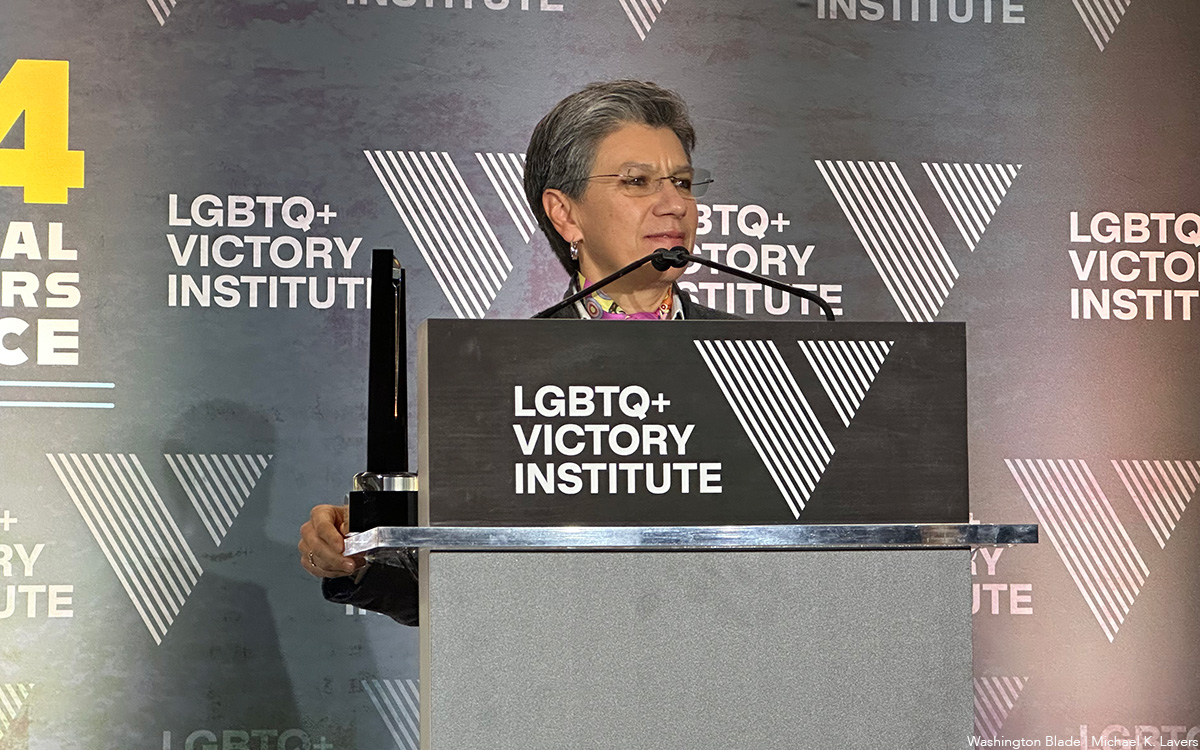
The LGBTQ+ Victory Institute on Dec. 5 inducted Spanish Sen. Carla Antonelli into its LGBTQ+ Political Hall of Fame.
Antonelli in 2011 became the first openly transgender woman elected to a regional legislative office in Spain when she won a seat in the Madrid Assembly.
She left Prime Minister Pedro Sánchez’s leftist Spanish Socialist Workers’ Party in 2022. Antonelli in 2023 became the first openly trans woman in the Spanish Senate when Más Madrid, a progressive regional party, named her Pablo Gómez Perpinyà’s successor in the chamber.
The Hall of Fame induction took place during the Victory Institute’s annual International LGBTQ+ Leaders Conference at the JW Marriott Hotel in downtown D.C. The Washington Blade spoke with Antonelli on Dec. 6.
“We are living in rather turbulent times, hence the importance and necessity of gatherings like this one … to unite in these times, come together, and develop common strategies and policies.”
Antonelli, 66, grew up in Güímar, a municipality on the island of Tenerife in Spain’s Canary Islands.
She said transphobia forced her to leave her hometown in 1977, and she turned to sex work to support herself. Antonelli’s political activism began that year when she joined the campaign against a 1970 law that criminalized consensual same-sex sexual acts and LGBTQ people.
General Francisco Franco, whose regime governed the country from 1936-1975, approved the Law on Social Danger and Rehabilitation. Spain in 1995 removed the statute’s remaining provisions from its penal code.
Antonelli in the 1980s became a well-known actress. She is also a former spokesperson for Federación Estatal de Lesbianas, Gays, Transexuales y Bisexuales, a Spanish LGBTQ advocacy group known by the acronym FELGTB.
‘We will not go back to the margins’
Antonelli in February gave an impassioned speech in support of trans rights on the Senate floor.
She specifically singled out members of Vox, a far-right political party, over their efforts to repeal a landmark 2023 law that allows people who are at least 16 to legally change their gender without medical intervention. Antonelli’s speech — and her proclamation that “we will not go back to the margins” — quickly went viral.
Antonelli told the Blade she received messages of support from people in Algeria, Australia, Turkey, Mauritius, and elsewhere around the world. She added her speech was “the conclusion of everything I can feel at any given moment, also the pride of having lived through all these historical processes.”
“For whatever reason, I was born in ’59, and I lived through the dictatorship in my country,” said Antonelli. “I lived through the dictator’s death and I lived through what Spain was like exactly 50 years ago. It began to walk in freedom, and so freedom must be defended.”
Antonelli feared US would not allow her into the country
The Victory Institute conference took place less than a year after the Trump-Vance administration took office.
Antonelli in June traveled to D.C. and participated in WorldPride 2025. She admitted the White House’s anti-trans policies left her wondering whether the U.S. would allow her into the country as a trans woman.
The White House only recognizes two genders: male and female.
President Donald Trump after he took office signed an executive order that bans the State Department from issuing passports with “X” gender markers. U.S. Citizenship and Immigration Services in August announced it will ensure “male aliens seeking immigration benefits aren’t coming to the U.S. to participate in women’s sports.”
Spain is among the countries that have issued advisories for trans and nonbinary people who are planning to visit the U.S.
“This speaks volumes about the policies of intimidation and targeting they’re implementing, policies that have made trans people scapegoats for all of humanity’s ills,” Antonelli told the Blade.
“In the United States, now with Trump, it’s absolutely terrifying because we’re talking about not just taking away a right, they’re going against our lives, against our very existence,” she added.
Antonelli in June met U.S. Rep. Sarah McBride (D-Del.), the first openly trans woman elected to Congress. Antonelli told the Blade she “watched with sorrow” how U.S. Rep. Nancy Mace (R-S.C.) and other Republicans treated the Delaware Democrat after her historic 2024 election.
“The first thing some vengeful scoundrels, thirsty for evil, do is prohibit her from entering the women’s restrooms,” said Antonelli.
“It’s nothing more than a desire to humiliate, to degrade,” she added. “Behind many of these policies lies a desire to do harm. In other words, these are bad people, evil people whose principles aren’t an ideology. They revel in it. They enjoy thinking about how they are making other human beings suffer.”
Antonelli also stressed “visibility” is “freedom.”
“The more they try to erase us, the more we have to be visible,” she said. “They know perfectly well that visibility inevitably leads to normality, to normalization, which is nothing more than what is repeated daily, routinely. What’s normal is what you see every day, so they’re trying to prevent us from being visible in every way possible, because what they don’t want is for society to accept, to live with this truth.”
Antonelli also offered advice for trans people who want to run for office.
“Always be upfront,” she said. “Don’t hold back, but above all, don’t forget where you come from. Because you might be lucky enough to rise and become a representative of the people, but don’t forget your origins.”
Antonelli noted she is the Más Madrid spokesperson for health, equality, culture, and other issues, but added she “will never, never, never abandon my trans sisters and the LGBTQ+ community.”
“I never severed times with my roots,” Antonelli told the Blade. “My roots are a conservative family, a town I had to flee and to which I didn’t return until 32 years later. My future, my past, is a street corner. My past is being able to make that journey in a democracy and go from that street corner to a seat in the Madrid Assembly and then from there to a seat in the Senate. And that is precisely the greatness of democracy.”
She ended the interview by a quote she gave to El País, a Spanish newspaper.
“Those who used to call us faggots have to now call us ‘your honors,’” said Antonelli.
-
Congress3 days agoEXCLUSIVE: George Santos speaks out on prison, Trump pardon, and more
-
Opinions4 days agoThe beginning of the fall of Trump
-
Congress5 days agoMarkey reintroduces International Human Rights Act in Senate
-
Egypt4 days agoIran, Egypt object to playing in Seattle World Cup ‘Pride Match’