News
Area sports teams adopt gay-inclusive policies
DC United player Dwayne De Rosario appears in anti-discrimination campaign

Nationals Stadium on opening day (Photo by Michael Myers via Wikimedia Commons)
Local professional sports teams continue to make strides towards protecting their gay employees from discrimination and harassment in the workplace.
A spokesperson for the Washington Nationals noted to the Washington Blade the team’s policies and procedures “are designed to support the provisions” of the D.C. Human Rights Act that ban discrimination based on more than a dozen factors that include sexual orientation and gender identity and expression. The Baltimore Orioles have a zero-tolerance policy for anti-gay harassment and discrimination as outlined in Major League Baseball’s Workplace Code of Conduct.
“Harassment and discrimination based on sexual orientation are against MLB’s values and will not be tolerated anywhere in the major or minor leagues,” the policy reads.
FIND MORE OF THE WASHINGTON BLADE SPORTS ISSUE HERE.
The Baltimore Ravens have also adopted a policy that bans discrimination based on sexual orientation and gender identity and expression.
The franchise repeatedly defended then-linebacker Brendon Ayanbadejo’s advocacy for marriage rights for same-sex couples after state Del. Emmett Burns (D-Baltimore County) urged Ravens owner Steve Bisciotti that Ayanbadejo “should concentrate on football and steer clear of dividing the fan base” after he learned he had donated two Ravens tickets as part of a Marylanders for Marriage Equality fundraiser.
“Brendon is permitted to express his viewpoints,” team spokesperson Patrick Gleason told the Blade before the Ravens defeated the San Francisco 49ers in this year’s Super Bowl. “The Ravens have always supported his right to free speech.”
The Washington Wizards did not respond to the Blade’s request for comment, but the collective bargaining agreement the NBA reached in 2011 includes sexual orientation in its anti-discrimination policies. The league also has those protections in place for its employees.
Both NBA Commissioner David Stern and Wizards President Ernie Grunfeld applauded Jason Collins after he came out as gay in an op-ed published to Sports Illustrated’s website in April.
“We are extremely proud of Jason and support his decision to live his life proudly and openly,” Grunfeld said. “He’s been a leader on and off the court and an outstanding teammate throughout his NBA career. Those qualities will continue to serve him both as a player and as a positive role model for others of all sexual orientations.”
The Washington Capitals did not respond to the Blade’s request for comment, but the National Hockey League’s anti-discrimination policy has included sexual orientation since 2005. The National Football League’s handbook states harassment and discrimination based on sexual orientation “are contrary to our values.”
National Center for Lesbian Rights Sports Director Helen Carroll told the Blade that more fans are asking professional sports teams to adopt LGBT-inclusive policies.
She said she feels Ayanbadejo, Chris Kluwe of the Oakland Raiders and other athletes who back marriage rights for same-sex couples have contributed to this increased support. Carroll added societal shifts in support of LGBT rights are also a factor.
“It has put everything front and center in a brand new light,” she said.
Teams host LGBT fan nights, support anti-discrimination campaigns

Last year’s Night Out at the Nationals was sponsored by Team D.C. (Washington Blade photo by Michael Key)
Team D.C. organizes LGBT fan nights that take place during Wizards, Nationals and Washington Mystic games and Washington Kastles matches. Ayanbadejo and the Orioles each made a video for the “It Gets Better” project against bullying.
The San Francisco Giants, the Chicago Cubs, the Boston Red Sox and Seattle’s four professional sports teams are among those that have also made their own “It Gets Better” video.
Dwayne De Rosario of DC United, Landon Donovan of the Los Angeles Galaxy and Kyle Beckerman of Real Salt Lake appear in a gay-inclusive anti-discrimination campaign that Major League Soccer launched last year. AS Roma in July backed the “Don’t Cross the Line” initiative that also seeks to combat racism in professional soccer before they played against each other during the MLS All-Star Game that took place in Kansas City, Kan., on July 31.
“The response has been really well received from the soccer community,” de Rosario told the Blade during a recent interview. “A lot of people are on board and want to see certain things that are involved in sports out of sports.”
http://www.youtube.com/watch?v=aHmTvpmLFKA



Politics
Trump’s war threats trigger rare 25th Amendment discussion
President threatened to destroy Iranian civilization in Truth Social post
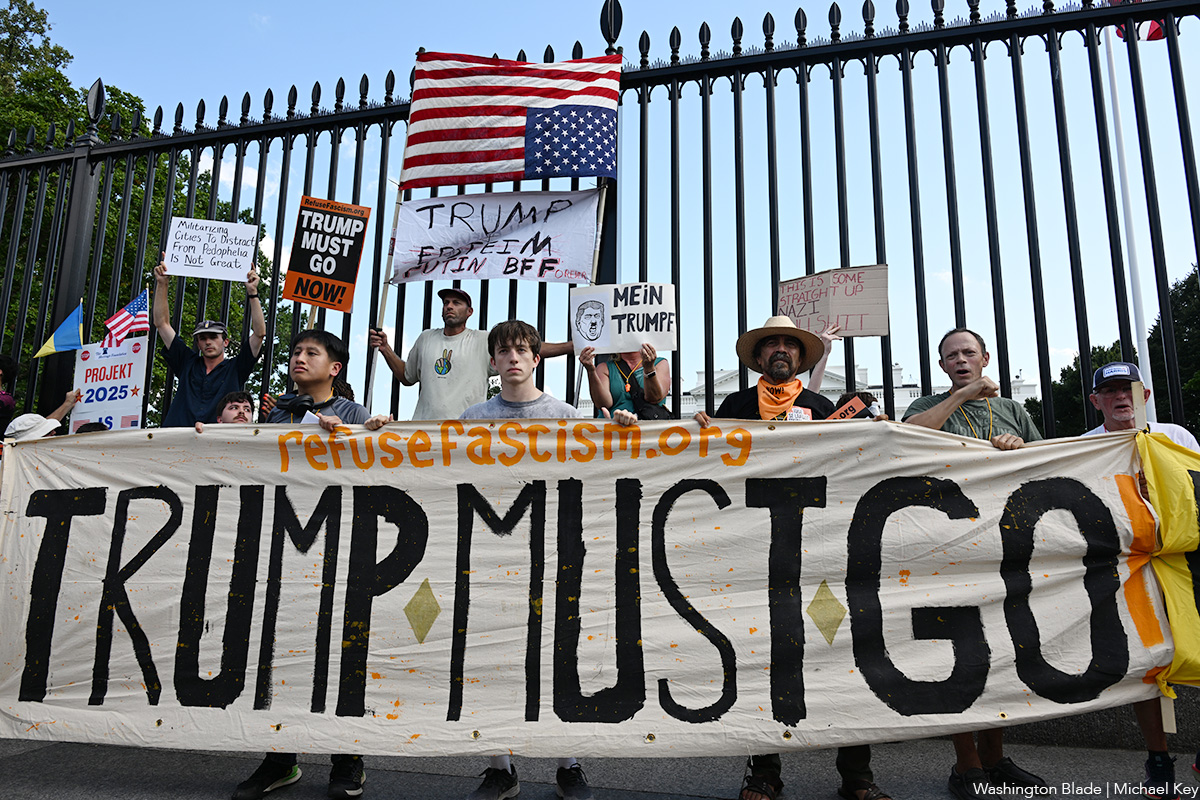
Following multiple brazen Truth Social posts this week related to the ongoing war with Iran — one which he said he could wipe out “a whole civilization,” — Democrats are seizing the opportunity to gain momentum in ousting President Donald Trump from office.
As the war with Iran continues to unfold, Trump appears increasingly frustrated — and willing — to use any means necessary to achieve his goals of ending the country’s nuclear capabilities, destroying its military, and ushering in regime change. So far, none of these goals have been met. As his frustration grows, so do calls to invoke a never-before-used safeguard for the nation—the 25th Amendment.
“A whole civilization will die tonight, never to be brought back again,” Trump posted on Truth Social on Tuesday morning. “I don’t want that to happen, but it probably will.”
This came only days after Trump posted a now-deleted, expletive-filled demand for the country to reopen the Strait of Hormuz on Easter Sunday, saying, “Open the Fuckin’ Strait, you crazy bastards, or you’ll be living in Hell.” On the same day, Trump told The Hill he would not rule out sending ground troops. And he told Fox News Sunday that he’s “considering blowing everything up and taking over the oil” if Iran doesn’t accept his deal.
The president then set a new deadline of 8 p.m. ET on Tuesday for Iran to reach a deal with the U.S., marking yet another extension, which did lead to a two-week ceasefire.
Since the president’s tirade, Democratic legislators in federal office have condemned his words, while Republicans are quietly standing behind him. Former Trump allies are among the loudest voices advocating for invoking the 25th Amendment, as some in international government organizations have sharply called Trump’s threats illegal.
“If there’s an attack on clearly civilian infrastructure, that is not allowed under international humanitarian law,” Stéphane Dujarric, spokesman for the United Nations secretary-general, said last week.
That concern is heightened by the broader human rights landscape in Iran, where violations of international legal standards are already well documented — particularly when it comes to LGBTQ people.
Iran has some of the harshest laws in the world regarding LGBTQ rights, policies that human rights advocates say are themselves in violation of international law.
Under the country’s legal system, all sexual activity outside a traditional Islamic marriage is illegal, including same-sex relations. Sexual activity between members of the same sex is criminalized and, in some cases, punishable by death under Iran’s Islamic Penal Code.
With international officials raising concerns about the legality of Trump’s threats, the conversation in Washington has increasingly shifted from condemnation to potential consequences, namely, whether the 25th Amendment could be used to hold him accountable.
“Section 4 of the 25th Amendment, which has never been invoked, allows for the vice president and a majority of Cabinet secretaries (or another body as Congress may provide) to declare the president unable to discharge the powers and duties of the office,” according to the Bipartisan Policy Center. “The vice president would then immediately assume the role of acting president.”
Although there seems to be momentum from Trump adversaries, this is unlikely, according to PolitiFact.
“For all of the partisan chatter, it is highly unlikely this legal procedure to remove a president will happen,” Louis Jacobson and Amy Sherman wrote for the nonprofit political fact-checking website that is operated by the Poynter Institute.”Trump has the support of Vice President JD Vance, his Cabinet and the majority of Republicans in Congress.”
Delaware Congresswoman — and the first transgender legislator on Capitol Hill — Sarah McBride issued a statement in response to Trump’s words.
“In a political career defined by grotesque statements, this president’s horrifying, illegal, and genocidal threat this morning is among the most dangerous and appalling,” McBride said. “You can’t shout ‘fire’ in a crowded theater, and a president cannot be allowed to threaten genocide with the United States military. Threats of war crimes and disregard for human life must be met with accountability under the law.”
She then, like many others, called for removing the president from office to protect the American people.
“Trump must go — and Republicans, whether in the Cabinet or Congress, must join Democrats in using any and all constitutional powers at our collective disposal to end this illegal war and take the gun out of this madman’s hands,” said McBride, the Congressional Democratic Women’s Caucus whip.
Mark Takano, the first openly gay person of color elected to Congress, pointed out that Trump’s ceasefire is only temporary, and does not ensure that Americans won’t be called to fight in a war they didn’t ask for.
“We heard no plan to end this war and no commitment to keep American boots out of Iran,” Takano said on X.
U.S. Sen. Tammy Baldwin (D-Wis.), the first openly gay member elected to the U.S. Senate, used her platform to remind Trump — and the world — that diplomacy remains critical.
“Diplomacy has always been the answer, which is why the president shouldn’t have gotten us into this war of choice,” a statement read on X. “It’s been reckless, cost U.S. soldiers their lives, and is raising prices on families. A ceasefire is a start, but Congress needs to do our jobs and end this war.”
“The House must pass articles of impeachment, and then the Senate must vote to convict and remove the President,” U.S. Sen. Ed Markey (D-Mass.), vocal supporter of LGBTQ rights wrote in a statement on X. “Or, the Cabinet and vice president, with congressional concurrence, must invoke the 25th Amendment and remove Trump.”
“Donald Trump’s instability is more clear and dangerous than ever,” said former House Speaker Nancy Pelosi (D-Calif.).
Multiple other Democrats also called for removing the president for violating international and constitutional law. U.S. Rep. Ilhan Omar (D-Minn.) called for “this unhinged lunatic” to “be removed from office.” U.S. Rep. Ro Khanna (D-Calif.), said, “Threatening war crimes is a blatant violation of our Constitution and the Geneva Conventions.” U.S. Rep. Yassamin Ansari (D-Ariz.), told Midas Touch Journalist Scott MacFarlane “In the last 48 hours alone, the rhetoric has crossed every line.”
In addition to Democrats, some staunch Trump supporters have also been loudly criticizing the president’s handling of the Iran war.
Conspiracy theorist, former Trump confidant, and $1.3 billion defamation case loser for spreading far-right lies, Alex Jones, asked “How do we 25th Amendment his ass?” on Monday’s InfoWars show.
Georgia Republican, former member of the House of Representatives, and former high-profile MAGA ally Marjorie Taylor Greene called Trump’s post about destroying civilizations “evil and madness” and posted a simple “25TH AMENDMENT!!!”
The White House
Report: Grenell wants Russian ambassadorship
Country’s anti-LGBTQ record a reported barrier

Richard Grenell, President Donald Trump’s special envoy for “special missions,” is making it known that he is interested in the Russian ambassadorship.
According to reporting by the Daily Mail, Grenell has “floated” his interest in the role to coworkers, but issues surrounding the former German ambassador’s sexuality have made securing the position more difficult.
“He had an interest in the job — or at least he floated the idea to select colleagues. But Putin’s regime is extremely anti–LGBTQ, so I’m sure they didn’t take that thought too seriously,” one source close to Grenell told the Daily Mail. “That would never happen anyway.”
Grenell has long been one of Trump’s closest allies and was the first openly gay person to hold a Cabinet-level position. He was ousted last month as acting director of the Kennedy Center, a position he had held since Trump reestablished the board to be composed of his political supporters in 2025.
In addition to leading the nation’s cultural arts center, Grenell previously served as the U.S. ambassador to Germany from 2018 to 2020, and as the special presidential envoy for Serbia and Kosovo peace negotiations from 2019 to 2021. He was also a State Department spokesperson to the U.N. under the George W. Bush administration and a Fox News contributor.
Russia has a longstanding history of being anti-LGBTQ.
In 2013, the country passed a law banning any public endorsement of “nontraditional sexual relations” among minors. In December 2022, Putin signed legislation expanding the ban, making it illegal to promote same-sex relationships or suggest that non-heterosexual orientations are “normal” for people of any age, widening censorship across media and public life.
The Russian courts have also supported the restriction of LGBTQ identity in the country. In November 2023, Russia’s Supreme Court granted a request from the Justice Ministry to outlaw the “international LGBT movement” as “extremist,” allowing authorities to criminalize advocacy and potentially prosecute individuals for expressions of LGBTQ+ identity or support.
In addition to LGBTQ rights issues, the war between Russia and Ukraine has become a global concern. Ukraine, which was part of the former Soviet Union, includes the territory known as Crimea, which Russia annexed in 2014. The annexation remains a major point of international dispute over sovereignty. Since 2022, Russia’s large-scale invasion of Ukraine has escalated the conflict, drawing global attention and sanctions while straining U.S.-Russia relations.
The U.S. has spent $188 billion in total related to the war in Ukraine since the Russian invasion in February 2022, according to the Council on Foreign Relations.
The Russian ambassadorship seems to be a difficult role to fill, according to additional information presented by the Daily Mail. With Trump already being seen as relatively positive by Russian President Vladimir Putin, and with close ties to members of his Cabinet and family — like son-in-law Jared Kushner — the ambassadorship is complicated and viewed as less critical than in previous administrations.
“There is no rush to fill that role because it has now been deemed unnecessary,” another source told the U.K.-based publication.
Bob Foresman, a seasoned businessman with decades-long ties to the Kremlin, was reportedly once the frontrunner, according to the Daily Mail. Foresman served as vice chair of UBS Investment Bank and Deputy Chairman of Renaissance Capital between 2006 and 2009, and earlier led investment banking for Russia at Dresdner Kleinwort Wasserstein from 1997 to 2000.
“This is a pattern, especially in the Trump administration — special envoys big–footing the ambassadors,” a source told the Daily Mail. “It is shocking that we are already in April and we don’t have an ambassador to one of the most important countries in the world.”
Politics
Log Cabin Republicans to honor Scott Presler
Event to take place at Capitol Hill Club on Friday
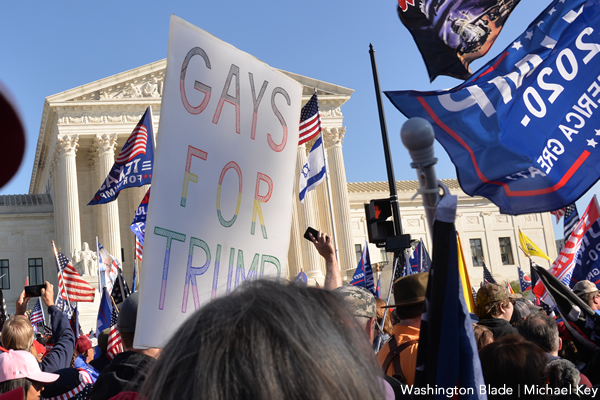
The Log Cabin Republicans, a group representing LGBTQ conservatives and their allies within the Republican Party, is set to honor gay conservative commentator and activist Scott Presler on Friday.
Presler will receive the organization’s 2026 “Game Changer Award” during its Spring Forward Cocktail Reception at the Capitol Hill Club, a private club steps from the U.S. Capitol that regularly hosts Republican political events.
Presler has risen to prominence through a combination of pro-LGBTQ conservative activism, political organizing, and a series of controversial affiliations.
He first gained national attention in 2017 for organizing the “March Against Sharia” rallies across the country. The demonstrations came amid heightened tensions in Portland, Ore., following a deadly attack on a metro train, in which Jeremy Joseph Christian killed two people and injured others after harassing Muslim women for wearing a hijab.
The rallies were organized in partnership with ACT for America, which advocates against what it describes as “the threat of radical Islam” in the U.S. and has been labeled a hate group by the Southern Poverty Law Center. Presler volunteered with the organization for three months.
He has said he was first motivated to “fight Muslim extremism” following the Pulse nightclub massacre, he told NPR, in which a gunman who pledged allegiance to ISIS killed 49 people at an LGBTQ nightclub in Orlando, Fla. The site now serves as a memorial to the victims of the attack.
Born May 15, 1988, in Jacksonville, Fla., Presler is the son of a U.S. Navy captain and was raised in both Florida and Fairfax County. He later attended George Mason University, where he earned a degree in criminal justice.
In addition to his anti-Islam activism, Presler has been involved in a number of other high-profile and controversial efforts. He co-founded “Gays for Trump” and attended their 2017 DeploraBall in Maryland for the first inauguration of Trump. According to a 2021 report from Media Matters for America, he also promoted the QAnon conspiracy movement through social media posts in 2018 and 2019.
He has also faced criticism tied to his early political work. According to a 2023 report from Politico Playbook, Presler’s work with the Republican Party of Virginia in 2016 ended after he allegedly engaged in sexual activity in a shared office space and posted explicit images online.
Beyond ideological activism, Presler has also organized community-focused initiatives. In 2019, he led a widely publicized cleanup effort in Baltimore that drew more than 100 volunteers and resulted in approximately 29 tons of trash being removed. The event was a result of criticism from President Donald Trump, calling the area, represented by then-U.S. Rep. Elijah Cummings (D-Md.) a “rodent infested mess.”
Presler has also been active in election-related organizing, leading a two-day “Stop the Steal” demonstration at the Pennsylvania State Capitol following the 2020 presidential election. He has appeared on the “War Room” podcast hosted by former Trump strategist and well-known right-wing populist conspiracy theorist Steve Bannon.
He has also expressed a controversial stance within the LGBTQ community for supporting then-candidate Trump for President over Hillary Clinton. He told prioritizing Second Amendment rights over certain LGBTQ policy goals, saying he is more supportive of gun rights than efforts to codify same-sex marriage, and adding, “I 100 percent believe in the notion that armed gays don’t get bashed. It is our right to feel safe.”
Presler voiced his support for the Florida Parental Rights in Education Act, more commonly referred to as the “Don’t Say Gay” law, signed into law by Republican Gov. Ron DeSantis in 2022.

Trump’s war threats trigger rare 25th Amendment discussion

A Sondheim masterpiece ‘Merrily’ rolls onto Netflix

ROSENSTEIN: Vote McDuffie for mayor of D.C.

New book celebrates 1970s dance music icons

Report: Grenell wants Russian ambassadorship

Risking it all for love during World War II

D.C. is the place for the Democratic Socialists of America

PHOTOS: The Bonnet Ball

Key lifestyle changes can help patients cope with diabetes