Theater
Fresh look at ‘Salomé’
Biblical femme fatale gets feminist makeover
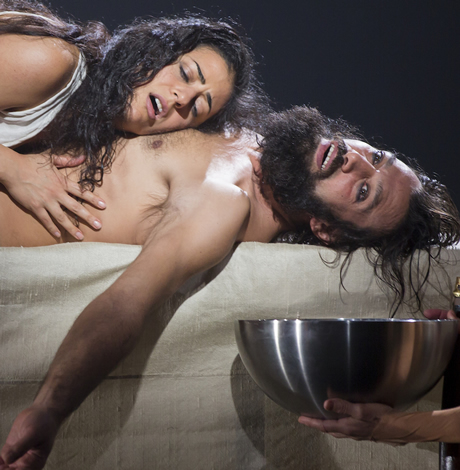
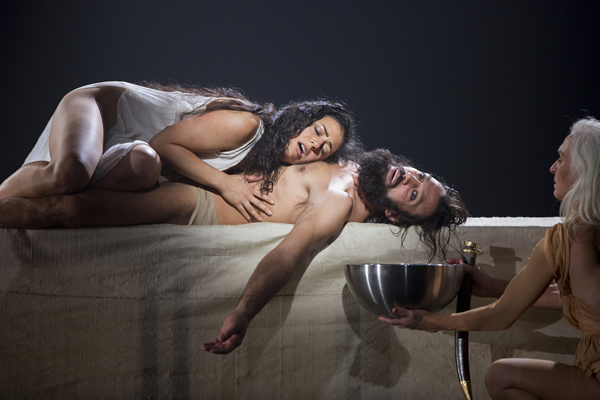
From left are Nadine Malouf as Salomé, Ramzi Choukair as Iokanaan and Olwen Fouere as Nameless Woman in ‘Salomé’ at Shakespeare Theatre Company. (Photo by Scott Suchman)
‘Salomé’
Through Nov. 8
Lansburgh Theatre
450 7th St. N.W.
$20-118
202-547-1122
With “Salomé,” adapter/director Yaël Farber turns the biblical tale on its head.
While Farber uses Oscar Wilde’s then-scandalous 1883 “Salomé” as the premise — Herod’s stepdaughter Salomé demands the head of Iokanaan (John the Baptist) on a silver platter as reward for dancing the Dance of the Seven Veils — her one-act now playing at the Shakespeare Theatre Company is otherwise something entirely new. Rather than cast Salomé as a vengeful femme fatale, Farber re-imagines her as an agent of revolution.
The action unfolds backwards. It “begins at the end” insists narrator Nameless Woman (fiercely played Olwen Fouéré), the older Salomé and an embodiment of unnamed women from the past. She sets the scene in Roman-ruled Jerusalem where Pontius Pilate is top dog. He’s focused — in no particular order — on collecting taxes, building aqueducts and keeping the populace at heel. Lesser powers include the debauched Herod (Ismael Kanater) and the Sanhedrin (played with perfect posture by Yuval Boim and Jeff Hayenga) who maintain the Hebrews’ religious tradition and collect Temple tax.
Unsurprisingly there’s a whiff of insurrection in the air. The people are overburdened by the occupation and looking for a messiah. Enter Iokanaan (Ramzi Choukair), a baptizer spreading ideas of rebellion and insurrection. His lines are delivered exclusively in Arabic (his words are translated by the ever present Nameless Woman and Yeshua the Madman played by Ricahrd Saudek).
As Nameless Woman moves the story back in time, the younger Salomé (the excellent Nadine Malouf) sits mutely, hooded and bound to a chair. By instigating the killing of Iokannan, she has lifted the radical zealot to martyr status, exactly what Pilate didn’t want. Moving further back to a fortress on the edge of the Dead Sea where Iokannan is held captive in an underground cistern, Malouf’s Salomé comes to life. Curious and determined, she uses her smarts and sensuality to persuade the jailors (Shahar Isaac and Elan Zafir) to allow her to descend a long wooden ladder to the prisoner’s damp cell. There, the heavily bearded Iokannan clad in his signature scratchy loincloth, baptizes the young woman. Reborn through water, Salomé is determined to defy her abuser and the powers that be. It’s both a pivotal spiritual and political moment for her.
Lyrical, visually striking and meticulously staged, “Salomé” is a sensory and audible pleasure as well as a world premiere production and STC’s entry in the citywide Women’s Voices Theater Festival. Composer and sound designer Mark Bennett’s ambient music sets the mood with drumming and tolling and the keening and operatic from cast members Lubana Al Quntar and Tamar Ilana.
Susan Hilgerty’s set morphs from a bare stage littered with straight back chairs and long sawhorse tables to an unfamiliar place of varied elements like falling sand, billowing veil-like curtains and water. Lit evocatively by Donald Holder, the set adapts itself to many moods and locales. Under Ami Shulman’s movement direction, the graceful 12-person cast moves slowly, almost trancelike, or they are very still on the sometimes rotating stage. And while the movement is deliberate and almost sluggish, the production never drags.
Farber’s Salomé certainly isn’t Hollywood, so don’t go expecting to see mantrap enticing holy man with a well-choreographed strip tease á la Rita Hayworth in the big screen version. Though still sexually charged, this is more about women’s voices, self-determination and political uprising.





Theater
‘Suffs’ an entertaining chronicle of battle to pass 19th Amendment
Tony-winning musical highlights trailblazing women’s rights activists

‘Suffs’
June 16 – 28
National Theatre
1321 Pennsylvania Ave., N.W.
$115 and up
Broadwayatthenational.com
Poised to kick off a two-week run at D.C.’s National Theatre (June 16-28), “Suffs,” the Tony Award-winning musical written by Shaina Taub, promises an entertaining chronicle of what was the arduous political battle to pass the 19th Amendment.
Far from a dry look backward, Taub’s dramedy brings to life a high stakes world inhabited by historical trailblazing women’s rights activists like Alice Paul, Carrie Chapman Catt and Catt’s lifetime partner, Mollie Garrett. It manages to be upbeat without neglecting the grim bits including incarcerations and forced feedings.
Out actor Gwynne Wood plays suffragist Lucy Burns. As Alica Paul’s old college friend and fellow organizer of the 1913 march on Washington, Wood’s Lucy brings comforting humor and razor wit.
In real life, Wood, a Boston Conservatory grad, is married to lighting designer Anna Brevetti. They met in 2023 while working on the tour of “1776” (Wood played Founding Father George Read) and were instantly smitten.
In true theater fashion, they became engaged while on tour in San Francisco and tied the knot this past March in Boston on a day off from “Suffs.” The entire cast was invited to the wedding.
“The craziest thing about touring and being newly married is that you’re away from the person you most want to be with. But I do love touring (with long-haired chihuahua Gemma for company), and I love doing this show.
“During my long-distance courtship with Anna, we felt so good, seen and appreciated; we didn’t want to let that go just because I’m on the road.”
As of now, Wood is booked with “Suffs” through Aug. 9, and then it’s home to Bushwick, Brooklyn to enjoy married life.
BLADE: You’ve expressed a close connection to your character Lucy Burns.
WOOD: I was an ensemble member of the “Suffs” pre-Broadway workshop, and even then, the role of Lucy (played on Broadway by Ally Bonino) resonated.
Lucy is that friend who we all want to be and have. She’s very funny. She’ll hold you accountable but will still give support. She’s the one who brings cupcakes to the sleepover.
She also has a poignant second act ballad aptly titled, “Lucy’s Song. In it, Lucy talks about the importance of her long friendship with Alice Paul, while also officially retiring from activism. Basically, she’s saying “girl, I’m tired.”
BLADE: What about “Suffs” is especially meaningful for a queer actor?
WOOD: There’s so much about it that’s GREAT for a queer actor. I love learning about queer suffragists who were at the front of societal change. They were fighting this fight while having to deal with internal stuff like feeling marginalized, some were experiencing gender fluidity and transness. There’s documented evidence of all these things.
For a lot of lesbians in particular who felt out of place in heteronormative society, the suffragist movement was a place where they felt comfortable, a place where they were not told what to do by men.
BLADE: What was your introduction to musical theater?
WOOD: Growing up in Waynesboro, Va., Mom put me in community theater at ShenenArts in nearby Staunton. My first part was a salt shaker in “Beauty in the Beast.” My sister was the pepper shaker. We were two little tiny redheads waddling out like penguins. I was obsessed.
BLADE: Was Lucy Burns queer?
WOOD: There’s no evidence that Lucy was queer. Unlike fellow prominent suffragists [Carrie Chapman and Mollie Garrett] who were buried side by side, Lucy isn’t known for being in a romantic relationship.
I don’t know if Lucy and Alice were a couple, and I don’t want to rewrite a story that I don’t know. But I can say there is a lot of love from Lucy to Alice. That said, “Suffs” is undeniably intertwined with queerness.
BLADE: Can you see yourself as having been a suffragist?
WOOD: I’d love to say yes. It takes a lot, but I hope that I could have done it. People before us have done it, and people after will probably have to do it too.”
Theater
Timothy Nelson on the premiere of his opera ‘Song of Sakuntala’
Story of love, loss, redemption unfolds amid Indian classical music

‘The Song of Sakuntala’
IN Series
In Washington and Baltimore
Atlas Performing Arts Center, 1333 H St., N.E.
(Selected dates June 6-14)
Baltimore Theatre Project, 45 W. Preston St., Baltimore
(June 19-21)
$25-35
Inseries.org
As the artistic director of IN Series, Timothy Nelson rarely blows his own horn, but for the world premiere of his own opera “The Song of Sakuntala,” he’ll make an exception.
During a recent interview squeezed in between afternoon and evenings rehearsals, Nelson took time to talk about his opera (while nearby his “blessing of a husband” prepared a giant dinner for the entire cast and crew).
As smart and gracious as ever, Nelson explains that he wrote the opera a decade ago at a low point in his life: He was divorcing and wanted to immerse himself into something musical, all-consuming, a project tantamount to writing a thick novel.
At the time, Nelson’s mentor, the influential American stage and opera director Peter Sellers, pushed him to write again. Nelson recalls, “I hadn’t composed for some time. I wanted to see if I could do it, and I wanted to revisit Indian classical music.”
He adds, “There was never any anticipation of it being produced. It was a way of processing and dealing with life in a healthy way.”
Adapted from Kālidāsa’s 5th-century dramatic masterpiece, “The Song of Sakuntala” brings together Western baroque and Indian classical musical traditions into a story of “love, loss, memory, and redemption.” His libretto, a reflection of South Asian storytelling, includes the words of the great Indian poets Tagore, Naidu, and Vidyapati.
The story follows “a prince and a woman of the forest who fall in love and wed in secret. He departs, and she later seeks him out, only to have him deny all recognition of her. She disappears in sorrow; he spends the rest of his life searching. At the end, in the same forest where they first met, they find each other again and are transfigured.”
At 90 minutes, the uninterrupted piece features three singers (Aryssa Leigh Burrs, Teresa Ferrara, Marvin Wayne Allen) accompanied by an instrumental ensemble led by acclaimed sitarist Rajib Karmakar, who specializes in bridging Indian and Western classical traditions, and conducted by Nelson who also joins the music making on drone and harmonium.
Burrs plays the prince. Originally written for a countertenor, Nelson imagined a man singing the role but ultimately cast a woman to play the part.
Because the piece is “fiendishly difficult in almost unnecessary ways,” Nelson explains with a wicked chuckle, he knew that Burrs had the talent and sharp brain required for the role.
The prince is cruel without explanation. Despite that, 40-something Nelson admits to relating to the opera’s prince: “In midlife, you reflect on your mistakes. At least for now that’s how I feel. I might have felt different earlier and it could change later on.”
Nelson lived in India for nine months, backpacking and studying in different places, absorbing different musical styles and playing pieces as varied and complex as any Western music.
And while based in D.C., IN Series performs in both Washington and Baltimore using various borrowed venues. “The Song of Sakuntala” is playing at both the Atlas Performing Center in D.C. (6/6-6/14) and Baltimore’s beloved Baltimore Theatre Project (6/19-6/21) with its terrific acoustics.
In a past conversation, Nelson who lives in Adams Morgan, shared that all audiences bring something specific to the table. Baltimore tends to attract more risk taking while D.C. audiences often lean into the intellectual side of what the company does.
At the helm of IN Series for eight years, Nelson has relished reimagining opera and musical theater, but only recently did he decide to program his latest work. The way in which “The Song of Sakuntala” blends Western and non-Western music is very much a part of the IN Series music brand, so it seemed the perfect selection to close the season.
“I do this humbly with great hesitancy. And I know it feels a little unseemly to cheer on your own work, but I will say, it’s a piece that is successful in sitting in both places (Western and South Asia) and the Indian musicians on board are responding to it.”
Theater
Cedric Neal on his juicy narrator role in ‘Pippin’
A rash of terrific reviews for a part he’s longed to play

‘Pippin’
Through July 26
Signature Theatre
4200 Campbell Ave.
Arlington, Va.
$47-$153
Sigtheatre.org
As Leading Player in Signature Theatre’s revival of “Pippin,” Cedric Neal portrays the manipulative narrator who guides the title character, a young medieval prince, on a quest for meaning. Neal is also receiving a rash of terrific reviews for a part he’s longed to play for some time.
Recently, after the first “Pippin” preview performance, Neal shared his thoughts. “Last night was exciting, mystic and exotic. It was magical. Words are overused, but it was all those things.”
With a powerful, rich tenor voice, Neal is best known as a charismatic West End and Broadway star (“Back to the Future,” “Hadestown,” “Guys & Dolls”) as well as for his memorable semifinalist win on the “The Voice UK” in 2019.
And now Stephen Shwartz’s “Pippin” marks Neal’s second show at Signature Theatre, a place he dearly loves. His first was as Jimmy Early in “Dreamgirls” in 2012, a raucous role that won him a Helen Hayes Award. During that production, Neal forged deep friendships with actor Nova Y. Payton and director Matthew Gardiner. What’s more, while rehearsing the show, he met his husband.
“He likes to say we met on Match.com but I remember it differently,” says Neal. “It was something called Adam4Adam. It might have been a hookup, but instead we met for coffee in Shirlington Village where we talked and talked for hours. Two years later we married.”
BLADE: Your triumphant return to town sounds pretty great.
NEAL: I’m having the time of my life. Takes me a half hour to come down after the show ends. It’s explosive.
BLADE: Is Leading Player a part you’ve wanted to do?
NEAL: Very much, and just this way. Rather than leaning on its circus troupe aspect, our director Matthew [Gardiner] explores the darkness of the story and the risk of falling prey to cultish ideology.
BLADE: Just how nefarious is Leading Player?
NEAL: I’m not judging my character. I believe at some point that Leading Player has good intentions. Somewhere along the line, ego becomes involved. The promise becomes warped.
BLADE: When doing “Pippin,” is it possible to separate the iconic Bob Fosse choreography and Ben Vereens’s sexy portrayal of Leading Player from the original production?
NEAL: Not entirely, but in our production Matthew [Gardiner] and Rachel Leigh Dolan have meticulously honored the choreography and storytelling of Fosse’s work without it being a carbon copy. I think it’s amazing.
BLADE: Was your participation in the “The Voice UK” a strategic career move?
NEAL: It was. At the time, I had just gotten a BIG NO on a West End show where the casting director told me the part should have been mine but using a then-unknown American would have created an uproar.
Then when “Voice UK” scouted me, my agent said this would be the perfect opportunity to boost my profile. Ultimately, I was given a global scale opportunity to go onstage and sing as Cedric.
BLADE: Your thrilling, original rendition of Stevie Wonder’s “Higher Ground” made the audience and judges like Jennifer Holliday and Sir Tom Jones just go crazy (in a good way). In musical theater, do you make beloved, well-known songs like “Join Us” and “Glory” in “Pippin,” your own in that same way?
NEAL: I couldn’t always, but I can now. When I talk to younger performers, I tell them about the song in “Gypsy” where the experienced strippers talk about getting a gimmick if you want to be a star.
I come from a gospel, R&B, and serious classical background and have always retained my gospel, soulful flair on things. When I entered the world of musical theater, I’d put my twist on a song and the musical director would ask that I tone it down.
Ten years into my career, I became known for putting my flair on musicals, and that became my gimmick. To “Cedricfy” a song is a legitimate term in musical theater. And you’ll see me bring that to “Pippin.”
BLADE: Reading about you, it seems you’ve made bold choices and surround yourself with supportive friends and family, blood and chosen.
NEAL: Yes, and it’s not an accident. I come from a bloodline of revolutionaries and pioneers whose shoulders I stand on. My ancestors are all fighters and refuse to let their fight be in vain. Also, I will always step up to the plate and represent all the marginalized communities that I’m a part of: Black, gay, biracial relationships, liberals.
BLADE: Are you and your husband still living in the windmill?
NEAL: We left the windmill but we’re still in the U.K. Try to imagine our story: A Black boy from the hood in Dallas, Texas, meets a fifth-generation cattle rancher from Alberta, Canada, and they move to the UK, adopt a labradoodle, and live in an actual windmill. Isn’t that the gayest shit you’ve ever heard?
BLADE: It’s like a fairytale.
NEAL: It was. It still is.

Netherlands to ban conversion therapy

Lewis George holds strong lead over McDuffie in D.C. mayor’s race

War, geopolitical tensions with U.S. overshadow Pride month events

Confronting homophobia at school

57 towns in 57 hours: Rep. McBride kicks off re-election campaign

PHOTOS: Lost River Pride

PHOTOS: Pride on the Pier

The advantages of owning your home

David Archuleta on Mormon faith, ‘Idol,’ more in new book