Arts & Entertainment
Watch: reporter accidentally has fangirl meltdown in front of Ricky Martin
Ana Belaval didn’t realize the star was still on-air with her
(Screenshot via YouTube.)
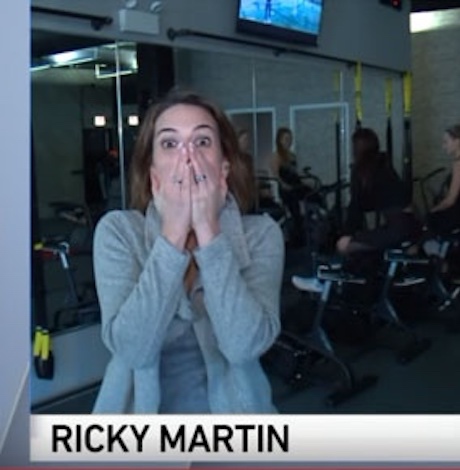
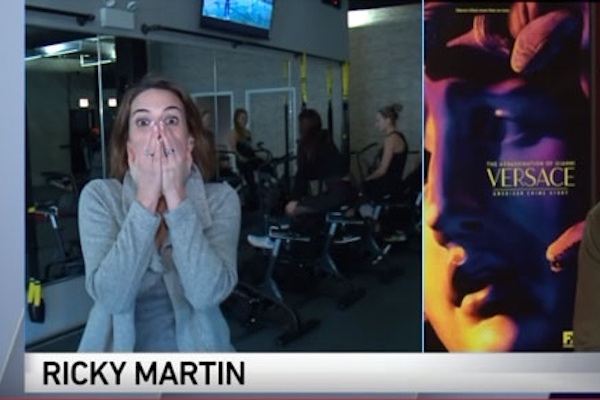
Ricky Martin witnessed WGN Chicago reporter Ana Belaval have a fan meltdown on-air over him after interviewing the star via satellite.
Martin was doing promotion for “The Assassination of Gianni Versace” in an interview with the anchors at WGN Chicago when Belaval was patched in at the end to ask about his recovery efforts in Puerto Rico.
The interview ends and Belaval starts to fangirl over talking to Martin without realizing that he is still on-air with her.
“I seriously went very berserk on Dean Richards [WGN anchor] because you have to understand, when you’re part of a minority and you don’t have a lot of role models in media, and you have a Ricky Martin that wherever you go in the world, it’s a good name to mention as a Puerto Rican ― oh my goodness you feel related to him,” Belaval says.
“He called me mama baby! Can we make this happen? He goes with me, I’ll take care of his kids,” she continues to gush.
“I’ll call 911 Ricky, don’t worry,” one of the anchors jokes.
“That’s beautiful. I love what I’m hearing,” Martin replies.
Belaval looks shocked as she realizes Martin has been listening in the whole time.
“He’s still there?” Belaval yells at the anchors. “I’m going to kill you.”
Martin laughs it off joking, “Please, I don’t want to be involved in another ‘American Crime Story.'”
Watch below.

Sports
US wins Olympic gold medal in women’s hockey
Team captain Hilary Knight proposed to girlfriend on Wednesday
The U.S. women’s hockey team on Thursday won a gold medal at the Milan Cortina Winter Olympics.
Team USA defeated Canada 2-1 in overtime. The game took place a day after Team USA captain Hilary Knight proposed to her girlfriend, Brittany Bowe, an Olympic speed skater.
Cayla Barnes and Alex Carpenter — Knight’s teammates — are also LGBTQ. They are among the more than 40 openly LGBTQ athletes who are competing in the games.
The Olympics will end on Sunday.
Movies
Radical reframing highlights the ‘Wuthering’ highs and lows of a classic
Emerald Fennell’s cinematic vision elicits strong reactions
If you’re a fan of “Wuthering Heights” — Emily Brontë’s oft-filmed 1847 novel about a doomed romance on the Yorkshire moors — it’s a given you’re going to have opinions about any new adaptation that comes along, but in the case of filmmaker Emerald Fennell’s new cinematic vision of this venerable classic, they’re probably going to be strong ones.
It’s nothing new, really. Brontë’s book has elicited controversy since its first publication, when it sparked outrage among Victorian readers over its tragic tale of thwarted lovers locked into an obsessive quest for revenge against each other, and has continued to shock generations of readers with its depictions of emotional cruelty and violent abuse, its dysfunctional relationships, and its grim portrait of a deeply-embedded class structure which perpetuates misery at every level of the social hierarchy.
It’s no wonder, then, that Fennell’s adaptation — a true “fangirl” appreciation project distinguished by the radical sensibilities which the third-time director brings to the mix — has become a flash point for social commentators whose main exposure to the tale has been flavored by decades of watered-down, romanticized “reinventions,” almost all of which omit large portions of the novel to selectively shape what’s left into a period tearjerker about star-crossed love, often distancing themselves from the raw emotional core of the story by adhering to generic tropes of “gothic romance” and rarely doing justice to the complexity of its characters — or, for that matter, its author’s deeper intentions.
Fennell’s version doesn’t exactly break that pattern; she, too, elides much of the novel’s sprawling plot to focus on the twisted entanglement between Catherine Earnshaw (Margot Robbie), daughter of the now-impoverished master of the titular estate (Martin Clunes), and Heathcliff (Jacob Elordi), a lowborn child of unknown background origin that has been “adopted” by her father as a servant in the household. Both subjected to the whims of the elder Earnshaw’s violent temper, they form a bond of mutual support in childhood which evolves, as they come of age, into something more; yet regardless of her feelings for him, Cathy — whose future status and security are at risk — chooses to marry Edgar Linton (Shazad Latif), the financially secure new owner of a neighboring estate. Heathcliff, devastated by her betrayal, leaves for parts unknown, only to return a few years later with a mysteriously-obtained fortune. Imposing himself into Cathy’s comfortable-but-joyless matrimony, he rekindles their now-forbidden passion and they become entwined in a torrid affair — even as he openly courts Linton’s naive ward Isabella (Alison Oliver) and plots to destroy the entire household from within. One might almost say that these two are the poster couple for the phrase “it’s complicated.” and it’s probably needless to say things don’t go well for anybody involved.
While there is more than enough material in “Wuthering Heights” that might easily be labeled as “problematic” in our contemporary judgments — like the fact that it’s a love story between two childhood friends, essentially raised as siblings, which becomes codependent and poisons every other relationship in their lives — the controversy over Fennell’s version has coalesced less around the content than her casting choices. When the project was announced, she drew criticism over the decision to cast Robbie (who also produced the film) opposite the younger Elordi. In the end, the casting works — though the age gap might be mildly distracting for some, both actors deliver superb performances, and the chemistry they exude soon renders it irrelevant.
Another controversy, however, is less easily dispelled. Though we never learn his true ethnic background, Brontë’s original text describes Heathcliff as having the appearance of “a dark-skinned gipsy” with “black fire” in his eyes; the character has typically been played by distinctly “Anglo” men, and consequently, many modern observers have expressed disappointment (and in some cases, full-blown outrage) over Fennel’s choice to use Elordi instead of putting an actor of color for the part, especially given the contemporary filter which she clearly chose for her interpretation for the novel.
In fact, it’s that modernized perspective — a view of history informed by social criticism, economic politics, feminist insight, and a sexual candor that would have shocked the prim Victorian readers of Brontë’s novel — that turns Fennell’s visually striking adaptation into more than just a comfortably romanticized period costume drama. From her very opening scene — a public hanging in the village where the death throes of the dangling body elicit lurid glee from the eagerly-gathered crowd — she makes it oppressively clear that the 18th-century was not a pleasant time to live; the brutality of the era is a primal force in her vision of the story, from the harrowing abuse that forges its lovers’ codependent bond, to the rigidly maintained class structure that compels even those in the higher echelons — especially women — into a kind of slavery to the system, to the inequities that fuel disloyalty among the vulnerable simply to preserve their own tenuous place in the hierarchy. It’s a battle for survival, if not of the fittest then of the most ruthless.
At the same time, she applies a distinctly 21st-century attitude of “sex-positivity” to evoke the appeal of carnality, not just for its own sake but as a taste of freedom; she even uses it to reframe Heathcliff’s cruel torment of Isabella by implying a consensual dom/sub relationship between them, offering a fragment of agency to a character typically relegated to the role of victim. Most crucially, of course, it permits Fennell to openly depict the sexuality of Cathy and Heathcliff as an experience of transgressive joy — albeit a tormented one — made perhaps even more irresistible (for them and for us) by the sense of rebellion that comes along with it.
Finally, while this “Wuthering Heights” may not have been the one to finally allow Heathcliff’s ambiguous racial identity to come to the forefront, Fennell does employ some “color-blind” casting — Latif is mixed-race (white and Pakistani) and Hong Chau, understated but profound in the crucial role of Nelly, Cathy’s longtime “paid companion,” is of Vietnamese descent — to illuminate the added pressures of being an “other” in a world weighted in favor of sameness.
Does all this contemporary hindsight into the fabric of Brontë’s epic novel make for a quintessential “Wuthering Heights?” Even allowing that such a thing were possible, probably not. While it presents a stylishly crafted and thrillingly cinematic take on this complex classic, richly enhanced by a superb and adventurous cast, it’s not likely to satisfy anyone looking for a faithful rendition, nor does it reveal a new angle from which the “romance” at its center looks anything other than toxic — indeed, it almost fetishizes the dysfunction. Even without the thorny debate around Heathcliff’s racial identity, there’s plenty here to prompt purists and revisionists alike to find fault with Fennell’s approach.
Yet for those looking for a new window into to this perennial classic, and who are comfortable with the radical flourish for which Fennell is already known, it’s an engrossing and intellectually stimulating exploration of this iconic story in a way that exchanges comfortable familiarity for unpredictable chaos — and for cinema fans, that’s more than enough reason to give “Wuthering Heights” a chance.
Crimsyn and Tatianna hosted the new weekly drag show Clash at Trade (1410 14th Street, N.W.) on Feb. 14, 2026. Performers included Aave, Crimsyn, Desiree Dik, and Tatianna.
(Washington Blade photos by Michael Key)


-
Baltimore4 days ago‘Heated Rivalry’ fandom exposes LGBTQ divide in Baltimore
-
Real Estate4 days agoHome is where the heart is
-
District of Columbia4 days agoDeon Jones speaks about D.C. Department of Corrections bias lawsuit settlement
-
European Union4 days agoEuropean Parliament resolution backs ‘full recognition of trans women as women’