News
Activist: I ‘misspoke,’ Pence wants gays in ‘conversion camps’
Pulse survivor says VP has shown ‘tacit support’ for conversion therapy
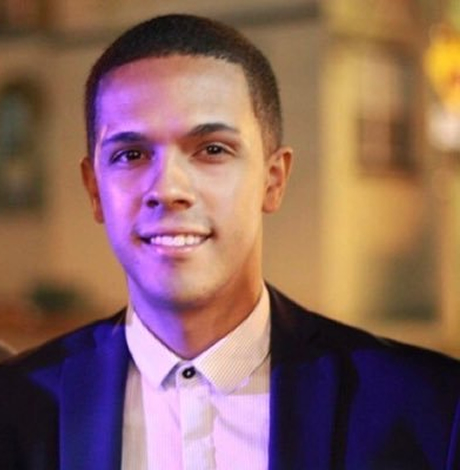
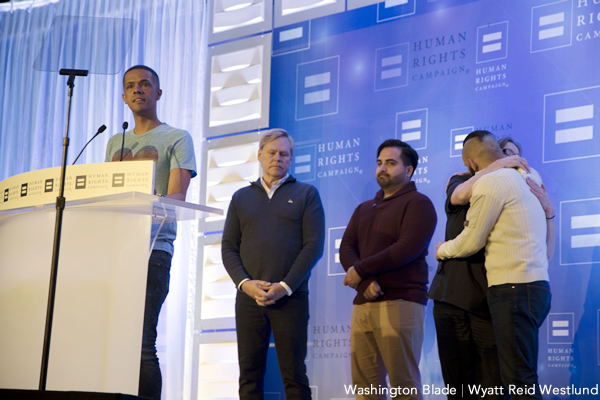
Brandon Wolf says he misspoke about Vice President Mike Pence wanting gays in “concentration camps.” (Washington Blade photo by Wyatt Reid Westlund)
Under fire from the right-wing media for comments he made about Vice President Mike Pence wanting gays in “concentration camps,” one of the survivors of the 2016 shooting at Pulse nightclub now says he “misspoke.”
Brandon Wolf — who’s now head of the Dru Project, an organization that supports GSAs in schools — told the Washington Blade via email on Monday he intended to say Pence wants gay people in “conversion camps” to subject them to the widely discredited practice of “ex-gay” conversion therapy.
“I misspoke on Joy’s show,” Wolf said. “What I meant to say was that Vice President Pence would have us in conversion camps. Which, of course, is a reference to Pence’s tacit support of the abhorrent practice of conversion therapy on LGBTQ youth. The psychiatric community has overwhelmingly condemned this form of torture on children while Pence and the modern GOP stubbornly stick by their support of it.”
Wolf added Pence, who had a long anti-LGBT history as a U.S. House member and governor of Indiana, should speak out against conversion therapy.
“I stand by my view that Vice President Pence is wildly out of touch with the realities faced by LGBTQ youth today and should publicly denounce the dangerous practice of conversion therapy,” Wolf said.
Wolf invoked the ire of right-wing media on Saturday during an appearance on Joy Reid’s MSNBC show when he said the focus should not be on the controversy over blog posts she wrote years ago now deemed homophobic, but the Trump administration.
Asserting the Trump administration is filled with “homophobic psychopaths,” Wolf took drew particular attention to Pence.
“If Mike Pence, God bless him, ended up in the White House, sitting behind that desk in the Oval Office, he would have us all in concentration camps hoping to pray away the gay,” Wolf said.
LGBT advocates maintain Pence supports conversion therapy and sought to transfer federal funds intended for HIV/AIDS program to the practice. That’s based on a statement from his 2000 campaign for the U.S. House that stated he supports HIV/AIDS funds on the condition that resources are directed to institutions that “provide assistance to those seeking to change their sexual behavior.”
That has been interpreted as support for “ex-gay” conversion therapy, although a Pence spokesperson has denied the vice president ever supported the practice.
But Pence’s anti-LGBT record goes beyond that, as a recent initiative from the Human Rights Campaign called “The Real Mike Pence” has sought to reveal.
As a U.S. House member, Pence backed a U.S. constitutional amendment that would have banned same-sex marriage nationwide and was a vocal opponent of pro-LGBT initiatives, including hate crimes protection legislation, “Don’t Ask, Don’t Tell” repeal and a version of the Employment Non-Discrimination Act.
Most prominently, Pence in 2015 as Indiana governor signed a “religious freedom” bill allowing businesses and individuals to refuse services and discriminate against LGBT people. After pressure from LGBT advocates and the business community, Pence was forced to sign a “fix” to the law significantly limiting its scope.
As for his time in the Trump administration, there are rumors that Pence was behind the transgender military ban, although his office has denied he was involved and said he defers to the Pentagon on the issue.



Hungary
Vance speaks at Orbán rally in Hungary
Anti-LGBTQ prime minister trailing ahead of April 12 vote
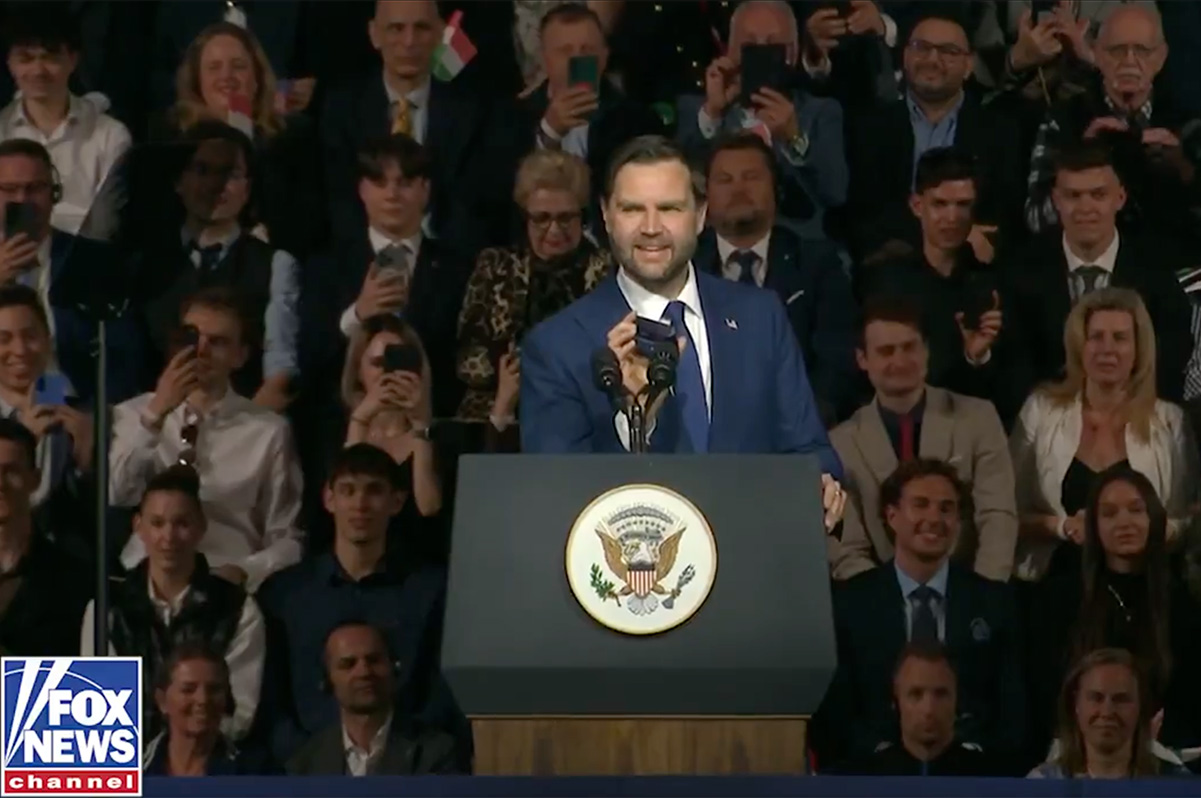
Vice President JD Vance on Tuesday urged Hungarians to support Prime Minister Viktor Orbán in the country’s April 12 elections.
“We have got to get Viktor Orbán re-elected as prime minister of Hungary,” Vance told Orbán supporters who gathered at Budapest’s MTK Sportpark.
Vance and Orbán on Tuesday met before they held a press conference in Budapest. Orbán also spoke at the rally.

The U.S. vice president after he took to the stage called President Donald Trump, who told the crowd he is “a big fan of Viktor” and is “with him all the way.” Vance, as he did during Tuesday’s press conference with Orbán, criticized the European Union.
“We want you to make a decision about your future with no outside forces pressuring you or telling you what to do. I’m not telling you exactly who to vote for, but what I am telling you is that the bureaucrats in Brussels, those people should not be listened to,” said Vance. “Listen to your hearts, listen to your souls, and listen to the sovereignty of the Hungarian people.”
Vance in his speech noted “across the West, we’ve got a small band of radicals” who, among other things, “condemn children to mutilization and sterilization in the name of gender care.” Vance also criticized a “far-left ideology given quarter in university circles, in the media, and in our entertainment industry, and increasingly among bureaucrats on both sides of the Atlantic.”
Vice President JD Vance speaks at MTK Sportpark in Budapest, Hungary, on April 7, 2026
Orbán has been in office since 2010. He and his Fidesz-KDNP coalition government have faced widespread criticism over its anti-LGBTQ crackdown.
A Hungarian activist with whom the Washington Blade previously spoke said it is “impossible to change your gender legally in Hungary” because of a 2020 law that “banned legal gender recognition of transgender and intersex people.” Hungarian MPs the same year effectively prohibited same-sex couples from adopting children and defined marriage in the country’s constitution as between a man and a woman.
The European Commission in 2022 sued Hungary, which is a member of the EU, over the country’s anti-LGBTQ propaganda law.
Hungarian lawmakers in March 2025 passed a bill that banned Pride events and allowed authorities to use facial recognition technology to identify those who participate in them. MPs later amended the Hungarian constitution to ban public LGBTQ events.
Upwards of 100,000 people last June defied the ban and marched in Budapest’s annual Pride parade.
Polls indicate Orbán is trailing Péter Magyar and his center-right Tisza party ahead of the April 12 election. Vance at Tuesday’s rally told Orbán supporters that he and Trump “want you to make a decision about your future with no outside forces pressuring you or telling you what to do.”
“I’m not telling you exactly who to vote for, but what I am telling you is that the bureaucrats in Brussels, those people should not be listened to,” said Vance. “Listen to your hearts, listen to your souls, and listen to the sovereignty of the Hungarian people.”
“Unlike some of the leadership of Brussels, I’m not threatening you or telling you that we’re going to withhold funds to which you’re legally entitled,” he added. “You will make the decision about Hungary’s future.”
The White House
White House ends protections for trans students in multiple school districts
Cape Henlopen School District in Delaware among administration’s targets

The Department of Education has terminated agreements with five school districts and a college aimed at protecting the rights of transgender students, backtracking requirements made in prior administrations, according to the Associated Press.
Allowing the reversal of these federal obligations removes formerly mandatory measures, including faculty training on responding to a student’s preferred name and pronouns, and policies allowing trans children to use bathrooms that align with their gender identity.
This policy change is a major shift from past democratic-led administrations, and will impact Delaware Valley School District in Pennsylvania, Sacramento City Unified School District in California, Cape Henlopen School District in Delaware, Fife School District in Washington, and La Mesa-Spring Valley School District, as well as Taft College in California.
Delaware Valley School District received notice from the Trump-Vance administration in February and has since voted to roll back anti-discrimination protections. Other schools, like Sacramento City Unified School District, said the change in minimum protections a district must offer will not affect their policies because it “remains committed to the support of our LGBTQ+ students and staff.”
This is part of a wider wave of anti-trans actions taken by the Trump-Vance administration. This White House has penalized schools attempting to accommodate students’ gender identity, filed lawsuits in California and Minnesota over state policies allowing trans students to participate in interscholastic sports, and opened civil rights investigations into multiple schools and universities over their policies on trans students.
Kimberly Richey, the Department of Education’s Assistant Secretary for Civil Rights, said the action underscored the administration’s efforts to prevent trans students from participating in girls’ and women’s sports teams and accessing shared locker rooms.
“Today, the Trump administration is removing the unnecessary and unlawful burdens that prior administrations imposed on schools in its relentless pursuit of a radical transgender agenda,” she said in a written statement.
According to the AP, this is just one instance of the administration rescinding civil rights protections in education. Last year, the Department of Education terminated two agreements: one involving the removal of books from a school library in Georgia, and another addressing harsh discipline and unequal education opportunities for Native students in the Rapid City Area School District in South Dakota.
Shiwali Patel, the senior director of education justice at the National Women’s Law Center, issued a statement in response to the removal of protections for trans students, saying the rollback will negatively impact all students — not just trans ones.
“There is absolutely no basis for what the Department of Education is doing, and it is unimaginably cruel. Title IX exists to ensure that students are protected from discrimination and treated with dignity so that they can learn and thrive in our schools,” Patel said. “It’s what students, families, lawmakers, and advocates fought for when Title IX was passed decades ago. But the Trump administration’s Department of Education has spent its limited resources to strip Title IX of that very purpose.”
She continued, highlighting the issues that will arise from the agreement removals in schools.
“Real complaints of discrimination and sexual assault are going unanswered by the Department of Education while conservative lawmakers continue to escalate their attacks on a small minority of students,” the nationally recognized Title IX expert and advocacy leader for gender-based harassment added. “Parents, teachers, and students need the Department to focus on addressing real harms on campuses instead of rolling back policies that keep all students safe.”
The schools that had their agreements terminated vary, but stem from the same issue: treating trans students with the same protections from harassment as their cisgender peers.
In 2023, Taft College, a community college in California’s Central Valley, became one of the few schools to settle a case with the Department of Education’s Civil Rights Office after a student accused faculty of discrimination, including refusing to use the student’s preferred pronouns. The college agreed to faculty training on Title IX protections and revised its policies to clarify that refusing to use a person’s preferred name and pronoun can constitute harassment.
The now-canceled agreement with Sacramento City Unified School District stemmed from a 2022 complaint brought by a student after a teacher refused to use the student’s preferred pronouns and/or refused to allow the male-identifying student to work in a boys’ group for a class activity. The 2024 resolution agreement had mandated training for employees on civil rights law, sexual harassment, and how to handle formal complaints.
Under a settlement the Delaware Valley School District reached with the Obama-Biden administration, the district was required to permit students to use bathrooms aligned with their gender identity. In February, the Trump-Vance administration sent the district a letter rescinding the settlement and requiring the rollback of antidiscrimination protections for trans students. The school board voted in late March to change its policies accordingly.
This move is part of a broader pattern of anti-trans actions from the White House since Trump returned to office.
In addition to restricting protections in federally funded education spaces, the administration has attempted to end trans girls’ and women’s participation in sports competitions and has sued states that have not complied. It has also blocked trans and nonbinary people from choosing sex markers on passports and attempted to stop those under 19 from receiving gender-affirming medical care.
India
Amendments to India’s transgender rights law criticized
Lawmakers approved changes that narrow definition of trans person
India has enacted the Transgender Persons (Protection of Rights) Amendment Act, 2026, that will reshape the country’s legal approach to gender identity.
Both houses of parliament approved the legislation last month, and it received presidential approval on March 28.
The Transgender Persons (Protection of Rights) Amendment Act, 2026, narrows the definition of a trans person, removes the provision for self-perceived gender identity, and requires medical certification for legal recognition. These changes mark a shift from the framework established under a 2019 law.
The Transgender Persons (Protection of Rights) Amendment Act, 2026, replaces the earlier definition of a trans person — previously framed as someone whose gender does not align with the gender assigned at birth — with a set of specified categories. It further provides that the term does not include, and is deemed never to have included, people defined solely by their sexual orientation or by self-perceived gender identity.
The bill retains certain categories within its definition, including people with socio-cultural identities such as kinner, hijra, aravani, or jogta. It also includes people with variations in sex characteristics at birth, such as differences in primary sexual characteristics, external genitalia, chromosomes or hormones from the normative standards of male or female bodies.
The Transgender Persons (Protection of Rights) Amendment Act, 2026, removes certain categories from the definition, including a trans man or trans woman, irrespective of whether such a person has undergone sex reassignment surgery, hormone therapy, laser procedures, or other forms of medical intervention. It also excludes genderqueer people — a category that had been recognized under the earlier framework. The Transgender Persons (Protection of Rights) Amendment Act, 2026, however, includes eunuchs, as well as people compelled to assume a trans identity through mutilation, emasculation, castration, or other surgical, chemical or hormonal interventions.
The Transgender Persons (Protection of Rights) Amendment Act, 2026, also revises the process for legal recognition, requiring a trans person to apply to a district magistrate for a certificate of identity, which can now be issued only after the recommendation of a designated medical board. The law specifies that the board will be headed by a senior medical officer and may include other experts. It further provides that individuals issued such a certificate will be entitled to change their first name in official documents, including birth records and other government-issued identification.
The Transgender Persons (Protection of Rights) Amendment Act, 2026, also introduces stricter penalties for certain offences, including cases in which a person is forced to assume a trans identity through kidnapping, coercion or physical harm. Such offenses may attract imprisonment ranging from 10 years to life in prison, along with fines, depending on the severity and whether the victim is an adult or a child. The Transgender Persons (Protection of Rights) Amendment Act, 2026, further requires medical institutions to report gender-affirming surgeries to the district magistrate, and mandates that individuals obtain a revised certificate of identity following such procedures.
India’s 2011 Census recorded 487,803 trans persons, yet only 5.6 percent had applied for a trans identity card, according to the Washington Blade’s previous reporting. These identity cards, required to access government welfare programs, have remained difficult to obtain, with delays and administrative barriers limiting uptake.
The Transgender Persons (Protection of Rights) Amendment Act, 2026, revised the certification process, which introduces additional requirements for legal recognition. This change is against this backdrop of uneven access to identity documentation.
India’s Election Commission in 2009 directed states to modify voter registration forms to include an “other” category, allowing individuals who did not identify as male or female to register accordingly. The Supreme Court in National Legal Services Authority v. Union of India in 2014 recognized trans persons as a “third gender” and affirmed their right to self-identification.
Justice Kalavamkodath Sivasankara Radhakrishna Panicker said that “recognition of transgenders as a third gender is not a social or medical issue, but a human rights issue.” Parliament in 2019 approved the Transgender Persons (Protection of Rights) Bill, 2019.
An advisory committee the Supreme Court created that former Delhi High Court Justice Asha Menon has urged the government to withdraw the Transgender Persons (Protection of Rights) Amendment Act, 2026. The panel said the proposal to deny self-identification of gender is inconsistent with theNational Legal Services Authority v. Union of India ruling.
Menon on March 25 wrote to Social Justice Minister Virendra Kumar conveying the panel’s resolution. According to the Hindu newspaper, the committee described the amendment as a “great shock” and a “tremendous setback” to efforts to mainstream trans communities.
The Queer Hindu Alliance, an advocacy group that seeks to uphold the dignity of LGBTQ people within India’s cultural and constitutional framework, expressed concern over the Transgender Persons (Protection of Rights) Amendment Bill, 2026.
“We write not in the spirit of opposition, but in the spirit of samvad — dialogue — and with a sincere call for community consultation before this legislation proceeds further,” the group said in a statement. “The Supreme Court of India recognized the concerns of the transgender community in 2014. The National Legal Services Authority v. Union of India judgment affirmed that a person knows who they are. This bill seeks to reverse that. The Queer Hindu Alliance finds this troubling as a question of basic human dignity.”
The Queer Hindu Alliance added that India “is not a young civilization fumbling for answers on how to understand human identity.”
“This culture has contemplated the nature of the self more deeply, and for longer, than any legal system that has existed. This is not a foreign conversation imported from the West. It is a conversation Bharat (India) has always been capable of having, on its own terms,” the Queer Hindu Alliance said.
Harish Iyer, an LGBTQ rights activist who was among those who fought for marriage equality in the Supreme Court, told the Blade that the amendment is “not just a rollback, but a blatant, arrogant insult” to the Supreme Court.
“The NALSA judgment gave us the fundamental dignity of self-determination — the right to look in the mirror and say, ‘This is who I am.’ This amendment drags us right back into the dark ages, handing over our bodily autonomy to a bunch of sarkari babus (government officers) and medical boards,” said Iyer. “But here is the most absurd part: you simply cannot define if someone is trans through any physical test. How exactly are you going to diagnose a human mind? Are they only going to regard those who have had gender affirmation surgery as trans? Because that is fundamentally not the definition of being transgender; transition is a choice and a privilege, not a prerequisite for identity. Or are they going to look at someone born with ambiguous genitalia and label them trans? Because that is intersex, which is a completely different reality.”
“Forcing a trans person to undergo degrading physical scrutiny based on the government’s spectacular ignorance of basic gender science isn’t a legal process; it’s state-sponsored trauma,” he added. “We fought too hard for our dignity to let a bureaucratic tribunal demand that we strip down to prove our humanity.”
Iyer said the Transgender Persons (Protection of Rights) Amendment Act, 2026, goes beyond protection and instead imposes control.
“You don’t ‘protect’ a community by criminalizing the chosen families and allies who offer safe haven to trans youth fleeing abusive homes,” he said, referring to provisions in the law. “This bill is about regulation, policing and control. By gatekeeping who gets to be trans and punishing those who support us, the government isn’t acting as a guardian — it’s acting as a warden. It is a calculated attack on our existence.”
Iyer said the revised definition could exclude individuals who do not fall within the listed categories.
“It effectively writes them out of existence,” he said.
Iyer added the Transgender Persons (Protection of Rights) Amendment Act, 2026, could create an administrative “black hole” for gender-fluid individuals and nonbinary people who do not fit into the government’s rigid categories.
“If you are legally invisible, you don’t get access to gender-affirming healthcare, you don’t get legal protection, and you are entirely cut off from participating in society,” said Iyer. “They are trying to legislate us into non-existence because they are too lazy to understand us.”

Vance speaks at Orbán rally in Hungary

White House ends protections for trans students in multiple school districts

Amendments to India’s transgender rights law criticized

Cuba under pressure and without answers

Police mental health struggles gain growing attention

Belarusian lawmakers approve bill to crackdown on LGBTQ rights

How new barriers to health care coverage are hitting D.C.

Kenyan advocacy groups launch LGBTQ voter mobilization campaign

Calendar: April 3-9