a&e features
Gay identity elusive for Little Richard and Roy of Siegfried & Roy
Rock pioneer later said he was ‘ex-gay’; Vegas tiger king evaded topic almost entirely
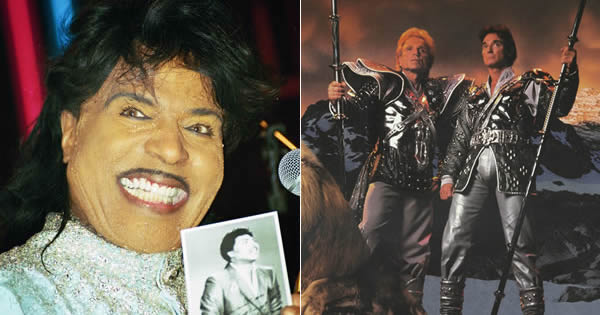
It was perhaps ironic that Little Richard and Roy Horn (of Siegfried & Roy) died within hours of each other this month. Though they were from totally separate pop culture factions, seeing their obits side by side in some outlets, such as the May 10 New York Times, was a sobering reminder of how an older generation of gay men — Horn, who died at 75 was on the outer cusp of the Boomers; Richard was 12 years older — dealt with (or didn’t deal with) their sexuality in a pre-Stonewall era when practically nobody was officially out but demeanor, style, stage persona and more “read” gay to middle America the same way sexual innuendo was implied in early jazz and movies long before it was discussed or depicted openly.
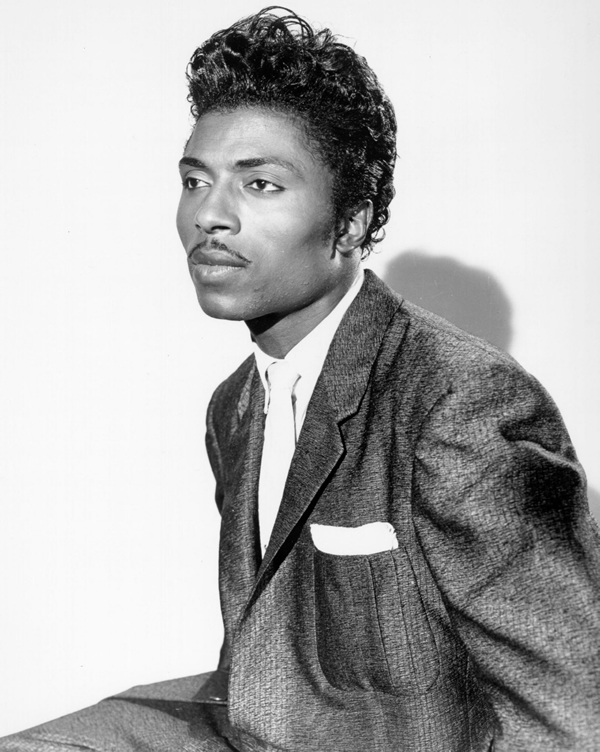
Little Richard (Richard Wayne Penniman was his legal name) was known for a string of ’50s hits like “Tutti Frutti” and “Long Tall Sally” whose impact went far beyond their initial chart peaks. Richard has been widely lauded as a rock and roll innovator and the first pop star to integrate black and white audiences in a time of rigid segregation in music and society. He died May 9 from bone cancer at his home in Tullahoma, Tenn., after a two-month illness. He was 87.
Horn came to fame with his nearly life-long professional (and for a time personal) partner Siegfried Fischbacher, who were known for their flashy Las Vegas act in which they made lions and tigers (and each other) vanish and reappear. They came to Vegas in 1967 and had a sellout run at the Mirage Resort and Casino from 1990-2003 that found them performing 500 shows yearly. By 1999, the show had grossed half a billion dollars and they were Vegas’s highest-paid entertainers.
Sadly, their careers ended abruptly on Oct. 3, 2003 (Horn’s birthday) when one of the tigers attacked Horn resulting in serious injury. Suffering a stroke and partial paralysis on his left side, Horn was eventually able to walk with assistance but never performed again. The duo made one final public appearance in 2009 with a tiger at a benefit for the Lou Ruvo Center for Brain Health in Las Vegas, the Times reported, before retiring officially in 2010. Horn died of COVID-19.
The duo (both German immigrants) only officially came out in 2007 in a National Enquirer article that announced “We’re gay” on the cover. They gave few interviews (even in their heyday) and could be testy about it when pressed.
Behind the glitz
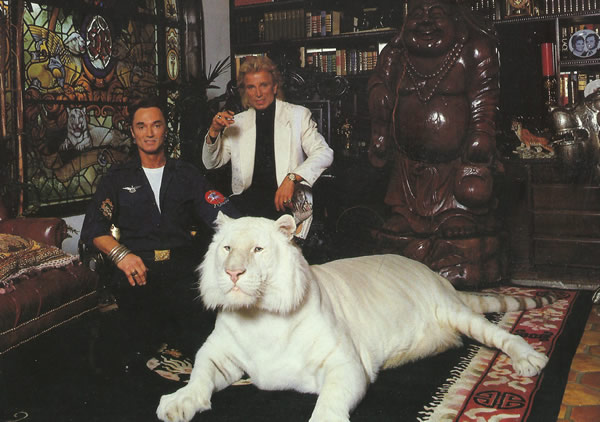
But with their over-the-top costumes (including Roy’s trademark codpiece), ostentatious Vegas home and inseparable public image (and never a hint that either might be involved romantically with anyone else), they didn’t have to state it explicitly. They donned capes and silver space suits, battled a sorceress and a fire-breathing dragon amidst smoke machines, lasers and, of course, lions and tigers, many of which were white, which are uber rare. Their act had a Liberace-esque flair to it, even if neither were ever quite that fey. Siegfried was the magician; Roy the animal trainer. They presented a yin/yang-type persona and lived together at Jungle Palace, an eight-acre Vegas estate (a much larger ranch was just outside the city proper) with, as of 1999, 55 tigers and 16 lions. Horn was the “Tiger King” decades before anybody heard of Joe Exotic (also gay) of the hit Netflix series.
“So you go deeper and say what is going on in my bedroom and in Roy’s bedroom,” Fischbacher said in a 1999 Vanity Fair profile. “I don’t care, I don’t know. I tell you this because this is me and I wouldn’t ask what you do with your dick either.”
Both said they were “very honored” to be considered gay icons but spoke of gay as “other.”
“I have a lot of friends who are gay and I made a lot of friends in show business and I found out that they are always interesting, intelligent and good people and fun to be with,” Fischbacher told Vanity Fair.
“I am flattered to think that people think that I am versatile,” Horn said. “You don’t have to define everything and I don’t want to disillusion people because I’m not a guy who kisses and tells.”
Pal Shirley MacLaine told the magazine they “used to be lovers a long time ago, yeah? In this day and age, who cares?”
Mainstream media only coyly touched on Horn’s sexuality. The Times said Fischbacher and Horn “were domestic as well as professional partners” but left it at that. Journalist Steve Friess, who in The Advocate called them “the world’s most openly closeted celebrities,” said a Mirage spokesperson told him the night of Horn’s attack that “it’s well known that they were lovers at one time.”
They were said to have little presence in Vegas gay life, according to Friess and others, and outside of buying an ad in a program book for an AIDS fundraiser, were not known to have used any of their vast wealth to support LGBTQ rights.
For some, that’s not a problem.
Milt Larsen, founder of The Magic Castle, a private club for magicians and enthusiasts in Hollywood, is 89, straight and knew Siegfried and Roy for many years, initially through his late sister-in-law, Irene Larsen. She and her husband Bill Larsen (Milt’s brother) loved magic and animals and discovered Siegfried & Roy in their early years in Vegas. Larsen later met the duo through his brother and sister-in-law and says Horn was “a dear, great friend.”
“Before Siegfried & Roy, magicians were very seldom anything other than an opening act,” Larsen says. “They came along and went from being an opening act to the headliner with their own huge show because it was so popular. … They were the best.”
Larsen’s friend Dale Hindman also know Siegfried & Roy and says he was at their house several times. He says Roy “fought like crazy” to recover and “they had the best medical people” working with him. He did daily physical therapy, swam and would zip around the grounds on a scooter. He recalls one Vegas convention in which Horn made a rare, post-accident appearance and walked to the podium.
“There wasn’t a dry eye in the house,” Hindman says. “I saw him a number of times at different places. He was in the scooter, he would talk, he loved people, he had great quality of life and they had the resources to have the best medical care. It’s such a shame that something like this virus came along and killed him.”
Larsen and Hindman say Horn’s sexuality was understood but “never really discussed.”
“I’ve been in show business a long time and sometimes it feels like just about everybody I’ve ever known was gay,” Larsen says with a laugh. “It was a different world then. I just don’t recall anybody ever talking much about it.”
Hindman says it was generational and gradual when more celebrities started coming out officially. Larsen says Fischbacher, especially (whom he calls a “great” businessman), just “never made a big point of it.”
“They were a couple in the sense that they were absolute partners in what they did and that their lives were their business,” he says. “People are people and in the world we live in today, it’s just not questioned as much.”
Larsen remembers “many, many times” being backstage in their Vegas dressing room post-show.
“The Champagne would be flowing and there were lots of wonderful friends,” Larsen says. “[Roy] was very, very gregarious and he and Irene really got to know each other and became wonderful friends.”
“There would be drinks and hors d’oeuvres and plenty of people,” Hindman says. “After awhile, Roy would go play with the animals. Siegfried would say, “I’m tired but you all stay as long as you want.’”
Out magician/actor Michael Carbonaro, 44, of reality show “The Carbonaro Effect,” said in a written comment to the Blade it didn’t matter if Siegfried & Roy were coy about their sexuality.
“I actually don’t know what Siegfried & Roy ever did or didn’t put into words,” he said. “I grew up seeing two gorgeous men living their magic dreams in bedazzled outfits, so they were always an iconic form of queer inspiration.”
It’s complicated
Others, however, aren’t willing to let them off the gay hook so easily. It’s unfair and unrealistic to expect everyone to have been a Frank Kameny or Barbara Gittings, but as time went on, many argue prominent gays should have done more for the cause.
Matthew Rettenmund, a gay blogger and pop culture historian/author, says Horn’s approach to being “out” reminds him of singer Barry Manilow who finally came out in 2017 at age 73 after decades of evading the question.
“They’re men who have convinced themselves that being gay in private is the same thing as being out,” he said in an e-mail. “Which is simply not true. I do hope that as the Rip Taylors and Richard Simmonses of the world leave us, as sad as it is to lose their talent, that they won’t be replaced by more of the same. Hiding in plain sight is still hiding and it still sends such a warped message of self-acceptance.”
Long-time gay Vegas resident/historian Dennis McBride says he can see where both sides of the issue were coming from.
“Siegfried and Roy were never involved in the Las Vegas queer community in any public way I’m aware of,” McBride wrote in an e-mail to the Blade. “They were much like Liberace in that respect — they were Las Vegas icons, counted Las Vegas as their personal and professional home, but deeply closeted because they came of age and established their careers during a time when they could have been jailed for being gay and lost those very lucrative careers. I remember there was some resentment in the community because we needed role models — particularly in the 1980s and early 1990s during the worst of the AIDS pandemic — and both Liberace and Sigfried & Roy might have been a great help in our struggle, brought credibility and support to our fight. I don’t think any of us entirely blamed them, though, because we were all in danger then ourselves as queer people.”
And while Richard stated he was gay explicitly on multiple occasions, he was never at peace with it and at multiple times in his career recorded gospel music and even for a time sold Bibles in a repudiation of the rock and roll and gay “devil’s” music and “lifestyle.” For him, being gay was a vexation and something to be overcome, which is, to some, even more troubling than Horn’s avoiding the issue.
“The problem is his religiosity and self doubt forced him back in the closet just as many times, “Rettenmund wrote. “And though he camped it up to earn a living in his final decades, it was homophobia that won. He died an ‘ex-gay,’ a sad loss.”
Richard was married to a woman from 1957-1964. They had one adopted son. As recently as 2017, he was condemning gay sex. “God, Jesus, he made men, men, he made women, women, you know? And you’ve got to live the way God wants you to live,” Richard told the Three Angels Broadcasting Network, a religious channel, reported by The Advocate.
Gay author/actor Michael Kearns (who’s been on “Cheers,” “Murder, She Wrote,” “The Waltons,” “Knots Landing” et. al. and has said in interviews and books he had sex with Rock Hudson and Barry Manilow) says Richard deserves a more compassionate assessment.
“I don’t know how much gay sex he was having, but for me it was all about him having such a gay persona,” Kearns says. “I think what young men like me found so stirring and exciting is that it gave us something to grasp onto. Here was this sissy, this exciting, flamboyant, theatrical, wild persona and yeah, he later had the doubts and went back into the closet as a religious fanatic, well, of course he did. He was a black man from the South dealing with all that church stuff. I mean that’s a big struggle and I think people just don’t give him enough human credit for battling that publicly.”
McBride says after their performing years, Sigfried & Roy were occasioally seen in Vegas’s gay spots. They separated romantically in 1996, he says, when Fischbacher got his own house in Spanish Trails. In more recent years, after Horn’s accident, speaking out for gay causes wouldn’t have carried as much weight, he says.
“No one really cared by then,” McBride says. “The moment when their honesty mght have made a positive difference to the Las Vegas queer community had long passed and so had the careers they might have lost if they’d come out earlier.”
He says they were “largely circumspect” but “we still saw them discreetly out and about.”
“Even before (they broke up), when we saw them in the community, it was usually separately,” he says. “The two of them would visit the Le Cafe nightclub in the 1970s which then stood on the northwest corner of Tropicana Avenue and Paradise Road. The club’s lesbian owner, Marge Jacques, counted them as friends. In the 1980s, separately or together, they’d come to Gipsy, which then was an upscale dance club on Paradise Road and Naples Drive.”
They were also spotted occasionally at seedier gay spots, McBride says.
“Roy seemed to enjoy the Talk of the Town adult bookstore when it was in the Crestwood Shopping Center on East Charleston Boulevard and one or the other was occasionally seen at the Camp David bath house on Industrial Road,” he says. “But mostly, they and their circle of gay friends — which included Liberace and Hans Klok, who came out about the same time Sigfried & Roy did in 2007, and their protege, Darren Romeo, who just came out during his run in Pigeon Forge, Tenn., — kept themselves pretty much sequestered at Little Bavaria back in the day. I think the idea of a queer community was alien to them, outside their experience, maybe even distracting and a bit threatening.”
Religious hangups
Gospel music producer/historian Anthony Heilbut has written at length about how black Christian denominations have shamed or welcomed queer musicians to varying degrees in the ‘50s, ‘60s and prior. He knew Little Richard — not well, but they’d met on several occasions — and says one must consider the era when deciding how much blame to assign him. He wanders into another room of his New York apartment during a phone interview last week and puts on a recording of gospel singer Marion Williams (1927-1994), who for a time was in The Famous Ward Singers, helmed by Clara Ward (one of Aretha Franklin’s major influences) and who also had a significant solo career. He holds the phone up to a recording of her whooping and hollering and it’s easy to see where Little Richard got some of his inspiration. Richard appeared at the Kennedy Center Honors when Williams was inducted.
“His phrasings and his timbre and even his ballad singing, and he was a great ballad singer although we typically think of him as this sort of rock and roll clown, all that came from Marion Williams,” Heilbut, who’s gay, says. “You can’t copyright phrasings. That’s what singers could take from each other.”
Heilbut also says Richard, whom he first met in 1961 and says he’s “one of the very few people who ever saw him sing on a gospel program,” says Richard’s gospel singing career was never terribly convincing or memorable partially because he came from a staid denomination (Seventh Day Adventist, not nearly as musically rowdy as black Baptists and those in the Sanctified Church) and the fact that it was performed more dutifully than his rock and roll material.
“He was singing, ‘I quit show business and I wanna go straight/I wanna serve the Lord before it’s too late,’” Heilbut says. “His singing was very bland. There was more of the real gospel drama in his R&B and rock music.”
Heilbut also says Richard admired Williams in the traditional way gay men have worshiped show-stopping divas. He remembers seeing Richard at a Nashville studio when Heilbut was producing one of Williams’ later recordings. He mimics Richard’s speech patterns, recalling the conversation: “‘Is she still fabulous? Do she still make notes? I makes notes. I heard she preaching. I preaching too. … She always war my heart, she know, she know. I’ve been singing like her down through the years. Mahalia good, but Marion always were my singer.’”
Heilbut also says Richard’s various stints in gospel music robbed his career of momentum in rock. As respected as he was among rock pioneers, he’s almost wholly associated with his ‘50s heyday. Attempts at secular music comebacks in the ‘60s and ‘70s could not come close to matching his peak period.
“He made some very lovely records later and he could be a wonderful singer, but by then the audience had changed,” Heilbut says. “The train had passed.”
Later in life, Heilbut says, Richard was seen socializing in gay bars. He never personally saw him but says friends reported him being “the belle of the ball” at St. Louis gay bars on various occasions.
Richard, whom Heilbut says “always struck me as very goofy,” was ultimately “just incredibly confused.”
Roy, Richard ‘lacked courage’
Gay activist/entrepreneur Mitchell Gold, who like Siegfried & Roy, knows something about being linked for life to a former partner — he and business partner/former domestic partner Bob Williams formed their eponymous furniture company Mitchell Gold+Bob Williams in 1989, which they continue to run jointly. He says celebrities holding onto or returning to the closet are a reminder of “how horrible these religious teachings are, how toxic.”
“I don’t even know what it’s like to live like that,” Gold says. “I was tortured about it until I was 24, 25 but then that was the end of it. These guys who live their whole lives having to be careful about that they said, it’s just horrible. I don’t know as much about Siegfried & Roy except that after awhile it just gets to be ridiculous, like the Barry Manilow thing was for so many years.”
Gold understands Richard not being out in the ‘50s or Siegfried & Roy at the advent of their careers but later in life, once they were financially secure, he says they “lacked courage.”
“I never cared if we lost money for being out,” Gold says. “I don’t have to be a gazillionnaire. If I make less, I make less and it’s the same for Siegfried & Roy. At some point they had plenty of money and so why wouldn’t they speak out for people who aren’t being sheltered the way they are and are forced to live a closeted, unhealthy life. The only thing I can say is I don’t think these folks even know what a healthy life looks like.”
Gay journalist/author Michael Musto agrees.
“It’s partly generational, though many of their generation ended up being belatedly but wonderfully out and proud — Richard Chamberlain, Joel Grey, etc.,” he wrote in an e-mail. “It’s more of a sort of self-loathing-tinged caution based on a lifelong fear of an image adjustment or career damage. Roy played to Middle American high rollers, but obviously didn’t want to gamble on his own career. One of his magic tricks was being cagey about his sexuality.”
Musto says the music business has been especially troubling for non-straight black entertainers.
“Little Richard renounced his queerness when he should have just been at peace with it and allowed himself to celebrate and be celebrated by our community,” Musto says. “Luther Vandross, Whitney Houston and many others were unwilling to step out of the shadows because the people around them (and sometimes their own inner voices) told them not to. Little Richard was so queer that it seems like a ‘duh’ that he should have just gone there. But with Adam Lambert, Sam Smith and many others (and Elton John, Melissa Etheridge and k.d. lang having led the way), things have inalterably changed.”
Although Fischbacher and Horn never spoke of their religious influences — their decor reflected influences of Eastern religion and Horn would sound a large gong in his bedroom to let the tigers know he was awake — for Richard, Kearns says, it was tragic.
“I’m not saying there aren’t some fabulously evolved people who are religious but we’ve seen time and time again how religion gets its hold on gay people at a very early age and just does not let go and the result can be horrific,” Kearns says. “Richard is a fascinating creature to me. In a way, it’s amazing he lived as long as he did with this struggle. He deserves a lot of credit. He didn’t have an easy time of it.”






a&e features
Bar Betsie, inviting and intimate, marks one-year anniversary

Not that a basic vodka-soda should ever dare to appear in print on the craft cocktail list at year-old Bar Betsie, but if it did, its name would be written in big black block letters, back-lit, on a marquee behind the 14-seat bar, with its ingredients – Tito’s, seltzer water – sitting visible on a shelf above.
Inviting and intimate, and with that arresting visual representation of cocktail ingredients along the wall, Bar Betsie has brought its vibes-forward approach to a dynamic corner of bustling Union Market. The sophomore effort from owners JP Sabatier, Ralph Brabham, and Drew Porterfield, the trio took a different tack at Bar Betsie than at their other, older (though not by much) 14th Street bar, Jane Jane.
Bar Betsie allowed Sabatier, Brabham, and Porterfield to expand their creativity. The three first connected several years ago, when JP was manager of Maydan and Brabham and Porterfield owned Beau Thai and BKK Cookshop. Immediately hitting it off, they dreamed of opening a bar together and in 2021, it became a reality, in the form of Jane Jane.
Featuring a short list of craft, rotating cocktails and shareable bar snacks, Bar Betsie is Jane Jane’s “grittier, edgier” sister. While Jane is named after Porterfield’s mother, Bar Betsie gets its moniker from Sabatier’s mom.
“While Jane Jane is going on a field trip, Bar Betsie feels like you’re skipping school,” says Brabham. Bar Betsie brings more of a party vibe, he says. They landed in the Union Market neighborhood after thinking through what a second bar might feel like: not a carbon copy, but an atmosphere unique to its physical space and surroundings. Union Market and its transitional nature translates to the bar’s interiors: its mood lighting regardless of time of day, the crushed-velvet booths, the blood-red curved curtains to the bathrooms and kitchen, and the air of timeless mystique contrast to the elevated, buttoned-up cocktail bar that is Jane Jane. No one would bat an eye if a cabaret broke out on top of the bar. When in Bar Betsie, they say, it’s as if the warm lighting cuts through the vibe (and the stories) of 50-year-old cigarette smoke in the air.
They decided to make the cocktail menu more concise: 12 to 15 signature drinks at a time. Tequila and mezcal lead the program (again, a nod to mom Betsie, who prefers agave-based liquors). Drinks rotate seasonally (a cocktail flip is happening this month) and are developed committee-style to ensure that the whole team has input. The Clover Cult has been especially popular, with bluecoat gin, raspberry, vermouth, and lemon, but passed through a high-speed blender that whips the drink into a frenzy: it’s a “yummy, sweet cocktail with foam with a beautiful pink color,” says Brabham.
Beers feature locally brewed options, like from DC Brau and Atlas, alongside a wine program featuring skin-contact wines. And hewing to that party-forward vibe, there’s a host of shooters like the blackberry firing squad with tequila and lime.
As for the food, Bar Betsie has a true kitchen, allowing Sabatier to stretch his cheffy wings (he attended the Culinary Institute of America). Bar snacks are plentiful, including Buffalo chicken dip, a giant pretzel with beer cheese, and chicken tinga nachos that are “fucking delicious” says Raplh. “We’re aiming for food that’s snacky, salty, crunchy, and tasty to pair with the drinks.” Guest chefs show up on Sundays for kitchen cameos.
Since opening Bar Betsie, the trio has welcomed some additional acclaim. They’ve begun to set up activations with other bars; last month, they held a pop-up at new cocktail den Frank’s Wild Years, and there’s an upcoming collaboration with Death &Co, the famed bar in Blagden.
Bar Betsie occupies a unique place in the city’s pantheon of drinking destinations. All three owners are gay, and yet this (like Jane Jane) is not a gay bar.
“We never hide who we are,” say Brabham and Porterfield. “There’s always the recognition of the community we come from, and love, and want to celebrate.”
They want people to know who they are and what they stand for, showing that by being inclusive and open in their support of the community. They work to ensure that the staff is diverse and inclusive as well. They also dropped an exclusive Easter egg: behind the medicine-cabinet mirrors in the bathroom is a video screen playing footage of drag queens either getting ready, fixing, or removing makeup and wigs. “It’s a little IYKYK moment, something fun and true to who we are as a queer-celebrating and owned space,” they say.
a&e features
Ryan Murphy’s ‘Monster’ vilifies the lesbian
Netflix show promotes stereotype that queer women are dangerous

Ryan Murphy’s “Monster: The Lizzie Borden Story” just premiered on Netflix and became the most watched show on the platform. Murphy and his series are deeply controversial. The past three seasons have focused on convicted killers Jeffrey Dahmer, Lyle and Erik Menendez, and Ed Gein, and have garnered considerable criticism for sensationalizing real-life trauma, exploiting victims for entertainment, and glorifying the perpetrators.
But his newest season centers on Lizzie Borden, the white, affluent Massachusetts woman still referenced today in nursery rhymes who was never convicted of killing her parents Andrew and Abby Borden. As with Murphy’s other seasons, the show plays fast-and-loose with real-life history, instead turning a real-life crime into a psychosexual spectacle.
In real life, Lizzie was found not guilty by an all-male jury in the highly publicized 1892 trial, largely due to a lack of evidence including blood on her clothing and a murder weapon. Her initial statement contradicted her later testimony but her defense team argued that the morphine a doctor repeatedly gave her likely caused her confusion. But despite the fact that Lizzie was acquitted in court, she was ostracized by her community during her life and has been branded a murderer ever since.
Murphy’s highly fictionalized retelling of Lizzie’s story leans into this accusation not only that Lizzie murdered her father and stepmother with an axe but that she was successful in covering it up with the help of the maid Bridget Sullivan. Murphy not only concocts a sapphic relationship between Lizzie and Bridget, pinning the idea of killing Lizzie’s parents on the widely traveled woman who dyes her hair and is repeatedly called a lesbophobic slur by Lizzie’s stepmother, but also portrays Lizzie as an inspiration to Aileen Carol Wuornos, a woman who killed seven men who solicited sex and was also in a relationship with a woman.
Further, Murphy’s retelling creates a false ending to Lizzie’s story. While in real life, Lizzie and her sister Emma buy a house called “Maplecroft” and live there for the rest of their lives, Murphy instead imagines Bridget returning sporadically for romantic rendezvous with Lizzie and eventually moving back in with her and marching together for women’s right to vote. In real life, Bridget left town immediately after providing testimony and lived in Montana until she died.
Lesbophobia is at the heart of this retelling of Borden’s story. Despite the fact that Murphy depicts Lizzie and Bridget having sex and possibly getting married or at least promising themselves to one another wearing flower crowns, there is no evidence that Lizzie and Bridget had any romantic or sexual relationship. If they did have a relationship, it would likely have been hidden and any evidence destroyed, but records show that Lizzie herself refused to call Bridget by her real name, instead referring to her as “Maggie,” the name of their previous maid. It was only Lizzie’s stepmother Abby who called Bridget her real name. In Murphy’s retelling, it’s Lizzie’s stepmother Abby who refuses to learn or use Bridget’s actual name and treats her with disdain along with her stepdaughter.
Some people online argue that we are witnessing Lizzie’s story retold through Wuornos’s perspective, so adding in elements of child abuse and sapphic relationships would make sense, but there is no record that Wuornos ever visited Lizzie Borden’s home, or that she was inspired by Borden throughout her life. Instead, Murphy and his co-creator Ian Brennan use (or I would say exploit) Wuornos as a thematic device to make broad stereotypes about female rage across generations. In doing so, they conflate two real-life examples of violence to sapphic individuals.
Depicting a lesbian relationship in this way is not progress, nor is it fruitful representation today. As sapphic shows are increasingly cut and cancelled, Murphy’s inclusion just reinforces the lesbophobic and sexist stereotype that lesbians and queer women are “dangerous” to straight women and abet or incite violence against men and a family unit. At a time when anti-LGBTQ+ legislation and real-world violence and murder of LGBTQ+ people, especially queer and trans people of color, is exploding, stories that frame murder of a family unit as germinating from a sapphic relationship feed into far right narratives.
They further the myth popularized by far right leaders (including those in the highest echelons of government) that LGBTQ+ people are dangerous, a threat to heterosexual norms and family life, despite the data showing that children of same-sex parents have above average health and well-being according to research by the University of Melbourne.
Today, many LGBTQ+ people feel they have to be (or are forced to be) idealized versions of themselves in order to stave off anti-LGBTQ+ stigma, policing and violence. These “acceptable” behaviors and appearances are rooted not only in cisgender, heterosexual norms but also white supremacy, colonialism, xenophobia, and ableism. It is respectability politics that tell us how we can and should behave (including those perpetuating in the wider LGBTQ+ community) and push LGBTQ+ people to assimilate into a society governed by queerphobic normativity.
I hope it’s clear that I’m not trying to argue that we cannot and should not have shows that depict queer women who kill, or at the very least queer women who are unethical or morally complex. We need these depictions because they ask difficult questions and they reference how some LGBTQ+ people can be and are unethical. In fact, several public LGBTQ+ figures are associated with employee abuse and exploitation, ableism, and fat phobia.
But when Lizzie’s sapphic identity is invented to drive the story along, arguably to generate interest (especially straight men’s interest) in this spectacle of historical slop, it’s not a story that invites discourse and dimensionality, it’s one that collapses Lizzie, Wuornos, and queer women’s identities and relationships to plot devices. It objectifies and fetishizes queer women, arguably committing violence against not only Lizzie but also Wuornos.
And when there is so little representation of sapphic relationships on mainstream television or streaming platforms, it makes this the vast majority of representation that queer girls and women will see of themselves first, and that the straight public will see. Historians will know that Murphy’s depiction of Lizzie’s life is wrong, but many viewers will not and may not go digging for the truth.
Why not focus on the stories of bisexual, lesbian, and queer women who really existed, shared their identities (sometimes covertly, sometimes not), and had long-term partners? In fact, “Boston marriages” were common in this time period and referred to women living together when sexual and romantic relationships between women were illegal, partially because penal systems didn’t know how women could have sex with one another and didn’t want to put the idea in “impressionable” women’s minds. Why not focus on these stories instead of creating a fictionalized account? We have always existed; we do not need to invent relationships.
Murphy’s depiction of Lizzie Borden is deeply problematic. Lesbophobia is not the only issue at the heart of Murphy’s drama, but it merits a broader discussion about how mainstream media routinely hurt queer women and is part of perpetuating queerphobic violence, and what we all lose in the process.
a&e features
Writing a play about Lincoln leads down a rabbit hole to a closet
As LGBT History Month arrives, new hints that our greatest president was gay
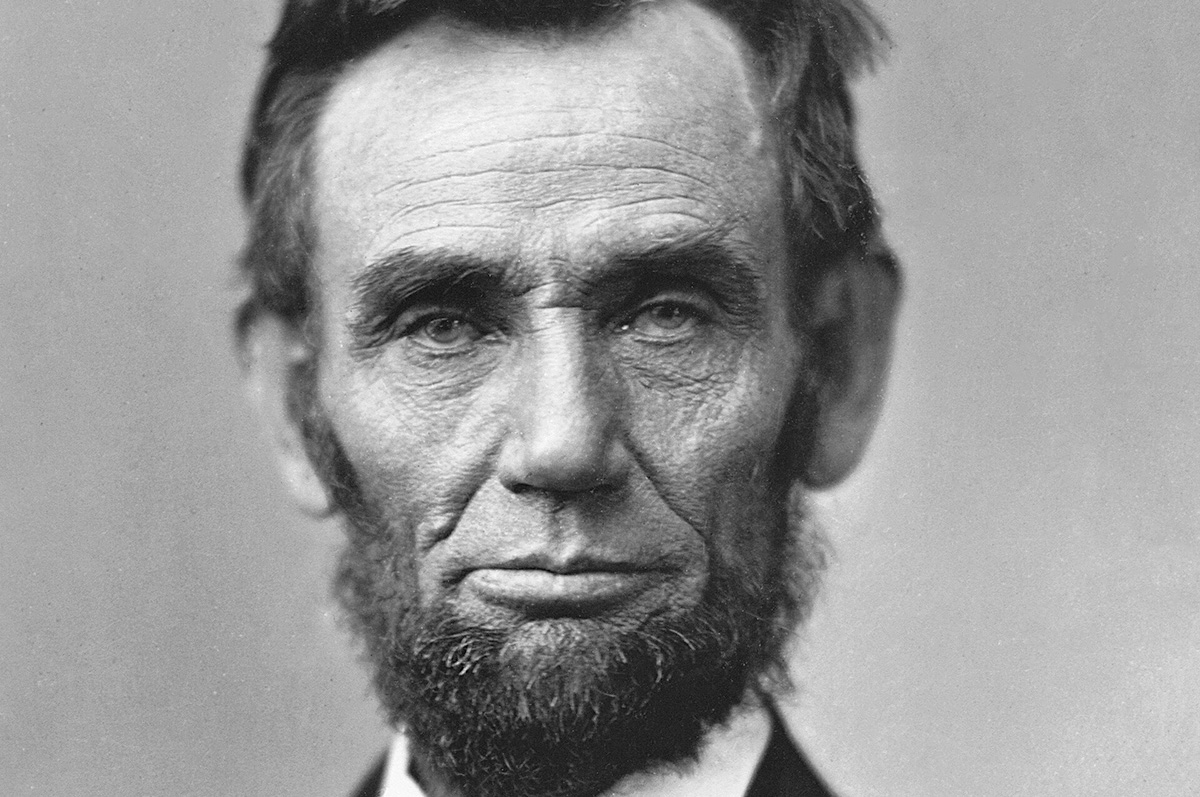
Abraham Lincoln treasured poetry and it turns out his particular favorites were pretty queer, but I never would have detected that if I hadn’t decided to write a stage comedy about his sex life. In my research for the play, I stumbled across what I believe is new evidence that Lincoln and Joshua Speed were lovers. The remarkable thing is that the evidence has been sitting in plain sight for more than 150 years.
The rabbit hole swallowed me in 2019, when C.A. Tripp’s revolutionary biography “The Intimate World of Abraham Lincoln” somehow fell into my hands. I was embarrassingly late to the Lincoln-was-gay party—Tripp’s book had come out 14 years earlier—and the wonderful-to-me news that Lincoln played for my team started me plotting out a play, because I was pretty sure if I didn’t know this, lots of people didn’t and inquiring minds want to know, and the young queers of America should be told that they have yet another genius over whom to kvell.
Historians and myth makers alike—often it’s hard to tell the difference—have always painted Abe straight, and now that it’s in question they’ve gotten peevish and insistent because, c’mon, bro, everybody knows that in the 19th century all the guys were writing each other gushingly romantic letters and sharing a bed every night for four years. Meanwhile, the Queer Studies crowd assures us that they, the inventors of homosexuality, had not yet invented it, so it couldn’t be that.
But what kind of play to write? I wanted to put at least two of his lovers into it, and no playwright with any sense of drama would omit Abe’s mad, physically abusive, spendthrift wife Mary. To get all of them in the same place at the same time meant bedroom farce. Keeping one’s lovers from knowing about each other is the keystone of bedroom farce and why the sets have so many doors. Speed, the great love of Lincoln’s life, who often visited the White House during the Civil War, would arrive while Lincoln’s wartime lover Army Captain David Derickson was there, too, and Abe would conceal them from each other and from Mary, who is suspicious and dangerous and prone to striking her husband. I also folded in Lincoln’s writing of the Emancipation Proclamation, which in the play is helped along by an invented Black housekeeper, who has suspiciously 20th-century opinions and a shiny new invention: the animatronic steampunk Lincoln robot. “The Loves of Lincoln” finally had its world premiere on June 19 of this year in Memphis, Tenn., where it was nominated for the best new original play of the 2025–26 season, and lost. Now we’re getting to the part about Lord Byron. Wait for it. It’s coming. We’re still setting the scene.
A cute, redheaded, gay Broadway producer told me the play would be stronger with a different kind of ending and for once a producer’s note was spot on—the play needed a final confrontation between Lincoln and Speed over love and slavery. The Speeds had dozens of slaves—lots more than Mary Todd Lincoln’s family, who had a few themselves. To write the scene I needed to know more than I did about the Speed-Lincoln relationship during the war. Speed was helping Lincoln keep the border state of Kentucky in line, but on the other hand his great wealth depended on slavery.
Time for some research. Enter “Your Friend Forever, A. Lincoln: The Enduring Friendship of Abraham Lincoln and Joshua Speed” (2016, Columbia University Press) by Charles B. Strozier, a “psychobiographer” who does the usual somersaults to explain away Lincoln’s behavior as straight because writing gushingly romantic letters to other guys and sleeping in the same bed for four years was absolutely not gay in the 19th century, which is proved by the fact that all the guys were doing it. Which kind of made me want to build a time machine and stop off in 19th-century Illinois on my way to ancient Greece. And then, suddenly, sitting there quietly on page 45, like a dangling thread on a cardigan begging to be pulled, was the interesting datum that Joshua lent his gangly, athletic bedmate books, among them Joshua’s “favorite”: Lord Byron.
The same Lord Byron who cut a swath a kilometer wide across the comely young men of Greece? The notorious libertine and sodomite—that Lord Byron? Well, yes, and it’s not hard to draw a line straight from there to Lincoln’s closet (coincidentally, one of the doors in The Loves of Lincoln leads into a closet—“Why is my husband always in the closet?”), but for some reason, up to now, no one I know of has drawn that line.
Understand, just reading Byron does not make Josh and Abe homosexuals. Byron was a big seller and lots of straight men read him, though perhaps not while gazing dreamily into each other’s eyes (Joshua’s wide and blue, Abe’s a melancholy gray), and OK we don’t know that’s exactly how it went down, but we do know other interesting things thanks to William Herndon.
Bill was a clerk in Speed’s general store, the store Speed and Lincoln slept above, and later the junior partner in Lincoln’s Springfield law practice. Herndon worshipped Lincoln. After the assassination he interviewed pretty much every significant person in Lincoln’s life, in what Strozier called one of the first oral history projects in America. Naturally, he interviewed Speed, who reported Lincoln’s passion for the poetry of Byron. The sexual significance of the connection between Speed, Byron, and Lincoln has up to now been ignored by all biographers—even the queer ones, like Tripp, who tried and did make the case for Lincoln’s homosexuality. Speed told Herndon he had introduced Lincoln to Byron: “I don’t think he had ever read much of Byron previous to my acquaintance with him.” Lord Byron’s poetry was a stew of intense male friendship, forbidden sexuality, secrecy, alienation, and erotic misbehavior, and in the wake of his scandalous divorce his name had for years been a transatlantic byword for transgressive sexuality. Byron also became, alongside Burns, Milton and Shakespeare, one of Lincoln’s four favorite writers.
Here’s where things get juicy. Speed said that, in particular, “Lincoln loved The Bride of Abydos.” Byron wrote the poem in the wake of his travels through the Ottoman Empire, which was partly what we today would call sex tourism. The poem’s beautiful young hero Selim is extremely feminized, conceals his true identity from his girlfriend (whom everyone thinks is his sister but they’re cousins), and only later reveals that he has a secret double life—in the case of the poem, as the leader of a band of pirates. Now there’s a secret life with an All-Male Cast. We’ll let you supply the pirate joke that goes right here.
It gets better. Herndon’s admittedly fragmentary notes from the Speed interview also specifically bring up Byron’s “To Inez,” the extraordinary lyric in “Childe Harold” in which a man tells a woman that her beauty gives him no pleasure, that her eyes scarcely charm him, and that she must not attempt to discover his “secret woe” or “unmask” his heart. The subtext that leaps off the page, given that Byron was, as the actor Michael Redgrave described himself to his son, “to say the least of it, bisexual,” is that the speaker is in the closet. In the last stanza, he begs her not to pry:
What is that worst? Nay, do not ask—
In pity from the search forbear:
Smile on—nor venture to unmask Man’s heart,
and view the Hell that’s there.
So, queer-coded Byronic poetry formed an important part of Lincoln’s imaginative world, and Speed remembered that fact nearly 30 years later, and told it to Herndon almost as if leaving literary breadcrumbs for posterity. As far as I have been able to determine, no previous Lincoln biographer or scholar of Lincoln’s sexuality has examined the queer implications of the Byron poems Speed specifically remembered Lincoln reading. Why has this been missed?
All of this would be meaningless if Speed and Lincoln didn’t understand that Byron was a lover of men, but I assert that they would have. Lincoln was a discerning reader with a famously penetrating, tenacious mind that wouldn’t let go of a thing until he understood it thoroughly—and a huge fund of worldly knowledge. He was by this time in the Illinois Legislature, had campaigned all over the state, and lawyers often encounter the seamy side of life, whether they seek it out or not. Furthermore, although Byron’s indisputable affairs with men weren’t explicitly documented in 19th century biographies and periodicals as they are today (the conventions and laws of the time all but guaranteed euphemism), rumors of Byron’s “unnatural” conduct crossed the Atlantic even during his lifetime. Articles repeatedly referred to an unnamed, horrifying, or “unnatural” offense, a “peculiar enormity,” and conduct violating the “ban of nature.” In 19th century usage, “unnatural crime” was a familiar euphemism for sodomy, while phrases like “peculiar enormity” and “ban of nature” invited readers to imagine sexual offenses too scandalous to name. Why use the words at all if readers weren’t going to get the point? American readers had easy access to Byron biographies and memoirs, including Thomas Medwin’s “Conversations of Lord Byron” and Thomas Moore’s enormously influential “Letters and Journals of Lord Byron,” while American periodicals discussed the Byron memoir burned by his friends and the salacious suspicions around its contents. Lincoln and Speed would certainly have understood that one of the unmentionable sexual accusations surrounding Byron was man-on-man action.
Lincoln’s love of Byron’s queer-coded writings, fostered by Speed, “proves” little on its own, but a lot when added to the rest of the evidence. And it’s part of an even bigger story: reversing the erasure of queerness from history and documenting that many of humankind’s greatest achievements are thanks to queer individuals. Both Lincoln and Speed had beards, literal and metaphorical—they didn’t want their secret spilled while they were alive. But then again, I like to think that when Joshua Speed told William Herndon of Lincoln’s love for those poems, he imagined a day when their love could be decoded and celebrated. Come to think of it, that day is today.

Calendar: October 9-15

ICC unseals arrest warrants for Taliban officials accused of persecuting LGBTQ people, women

Bet Mishpachah participates in D.C. Oct. 7 commemoration ceremony

Man charged in Mall of America shooting plot inspired by Pulse massacre: report

Bar Betsie, inviting and intimate, marks one-year anniversary

Eliot Glazer’s new book an engaging collection of essays

‘Merrily’ is for Sondheim super fans, the uninitiated, and anyone in between

The financial realities facing LGBTQ+ first-time buyers

PHOTOS: Winchester Pride

Engrossing ‘Tip Toe’ delivers tension and an ominous warning
-

 Books5 days ago
Eliot Glazer’s new book an engaging collection of essays
-
Theater5 days ago
‘Merrily’ is for Sondheim super fans, the uninitiated, and anyone in between
-
Real Estate5 days ago
The financial realities facing LGBTQ+ first-time buyers
-
Television5 days ago
Engrossing ‘Tip Toe’ delivers tension and an ominous warning