District of Columbia
Gay candidates call for restoring LGBTQ representation on D.C. Council
Ward 1 and 5 contenders join two gay rivals in backing programs for queer youth

Gay former D.C. police officer Salah Czapary, who’s running in the city’s June 21 Democratic primary for the Ward 1 D.C. Council seat, and gay D.C. school board member Zachary Parker, who’s running in the primary for the Ward 5 Council seat, told viewers of a virtual May 4 LGBTQ candidates forum that they hope to bring back direct LGBTQ representation on the Council.
Czapary was among the three Democratic Ward 1 Council candidates, including incumbent Council member Brianne Nadeau and fellow challenger Sabel Harris, who participated in one of two forums Wednesday night organized by Capital Stonewall Democrats, the city’s largest local LGBTQ political group.
Parker was one of four of the seven candidates running in the hotly contested Ward 5 Council race that participated in the second of the two forms held by Stonewall on Wednesday evening. The others who participated were Gordon Fletcher, Faith Gibson Hubbard, and Vincent Orange, a former Ward 5 and at-large D.C. Council member.
The Ward 5 candidates who didn’t participate were Kathy Henderson, Art Lloyd, and Gary Johnson. Capital Stonewall Democrats didn’t provide a reason for their absence.
Similar to their fellow candidates, Czapary and Parker pledged to address the needs of all of the diverse residents of their respective wards, especially those they referred to as underserved and underrepresented.
“Despite D.C. being a city with the highest count of LGBTQ individuals per capita than any other city, we currently don’t have representation on the Council,” Parker said at the Ward 5 forum. “And I’m hoping my candidacy this cycle changes that.”
Czapary said if elected he would aggressively address issues of concern to all Ward 1 residents, especially LBTQ residents, with a special outreach to the trans community.
“Washington, D.C. has a thriving LGBTQ community,” he said. “But far too many of our LGBTQ residents are not able to access healthcare, housing or employment,” he added. “I promise to be a tireless, present and accessible and available Council member, an advocate for our community and all communities.”
Nadeau, the Ward 1 incumbent running for her third term on the Council, pointed to her longstanding record of support for LGBTQ issues. Although she didn’t say so directly, she acknowledged that she began her first term in office in January 2015 after defeating then openly gay Ward 1 Council member Jim Graham in the 2014 Democratic primary.
“When I first became a Council member, I knew that I was taking over a very special role in the community,” she told the Stonewall Democrats forum. “Not only because I was succeeding an openly gay Council member but also because of the depth and breadth of the involvement of our LGBTQ community in Ward 1.”
Added Nadeau, “I take that responsibility very seriously. And as a result, since day one walking in the door I knew that I could be an ally and work on the issues our LGBTQ community faces.”
Graham, who won election to the Council in 1998 after years of AIDS related service work as executive director of the Whitman-Walker Clinic, became the subject of criticism for ethics related issues after the Council voted to reprimand him in 2014 for allegedly pushing for a developer to win a city lottery contract. Graham denied he did anything illegal and said his aim was to bring development to Ward 1.
The fallout related to what critics, including the Washington Post editorial board, called an ethics “scandal” has been credited with leading to Graham’s defeat by Nadeau, who won the 2014 primary by a margin of 59 percent to 41 percent for Graham.
Harris, a Ward 1 ANC commissioner representing the 14th and U Street, N.W. area, also pledged to be a strong LGBTQ ally, saying she is running for the Council seat, among other things, “to help uplift those who have been forgotten.”
Ashley Smith, president of D.C.’s Capital Pride Alliance who served as moderator of both the Ward 1 and Ward 5 forums, asked the candidates a series of questions on topics both LGBTQ specific and political in nature, including whether the candidates support expanding the size of the D.C. Council and how they would address income disparity among all city residents.
The LGBTQ related topics included how the city should address problems faced by LGBTQ seniors, which city agencies can best partner with LGBTQ service organizations, how best to address growing instances of violence faced by transgender women of color, whether the city’s public school system should remain under the full control of the mayor, and how best to address a growing problem of homeless LGBTQ youth.
Each of the candidates participating in the forums for both Ward 1 and 5 responded to the questions by expressing strong support for the LGBTQ community and outlining plans to address problems faced by LGBTQ people.
During his closing statement in the Ward 5 forum, Orange, who said the chairman of his own campaign is gay, became the only candidate at the forum to criticize a fellow candidate when he implied that Parker failed to adequately address problems faced by LGBTQ youth during his years on the D.C. State Board of Education.
“I heard Mr. Parker say I’m openly gay and I’m espousing to help,” Orange said. “But he’s been an elected official for almost four years and all the things we’ve talked about tonight, he could have helped those young kids,” said Orange. “But so just because becoming openly gay a couple of months ago seems to be a matter of convenience,” Orange said in referring to Parker’s public announcement earlier this year that he’s gay.
Parker, who along with Czapary, has been endorsed by the LGBTQ Victory Fund, the national group that provides financial support for out LGBTQ candidates for public office, did not respond to Orange by name when he delivered his own closing remarks. But he may have been referring to Orange when he said, “And it’s worth noting that violence comes in many forms, and we’ve seen that here tonight.”
Added Parker, “What is at stake in this race is how we’re going to move forward as a ward and as a community. And it’s not just about vision, although I’ve provided that,” he said. “It’s not just about community connection, and I have that. But it’s also about a Council member that’s going to lead us ethically and honorably at all times.”
Parker was likely referring to Orange’s decision to resign from his at-large seat on the D.C. Council in August 2016 in the midst of an ethics controversy, shortly after he lost his re-election bid in the Democratic primary to Robert White and just under five months before his term on the Council was to end in January 2017. The controversy surfaced over Orange’s decision to accept a job as president of the D.C. Chamber of Commerce while still a sitting member of the Council.
His Council colleagues expressed strong objections to his holding the two positions, saying it presented a conflict of interest.
A video recording of the Capital Stonewall Democrats Ward 1 and Ward 5 candidate forums can be accessed here.
A Washington Blade transcript of the opening statements of the candidates that participating in Capital Stonewall Democrats Wards 1 & 5 forums can be viewed below:
Ward 1 Candidates – Opening Statements
Salah Czapary
Thank you. Good evening and thank you for having me. My name is Salah Czapary and I’m a candidate to represent Ward 1 on the D.C. Council. I’m a proud gay man. And while D.C. is ranked as one of the most accepting states for general acceptance of our community, the work of advancing LGBTQ rights is not over. The rights we enjoy are fragile and must be reinforced. We’re seeing even this week with the draft opinion from the Supreme Court indicating a vote to overturn Roe v. Wade.
We all know someone who came to D.C. because their family rejected them, their community rejected them. We are seeing more and more assaults on LGBTQ rights across the nation. And it is imperative that D.C. remain a safe haven for the community. To do that we have to make intentional long term stable housing for LGBTQ youth and in particular trans youth that is connected with case management and mental health services. We know that LGBTQ youth are much more likely to become unhoused and in need of needing those services.
The increasing use of PrEP has helped lower the HIV infection rate in our city. But knowledge about PrEP and access to medication remains uneven. Too many people do not know that PrEP is effective or even that it exists. Moreover, many lack the means to afford monthly prescriptions. Black LGBTQ+ individuals are also disproportionately infected with HIV and less likely to have access to PrEP and adequate healthcare. When elected, I will work to bridge the gap and ensure all of our LGBTQ+ populations have access to preventative medication. I’ll fight to raise awareness about HIV prevention and ensure affordable access to lifesaving medications.
As we work to reduce infections, we must also address the long-term effects of HIV. Many LGBTQ people infected during the 1980s and 1990s AIDS crisis live with debilitating illness. And I will ensure that we invest in medical and mental health care for all surviving with HIV.
Finally, LGBTQ+ seniors helped build the community we now enjoy. And yes, there is still more work to do. But we have to ensure that D.C. is senior friendly and provides programming and support to a population that worked so hard to make our city uniquely D.C. Thank you.
Brianne Nadeau
Thank you so much. I am Brianne Nadeau. I am the Ward 1 Council member. And I’m so happy to be here with you tonight. When I first became a Council member in 2014, I knew that I was taking over a very special role in the community. Not only because I was succeeding an openly gay Council member but also because of the depth and breadth of the involvement of our LGBTQ community in Ward 1.
Not limited to the location of the D.C. Center or so many nonprofits here in the ward like Us Helping Us to serve our LGBTQ community. I take that responsibility very seriously. And as a result, since day one walking in the door I knew that I could be an ally and work on the issues our LGBTQ community faces. Whether that is the deep work that I have done with our youth, especially our youth experiencing homelessness, the work I have done to help expand healthcare options, or the workforce development program.
Those have all been hand and hand with leaders who have come to me and said this is the path that we want to chart. Will you be there with us? I’m really proud of that work. As Council member, I’ve also kept my promises to prioritize affordable housing, education, public safety, and constituent services. There are more than 1,200 units of affordable housing in the pipeline here in the ward. Improving our schools. Ensuring that we have millions of dollars each year in all modes of public safety from police on to the highest and best prevention programs that do exist in this country.
And our team here in Ward 1 has [inaudible] more than 8,000 constituent services cases since I took office nearly eight years ago. I’m incredibly proud of this work. I’m not sure if the time is up. So, I’m just going to stop and not go accidentally over. I know we’re having trouble with the timer here. But I look forward to delving more into these issues as we go.
Sabel Harris
Thank you so much for having me, Capital Stonewall Dems. I’m Sabel Harris. I’m a community builder, organizer and advocate. And I’m currently serving as ANC for the 14th and U area. I’m grateful to be here tonight because a close family member of mine whose privacy I want to respect came out to our family. They were met with denial with the reality of their life, that it was just a phase, and it would pass. I know what that is like and what it’s like to be overlooked, cast aside and discounted.
And I think a lot of us in this room know that too. I’m running for Ward 1 Council member to help uplift those who would have been forgotten. We don’t just need a Council member to write checks or the big policies. We need a Council member who will show up in times of joy and in times of crisis. That is my promise to you. As Council member, I will be there to celebrate, to mourn, and to be the person you can call when you need help. I will be the person who not only adds the right policy but has the right follow through. My platform consists of schools, sustainability service and safety. And I’m looking forward to tonight’s discussion on how we can create a community that works for us all. Thank you.
Ward 5 Candidates – Opening Statements
Faith Gibson Hubbard
Good evening. My name is Faith Gibson Hubbard. And I’m really thrilled to be here with you this evening. I am running to be the next Ward 5 Council member because I believe in the power of community. Community and creating a visible belonging have been a big factor for me in all of my work and throughout my life. And we know that is something extremely important for the quality of life in our city and particularly right here in our ward.
I’ve been so fortunate in the course of my life that I’ve been able to learn from so many of my colleagues, friends and loved ones who are part of the LGBTQ community and to share about the daily issues and discrimination and offer great beauty and opportunity that there is in the community. And I’m thankful for that opportunity and for the love that I have received.
The breadth of challenges that we face as a city requires a Council member who has demonstrated a commitment to thoughtful and consistent and collaborative and representative leadership, and someone who is skilled and experienced in being able to solve problems. And I would submit to you that I am that person. You may not have heard my name over the last twelve years because I’ve been busy doing the work behind the scenes building relationships and advocating for each and every one in our communities.
And while I have had great opportunities to work both inside and outside of government, I was so thankful for the last two work opportunities that I had that had me cross paths with Sheila Alexander Reid. I served as executive director, the first executive director of [inaudible] D.C. and the director of the Mayor’s Office of Community Affairs while working closely with the Mayor’s Office of LGBTQ Affairs and had an opportunity to learn so much.
So, we need someone who is concerned about creating a community and belonging and making sure we are able to see the reflections of ourselves and someone who is going to work hard. I am that person, who is looking to build communities in the beautiful city that we all deserve so that my children and all of us can grow up in a city where we all feel a wonderful sense of belonging. So, I look forward to the opportunity to talk more with you this evening.
Vincent Orange
Good evening, Capital Stonewall Democrats. My name is Vincent Orange. I’m an attorney and certified public accountant, a former two-term Ward 5 Council member, a two-term at-large Council member and also served as a Democratic National Committeeman in the Obama administration. And I’ve had the opportunity to be endorsed by the Gertrude Stein Democratic Club on a couple of occasions. Having worked with the amazing Jim Graham, together we established on a permanent basis the Office of LGBTQ. I also championed the legislation that enacted legislation to prevent discrimination against transgender individuals in the workplace.
I had the honor to actually conduct a same-sex marriage in the Wilson Building in 2015 for two nurses, Bradley Jason [inaudible] and Sam [inaudible]. Also, as a Democratic National Committeeman supported same-sex marriage. And while with Pepco, early in my career, I was able to get benefits for domestic partnerships. I was very pleased to have represented Ward 5 in the past in 1999 and 2007 where we jump started economic development for the city, school modernization and recreation centers renovation.
I am really honored to be with you this evening. Folks can get more information on my campaign on OrangeWard5.com. And I ask for your vote and support. I’m number seven on the ballot. Running for Ward 5 with number seven on the ballot. And I’d love to have your vote and support. Thank you so much for having me.
Zachary Parker
Good evening, everyone. I am Zachary Parker. I am the current Ward 5 representative to the State Board of Education. In fact, I’m just coming from a State Board meeting. I’m also the past president of the State Board and currently stand as the highest elected openly gay official in the District of Columbia, which I’m really proud of.
I come to this space because Ward 5 is gearing up for new leadership and we need a Ward 5 Council member that’s going to advance the issues that matter most to all Ward 5 residents – public safety and housing, that’s going to lead our community ethically and honorably. But that’s also going to give voice to communities that have long been underserved and underrepresented.
Despite D.C. being a city with the highest count of LGBTQ individuals per capita than any other city, we currently don’t have representation on the Council. And I am hoping that my candidacy this cycle changes that. Because there is much more that we need to do to house especially our youth that are constantly needing support in terms of housing but that are also struggling within our schools.
My vision is pretty simple. It is to build healthy communities for all Ward 5 neighbors so that all our basic needs are met. And that is not a simple or empty slogan. But it is around how can we co-create a vision around what every neighbor, every community deserves in Ward 5 regardless of their zip code. And work via the Council to make sure we funnel resources and supports to those communities. I’m proud to come here endorsed by a number of organizations, including the Victory Fund. And again, I’m looking forward to a spirited and thoughtful discussion that centers the needs of our LGBTQ community. And I just want to again thank you for hosting the discussion tonight.
Gordon Fletcher
Thank you so much for having me. And I just want to say thank you to the Capital Stonewall Democratic association for having me here. My name is Gordon Fletcher. And I’m running to be the first immigrant to become a Council member. So, while I’m not a member of the LGBTQ community, I am a member of a marginalized community. And I want to make sure I represent all individuals within Ward 5.
I come to you as a three-term ANC commissioner in the North Michigan Park community where I’ve lived in D.C. for over twenty years, but within Ward 5 for a little over ten. My wife Brittany is a therapist, and she served the community as well. I’ve worked with every level of government, from federal to congressional to local. So, I understand how to deal with legislation and deal with policy. I also deal with budgets. I’m also an educator. I teach at American University. I teach criminal justice and public policy.
As a commissioner, I’m proud to say I helped stop the opening of a liquor store. And just overall within Ward 5, my key issue as the next Ward 5 Council member is safety. And we also have to make sure we’re protecting all communities, marginalized communities, communities that recognize and identify themselves as members of the LGBTQ community. I understand that within that community there is unnecessary undue discrimination, harassment, and violence. The community has played such an integral role in the District of Columbia from socioeconomic and cultural development.
And we have to make sure we are advancing every possible measure for all communities, including the LGBTQ community. I understand that some of the major issues are centered around housing, access to living wages, and employment. And those are the issues I want to advocate for as the next Ward 5 Council member. And I look forward to a great discussion this evening. And I’m just glad to be here.



District of Columbia
How Pepper the courthouse dog helps victims of abuse
Reshaping how the legal system balances compassion with procedure
Deborah Kelly’s blind husband, Alton, was dragged for blocks to his death by a hit-and-run driver who had already plowed into her on Alabama Ave., S.E., in June 2024.
But her trauma had only just begun. It took 10 months before the driver, Kenneth Trice, Jr., was arrested, and another six months before he was sentenced to just six months behind bars.
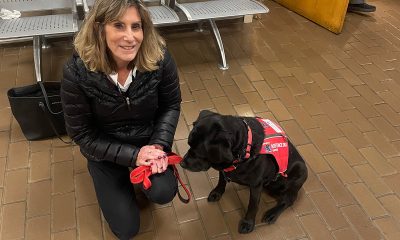
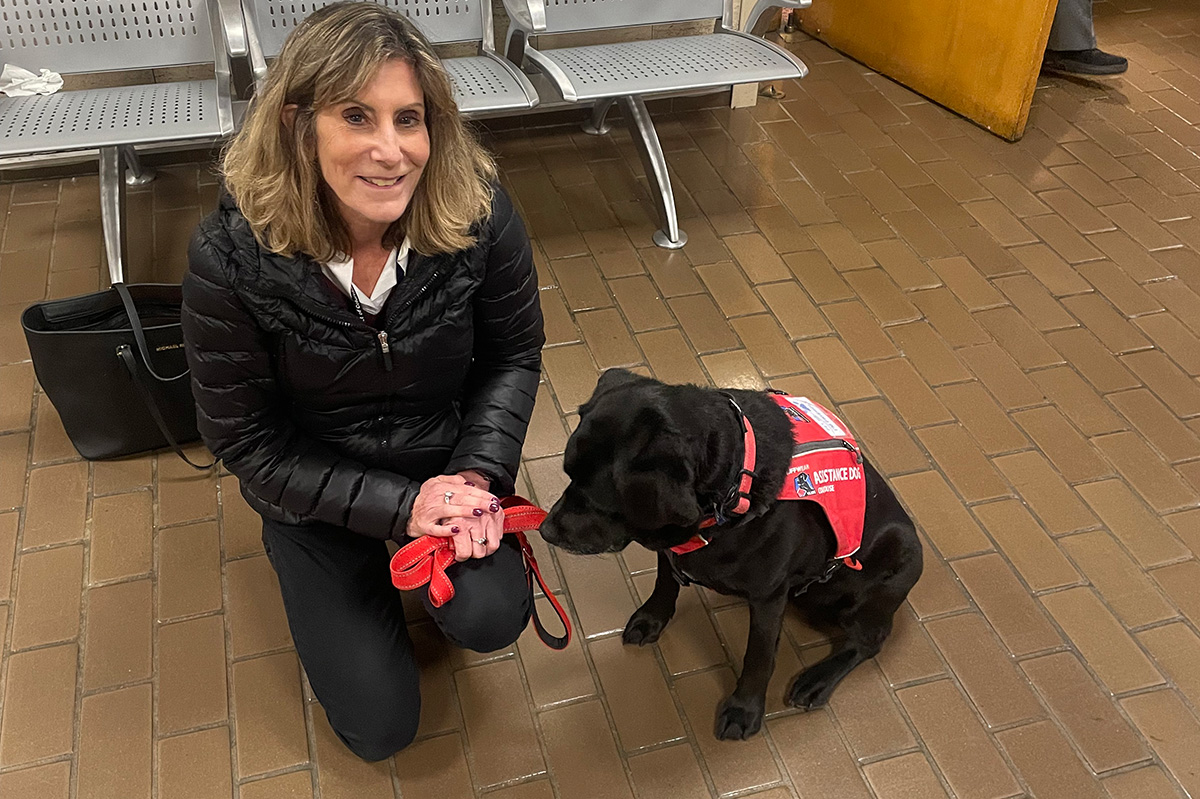
As she heaved and sobbed in the courtroom in November, Kelly had a steady four-legged presence by her side: Pepper the Courthouse Dog, as the black Labrador retriever is known in D.C. Superior Court.
Abby Stavitsky, a former federal prosecutor who now serves as a victims’ advocate, is the owner and handler of nine-year-old Pepper. She says that one of the things that has made Pepper such a great asset in the court in the past six years is the emotional support and comfort she provides to victims.
“She absorbs all of the feelings and the emotions around her, but she’s very good at handling it,” Stavitsky said.
Pepper and Stavitsky started working in Magistrate Judge Mary Grace Rook’s courtroom — and now works in Magistrate Judge Janet Albert’s — to provide support for youth who suffer trauma, especially young survivors of commercial sexual exploitation.
These specially trained dogs offer emotional support to trauma victims of all ages. Courthouse dogs can reduce victims’ and witnesses’ anxiety and stress, making it easier for them to provide clear statements in the courtroom, according to a 2019 report in the Criminal Justice Review.
“Having something to pet and interact with is a distraction that results in victims being calmer when testifying in court,” says Stavitsky. “This gives them an extra level of comfort.”
What brought Stavitsky and Pepper together
Stavitsky, who spent 25 years as an assistant U.S attorney, handled a lot of victim-based crimes, mostly domestic violence and sex offenses. She was also a dog lover, and once she learned about courthouse dogs and their use, she was inspired.
In 2019, Pepper was given to Stavitsky by a Massachusetts-based organization, NEADS, formerly known as the National Education for Assistance Dog Services. Although Pepper was originally trained to be a service dog, evaluators determined her character was best suited for a courthouse dog.
Pepper now works regularly in various treatment court cases involving juveniles, many of whom have experienced trauma or are involved in the child welfare system. She also sits with victims while they are testifying in a trial.
“She loves people, especially children,” Stavitsky said. “She loves that interaction.”
Courthouse dogs have a long history
In courthouses across the U.S. specially trained “facility dogs” are becoming an important part of how the justice system supports vulnerable victims and witnesses.
Since the late 1980s, these dogs were used to help trauma survivors and anxious children during testimonies and interviews. The first dog to make an appearance in a courtroom was Sheba, a German shepherd who assisted child sexual abuse victims in the Queens (N.Y.) District Attorney’s Office. Courthouse dogs help them communicate more clearly, especially in these settings that make them anxious and stressed.
Unlike service dogs, courthouse facility dogs are professionally trained through accredited assistance dog organizations and work daily alongside prosecutors, victim advocates, and forensic interviewers. For example, courthouse dogs can have more social interaction, unlike service dogs.
Courthouse dogs’ growing use has prompted state laws and professional guidelines to recognize the dogs as a trauma-informed tool that helps victims participate in the justice process without compromising courtroom fairness.
As more jurisdictions adopt these programs, courthouse dogs are reshaping how the legal system balances compassion with procedure, ensuring that victims’ voices can be heard in environments that might otherwise silence them.
Pepper makes it easy to see why.
“I really love people, especially kids, and can provide emotional support and comfort during all stages of the court process,” reads the business card Stavitsky hands out with Pepper’s picture. “I’m calm, quiet and can stay in place for several hours.”
(This article was written by a student in the journalism program at Bard High School Early College DC. This work is part of a partnership between the Washington Blade Foundation and Youthcast Media Group, funded through the FY26 Community Development Grant from the Office of D.C. Mayor Muriel Bowser.)
District of Columbia
How new barriers to health care coverage are hitting D.C.
Federally qualified health centers bracing for influx of newly uninsured patients
Washington, D.C. has the second-lowest rate of people who lack health insurance in the country, but many residents are facing new barriers to health care due to provisions of the sweeping federal law passed in July, which threatens access for thousands.
Changes to insurance eligibility and the rising cost of premiums, which kicked in for some in October and others more recently, are expected to leave many more patients uninsured or unable to afford medical care. Federally qualified health centers, including D.C.’s Whitman-Walker Health, where 10 to 12 percent of patients are uninsured, are bracing for an influx of newly uninsured patients while facing their own financial challenges.
Even in D.C., where uninsured rates have been among the lowest in the country, changes brought on by the passage of the Republican mega bill (known as the “Big Beautiful Bill”) will have major effects.
The changes from the bill affect Medicaid, which is free to low-income patients, and subsidies for insurance that people buy on the health insurance exchanges that were started under the Affordable Care Act, which were allowed to expire on Dec. 31.
Erin Loubier, vice president for access and strategic initiatives at Whitman-Walker Health, says some Whitman-Walker Health patients have received notices about premium increases, including several who say the increases are up to 1,000 percent more than they were paying.
“That is like paying rent,” she says. “We live in an expensive city, so any increases are going to be really, really hard on people.”
Whitman-Walker Health and other healthcare providers are expecting the changes to have multiple effects — some patients may not be able to afford coverage or may avoid going to the doctor and allow health conditions to worsen because they can’t afford care, and many more will be seeking care who don’t have insurance.
“I’m worried that we’re going to not just have people who can’t get care, but that they delay care until they’re really sick, and then the care is not as effective because they might have waited too long, and then we may have a less healthy population,” Loubier says.
Loubier says delaying care, and serving more people without insurance has major implications for Whitman-Walker Health and other health centers serving the community.
“There’s going to be a lot of pressure on us to try to find and raise more money, and that’s going to be harder, because I think all organizations who provide health care are going to be facing this,” she says.
The U.S. health care system is the most expensive in the world, and has much higher out-of-pocket costs for individuals. But in other countries like the United Kingdom, Australia, Canada, and many others, health care is much less expensive — or even free.
Even though the U.S. has a high-priced healthcare system, critics say there are still ways to bring down costs by forcing insurance and pharmaceutical companies to absorb more of the costs, rather than transferring the costs to patients.
“In the U.S., they end up trying to cut costs at the person’s level, not at the level of the different corporations or structures that are making a lot of money in healthcare,” said Loubier. “Our system is so complicated and there is probably waste in it, but I don’t think that that cost and waste is at the ‘people’ level. I think it’s higher up at the system level, but that is much, much harder to get people to try to make cuts at that end.”
Ultimately at Whitman-Walker Health, healthcare providers and insurance navigators are planning to help with everyday necessities when it comes to healthcare coverage and striving to provide healthcare in partnership with patients, said Loubier.
“The key here is we’re going to have a lot of people who may lose insurance, and they’re going to rely on places like Whitman-Walker Health and other community health centers, so we have to figure out how we keep providing that care,” she said.
(This article was written by a student in the journalism program at Bard High School Early College DC. This work is part of a partnership between the Washington Blade Foundation and Youthcast Media Group, funded through the FY26 Community Development Grant from the Office of D.C. Mayor Muriel Bowser.)
District of Columbia
Mayor Bowser signs bill requiring insurers to cover PrEP
‘This is a win in the fight against HIV/AIDS’

D.C. Mayor Muriel Bowser on March 20 signed a bill approved by the D.C. Council that requires health insurance companies to cover the costs of HIV prevention or PrEP drugs for D.C. residents at risk for HIV infection.
Like all legislation approved by the Council and signed by the mayor, the bill, called the PrEP D.C. Amendment Act, was sent to Capitol Hill for a required 30-day congressional review period before it takes effect as D.C. law.
Gay D.C. Council member Zachary Parker (D-Ward 5) last year introduced the bill.
Insurance coverage for PrEP drugs has been provided through coverage standards included in the Affordable Care Act, known as Obamacare. But AIDS advocacy organizations have called on states and D.C. to pass their own legislation requiring insurance coverage of PrEP as a safeguard in case federal policies are weakened or removed by the Trump administration, which has already reduced federal funding for HIV/AIDS-related programs.
Like legislation passed by other states, the PrEP D.C. Amendment Act requires insurers to cover all PrEP drugs approved by the U.S. Food and Drug Administration.
Studies have shown that PrEP drugs, which can be taken as pills or by injection just twice a year, are highly effective in preventing HIV infection.
“I think this is a win for our community,” Parker said after the D.C. Council voted unanimously to approve the bill on its first vote on the measure in February. “And this is a win in the fight against HIV/AIDS.”

Surviving spring cleaning

Iconic Eddie Izzard takes on 23 characters in ‘Hamlet’

How Pepper the courthouse dog helps victims of abuse

Women’s FEST returns to Rehoboth Beach next week

Belarusian lawmakers approve bill to crackdown on LGBTQ rights

Trans activists gather on National Mall for Transgender Day of Visibility

Kristi Noem ‘devastated’ as husband’s alleged fetish spending surfaces

D.C.’s affirming congregations to mark Holy Week, Easter

Glisten report details hostile climate for LGBTQ students

Supreme Court ruling against conversion therapy bans could affect Md. law
-

 District of Columbia5 days ago
Trans activists gather on National Mall for Transgender Day of Visibility
-
The White House4 days ago
Kristi Noem ‘devastated’ as husband’s alleged fetish spending surfaces
-
Local4 days ago
D.C.’s affirming congregations to mark Holy Week, Easter
-
Research/Study4 days ago
Glisten report details hostile climate for LGBTQ students