Movies
Jolie delivers diva perfection as ‘Maria’
A fascinating film addressing matters of life and death
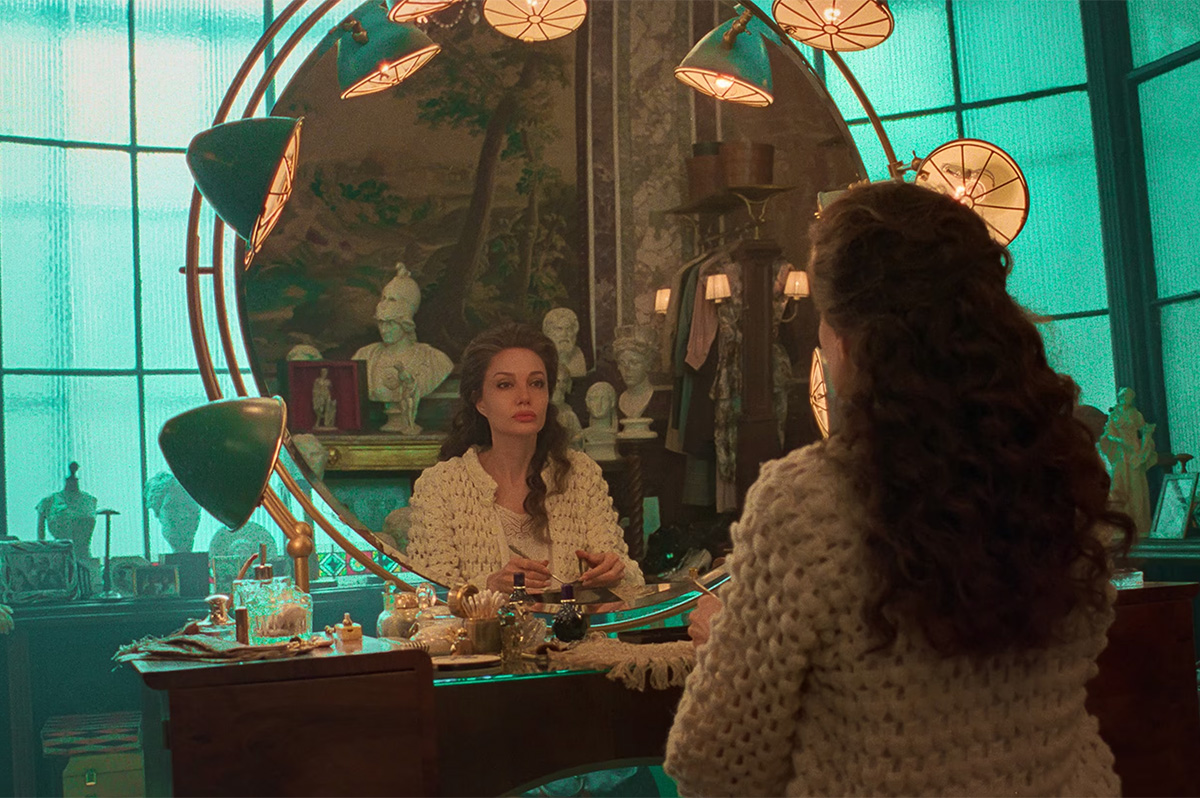
In today’s world, it’s difficult to imagine that an opera singer could achieve the kind of international fame and popularity enjoyed by modern musical artists like Lady Gaga or Taylor Swift, yet that is exactly what Maria Callas did.
Possessed of a singular, inimitable, and often controversial vocal talent, she rose to the height of her profession and became a world-class artist, performing on international stages and moving within a circle that included the wealthiest, most influential and powerful people of her era. Her private life, which included a long-running affair with mega-rich Greek shipping magnate Aristotle Onassis and a reputation for temperament that matched or exceeded expectation for a diva of her stature, was the stuff of gossip columns, and her stature as an artist was such that any scandals that might have arisen there had little impact on her reputation for the millions of fans who adored her.
Even now, nearly 50 years after her untimely death (she was only 53) in 1977, her name is still spoken with reverence among those who belong to the still-potent “cult of personality” that made her an object of near-worship, and even if you’re not an opera fan, a listen to any of the magnificent recordings she left as her legacy is enough to help you understand why. Not only did the woman have a gift for singing, she had a way of inhabiting the music she sang so completely that it seemed to belong solely to her, as if it came fully formed into the world through her own being, no matter how many other great vocalists had sung it before.
Yet the Callas we meet in Pablo Larrain’s “Maria,” a speculative biographical fantasia about the final week in the diva’s tumultuous life that premiered in competition for the prestigious “Golden Lion” award at the 2024 Venice film festival and drops on Netflix Dec. 13 following a limited theatrical release, is but a comparative shadow of that once-renowned formidable persona. Her health failing, her voice diminished, and her mind drifting between morose contemplation of her decline and drug-addled delusions of returning to her former glory, she holds a reclusive and tenuous dominion over her Paris apartment, engaged in a power struggle with her overprotective house servants and stubbornly ignoring doctor’s orders by pushing herself to regain the transcendent voice that had brought her success, fame, and a personal power that had helped her endure the traumas of a childhood in the Axis-occupied Greece of World War II.
That’s just on the surface, however. As rendered by Angelina Jolie in a career-topping performance, the Callas of “Maria” feels fully worthy of the still-imperious demeanor she wields against the world. Far from surrendering to the tragic downward spiral into which she has become entangled, she shines from within with a courageous – which is not the same thing as “fearless” – sense of self that infuses her seemingly desperate efforts to reclaim her former glory (for herself, at least, if not for public approval) and makes her story a tale of self-actualization rather than the tragic “dance with death” it might appear to be through a surface perspective.
After all, in Larrain’s vision (and the exquisitely nuanced screenplay by Steven Knight), Callas is seeking not to recapture her fame and fortune – those are hers for life, already – but to reclaim her voice. As plainly shown by the life told in bold strokes via the flashbacks interwoven throughout the film, music has been the means for Callas to overcome the oppression of men and assert personal power over her own life. From the fascist soldiers to whom she was “pimped out” in her youth by her mother to the coarse-but-doting plutocrats that have attempted to “possess” her in adulthood, she has maintained agency over them all through the gift of her vocal talent. Now, with full knowledge and acceptance that the final chapter of her life is being written, she has chosen to hold the pen firmly in her hand, asserting ownership over her own life by composing the end of its narrative for herself. It’s an unconventional path that she chooses, but how many truly great spirits ever settle for being conventional?
Whether or not she was ultimately victorious in this goal – either in her real life or in Larrain’s imagined rendering of it – might be something viewers have to decide for themselves. It’s hardly the point, however; what “Maria” conveys, more than any definitive truth about its legendary subject, is a suggestion that what matters is the fight, not the winning of it, and that perhaps the “win” is in the fight itself. Beyond that, it finds a metaphor in the diva’s willing descent into hallucinatory fantasy for engaging in a direct relationship with that part of our own nature that feels divine – one which manifests itself in our lives through many forms, be it a character in a centuries-old opera, an imagined collaboration with the long-dead composer who created it, or a fresh-faced TV interviewer (who may or not be real) with a knack for asking the questions you don’t want to answer.
The element that has sparked the most buzz about Larrain’s film, of course, is the work of its star. Jolie, who trained to sing opera for seven months in preparation for the role (though she lip-syncs to recordings of the real Callas in flashbacks of the diva’s career highlights, it is her own voice we hear when she sings in the “present-day” scenes), doubtless brings some of her own experience to the table as a successful woman whose artistic triumphs always seem less important in the public eye than her personal relationships with men.
If so, it works beyond expectation, resulting in an old-school Hollywood star turn that dazzles us with its commitment to finding a human truth behind the veneer of glamour and moves us with the raw, unfiltered emotion she masterfully underplays throughout. Oscar talk is cheap, this early in “Awards Season,” but look for this performance to be a hot contender for a nod, and perhaps even a win.
Yet even if she’s the main attraction, “Maria” boasts plenty of excellence all around, from a superb supporting cast to the luminous cinematography of Edward Lachman, which bathes the movie’s sumptuous interiors in a palette of stained-glass colors to conjure the bittersweet nostalgia for a beautiful world as it slips away into oblivion. Knight’s intelligent script, crafted with the literary eloquence of a play, explores multiple facets of the diva’s life, while using it as a springboard into a meditation on loss, letting go, and embracing our own mortality even as we strive to touch the immortal. Finally, though, it’s Larrain’s direction that ties it all together, crafting a visually gorgeous, palpably intimate film that nevertheless delves deeply into some of the grandest aspects of our existence.
For opera lovers, of course, it’s a must-see. For the rest of us, it’s still a fascinating and deeply affecting film, addressing matters of life and death as vast as the ones that drove the timeless musical masterworks in which Callas made her name.




Movies
Greg Araki still wants your sex
Shrewd, sexy film may be the most fun you’ll have this summer

Greg Araki may not have been solely responsible for the “New Queer Cinema” movement of the 1990s, but he certainly gave it an edge.
From early low-budget groundbreakers like “The Living End” (1992) through his “Teen Apocalypse Trilogy” (1993-97) and beyond, his films have subverted cinematic tropes with queer characters and themes and co-opted them into his own unique brand of filmic storytelling — extreme, campy, and transgressive – in which his queer characters were usually framed as sexual outlaws, flawed and anti-heroic outsiders who disregard not only sexual conventions, but often the law and the social order itself.
In subsequent decades, he’s continued to bring that same fiercely counter-cultural swagger to a surprisingly diverse array of projects, from the melancholy and critically acclaimed “Mysterious Skin” (2004) to the first-ever Cannes Queer Palm winner “Kaboom” (2010). And though it’s been 12 years since his last feature film release (“White Bird in a Blizzard”), he’s brought his twisted talents under the radar to helm episodes of popular TV shows like “13 Reasons Why,” “Riverdale,” and “Monster: The Jeffrey Dahmer Story.”
Now, he’s back to the big screen with “I Want Your Sex,” a new erotic comedy-thriller that proves he hasn’t lost that edge. In fact, he may have honed it to a sharpness that cuts deeper than ever — and he’s aimed it not only at the moralistic posturing of mainstream attitudes around carnality, but at the thinly veiled high end consumerism that drives the world of avant-garde art.
Structured with a nod to “Sunset Boulevard” – it begins with a shocking “face down in a swimming pool” moment that is then explained in flashback – and flavored with the kind of sexual anarchy that rarely manages to penetrate the cultural mainstream, it’s the quintessentially “L.A.” story of Elliot (Cooper Hoffman), a perennially down on his luck 23-year-old would-be podcaster who manages to land a job as an assistant to multi-media artist Erika Tracy (Olivia Wilde), known as much for her domineering personality as for her highly sexualized (and deliberately provocative) work. At first, he is just one of a small army of fellow assistants tasked with helping prepare for an exhibition of new work at her gallery, which ranges from writing emails and scheduling interviews to chewing gum for a conceptual artwork depicting her vagina; but something about him catches her eye, and he soon finds himself taking on the additional duty of being her sexual plaything.
It’s strictly a business arrangement, of course, and all under cover of an NDA he signed before ever being hired; she needs the sexual outlet to keep her focused on her work, and he – thanks to his unsatisfying relationship with disinterested girlfriend Minerva (Charlie XCX) and his desire to finally pay his share of rent for the apartment he shares with BFF Apple (Chase Sui Wonders) – is happy to be of service. At first, it all feels like a dream come true, as he crosses his own boundaries to become enmeshed in a Dom/sub dynamic with an older woman on whom he’s long had a crush; she’s the Dom, of course, and he soon discovers he has more than just a mild taste for being submissive. But as things progress, he begins to “catch” the feelings he was never allowed to have, while Erika’s manipulation and humiliation of him starts to cross lines that threaten to undermine his tenuous sexual liberation, simultaneously eroding the comfortable relationships that have kept him feeling grounded, if perennially dIsappointed, up until now. Needless to say, things get progressively twisted, and Elliott finds himself ever more haplessly exploited as the story winds back to that “swimming pool moment” with all the inevitability of a train wreck experienced in irresistibly delicious slow motion.
Yes, it’s all deliberately “shocking” in the sense that it takes us places – both sexually and psychosexually – that a lot of audiences might never have thought they’d be expected to go. There’s plenty of nudity, the kinky sex is “explicit” in the sense that we have no doubt about the physical logistics of what’s happening even if we don’t see it, and the overall sense of “ethics” is pretty much “who cares?” In today’s world of “purity politics,” that might actually be the most transgressive thing of all about Araki’s film.
It’s not all just thumb to the nose at 21st century morality, however; nor is it merely a chance to undermine our faith in concepts like “consent” or suggest that inappropriate sexual dynamics in the workplace are anything other than toxic. Erika is most definitely a kind of beautiful monster – all the more because her angle, from the beginning, is all about increasing the value of her “brand” – but to frame her as a villain is missing a crucial point in what is essentially, despite its coy pretense at being a thriller, a coming-of-age story wrapped in a dark and de-romanticized rom-com.
Central to Araki’s story is the oft-cited observation that Gen Z people, having come of age in a time of social isolation in which private indiscretion can frequently lead to public shame, are afraid of sex. Elliot himself discusses this generational trope, yet he exposes himself to betrayal and humiliation anyway – and while that choice may take him down a rocky road, it also takes him on the journey of sexual self-discovery that he’s always wanted to have. Erika facilitates this, however unethically she may go about it, and even makes some discoveries about herself along the way; and despite the fact the journey ends up with police interrogations, tabloid scandal, and reversals of fortune not even she can see coming, the sex itself is never really to blame. After all, it’s only sex.
Maybe that’s the main point of “I Want Your Sex,” if there is one: all the stigma, all the prudish judgments and standards of moral “decency” become absurd in the face of the act itself, which – for most humans, at least – only comes naturally and, when stripped of unnecessary shame, can be a joyful experience, no matter how “kinky” it gets.
In fact, it’s not so much the sexual “deviance” or betrayals that Araki positions as the driving force in his movie, but the pretensions of a commercialized art world in which notoriety, controversy, and even tragedy can boost fame and fortune overnight – something that savvy artists, like Erika (and perhaps Araki himself) understand and exploit without qualm. One can make judgments about that, too, but in the end, isn’t that just part of how capitalism works?
In any case, “I Want Your Sex” doesn’t make judgments about any of it, just observations – with wit, slyness, and a refreshingly sex-positive attitude. Wilde and Hoffman deliver superb performances, as does the entire cast – which, apart from others previously mentioned, includes Mason Gooding as Elliot’s super-gay co-worker, Daveed Diggs as Erika’s haughty business manager, and Margaret Cho and Johnny Knoxville in admirably deadpan roles as a pair of police detectives. Shrewd, sexy, and all in good fun, it might well be the most fun you’ll have at the movies this summer.
Movies
‘Heartstopper Forever’ delivers satisfying conclusion
Beloved queer phenomenon shows us hope can belong to everyone

When I wrote my review of the first season of “Heartstopper,” I said that if the series could only be summed up in one word, it would be “adorable.”
After an additional two seasons and a movie length series finale (which began streaming on Netflix July 17), I’m going to make up a new rule and say that I can choose a second word to close things out. By the time I reach the end of my review of “Heartstopper Forever,” in which our adorable Nick and Charlie must face the possibility that their tender young romance may not be able to survive their graduation to college, I hope I’ll have figured which word it would be.
Directed by Wash Westmoreland and written (as always) by Alice Oseman, artist and creator behind the YA webcomic/graphic novel that launched the whole “Heartstopper” phenomenon, this final installment finds a very different Nick and Charlie than we met in those early episodes – yet in many ways they’re still very much the same. Far from the timid and bullied queer lad of the first season, Charlie (Joe Locke) is now boldly out and confident enough to win the election for “head boy” in his final year at school, and Nick (Kit Connor) no longer struggles with being open about his bisexuality; yet as the stress of their impending separation – each to a different college in a different city – begins to become more urgent, both of them fall back on old patterns.
To those of us who have been around long enough to re-examine such a crisis with 20/20 hindsight, that’s bound to strike chords of recognition. To the younger “Heartstopper” fans, however, it’s likely to feel like high drama – exactly as it did for us when we were going through it ourselves. It’s not just Nick and Charlie, either; other characters, like transgender prodigy Elle (Yasmin Finney) and her cis-het boyfriend Tao (William Gao), must also come to terms with the changing dynamics of their relationships. The result is multiple mirrors through which queer teens can see their own experience reflected, which has always been the appeal of “Heartstopper” in the first place. And as it has from the beginning, Oseman’s intent to provide her teen audience with positive perspectives shines through, ensuring that the story’s final chapter lands in a place where hope can belong to everyone.
That doesn’t mean it doesn’t have its share of dark moments – it wouldn’t be “Heartstopper” if it didn’t, would it? Part of the show’s value for its fans, young and old alike, has always come through its various characters’ growing pains; their missteps and misjudgments, their confused emotions, their fumbling efforts at “first times,” their struggles toward self-esteem. All these and more have provided the necessary “weight” to counter the show’s bubbly optimism and keep it from becoming as insubstantial as spun sugar. More importantly, these issues have always been the real core of the story: We love the sweetness of the romance, but the deeper satisfaction comes from watching these young people navigate all their challenges, sometimes alone but more often together, and build a community through the shared experience of working through them.
The final installment, having brought Charlie, Nick, and all the rest to the cusp of young adulthood, brings a suitably more mature level of problems into the mix. Sure, Charlie has grown into the hero he once needed himself, but the uncertainty that emerges between himself and Nick as they ponder their impending separation is enough to spark a relapse of his eating disorder; likewise, Nick may be confident and unguarded about his sexuality and openly proud of being Charlie’s boyfriend, but that doesn’t stop him from slipping back into self-doubt (and bad behavior) when he contemplates the possibility that their love story might be coming to an end. We know they have the “tools” to get back on track, but with everything so up in the air, will they be able to remember how to use them?
So, too, throughout the series, we have seen these kids come to terms with their individual queerness, navigating those personal journeys and learning how to embrace who they are in an environment where, for the most part, they get a lot of support. At the same time, there have been shadows around the edges, encounters and circumstances that remind them (and us) that, outside the protective circle provided by their school and each other, bigotry still exists. In “Heartstopper Forever,” those reminders are still there, and they feel all the more ominous – not just because of the worldwide rise in anti-LGBTQ+ sentiment, though that’s tied to it, but because these bright young things will soon be moving into a larger world where safety and shelter from the hate is not quite so certain.
Still, it’s Nick and Charlie’s story above all else, and naturally the main focus of this finale is on them. There has always been a too-good-to-be-true perfection to their romance, but Locke and Connor are so good at bringing it to life we believe it; here, fittingly for a final chapter, these boys finally face the crossroad that comes with adulthood – the recognition that, one way or another, there will be an ending to their relationship. How they handle that, we won’t spoil; once again, though, this is “Heartstopper,” one can feel sure that Oseman’s characters will work their way through it in the most imperfectly perfect – and emotionally satisfying – way possible.
Deserving of mention: characters like Isaac (Tobie Donovan), Imogen (Rhea Norwood), and Charlie’s sister Tori (Jenny Walser) return to get their fair share of the spotlight, and gay teachers Mr. Ajayi (Fisayo Akinade) and Mr. Farouk (Nima Taleghani) get the chance for a new beginning of their own; and out UK acting legend Derek Jacobi (“I, Claudius”) appears alongside real-life partner Richard Clifford as an elderly couple in a quiet but important scene at the cafe where Charlie works.
With any “franchise” as popular as “Heartstopper,” the task of bringing closure to a story that has emotionally involved so many fans is almost always a thankless one (just ask George Lucas), so there are sure to be some who have objections to the way Oseman brings her beloved story to an end; but it’s her story to end, and in choosing to uphold its sensational (yet sentimental) imagining of the world as it could be, “Heartstopper Forever” doubles down on the idea that we can make it the way that it should be.
That’s why my choice for the second word we can use to sum up “Heartstopper” is “aspirational.” In the relative innocence and un-ironic preciousness of Nick and Charlie’s enduring love story, we can find no excuses; not all of us can keep our first love alive for an entire lifetime (nor, often, should we), but maybe we can learn to follow our hearts as surely and openly as they do.
That’s about as aspirational as any of us can hope to be – but don’t worry: it’s still adorable, too.
Movies
‘Into the Grey’ unites Cavill, Gyllenhaal for thrills and gay love
Did studio sabotage film’s release because of queer plot?
What if they released the LGBTQ-themed action movie we’ve all been waiting for and they didn’t bother to tell us?
It’s a rhetorical question, really, because we already know the answer, and it can be found between the lines in the distribution-and-release history of “In the Grey,” a typically slick and cynical “caper thriller” from veteran filmmaker (and former Madonna husband) Guy Ritchie, which is now available on VOD platforms after a perfunctory theatrical opening in May.
Like almost all of Ritchie’s films, it’s fast-paced, clever, and full of surprises, some of which have to do with the plot, but most of all involve its characters – who, also in the tradition of Ritchie’s former work, inhabit a rarified world in which confidence, bravado, and stoic humor define the moral environment while something else (call it “fate” or “karma” or simply “the consequence of choices”) works behind the scenes to deliver a conclusion that satisfies our jaded sense of justice even as it fairly drips with irony. Also like most of Ritchie’s films, it succeeds in sucking us into its plotting while drawing a clear line between the “good guys” (i.e. the ones who are ostensibly working toward an equitable outcome, if not a moral high ground) and the out-of-balance despotism of a weighted power hierarchy that defines the shadowy status quo of human endeavor.
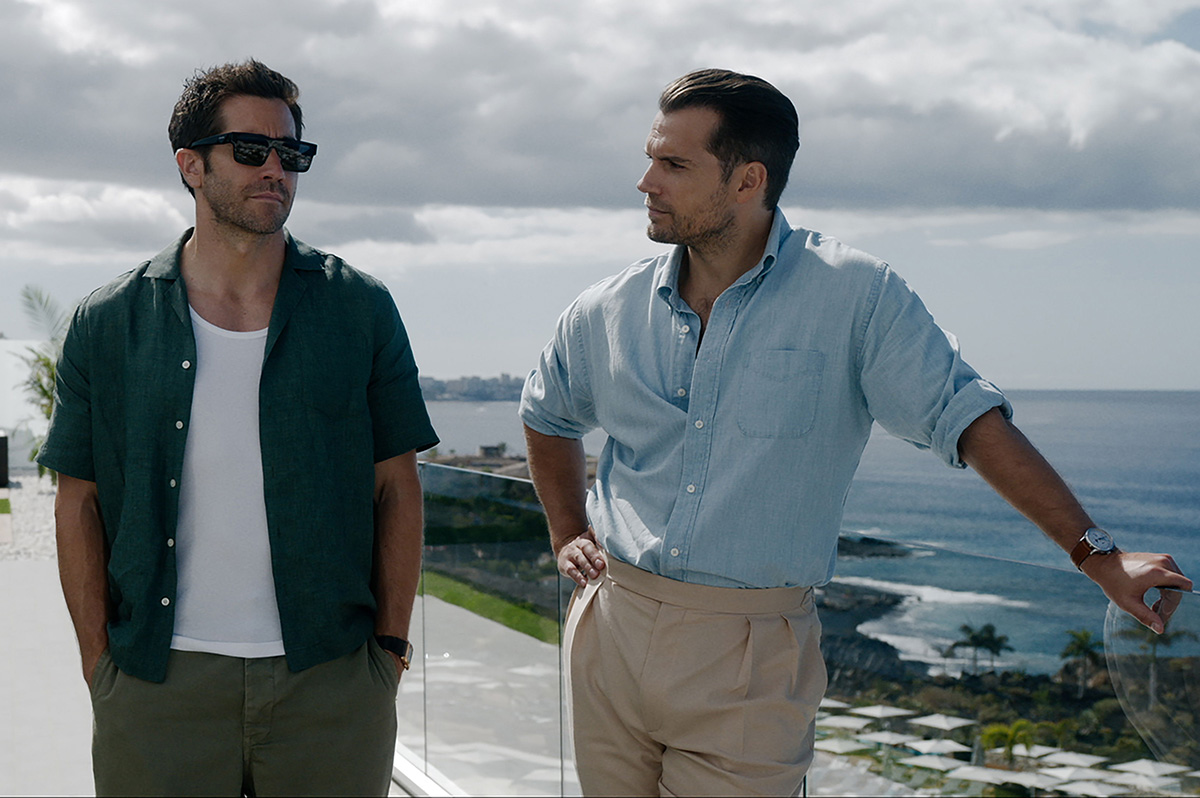
The caper in question is being run by Rachel Wild (Eiza Gonzalez), an elite lawyer who specializes in retrieving funds owed to high-finance “asset management” firms by wealthy clients, whose latest case puts her into a showdown with ruthless crime boss Manny Salazar (Carlos Bardem) over a billion-dollar debt. She’s elite for a reason, though; she’s backed up by her own small militia of “fixers” headed by trusted “extralegal” operatives Bronco and Sid (Jake Gyllenhaal and Henry Cavill, respectively), who are more than capable of carrying out her plans and have no intention of allowing Salazar to gain the upper hand. The plan involves blocking and handicapping his operations until he is forced to return the money; but when their powerful quarry decides to make things personal by going after Rachel in retaliation, it’s up to her loyal protectors (and their highly skilled team) to keep her safe.
Crafted by Ritchie with his usual blend of intricate plotting, jocular amorality, and shocking violence, it’s also a movie that fairly oozes testosterone; yes, there’s a smart and powerful woman at the center of it all, but she’s got as much (or more) macho swagger as anybody else so the effect is just the same. In fact, there’s a lot of hyper-masculine posturing, attitude, and tough talk that goes on all around, most of it delivered with that jocularity we mentioned. Action, naturally, is key to the formula, and “In the Grey” ramps it up to near orgiastic levels with an escalating collection of high-octane set pieces – chases, gunfights, explosions, zip-lining – all carefully spelled out ahead of time for us, point for point, in expository detail so that we can keep up with them as they unfold. It’s a movie about planning and strategy as much as anything else, and it wants to make sure we’re all prepped and ready for “go time.”
As for feelings, in a film like this, you might just think they don’t matter and leave it at that – but that’s not entirely true. Almost hidden in the middle of all this morally murky bluster and bravado is an unexpected angle, and it lends a touch of tenderness to the whole thing that somehow ends up being essential.
The movie takes pains to create a slow reveal, so it feels like a spoiler (consider this your warning) to say it, but underneath all the non-stop action there’s a love story going on, and it’s between the two leading men. We’re not sure at first, though the jovial banter between Cavill and Gyllenhaal has a distinct “romcom” vibe from the beginning, but as the movie goes on it gradually becomes clear that they are, in fact, a couple.
Perhaps not surprisingly, there was no mention of the nature of their relationship in any of the film’s publicity; the studio (Lionsgate) delayed release for months and eventually gave up distribution rights to Black Bear International. When it hit theaters, it finished ninth at the box office; even the popularity of its two stars was not enough to make up for the lack of push that accompanied its release. Does all of this suggest that the studio scuttled their own movie just because of the “gay angle” and the reaction it might get in today’s environment? It’s hard not to speculate on that possibility, but either way, those two characters are gay.
Does it matter to the plot? Not really; there’s no lovestruck romance here – these guys have obviously been together a long time, and they carry the comfortable familiarity to prove it – nor is there even a kiss. It’s just a layer to their characters, a nuance that offers a glimpse of relatable, everyday humanity in a plot where almost everything else is bombast. Importantly, it also raises the stakes for the audience; knowing they are together gives us a reason to root for them beyond simple “good guy/bad guy” dynamic (which is complicated in a movie where both sides are trying to gun each other down mercilessly), and while we might not be so invested in the film’s overarching plot – do we really care if a venture capital corporation gets its money back from the murderous gangster they lent it to in the first place? – we can at least hope that these two handsome mercenaries will be able to go home to their cats together at the end.
As for the acting, this is not a film that demands anything more subtle than broad strokes from its players, but Cavill and Gyllenhaal, given such rich possibilities for subtext in their otherwise formulaic dialogue, clearly play it up with enthusiasm; they also convey that all-important tenderness – especially Gyllenhaal, who stirs an occasional echo of his “Brokeback Mountain” performance from two decades back. The rest of the cast – with the exception of Fisher Stevens as Salazar’s long-suffering lawyer, and Rosamund Pike as Rachel’s treacherous client – mostly play stock characters, familiar, predictable, and not too deep, but they do it well enough.
All that said, and with or without the gay couple in the middle of it, “In the Grey” is not a very remarkable movie. It’s more clever than smart, and while it benefits from Ritchie’s signature fast-paced, edgy style it sometimes feels repetitive – it’s nothing we haven’t seen before, and even if the setting within the corrupt world of the financial elite might strike a note for some viewers today, it never gets political enough to stir up any kind of fervor.
Cavill and Gyllenhaal, however, are good enough together to make it worth a watch – so why not? After all, brains (and eyes) like candy once in a while, too.

HRC condemns DoE removal of LGBTQ bullying data from federal survey

Dutch PM: More needs to be done to defend trans rights

HRC files class action over federal ban on gender-affirming care coverage

Perez Hilton’s live breakdown reveals social media mental health crisis

Mr. Henry’s to host 60th anniversary party

Madonna headlines World Pride Music Festival in Amsterdam

PHOTOS: Petal Release Party

My evening with Madonna

Remembering Elliot Leonard, generous visionary who helped LGBTQ communities thrive