News
Manny Pacquiao compares marriage to ‘sex between animals’
Boxer is running for the Philippines Senate

Philippine boxer Manny Pacquiao on Feb. 15, 2016, described marriage rights for same-sex couples as worse than “sex between animals.” (Photo by inboundpass; courtesy Wikimedia Commons)
Manny Pacquiao on Sunday compared marriage rights to same-sex couples to “sex between animals.”
“Same-sex marriage is more disgusting than (sex) between animals,” said the Philippine boxer during an interview with the website Bilang Pilipino.
Pacquiao, who is a member of the United Nationalist Alliance, is running for a seat in the Philippines Senate in national elections that are scheduled to take place on May 9. He has represented the province of Sarangani in the Philippines House of Representatives since 2010.
Jonas Bagas of TFL Sexuality, a Philippine advocacy group, blasted Pacquiao over his comments.
“Manny Pacquiao’s reprehensible attitude towards LGBTs and marriage equality shows an appalling lack of understanding of human dignity,” Bagas told the Washington Blade. “He’s not just a popular sports icon, he is also a legislator and a candidate for higher office in the Philippines.”
“His willingness to strip LGBTs of humanity shows he’s not fit for public service,” he added.
Dindi Tan, a member of the Quezon City Pride Council board of directors, posted a lengthy response to Pacquiao’s comments onto her Facebook page. The post contained the headline “Day of Infamy for Manny Pacquiao.”
“Today will go down in history as that day when you dropped the bomb against your fellow Filipinos — the Philippine LGBT community,” wrote Tan.
Boxer previously said he is ‘not against’ gay people
Pacquiao in 2012 criticized President Obama’s support of marriage rights for same-sex couples during an interview with the Examiner.
The article appeared to show him using a passage from the Book of Leviticus that calls for the death of men who engage in same-sex sexual relations. The Grove, a popular Los Angeles shopping mall, banned Pacquiao after the website published the interview.
Pacquiao reaffirmed his opposition to marriage rights for same-sex couples to the Associated Press, but he stressed he is “not against the gay people.”
The boxer noted to the Associated Press that his cousin and other relatives are gay. The Examiner later clarified that Pacquiao did not refer to Leviticus during its interview with him.
Bagas told the Blade in response to Pacquiao’s latest comments that the boxer should no longer receive endorsements from Nike and other brands.
The Blade has reached out to Pacquiao and Nike for comment.
Activist: Pacquiao is a ‘bigot’
The Philippines national elections will take place roughly six months after a court found a U.S. Marine guilty of killing Jennifer Laude, a transgender woman, in an Olongapo City motel room in 2014.
Laude’s death sparked widespread outrage among Philippine advocates who continue to urge the country’s lawmakers to approve an LGBT-inclusive anti-discrimination measure that has languished for more than a decade. The case also highlighted opposition to the U.S. military presence in the Philippines.
“Its time for the ‘pink vote’ to judge your rightful place in history,” wrote Tan on her Facebook page. “Let us unite to campaign against this bigot. Mr. Manny Pacquiao you may win the Senate but we will make sure that you will also go down in history as one of the most-celebrated cowards of our time.”
Pacquiao on Tuesday apologized for his comments in a video he posted to his Twitter page.
I'm sorry for hurting people by comparing homosexuals to animals. Please forgive me for those I've hurt. God Bless! pic.twitter.com/bqjRcWqp8R
— Manny Pacquiao (@mannypacquiao) February 16, 2016



District of Columbia
Over 2,000 turn out for Hands Around the Kennedy Center protest
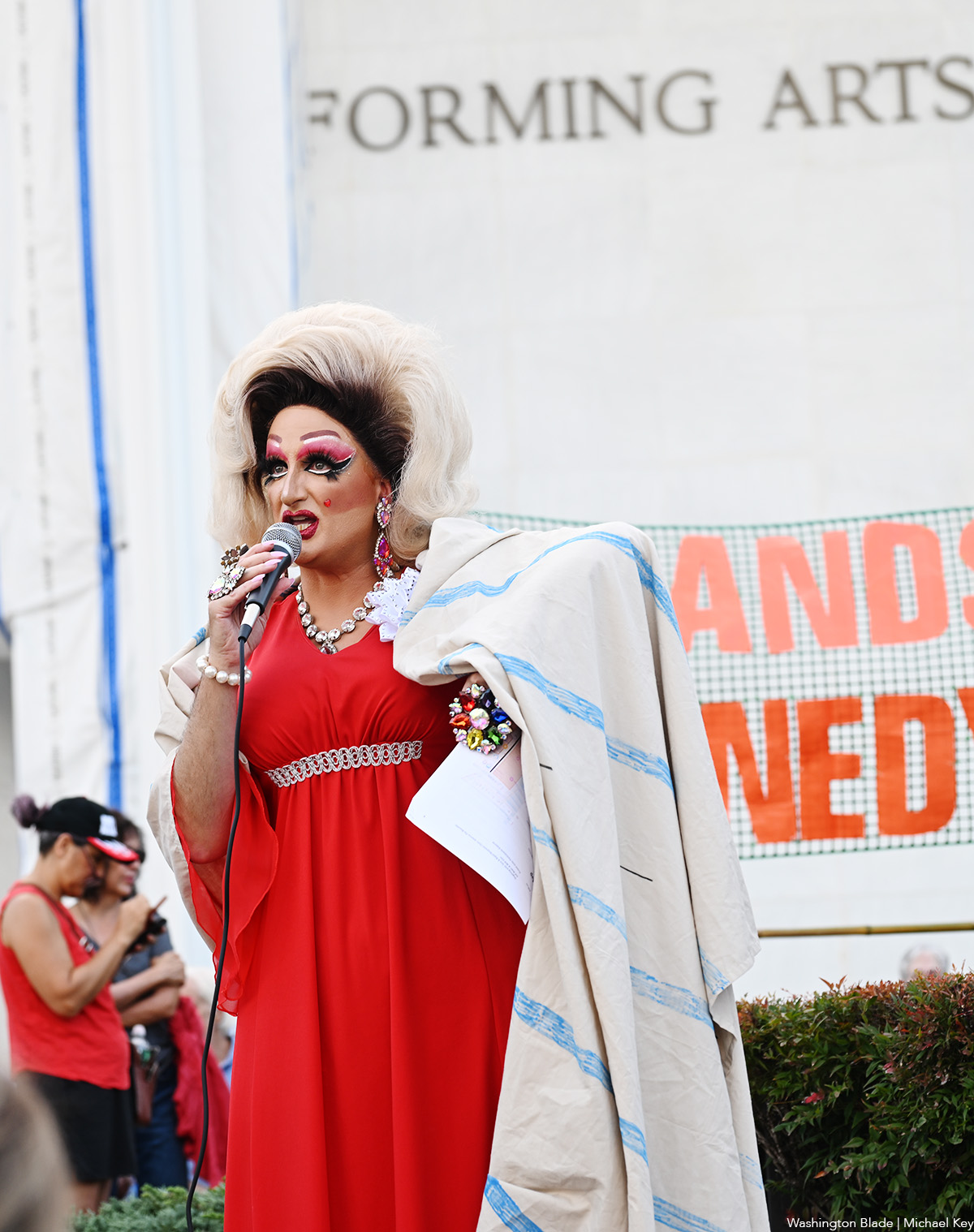
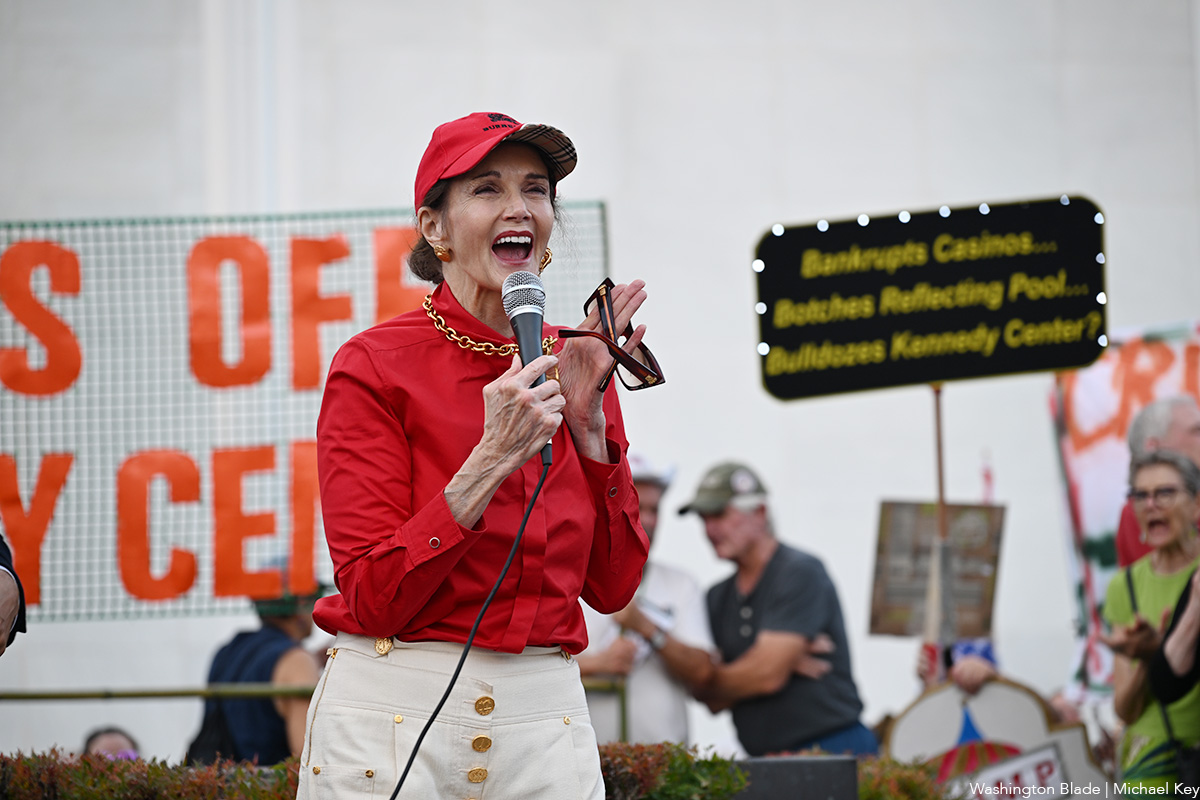
Drag performer Tara Hoot serves as MC, Gay Men’s Chorus of DC performs, attendees shout for Trump to keep ‘hands off’ Kennedy Center
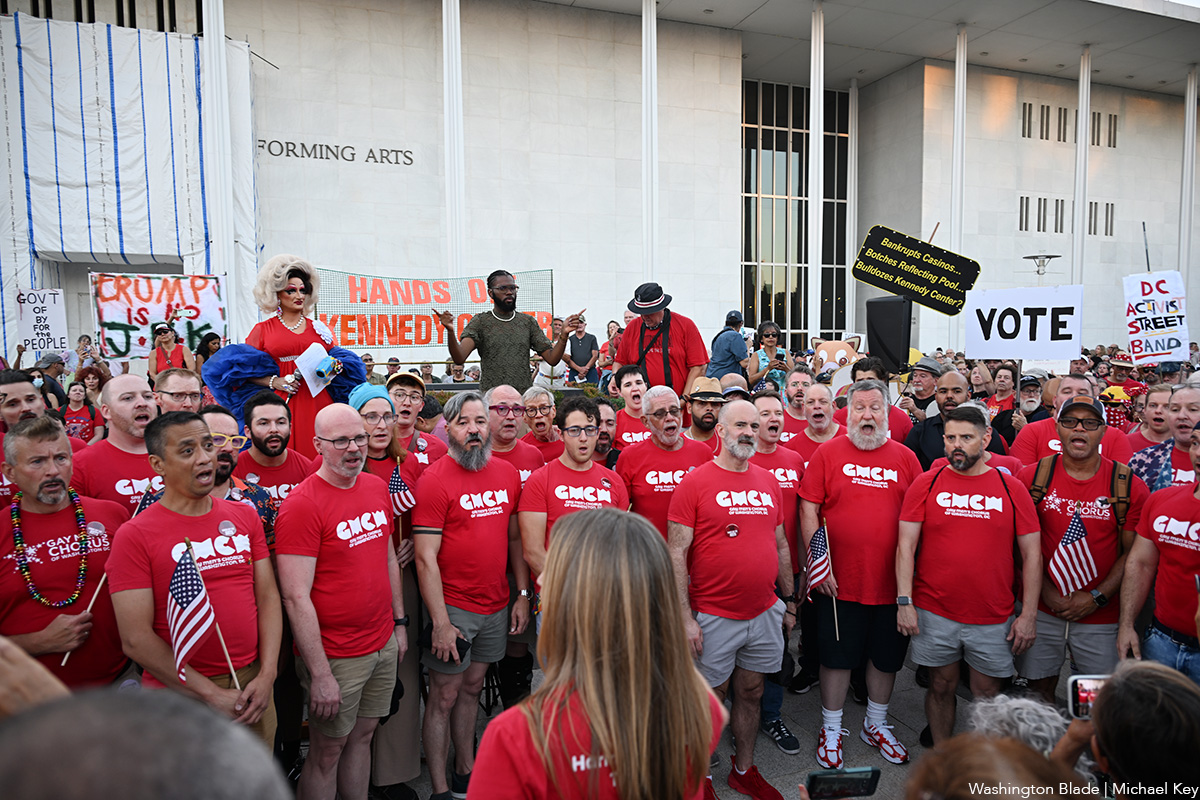
More than 2,000 supporters of the John F. Kennedy Center for the Performing Arts turned out on Sept. 18, for a rally in support of the performing arts center and a vocal protest against President Donald Trump’s threats to permanently close the center and possibly demolish it.
The event was organized by a group called Hands Off the Arts, which initially called for participants to form a “human chain” around the Kennedy Center’s main building following a rally on the plaza in front of the building.
However, due to a decision by the Trump-controlled Kennedy Center’s board of trustees to close the center earlier in the week and install fencing around part of the building, participants could only form the chain around part of the building, according to organizers.
Drag performer Tara Hoot, who co-organized the event and served as master of ceremonies for the rally preceding the “human chain,” said the large turnout could have fully surrounded the building at least twice had the fencing not prevented a full encirclement.
Among the musicians and singing groups that performed at the rally was the Gay Men’s Chorus of Washington, which, like other rally performers, had performed at the Kennedy Center in past years. They drew loud applause after singing one of their favorite songs from the Broadway musical show Ragtime, which includes the lyrics, “Will justice be demanded by 10 million men? Make them hear you. When they hear you, I’ll be near you again.”
View on Threads
Prior to their performance, Gay Men’s Chorus of Washington’s artistic director, Thea Kano, spoke at the rally, reminding participants that shortly after the Trump takeover of the center last year, Kennedy Center officials cancelled a concert the chorus was scheduled to perform there for World Pride 2025.
A Kennedy Center spokesperson said the cancellation was due to a scheduling conflict, but chorus members and LGBTQ activists believe it resulted from policies put in place by Trump and his leadership team at the Kennedy Center following Trump’s statements that he would end controversial “woke” performances that he claimed the majority of Americans disapprove of.
“Now this building sits empty in silence,” Kano told the crowd at the rally. “Let us raise our voices together and bring back the Kennedy Center as it was intended, a place where American culture could be celebrated and elevated, embracing the vibrancy with the spectrum of identify without censure and without politics,” she said.
Among the others who spoke at the rally were U.S. Rep. Don Beyer (D-Va.), U.S. Rep. Jonathan Jackson (D-Ill.), and D.C. Councilmember Robert White (D-At-Large).
Most speakers, along with LGBTQ participants in the hands-around-the-building event expressed strong opposition to Trump’s demand that the Kennedy Center name be changed from the John F. Kennedy Center for the Performing Arts to the Donald J. Trump and the John F. Kennedy Center for the Performing Arts.
At Trump’s request, his appointed board initially made that name change and placed Trump’s name on the front wall of the building along with the Kennedy name. But following legal action taken by opponents who pointed out that Congress must approve such a name change, a judge ordered the removal of Trump’s name from the building. Trump has said he will take steps to reverse that order and has said he will stop plans to renovate the Kennedy Center building and possibly demolish it if his name is not restored in the Kennedy’s Center’s official name.
Throughout the Sept. 18 rally, LGBTQ participants repeatedly responded to the Trump threats by shouting, “Hands Off!”
Chris Raleigh, one of the founders of Hands Off the Arts and a lead organizer of the Sept. 18 event at the Kennedy Center who spoke at the event told the Washington Blade that more similar events are being planned and he welcomes the support the event has received from the LGBTQ community.
“The LGBTQ community was here first, and we’re following them,” he said. “They’ve been the spearhead; they’ve been the vanguard. And I’m so thankful for heroes like Tara Hoot,” he said, adding, “It’s because they know what it means and how this is a safe place – the theater – for many LGBTQ people.”
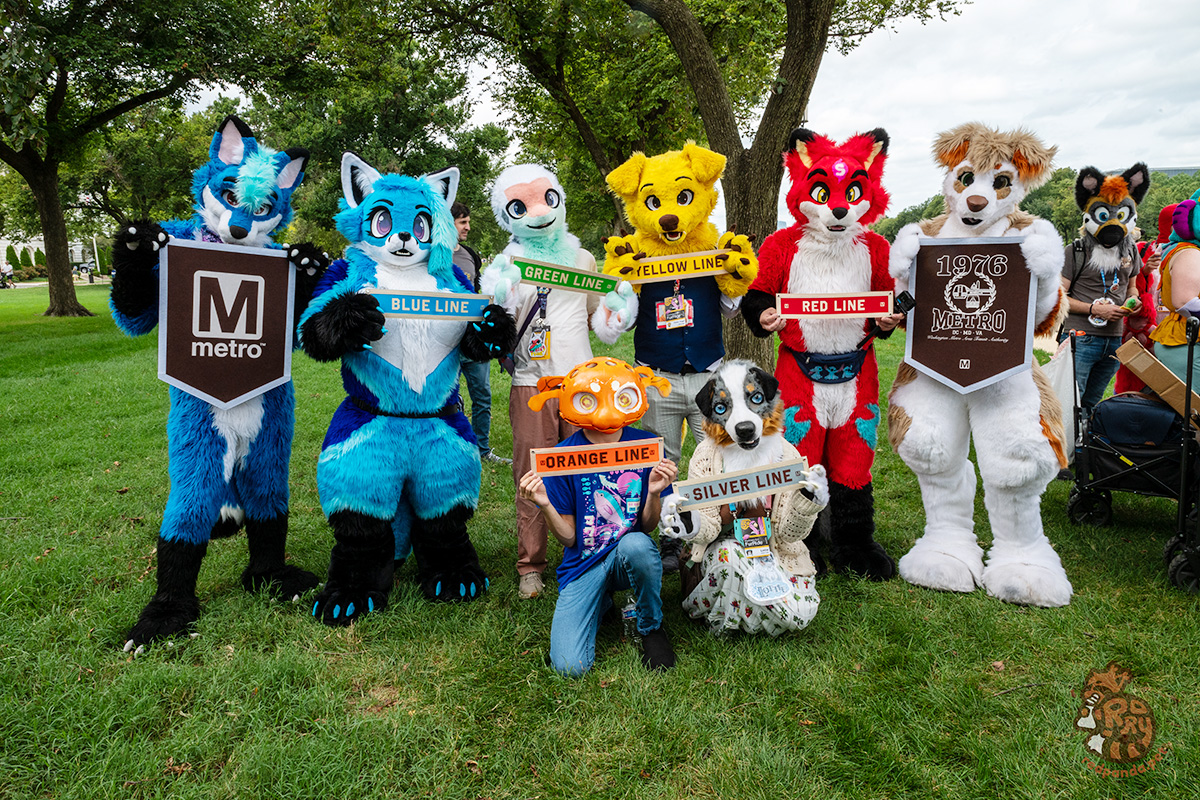
The DMV’s own furry group was on full display on the Metro on Sept. 12.
Shutterpaws is a volunteer-led 501(c)(3) non-profit organization located in Maryland.
The furry group has been doing the FurRide event since 2024 and has blown up in popularity for furries around DMV. They showcased themselves on the Silver and Blue Lines near the Smithsonian on Sept. 12.
“A lot of careful planning goes into running these events, with the goal being a seamless and enjoyable experience for everyone who attends,” says Zayre, a Shutterpaws staff member. “There’s a lot that you learn just by trial and error, and as Shutterpaws hosts more and more events, our team of event organizers continues to learn and refine our approach to keep things running smoothly and finding new ways to engage with our community.”
With a larger growth of participation in the community comes many challenges with the group, especially when it comes to the Metro rides and organizing.
“The biggest challenge that we face as organizers is keeping things fresh and finding new and engaging venues to host events,” says Zayre. “Recently we saw a lot of success hosting a meet at On Target Battlezone, an indoor NERF gun battle arena where our crew was welcome to show up and play both with and without a fur suit.”
Nevertheless, Shutterpaws receive overwhelming support from the community and partners.
“Across the DMV there are so many amazing places to host a Shutterpaws event so we can pursue our mission of helping connect fur suiters and photographers, and we’re blown away with the amount of support we’ve received from our community partners,” says Zayre.
Shutterpaws plans to do more events for anyone in the DMV who is interested.
Their next event in collaboration with DC Fur Meet will take place at Pitchers (2317 18th St., N.W.) on Saturday. Visit Shutterpaws’ website for more information.
Turkey
Activists protest outside Turkish Embassy in D.C.
Dozens detained during anti-LGBTQ ‘My Family Is Safe’ campaign raids
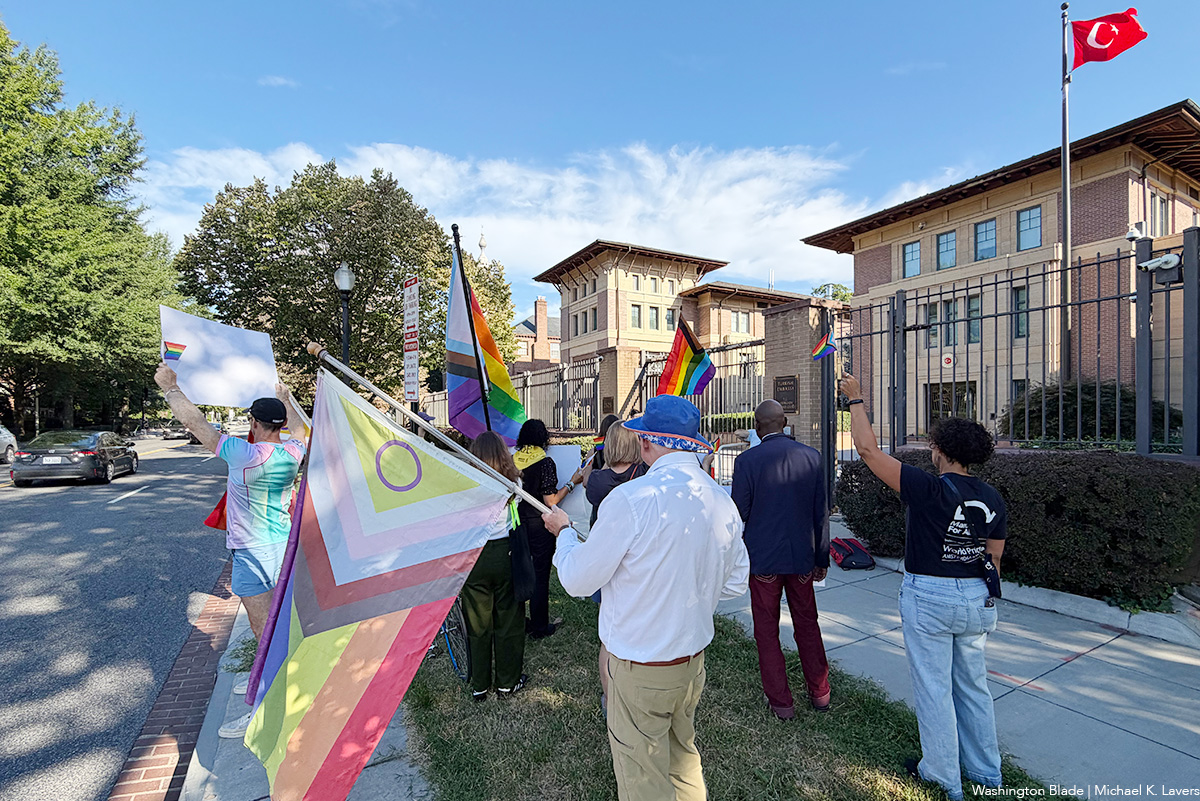
A group of activists on Friday gathered in front of the Turkish Embassy in D.C. to protest the country’s anti-LGBTQ crackdown.
The protest — which the Council for Global Equality, Amnesty International USA, Outright International, and Health GAP organized — took place less than a week after Turkish authorities detained dozens of people during raids that targeted the country’s LGBTQ community and advocacy groups and HIV/AIDS service organizations.
Authorities in Istanbul on Sept. 15 detained more than 150 people who gathered outside a courthouse to protest the raids that are part of the government’s “My Family Is Safe” campaign. Journalists are among those who were taken into custody.
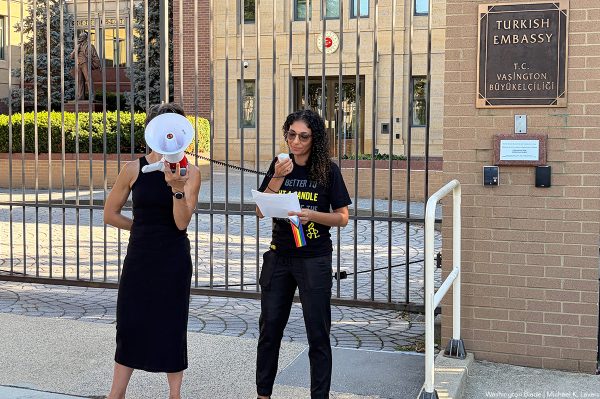
“This crackdown is not making families safer,” said Amnesty International USA Executive Director Nadia Daar, speaking in front of the Turkish Embassy.
Council for Global Equality Managing Director Keifer Buckingham stressed that “homosexuality is not a crime in Turkey.” Health GAP Executive Director Asia Russell and Outright International Senior Director of Law, Policy, and Research Neela Ghoshal also spoke.
View on Threads
Activists in Madrid and in other cities around the world held similar protests on Friday.

PHOTOS: Walk and 5K to End HIV

PHOTOS: Wanda Alston Foundation Fall Reception

Moving presents a chance to ‘clean house’

EV ecstacy: BMW iX3, Rivian R2

Curl up with a good book this fall

Trump’s Cabinet: Dumb, dumber, dumbest, and evil

More than 150 people detained outside Istanbul courthouse

Gay man sues Delaware AG for not prosecuting partner in domestic violence case

D.C.’s fall theater season is already well underway

Gun reform is an LGBTQ rights issue
-

 Opinions5 days ago
Trump’s Cabinet: Dumb, dumber, dumbest, and evil
-
Turkey5 days ago
More than 150 people detained outside Istanbul courthouse
-
Delaware5 days ago
Gay man sues Delaware AG for not prosecuting partner in domestic violence case
-
Theater5 days ago
D.C.’s fall theater season is already well underway