News
Gay ambassador reflects on U.S. efforts in Ukraine
Baer talks monitoring mission, being openly gay in negotiations with Russia
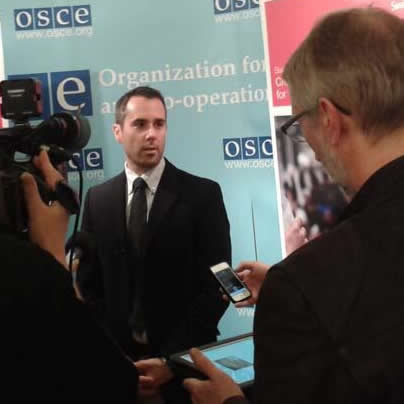
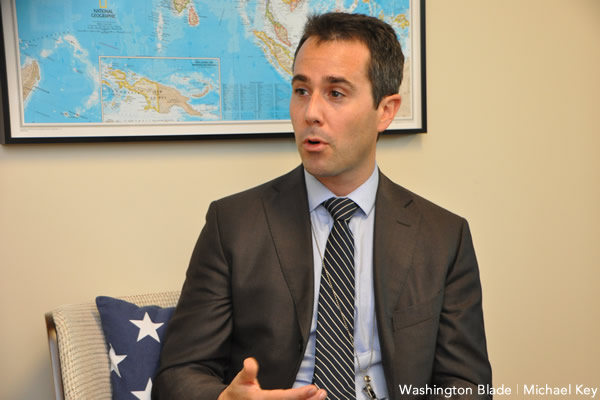
Gay U.S. ambassador Daniel Baer is representing U.S. interests during the Ukraine crisis at the Organization for Security & Cooperation in Europe (Washington Blade photo by Michael Key).
Amid the ongoing crisis in Ukraine following Russian President Vladimir Putin’s military incursion into the country, the Obama administration is relying on a gay ambassador to help de-escalate tensions.
Daniel Baer, U.S. ambassador to the Organization for Security & Cooperation in Europe, has in the days since the start of the crisis been working with envoys at the Vienna-based pan-Atlantic international forum to address the situation — in addition to keeping the world updated via his Twitter account.
His priority for the moment is achieving a consensus to allow a OSCE-based monitoring mission to enter Ukraine, although he admits he’s under “no illusion” that will be easy in a body on which Moscow has veto power.
In an interview with the Washington Blade via phone from Vienna after the third emergency meeting at the forum in as many days, Baer described the multi-level approach the United States is undertaking to de-escalate tensions in Ukraine.
“In the past, we’ve seen in other situations where there have been similar concerns raised, a monitoring mission [has worked] by both assessing and reporting facts on the ground and by being there to work to mediate tension and addressing the concerns that have been raised,” Baer said.
But Baer’s participation has significance because he’s openly gay and handling negotiations with a country that is known for enacting anti-LGBT laws and having an anti-LGBT climate.
Nonetheless, Baer, 37, said he’s never felt that his sexual orientation has been an issue for Putin’s representatives at OSCE.
“Just like being gay, working with the U.S. ambassador is not a choice, and I’m ready to work with all of them,” Baer said.
Founded during the Cold War, the OSCE was set up as a forum for the United States and the Soviet Union to speak about concerns and has become a pan-Atlantic forum now comprising 57 European, Asian and North American countries.
After the U.S. Senate confirmed Baer in August as U.S. envoy to OSCE, he relocated to Vienna with his partner of three-and-a-half years Brian Walsh, 27, a physicist now working at an international think-tank on environmental issues.
The transcript of the interview between the Washington Blade and Baer follows:
Washington Blade: How would you characterize the situation in Vienna as the crisis in Ukraine unfolds?
Daniel Baer: I guess a couple things. The OSCE is a big political organization, and an operational entity that has field offices in 16 countries, including Ukraine and many independent institutions that are doing things all the time. So, there’s been kind of two levels of activity.
One, there’s been a sense of urgency in terms of getting the existing capacities of OSCE mobilized to engage in Ukraine, and particularly in Crimea now, in the ways that they can to help de-escalate tension. So, there’s a High Commissioner for National Minorities, the Swiss special envoy who’s the current ambassador to Germany now, but a designated special envoy to Ukraine who sits as the chair of the OSCE right now. The Representative on Freedom of the Media, they just arrived in Crimea a couple hours ago, and then the project office in Kiev is being supplemented.
In addition, because OSCE does arms control, and military transparency, the Ukrainians have invited military monitoring missions. They have an invitation for two military monitors from every participating state in the OSCE.
Then, there’s the political side, and lot of people focus on the downside of the OSCE, which is you operate on consensus. And it’s a big tent that includes the Russian Federation, the United States, Canada and basically everybody in between — and Mongolia. That is both a hindrance, in the sense that it makes consensus harder, but it’s also an asset in the sense that the other project that we’re starting to work on now is trying to develop a mandate for a new special monitoring mission to Ukraine and that will require consensus, but the upside is that if we can find a description of a mandate that works for everyone, it will also have the political value of being blessed by Ukrainians, the Federation, the EU countries, Turkey, ourselves and Canada.
So, it’ll have broad backing. And so, we’re kind of taking the two-pronged approach of mobilize quickly everything that’s already set up and teed up, and ready to go, and also look at this kind of near-to-medium term possibility of setting up a monitoring mission.
That’s something that I’m under no illusions — I think it’s going to be very hard, and really all we can do is tee it up, and leave that door open. And if and when the Russian Federation decides to engage on that and walk through that door, we’ll be ready to work with them.
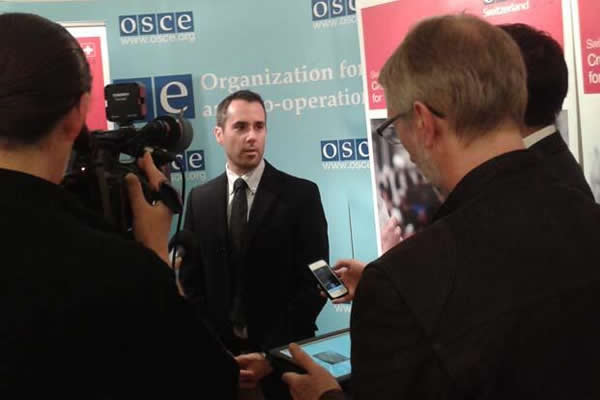
U.S ambassador to the Organization for Security and Cooperation in Europe (OSCE) Daniel Baer addresses the media following a meeting. (Photo public domain)
Blade: What makes setting up that monitoring mission “very hard”? I know Moscow has veto power on the OSCE, so how likely is it that we’ll actually see that happening?
Baer: I think the answer is it won’t happen unless Moscow decides that they see value in it, or they think it can be useful. I think our position all along has been there are a variety of concerns that have been raised by the Russian Federation, including concerns about the security of their military base and the human rights of the Russian minority in Crimea, and Ukraine more broadly, etc. There are obviously concerns that are being raised by the Ukrainians themselves about a Russian military incursion on their territory.
But the way to address the concerns that the Russians have raised is not through sending in troops, but through a monitoring mission. And this is an alternative for them. In the past, we’ve seen in other situations where there have been similar concerns raised, a monitoring mission [has worked] by both assessing and reporting facts on the ground and by being there to work to mediate tension and addressing the concerns that have been raised. Yes, they have to choose to take that route instead of the illegal and illegitimate route that they are currently taking, but… one of the ways in which we can make de-escalation more likely is by teeing up that choice, so they can make that choice. …
Blade: Let’s get a little personal. What do you think is the significance of an openly gay person representing U.S. interests in diplomacy with Russia, a country that has passed laws against gay people?
Baer: You know, I think to all of my colleagues when I showed up here in Vienna, most of my colleagues only knew one or two things about me. Everyone knew that I was gay, and the other thing talked about was that I was young. Other than that, they knew that I was an American ambassador. Six months later, it’s certainly more important that I’m the U.S. ambassador than anything else about me, and I have a decent working relationship with all my colleagues.
I have a weekly meeting with the Russian ambassador, and Brian and I have invited him and his wife to the Marine ball along with others. So, we built a working relationship. I guess it would be an interesting question for him. For me, I’m trying to do my job the best I can and represent my country the best I can.
I think one of the strengths that America has is that we increasingly — there’s still work to do on many dimensions — but we increasingly have a diplomatic corps that represents our diversity, and part of that is important because it makes us more effective. Part of that is important because it more accurately represents the country. And it’s super important because part of what others see as valuable and powerful and engaging and attractive about America is the promise of progress toward a society that embraces rights for everyone. I don’t see that as having anything to do with me, per se, but to the extent that there’s a broader story there. I think it’s valuable that we continue to make progress on that front.
Blade: So no Russian officials refused or expressed any reluctance to negotiate with you because of your sexual orientation?
Baer: I have not had any experience where they have refused to engage with me. For some people, whether Russian or otherwise, I’m the first ambassador from the United States that they’ve known was gay and they have to work with. I guess one of the advantages of being the U.S. ambassador in a multi-lateral institution is that it’s pretty hard to be effective and not work with the U.S. ambassador — one way or the other. Just like being gay, working with the U.S. ambassador is not a choice, and I’m ready to work with all of them. And I certainly go into it giving everybody the benefit of the doubt that it isn’t an issue because it shouldn’t be an issue.
Blade: You said they haven’t refused, but have they expressed any reluctance to work with you because of your sexual orientation?
Baer: Not to me. Not to me. If they have, they’ve kept it from me.
Blade: Let’s get back to the bigger picture. Regarding Secretary of State John Kerry’s visit to Ukraine, what impact do you think it’ll have on the situation?
Baer: I think the secretary has actually come and has already arrived in Paris, and will meet with [Russian] Foreign Minister [Sergey] Lavrov in Paris tomorrow. But he spent today in Kiev. I think everybody recognizes that the people of Ukraine have a new temporary government. An election’s declared for May 25. It’s usually important that there is strong support for free and fair elections, and a free and fair campaign environment. Everybody is rightfully focused on the security crisis in Crimea, and also in the rest of the country, there’s a lot of work to do.
And I think the people of Ukraine need to be supported in their efforts to build a prosperous, free, democratic Ukraine. And that’s going to take a lot of support from the international community, and I think Secretary Kerry is going to demonstrate our support for the transition government that is there until the election and our willingness and readiness to help support them in their efforts to build a free, democratic Ukraine.
Blade: How is Kerry being there having an impact as opposed to monitoring the situation from overseas?
Baer: Well, I think, certainly there’s a diplomatic value to it in terms of the conversations that you have, and, of course, it also sends a signal. So if being there sends a signal that the depth of the U.S. commitment and our engagement with the government, I think that signal is an important one to send, particularly at a moment like this.
Blade: What about sanctions? A number of European countries seem reluctant to impose sanctions on Russia. What actually can this administration do to convince its NATO allies and trading partners to get on the program for sanctions with real teeth against Russia?
Baer: Oh, I think the president and Secretary Kerry have had a number of conversations over the last 72 hours and 96 hours with allies and partners in Europe, and I think although the EU has its own function, and we have ours, etc., I think there’s a lot of strong cooperation right now on ways to respond to Russia’s illegal actions…I think there is strong cooperation between the U.S. and the E.U. and individual member states in the E.U. making clear that the Russian incursion and military presence is unacceptable and that they need to go back to their bases, and that it’s up to President Putin to do the right thing and de-escalate the situation.
Blade: Do you see that co-operation extending to an agreement on sanctions with Europe with regard to Russia?
Baer: Like I said, the secretary and president are working very hard to keep our allies and partners appraised of our steps, and to coordinate those. I think those conversations are ongoing, and I think that that strong cooperation will continue.
Blade: What do you think Putin is trying to accomplishment with this incursion? Restoration of the Soviet Union?
Baer: I don’t know. That’s a question for President Putin. I don’t know what he’s trying to accomplish, but certainly the steps that he’s taking are not contributing to stability in the region, to the future of a strong Ukraine, which Russia has everything to gain from as a close neighbor. Russia and Ukraine are going to have a relationship determined by geography if not by partnership, and so Russia has everything to gain from a strong Ukraine. There’s not an either-or choice, and the actions that Mr. Putin have taken are a violation of international law, they’re a violation of many commitments the Russian Federation has made, including here at the OSCE with respect to the sovereignty and territorial integrity of participating states. And they’re a violation of reason, and they are not in Russia’s interest, and certainly not in Ukraine’s.
Blade: What’s your reaction to today’s news that Putin said he sees no reason for Russian forces to intervene in eastern Ukraine at the moment but that Russia “reserves the right to use all means at our disposal to protect” Russian speakers if they are in danger?
Baer: I think I reject the rationale that has been offered for the military incursion and invasion so far, and there’s no defensible rationale for further movement. The right direction for the troops to move is not further, but back to their bases.
Blade: Do you think that comment is troubling?
Baer: Like I said, I think there’s no good rationale for the Russian Federation to have its troops on Ukrainian soil.
Blade: Do you see any scenario in which this crisis will escalate into military engagement involving the United States?
Baer: Nobody wants an escalation into war, so all of our efforts are focused on de-escalating the situation through direct diplomatic engagement and the deployment of an international monitoring force either through the OSCE or the UN. They’re other ways to approach this, but we’re certainly working around the clock to the head in that direction.
Blade: Is it safe to say military engagement is off the table?
Baer: That’s not a question for me.

U.S. ambassador for the Organization for Security and Co-operation in Europe (OSCE) Daniel Baer with partner Brian Walsh. (Image public domain)
Blade: Let’s get back to some personal stuff. How is the situation with Brian since you’ve moved to Vienna and since the start of his crisis?
Baer: I get to spend far less time with Brian, but other than that it hasn’t changed anything. We’re settling well, and he’s incredibly supportive.
Blade: Do you have any anecdotes about any activities you too had engaged in since you’ve moved to Vienna?
Baer: Well, it’s been a big change because it’s a new country and a new job. And we’ve been skiing in Austria, and that was fun. Being a diplomat overseas is very different from working in the State Department. One of the advantages being here in this post is you have 56 other ambassadorial colleagues and there’s an interesting and diverse group of people to get to know.
We’re settling into that world, and the whole time, we’re very, very much aware of the fact that this is a temporary arrangement. We’re trying to make the most of it. Enjoy the hard work, enjoy the fun and cool parts of the job.
Blade: Let’s get back to Russia. How do you evaluate how Russia handled the Olympics?
Baer: I think we’re all glad that the Olympics came off without any security incidents, etc. I think, as everyone knows, there was a great deal of investment of resources and political attention in the Olympics, and I was proud of U.S. athletes.
Blade: There were reports that were some arrests of demonstrators, including those protesting about LGBT rights. Were you aware of that and do you think they were cause for concern?
Baer: Yes. It’s always of concern when there are arrests of people protesting. In the Russian Federation, unfortunately, it’s not extraordinary. And there were arrests this past weekend of protesters who were protesting Russia’s invasion. Several hundred people were detained, I believe. I should check the reports. And there was a sentence last week of protesters, people who protested in the Bolotnaya Square, protests in 2012. So, Russia’s recent record on freedom of expression and freedom of association and assembly is not encouraging.
Blade: Russia has passed anti-gay laws that were criticized by the international community. Now that the Olympics are over, what is going to happen to LGBT people in Russia?
Baer: I think there are two things. One, we will continue to call out the so-called gay propaganda law and the other laws that have either been proposed or enacted along with it. Obviously, they’re inconsistent with internationally recognized human rights, and that such laws not only affect gay people, but the broader population, and also have a teaching effect, which creates a climate in which the rights of LGBT rights are most likely to be disrespected. We’ve seen an uptick in the kind of vigilante beatings of LGBT people posted online. The climate of intolerance that such laws encourage is something to be deeply concerned about.
That said, I think one of the things that it’s really important to focus on is that it’s not only gay people who have their rights trampled in the Russian Federation. Minorities, migrants from neighboring countries that represent minority populations suffer enormous discrimination, and obviously any Russian citizen has a hard time expressing political views that are critical of the government or joining a peaceful protest. The anti-gay laws are actually happening against a much broader recession on human rights more generally.
Blade: And what do you think is the best way forward to address that by the international community?
Baer: I think first of all, I always start from the premise that lasting change comes from within, so to continue to shine a light on human defenders and advocates who are making the case for change where they are — both LGBT, and more broadly, the human rights defenders and activists — and to call out the cases when their rights are violated. I think making the case to the Russian population more broadly as well to Russian leadership that a strong stable Russian Federation does not come from doubling down on restrictions it comes from democratic progress, including people who have respect for human rights. You have to make the political argument, and you have to call out the failures, and to continue to press, and know that doors will open where you don’t expect them, and you need to be ready to walk through them.
By calling out people’s situations, you remind them that they’re not alone and that they have people who are with them, and, over the long run, you push and you push and you push.
There’s a strong civil society that understands all of the reasons why the backsliding on human rights more broadly is bad for business, and all around it’s bad for Russia, and that trajectory needs to be turned around.
Blade: What about upcoming plans for you and Brian?
Baer: We’re getting married this summer. We haven’t quite figured that out yet because same-sex marriage isn’t legal in Austria, but we’re working on that. But in August.
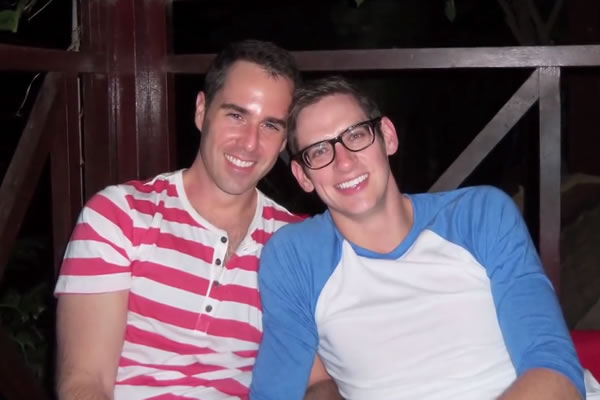
U.S. ambassador for the Organization for Security and Co-operation in Europe (OSCE) Daniel Baer with partner Brian Walsh. (Image public domain)




District of Columbia
Former Capital Pride board member reiterates sexual harassment allegation
Trans activist says resignation of board chair won’t change org’s culture
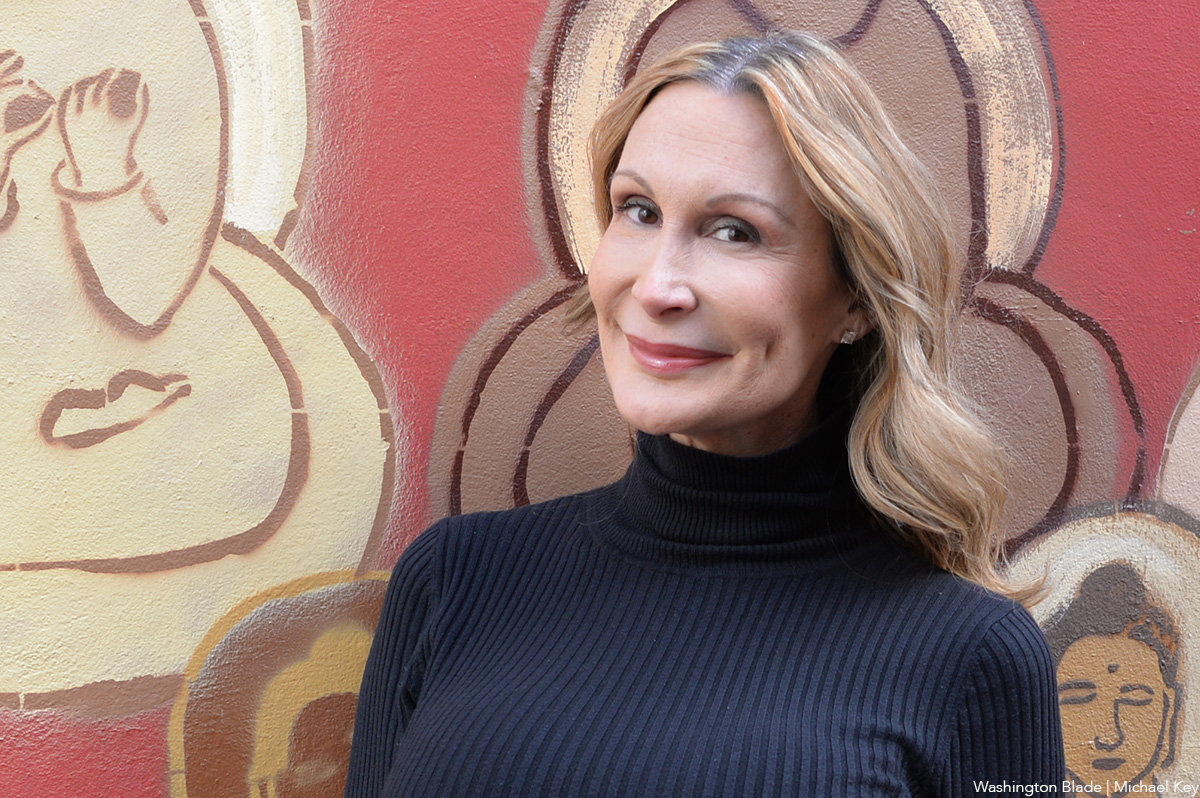
Taylor Lianne Chandler, who earlier this year resigned from the Capital Pride Alliance Board of Directors after expressing concern that the board failed to address instances of “sexual misconduct” within the Capital Pride organization, said this week she doesn’t believe her concerns will be addressed following the resignation of the board’s current chairperson.
Capital Pride Alliance serves as the lead organizer of D.C.’s annual LGBTQ Pride events.
Anna Jinkerson, who has served as chair of the Capital Pride board for only 10 months and has served on the board for the past four years, confirmed she is resigning from the board effective Sept. 30.
In a statement to the Washington Blade commenting on the possible impact of Jinkerson’s resignation, Chandler said Capital Pride board member Natalie Thompson would be replacing Jinkerson as board chair, and she didn’t expect that change to impact what she called Capital Pride’s problematic “culture.”
But Ryan Bos, the Capital Pride president and CEO, told the Blade that Thompson had not been selected as the new board chair and that a new chair would not be selected until the board holds an election scheduled for October.
Chandler, who identifies as transgender, said it was a Capital Pride board member who told her that Natalie Thompson had been or would be selected as the new Capital Pride board chair. She didn’t identify the board member.
“My concerns about how Capital Pride has handled serious allegations of sexual misconduct have not disappeared with a change in leadership,” she told the Blade in her statement. “When leadership continues to socialize, smile for photographs, and share spaces with someone facing serious allegations, what message does that send to the people who say they were harmed,” she said.
Chandler has told the Blade a Capital Pride investigation identified an individual implicated in a “pattern” of sexual harassment-related behavior but said she was bound by a Non-Disclosure Agreement that applied to all board members and she could not provide further details.
When asked by the Blade to comment on Chandler’s allegations at the time she resigned from the board in February of this year, board chair Jinkerson said Capital Pride acts “quickly and appropriately” to address concerns such as those raised by Chandler. But she and other Capital Pride officials did not at that time or since then specifically acknowledge whether someone associated with the organization engaged in sexual harassment.
“The community deserves transparency, accountability, and leadership willing to make difficult decisions,” Chandler said in her statement to the Blade this week. “Changing the chair doesn’t change the culture,” she added. “Actions do.”
In response to a request from the Blade for an update on its response to Chandler’s allegations about alleged sexual misconduct within the Capital Pride organization, Bos sent the Blade a statement on behalf of Capital Pride.
“The Capital Pride Alliance takes allegations of harassment, misconduct, and unsafe behavior seriously,” the statement says. “The organization follows standard procedures and engages appropriate resources to support a thorough, confidential, and impartial review, when information is reported.”
The statement adds, ”Because these matters require maintaining confidentiality and protecting the privacy of personnel, volunteers, and governance processes, we will not comment on specific individuals, allegations, investigative findings or communications involving law enforcement.”
It concludes by stating, “We remain committed to fostering a safe, respectful, and inclusive environment, appropriately addressing concerns raised, and continuing to strengthen our policies, governance practices, and organizational culture.”
Although the statement refers to “communications involving law enforcement,” Capital Pride has not disclosed whether instances of alleged sexual harassment or, as stated by Chandler, a possible instance of sexual assault, have been reported to D.C. police.
A D.C. police spokesperson, in response to a Blade inquiry, said they have no record of a sexual harassment or sexual assault complaint surfacing from the Capital Pride office, which is located in the D.C. LGBTQ+ Community Center building at 1827 Wiltberger Street, N.W.
Officials at Capital Pride recently exchanged testy public Facebook posts with Chandler. June Crenshaw, COO of Capital Pride Alliance, criticized Chandler for her social media posts on the matter.
“It is remarkable to watch people publicly accuse others of failing to create safe spaces when, during the time they themselves held positions of leadership and significant volunteer responsibility, they claim to have witnessed deeply troubling behavior, yet never reported what they allegedly witnessed to fellow leaders, law enforcement, the Office of the Attorney General, legal counsel, or staff responsible for addressing such concerns,” Crenshaw wrote. “When I became aware of allegations or personally witnessed conduct that required intervention, I reported what I knew through the appropriate channels, including to law enforcement and other relevant authorities. Investigations were conducted. Those processes created records, documentation, correspondence, timelines, and conclusions.”
Chandler responded, “I was NOT in organizational leadership or fully informed about the scope of these allegations when much of what you reference occurred. I was read into the situation after becoming an executive officer. By that point, the investigation had already concluded, and we were awaiting the final report. … Once that report became available to me, and once I understood the seriousness and scope of what was being alleged, my position was anything but ambiguous: I did not believe this individual should be welcomed at, participate in, or have access to official Pride events.”
Capital Pride’s attorney Nick Harrison then joined the exchange, accusing Chandler of violating confidentiality rules.
“You served on the Board for years. You cannot now present yourself as an outsider with no responsibility for what occurred during your tenure,” Harrison wrote. “When the situation became difficult, you resigned, provided your resignation letter to the media, disclosed confidential organizational matters, and recast yourself as the victim.”
Again, no one has publicly identified the person Chandler references as being welcome at Pride events and photographed with Capital Pride leadership.
New York
Grace Meng sharply criticizes DOJ over hospital settlements
N.Y. congresswoman spoke with the Blade this week
Few things have riled up Republicans in power like the ongoing fight to restrict gender-affirming care for minors.
The Trump-Vance administration has been clear in making the fight against transgender rights, healthcare, and visibility a priority as they enter their “lame duck” phase of the presidency.
With the midterms looming, they are hoping scapegoating trans children — as they did in 2020, only for it to grow into a core national party strategy in the following elections — will save them from a less-than-secure control of the federal government like they’ve had since Trump took office.
In the past year, numerous deals have been struck between hospitals that have provided gender-affirming care to minors and the Justice Department to halt any further care.
While Republican pundits and conservative voices continue to accuse these hospitals — like NYU Langone and Mount Sinai Health System — of committing what they contend are atrocities against these children, large portions of gender-affirming care for minors involve social transitions and puberty blockers, which are reversible.
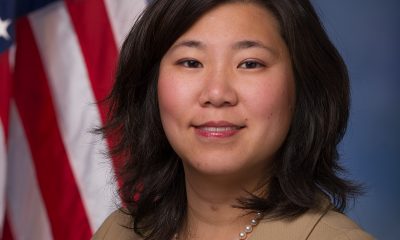
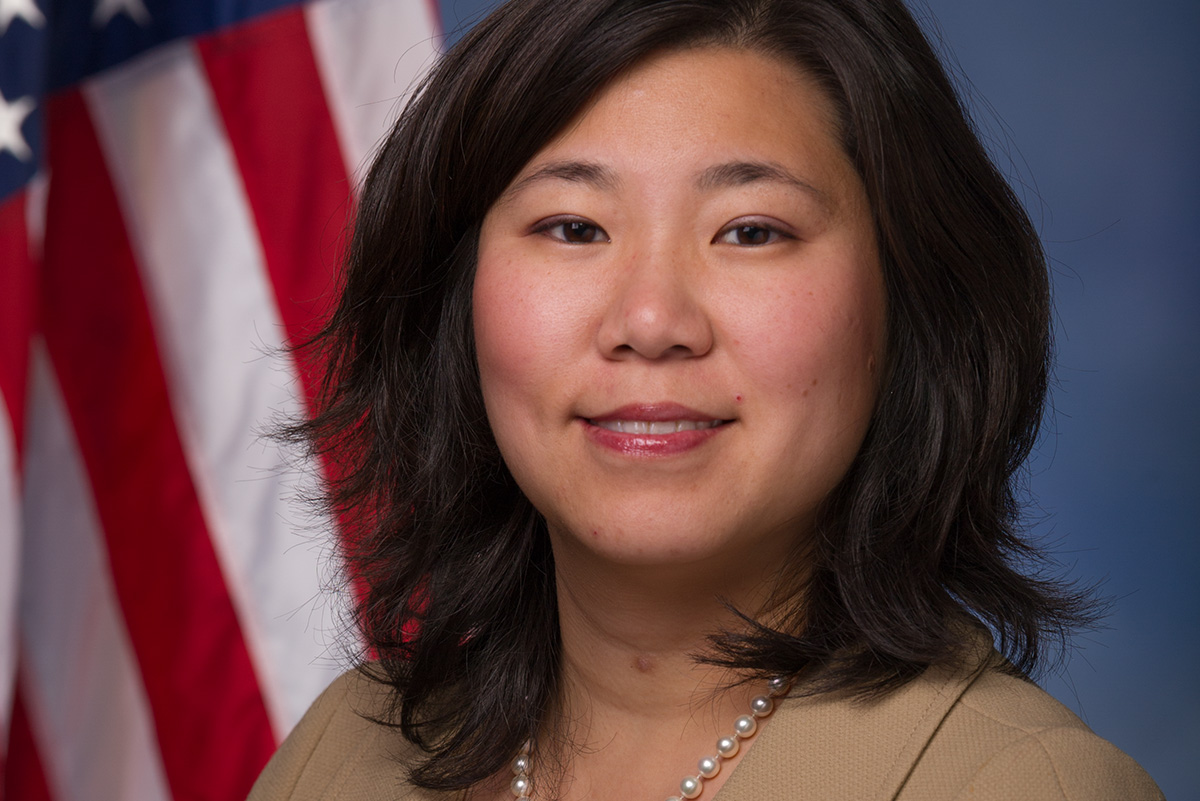
The Washington Blade spoke with Congresswoman Grace Meng, who represents New York’s Sixth Congressional District and is the ranking member of the House Appropriations Subcommittee on Commerce, Justice, Science, and Related Agencies, to discuss whether these ongoing settlements between hospitals and the Trump-run Justice Department are legal.
In her role as the ranking member of the House Appropriations Subcommittee on Commerce, Justice, Science, and Related Agencies, Meng oversees funding for Justice Department and a slew of other federal agencies. The position gives her the power to look behind the coercion, examine how things are being done, and question the policies and actions of these federal powers in a way many other members of Congress cannot.
Meng said the Justice Department’s actions against hospitals providing gender-affirming care are part of what she sees as a broader pattern of institutions — under the control of this president — targeting LGBTQ people.
“Unfortunately this is not the first time that the DOJ is weaponizing the agency to target our communities, and our LGBTQ+ community, especially our young people, are unfortunately yet another victim of that,” Meng told the Blade. “The real victims are the actual patients and families who are losing a trusted provider.”
She argued that one prong of this ongoing situation is the way the DOJ is going about these “wins” — through pressure rather than through going to court to find actual wrongdoings.
“This DOJ knows that they can’t win in the courts based on the merit of these types of actions, so they are just working by bullying and using coercion to cheat their way through getting what they want,” she said.
She pointed to the use of litigation, subpoenas, and reputational damage against the hospitals as part of that pressure campaign.
“They know that they can’t prove any wrongdoing in court, so they’re just using the threat of prolonged litigation, subpoenas for patients’ records and trying to damage reputations of these institutions as they’ve been cutting funding for them.”
The hospitals involved so far include NYU Langone Hospitals in New York, University of Pittsburgh Medical Center in Pennsylvania, the Mount Sinai Health System in New York, the Cleveland Clinic Foundation in Ohio, Connecticut Children’s Hospital in Connecticut, and Texas Children’s Hospital in Texas.
Meng said the settlements are part of a broader strategy by the Justice Department.
“This is a part of their larger deliberate strategy across the country. They’ve obviously gone after NYU Langone. They’ve gone after Mount Sinai in my state, and they’re doing this in other states as well.”
When asked about the agreements being reached between the Justice Department and hospitals, Meng was direct.
“I think these are forced settlements. Absolutely,” Meng said.
Meng described the federal government’s involvement in individual trans healthcare decisions as an intrusion into private medical decisions.
“This is cruel. It’s a cruel form of coercion. It’s a form of cheating,” she went on, comparing this to the ongoing fight for reproductive freedom in the country. “Just like when we’re talking about reproductive rights, right? It’s an invasion of privacy. These are confidential patient records.”
Meng said the federal government should not be involved in decisions between families and their doctors.
“President Trump and the federal government do not belong in a hospital, helping to make decisions that are very personal and sensitive to every single family. They should not be involved in these decisions.”
She said the settlements could leave families without access to healthcare they need.
“Their way of forcing these settlements and leaving so many without the healthcare that they really need is really just devastating.”
Meng said the impact is already being felt by families in her district and across New York.
“The human impact, the impact on our families, on our constituents here in Queens and throughout New York, is really hurtful.”
Meng framed the issue as part of what she described as a larger pattern within the Trump-Vance administration of attacking the most vulnerable.
“If you ask me to sum up this administration in one word, it would be cruelty,” she said. “They feel like they have a right to decide who is American enough in this country, and who is good enough, and who is deserving enough.”
She went further, saying Trump is “literally acting as a dictator.”
She contrasted his leadership with that of a traditional public servant.
“Most public servants wake up every day thinking of ways that they can make people’s lives better, how they can help people. This administration and this action is no different. It wakes up and thinks of a new way to target a different community every day.”
As the ranking member of the House Appropriations Subcommittee on Commerce, Justice, Science, and Related Agencies, Meng said Congress has tools available to examine how the Justice Department operates and spends federal money.
“The purpose of our 12 subcommittees is to have direct oversight and leverage as Congress members, as the third branch of government, over how the Department of Justice spends our taxpayers’ money.”
One crucial thing Meng pointed out about being on this committee is the fact that much of the work of appropriations is bipartisan and is entirely within the power of Congress via the Constitution.
“We need the White House to respect the constitutional process that the Appropriations Committee goes through,” she said. “We write the Appropriations Law. It’s between Republican and Democratic Congress members.”
When asked about the funding from the settlements — and the continued funding for an increasingly looked-down-upon DOJ — she said she is seeking greater transparency into how federal money is being spent.
“I think that both sides will end up wanting more transparency into the money, how the money is spent.”
Meng said Congress has the legal authority to place requirements on the Justice Department through appropriations legislation.
“We have the legal authority to include language that helps write the DOJ and other agencies, but the DOJ’s budget, and so we will certainly exercise that authority whether or not we’re in the majority.”
She also pointed to the possibility of Democrats taking control of the U.S. House of Representatives after the midterms.
“Hopefully, as we’re in the majority after November, we will be able to have more teeth and more ability to apply that pressure and to write the bill in a way that is transparent and doesn’t harm our families.”
Despite the growing public agitation and disappointment over these settlements, Meng said there is not yet a specific schedule for congressional hearings on the issue, but that it may come after the midterms.
“We don’t have a timeline of hearings and specific topics, but CJS is everything under Commerce, Justice, and Science-related agencies,” she said. “Hopefully, when House Democrats control the House and maybe even the Senate, that we’ll be able to claw back some of their overreach.”
Meng also criticized what she described as a Justice Department operating outside the traditional boundaries of the agency.
“They can’t operate as a rogue agency or as a personal law firm of this president, in the way that they’re doing now. Using subpoenas, threatening prosecutions, these settlements — they are tools that are being used, I believe, unethically and illegally.”
Meng said trans children and their families could continue to face the consequences of the administration’s actions as the Justice Department expands its efforts.
“These are maybe low-hanging fruit or easy targets for the administration, but I can see them going after institutions in other states as they started to do as well.”
She said members of Congress have a responsibility to reassure affected families that they are not alone.
“Our job, whether it’s a representative for my Queens families, but for families across America too, is to let them know that I and my colleagues, many of my colleagues, are standing with them.”
“We are still with them, especially with the patients and the families affected by the NYU Langone deal, but any of these institutions and how they’re hurting them.”
Meng said she wants to achieve that through partnerships outside of government.
“We’re gonna do our best to expand partnership with organizations on the ground to make sure that they’re getting the support and the care that they need.”
While talking to the Blade, Meng also raised broader concerns about the relationship between Congress and the executive branch.
“This administration has definitely not followed the Constitution, and I know that there are pending lawsuits,” she said.
Just this week, the Trump-Vance administration was taken to court over what CNN, POLITICO and MS NOW alleged were violations of their First Amendment rights.
Meng said the administration has not treated Congress as an independent branch of government.
“They [the president] do not act as if Congress is a third branch of government. They think and act like Congress works for them, like they’re a part of their agencies that they’re weaponizing.”
Meng said she believes the public has become more aware of the administration’s actions, but that there is still work to do in explaining how those actions unfold.
“I think that the American people’s eyes have been opened a little more under this administration than in past ones … There’s definitely more room to continue to educate the public as to what this administration is doing.”
For Meng, the debate over trans healthcare ultimately comes down to the families affected by the decisions being made in Washington.
“What’s most important is not just the legalese that everyone’s debating these days when news like this comes out. We have to remember that there are real human beings, real families that are being impacted,” she said. “There are people crying behind closed doors in their homes, and they don’t know literally what they can do or where they will call next to get the care that they need and that they want.”
Meng said lawmakers have a responsibility to address the issue legislatively while also supporting families in their communities.
“It’s our job in Washington, in the capital, to fight these fights legislatively. But in our home districts and in our communities, it’s our job to reassure these families that we’re there for them, and that we’re going to be creative, and we’re going to find new partnerships and expand existing ones to make sure that our families have a path forward.”
She said local and state governments are also being forced to find ways to respond — and, in many cases, end up being some of the only places where protections can happen.
“Our local legislators and many of our communities, on the city level, municipal level, and the state level, they’re looking for more funding options, and a lot of them, including in New York, have had to step up in major ways.”
“Everyone has to step up in newer and more creative ways.”
Ultimately, Meng said the focus should remain on the families affected by the decisions.
“But at the end of the day, it’s the families that are impacted that we’re doing this for,” she said.
The Human Rights Campaign, the largest LGBTQ advocacy group in the U.S., issued a statement this week following the announcement of more settlements.
“This is nothing less than a crisis for families and transgender youth. Since day one, Trump and his callous administration have used the full force of the federal government to come after transgender young people, their families and their doctors — and far too many hospitals are complying and abandoning their patients. Now, even in states with policies that protect transgender people, the options for parents to get their children best-practice, and potentially life-saving healthcare, are dwindling day by day,” HRC President Kelley Robinson said.
“This is the exact outcome Trump wants to see — and this cruelty shouldn’t be lost on anyone who has ever had to make difficult decisions about how to safeguard their child’s health and well-being. Our thoughts are with the countless families across the country who feel scared and under siege. We will not stop fighting until everyone can have access to the healthcare they need.”
While the Blade had her, they also asked about House Speaker Mike Johnson (R-La.), and his decision to send members of Congress home rather than hold a vote on impeaching Defense Secretary Pete Hegseth, in part over his trans military ban, which has left thousands of highly skilled, ready and able workers sitting on the sidelines awaiting the courts to tell them if they are guaranteed the right to fight on behalf of the country.
“I can’t take credit for this, but someone called it the Hegseth holiday,” Meng said. “This speaker, every time there’s a tough vote, instead of acting as a leader and a speaker, he just calls it quits and he sends us home.”
“I believe — and I’m sure he does — that we had enough votes to impeach Hegseth, and he didn’t want to do it. So off we go.”
District of Columbia
Center for Black Equity’s annual gala to take place Oct. 3
Advocacy group to honor Black LGBTQ community champions
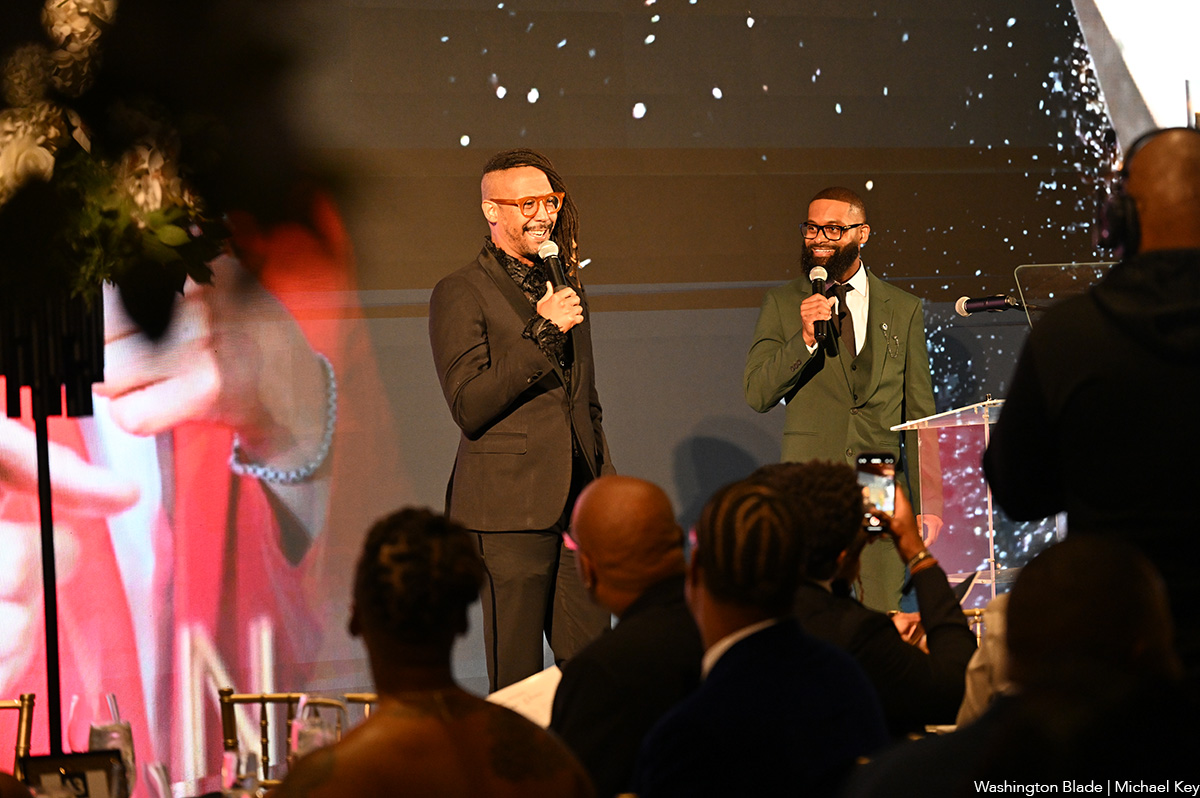
The Center for Black Equity, the D.C.-based international network of LGBTQ activists and organizations that advocate for Black LGBTQ communities and organize Black Pride events worldwide, will hold its annual 2026 BE Gala in D.C. on Oct. 3.
The event, to be held at the Conrad Washington Hotel at 950 New York Ave., N.W., among other things, will honor at least a dozen “distinguished Black individuals” and organizations that champion Black LGBTQ communities, according to a statement released by the Center for Black Equity.
“The honorees will receive awards recognizing extraordinary leadership, advocacy, and service across civil rights, public health, the arts, media, entrepreneurship, and community life,” the statement says.
“With an elegant atmosphere and a bold mission, this unforgettable evening brings together advocates, allies, and change makers committed to equity and joy,” the statement says in referring to the Oct. 3 BE Gala.
The statement notes that tickets for the event, which serves as a fundraiser for the Center of Black Equity, begin at $250 for individuals and include dinner and two drinks. It says reserved tables for eight were being offered for $2,000, and “Premier” tables for eight were selling for $2,500 and include seating near the stage.
“The BE Gala is more than an evening of celebration,” according to the statement. “It is an opportunity to honor Black LGBTQ+ leadership while investing in the work of the Center for Black Equity.”
Kenya Hutton, the Center for Black Equity’s CEO, told the Washington Blade the name “BE” for the gala is not an acronym. “The name is rooted in the idea of being: being seen, being celebrated and being fully and authentically yourself,” he said.
“BE Gala creates a space to celebrate Black LGGTQ+ people for who they are, the lives they lead and the impact they make,” he added.
The Center for Black Equity until 2012 was called the International Federation of Black Prides and was founded by organizers of D.C.’s Black Pride celebration.
Its current website includes a statement saying it’s mission is to “promote a multinational LGBTQ+ network dedicated to improving health and wellness opportunities, economic empowerment, and equal rights while promoting individua and collective work, responsibilities, and self-empowerment.”
The 2026 Center for Black Equity award honorees as announced in its statement released this week are:
Courtney Snowden: Welmore Cook Advocacy & Service Award
Clover Barnes: Ernest Hopkins Public Health Leadership Award
Nikki Alexander: Unsung Hero Award
Darryl G. Moore: Center for Black Equity Leadership Award
The Freelux Project: Center for Black Equity Small Business Award
Tori Cooper: Earline Budd Transgender Leadership Award
Bishop Steven R. Sawyer: Bishop Kwabena Rainey Cheeks Spiritual & Community Leadership Award
Rev. Carmarion D. Anderson-Harvey: Bishop Kwabena Rainey Cheeks Spiritual & Community Leadership Award
Monroe Alise: Trans Power in Media Award
Justin N. Stewart: National Black Pride Image Award
Marlene McNeese: Curtis L. Etherly Jr. Ally Award
Venton Jones: Eleanor Holmes Norton Civil Rights & Justice Award
In Our Own Voices, Inc.: Ruth Ellis Community Impact Award

Tyler Clementi Foundation to host fundraiser in Rehoboth

Calendar: September 25-October 1

Former Capital Pride board member reiterates sexual harassment allegation

Grace Meng sharply criticizes DOJ over hospital settlements

‘Star Trek: Strange New Worlds’ star Celia Rose Gooding breaks down that finale time travel twist

PHOTOS: Shenandoah Valley Pride

White House press pool pushes back after Trump bars three outlets

Long-time DignityUSA executive director announces retirement

For lesbian victims of domestic violence, competent care is scare

United States Conference on HIV/AIDS grapples with federal budget cuts
-

 Photos4 days ago
PHOTOS: Shenandoah Valley Pride
-
White House4 days ago
White House press pool pushes back after Trump bars three outlets
-
National5 days ago
Long-time DignityUSA executive director announces retirement
-
National4 days ago
For lesbian victims of domestic violence, competent care is scare