News
Uganda anti-gay law challenged in court
Yoweri Museveni signed statute last month
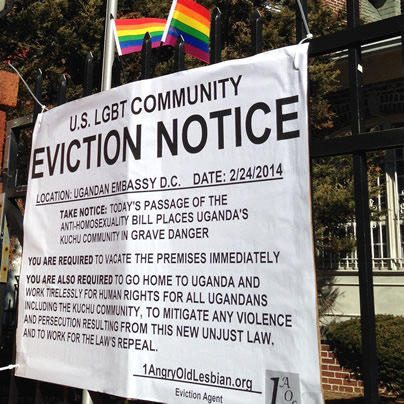
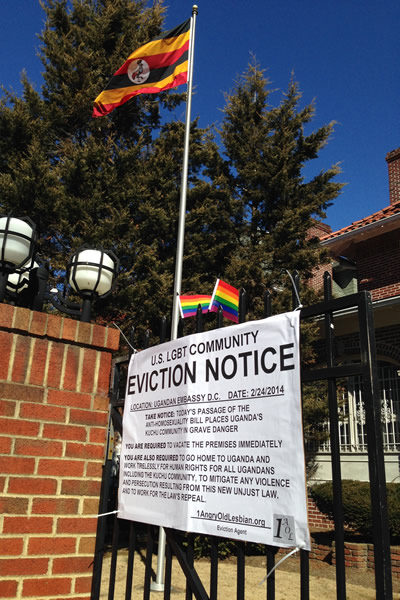
Ugandan human rights advocates on Tuesday petitioned the Ugandan Constitutional Court to block an anti-gay law the country’s president signed last month. (Photo courtesy of Ellen Sturtz)
Ugandan LGBT rights advocates Frank Mugisha, Julian Pepe Onziema and Jacqueline Kasha Nabagesera are among those who signed onto the Civil Society Coalition on Human Rights and Constitutional Law’s challenge of the so-called Anti-Homosexuality Bill that President Yoweri Museveni signed into law on Feb. 24.
They argue in their petition to the Ugandan Constitutional Court that the statute violates the right to equality and privacy outlined in the country’s constitution. The advocates said the anti-gay law also discriminates against people with HIV and disabilities and imposes a “disproportionate punishment for the offense (of homosexuality) in contravention of the right to equality and freedom from cruel, inhuman and degrading punishment.”
The activists also contend Ugandan parliamentarians approved the measure late last year without the necessary quorum.
“The spirit of the Anti-Homosexuality Act 2014, by promoting and encouraging homophobia, amounts to institutionalized promotion of a culture of hatred and constitutes a contravention of the right to dignity,” reads the petition. “The Anti-Homosexuality Act 2014, by encouraging homophobia and stigmatization, is in contravention of the duty of the government to respect, protect and promote the rights and freedoms of persons likely to be affected by the act.”
The activists’ petition asks the court to block enforcement of the law and prevent Ugandan media outlets and websites from publishing the names and pictures of those who are open about their sexual orientation or suspected of being gay.
Jeffrey Smith of the Robert F. Kennedy Center for Justice and Human Rights, which honored Mugisha in 2012 and whose president, Kerry Kennedy, discussed the Anti-Homosexuality Bill with Museveni in January, welcomed the petition to the Ugandan Constitutional Court.
“The Anti-Homosexuality Law clearly violates a host of constitutionally protected rights in Uganda, not to mention international human rights standards pertaining to nondiscrimination, the right to privacy, and freedom of expression,” Smith told the Blade on Tuesday. “These rights belong to every Ugandan citizen, regardless of sexual orientation or gender identity, and the government has a duty to not only protect these rights, but to both promote and advance them as well. Today’s constitutional challenge is therefore a significant step forward in the struggle for the respect of basic human rights for all Ugandans.”
The Obama administration announced after Museveni signed the Anti-Homosexuality Bill into law that it has begun reviewing its relationship with Uganda. U.S. Sen. Jim Inhofe (R-Okla.), who met with Museveni in January during a trip to the East African country with other members of Congress, former U.S. Ambassador to the U.N. John Bolton and U.N. High Commissioner for Human Rights Navi Pillay are among those who also criticized the measure.
“I certainly disagree with the controversial legislation that Uganda may enact in the coming days,” Inhofe told the Washington Blade before Museveni signed the Anti-Homosexuality Bill.
Ugandan LGBT rights advocates and their supporters maintain U.S. evangelicals exploited homophobic attitudes in the East African country and encouraged lawmakers to approve the Anti-Homosexuality Bill. A federal judge in Massachusetts last August ruled a lawsuit the Center for Constitutional Rights filed against Scott Lively on behalf of Sexual Minorities Uganda, a Ugandan LGBT advocacy group of which Mugisha is executive director, can proceed.
Lively described the law as “overly harsh on its face,” but “typical of African criminal law across the country” to the Blade during a press conference last month at the National Press Club in downtown Washington.
“Poor countries with limited criminal justice systems tend to rely on the harshness of the letter of the law to be a deterrent to criminals,” said Lively. “In practice, the sentencing is usually pretty lenient. Kenya, for example, has the death penalty for burglary, but burglars are definitely not being executed there.”

National
For lesbian victims of domestic violence, competent care is scare
Heteronormative assumptions, funding cuts contribute to lack of resources for survivors
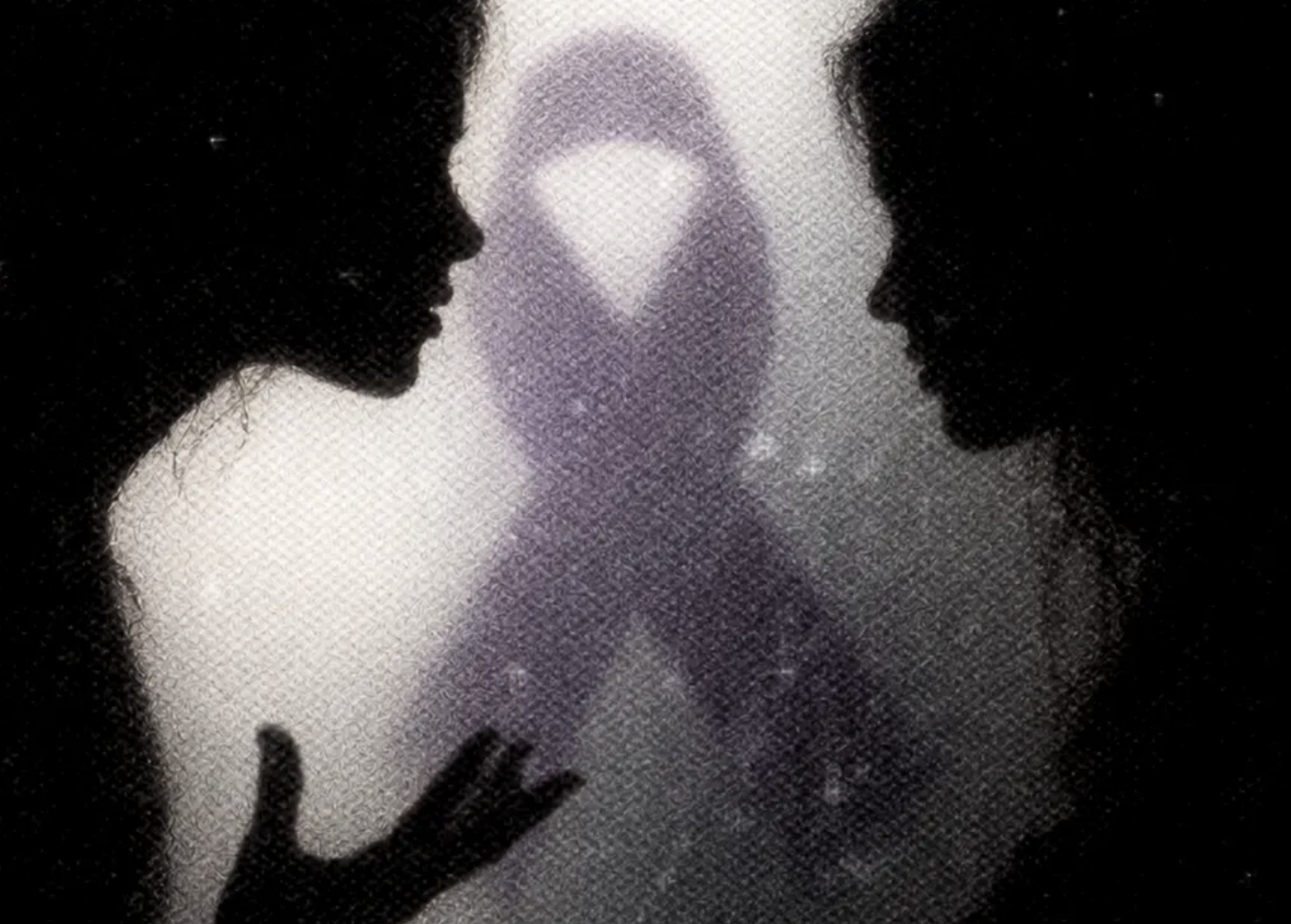
Uncloseted Media published this story on Sept. 22.
By EMMA PAIDRA | Claire, a 25-year-old Los Angeles resident, distinctly remembers the night she and her ex-girlfriend broke up.
“She was strangling me in a CVS parking lot,” Claire recalls, adding how she was gasping for air as bystanders looked on. “I made eye contact with one man who just kept walking, and we were right behind a car that was trying to reverse out of a parking spot. No one got out of the car. They didn’t honk; they didn’t do anything.”
Claire, who asked to use a pseudonym due to safety concerns regarding her ex, says she managed to fight her way out of her then-girlfriend’s grasp. It was at this moment in 2024 she realized things had reached a breaking point.
While research on intimate-partner violence has traditionally focused on opposite-sex couples, two recent reports found that queer women, like Claire, are not immune to this type of abuse. An international research review published last year in the Journal of Media Critiques found “IPV rates in same-sex relationships are comparable to or exceed those in heterosexual relationships,” with up to 46 percent of lesbians encountering such abuse, compared to 36 percent of straight women. A separate review published earlier this year found that nearly 27 percent of lesbians surveyed had experienced IPV.
Despite the prevalence of IPV in lesbian relationships, heteronormative and outdated assumptions have left many queer women feeling like they have nowhere to turn for competent services and support, according to experts, advocates and victims interviewed by Uncloseted Media.
“Queer folks are joining the conversation to say, ‘This is happening in our communities, too, and we need the same resources and support services that straight women are offered,’” Tori Stranges, a professor of women’s studies at the University of British Columbia, told Uncloseted Media.
A frequently overlooked problem
Stranges says the false notion that only men are domestic abusers can result in violent same-sex relationships not being taken seriously.
“People assume that violence is perpetrated by men against women,” she says, adding that this “has left queer people out of the conversation.”
“If it was a man that was doing all these things, and people heard and saw it, I’m sure I would have been taken seriously,” says Claire. “People saw a 5-foot-7 woman who didn’t look that strong — and above all, she was a woman. Men, especially, don’t really see that as a threat. So they’re like, ‘If I’m not threatened, then I’m sure it’s not a big deal.’”
Outdated assumptions about IPV can even result in victims themselves overlooking their abuse.
“When it comes to abuse in heterosexual relationships, there are national campaigns, there are resources that you can access,” Stranges says. “There are people coming into the school systems to talk about relationship violence. We don’t have similar recognition and the same conversations about queer people.”
Claire says the violence she was subjected to was paired with moments of intense affection, which made it harder for her to recognize the abuse.
“We would get into a fight, and she would physically abuse me, and then apologize. She was actually also very gentle with me sometimes,” Claire recalls. “That kind of cycle can be really addicting. I would always wait for the good parts.”
The role of mental illness
K.P., a 47-year-old lesbian living in Maine, was with her abusive ex-girlfriend for five years before ending the relationship in 2023. During their time together, K.P. says her ex, who struggled with panic disorders, ADHD and depression, experienced a decline in her mental health, which contributed to more frequent outbursts of rage. When it comes to the link between rage and violence, one 2022 meta-analysis found that “anger was a significantly stronger correlate of IPV perpetration for women than men.”
K.P., who was working from home at the time and felt like she had no escape, says her ex’s verbal abuse spiraled into physical violence.
“I was on the couch with my laptop, trying to work, and she was just being belligerent,” recalls K.P., who asked to be identified by only her initials because of safety concerns. “I tuned her out, but when she realized I wasn’t giving her the attention that she expected, she went to the kitchen, grabbed two knives and started coming at me.”
K.P. ran outside, trying to get away. Her ex ran after her and then chased her back inside to avoid being seen by neighbors.
Once inside, her partner hid her phone. K.P. used this brief window to message a co-worker on her laptop, asking him to call the police.
“I was confused and afraid,” K.P. told Uncloseted Media. “I’d never been chased with a knife before, let alone by someone who I cared about.”
Research shows LGBTQ people have higher rates of mental health conditions than their non-LGBTQ peers. A study published last year in JAMA Network Open found sexual and gender minorities had “significantly higher odds of at least four of 10 commonly diagnosed mental health conditions,” including post-traumatic stress disorder and bipolar disorder.
IPV may also contribute to negative mental health effects, with research finding that victims experience an increase in depression, anxiety and PTSD and a reduction in life satisfaction.
“After we broke up, I was messed up,” K.P. says. “It took me a good six or eight months to feel like I could breathe again.”
Trapped in a ‘double closet’
In addition to mental health, the stigma of being queer may affect a victim’s response to being in an abusive relationship. When Claire first came out to her family, she says they kicked her out of their home until she returned to the proverbial closet. They eventually accepted her sexuality, but Claire says the residual shame she carried afterwards led her to avoid the added stigma she feared she’d experience if she admitted to being in an abusive relationship.
“All of that combined made me feel so trapped. I just thought, ‘Oh my god, I’m being judged from every single angle,’” she says. “There was just nowhere to go.”
Letícia Yuki de Araujo Furukawa, a clinical psychologist specializing in supporting survivors of IPV, says this kind of thinking is not uncommon among queer women in abusive relationships.
“Sometimes lesbian women who are experiencing IPV relationships start to isolate themselves, to prevent themselves from the shame and judgment they think they are going to suffer,” she says.
Furukawa says this impulse is rooted in the layers of stigma queer women face.
“It comes down to two things that make it like a double closet: We have the closet of being a lesbian, and you have the other one that comes from being in a violent relationship.”
According to Furukawa, having a supportive family can decrease the risk of entering an abusive relationship. Unfortunately, strained familial relationships are common among queer people: A 2022 study in the Journal of Marriage and Family found that 32 percent of gay and lesbian adult children — compared to 22 percent of their heterosexual counterparts — were estranged from their fathers.
Because of the shame Claire faced from her family when she came out, she was reluctant to admit there was a problem in her relationship when her mother and sister expressed concern. She worried that if her family knew her lesbian relationship was abusive, they would stop accepting her queer identity.
“My mom and sister would say to me during the relationship that they thought my ex looked evil, and that I changed so much. I used to be such a bubbly girl, and my personality made a complete 180,” she remembers. “In my head, I was like, ‘I can’t admit that it’s true.’”
‘Gaps in, policy, care, and services’
When queer women have the courage to report IPV, some don’t receive the response they’re hoping for. When police arrived at K.P.’s home following the knife-wielding incident, she says they opened a case file and wrote an incident report but said there was nothing else they could do because her ex had fled the scene.
“It was a little frustrating that since my ex-girlfriend drove away, the police couldn’t do anything,” K.P. explains.
Laura Elizabeth, an assistant professor of criminal justice at Virginia Union University who researches IPV, says there may have been additional steps police could have taken to support K.P., including connecting her with resources for domestic-violence survivors.
“It is vital that [police] make the proper referrals, and that it not just be limited to handing the victim a brochure,” she says. “There needs to be an active discussion with victims about what their options are in terms of who they can reach out to, who can offer what services.”
Kimberley Jackson, an associate professor at the Arthur Labatt Family School of Nursing at Western University, says lack of research on same-sex domestic violence also impacts the support services available to lesbian victims.
“The intersection of IPV and the LGBTQ community is really not well understood,” Jackson told Uncloseted Media. “What we can tell you based on really limited evidence, is that there are huge gaps in policy, care and services. And with respect to shelters, we haven’t really moved the needle very far.”
One area in which shelters may be failing lesbian victims has to do with both the perpetrator and the victim being able to access the same shelter.
“This issue is further compounded in rural areas, where there’s likely only one shelter,” Jackson says. “There’s a chance they won’t be able to turn someone away, even if they’re the perpetrator.”
Jackson says queer victims of domestic violence who aren’t open about their sexuality may face additional obstacles.
“With respect to anonymity, in a lot of rural places, you’re going to know people in the community,” she says. “There are issues with accessing help if you’re worried about outing yourself.”
Calls for change
Experts and victims say LGBTQ training for shelter workers and law enforcement, as well as funding for research, could help prevent same-sex IPV and address the damage done by such abuse.
But under the Trump-Vance administration, these funding resources are slipping away. In March of last year, the administration canceled at least 68 grants, totaling nearly $40 million, that were focused on LGBTQ health. A second round of cuts followed two months later, during which $800 million worth of grants dedicated to researching LGBTQ health were terminated.
Rebecca Hobbs, co-executive director of Through These Doors, a domestic violence resource and advocacy center in Portland, Maine, says LGBTQ training materials are essential to ensuring shelters can support lesbian victims.
“LGBTQ people will not come to us unless they see themselves reflected in our materials,” Hobbs says. “We want our advocates to be well versed in understanding the additional barriers and challenges that LGBTQ people might experience.”
Advocates say police departments could also benefit from LGBTQ-awareness training.
The state of California and a number of large cities — including Atlanta, Chicago, Los Angeles, Houston, New Orleans, New York, Philadelphia and D.C. — have implemented some form of LGBTQ-sensitivity training.
But Greg Miraglia, founder and CEO of Out to Protect, a national organization supporting LGBTQ police officers and equipping all officers to serve queer people, says these programs are the exception, not the rule.
“Most other states do not require any type of LGBT awareness training,” Miraglia, a retired police officer who is based in California., told Uncloseted Media “There are over 18,000 law enforcement agencies out there, and I don’t think we’ve scratched the surface.”
“The problem comes about when law enforcement goes into a domestic violence incident with a same-sex couple without any training, carrying a lot of stereotypes that are common,” Miraglia adds. “They’re not picking up the fact that this is a couple that’s involved in an intimate relationship, and therefore domestic violence laws in that state apply.”
Claire says she wishes someone had intervened when her ex abused in the CVS parking lot and on her college campus. “The police had the biggest missed opportunity to intervene, as well as campus security,” she says. “A lot of our fights were in public, and she would get very loud. I made a promise to myself that if I ever saw anything like that in public, I would say something, because that’s all I needed at the time.”
United Nations
UN human rights chief sounds alarm over ‘comprehensive onslaught’ against LGBTQ rights
Volker Türk on Monday spoke at UN LGBTI Core Group event
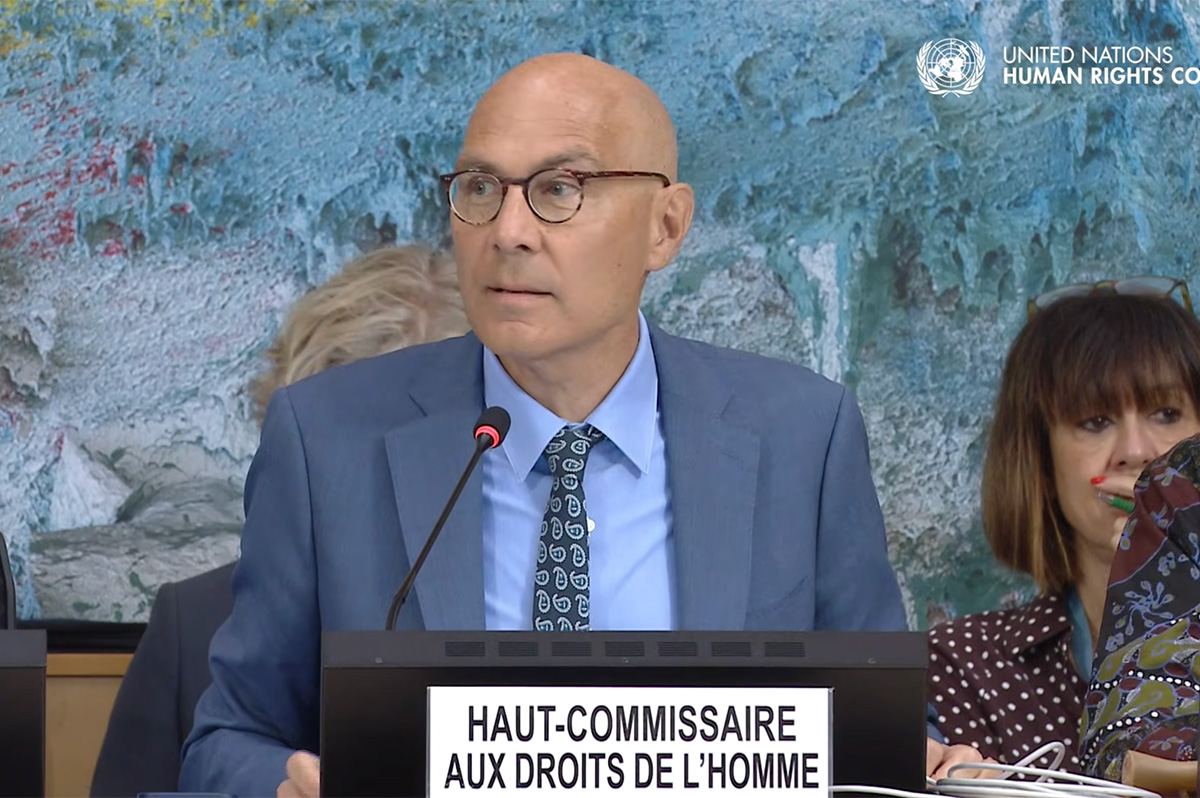
UNITED NATIONS — U.N. High Commissioner for Human Rights Volker Türk on Monday said there is a “comprehensive onslaught” against LGBTQ and intersex rights around the world.
“We know that progress for human rights has never been linear … but today’s backlash is deep and it is coordinated and the persecution of LGBTIQ+ people around the world is escalating at an alarming rate,” he said during an U.N. LGBTI Core Group event that took place on the sidelines of the U.N. General Assembly.
The Core Group is a group of U.N. member states that have pledged to support LGBTQ and intersex rights.
Mexico and Norway are the current co-chairs. The U.S. withdrew from the Core Group shortly after the Trump-Vance administration took office in 2025.
“We know that across every region, LGBTIQ+ people continue to live and to love in the face of hostility and exclusion,” said Türk. “Their rights, safety, well-being are under attack … it’s a comprehensive onslaught.”
The event took place days after Turkish authorities carried out raids in Istanbul and in other cities across the country that targeted the country’s LGBTQ community.
Türk in his remarks specifically referenced Turkey and Senegal, which further criminalized consensual same-sex sexual relations earlier this year. He also noted some countries have deemed LGBTQ and intersex rights groups as “terrorists, extremists, or national security threats.”
The Trump-Vance administration’s anti-terrorism strategy that it released in May specifically references “radically pro-transgender” groups.
Türk noted “more and more candidates and political parties … use bigotry in order to promote anti-LGBTIQ+ sentiments” during election campaigns. He pointed out trans people and women are often targeted.
“These attacks are designed to confuse and to distract,” said Türk. “They cloak bigotry in the language of decency and morality. They evoke the protection of children against manufactured threats, while real and growing dangers to children’s lives and futures, including those linked to technology, to inequality and to the climate disaster remain unaddressed.”
“More broadly those who seek to erase difference and independent thought, expression, and voices from our societies often begin this by erasing LGBTIQ+ people from books and classrooms, from film and culture and from our streets,” he added. “So, this is always the beginning. It’s a wedge issue that unfortunately is used politically to erase other portions of society eventually.”
90 percent of LGBTQ, intersex groups have lost funding since 2025
The event took place less than two weeks after Outright International released a report that found 90 percent of LGBTQ and intersex rights groups around the world have lost funding since January 2025.
The Trump-Vance administration froze nearly all U.S. foreign aid shortly after it took office.
Secretary of State Marco Rubio in March 2025 announced 83 percent of U.S. Agency for International Development contacts had been cancelled, and the State Department would administer the remaining programs. USAID officially shut down on July 1, 2025.
Rubio issued a waiver that allowed PEPFAR and other “life-saving humanitarian assistance” programs to continue to operate during the funding freeze. The Washington Blade has previously reported PEPFAR-funded programs in Kenya and other African countries have been forced to suspend services and even shut down because of gaps in U.S. funding.
Dutch Foreign Trade and Development Cooperation Minister Sjoerd Sjoerdsma in his remarks at the Core Group event noted his government — openly gay Prime Minister Rob Jetten took office in February — will pledge €50 million ($57.29 million) to support LGBTQ groups around the world. British Under Secretary of State Chris Elmore pointed out his government has pledged £21 million ($28.05) from 2026-2029 to bolster LGBTQ and intersex rights around the world.
“Equality benefits everyone,” said Elmore.
Mexican Foreign Affairs Secretary Roberto Velasco Álvarez, Norwegian International Development Minister Åsmund Aukrust, Icelandic Foreign Affairs Minister Þorgerður Katrín Gunnarsdóttir, Maltese Foreign and European Affairs Minister Chris Fearne, Brazil’s National Secretary for the Promotion and Defense of the Rights of LGBTQIA+ People Symmy Larrat, Irish State Minister for International Development and Diaspora Neale Richmond, South African Department of International Relations and Cooperation Director-General Zane Dangor, Uruguayan Multilateral Affairs Director María Noel Beretta, French Ambassador-at-Large for Human Rights Isabelle Rome, Cabo Verdean Permanent U.N. Representative Tania Romualdo, Estonian Department of International Organizations and Human Rights Director General Käthlin Saluveer, and Swedish International Development Cooperation Director-General Camilla Nevstad Bruzelius also spoke at the event that Outright International Executive Director Maria Sjödin moderated.
Other speakers included Jon Tilli of Deutsche Bank, UN Women Civil Society Division Director Lopa Banerjee and two activists: Gloria Quaye of Ghana and Nhuun Wannapong Yodmuang of Thailand.
Quaye was among the 21 people who Ghanaian authorities arrested in 2021 during a human rights workshop for LGBTQ activists. She was detained for three weeks until a court dropped the charges.
“In times of adversity, countries can often be tempted to turn inward at precisely the moment when international cooperation is needed the most,” said Sjödin. “The United Nations, of course, brings together sovereign states, but sovereignty cannot be used to decide whose rights count.”
Then-first lady Jill Biden in 2024 spoke at a Core Group event that took place on the sidelines of that year’s U.N. General Assembly. Then-Vice President Joe Biden in 2016 headlined the Core Group event that coincided with that year’s U.N. General Assembly.
The U.S. did not send any representatives to this year’s event.
Jessica Stern, the former special U.S. envoy for the promotion of LGBTQ and intersex rights under the Biden-Harris administration, and former U.S. Ambassador to Bosnia and Herzegovina Eric Nelson were among those from the U.S. who attended.
“The movement for the equal rights of LGBTIQ+ people has much to teach the world, particularly at this moment, but some seek to erase or reject those lessons,” said Türk. “The history of the movement for the equal rights is full of courage, dignity, and solidarity and it is an integral part of the human rights movement.”
“It’s not something separate; it’s an integral part of the full human rights movement,” he added. “In claiming their freedom, the LGBTIQ+ communities helped free our societies. We need to see it as a broader strive for freedom.”
White House
White House press pool pushes back after Trump bars three outlets
As President Trump refuses entry to outlets he deems unreasonable, lawsuits have been filed to regain access to the West Wing
Past the first checkpoint to get into the White House, multiple carts filled with camera equipment sat along a fence. Wagons loaded with tripods, cables, mics, and cameras sat just past where they normally would be working at full power. Today, they were turned off and packed away.
Last week, President Donald Trump decided to bar CNN, MS NOW and POLITICO from the White House following reporting he considers “FAKE NEWS.”
Trump, in a post on Truth Social on Monday morning, described his move as “instituting an assault on the FAKE NEWS,” which he said has “grown like Cancer in our beloved United States of America.”
“It is corrupt, purposeful, pervasive, fully coordinated, and totally out of control,” he wrote on the social media site he owns. “It is a threat to our National Security, and must be stopped, NOW!”
As a result, all of the major television networks that comprise the television press pool — ABC, CBS, NBC, CNN, and Fox News — suspended their White House TV pool coverage. They decided to no longer send camera crews to cover President Donald Trump’s events.
“The public has a vital interest in receiving accurate, independent information about its government,” the five White House TV pool networks said in a joint statement Monday. “No administration should restrict a news organization because it objects to its reporting.”
POLITICO, CNN and MS NOW filed a lawsuit Monday to immediately restore access for their reporters, who had their credentials confiscated by the Secret Service.
In the White House, there was a noticeable shift in the atmosphere. The Washington Blade is the only LGBTQ news outlet that is part of the White House Press Pool, and was acting as the primary print pooler as the situation unfolded on Monday.
Whispers about who might be kicked from the press pool next could be heard both in the press area of the West Wing, as well as outside the part of the White House dedicated to filming the president’s office. The area where TV stations normally film their live shots of the White House while reporting looked less busy than a normal Monday — especially as the president made his way to New York City ahead of the UN General Assembly meeting this week.
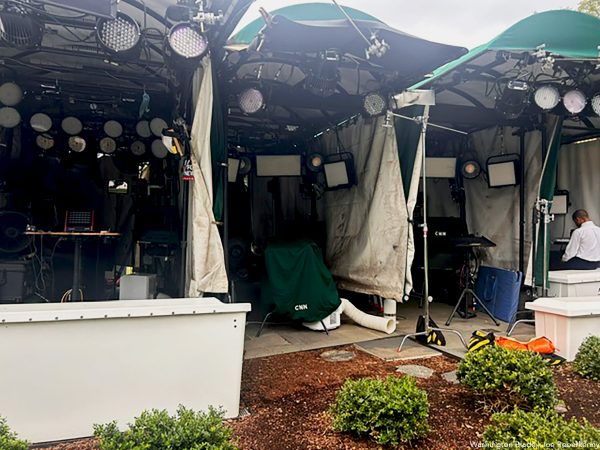
CNN’s outdoor filming area, which is staffed nearly at all times, sat dark with a green cover over the space that normally houses its cameras and political reporters like Kaitlan Collins.
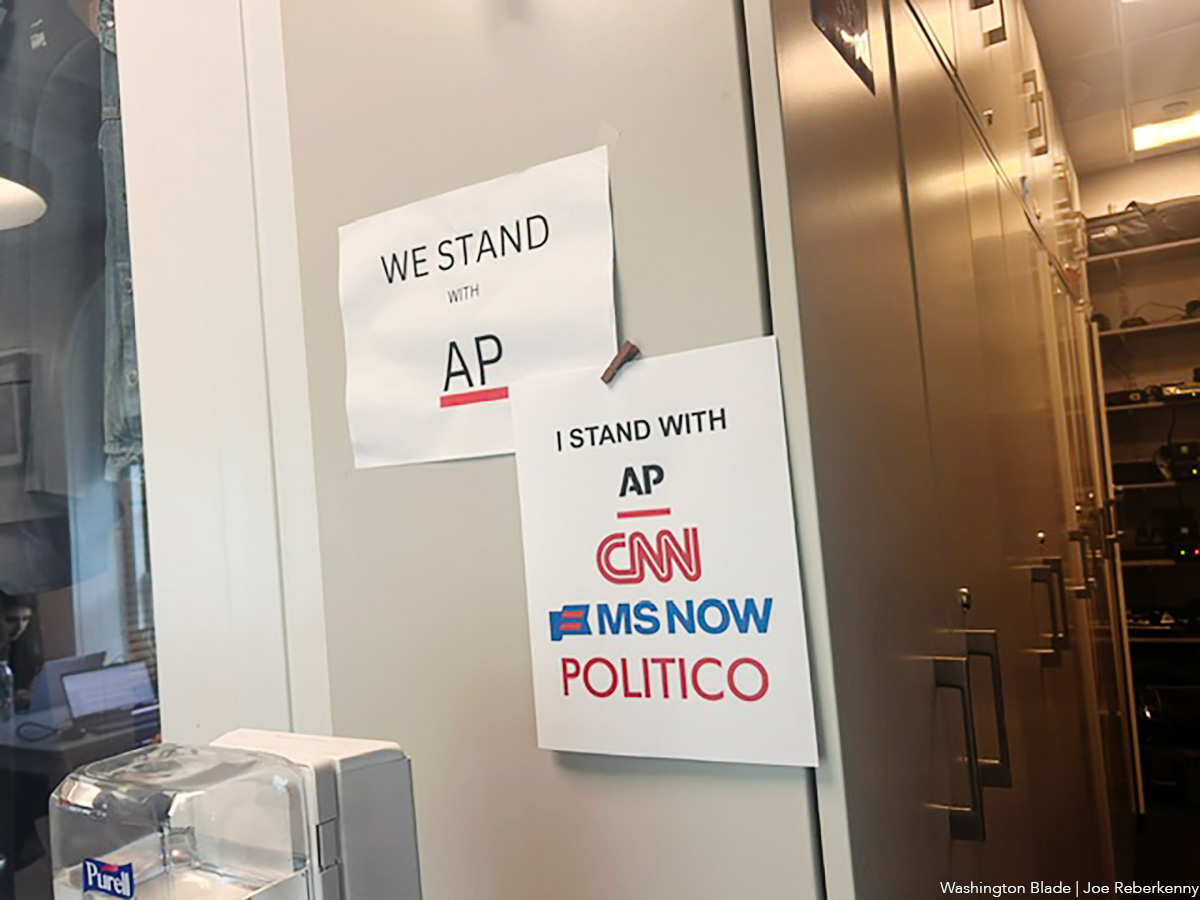
There were small signs of solidarity from other outlets in the press office. A sign that has hung outside one of the news offices in the West Wing was updated. It originally read, “WE STAND WITH AP” following President Trump’s first attempt at removing a news outlet he deemed unfavorable. It now includes “I STAND WITH AP CNN MSNOW POLITICO.”
The change could also be felt as the press pool attempted to cover the president.
There was a ribbon cutting in honor of the $6 million helipad installed at Trump’s behest — which had nearly no audio as a result of fewer microphones in the space following the outlets’ removal on Monday afternoon, and partly because of the loud sound of Marine One.
Vice President JD Vance defended Trump when asked about the changes to TV access at the White House, standing with the president despite this likely being a violation of the First Amendment’s guarantee of a free and fair press.
“He’s not banning media outlets. What he’s doing is saying we’re not going to give you special access to the White House if you engage in what is effectively propaganda,” Vance said, alleging that 92% of the stories from CNN, MS NOW and Politico about Trump are “negative.”
“That’s not representative of the American people. It’s not representative of public opinion,” Vance said.
He pushed back on the notion that this is a hindrance on free speech — claiming access to the president through White House visitation is a privilege — a privilege that in this administration, at least until courts weigh in, could change the landscape of the American media system.
“It’s about basic fairness. They can still report. They still have the access to free speech. They’re just not going to get an office in the White House anymore,” Vance said.
Jacqui Heinrich, the White House Correspondents Association President condemned the president’s actions in restricting media access in a statement sent to WHCA members on Saturday.
“Today’s action revoking access for journalists from CNN, POLITICO, and MSNOW violates the First Amendment. The implications extend beyond these organizations: a standard used to exclude one news outlet because of its coverage could be applied to any outlet in the future.
“The American people, through a free and independent press, must be able to scrutinize those elected to power, regardless of whether government officials view it favorably. That’s why courts have repeatedly held that once the White House provides access to journalists, it cannot deny that access arbitrarily or based on the content of their reporting. The WHCA calls on the administration to immediately restore our colleagues’ access.”

For lesbian victims of domestic violence, competent care is scare

UN human rights chief sounds alarm over ‘comprehensive onslaught’ against LGBTQ rights

White House press pool pushes back after Trump bars three outlets

PHOTOS: Shenandoah Valley Pride

Long-time DignityUSA executive director announces retirement

Jeremy Moss looks to bring LGBTQ advocacy from Lansing to Capitol Hill

Republican challenger misgenders McBride during forum, forced to leave

Queer mega stars coming to D.C. this fall

Activists protest outside Turkish Embassy in D.C.

A roundup of fall events not to be missed
-

 Congress5 days ago
Jeremy Moss looks to bring LGBTQ advocacy from Lansing to Capitol Hill
-
Delaware4 days ago
Republican challenger misgenders McBride during forum, forced to leave
-
Turkey4 days ago
Activists protest outside Turkish Embassy in D.C.
-
Music & Concerts4 days ago
Queer mega stars coming to D.C. this fall