Politics
Obama vs. Biden: No easy task comparing the two on LGBTQ records
One president moved with caution, the other with speed
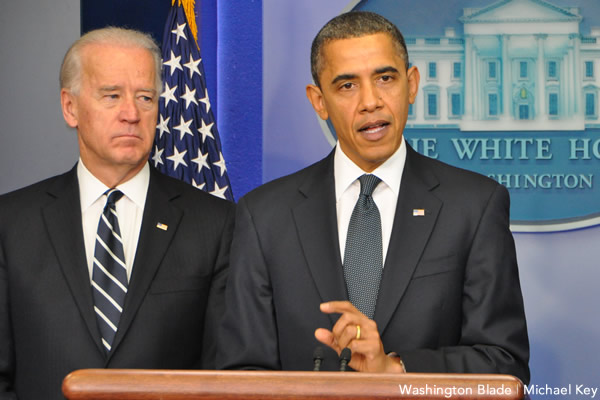
More than seven months into his administration, President Biden has quickly gained a reputation for being a champion for the LGBTQ community — but don’t ask whether that LGBTQ record is superior to his predecessor Barack Obama’s without expecting a fight.
Among the LGBTQ initiatives marking Biden’s tenure within a few months: Undoing the transgender military ban; ordering federal agencies to implement a U.S. Supreme Court ruling against anti-LGBTQ discrimination to the fullest extent possible; and integrating LGBTQ human rights into his foreign policy vision. When Obama was in office, policies along those lines for the LGBTQ community were more spanned out and took an entire eight years to implement.
Take, for example, transgender military service. Biden through an executive order within the first week of his administration reversed Trump’s policy-by-tweet banning transgender people from serving in the U.S. armed forces “in any capacity.” During the time of President Obama, who took office when “Don’t Ask, Don’t Tell” for openly gay service members was still law of the land, it took until the last six months before the end of his second term to lift older regulations similarly against transgender service.
Matt Hill, a White House spokesperson, wasn’t shy about ticking off each of these achievements when asked about the comparison between Obama and Biden on LGBTQ issues, but didn’t discount the work of the earlier president.
“President Biden is proud of the work accomplished alongside President Obama to advance LGBTQ+ equality from championing marriage equality, enabling LGBTQ+ Americans to serve openly in the military, combatting and preventing discrimination and more,” Hill said. “The Obama-Biden administration made historic progress for LGBTQ+ people at home and abroad, and the Biden-Harris administration is proud to continue making historic progress in the march toward full equality.”
If the chorus from the Lily Allen song “Not Fair” is coming to you in terms of comparing Biden to Obama on LGBTQ issues, that response would be justified. Trying to reach a definite conclusion about who was better is complicated simply because of different times.
Obama came into office when LGBTQ rights were unpopular compared to today and no president ever before had billed themselves fully as an ally the LGBTQ community. Not long ago, President George W. Bush scored political points and possibly won re-election as the war in Iraq turned into a fiasco by making a U.S. constitutional amendment against same-sex marriage a centerpiece of his campaign.
Mara Keisling, who as former executive director of the National Center for Transgender Equality advocated for LGBTQ issues in both the Obama and Biden administrations, said “it is that way” Biden’s achievements have been more rapid and Obama’s more spread out over eight years, but added comparing the two is “apples and oranges.”
“We were in a very different place in 2009,” Keisling said. “There had never been a federal government administration that did trans policy before, and so they had to go about it more slowly or they had to figure out how to do it. Second, there weren’t there weren’t a lot of experienced advocates in the LGBT movement. There were really very few people who had done any administrative advocacy in 2009, and now we’re starting this administration with 50 or 60 experienced advocates who got right to it.”
Keisling said the preceding Trump administration, with all its anti-LGBTQ rollbacks, was ironically helpful in getting Biden started because “Donald Trump accidentally left the whole blueprint for what to do, which is just fix a lot of the things he broke.”
The difference in times is key to understanding why to bother comparing Obama and Biden on LGBTQ issues in the first place when they’re both generally regarded of supporters of LGBTQ people. It’s more a way to reflect on changing times, recognizing moving quickly on LGBTQ issues was more difficult 12 years ago than it is now.
Nonetheless, despite the Obama years being a different epoch, LGBTQ rights advocates at the start of his administration were outright hostile to Obama for not moving more quickly to push the nation forward, particularly on holding out on “Don’t Ask, Don’t Tell” repeal until two years in office. An initial legal brief defending the anti-gay Defense of Marriage Act in court, which compared same-sex relationships to underage and ancestral marriages, had LGBTQ people up in arms against a president they worked hard to elect.
The gay blogosphere, in its heyday at the end of the 2000s, skewered White House press secretaries Robert Gibbs and Jay Carney for inartful answers on Obama’s commitment to LGBTQ issues. Liberal bloggers such as John Aravosis at AMERICAblog, Pam Spaulding at Pam’s House Blend and Andy Towle at Towleroad had anti-Obama content alongside posts against Republicans.
Aravosis, in response to an email inquiry from the Blade, said making comparisons of Obama and Biden at this point in their presidencies is difficult given the different nature of the times.
“It’s always hard to compare 2008 and 2021,” Aravosis said. “They were different eras, with different demands. The three big issues for Obama were ‘Don’t Ask, Don’t Tell,’ DOMA and marriage equality. And we got him on board all three of those, with a little cajoling — DADT they delayed action on, DOMA they were defending in court, and marriage took until 2012 to get Obama on board. But eventually he did, on all those issues.”
Aravosis conceded at this time Biden comparatively has made “a ton of small to medium accomplishments early on,” and cited the confirmation of Pete Buttigieg as the first openly gay Senate-confirmed Cabinet secretary as one of “a few big ones.”
Even during the Obama years, Biden was credited with moving Obama forward, famously speaking out in favor of same-sex couples getting married on “Meet the Press” as Obama’s “evolution” on the issue was still taking place. Obama would come out for marriage equality days later. Biden had also spoken out in favor of an LGBTQ non-discrimination order in the workplace for federal contractors before Obama made that happen.
Keisling said even though some of Obama’s early caution and missteps had angered LGBTQ advocates at the time, such as excluding transgender people from a 2009 presidential memorandum seeking to expand partner benefits for same-sex couples, they ended up proving beneficial.
“I don’t think any of us really understood what a momentous thing that was,” Keisling said. “But it was from that memo that they immediately realized that the federal government had to protect trans federal employees.”
In contrast to early consternation under Obama, seven months into the Biden administration nary an objection has been heard from LGBTQ leaders, save for a legal brief claiming a right to defend an exemption to LGBTQ non-discrimination law for religious schools that wasn’t even based on the merits. To the contrary, Biden has been lauded as the greatest supporter of LGBTQ people in the White House as his administration has rolled back Trump’s anti-LGBTQ initiatives, fully embracing LGBTQ people in his first months without the need for public cajoling from voices seeking equality.
One person who has worked both in and outside the White House on LGBTQ issues is Brian Bond, now executive director of PFLAG and the first LGBTQ White House liaison under Obama. Bond, however, would not agree to an interview for this article.
Despite the early consternation, the long view on Obama is different. By the time his administration was over after eight years, the LGBTQ community could look back on hate crimes legislation signed into law, “Don’t Ask, Don’t Tell” repeal, marriage equality nationwide and transgender people being more visible and respected.
When the Washington Blade reached out to the Office of Barack and Michelle Obama for a comment on the comparison between Obama and Biden on LGBTQ issues, a spokesperson ticked off many of these achievements.
“We are so proud of President Obama’s record on LGBTQ issues, including repealing Don’t Ask, Don’t Tell, ending the government’s legal defense of the Defense of Marriage Act, and signing historic hate crimes legislation, but he’s always said the presidency is a relay race and there’s nobody he’d rather have holding the baton right now than Joe Biden, especially when it comes to matters of equality,” the spokesperson said.
It was based on Obama’s overall record, especially his endorsement of same-sex marriage at a critical time in 2012 when the issue was at the polls in four states, that gay commentator Andrew Sullivan in 2012 dubbed him the “First Gay President” for a high-profile cover article in Newsweek.
Sullivan, who has declared the fight for gay rights now over and has been critical of continued efforts in the LGBTQ movement, said the comparison between Obama and Biden on LGBTQ issues is no contest.
“Neither president is responsible for gay equality. We are,” Sullivan wrote in an email to the Blade. “But there is no comparison. Marriage equality and openly gay troops under Obama dwarf anything Biden has done. The Bostock decision — the biggest advance in history for trans rights — happened under Trump.”
Obama, in an interview published in The Advocate last month, said he would “love my legacy to be overshadowed, because it would mean another president was doing even more to protect LGBTQ rights,” which he said was why he was pleased with Biden’s initiatives.
“Now, we obviously have more work to do,” Obama added. “We need to do even more to guarantee basic rights and protections for every American. My hope is that whatever success we had while I was president proves that progress is possible.”
A continued one-up Obama has over Biden in terms of LGBTQ issues is major legislative achievements. For all the hurdles Biden has already cleared on LGBTQ issues compared to Obama, the Equality Act — the centerpiece of Biden’s campaign promise for LGBTQ people — continues to languish in the U.S. Senate and is all but dead.
By this time in the Obama years, the measure honoring gay teenager Matthew Shepard, who was brutally murdered, was on its way to the White House as an amendment to major defense spending authorization legislation in Congress. The Equality Act, on the other hand, hasn’t even gotten a vote in the Senate Judiciary Committee.
Aravosis said the lack of traction for the Equality Act in the Senate is a “similar dilemma” to the one supporters of gay rights faced in 2010 with hurdles in getting “Don’t Ask, Don’t Tell” repealed.
“We were extremely concerned that we’d lose the House in the 2010 midterm elections, so we wanted to get DADT repealed BEFORE that,” Aravosis said. “Same problem today. We need to get the Equality Act passed BEFORE the 2022 midterm elections, lest we lose the House or Senate.”
At the end of the day, however, unlike his criticism for Obama for not moving quickly on “Don’t Ask, Don’t Tell” repeal, Aravosis said he doesn’t fault Biden for not getting the Equality Act on his desk.
“With a one-vote margin in the Senate, and the filibuster still in place, I’m not sure how we do that,” Aravosis said. “So, no, I don’t blame Biden for the current vote count being extremely difficult in the Senate.”
Biden last month signed a resolution designating the Orlando, Fla.-based Pulse nightclub, where 49 people were killed in a mass shooting, as a national monument, but that went through Congress unanimously and required no significant political power.
Keisling, when asked if the lack of major legislative achievements on LGBTQ issues detracts from Biden’s record, said the fault lies elsewhere.
“Nothing’s happening in Congress,” Keisling said. “What he has gotten done is kind of amazing — I mean in general not the LGBT stuff, because there really hasn’t been LGBT stuff — because Congress is currently broken. The Senate is broken anyway.”
When the Blade pointed out by this time in his administration Obama was on track to sign hate crimes legislation into law in October 2009 and asked what has changed, Keisling replied, “Talk to me about that in December.”
“I’m more optimistic than you are,” Keisling said. “I know the Blade has tried really hard to express pessimism. But we’re working it, it is still very much alive and there’s actual conversations going on between the right senators. I’m very hopeful still.”
The Human Rights Campaign, which has lobbied on LGBTQ issues in both the Obama and Biden administrations, didn’t respond to a request to comment for this article.




2026 Midterm Elections
Chris Pappas wins NH Democratic Senate primary
Gay congressman running to succeed retiring U.S. Sen. Jeanne Shaheen

New Hampshire Congressman Chris Pappas on Tuesday won the Democratic primary in the race to succeed retiring U.S. Sen. Jeanne Shaheen (D-N.H.) in the U.S. Senate.
Pappas defeated Karishma Manzur, who was his primary challenger, by a 61.8-36.1 percent margin.
The gay congressman will face off against former U.S. Sen. John E. Sununu, who defeated former U.S. Sen. Scott Brown in the Republican primary.
“Tonight’s victory sends a clear message that voters are looking for leaders who will fight for their rights, their freedoms, and to be treated with dignity and respect,” said Human Rights Campaign President Kelley Robinson in a statement.
She campaigned for Pappas in Manchester, New Hampshire’s largest city, on Aug. 30.
“Chris Pappas has delivered results, stood up for equality, and showed up for the people he serves,” said Robinson in her statement. “HRC was proud to mobilize Equality Voters across New Hampshire to help power this win. We don’t have a second to waste between now and November. We look forward to continuing our work with Rep. Pappas as he drives toward victory in November so he can help return a pro-equality majority to the United States Senate.”
A poll the University of New Hampshire Survey Center released on Aug. 26 showed Sununu ahead of Pappas by a 45-43 percent margin if they were to face off in the general election. The margin of error is +/-2.1 percent.
Pappas would become the first openly gay man elected to the U.S. Senate if he were to win in November.
2026 Midterm Elections
Markey’s primary win deemed success for LGBTQ activists
Mass. lawmaker champions transgender rights
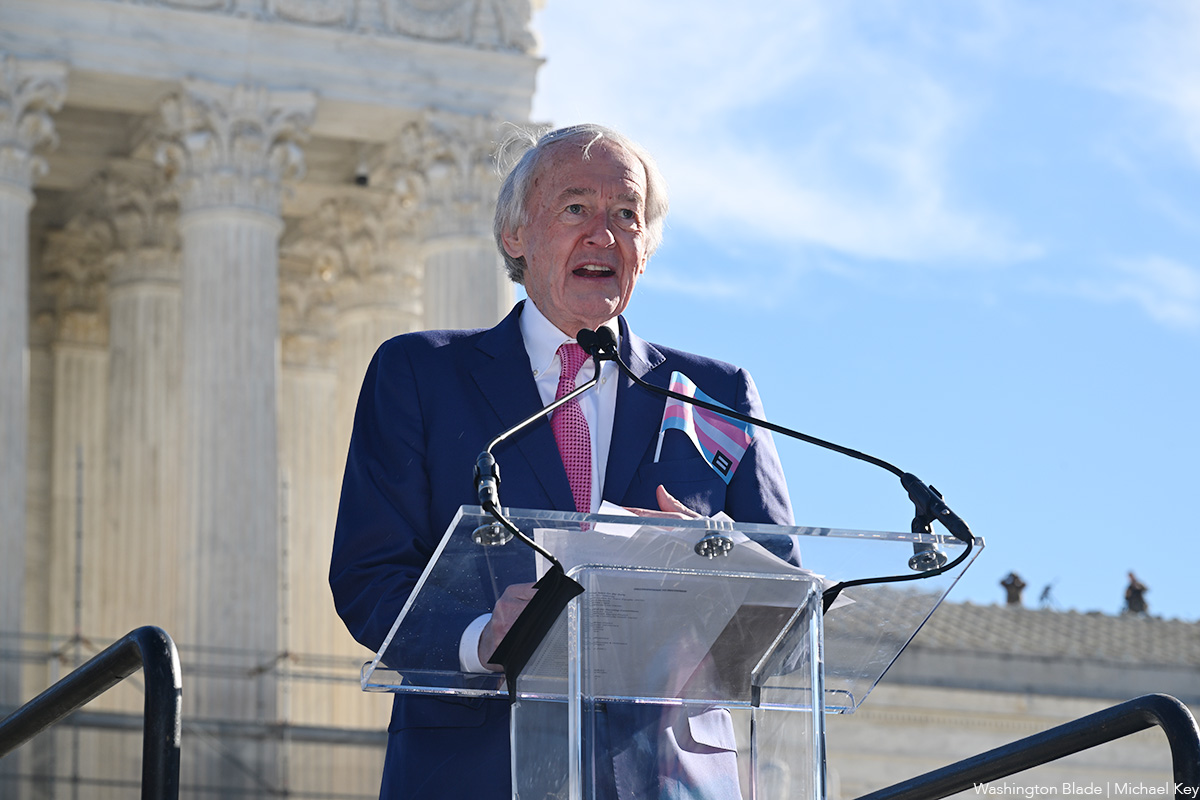
U.S. Sen. Ed Markey (D-Mass.) clinched the Democratic seat for his reelection campaign in Massachusetts’s primary election on Tuesday.
Markey won the deep-blue state with 64.8 percent of the vote, according to NBC News, triumphing over Marine Corps combat veteran and Congressman Seth Moulton, who received 35.2 percent of the vote.
Massachusetts’s primary election, which determined which Democratic candidate will head to the polls to face off against the Republican challenger in November, is being considered a victory for LGBTQ-inclusive policy, as well as for a divisive pro-transgender rights candidate — both things Markey has become an outspoken champion of.
Markey has experience at multiple levels of government, from the state level, where he served three terms in the state House of Representatives, to his federal tenure, including 20 terms in the U.S. House of Representatives and is now serving his second term as a senator. He has become a fixture of a changing Democratic Party in one of the most consistently blue places in the U.S.
This primary — and much of the national discussion surrounding the Senate seat — focused a lot of campaigning power on fighting the growing sentiment, led mostly by Republicans, that the frustration many Americans feel lends itself to an anti-establishment and anti-incumbent attitude.
Markey ran his campaign using his past as a reflection of his commitment to constantly putting his best foot forward for Bay Staters — particularly with apprehension for issues younger and more progressive democrats have been righting for — including Green New Deal and “Medicare for All” while Moulton — who was also elected to federal office prior to this run — campaigned on being younger than Markey, arguing that he was not the same type of established politician.
Moulton also faced backlash for negative comments about trans athletes, sparking criticism for those who did want younger candidate but want for trans rights to be protected.
Markey’s track record of supporting the LGBTQ community is one of the most clear in federal politics, one that has garnered a “100 percent lifetime voting record” on the Human Rights Campaign’s PAC politician review scorecard.
That list of Markey’s actions includes being a cosponsor of the Equality Act, driving landmark legislation to ensure federal protections for LGBTQ Americans, and being one of the most vocal proponents for trans rights in the federal government — specifically in multiple appropriations bills and in the National Defense Authorization Act. He was also the lead sponsor of the Transgender Health Care Access Act and the Transgender Bill of Rights resolution.
Markey first introduced the Transgender Bill of Rights in the Senate in 2023, where it ultimately failed to be brought to law. He reintroduced the legislation this year once again. This was a direct response to the attitude pushed by many conservatives after 2021, when the push to minimize trans rights started to become a key part of their cause and has been constantly propped up by the Trump-Vance administration.
“Massachusetts needs a senator who stands up and fights back, a senator who never forgets who they are fighting for,” Markey said during his victory speech. “That has been the mission of my life, and it always will be.”
Following the calling of the primary, a slew of LGBTQ organizations rallied behind Markey, many pushing his past as an asset that puts his money where his mouth is through advocating for legislation specifically protecting the LGBTQ community.
Tyler Hack, the executive director of the Christopher Street Project, an organization dedicated to pushing for legal protections for trans americans, released a statement following Markey’s win. Hack argued that putting forward such a staunchly pro-trans candidate is a win for the community, especially after endorsing him earlier this year.
“Tonight, anti-trans politics lost. Massachusetts rejected the idea that attacking transgender people is a shortcut to political power. Voters chose a different path: one where equality is not negotiable, cruelty is not courage, and transgender people do not have to disappear for Democrats to succeed.”
The Human Rights Campaign also endorsed him as a candidate earlier this year and issued a statement via its president, Kelley Robinson.
“Ed Markey has spent decades fighting for LGBTQ+ equality, for working people, and for a more livable world,” Robinson said. “He knows why equality matters. He’s stood with us no matter what. We were proud to endorse him this year, and when a pro-equality majority takes back the Senate this fall, we will continue to count on him as a champion for our community.”
Markey is running for reelection against Republican John Deaton in November, where he is expected to win.
Congress
HRC president campaigns for Chris Pappas in NH
Gay congressman running to succeed retiring U.S. Sen. Jeanne Shaheen

Human Rights Campaign President Kelley Robinson on Sunday campaigned for U.S. Rep. Chris Pappas (D-N.H.) in New Hampshire.
Robinson traveled to Manchester, the state’s largest city, nine days before the Sept. 8 primary that will determine who will vie for retiring U.S. Sen. Jeanne Shaheen (D-N.H.)’s seat.
We’re hitting the pavement across New Hampshire to fight for a freer, fairer future for everyone.
Glad to have Human Rights Campaign President @KelleyJRobinson join us for a canvass launch in Manchester today. pic.twitter.com/XWCEaQxy4o
— Chris Pappas (@ChrisPappasNH) August 30, 2026
Former U.S. Sen. John E. Sununu, who represented New Hampshire in the U.S. Senate from 2003-2009, will face off against former U.S. Sen. Scott Brown, who represented Massachusetts in the U.S. Senate from 2010-2013, in the Republican primary.
Karishma Manzur is among the Democrats challenging Pappas.
A poll the University of New Hampshire Survey Center released on Aug. 26 shows Sununu is ahead of Brown. The same survey shows Pappas ahead of Manzur and his other Democratic challengers.
The UNH Survey Center poll shows Sununu ahead of Pappas by a 45-43 percent margin if they were to face off in the general election. The margin of error is +/-2.1 percent.
Pappas would become the first openly gay man elected to the U.S. Senate if he were to win in November.

Historiography with heart

Remembering the LGBTQ heroes of 9/11 terrorist attacks

How Dolly became a folk saint for Appalachian queers

Report: 90 percent of LGBTQ groups around the world have lost funding since 2025

PHOTOS: SUNFESTIVAL

‘Here the Whole Time’ delivers queer coming-of-age comedy

Blade Foundation to host fundraiser in Rehoboth on Sept. 12

New book examines fashionista Audrey Smaltz’s fabulous life

Actress takes on bisexual ‘Ma’ Rainey in new Round House production

Iceland implements gender-neutral blood donor rules
-

 Movies4 days ago
‘Here the Whole Time’ delivers queer coming-of-age comedy
-
Out & About3 days ago
Blade Foundation to host fundraiser in Rehoboth on Sept. 12
-
Books3 days ago
New book examines fashionista Audrey Smaltz’s fabulous life
-
Theater3 days ago
Actress takes on bisexual ‘Ma’ Rainey in new Round House production