National
Obama earns mixed reviews on LGBT progress
Is the president our ‘fierce advocate’ or a disappointment?
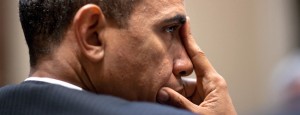
Once hailed as a ‘fierce advocate’ of LGBT equality, President Obama now inspires mixed reviews from activists. (Photo by Pete Souza; courtesy of the White House)
After 18 months in office, the harsh realities of politics and compromise have caught up to President Obama. Hailed as a champion of LGBT rights during the 2008 campaign, LGBT rights advocates now give Obama mixed reviews for his performance to date.
In a statement to the Blade, Joe Solmonese, president of the Human Rights Campaign, said “there’s no doubt” that Obama has done more for LGBT people than any other U.S. president in history.
“Within the constraints of current law, he’s advanced policies that will vastly improve the lives of tens of millions,” Solmonese said. “Has change occurred quickly enough? No. The pace of change will never be quick enough for a community that is consistently denied their equality.”
Solmonese noted that LGBT people continue to face inequality on “a whole host of fronts” that could be remedied through legislative or policy change.
“But none of that obscures the fact that this president has and will continue to be our partner and advocate,” Solmonese said.
But Richard Socarides, a gay New York attorney who was an adviser to former President Clinton, has a very different view of Obama’s tenure. Socarides said there’s a “pretty strong consensus that it’s been a disappointing 18 months.”
Among Obama’s early disappointments, Socarides said, was the invitation to Rick Warren, pastor of the Saddleback Church in California and staunch opponent of same-sex marriage, to give the invocation during last year’s inauguration.
More recently, Socarides said he was unhappy that Obama approved a “Don’t Ask, Don’t Tell” repeal compromise that “did not include a non-discrimination rule, nor even actual repeal.”
“When Obama took office, these were our priorities: open military service, a federal statute banning workplace discrimination, and repeal of federal anti-marriage laws,” Socarides said. “You tell me how we’re doing.”
Socarides also criticized the White House for failing to install a senior official whose primary responsibility is LGBT rights, much like the role he held in the Clinton administration.
“There is no gay person in Obama’s inner circle, period,” Socarides said.
Shin Inouye, a White House spokesperson, said Obama ran on a commitment to bring change to all Americans — including LGBT people — and since taking office, the president has “taken many steps toward achieving that goal.”
Inouye noted the signing of federal hate crimes legislation as among Obama’s accomplishments for LGBT people and said the president looks forward to signing more pro-LGBT legislation.
“The president and his administration remain committed to achieving equality for all, and it’s clear that we’re moving forward,” Inouye said.
Two years ago, he issued an open letter during Pride month outlining his promises to the LGBT community.
“I’m running for president to build an America that lives up to our founding promise of equality for all — a promise that extends to our gay brothers and sisters,” Obama wrote at the time. “It’s wrong to have millions of Americans living as second‐class citizens in this nation. And I ask for your support in this election so that together we can bring about real change for all LGBT Americans.”
In the letter, Obama pledged to “place the weight” of his administration behind the enactment of hate crimes protections legislation and to pass a trans-inclusive Employment Non-Discrimination Act.
Obama has sometimes been credited with having a role in the decision to advance the hate crimes legislation last year as an amendment to defense authorization legislation.
Progress on ENDA, on the other hand, has been stagnant. The bill remains pending before committees in the House and Senate and many supporters are concerned that lawmakers won’t take up the bill by year’s end.
Mara Keisling, executive director of the National Center for Transgender Equality, noted that Obama “exerted appropriate influence” in guiding the hate crimes legislation toward passage.
On ENDA, Keisling said the administration has been “as helpful as they can be” to this point, and she expects the president “will be a lot more helpful once it starts moving.”
At this point, Keisling said “there really hasn’t yet been much for them to do” on ENDA.
Keisling noted that for congressional hearings on ENDA last year in the House and Senate, the administration sent officials who provided “really great testimony” in favor of moving forward with the legislation.
“If the president had prioritized ENDA instead of, I don’t know, health care reform or financial reform or bank bailouts, we’d be better off, but he prioritized what he prioritized,” she said. “I’m very hopeful that when ENDA does start moving, the White House will be extremely supportive and will help get it done.”
Also in the letter, Obama promised to “use the bully pulpit” to urge states to treat same-sex couples equally in their family and adoption laws. He additionally advocated for the establishment of civil unions as the best way to advance rights for LGBT couples.
“But I also believe that the federal government should not stand in the way of states that want to decide on their own how best to pursue equality for gay and lesbian couples — whether that means a domestic partnership, a civil union, or a civil marriage,” Obama wrote.
Additionally, the presidential candidate said he supported “complete repeal” of the Defense of Marriage Act.
“Federal law should not discriminate in any way against gay and lesbian couples, which is precisely what DOMA does,” Obama wrote.
Obama has stuck to his position on same-sex marriage as several jurisdictions — such as Iowa, Vermont, New Hampshire and D.C. — have advanced marriage rights for same-sex couples. The White House has either said nothing in response to those developments or reiterated that Obama prefers civil unions.
Evan Wolfson, executive director of the New York-based Freedom to Marry, said Obama has “taken some positive steps” in advocating for same-sex couples, but hasn’t “matched his actions to his words.”
Wolfson said Obama should be leading the fight to repeal DOMA legislatively through the Respect for Marriage Act, a bill pending in the U.S. House, and should stop urging judges to “rubberstamp” DOMA in Justice Department briefs defending the statute against legal challenges.
“And, most importantly, he should make the case to the American people that same-sex couples deserve fair and equal treatment under the law — using personal stories and appeals to values such as fairness, respect for commitment and the Golden Rule,” Wolfson said.
Another item that Obama mentioned in the letter is repeal of “Don’t Ask, Don’t Tell.” Late last month, Congress voted in favor of a compromise measure that would end the law after the Pentagon completes its study on the issue at the end of the year.
Alex Nicholson, executive director of Servicemembers United, said the White House’s endorsement of the compromise the week that Congress voted on it was helpful in finding the votes needed to advance the measure.
“The fact that the White House was willing to come out and publicly support a repeal plan and get the Pentagon to do the same was a critical element in getting that passed in the Senate Armed Services Committee,” Nicholson said.
Still, Nicholson said he didn’t know how involved Obama was in lobbying members of the House and Senate directly to vote in favor of repeal once the deal was reached.
Also in the letter, Obama pledged to work to address HIV/AIDS, arguing that “we do not have to choose between values and science” in working to fight the epidemic.
“While abstinence education should be part of any strategy, we also need to use common sense,” he wrote. “We should have age‐appropriate sex education that includes information about contraception.”
Carl Schmid, deputy executive director of the AIDS Institute, said he had mixed feelings about Obama’s track record on the matter.
“There have been a lot of positives, but there still needs to be greater attention in response and resources,” he said.
Schmid said Obama has followed through on his plans to confront HIV/AIDS through scientific means and has set out to eliminate “abstinence-only” sex education programs through the budget process.
But Schmid noted the abstinence-only sex education programs were reinstated by amendment in the passage of the health care reform legislation.
“It’s not in the appropriations bill, but it’s in the managerial program now, just like it was in the past,” he said.
Schmid cited the reauthorization of the Ryan White Care Act as an accomplishment regarding HIV/AIDS, as well as passage of health care reform legislation, which he called a “huge, huge, huge accomplishment.”
He said the White House was of limited help, though, in pushing to renew funding under the Ryan White Care Act.
“The administration was very slow in getting their principle and positions out on getting the Ryan White reauthorized,” he said. “They didn’t speak out and early enough. Ryan White is up for renewal in 2013 — right before all this health care reform kicks in. We’re going to need the administration’s support for the continuation of Ryan White after 2013.”
Noting a national AIDS strategy is currently being developed in the White House, Schmid said he hopes the plan will provide the discussion of homosexuality at appropriate ages in sex education programs because HIV is often transmitted through men who have sex with men.
Schmid gave Obama credit for lifting the travel ban that prevented foreign nationals with HIV from entering the country, although he noted this process began under the Bush administration with the passage of the President’s Emergency Plan for AIDS Relief legislation.
Obama closed his letter by calling on people to step “outside our comfort zone” to win broader support for LGBT rights in places often considered homophobic, such as black churches.
“If we want to repeal DOMA, repeal ‘Don’t Ask, Don’t Tell,’ and implement fully inclusive laws outlawing hate crimes and discrimination in the workplace, we need to bring the message of LGBT equality to skeptical audiences as well as friendly ones — and that’s what I’ve done throughout my career,” Obama wrote.
In the letter, Obama noted that he spoke out against homophobia during the presidential campaign at the Ebenezer Baptist Church in Atlanta, Ga., where Martin Luther King, Jr. once preached.
Obama also spoke out against homophobia during a February speech at the National Prayer Breakfast in D.C., a gathering of Christian evangelical leaders. And late last month, Obama spoke in favor of LGBT rights during his keynote speech at the National Association for the Advancement of Colored People’s centennial convention.
Sharon Lettman, executive director of the National Black Justice Coalition, said Obama has “absolutely” been faithful to his promise of speaking out in favor of LGBT rights in places that are sometimes deemed unfriendly to LGBT people.
“I’ve experienced it on a number of occasions in predominantly black or all black venues,” she said. “Even in his normal stump speech, he makes reference to his support of LGBT equality.”
Lettman said as the first black president, Obama has a special role to play in educating black Americans about the LGBT community.
“He makes a point to always be inclusive,” she said. “He doesn’t selectively leave it out — not just in black churches, but in front of civil rights leaders and civil rights venues, like the NAACP convention, and other areas.”
Lettman said Obama is “definitely trying to paint a picture of one America” in his actions and his speeches.
“In so many ways, even in the progressive agenda, people don’t always select to include our community,” she said, “and I have to give him a lot of credit for making sure that he speaks with one voice about his support for LGBT equality.”



National
Man charged in Mall of America shooting plot inspired by Pulse massacre: report
Suspect exchanged hundreds of messages, pledged loyalty to ISIS
The U.S. Department of Justice charged Sheikhdoon Abdullahi Mohamud, 18, of Richfield, Minn., on Oct. 7 with one count of knowingly receiving a firearm and ammunition in order to commit a federal crime of terrorism. Mohamud allegedly planned to carry out a mass-casualty attack in support of ISIS, inspired in part by the Pulse nightclub massacre that took place on June 12, 2016 when then-29-year-old Omar Mateen murdered 49 people and wounded 58 – one of the deadliest mass shootings in U.S. history, and the deadliest targeting the LGBTQ+ community.
According to a DOJ statement release, Mohamud was arrested on Oct. 6 by the FBI, which had arranged to sell him an AK-47 assault rifle, magazines, and ammunition through an undercover FBI employee. Mohamud was arrested shortly after paying $600 in cash and taking possession of those items; he reaffirmed his intention to shoot people at the Mall of America during the transaction.
“Mohamud allegedly sought to carry out a mass-casualty shooting at the Mall of America, expressing a desire to emulate some of the most horrific ISIS-inspired attacks in the United States, including the atrocities at Pulse Nightclub and 2025 New Year’s Day attack in New Orleans,” said Assistant Attorney General for National Security John A. Eisenberg in the statement by the DOJ. “The National Security Division will continue to work closely with the FBI and Joint Terrorism Task Force to track down and prosecute ISIS-inspired terrorists in the United States.”
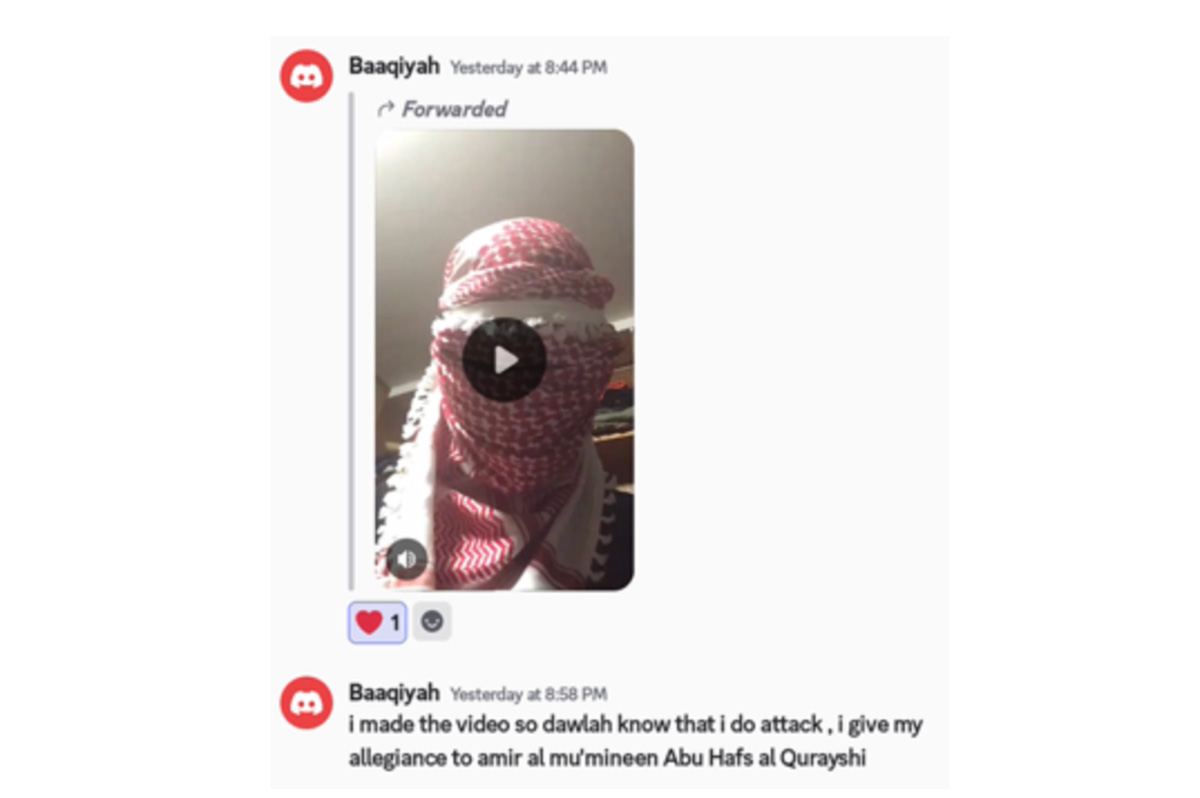
According to the complaint, beginning on or about December 2024, Mohamud had exchanged hundreds of messages through multiple social media and messaging apps with a confidential source, and expressed a desire to travel to Somalia to join a designated foreign terrorist organization to fight on their behalf.
The defendant stated many times that if he was unable to travel overseas because of a lack of funds, he planned to carry out a mass-casualty event in Minnesota in support of ISIS.
According to the DOJ, “In July 2026, Mohamud sent messages discussing his intent to carry out a mass-casualty shooting attack at the Mall of America because he claimed it was owned by Jews. He wrote that [he] wanted to kill 30 to 60 people so no one would go there.”
“During the course of his communications, Mohamud stated that he wanted to commit an attack similar to those of the Pulse Nightclub mass-shooting in Orlando, the Bondi Beach mass-shooting in Australia, and the New Year’s Day vehicle-ramming attack in New Orleans.”
This case is being prosecuted by Trial Attorney Ryan White of the National Security Division’s Counterterrorism Section and Assistant U.S. Attorney Benjamin Bejar for the District of Minnesota.
California
Calif. GOP gubernatorial candidate ad ‘disgusting attempt to exploit lesbian intimacy’
Activists, anti-LGBTQ religious leaders criticized Steve Hilton spot

Two women sit on a bed, a Pride flag hanging behind them. One is nervous; the other tells her to be calm and that she’ll do “all the work.” The music swells. The two hold hands and — fill out a ballot voting for Steve Hilton?
This is the new advertisement from the Hilton gubernatorial campaign that is drawing rebuke from both sides of the aisle, but for very different reasons.
Jorge Reyes Salinas, the communications director at Equality California, said the ad was an insult to the queer community.
“This ad is a disgusting attempt to exploit lesbian intimacy for political attention,” he said. The advertisement plays on media tropes that Salinas says “reduce lesbian and bisexual women … to sexual entertainment,” rather than showing them as well-rounded characters. “Any group of the LGBTQ+ community deserves the same dignity and respect as everyone else,” he said.
The ad is truly hyper-sexualized. It ends with one woman telling the other, “Now lick it.” The two pause and stare before she reveals an envelope to send the ballot, and large text pops up saying, “Just try it!”
Salinas characterized the ad as a desperate attempt to get attention from a candidate who is trailing far behind in the polls in heavily Democratic California. The Democratic candidate Xavier Becerra, who is endorsed by Equality California, holds a 25-point lead over Hilton according to recent polling by the UC Berkeley Institute of Governmental Studies.
Conservatives have also criticized the ad.
Influential evangelical Pastor Jack Hibbs thought the ad was distasteful and said, “lesbianism among college girls and some high school girls that right now is an actual pandemic of social ill.” Republican attorney general candidate Michael Gates said it undermines “the sanctity of the relationship between parents and their children.” This criticism is rather confusing because although the ad features two relatively young women, they both appear to be adults, not minors.
“The comments from Pastor Jack Hibbs should be criticized because there is nothing wrong with two women being attracted to each other,” Salinas said. “We’re calling out the ad’s stereotypes, while also rejecting the homophobia in the response to it … by other Republicans.”
The backlash from Hilton’s own party and supporters shows that an advertisement full of queer innuendo was ill-considered, considering the national GOP’s attacks on LGBTQ people in recent years. Hilton himself has been campaigning against transgender girls and women competing in school sports and using locker rooms that correspond with their gender identity. This context might be why Hilton’s political base responded to the ad just as poorly as the liberal voters he was attempting to court.
Hilton says the ad is part of a new series rolling out before Election Day, showing stereotypical California liberal archetypes voting for Hilton. He claims these ads are authentically filmed with real actors, as opposed to being A.I. generated, like many of his previous ads. One other advertisement has been released so far by the campaign showing a man at a spiritual retreat also being swayed to vote for Hilton, although it is notably absent of sexual innuendo.
Caleb Kaufman is a California Local News Fellow placed with the Los Angeles Blade. The California Local News Fellowship is a state-funded initiative to support and strengthen local news reporting. Learn more about it at fellowships.journalism.berkeley.edu/cafellows.
2026 Midterm Elections
Trump uses anti-trans slur against Democratic Senate candidate
President mocked Annie Andrews

President Donald Trump used an anti-trans slur against Democratic South Carolina Senate candidate Annie Andrews on Monday as he sought to rally support for Republicans in the state’s Senate race.
In a post on Truth Social, Trump attacked Andrews three times, referring to her as “trannie” while promoting U.S. Sen. Darline Graham (R-S.C.)’s campaign.
Andrews is running against Graham for a Senate seat in the solidly Republican state.
Earlier this year, Graham was specially appointed to the seat following the death of her brother, Lindsey Graham, who represented South Carolina in the Senate from 2003 to 2026.
Andrews, the Democratic nominee from the state, is a pediatrician that lives in Charleston with her three children. She told NBC News that she will “work with anyone to put South Carolina first.”
“As a mom and a pediatrician, I’m in this race to fight for my patients, my three kids, and South Carolina,” Andrews said, adding that “lowering costs and making life better for families across our state is going to take all of us working together.”
Andrews used the attention from the president’s attack to emphasize what she described as a focus on policy issues rather than the culture wars that have dominated much of the political debate.
“If you care more about your bills than the politics in Washington, this campaign is for you,” she added.
Trump’s remarks have drawn criticism from leaders on both sides of the aisle.
Senate Minority Leader Chuck Schumer (D-N.Y.) condemned Trump’s words Monday night on social media, calling his attacks on Andrews “despicable.”
“Annie Andrews is a mom and pediatrician who’s always put her community first — and she’s exactly who South Carolina needs representing them in the Senate,” Schumer said on X.
Former South Carolina Gov. David Beasley, a Republican, also criticized the president’s attack on Andrews, urging voters to “reject politics based on division and hate.”
“This is abhorrent. Elections don’t have to be about cruelty and lies. South Carolina deserves better,” Beasley wrote Monday night on X.
South Carolina has not elected a Democratic senator in nearly three decades.
Andrews’s campaign website does not mention her positions on LGBTQ issues.
The Washington Blade reached out to Andrews’s campaign for comment on Trump’s attack and her positions on transgender rights but did not hear back by time of publication.

Center for Black Equity honors leaders, activists at BE. Gala

In ‘The Lost Brontë,’ a complicated lie can lead to danger

CAMP Rehoboth Block Party returns Oct. 18

Essential queer horror classics for Halloween

Solidarity beyond the parade: the actual cost of Pride

10 years later, we still can’t shake Barry Jenkins’s ‘Moonlight’

‘Some Like It Hot’ a wild ride at renovated Bernard Family Theatre

D.C.’s LGBTQ homeless facilities face possible hit from Trump funding cuts

Trump uses anti-trans slur against Democratic Senate candidate

Calif. GOP gubernatorial candidate ad ‘disgusting attempt to exploit lesbian intimacy’
-

 Movies4 days ago
10 years later, we still can’t shake Barry Jenkins’s ‘Moonlight’
-
Theater4 days ago
‘Some Like It Hot’ a wild ride at renovated Bernard Family Theatre
-
District of Columbia4 days ago
D.C.’s LGBTQ homeless facilities face possible hit from Trump funding cuts
-
2026 Midterm Elections4 days ago
Trump uses anti-trans slur against Democratic Senate candidate