News
Where does the LGBT movement go in 2014?
More battles, victories anticipated this year in the aftermath of historic 2013
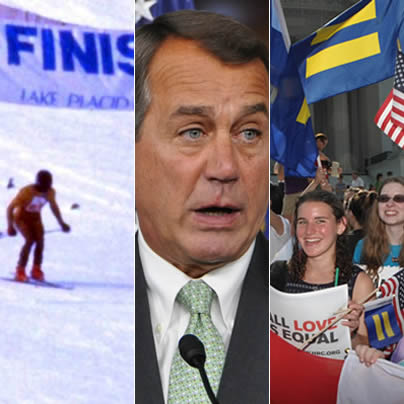
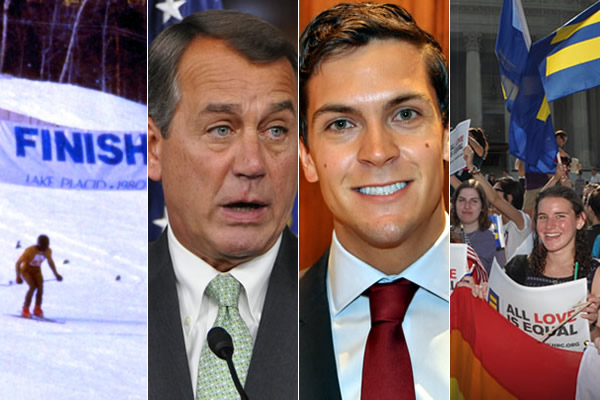
New advancements on LGBT rights are expected in 2014 in the aftermath of a milestone year in 2013. (Photo of the Winter Olympics public domain; Washington Blade photos of John Boehner, Sean Eldridge and activists in front of the Supreme Court by Michael Key)
Although 2013 will be a tough act to follow in terms of achievements for the LGBT community, some advocates say significant new battles and potential victories are on the horizon for 2014.
Additional court rulings on marriage and the upcoming Olympic Games in Sochi will attract attention, but the focus will also be on the lead-up to the mid-term elections in November 2014. Voters are expected to decide the issue of marriage equality at the ballot and make decisions in candidate elections that would shape LGBT rights in the future.
Next month, all eyes will be on the Winter Olympics to see what impact gay athletes coming to compete in Sochi, Russia, might have on the anti-gay laws there, including the now notorious law prohibiting pro-gay propaganda. The Olympics will be held between Feb. 6 and 23.
It remains to be seen whether any of the athletes who’ll compete in the games — or any of the three openly gay members of the U.S. delegation to the Olympics — will speak out against the anti-gay policies, and whether the Russian government will subject them to punishment under the propaganda law for doing so.
In terms of the advancement of marriage equality, no one is predicting movement in the state legislatures as seen in 2013, but action is expected at the ballot and as a result of numerous court cases filed throughout the country.
In Oregon, activists are preparing for a campaign to legalize same-sex marriage at the ballot. They’re already touting 118,176 signatures, which is more than 116,284 needed by July 3 to place the measure before voters. Success at the ballot would mean Oregon would become the first state in the country to overturn a state constitutional amendment banning same-sex marriage through a ballot initiative.
Another effort is underway in Ohio, where the group Freedom Ohio is touting a new poll showing 56 percent of Ohio residents support marriage equality as part of an effort to place a measure on the ballot in 2014. National LGBT groups, however, aren’t behind this endeavor and reportedly have said 2014 isn’t the year to bring marriage equality to the ballot in Ohio.
But 2014 may also see the return of state constitutional amendments at the ballot banning same-sex marriage. Opponents of same-sex marriage in Indiana are seeking a vote in the legislature on such an amendment, which would bring the issue before voters in the 2014 election.
It’s possible that a similar amendment may appear on the 2014 ballot in New Mexico, where anti-gay lawmakers unhappy with the state Supreme Court’s recent decision to legalize same-sex marriage have threatened to take action. However, the legislature needs to approve the amendment before it goes to voters, which is unlikely because Democrats control both the House and Senate.
Amid efforts to place the marriage issue on the ballot, courts may issue rulings in favor of marriage equality in any of the at least 23 states with pending marriage litigation. Such rulings could happen in Michigan, where a trial on the ban same-sex marriage has been set for February, or in Pennsylvania. A federal court in West Virginia may respond to a request for summary judgment filed Tuesday by Lambda Legal on behalf on same-sex couples seeking to wed in the state.
For the first time since the Supreme Court ruling against the Defense of Marriage Act, federal appeals courts will also take up the issue of marriage equality. The U.S. Tenth Circuit Court of Appeals will review the marriage lawsuit in which U.S. District Judge Robert Shelby recently instituted marriage equality in Utah, and the U.S. Ninth Circuit Court of Appeals will review Nevada’s ban on same-sex marriage in the case known as Sevcik v. Sandoval.
It’s possible that rulings at the appellate level could send the issue of marriage equality back to the Supreme Court as soon as next year.
Marc Solomon, national campaign director for Freedom to Marry, said the endeavors to advance marriage equality in 2014 will foster a better climate for the Supreme Court to make a “national resolution” in favor of marriage equality.
“We really don’t know, and nobody knows, which case is going to be that case that gets to the Supreme Court, when it’s going to happen, if it’s going to happen next year, if it’s going to happen in five years,” Solomon said. “Basically, we are full-steam ahead with what we call our ‘Roadmap to Victory’ to win more states, grow public support, get more unexpected allies, and demonstrate that the country is completely ready.”
Solomon said his organization also plans to participate in public education campaigns in Arizona, Ohio, Michigan, Colorado and Nevada in anticipation of going to the ballot to win marriage equality in 2016 in addition to a similar campaign in Pennsylvania to foster a climate for a court ruling in favor of marriage equality in the Keystone State.
Advancement of pro-LGBT federal legislation may also take place, although the chances such legislation will reach President Obama’s desk are low — to say the least — because Republicans control the House.
Supporters of the Employment Non-Discrimination Act are pushing for a vote in the Republican-controlled chamber following a bipartisan vote in the Senate in favor of the legislation. Although the legislation has 201 sponsors in a chamber where 218 votes are needed for passage, House Speaker John Boehner (R-Ohio) has repeatedly said he opposes the legislation when asked if he’ll bring up the bill for a vote.
Issues for married same-sex couples in the aftermath of the U.S. Supreme Court decision striking down Section 3 of the Defense of Marriage Act are also expected to surface. Senate Judiciary Committee Chair Patrick Leahy (D-Vt.) has pledged to hold a hearing on these outstanding issues.
Among them is the Social Security Administration’s continued hold on benefits claims for married same-sex couples in non-marriage equality states. Passage of the Respect for Marriage Act would address these issues by ensuring married same-sex couples would be able to receive federal benefits wherever they move in the country.
The Senate early this year may also take up a version of No Child Left Behind reauthorization — reported out on a party-line basis in June by the Senate Health, Education, Labor & Pensions Committee — that contains anti-bullying provisions along the lines of the Student Non-Discrimination Act and the Safe Schools Improvement Act.
Rea Carey, executive director of the National Gay & Lesbian Task Force, said the successes of 2013 are “much to celebrate,” but said they also highlight more work is necessary at the federal level — not just on LGBT-specific issues, but other areas like immigration reform and restoration of the Voting Rights Act.
“Every victory we achieve makes clearer the inequalities that remain — the painful gap between progress and true freedom,” Carey said. “That’s why we need the House to pass the Employment Non-Discrimination Act; fair immigration reform legislation; and to restore the heart of the Voting Rights Act, so unceremoniously gutted by the Supreme Court this past year. We must win on these issues in 2014; we can win on these issues in 2014.”
Meanwhile, campaigns are ramping up for elections in 2014. For the first time ever, at least two openly gay candidates may appear as gubernatorial candidates representing a major party.
In Maryland, lesbian Del. Heather Mizeur is running against two other candidates in a bid for the Democratic nomination for governor. Her primary is June 24.
And in Maine, Rep. Mike Michaud (D-Maine), who came out as gay in 2013, is seeking to oust Republican Gov. Paul LePage. Michaud is the only declared candidate on the Democratic side.
In Congress, six openly LGB members of the U.S. House will be seeking to retain their seats. Those running in moderate districts who may face more challenging re-election bids are Reps. Mark Takano (D-Calif.), Kyrsten Sinema (D-Ariz.) and Sean Patrick Maloney (D-N.Y.).
Sean Eldridge, an entrepreneur known for his work advocating for marriage equality in New York and also known for being married to Facebook co-founder Chris Hughes, is seeking to unseat incumbent Republican Chris Gibson to represent New York’s 19th congressional district.
Other gay newcomers are on the Republican side. Former Massachusetts State Sen. Richard Tisei, who narrowly lost a challenge to Rep. John Tierney (D-Mass.) in 2012, is considering a rematch in 2014.
Former San Diego City Council member Carl DeMaio is seeking to represent the San Diego area in the U.S. House and University of New Hampshire administrator Dan Innis has launched a bid to unseat Rep. Carol Shea-Porter (D-N.H.).
Despite openly gay candidates on the Republican side, LGBT advocates will likely also work for Democratic majorities in Congress — achieving it in the House and preserving it in the Senate — to foster a better climate for passing pro-LGBT legislation.
That may be an uphill battle. A recent survey from CNN/ORC International shows Republicans have increased their edge in the race for control of Congress. Republicans lead Democrats by 49 percent to 44 percent among registered voters asked to pick between unnamed candidates from each party in their district. That’s up from a smaller two-point edge in favor of Republicans last month.
Stuart Rothenberg, editor of the Rothenberg Political Report, said he doesn’t think the House will be in play given the abysmal state of President Obama’s polling numbers, and Republicans have a strong chance of winning the Senate.
“The Senate definitely is up for grabs,” Rothenberg said. “It’s probably close to 50-50 that Republicans will net the six seats that they will need to get to 51 seats. But there is plenty of time for events to occur that could change the current outlook.”
Whatever happens in Congress, LGBT advocates pledge to work at all levels of the government — federal, state and local — to continue to advance rights for the LGBT community.
Fred Sainz, the Human Rights Campaign’s vice president of communications, said 2014 will present “tremendous opportunities” for the LGBT community in the aftermath of 2013’s victories.
“We will continue to advance all measures of equality in the states, most importantly non-discrimination laws that affect the greatest number of LGBT people,” Sainz said. “And federally, we will continue to grow support for ENDA toward its eventual passage — as well as other bills that are part of our legislative agenda.”


Federal Government
Education Department rolls back protections for LGBTQ students under Title IX
The DoE policy rescinds Biden-era protections

The Department of Education rolled back a Biden-era Title IX interpretation on Monday that secured sex-based discrimination protections for students on the basis of sexual orientation and gender identity.
Title IX was established in 1972 as landmark civil rights law. It prohibits sex-based discrimination in any school or any other education program that receives funding from the federal government.
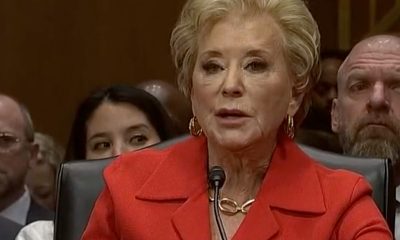
Education Secretary Linda McMahon spoke about the revision of the policy, claiming the decision would explicitly help “women and girls.”
“Thanks to today’s action, the published Title IX regulations faithfully reflect court orders and congressional intent — reducing confusion for parents, students, and educational institutions. We will continue to relentlessly champion equal opportunity for all Americans and hold accountable any school or college that violates the rights, privacy, or athletic opportunities of our women and girls,” McMahon said via press release.
Prior to her work under the Trump-Vance administration, McMahon was a World Wrestling Federation/World Wrestling Entertainment executive before resigning to pursue a career in politics. She was appointed to the Connecticut State Board of Education by then-Gov. Jodi Rell in January 2009, but resigned from her role shortly afterward to run what ultimately became two failed campaigns for Connecticut’s U.S. Senate seat in 2010 and 2012.
A “fact sheet” provided by the Department of Education also called the inclusive sexual assault and gender identity protections expanded under the Biden-Harris unlawful, saying, “This change is necessary to provide clarity in the Code of Federal Regulations so that institutions, administrations, students, and families can see the rules that are actually in force and to help eliminate public confusion about the Biden administration’s unlawful attempt to stretch Title IX’s legal protections to cover ‘sexual orientation’ and ‘gender identity.’”
This is not the first time this policy has faced judicial hurdles. While Biden was still in office, the plan was struck down in multiple courts in Republican states.
Opponents of the move say it will harm transgender athletes and weaken protections for sexual assault victims.
“Sexual harassment and assault continue to be pervasive in schools and, to the fullest extent possible, we should be working to enforce the laws that protect student survivors of sexual violence. Yet, Education Secretary Linda McMahon and the Trump administration have decided to ignore what survivors need, instead weaponizing Title IX to attack trans students,” said Shiwali Patel, senior director of education justice at the National Women’s Law Center.
This is a return to a first Trump term policy after Biden issued an executive order to attempt to curb discrimination for all — especially those with different sexual orientations and gender identities — that had been given a pass during Trump’s first term. Much of Title IX’s policy has a narrow vision of what sex protections look like that often and enthusiastically leave gender-diverse and non-heterosexual people out.
In March 2021, President Joe Biden signed Executive Order 14021, “Guaranteeing an Educational Environment Free From Discrimination on the Basis of Sex, Including Sexual Orientation or Gender Identity,” to attempt to undo some of the flagrantly anti-LGBTQ policy the Trump-Pence administration had set forth relating to Title IX protections for LGBTQ students and sexual assault survivors.
The secretary focused this “win” for the administration as one more step toward restricting transgender students from competing in women’s sports, but the 2020 rule, completed under former Education Secretary Betsy DeVos, didn’t explicitly ban trans students from participating on sports teams consistent with their gender identity. It did limit the types of sexual harassment and assault complaints that schools had to investigate and required live hearings so male students could respond to accusations.
McMahon didn’t discuss those aspects in her statement or in requests for comment. The 2020 rule drew praise from conservatives and intense opposition from advocates who said it downplayed sexual abuse and left victims unprotected.
In a statement, U.S. Rep. Tim Walberg (R-Mich.), who chairs the House Education Committee, said, “Returning to the 2020 regulations restores longstanding protections for women and girls that the Biden-Harris administration attempted to dismantle and realigns Title IX policy with court precedents.”
LGBTQ activists have called this decision a direct attack on LGBTQ safety — particularly for trans students who continue to face a barrage of legislative, executive, and judicial attacks in recent years from the Trump-Vance administration.
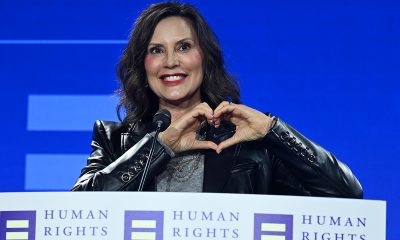
Kelley Robinson, president of the Human Rights Campaign, the largest LGBTQ advocacy group in the world, released a statement following the DoE’s announcement.
“Title IX is, quite simply, about protecting students and ensuring that they are safe from abuse, harassment, and discrimination while they pursue their education. But Donald Trump and his cronies aren’t interested in any of that,” Robinson said. “Donald Trump’s Department of Education has completely lost sight of that mission. Instead of enforcing protections for students, they’re rescinding them. They don’t care if sexual harassment and assault go unaddressed. And they’re happy to strip funding away from school districts and states that are actually trying to keep students safe.
“We know who will be hurt: women, girls, and others who are vulnerable to sexual harassment, assault and abuse — including LGBTQ+ students. The fact that they’re dropping this rule into place abruptly, without a comment period, denying families, educators, loved ones, and the students themselves a say in how they should be treated, shows how little they care about the safety of our students.
“This is a monstrous injustice, and it drives home how essential it is that we take action at the polls this November to start bringing some accountability to an administration that has turned its back on the very students Title IX was written to protect,” she added.
The Washington Blade reached out to the DoE for comment and questions on whether Title IX protections still included LGBTQ students, and received this email response from Education Spokesman Sabin Sidney:
“Your questions indicate you are clearly missing the entire point of this Final Rule. The Biden Administration illegally rewrote Title IX to include ‘sexual orientation’ and ‘gender identification’ in the definition of sex-based discrimination. The Trump Administration is rescinding this rule—only after every federal court that heard legal challenges rejected it as unlawful.
“Since January 2025, the Department has been enforcing Title IX consistent with the President’s Executive Order grounded in biological truth that there are only two sexes. The Trump Administration is restoring the original promise of Title IX and providing clarity to students, parents, and educational institutions. We will vigorously defend equal opportunity consistent with the law’s intended purpose.”
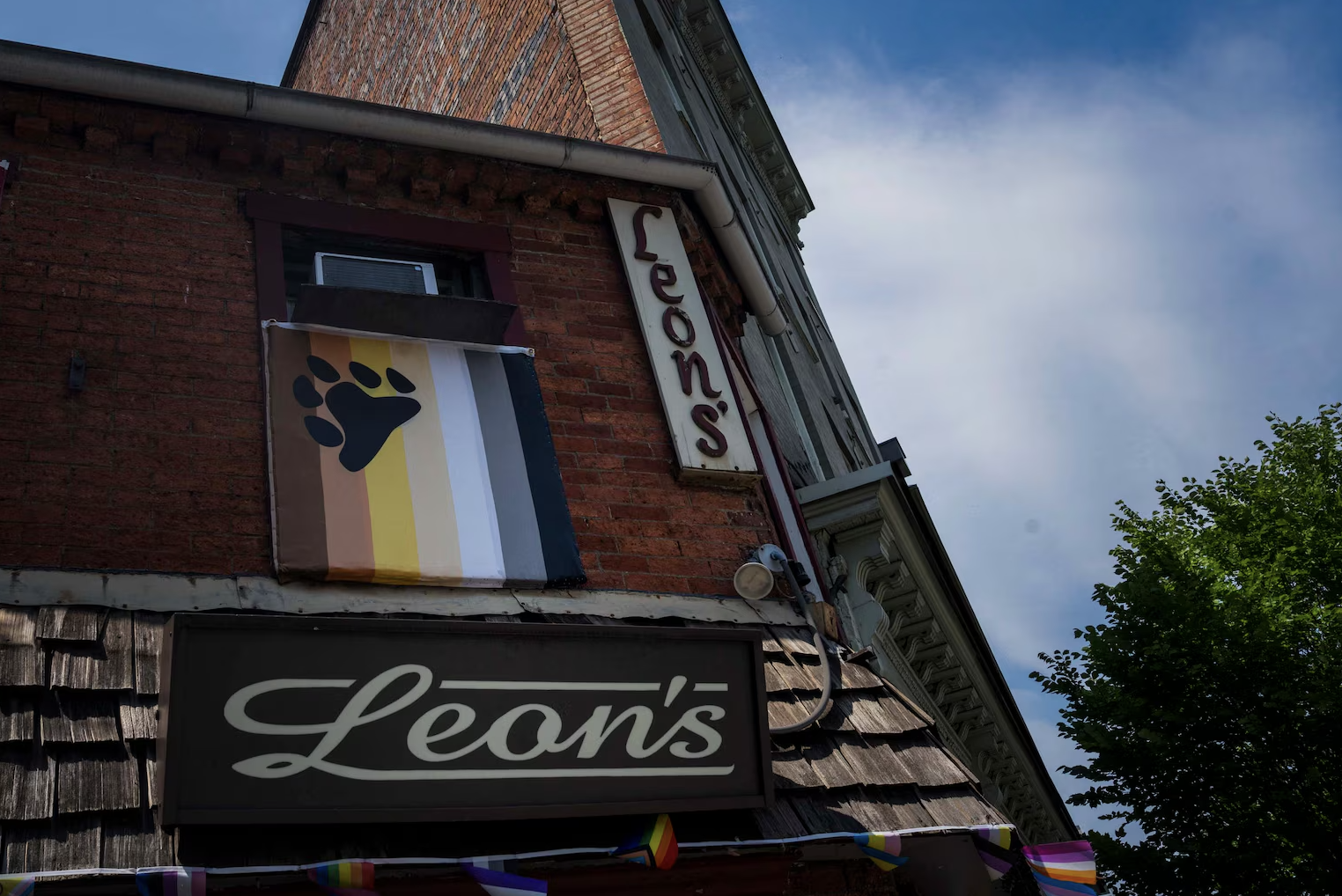
By JOHN-JOHN WILLIAMS IV | Those legendary heavy-handed pours, spirited karaoke and trivia nights, and groan-worthy wall-to-wall patrons on packed nights are back!
Leon’s will live to see another day.
Baltimore’s oldest gay bar, which opened in the 1950s, closed in July following the death of its owner, Ron Singer.
The rest of this article can be read on the Baltimore Banner’s website.
National
Dr. Fauci ‘honored to be part of’ LGBTQ history
Equality Forum presents pioneering AIDS researcher with Int’l Role Model Award
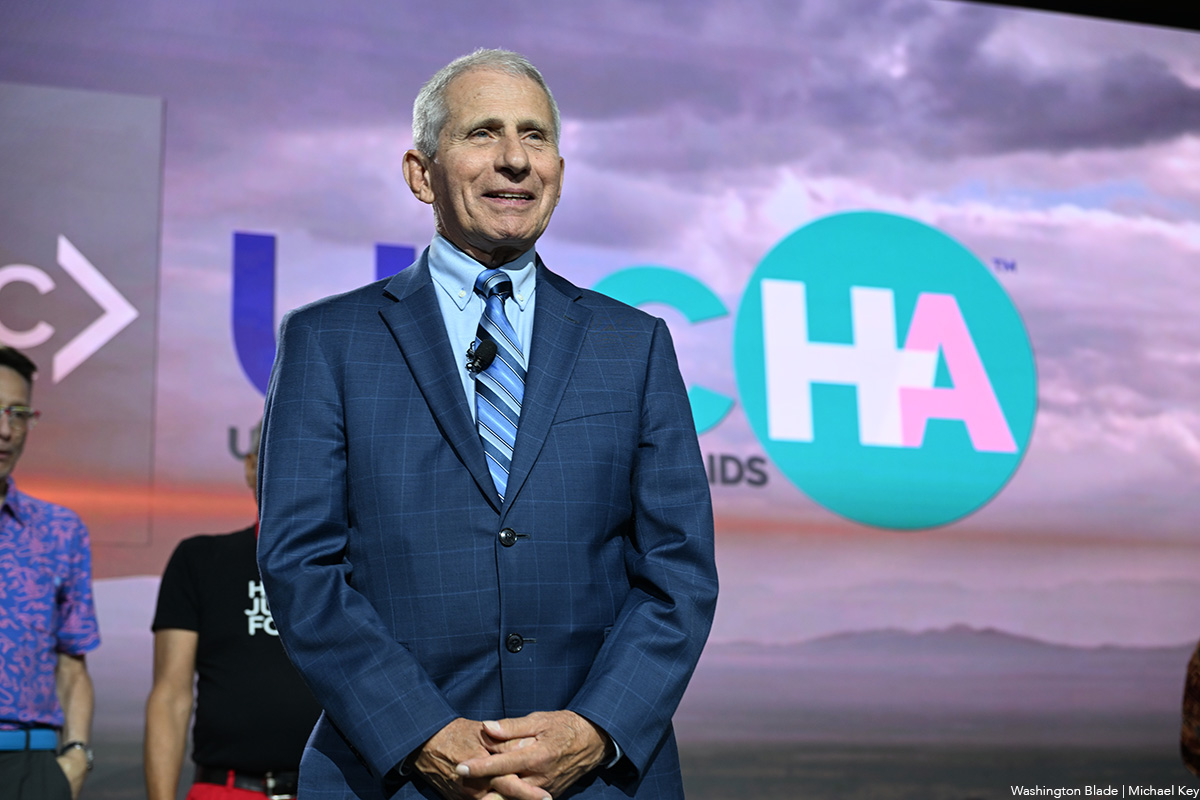
PHILADELPHIA — Dr. Anthony Fauci accepted an award from the Equality Forum on Sunday in which he told the audience that he is honored to be part of the LGBTQ community’s history.
“Over these many decades I have not simply admired the community — I have genuinely enjoyed being part of the conversation with it,” Fauci said. “I’ve enjoyed the arguments, debates, disagreements, the humor, the friendship and above all the extraordinary commitment to alleviate suffering and prevent premature death for persons living with HIV.”
Fauci continued, “I am grateful to the Equality Forum for this award. I am grateful to the LGBTQ community for allowing me throughout these many years to become part of your struggle and I am deeply honored to be part of your history.”
Fauci traveled to Philadelphia to accept the Equality Forum’s International Role Model Award. Longtime HIV/AIDS activist Peter Staley presented Fauci with the award, recalling the early days in the fight against the disease and that activists in the 1980s frequently clashed with Fauci, director of the National Institute of Allergy and Infectious Diseases at the time. In his remarks, Staley recalled the message on one sign from an ‘80s protest, “Fuck Fauci.” But activists warmed up to Fauci and he ultimately befriended his former gay critics, including Larry Kramer.
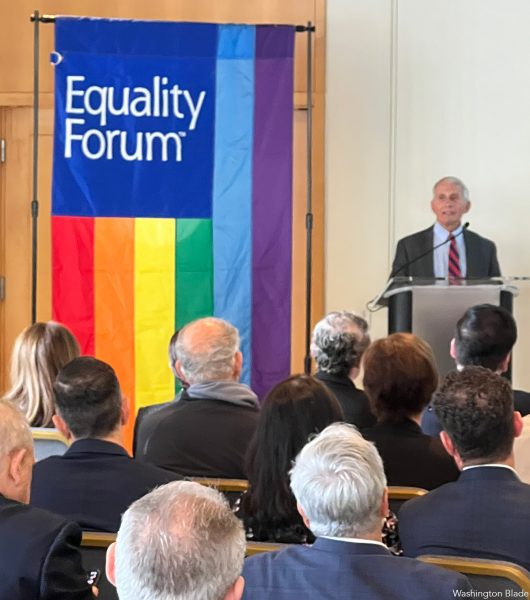
Also at Sunday’s event, the Equality Forum honored Erica Deuso, the first out transgender mayor in Pennsylvania; she was elected mayor of Downington, Pa., and sworn in last January. Ben Garcia, executive director of the American LGBTQ+ Museum in New York presented Deuso with the Frank Kameny Award.
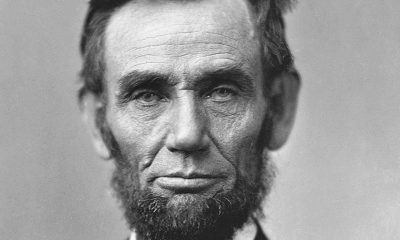
The event also served as the kickoff of LGBT History Month, which Equality Forum honors by naming 31 LGBT Icons, one per day in October. Visit equalityforum.org for a full list of its more than 600 queer Icons. This year’s honorees include designer Calvin Klein, Rep. Chris Pappas, and President Abe Lincoln.

Education Department rolls back protections for LGBTQ students under Title IX

Debbie Allen shares on loss, love, and the power of speaking out

Baltimore’s oldest gay bar to reopen this week

Dr. Fauci ‘honored to be part of’ LGBTQ history

Factors to consider when hiring an interior designer

Colombia withdraws from Equal Rights Coalition

Writing a play about Lincoln leads down a rabbit hole to a closet

Trump-appointed judge restores White House TV pool access

Philadelphia event to launch 2026 LGBT History Month

‘Star Trek: Strange New Worlds’ star Celia Rose Gooding breaks down that finale time travel twist
-

 Colombia5 days ago
Colombia withdraws from Equal Rights Coalition
-
a&e features4 days ago
Writing a play about Lincoln leads down a rabbit hole to a closet
-
White House4 days ago
Trump-appointed judge restores White House TV pool access
-
National4 days ago
Philadelphia event to launch 2026 LGBT History Month