Financial
Kay Wigs closeout: Fond farewell for drag queens
Beloved shop owner’s four-decade business mirrors gay acceptance
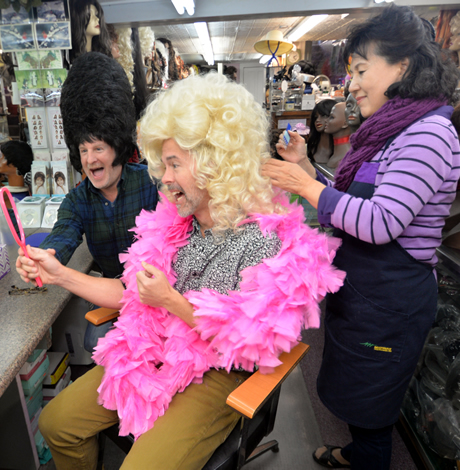
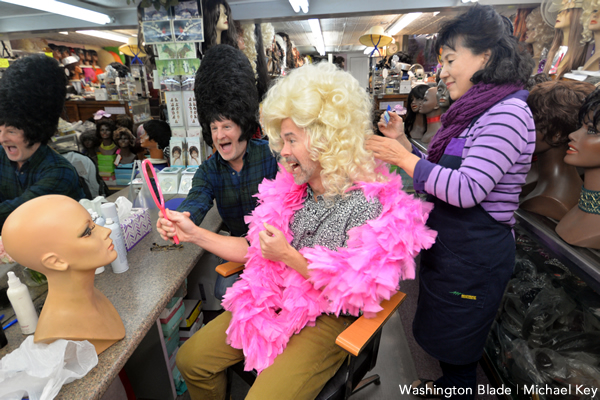
Kee ‘Kay’ Kim, on right, is closing her well-known shop Kay Wigs next month after 40 years. (Washington Blade photo by Michael Key)
Can church ladies and drag queens coexist while shopping for wigs?
A question fictional columnist Carrie Bradshaw might have pondered on the HBO series “Sex and the City” is one that the delightfully personable longtime owner of Kay Wigs has provided an answer.
In doing so, she has earned the affection and loyalty of both occasional and more practiced local drag queens. Many a “pretty lady” has made a pilgrimage to her storefront for the “high holydays” of Halloween, including the long-running annual High Heel Race and Miss Adams Morgan Pageant events.
Kee “Kay” Kim has worked in the hair trade for 40 years, from when she and her husband, now a seminary-educated preacher, immigrated to D.C. from South Korea in 1975. Working at her sister-in-law’s wig shop in a then-tousled downtown commercial district, Kim adopted the business moniker as her name when purchasing the shop soon after.
Opening a second shop several blocks away, Kim would split her time between locations. She later consolidated under the vaulted ceilings of a narrow shoebox-shaped storefront at 940 F St., N.W., neighbor to the original location of D.C.’s famed 9:30 Club and the former Fifth Column nightclub. For club-goers in the 90s, the lighted “Kay Wigs” sign was a familiar fixture on a well-traveled streetscape.
It was at that time 20 years ago that Philip Gerlach, the “Queen Bambi” who would later be crowned Miss Adams Morgan 2004 and become stage and lighting designer every year since, first ventured inside Kim’s shop in search of the perfect performance periwig. Gerlach was weary of the high-pressure sales demeanor and wary of the off-limits attitude at other wig shops. What caught Gerlach off-guard was Kim’s ready extension of personal attention, gently placing and adjusting wigs on his head.
Kim recalls those early days when gay men started shopping in her store, saying it initially “shocked” her. She employed her standard service approach, however, fitting wigs on them and casually teasing the curls. It was something that Gerlach and other drag aficionados came to appreciate. “It was her edge,” Gerlach remembers, “we felt welcomed.”
“All those years ago, I couldn’t at first say ‘it looks nice’ when fitting a wig on a man,” confesses Kim, instead substituting “if you want to buy it you can.” She quickly became known for her gracious comportment and friendly manner.
In the words of a hardworking and dedicated small business operator, Kim describes her entrepreneurial philosophy simply. “Treat customers with patience and kindness,” she notes, “and you will be successful.”
Kim relocated Kay Wigs to Capitol Hill 12 years ago last month, when development drove commercial rents through the elevated ceiling of her high-profile downtown shop. Crowded into a cramped basement hideaway below a storefront window at 325 Pennsylvania Ave., S.E., next to the Hawk ‘n Dove and Tune Inn eatery bars, the most impressive aspect of the space remains Kim’s warm and welcoming demeanor.
Kim’s customer base has been thinned over the years by online merchandising, as well as the rising popularity of hair pieces, weaves and extensions offered by hair salons. Loyalty among mainstay African-American women seeking a Sunday-best coiffed appearance or alternate look and gay men creating a drag persona have stuck with her like the voluminous hairspray she employs when styling a “high to the heavens” drag queen concoction.
“Kay works out of a small space,” five-year Miss Adams Morgan Pageant participant Darryl Stephens says, “but, oh, it’s like wig heaven.” “Bring her a picture of what you want,” he adds, “and she’ll deliver that look.”
For many appreciative gay men, their drag exploration began at Kay Wigs. “It all begins and ends with the wig,” Gerlach points out.
The impending closing of Kim’s shop in late December is a sentimental end to a four-decade enterprise by a woman who added to a community’s history by welcoming gay men when others wouldn’t.
The Going Out of Business Sale at Kay Wigs continues through the end of December with wigs discounted up to 75 percent. Mannequin heads are also available for purchase. Call Kay at 202-543-6677 or visit KayWigs.com for shop hours.
Mark Lee is a long-time entrepreneur and community business advocate. Follow on Twitter: @MarkLeeDC. Reach him at [email protected].




Real Estate
When buying a home, it’s decisions, decisions, decisions
Keeping notes on the process makes for an informed purchase

When looking to buy a home, there are lots of details to consider. Many of my clients would come to me and say, “Joe I want to buy a place, but I haven’t decided which neighborhood to buy in.” And the struggle was real. A few clients had everything decided from the color of the hallway walls to the cabinet handles and sometimes which three square blocks they wanted to look at.
But other clients were occasionally looking at properties in areas as distinct as Union Market/NOMA, Brookland, Logan Circle, and then we would even go across the river to look at a property in Shirlington or the Van Dorn areas of Virginia, which all have their own unique flavor and characteristics.
Sometimes clients would tell me, “I only want to look in Mount Pleasant or Adams Morgan.” Or, “don’t even show me any properties west of this street or south of that street.” My job wasn’t to convince people where to live. It was to just take the parameters they set for me and find as good of a property in that zone as I could, coordinate the showings and, if necessary, offer the strategy.
One can see that buyers often had more decisions to make than a seller. From a seller’s perspective, the house was where it was, and we just had to make the best of it. But working with a buyer could mean looking at five different neighborhoods, and then being a “thought partner” to help them figure out which were the top two or three areas they had seen, and then further distilling those down into what was available and weighing those options against each other.
One house could have the dream bathroom but also be located six blocks further from a Metro stop, walkable shopping and dining, and “just too far away from my friends.” Another house could have all the neighborhood options a client was looking for, but was just not in turnkey condition, and would require an additional $30,000 of upgrades once purchased to make it into the dream home they envisioned.
One activity I often asked buyers to do was to keep an active list in their heads of the properties they liked, and to keep a running rank of the top three. I often encouraged them to bring a notebook along on the journey where they could take notes and write down questions they thought of as they looked. It was an important decision, and sometimes the largest purchase of their lives. Why not take it a little seriously, and take notes? This could often help the buyer later when they felt it was time to decide.
The point here is, keeping a notebook handy can sometimes help a person with what feels like an overwhelming process. It provides a space to explore how one feels, jot down important details to remember, and then use that to make an informed decision.
Joseph Hudson is a referral agent with RLAH. Reach him at 703-587-0597 or [email protected].
Real Estate
Under-the-radar Delaware beach towns smart buyers are targeting
There are other options if Rehoboth prices are scaring you off

Look, we love Rehoboth. We will always love Rehoboth. Queer folks have been flocking there since the 1940s, and with scores of LGBTQ-owned businesses and a Pride calendar packed tighter than the boardwalk in July, “Rehomo” earned its crown fair and square.
But let’s be honest with each other: trying to buy property there right now feels a lot like trying to get a reservation at the one good restaurant in town on a Saturday in August. Everyone wants in, inventory is tighter than your swim trunks after Labor Day brunch, and the prices have officially entered “are you kidding me” territory.
So here’s a thought: What if you didn’t fight the crowd? What if, instead, you let Rehoboth keep doing its glorious, chaotic, glitter-bomb thing and you quietly built your beach life 15 minutes away for considerably less drama and considerably more square footage? Here are four towns ready for their close-up.
Lewes: The Charming Overachiever
Lewes is what happens when a beach town actually has its life together. Historic charm, walkability, proximity to Cape Henlopen State Park, less crowding, and a strong year-round community. Unlike towns that turn into ghost towns after Labor Day, Lewes maintains a real community all year long, which is more than we can say for some situationships.
And right now, the market is practically begging you to make a move. It’s one of the most desirable and stable markets in the county — built for buyers thinking long-term, not flippers, and Sussex County overall has flipped into genuine buyer’s market territory for the first time in years. Translation: you finally get to be the one with leverage.
Bethany Beach: My Personal Pick
Full disclosure: I own in Bethany. So consider this section a little biased — and also the most honest thing I’ll tell you in this whole article.
When I drive down from D.C., I’m not looking for more of D.C. I love this city, but I also love leaving it — and yes, some of the people in it too (you know who you are, and so do I). Bethany gives me that full exhale. It’s quiet in the way that actually means something: fewer crowds, slower mornings, a soundtrack that’s mostly waves instead of nightlife. It leans hard into its “quiet resort” reputation, with low property taxes and a limited geographic footprint, and it is not the least bit sorry about it.
But quiet doesn’t mean isolated. I’ve got a genuinely excellent food scene nearby, real shopping, and a string of charming neighboring beach towns — and when I do want a taste of Rehoboth’s energy, it’s a short, easy drive away. I get to choose my dose of chaos instead of living inside it.
And here’s the part that matters most for this article: the price. If you’ve looked at Rehoboth listings and quietly closed the tab in despair, I need you to hear this — you can absolutely afford a beach house. It just doesn’t have to be in Rehoboth. Bethany’s average home value sits around $848,592, which is still real money, no question — but it buys you more house, more land, and more peace than the same budget gets you closer to the boardwalk. Bethany is welcoming too, just without Rehoboth’s decades of built-in queer institutional history — and for plenty of us, that trade-off is more than worth it.
Fenwick Island: Small Town, Big Flex
Fenwick rarely gets mentioned and, frankly, it should be insulted. It’s tiny, it’s quiet, and it has beach access without the carnival energy. The market data tends to lump it in with Bethany, where single-family oceanfront homes clear $1 million while entry-level condos start in the $600s — proof that “under-the-radar” doesn’t mean “bargain bin,” it means “fewer people fighting you for it.”
South Bethany: For the Boat Gays
Some of us want sand between our toes. Others want a private dock and a boat named something deeply unserious. South Bethany’s canal communities are built for the latter — water access on both sides, fewer crowds, and a lifestyle that says, “I have a captain’s hat and I am not afraid to wear it.”
The Math Works in Your Favor Now
Here’s the part that should really get your attention: Sussex County’s median sold price has dropped to $440,000, down 3.3% year-over-year, and buyers are routinely closing around 88 cents on the dollar compared to asking price. That’s a far cry from the unhinged bidding wars of 2021 and 2022, when overpaying was basically a competitive sport. Inventory across the county sits at nearly 2,500 active listings — the most of any county in Delaware, meaning you actually get to be picky for once. Revolutionary, we know.
And no, choosing one of these towns doesn’t mean leaving your people behind. Sussex Pride serves the entire county, not just Rehoboth proper, and CAMP Rehoboth’s resources extend well beyond town limits too. You’re not exiling yourself to the suburbs of queerness — you’re just getting a bigger kitchen, a quieter porch, and a much shorter line for the bathroom.
Add in the fact that Delaware has no estate tax and some of the lowest property taxes around, savings that genuinely add up over a retirement horizon, and the case writes itself. Rehoboth will always be the beating, sequined heart of queer beach culture in Delaware. But if you’ve been telling yourself a beach house isn’t in the cards — I’m here to tell you it absolutely is. It just might be 15 minutes south, with your own quiet porch, your own salt air, and considerably more room to breathe.
Have a real estate question or Rehoboth market tip? Reach out to [email protected] for LGBTQ-friendly real estate resources in the Rehoboth area.
Justin Noble is a Realtor licensed in D.C., Maryland, and Delaware with Monument Sotheby’s International Realty. Reach him at [email protected] or 302-897-7499.
Real Estate
‘Culture eats strategy for breakfast’
Real estate agents must adapt, learn how to manage from within

“Culture Eats Strategy for Breakfast” was a phrase often repeated in many of my management courses from the University of Illinois. The concept was discussed at length – how the best laid plans can sometimes be supported or derailed by the culture of the people involved in whichever project to be implemented. Whether it be a project to implement new software, roll out a new product or service, or just reaching a sales target, the way the team involved works together can indeed affect the outcome.
Perhaps this is just another way to say, “teamwork makes the dream work!” Most teams usually have someone who is designated as a leader. The leader can try to lead through authority and control or can alternatively try to lead through influence and encouraging a more collective framework for solving problems.
Why does this matter when picking the right real estate agent or team to work with? Besides having a job as a salesperson for the brokerage, the real estate agent is contractually bound to act on their client’s behalf. The buyer broker agreement is in place so that the agent and the client can work together as a team in communications regarding offer strategy, during negotiations, implementing marketing plans, as well as selecting which renovations or upgrades to choose before selling a property. After the property goes under contract, the job isn’t “done”. There is still work to do.
At this point, the agents then turn into a project manager of sorts – coordinating communications between the lending team, the title attorneys, the other client’s agents, any governmental agencies that could be involved in down payment assistance or helping to clear a property for a sale, and often times groups like a condo board, a home inspector, or contractors when arranging repairs and estimates before a final walk through.
In short, the agent takes on somewhat of a “leadership role” in the transaction and ensures that all the ducks stay in a row until the project is complete. That agent will hopefully be very fluid and forthcoming with their information, copying the required parties on all communications and creating a “paper trail” of who said what or didn’t offer to fix A, B, or C, so that all the minutiae of the contract can be addressed and fulfilled before the settlement date. The agent often must wear many hats and quickly learn the communication styles of an entire new set of people in a short period. One person may not return calls for a week after being contacted. Another person may go on vacation at the beginning of the process and not return emails for two weeks. Another person may wish to have daily updates of the progress of the process.
In this way – an agent quickly learns in each transaction that “culture can eat strategy for breakfast.” Because the agent must adapt to a wide variety of communication styles, learn how to “manage from within”, build support for closing the project by the due date, and somehow keep all the interested parties invested, engaged, and responsive.
Who you work with matters when picking the right person to represent you in your next transaction – so, just remember that “teamwork makes the dream work!”
Joseph Hudson is a referral agent with RLAH. Reach him at 703-587-0597 or [email protected].

PHOTOS: Vitamin C at JR.’s

PHOTOS: Rehoboth Beach Pride Festival

Liza’s book a tale that’s better than most celebrity memoirs

Hot hatchbacks: Honda Civic, Subaru Impreza

When buying a home, it’s decisions, decisions, decisions

Expected India Supreme Court ruling could shape future LGBTQ rights cases

Celebrate Pride in Rehoboth Beach this weekend

Christa Tichy hopes to preserve LGBTQ representation in Md. House of Delegates

Advocacy groups join Venezuela earthquake relief efforts

Rehoboth’s Aqua to celebrate 20th anniversary Sunday
-

 India4 days ago
Expected India Supreme Court ruling could shape future LGBTQ rights cases
-
Rehoboth Beach4 days ago
Celebrate Pride in Rehoboth Beach this weekend
-
Maryland4 days ago
Christa Tichy hopes to preserve LGBTQ representation in Md. House of Delegates
-
Venezuela4 days ago
Advocacy groups join Venezuela earthquake relief efforts