Opinions
Fighting for a seat at the table
Democrats must speak to voters across spectrum of society
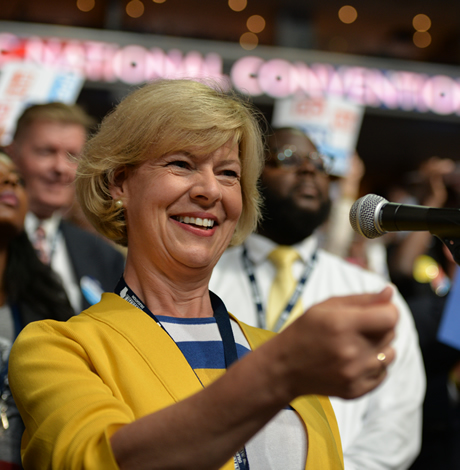
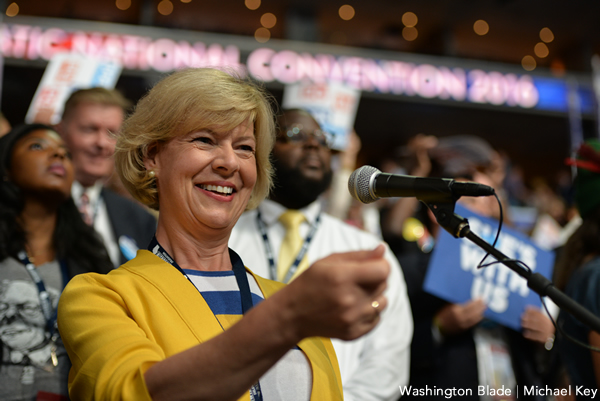
Sen. Tammy Baldwin (D-Wis.) (Washington Blade file photo by Michael Key)
Sunday was the Victory Fund’s annual National Champagne Brunch. It seemed low key compared to previous years. It is an off year for major races with LGBT candidates. The welcome was delivered by Kim Hoover, chair of the Victory Fund board. She spoke well as usual and I say that not only because I was a guest at her table. Hoover and her wife Lynne Hackney have dedicated countless hours and money to promoting the values of our community and supporting candidates across the country who share a vision for equality. She had the honor of introducing Sen. Tammy Baldwin (D-Wis.) who delivered the keynote.
Baldwin was great as always and spoke of how we need to stand together and continue to speak out, especially in these difficult times. She spoke of the fact that our wins in this Congress and with this White House may be simply managing to maintain what we have won before. Baldwin is a target of the GOP in her 2018 re-election bid and you can help ensure her voice continues to be heard.
It was a monied crowd at the Omni Shoreham Hotel ballroom. It is crucial everyone there contribute to the max if we are to fund the work of organizations like Victory Fund. But maybe in the future they could drop the word “Champagne” from the name of their brunch. Somehow it just reeks of elitism. Now, it is an elite group and, of course, not everyone can afford to attend, but I think the public image of the organization is also really important. I remember when HRC was HRCF and colloquially called the Human Rights Champagne Fund. They got away from that long ago and while it may not change the organization, image does matter.
A number of other candidates aside from Baldwin were introduced and spoke but to many the highlight of the afternoon was South Bend, Ind. Mayor Pete Buttigieg. My friend Jeffrey went as far as calling him the “Gay JFK.” He is a dynamic young man and we will hear much from him in the future. Even though he lost, he made a good impression on Democrats nationally when he put his hat into the ring for the position of chair of the Democratic National Committee.
Except for Buttigieg who compared us to other communities and said “our common suffering is greater than our differences” what I missed from most of those who spoke was the recognition we won’t be successful if we don’t join with others also fighting for their full civil and human rights; women, African Americans and other minorities, and immigrants. The work we must do to bring our own divided community together. To me one of the goals of promoting and electing a diverse group of LGBT candidates must be that when they win they use their seat at the table to fight for those who are the most marginalized in our own community along with the poor, workers and the middle class.
My experience attending political fundraisers began many years ago with the Democratic Party. For years, no event like this would have concluded without the workers and waiters who helped make the event a success being thanked from the stage. A friend sitting at a table that was purchased by a union brought my attention to the fact none of the organization’s speakers did that.
Baldwin counseled us to “focus on the future.” To understand that we must be prepared when our turn to control the levers of government comes again, and it will. To win, LGBT candidates will not only have to focus on the future when talking to their constituents but also learn to speak to voters across the broad spectrum of society. It will be incumbent on the Victory Fund in its candidate trainings to remind candidates of this and in many cases teach them what it means. It is speech that should be modeled by those who work for all our LGBT organizations when they stand in front of an audience.
It is fine at these events to speak to each other but it may be just as important and productive in the long run to speak to those who are serving us our meal so they believe we also really care about making life better for them and their families.
Peter Rosenstein is a longtime LGBT rights and Democratic Party activist. He writes regularly for the Blade.






For years, transgender Americans have been told that visibility is important. We should tell our stories, educate people, speak publicly about our experiences and show younger transgender people that a future is possible. I understand that argument because I have participated in that kind of visibility myself. Nearly a decade ago, I appeared in National Geographic’s “Gender Revolution,” in 2017, hosted by Katie Couric. I have written publicly about being transgender, participated in LGBTQ politics and spent years thinking about what it means to transition in America. My history is hardly a secret. But as I have gotten older, I have increasingly found myself wanting something considerably less dramatic: I want the right to be an ordinary man.
That does not mean I am ashamed of being transgender, nor does it mean that transgender activists should stop fighting for our rights. Many of the freedoms I enjoy exist because previous generations of LGBTQ people were willing to be conspicuous when visibility carried considerable personal risk. But equality cannot require permanent visibility. There is a strange expectation placed upon members of minority groups that our lives should contain some larger social meaning. A transgender person who overcomes adversity is called “brave.” Someone who talks openly about transition becomes “inspiring.” Someone who succeeds becomes an example of “trans resilience.” Sometimes those descriptions are deserved and sincerely appreciated. But sometimes I do not want to represent resilience. Sometimes I just want to walk my dogs, sit in a coffee shop with my laptop, complain about Northern Virginia traffic, go swimming, write books and figure out what I am having for dinner. I also want to be able to gossip with my friends in meaningless ways and do off kilter things that resemble fun: axe throwing, bowling, and karaoke.
When I was younger, being transgender occupied an enormous amount of psychological territory. Transition required decisions, explanations and difficult conversations. Other people had questions. My body seemed consequential in a way that other people’s bodies did not. There was always another milestone ahead of me, and for a while it was difficult to imagine reaching a point when gender would no longer dominate my thoughts. Eventually, however, something unexpected happened: life became life again. The questions that occupy me today are increasingly the same mundane questions that occupy millions of other adults. What kind of career do I want? Am I being a good friend? What should I write next? What kind of person do I want to become?
Most strangers who meet me today simply see a man. They do not know my medical history or what I looked like years ago. They don’t know that I looked like a skinny track star, and then was put into the resemblances of a meager nonbinary body. They do not know the chronology of my transition unless I decide to tell them. There is tremendous freedom in that, and I have come to think of it not as deception but as privacy. Nobody introduces himself by providing strangers with a complete inventory of his medical history, childhood insecurities and previous identities. Human beings reveal themselves gradually. Different people know different parts of us, and intimacy develops when we decide that somebody has earned access to more of our story.
Yet transgender people are frequently encouraged to regard disclosure as a measure of authenticity. I no longer believe that it is. There are circumstances in which being transgender matters enormously, and there are others in which it barely matters at all. When I am writing, I want somebody to care about the quality of the sentence. When I am working, I want somebody to care whether I did the job well. When I make a friend, I want that person to discover the complicated human being underneath the surface: my ambitions, flaws, anxieties, ridiculous stories and sense of humor. Being transgender may eventually become part of that conversation, but it does not have to be the first thing somebody knows about me.
That, to me, is one of the least discussed promises of equality. For decades, LGBTQ people fought for the right to be seen because invisibility was often enforced through shame and discrimination. Visibility therefore became a form of liberation. But perhaps successful visibility should eventually produce another freedom: the freedom to become unremarkable. A gay couple should be able to bore their neighbors with complaints about their mortgage. A lesbian should not have to become an ambassador for lesbianism whenever she enters a room. A transgender man should not have to turn his body into a public seminar about gender. He should occasionally be allowed to be some guy. Transgender people, in a sense, should also have the right to be flawed: sometimes we yell at our romantic counterparts, and other times we get fired from jobs for being obnoxious. But we are only human, just like you.
There are, of course, transgender people who cannot or do not want to disappear into ordinary life, and there are young transgender people desperately searching for evidence that adulthood is possible for them. Visible transgender people can provide that evidence. But there should be another story available to those young people as well: you can grow up, transition and eventually spend less time thinking about transition. You can become preoccupied with your career, fall in love, get divorced, write a terrible first draft and spend three days fixing it, worry about your parents, buy groceries and acquire all the wonderfully tedious problems of adulthood.
That might not sound revolutionary, but perhaps that is precisely what makes it meaningful. The ultimate promise of transgender equality should not be that every transgender person becomes visible, celebrated, courageous, or inspirational. It should include the possibility that a transgender man can walk into a room and nobody finds his gender history particularly interesting. He can simply be a man living his life. Increasingly, I think that ordinary freedom is what I wanted from transition all along.
Isaac Amend is a transgender man and writer based in D.C. In 2017, he starred in National Geographic’s ‘Gender Revolution’ documentary. He sits on the board of the LGBT Democrats of Virginia. His author’s portfolio is available at isaacamend.com, and you can catch him on Instagram at: @isaacamend.
Opinions
LGBTQ community must vote in big numbers
We have a chance to retake Congress and flip governors’ mansions
On Nov. 3, we have a chance to make a difference for our own community, and for so many others, who are being hurt by the lying, grifting, felon in the White House, his fascist aides, and sycophants in Congress. The danger they pose is real.
We have seen members of the LGBTQ community have their lives threatened, and some even killed. The anti-trans language, and anti-trans legislation, both supported and proposed by this administration, and their MAGA followers around the nation, is real. In the Department of Defense, we have seen trans heroes drummed out of the military. Books on our community taken off library shelves, and our history being wiped out. Even the history of the Enola Gay, the plane that dropped the atomic bomb, was wiped out before someone actually told the dangerous, moron, Pete Hegseth, Secretary of Defense, that Gay was the name of the pilot’s mother, not a reference to our community.
Many members of the Log Cabin Republicans will proudly tell you that the administration is actually pro-LGBTQ, as there are gay members of the felon’s administration. What they don’t like to dwell on, is their silence during these attacks on the community. Yes, there are people like Richard Grennell, who destroyed the Kennedy Center. He cancelled concerts by the Gay Men’s Chorus, and programs by drag queens. Then there is Scott Bessent, the highest-ranking queer, a clearly self-hating, Secretary of the Treasury. A man who benefitted from the work of all the activists in our community, so he could get married, and have children, but then won’t speak out for the community. I wrote a column suggesting when his children grow up, they will be embarrassed by what their father didn’t do. Most of the other members of the LGBTQ community in this administration are either members, or supporters, of Log Cabin, and have sworn fealty to the lying, grifting, Trump in order to get, and keep, their jobs.
So, it is beyond time, for the LGBTQ community, and our allies, to vote, and vote in large numbers, to say ‘ENOUGH’, we will not continue to stand idly by while we, and others, are being hurt by this self-serving, venal administration.
Barney Frank once said “If we aren’t at the table, we are on the menu.” But we have come to realize, not every one of us at the table, will work to protect us. There are some at the table today who either agree with what the administration is doing, or are remaining silent out of fear. They remind us every day of the truth of the slogan, ‘Silence = Death.’
So, Nov. 3 is our next chance to speak out. We can do it with our votes. If we vote in large enough numbers, we have the chance to not only take back the Congress, the House and Senate, but to impact state governments, cities, and local communities. We have the real chance to take back the governor’s mansions in Ohio, by electing Amy Acton; in Iowa, by electing Rob Sand; in Florida, by electing David Jolly; and in Georgia, by electing Keisha Lance Bottoms, among other states. These races are all close, and our voting in big numbers can make the difference. Then we can flip state legislatures, mayor’s offices, local commissions, and even school boards. We have seen even in small communities like Rehoboth Beach, Del., when we vote, we elected the first out lesbian mayor, Susan Stewart. In Key West, we elected a commissioner, Christopher Massicotte. Our votes, along with so many other decent people, do make a real difference.
It is not only electing members of the LGBTQ community. It is electing those who will have our backs, and fight for us. We must support, and vote for, candidates who will have our backs and fight against the homophobia, and vicious attacks, on our community by today’s MAGA version of the Republican Party. While the numbers vary, there have been more than 500 anti-LGBTQ bills filed in state legislatures thus far in 2026. I may have missed something, but as far as I know the felon’s administration has not opposed any of them. They have endorsed a host of them through their words and actions.
So, I beg you, as a member of the LGBTQ community, and someone who believes in equal rights, and human rights, for all; please vote. Make the effort to get all your friends and family that support you, to vote as well. Martin Luther King, Jr., who I had the honor of meeting and taking with, once told me “Each one of us can make a difference.” This is your chance!
Peter Rosenstein is a longtime LGBTQ rights and Democratic Party activist.
Commentary
Washington Blade responds to concerns over White House pool duties
Inaccurate media reports create confusion but we stand with our colleagues
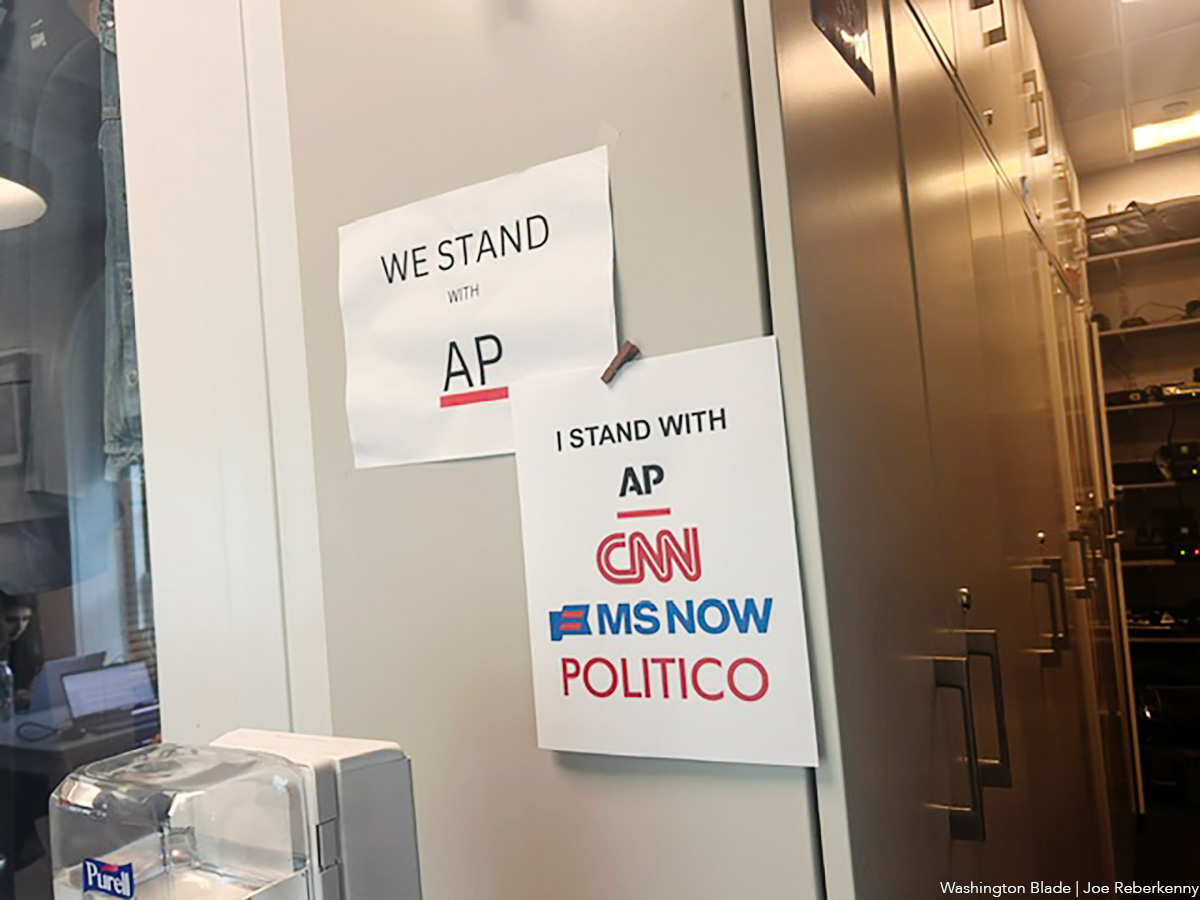
Last week, President Trump announced his unconstitutional ban of CNN, MSNow, and Politico from the White House. Coincidentally, on Monday, it was the Washington Blade’s turn to serve as the print pool reporter on duty covering the president’s actions that day. This important responsibility is shared and rotated among the print members with each serving roughly once per month. The Blade is the only LGBTQ outlet with a seat in the briefing room, a slot in the pool rotation, and membership in the White House Correspondents’ Association, something we fought for decades to secure after enduring years of discrimination, ridicule, and resistance to openly queer journalists working inside the White House. We take our responsibilities there seriously.
There are two pools that cover the president: broadcast and print. The other four members of the broadcast pool — ABC, CBS, NBC, and Fox News — agreed to boycott their pool duties. There has been no boycott among the print pool, which is a separate entity. I called the president of the White House Correspondents’ Association on Monday to confirm that no outlets in the print pool were boycotting.
A boycott by the Blade would set us back and lead to our expulsion from the pool and briefing room and our replacement by a right-wing outlet sympathetic to President Trump’s approach to attacking the media. The LGBTQ community is far better served with the Blade in the room than a far-right blogger taking our seat.
Let’s be clear: the Blade stands for diversity, equity, and inclusion and we stand for the First Amendment and freedom of the press. In solidarity with the broadcast pool, we made two important decisions on Monday — the first day anyone had to think about any of this. First, we refused to take or share any videos or still photos of the president, which would have undermined the broadcast boycott. Second, when Politico’s turn comes up for pool duty in mid-October, the Blade will not fill in and cover for them while they are banned. Politico must be readmitted and allowed to do their job.
After a rough day navigating and reporting on all of this, the Advocate published a reckless and inaccurate story suggesting that the Blade had crossed a picket line. Not true, as there is no print pool boycott. They claimed that I wouldn’t talk to their reporter. Also not true. I called their reporter within 90 minutes of receiving his message and he didn’t take the call or call me back. Their story named me and our White House reporter, immediately exposing us to public criticism and worse. The environment in D.C. is so toxic and even violent these days that subjecting our staff to unfair and false accusations like this invites harassment, doxxing, and worse. To do that without even talking to us is next level irresponsible and the antithesis of journalism.
On Tuesday, I talked to two reporters and an editor at the Advocate but they refused to retract anything in their inaccurate story. If the reporter had returned my call, I could have explained all of this but they are more concerned with clickbait and sensational headlines, a dangerous practice in these troubled times.
Back to the pool. The Blade was in the briefing room in the Reagan era, when Press Secretary Larry Speakes made jokes about AIDS and the reporters in the room laughed out loud. We endured all of that abuse and worse for decades, always standing in the back of the room and never being called on. The Blade’s journalists persevered. When President George W. Bush was re-elected in 2004, the Blade’s White House credentials were revoked amid an earlier press crackdown. Notably, no one boycotted or stood up for us. When Barack Obama won election in 2008, I received an email from his communications director informing me that effective midnight on Jan. 20, 2009, the Blade’s credentials would be restored.
So we have had quite a ride navigating administrations and their changing requirements for gaining access but always playing the long game. As Barney Frank used to say, “If you’re not at the table, then you’re probably on the menu.” The Blade is at the table and we do our best to ensure the LGBTQ community’s issues are addressed by both parties.
Thanks for reading and supporting the Blade’s work. If you have questions about our approach, you can reach me at [email protected].
Kevin Naff is editor of the Washington Blade. Reach him at [email protected].

The financial realities facing LGBTQ+ first-time buyers

‘Merrily’ is for Sondheim super fans, the uninitiated, and anyone in between

Engrossing ‘Tip Toe’ delivers tension and an ominous warning

Eliot Glazer’s new book an engaging collection of essays

Equality Chamber hosts Pride in Business Expo and Profits & Pours

Ana Brnabić becomes world’s first openly lesbian head of state

Meet the LGBTQ candidates running for U.S. House, Senate

Vote now! Best Of LGBTQ DC readers’ choice awards

Gay Va. couple hopeful voters will enshrine marriage equality in state constitution

Victory Fund board investigates former staffers’ allegations against CEO Evan Low
-

 Serbia4 days ago
Ana Brnabić becomes world’s first openly lesbian head of state
-
2026 Midterm Elections4 days ago
Meet the LGBTQ candidates running for U.S. House, Senate
-
Arts & Entertainment4 days ago
Vote now! Best Of LGBTQ DC readers’ choice awards
-
Virginia3 days ago
Gay Va. couple hopeful voters will enshrine marriage equality in state constitution