Arts & Entertainment
Help choose the 2022 DC Brau Pride Pils can design
For the 5th time, DC Brau partners with the Blade Foundation & SMYAL on a specially packaged pilsner in honor of Pride.
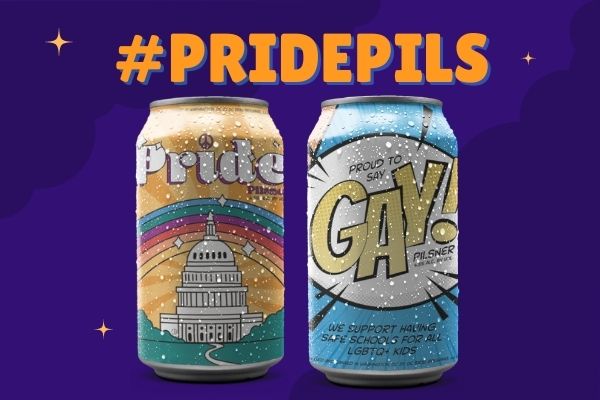
Pride is back and it is time for you to help us choose the 2022 Pride Pils can design. This year DC Brau, DC’s original craft brewery, has partnered with local artist Chord Bezzera of District Co-Op to design this year’s Pride Pils. Chord has designed two distinct cans for the public to choose from.
Restaurants, bars and retailers will be selling the specially branded DC Brau Pride Pils cans for the fifth year with 100% of the proceeds going to benefit SMYAL (smyal.org) and The Blade Foundation (bladefoundation.org). Since 2017, DC Brau has donated a total of $42,083.92 and sold over 81,576 cans through the Pride Pils program. This year the can labels have been generously donated by Blue Label Packaging Company.
The public can vote below or at washingtonblade.com/pridepils through March 31st. The winning design will be unveiled in June and will be available across the city for purchase during DC Pride.
Design 1 – Pride Pilsner
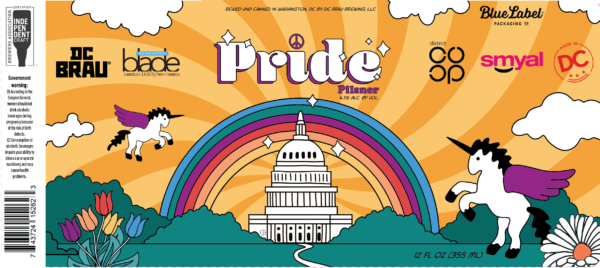
Design 1 was inspired by the 1970s, a transformational decade for LGBTQ+ culture that saw the rise of activism and the establishment of Pride Week. This design reflects the vibrant optimism and that freedom of thought that is still needed today.
Design 2 – Proud to Say Gay Pilsner
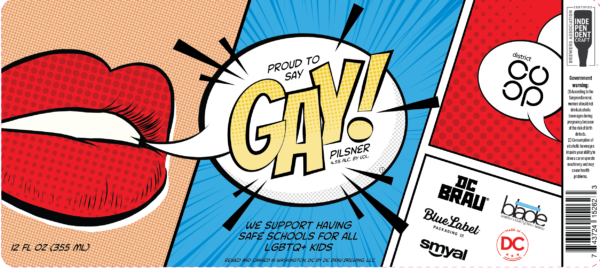
Design 2 is in direct response to the passage of Florida’s “Don’t Say Gay” bill, which limits what classrooms can teach about sexual orientation and gender identity thereby disenfranchising vulnerable youth. This design seeks to counter the bills harmful message and celebrate Pride across the LGBTQ+ community.
Vote below or by clicking HERE.
The Washington Blade was founded in 1969 and is known as the “newspaper of record” for the LGBT community both locally and nationally. For more information, visit washingtonblade.com and follow on Facebook (@WashingtonBlade) & Twitter (@WashBlade).
DC Brau has been producing award-winning craft beer at its brewery in Northeast DC since 2011. For more information, visit www.dcbrau.com, and follow on social media @dcbrau.
District CoOp is a collection of artists celebrating design, diversity and the culture of D.C. We’re all about supporting and empowering local artists and creating a brand for the people by the people. All designs are available in both men’s and women’s and as a tank or crew. Follow us on Instagram (@District_CoOp) or Facebook (@DistrictCoOp).





Friday, July 31
Go Gay DC will host “LGBTQ+ Community Happy Hour” at 7 p.m. at DIK Bar. This is a chance to relax, make new friends, and enjoy happy hour specials at this classic retro venue. Attendance is free and more details are available on Eventbrite.
Saturday, August 1
Go Gay DC will host “LGBTQ+ Community Brunch” at 11 a.m. at Freddie’s Beach Bar & Restaurant. This fun weekly event brings the DMV area LGBTQ+ community, including allies, together for delicious food and conversation. Attendance is free and more details are available on Eventbrite.
Sunday, August 2
“Black Gay Flea: Summer Kickback” will be at 12 p.m. at Wunder Garten. This is a space created to celebrate Black LGBTQ+ creatives, artists, makers, entrepreneurs, and the community that shows up for them. Come spend the afternoon shopping with local vendors, discovering new brands, supporting small businesses, and connecting with people from across the DMV. More details are on Eventbrite.
Monday, August 3
“Center Aging: Monday Coffee Klatch” will be at 10 a.m. on Zoom. This is a social hour for older LGBTQ+ adults. Guests are encouraged to bring a beverage of choice. For more information, contact Adam ([email protected]).
Tuesday, August 4
The DC Anti-Violence Project will host “Soul Centered” at 7 p.m. at Thurst Lounge. This is not a dating event in the traditional sense. It is a space to meet kindred spirits, future collaborators, mentors, friends, or maybe someone who reminds you of what’s possible. Romance may happen, but it’s not the expectation. For more details, visit DCAVP website.
Wednesday, August 5
Job Club will be at 6 p.m. on Zoom upon request. This is a weekly job support program to help job entrants and seekers, including the long-term unemployed, improve self-confidence, motivation, resilience and productivity for effective job searches and networking — allowing participants to move away from being merely “applicants” toward being “candidates.” For more information, email [email protected] or visit thedccenter.org/careers.
Center Aging Women’s Social & Discussion Group will be at 6 p.m. on Zoom. This group is a place where older LGBTQ+ women can meet and socialize with one another. To register, visit the DC LGBTQ+ Community Center’s website.
Thursday, August 6
The DC LGBTQ+ Community Center’s Fresh Produce Program will be held all day at the Center. People will be informed on Wednesday at 5 p.m. if they are picked to receive a produce box. No proof of residency or income is required. For more information, email [email protected] or call 202-682-2245.
Virtual Yoga Class will be at 7 p.m. on Zoom. This free weekly class is a combination of yoga, breath work and meditation that allows LGBTQ+ community members to continue their healing journey with somatic and mindfulness practices. For more details, visit the DC LGBTQ+ Community Center’s website.
Celebrity News
Madonna to perform at World Pride in Amsterdam
‘Confessions II’ album released earlier this month to rave reviews

Editor’s note: International News Editor Michael K. Lavers and Photo Editor Michael Key will be on assignment in the Netherlands through Aug. 10. They will be covering World Pride in Amsterdam.
AMSTERDAM — Madonna on Saturday will perform at World Pride in Amsterdam.
She is scheduled to appear alongside Stuart Price, Honey Dijon, and other “special guests” at the World Pride Music Festival at AFAS Live concert hall. The Amsterdam Pride Canal Parade will take place earlier on Saturday.
MISTR, a telehealth platform that offers free access to PrEP, Doxy PEP, STI testing, and long-term HIV care, is organizing Madonna’s performance.
Madonna on July 2 released her new album, “Confessions II,” to rave reviews.
She appeared at The Abbey in West Hollywood, Calif., in April. Madonna in June celebrated Pride month with a pop-up performance in New York’s Times Square.
“Everyone here is a work of art,” says the World Pride Music Festival performance poster, referring to a line from “Danceteria” on “Confessions II.”
Movies
‘Heartstopper Forever’ delivers satisfying conclusion
Beloved queer phenomenon shows us hope can belong to everyone

When I wrote my review of the first season of “Heartstopper,” I said that if the series could only be summed up in one word, it would be “adorable.”
After an additional two seasons and a movie length series finale (which began streaming on Netflix July 17), I’m going to make up a new rule and say that I can choose a second word to close things out. By the time I reach the end of my review of “Heartstopper Forever,” in which our adorable Nick and Charlie must face the possibility that their tender young romance may not be able to survive their graduation to college, I hope I’ll have figured which word it would be.
Directed by Wash Westmoreland and written (as always) by Alice Oseman, artist and creator behind the YA webcomic/graphic novel that launched the whole “Heartstopper” phenomenon, this final installment finds a very different Nick and Charlie than we met in those early episodes – yet in many ways they’re still very much the same. Far from the timid and bullied queer lad of the first season, Charlie (Joe Locke) is now boldly out and confident enough to win the election for “head boy” in his final year at school, and Nick (Kit Connor) no longer struggles with being open about his bisexuality; yet as the stress of their impending separation – each to a different college in a different city – begins to become more urgent, both of them fall back on old patterns.
To those of us who have been around long enough to re-examine such a crisis with 20/20 hindsight, that’s bound to strike chords of recognition. To the younger “Heartstopper” fans, however, it’s likely to feel like high drama – exactly as it did for us when we were going through it ourselves. It’s not just Nick and Charlie, either; other characters, like transgender prodigy Elle (Yasmin Finney) and her cis-het boyfriend Tao (William Gao), must also come to terms with the changing dynamics of their relationships. The result is multiple mirrors through which queer teens can see their own experience reflected, which has always been the appeal of “Heartstopper” in the first place. And as it has from the beginning, Oseman’s intent to provide her teen audience with positive perspectives shines through, ensuring that the story’s final chapter lands in a place where hope can belong to everyone.
That doesn’t mean it doesn’t have its share of dark moments – it wouldn’t be “Heartstopper” if it didn’t, would it? Part of the show’s value for its fans, young and old alike, has always come through its various characters’ growing pains; their missteps and misjudgments, their confused emotions, their fumbling efforts at “first times,” their struggles toward self-esteem. All these and more have provided the necessary “weight” to counter the show’s bubbly optimism and keep it from becoming as insubstantial as spun sugar. More importantly, these issues have always been the real core of the story: We love the sweetness of the romance, but the deeper satisfaction comes from watching these young people navigate all their challenges, sometimes alone but more often together, and build a community through the shared experience of working through them.
The final installment, having brought Charlie, Nick, and all the rest to the cusp of young adulthood, brings a suitably more mature level of problems into the mix. Sure, Charlie has grown into the hero he once needed himself, but the uncertainty that emerges between himself and Nick as they ponder their impending separation is enough to spark a relapse of his eating disorder; likewise, Nick may be confident and unguarded about his sexuality and openly proud of being Charlie’s boyfriend, but that doesn’t stop him from slipping back into self-doubt (and bad behavior) when he contemplates the possibility that their love story might be coming to an end. We know they have the “tools” to get back on track, but with everything so up in the air, will they be able to remember how to use them?
So, too, throughout the series, we have seen these kids come to terms with their individual queerness, navigating those personal journeys and learning how to embrace who they are in an environment where, for the most part, they get a lot of support. At the same time, there have been shadows around the edges, encounters and circumstances that remind them (and us) that, outside the protective circle provided by their school and each other, bigotry still exists. In “Heartstopper Forever,” those reminders are still there, and they feel all the more ominous – not just because of the worldwide rise in anti-LGBTQ+ sentiment, though that’s tied to it, but because these bright young things will soon be moving into a larger world where safety and shelter from the hate is not quite so certain.
Still, it’s Nick and Charlie’s story above all else, and naturally the main focus of this finale is on them. There has always been a too-good-to-be-true perfection to their romance, but Locke and Connor are so good at bringing it to life we believe it; here, fittingly for a final chapter, these boys finally face the crossroad that comes with adulthood – the recognition that, one way or another, there will be an ending to their relationship. How they handle that, we won’t spoil; once again, though, this is “Heartstopper,” one can feel sure that Oseman’s characters will work their way through it in the most imperfectly perfect – and emotionally satisfying – way possible.
Deserving of mention: characters like Isaac (Tobie Donovan), Imogen (Rhea Norwood), and Charlie’s sister Tori (Jenny Walser) return to get their fair share of the spotlight, and gay teachers Mr. Ajayi (Fisayo Akinade) and Mr. Farouk (Nima Taleghani) get the chance for a new beginning of their own; and out UK acting legend Derek Jacobi (“I, Claudius”) appears alongside real-life partner Richard Clifford as an elderly couple in a quiet but important scene at the cafe where Charlie works.
With any “franchise” as popular as “Heartstopper,” the task of bringing closure to a story that has emotionally involved so many fans is almost always a thankless one (just ask George Lucas), so there are sure to be some who have objections to the way Oseman brings her beloved story to an end; but it’s her story to end, and in choosing to uphold its sensational (yet sentimental) imagining of the world as it could be, “Heartstopper Forever” doubles down on the idea that we can make it the way that it should be.
That’s why my choice for the second word we can use to sum up “Heartstopper” is “aspirational.” In the relative innocence and un-ironic preciousness of Nick and Charlie’s enduring love story, we can find no excuses; not all of us can keep our first love alive for an entire lifetime (nor, often, should we), but maybe we can learn to follow our hearts as surely and openly as they do.
That’s about as aspirational as any of us can hope to be – but don’t worry: it’s still adorable, too.

Taiwan’s government has failed to update process to change gender markers on ID documents

Calendar: July 31-August 6

BLADE ENDORSEMENT: Susan Stewart for mayor of Rehoboth Beach

Madonna to perform at World Pride in Amsterdam

‘Heartstopper Forever’ delivers satisfying conclusion

D.C. summer theater offers something for every taste

Summer in the City: Free exhibits, movies, more fill D.C.’s calendar

With gas prices soaring again, a staycation is a good plan

Gary Sutton, known for ‘warmth and laughter,’ dies at 62

White House threatens Anne Arundel schools over gender identity policy
-

 Theater5 days ago
D.C. summer theater offers something for every taste
-
a&e features5 days ago
Summer in the City: Free exhibits, movies, more fill D.C.’s calendar
-
Real Estate5 days ago
With gas prices soaring again, a staycation is a good plan
-
Obituary4 days ago
Gary Sutton, known for ‘warmth and laughter,’ dies at 62