Theater
Getting to know you
Remounted ‘King’ is no run-of-the-mill touring musical
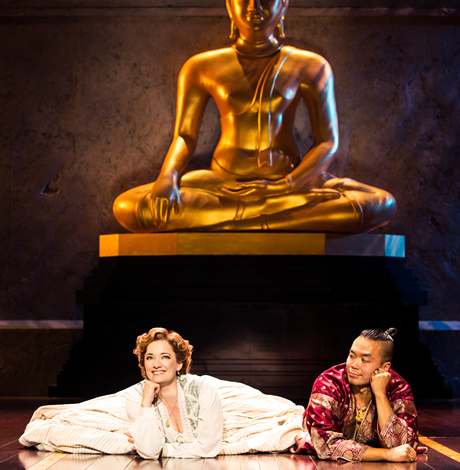

Laura Michelle Kelly and Jose Llana in ‘The King and I.’ (Photo by Matthew Murphy; courtesy Kennedy Center)
‘The King and I’
Through Aug. 20
The Kennedy Center
$49-159
202-467-4600
As curtains part and the prow of an enormous wooden ship glides to the edge of the Kennedy Center’s Opera House stage, it’s immediately evident that this isn’t the average national tour. Director Bartlett Sher has ensured that Lincoln Center’s 2015 Tony Award-winning revival of “The King and I” lives on as an exciting road show.
The ship’s cargo in the person of luminous Laura Michelle Kelly as British schoolteacher Anna Leonowens further confirms Sher’s intentions. Kelly and the other talented principals — all great singers — lend an operatic intensity to composer Richard Rodgers and lyricist Oscar Hammerstein’s magical score. Intelligently and beautifully realized sets by Michael Yeargan and Catherine Zuber’s sumptuous costumes up the quality quotient.
Kelly’s Anna is plucky rather than prim, resolute yet compassionate and willing to stand up to the King on issues of integrity and fairness. And the King of Siam played by out actor Jose Llana makes for the perfect counterpart playing the monarch as hammy, sarcastic and impossibly arrogant, but also compellingly relays the complicated inner life of a monarch facing change.
The time is 1862. Anna and her young son Louis (Graham Montgomery) have come to Siam where she will instruct the King’s children in English, some science and aspects of Western culture. A daughter of the British Empire who has lived in the East since she was 15, Anna isn’t scared of new experience; still, the King’s violent secret police and half-naked emissary leave her a tad unnerved. But she doesn’t show it. Instead she breaks into “I Whistle a Happy Tune,” the first of many familiar songs.
Custom dictates that the King’s subjects (including his wives and many children) lie prostrate before him. Though Anna begrudgingly obliges, she is otherwise not subservient. Though they butt heads, they learn from each other. She provides the King with new catch phrase “etcetera, etcetera, etcetera,” and he impresses her. He shows her a ruler willing to improve. Mutual respect and a near-romance develop that manifests with “Shall We Dance?” a rousing waltz that here registers more playful than passionate.
Closely orbiting the despotic ruler are his number one wife Lady Thiang, played by Joan Almedilla who proves her husband’s greatest champion with the beautifully sung “Something Wonderful,” the aloof but thoughtful Crown Prince Chulalongkorn (Anthony Chan); and Kralahome (Brian Rivera), the King’s big bare-chested loyal advisor, and the other wives and children.
Also on hand is the King’s concubine Tumptim (Manna Nichols), a gift from the King of Burma. Tumptim is the dangerously in love with the Lun Tha (Kavin Panmeechao), the envoy who delivered her from Burma. It’s a potentially steamy subplot that in this case doesn’t give much heat. But it does instigate a climatic disagreement between Anna and the King.
There are some politics in Hammerstein’s book. European powers are encroaching on the East. Cambodia has fallen to the French. Word has gotten to Queen Victoria that the King of Siam is a barbarian. To counteract that claim, the King with Anna’s help seek to impress a visiting party of British diplomats:
That means insisting the wives must trade their sumptuous sleek silks for more European voluminous skirts. Dismayed by their unwieldy new getups, the court ladies take a nice jab at the West with “Western People Funny.” The British guests are presented a stunningly executed Balinese ballet based on “Uncle Tom’s Cabin” which includes Jerome Robbins’ original choreography from the 1951 Broadway smash hit production that famously starred Yul Brynner and Gertrude Lawrence.
Ultimately the star of “The King and I” is the score. And here it’s served incredibly well.


Theater
Immersive ‘Nation-State’ imagines a society free of authoritarianism
Queer duo brings unique theater experience to Dupont Underground

‘Nation-State: A Live Experiment’
Sept. 2-13
La Pluma Theatre
Dupont Underground
19 Dupont Circle, N.W.
$25-40
Dupontunderground.org
Industry Night: September 7. Free for all theater makers
A relevant piece replete with borders and passports, La Pluma Theatre’s “Nation-State: A Live Experiment”is immersive, site-specific, and testimonial.
With the production, the company’s queer co-founders Victor Salinas and Gabriel de la Cruz pose unique situations and experiences. In lieu of tickets, audience members get passports. What follows are questions and tests, and whether they gain entrance into a nation built to protect its citizens from authoritarianism, resource theft, and colonization remains to be seen.
Originally from Mexico and Peru, respectively, Salinas and de la Cruz met at a birthday party in D.C. and instantly clicked as theater makers, sharing outlook and ambition. Reluctant to go it alone, both had been searching for artistic and producing collaboration. That all changed.
And while their enterprise is primarily Latino and queer, these professional partners refused to be confined to a box, choosing rather to amplify the voices of all of D.C.’s diverse communities. In line with their plans, “Nation-State” is open to serving many points of view.
As director of “Nation-State,” de la Cruz mostly guides the questioning. He’s the right man for the job. Since arriving in the U.S. six years ago, he has been consistently curious about certain things. Who belongs here? How do you make this your home? And who is creating the rules?
“But the writing process is shared,” de la Cruz corrects. “I come up with questions. I provide Victor the topic and he goes from there. We’re both writing what happens next.”
He adds, “the most exciting moment for people is when they share something unique. As a questioner, you need to find the confidence and the right moment to ask the question. If you provide the space for that, the actor or audience member will give you something singular.”
Since before La Pluma opened in November 2025, its creators have agreed that “the most beautiful thing is when you use theater to fashion something innovative. Theater is the place where you can create new frameworks and rehearse new ways to live.”
At just an hour, “Nation-State” is performed in English at Dupont Underground – the company’s historic residence, a once subterranean street car barn located beneath Dupont Circle. For the production, the tunnels serve as boundaries, and its different curved spaces make up a micro nation and welcome different guest actors who will come to share their stories.
At certain times, Salinas plays Officer Salinas, Director of N.I.C.E. (Non-Discriminatory, Inclusive Customs Enforcement), a humorous social critic of the system and border patrol. Other times, it’s Salinas as himself telling his real-life stories. He says, “it’s a level of vulnerability that I’ve never experienced. The script is my personal life with zero censorship. But I think, if not now in a play that we are pouring our souls into, then when?
“As a kid I dreamed of being TV show host and now I am. I will sing and tell my stories. I feel comfortable and ready to do it.”
In Spanish, “pluma” means both pen and feather. For the company, it’s the latter, and comes with lively associations. Salinas explains. In mysticism, feathers serve as a portal between the real and spiritual worlds, like that between fact and fiction. And in Spanish and Latin American slang “showing feathers” (in other words, showing queerness). La Pluma encourages a good display of authenticity.
And specifically for Salinas, there’s a personal story involving his beloved grandmother with whom he was extremely close. After she died, he has regularly found feathers as if she’s making contact. “A bit romantic, I know. But I think if you’re open you can see these things,” he says.
“Nation-State” is challenging but fun. It’s unmistakably La Pluma. In the end, the company wants to build a world where everyone feels safe to tell their own stories, as individuals and performers.
Theater
New GALA show about WWII spy full of conflict, intrigue
‘GARBO: The Actor Who Saved the World’ an inspired true story

‘Garbo: The Actor Who Saved the World’
Sept. 3-27
GALA Hispanic Theatre
3333 14th St., NW
$25-$50
galatheatre.org
Conflict, intrigue, and abundant imagination – all the elements for an extraordinary story. Add real-life Spanish spy Juan Pujol García who worked as a double agent loyal to the United Kingdom against Nazi Germany during World War II to the mix and it’s truly inspired.
Code-named “Garbo” by the British (a nod to his acting prowess), the anti-fascist’s mission took him from Madrid to Lisbon and later a London suburb where he created fictitious reports while unassumingly blending in with middle-class commuters.
By inventing a phony spy network of 27 agents with intricate backstories and tales of espionage worthy of Balzac’s pen, Garbo convinced Hitler’s generals that the D-Day invasion would hit Calais instead of Normandy, saving thousands of lives along the way.
And now the tale unfolds on stage in “GARBO: The Actor Who Saved the World,” a premiere thriller at GALA Hispanic penned by GALA artistic director Gustavo Ott, staged by Cuban director Carlos Celdrán, and starring out actor Kevin Jorges in the title role.
When Jorges was tapped to play Garbo, he (like the rest of the cast) was utterly unfamiliar with the play’s cunning protagonist.
But that changed quickly. Jorges, 37, has immersed himself in the biography and become increasingly interested and somewhat enamored with the character.
Charismatic with an easy smile and rich, warm voice, Jorges says he had to put aside his sensibility as a gay man in order to portray Garbo, who was a straight, patriarchal figure. But he also embraced similarities with the spy, like their shared aversion to physical violence.
And Jorges cites what he finds a pivotal moment: Garbo says to his British MI5 case officer and handler Thomas Harris (played by gay GALA veteran Carlos Castillo) that after what they’ve been through, neither will be what they once wanted to be. They are changed. They’ll never be the same.
Performed at 90 minutes in Spanish with user friendly English surtitles, “Garbo” is about imagination as resistance. “It’s also about a theatrical vocation that went unfulfilled,” says Ott. “That is perhaps the greatest disappointment of modernity: the insurmountable obstacles a vocation faces.
“Through his imagination, Garbo attempts to reclaim his lost calling—that of being an artist—and in his new trade as a spy, he uses it as a lifeline.”
Ott adds, “Walt Whitman viewed imagination as a traveling companion. He could rely on it when he was alone, when he lost hope, and when life slammed every door shut.”
Jorges was was attracted to acting at an early age, but the murder of his father in Caracas in 1999, made it more than an interest, theater became a refuge that saved him from tragedy. Today, he believes that theater is a refuge for many Venezuelan artists, it’s a way for them to contribute to society despite difficult circumstances.
Despite enjoying a successful early career in Caracas with many roles and accolades, Jorges had no choice but to seek new horizons. Political turmoil and economic collapse prompted him to leave Caracas in 2019 for Spain where he worked outside of his profession for a few years.
The actor credits “migrant persistence” for his return to the stage. On New Year’s Eve in 2022, Jorges made a pilgrimage to the famous monument to Cervantes at Plaza de España in Madrid where he made a heartfelt wish to act again.
Soon after, Jorges was collaborating with playwright and director Elio Palencia on “Timón Of(f) Caracas,” a personal one-man adaptation of Shakespeare’s “Timon of Athens, reframing the universal themes of betrayal, excess, and misanthropy to mirror the sociopolitical realities of Venezuela. To much success and acclaim, the production toured important cities throughout Spain.
It was Palencia who suggested to GALA’s Ott that Jorges hop the pond to play Garbo in D.C.
While he once viewed each acting job as an opportunity, Jorges now sees them as gifts. And, he says, the part of Garbo is a gift filled with possibilities: “It’s wonderful performing in Spanish with English translation. I love the interaction of culture. I really enjoy seeing the way things are done at GALA. Maybe sometime I’ll be performing in English too.”
Theater
National tour of ‘The Notebook’ retains its tearjerking power
Talented queer actor Grace Rundberg joins cast fresh out of college

‘The Notebook’
Aug. 18-30
National Theatre
1321 Pennsylvania Ave., N.W.
$89-$197
Broadwayatthenational.com
When Grace Ohwensadeyo Rundberg first imagined a career in musical theater, she wasn’t sure exactly how she’d fit in. As a gay actor would she play queer characters? Outside of “Rent” and a few other shows, would there be lesbian parts coming her way?
Rundberg, 23, remembers an acting class in college. “I was doing a romantic scene opposite a male actor when the professor interrupted to say it was ‘unconvincing.’ Well, I’d never had the experience of what it’s like to be with a man, so I’m not surprised it looked a little awkward.”
But for Rundberg, being in the national tour of “The Notebook” has quelled those misgivings. Of course, booking the show straight out of college bolstered her confidence, and playing a woman whose love interests are men has put Rundberg in a place where she’s fine playing straight or gay.
Opening this week in D.C.’s National Theatre (Aug. 18-30), “The Notebook” is a genuine tearjerker (the book, the film, and the musical). It’s the decades long love story of Noah and Allie who despite vast differences, fall in love as teenagers. Over the years, their romance faces separation, societal pressures, the challenges of Alzheimer’s disease, yet somehow prevails.
Shortly after graduating from Pace University’s musical theater program in 2025, the upfront and buoyant Rundberg was signed to play ensemble member Georgie and understudy for Middle Allie (a young woman caught between youthful passion and reflective memory).
A mezze soprano mixed belter experienced with folk, pop, contemporary styles, she proves an ideal performer to sing Ingrid Michaelson score and act Bekah Brunstetter’s romantic libretto.
And when she understudies the role of Middle Allie, whether by scheduled design or insanely short notice, she sings the familiar tune “My Days,” a standout track from the musical that serves as the show-stopping “11 o’clock number.” Here, she captures the emotional climax when Middle Allie chooses the life and loves she desires.
During a musical childhood spent in Pittsford, N.Y, just seven miles outside of Rochester, Rundberg began music classes at four; she learned piano and belonged to choirs. And though, she says, the family was not really into theater, her mom was a Cher impersonator for a while.
Significantly, Rundberg (whose middle name Ohwensadeyo translates from Cayuga as “Beautiful Earth”) is a citizen of the Cayuga Nation, an Indigenous nation native to New York state.
Recently, she began learning the Cayuga language, a very important part of the culture, particularly since it’s almost exclusively a spoken language. Rundberg’s cousin, a professor at Cornell University where he teaches Cayuga language and culture, has been a great help. She feels fortunate: “Not everyone has access to their ancestry I’m blessed in this way.”
The Brooklyn-based actor’s ambitions are bold and varied. While landing a national tour was high on her bucket list, she longs to work on Broadway and auditions for TV and film. Being the first to create a character in a new work, especially a lesbian character, is a big goal. “That would tie a lot of things together,” she says. “That’s the ultimate dream.”
In the meantime, Rundberg is working professionally and seeing the country. But touring isn’t without its drawbacks. “I miss New York a lot,” she says. “My girlfriend is there; long distance is a challenge for sure. I’m always in a different place often with different time zones. Still, she has come to see me in San Francisco, Miami, Cleveland, and a few other stops. And I fly to New York when I can. We make it work.”
As a kid, Rundberg watched and rewatched the movie version of ‘The Notebook.’ She says, “It’s one of my favorites. It’s kind of a cliché, I know, but I’m a hopeless romantic.”
The show touches a lot of people; it’s evident at every performance. From the stage, the cast sees audience members crying. In fact, “The Notebook” sells branded souvenir tissue boxes at its merchandise stands for five dollars a pop.
“Beyond elements of sadness there’s also joy,” she adds. “There’s the never-ending devotion and getting through hard times together too. We do our best to send the audience home with hope and love.”

‘Here the Whole Time’ delivers queer coming-of-age comedy

Pentagon expands testosterone screening as trans troops face hormone therapy restrictions

Calendar: September 4-10

Swiss government backs nationwide conversion therapy ban

Gloria Steinem dies at 92

Beloved D.C. ‘Old Catholic’ Bishop Charles Braun dies at 86

Blade welcomes fall intern

Top Bulgarian court rules government must legally recognize trans people

Markey’s primary win deemed success for LGBTQ activists

Lou Chibbaro Jr. documentary wins award from NLGJA
-

 Obituary5 days ago
Beloved D.C. ‘Old Catholic’ Bishop Charles Braun dies at 86
-
District of Columbia5 days ago
Blade welcomes fall intern
-
Bulgaria5 days ago
Top Bulgarian court rules government must legally recognize trans people
-
2026 Midterm Elections5 days ago
Markey’s primary win deemed success for LGBTQ activists