Politics
Texas Nat’l Guard pressured to grant benefits to gay troops
Lambda gives 10 days for adjutant general to respond to request
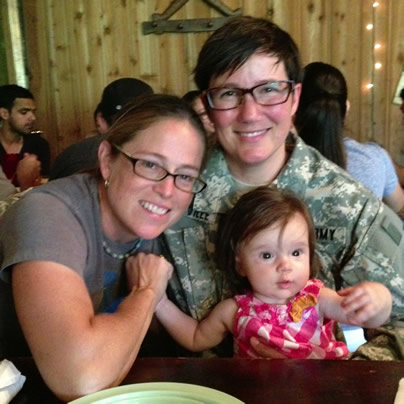
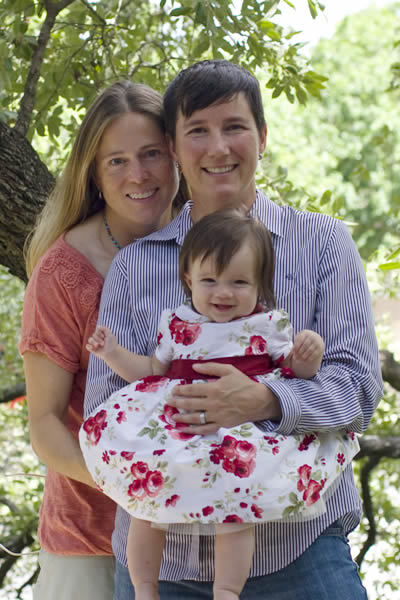
Alicia Butler (left) and Judith Cedville with daugher, Jordan, were denied benefits from Texas Military Forces (Photo courtesy of Alicia Butler).
The Texas National Guard is being pressured to revisit its policy blocking gay troops from enrolling at state-run facilities to receive spousal benefits as one LGBT legal group is seeking a response within 10 days.
In a letter dated Sept. 13, Paul Castillo, staff attorney for Lambda Legal, writes that Texas Military Forces — which comprises the state national guard — should change its current policy because it “fails its troops and their families.”
“The discriminatory treatment of lesbian and gay spouses of service members, including those in the Army National Guard in Texas, is illegal,” Costillo writes. “It also is detrimental to good order, discipline and morale and fails to accord all soldiers dignity and respect — guiding principles of the military.”
The letter — addressed to Texas Adjutant General Maj. Gen. John Nichols — requests a response from Texas Military Forces within 10 days. The Texas National Guard didn’t respond to the Washington Blade’s request to comment on the letter this week.
The Pentagon, beginning Sept. 3, allowed gay troops in legal same-sex marriages to receive federal spousal benefits allocated to married straight service members — such as health and pension benefits — in the wake of the Supreme Court decision against the Defense of Marriage Act.
But Texas Military Forces has said it cannot enroll the spouses of gay troops into the Defense Enrollment Eligibility Reporting System, or DEERS, because state law in Texas prohibits same-sex marriage. Instead, Texas Military Forces is telling gay married troops in the state to seek out installations run by the federal government to apply for benefits.
Texas is the one of three states that reportedly isn’t enrolling the same-sex spouses of gay troops into DEERS. Others are Louisiana and Mississippi. The national guards in other states — even the ones where same-sex marriage isn’t legal — have been enrolling gay couples.
As reported by the Blade, Alicia Butler, an Austin, Texas, attorney, and her spouse, Judith Chedville, an Army nurse and Iraq war veteran, were denied spousal benefits at Camp Mabry in Texas when they sought to apply for them. The letter indicates that Lambda is representing the couple.
Although Texas Military Forces has cited state law as the represent why it must withhold spousal benefits to gay troops like Butler and Chedville, Costillo calls this reasoning “dubious” because the couple was seeking federal benefits and the installation receives federal funds.
“Our client did not ask you to identify and provide any state-specific benefits, in recognition of her marriage, only to comply with the military’s polices — a condition of the extensive federal funding you receive,” Costillo writes.
But Lambda isn’t the only group asking Texas Military Forces to change its position. The LGBT group known as the American Military Partner Association made public a letter this week from 16 members of the Texas State House calling on Nichols to process benefits for same-sex military spouses at National Guard facilities in Texas.
“We call on you to respect Texas’ military families, to reconsider your position, and to follow the lead of virtually every other Adjutant General for the National Guard of the United States by, without further delay, enrolling all eligible spouses of National Guard service members at facilities operated by Texas Military Forces,” the letter states.
Also on Friday, the American Military Partner Association made public additional guidance indicating that Texas Military Forces not only won’t enroll same-sex couples into DEERS, but is also prohibiting them from becoming official members of family readiness groups or attend “Strong Bonds” marriage enrichment retreats.
Stephen Peters, president of the American Military Partner Association, said the denial of benefits at Texas National Guard installations has “gone far beyond the ability of same-sex spouses to process for federal benefits at national guard facilities.”
“Considering Major General Nichols, the head of the Texas National Guard, has decided to defy the Defense Department and go so far as to threaten to prevent same-sex military spouses from participating in family readiness groups or even attend marriage enrichment retreats, who in the chain of command is making sure these military families are taken care of and get the support and benefits they need and deserve?” Peters concluded.


The White House
White House counterterrorism strategy targets ‘anti-American, radically pro-transgender’ groups
Administration released document last week

The White House released the “United States Counterterrorism Strategy” last week, introducing enforcement priorities that include references to people with “extreme transgender ideologies.”
The document is the first executive branch counterterrorism strategy released since former President Joe Biden’s 2021 “National Strategy for Countering Domestic Terrorism,” which largely focused on threats tied to domestic extremism and the Jan. 6 Capitol attack. The Trump-Vance administration’s new strategy instead centers heavily on cartels, Islamist organizations, and what it describes as “violent left-wing extremists.”
The report identifies three primary categories of terror threats facing the U.S.: “Narcoterrorists and Transnational Gangs,” “Legacy Islamist Terrorists,” and “Violent Left-Wing Extremists, including Anarchists and Anti-Fascists.” The strategy repeatedly frames those groups as existential threats to the U.S. and outlines a more aggressive, militarized counterterrorism posture.
The introduction to the report closes with a warning from President Donald Trump referencing counterterrorism operations carried out during his second administration: “We will find you and we will kill you.”
In the section outlining the administration’s counterterrorism priorities, the document argues that federal intelligence, and law enforcement agencies under prior administrations focused on the wrong threats while overlooking violence committed by left-wing extremists. The strategy specifically references transgender ideology while discussing political violence.
“As real threats were ignored or underplayed, Americans have witnessed the politically motivated killings of Christians and conservatives committed by violent left-wing extremists, including the assassination of Charlie Kirk by a radical who espoused extreme transgender ideologies.”
Claims tying a trans person to Kirk’s killing have been disputed, however, and multiple news outlets later retracted or corrected early reports that identified the shooter as trans.
The report later expands on that argument, saying the administration will prioritize targeting “violent secular political groups” it describes as anti-American and “radically pro-transgender.”
“In addition to cartels and Islamist terror groups, our national CT activities will also prioritize the rapid identification and neutralization of violent secular political groups whose ideology is anti-American, radically pro-transgender, and anarchist.”
The rhetoric mirrors claims frequently made by Trump allies and conservative commentators linking trans people and left-wing activism to political violence. However, data compiled by researchers and organizations tracking mass shootings does not support the idea that trans people are responsible for a significant share of such attacks.
Factcheck.org says rhetoric from Trump and several far-right political pundits contradicts available data, noting that the percentage of mass shootings committed by trans people is “exceedingly small.”
Despite the lack of evidence supporting generalized claims about trans people, the president’s son Donald Trump, Jr., told Fox News in September 2025 that he could not “name a mass shooting in the last year or two in America that wasn’t committed by, you know, a transgender lunatic.”
Factcheck.org also found that even if cases involving shooters with unclear gender identities were included in statistics about trans mass shooters, the number would still account for only a fraction of a percent.
Mark Bryant, founding executive director of the Gun Violence Archive, said the number of trans mass shooters could be as high as eight, but would still account for less than 0.1 percent of mass shootings over the last 12 years, according to GVA data. He added that the figure would remain below 0.2 percent even when examining incidents from 2018 to the present.
Beyond domestic extremism, the strategy frames the administration’s broader counterterrorism agenda through the lens of “America First” foreign policy and renewed U.S. dominance in the Western Hemisphere. The report repeatedly references the Monroe Doctrine, the nearly 200-year-old policy warning European powers against interference in the Americas.
“After years of neglect, the United States will reassert and enforce the Monroe Doctrine to restore American preeminence in the Western Hemisphere, and to protect our homeland” Trump said in the report.
The document also breaks down counterterrorism priorities by region, including the Middle East, where it argues the U.S. is “no longer as dependent” on the region because of increased domestic energy production.
“Our growing domestic energy production means the Middle East is no longer as central to America’s stability, yet threats from this region remain, and our counterterrorism goals continue to be specific and rooted in realistic threat analysis.”
The statement comes amid rising gas prices tied in part to instability surrounding the war involving Iran, with fuel costs reaching some of their highest levels since 2022. According to AAA, the national average price for gasoline climbed to $4.52 per gallon as the national average rose “$.25 for a second straight week.“
Congress
Bill seeks to block global gag rule expansion
Policy now bans US foreign aid to groups promoting ‘gender ideology’

Lawmakers on Wednesday introduced a bill that would block the expansion of the global gag rule.
President Ronald Reagan in 1985 implemented the global gag rule, also known as the “Mexico City” policy, which bans U.S. foreign aid for groups that support abortion and/or offer abortion-related services.
Trump reinstated the rule during his first administration. The Biden-Harris administration shortly after it took office in 2021 rescinded it.
The Trump-Vance administration earlier this year expanded the global gag rule to ban U.S. foreign aid for groups that promote “gender ideology.” The expansion took effect on Feb. 26.
U.S. Sens. Jeanne Shaheen (D-N.H.) and Jacky Rosen (D-Nev.) introduced the Protecting Human Rights and Public Health in Foreign Assistance Act in the U.S. Senate. U.S. Reps. Grace Meng (D-N.Y.), Lois Frankel (D-Fla.), Diana DeGette (D-Colo.), Pramila Jayapal (D-Wash.), Sara Jacobs (D-Calif.), and Gregory Meeks (D-N.Y.) introduced it in the U.S. House of Representatives.
“Using taxpayer money to export the Trump administration’s anti-trans, anti-science, and anti-abortion ideological agenda isn’t just immoral — it’s antithetical to efficient, effective, and rights-based foreign assistance,” said Council for Global Equality Senior Policy Fellow Beirne Roose-Snyder on Wednesday in a press release.
Meng added the Trump-Vance administration’s “crusade against healthcare and global aid is putting millions of lives at risk worldwide.”
“No one will flourish under the new expanded global gag rule,” said the New York Democrat. “These policies weaponize foreign aid and will result in greater harm, particularly for women and girls, marginalized communities, and LGBTQI+ individuals.”
“They should never have been implemented at all, let alone without even a basic public comment process,” she added. “This legislation will reverse these dangerous policies.”
The White House
From red carpet to chaos: A first-person narrative of the WHCD shooting
The Blade’s WH correspondent Joe Reberkenny recounts his night at the WHCD after a shooter attempted to gain entry.

It started as any White House Correspondents’ Dinner is supposed to go—I assume. I’ve never been to one before this, but based on other events I’ve attended at the Hilton, including an HRC gala, it all seemed fairly normal.
There was a lot of traffic. Police had blocked off streets encompassing a large portion of Adams Morgan—particularly around the hotel. The president was making his first appearance after boycotting the event during his first term, so there was a sense of anticipation. It took me about 45 minutes to go just under a mile from my apartment to about three blocks from the hotel in my Uber. I waited until the last possible second before I felt like I was going to be late—6:30—to get out of the car, because it was raining and I was wearing my green tux.
I walked up to a group of people checking tickets at the base of the hotel. They seemed to just be glancing at the tiny, index-card-sized tickets rather than conducting any kind of full security screening outside. As I walked from that first checkpoint to the drive-around drop-off area, I joined what was essentially one long line for the red carpet. It eventually split into people who wanted photos and those who didn’t—but again, there was no real need to show anything beyond that small ticket upon entering, and even that wasn’t being checked closely.
A light went off in my head; I felt that, given the speed at which security was checking tickets, they couldn’t fully see the foil logo and tiny table numbers from that distance. I remember thinking that if I had a similarly sized piece of paper, I could have gotten through up to that point.
I also noticed there was no real security checkpoint or metal detectors upon initially entering the hotel grounds—unlike what I had seen at the HRC gala the year before.
I waited about 35 minutes in line in the car drop-off area—without cars, since it had been repurposed to corral press and their guests before entering the building and heading onto the red carpet. I took my photo, then went up the escalator to meet my date, Jacob Bernard from Democracy Forward. They wouldn’t let him onto the red carpet without his ticket, so I gave him his, which I had been holding. He was already inside the venue despite not having his ticket on him and had been at one of the pre-parties.
That also struck me as odd—that you could access a pre-dinner party without a ticket or going through any visible security.
After I found him, we took a photo together at a step-and-repeat past the main red carpet area around 7:45. Oddly enough, a group of my friends—gays who I regularly see on the dance floors of the gay bars of Washington, who work in various government and media-adjacent fields—found me, and we took pictures together. None were White House correspondents or held a “hard pass” to the White House (security credentials that allow entry into the White House complex).
Another light went off in my head that indicated party crashers probably shouldn’t be getting inside to an event that is supposed to be one of the most secure rooms in the country.
After the photos, I could see groups of people being moved from pre-party spaces in various meeting rooms on other floors and directed toward the main floor where the red carpet had been.
My guest and I went back up to the main floor and walked through a small security checkpoint that included only a handful of metal detectors. From there, I went down the stairs from the lobby into the International Ballroom, where we took our seats at Table 200. I talked to a few people I knew—very traditional pre-event chit-chat. The vibes felt good. It was my first time attending, and I was genuinely excited.
Around 8:15, the Marine Corps Band played and “Commandant’s Four” color guard presented the flags. We were then told to take our seats.
They introduced the head table—the president, first lady, vice president, and members of the White House Correspondents’ Association board. Weijia Jiang, senior White House correspondent for CBS News and president of the WHCA, gave a brief speech, essentially saying we would eat first and then move into the main program, which was supposed to feature mentalist Oz Pearlman.
At this point my table, 200 which included members of the Wall Street Journal, the Blade, and a European outlet all started eating. About 15 minutes later, Washington Hilton staff began clearing plates and preparing to bring out the next course.
As they cleared the plates, I heard four loud bangs.
I saw hotel employees immediately start ducking. They seemed to understand the gravity of the situation much faster than most attendees, including myself. At first, it sounded like a tray might have fallen over (but I later found out that wasn’t the case).
After about 30 seconds of watching some people duck, others look around in confusion, and some continue eating and drinking, I got down. I kneeled with my chair in front of me as a kind of barrier. Being at Table 200, I felt somewhat removed from where the actual incident occurred.
Then I saw the president being whisked away quickly by Secret Service, along with the first lady and others at the head table.
My reporter instincts kicked in. I grabbed my phone and started filming. I saw SWAT team members rush into the ballroom and onto the stage, clearing the area. I captured a video of people looking around, confused about what had just happened.
A few minutes later, the room was told by the WHCA president to hold on—that they would provide more information and guidance on what would happen next. There was some indication that they might try to continue the event despite what had occurred.
Everyone started frantically checking X to see if any major outlets were reporting. I was receiving texts from family, friends, and colleagues about the rapidly unfolding situation.
I walked to the bathroom—twice, technically. I couldn’t find it initially because it was hidden behind black curtains. (Later, those curtains were removed, and the men’s room was in clearer view.)
During the first walk to the bathroom, I called my editor to tell him what was happening. He instructed me to start sending copy to another editor, who would get it online. The ballroom had almost no service—it’s in the basement of a 12-story hotel—so it was a challenge. I utilized SMS fallback (since iMessage wasn’t working) to send updates.
I returned to the table, where people were still hovering—calling editors, scrolling, texting, sending photos and copy. I was already drafting my story and sending it in chunks, adding details as I gathered more information.
I walked my guest toward the bathroom again, which was on the opposite side of the ballroom from our table, so I had to cross what felt like a sea of journalists, PR officials, guests, and others on their phones, talking and scrolling. My guest pointed out that the press pool was being held in an alcove away from the ballroom doors and escalator exit—not in the ballroom with everyone else.
“Alive” by the Bee Gees was playing over the speakers in the bathroom, which felt a little too on the nose.
On my way out, I heard someone speaking over a microphone and rushed to the ballroom entrance. WHCA President Weijia Jiang was speaking. She announced that the event was over and the space was being evacuated.
She also said that President Trump would hold a press conference at the White House in about 25 minutes.
That’s when I knew it was a race against the clock.
I called my editor a second time to update him and asked if I should head to the briefing (knowing the answer would be yes). He confirmed.
Then the crowd began to move. People grabbed purses, bottles—some left belongings behind. Even though it was technically becoming a crime scene, no one was actively forcing us out. It felt more like a collective understanding: It was time to go.
I texted my guest: “OK, I have to go to the White House. I’m so sorry to leave you.”
I made my way with the sea of people toward the one exit we were allowed to use and zipped between women in fancy gowns and men looking like penguins.
I put on my hard press pass, opened the Capital Bikeshare app, reserved the closest e-bike, and headed out.
I walked up Columbia Road to 20th and Wyoming, grabbed the bike, and rode down Wyoming, then 18th, cut over to U Street, and went straight down 16th to the White House. That ride was exhilarating. I also filmed an Instagram Reel updating my followers on what was going on. I could see tourists and D.C. residents alike looking at me from their cars and the sidewalk, obviously confused as to why a man dressed in a tux had hopped on a bike.
I got off the bike where 16th Street meets Lafayette Square and darted toward the first White House security checkpoint, where they were verifying press credentials. Luckily, I had mine. After that, it turned into a mad dash. Everyone who made it through started moving quickly.
The sound of heels on what I think was cobblestone—or maybe brick—sticks with me. My own shoes were clacking as I ran toward the White House alongside other journalists in heels and dress shoes.
At the Secret Service checkpoint, there was a separate line for hard pass holders. Having my hard pass let me skip much of the impeccably dressed line of journalists who didn’t think to bring their hard pass with them.
It was probably the most exquisitely dressed press crowd I’ve ever seen—tuxedos, gowns, full makeup. It felt like something out of “The Hunger Games.”
I went through security, put my belongings through the metal detector, entered my code, grabbed my things, and ran to the briefing room.


U.S. attorney nominee confirmed despite anti-LGBTQ history, no trial experience

Vt. lawmaker equates transgender identity with bestiality

Gay Men’s Chorus celebrates 45 years at annual gala

BREAKING NEWS: Barney Frank dies at 86

Intersex lives, constitutional freedom, and the dangerous future of Ghana’s Human Sexual Rights and Family Values Bill

Disillusioned about democracy? Think of it as a community garden

Honey, have we been priced out of gay paradise?

IDAHOBiT a reminder we all must stand up against transphobia

PHOTOS: Blade Summer Kickoff Party