Arts & Entertainment
Deep in Tennessee
Obscure one acts by gay playwright produced at Shakespeare
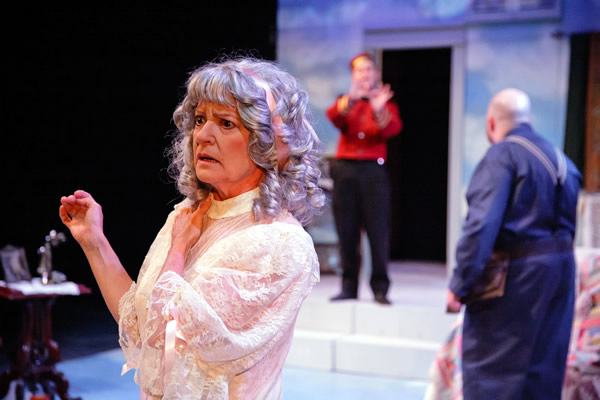
Lynn Sharp Spears as Lucretia in ‘Portrait of a Madonna,’ Tennessee Williams’ one act precursor to ‘Streetcar Named Desire.’ (Photo courtesy Washington Shakespeare Company)
‘Tennessee Continuum: Two One-Act Plays by Tennessee Williams’
Through July 3
Washington Shakespeare Company
Artisphere
1101 Wilson Blvd, Arlington, VA.
$25-$35; pay what you can for Saturday matinees
888-841-2787
Like the name suggests, Washington Shakespeare Company is a little Bard-centric, but the Rosslyn-based troupe successfully interprets modern playwrights too, particularly Tennessee Williams. Currently the company is presenting two rarely performed pieces from different phases of the gay playwright’s epic career.
Though ostensibly not a bit alike, “Portrait of a Madonna” and “The Gnädiges Fräulein” (together billed as “Tennessee Continuum: Two One-Act Plays by Tennessee Williams), are both poignant and inhabited by tragic characters. They share some of the inescapable Williams’ themes of unrequited attachments and survival in an unkind world.
Written in 1940, “Madonna” is a precursor to Williams’ later, greater works. Set in a grim apartment in an unnamed city, it’s the story of Lucretia Collins, a kooky maiden lady who is haunted by an ill-fated romance from her genteel, small town southern past. Now poor and alone, the aging preacher’s daughter loses her mind: She believes the man she once loved invades her bedroom nightly to “indulge his senses” as she rather delicately puts it. When she calls the apartment management for help, they summon mental health professionals and not the cops.
Sensitively staged by Lynn Sharp Spears, the one act reeks with the stuff that made the young Williams famous: faded belles, gentleman callers and glimpses into madness — Annetta Dexter Sawyer’s Lucretia is certifiably nuts. Slice Hick’s empathetic, human porter and Bob Sheire as the mocking elevator operator give an idea of the variety of characters that a lady might encounter in the sometimes uncertain outside world.
In “Madonna’s” final scene, a kindly doctor (here played by Christopher Henley sporting a Tyrone Power-inspired haircut) comes to escort an increasingly disconnected Lucretia to a state asylum. Williams would rewrite this same situation a few years concerning another distressed lady — Blanche DuBois in “A Streetcar Named Desire.” Interestingly, after seeing Jessica Tandy play Lucretia in a West Coast production of Madonna in 1947, he cast her as Blanche in the original production of “Streetcar.”
After intermission, it’s “The Gnädiges Fräulein,” a very funny paean to human survival written in 1966 when Williams was no longer the darling of critics. In fact, this one act (which translates from German as “Gracious Young Lady”) originally closed on Broadway in less than a week. Set in Williams’ beloved Florida Keys, the oddball comedy was his first foray into the absurd and, many say, an allegory of his own artistic life.
In search of a scoop, society reporter Polly (Mundy Spears) shows up at an unconventional guest house owned by no-nonsense Molly (Emily Webbe). It’s a strange place: The front porch is dripping with blood and a vicious Cocaloony bird (Karin Abromaitis) is circling the property intimidating everyone it meets. And the tenants are equally unusual. Wearing just a tiny loincloth, pulchritudinous and platinum blond Indian Joe (James Finley) struts about and says very little. The orange-haired title Fraulein (Karin Rosnizeck) was once a performer. Now deaf and blind in one eye, she earns her keep by battling increasingly fearsome Cocaloonies for fisherman’s castoff catch down at the docks. When not trading Williams’ gloriously crafted barbs, frenemies Polly and Molly smoke joints and engage in furious, highly sexualized synchronized rocking.
Gay director Jay Hardee elicits just right performances from an excellent cast. His inspired staging effortlessly coaxes the show’s many aspects — campy humor, menace, and melancholy — to the fore. Elizabeth Jenkins McFadden’s nonintrusive set cleverly morphs from tenement flat to seaside abode with very little fuss.
“Tennessee Continuum” is now running in repertory at Artisphere with a production of “Night and Day” by Tom Stoppard — another of the company’s favorite playwrights.


Theater
Studio’s ‘Mother Play’ draws from lesbian playwright’s past
A poignant memory piece laced with sadness and wry laughs
‘The Mother Play’
Through Jan. 4
Studio Theatre
1501 14th St., N.W.
$42 – $112
Studiotheatre.org
“The Mother Play” isn’t the first work by Pulitzer Prize-winning lesbian playwright Paula Vogel that draws from her past. It’s just the most recent.
Currently enjoying an extended run at Studio Theatre, “The Mother Play,” (also known as “The Mother Play: A Play in Five Evictions,” or more simply, “Mother Play”) is a 90-minute powerful and poignant memory piece laced with sadness and wry laughs.
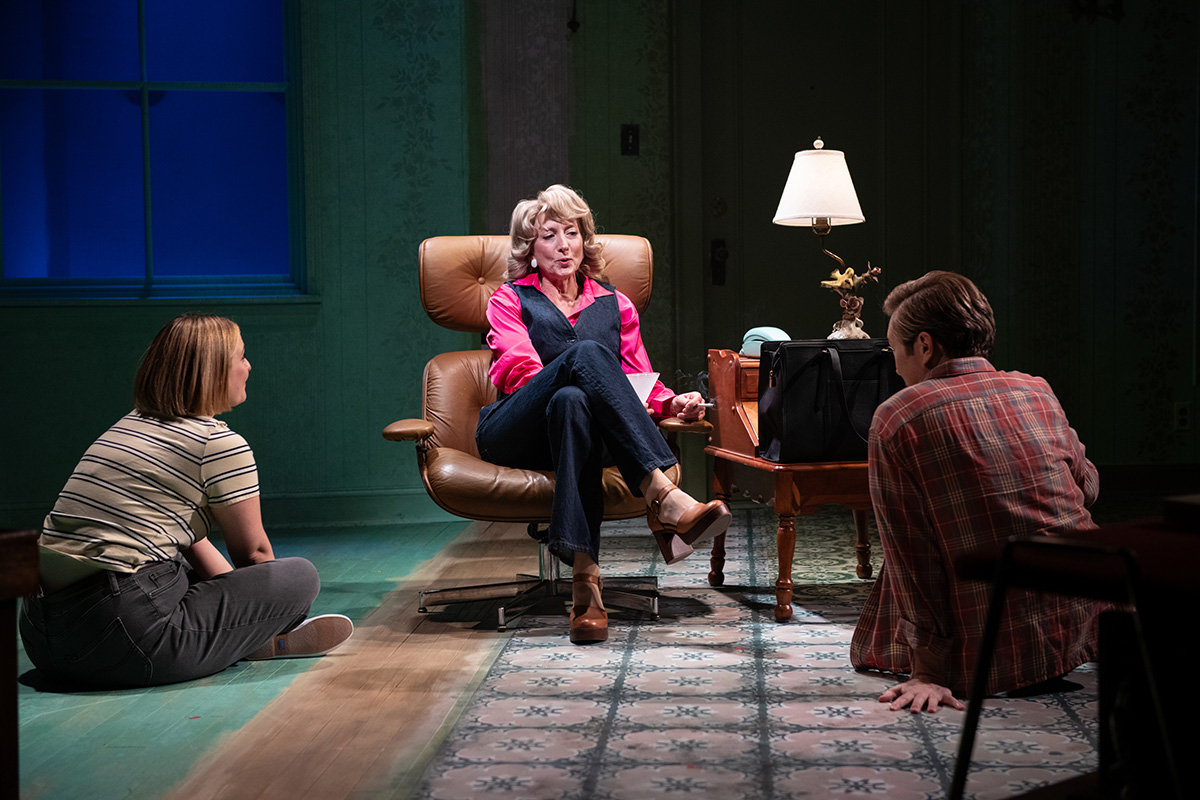
The mother in question is Phyllis Herman (played exquisitely by Kate Eastwood Norris), a divorced government secretary bringing up two children under difficult circumstances. When we meet them it’s 1964 and the family is living in a depressing subterranean apartment adjacent to the building’s trash room.
Phyllis isn’t exactly cut out for single motherhood; an alcoholic chain-smoker with two gay offspring, Carl and Martha, both in their early teens, she seems beyond her depth.
In spite (or because of) the challenges, things are never dull in the Herman home. Phyllis is warring with landlords, drinking, or involved in some other domestic intrigue. At the same time, Carl is glued to books by authors like Jane Austen, and queer novelist Lytton Strachey, while Martha is charged with topping off mother’s drinks, not a mean feat.
Despite having an emotionally and physically withholding parent, adolescent Martha is finding her way. Fortunately, she has nurturing older brother Carl (the excellent Stanley Bahorek) who introduces her to queer classics like “The Well of Loneliness” by Radclyffe Hall, and encourages Martha to pursue lofty learning goals.
Zoe Mann’s Martha is just how you might imagine the young Vogel – bright, searching, and a tad awkward.
As the play moves through the decades, Martha becomes an increasingly confident young lesbian before sliding comfortably into early middle age. Over time, her attitude toward her mother becomes more sympathetic. It’s a convincing and pleasing performance.
Phyllis is big on appearances, mainly her own. She has good taste and a sharp eye for thrift store and Goodwill finds including Chanel or a Von Furstenberg wrap dress (which looks smashing on Eastwood Norris, by the way), crowned with the blonde wig of the moment.
Time and place figure heavily into Vogel’s play. The setting is specific: “A series of apartments in Prince George’s and Montgomery County from 1964 to the 21st century, from subbasement custodial units that would now be Section 8 housing to 3-bedroom units.”
Krit Robinson’s cunning set allows for quick costume and prop changes as decades seamlessly move from one to the next. And if by magic, projection designer Shawn Boyle periodically covers the walls with scurrying roaches, a persistent problem for these renters.
Margot Bordelon directs with sensitivity and nuance. Her take on Vogel’s tragicomedy hits all the marks.
Near the play’s end, there’s a scene sometimes referred to as “The Phyllis Ballet.” Here, mother sits onstage silently in front of her dressing table mirror. She is removed of artifice and oozes a mixture of vulnerability but not without some strength. It’s longish for a wordless scene, but Bordelon has paced it perfectly.
When Martha arranges a night of family fun with mom and now out and proud brother at Lost and Found (the legendary D.C. gay disco), the plan backfires spectacularly. Not long after, Phyllis’ desire for outside approval resurfaces tenfold, evidenced by extreme discomfort when Carl, her favorite child, becomes visibly ill with HIV/AIDS symptoms.
Other semi-autobiographical plays from the DMV native’s oeuvre include “The Baltimore Waltz,” a darkly funny, yet moving piece written in memory of her brother (Carl Vogel), who died of AIDS in 1988. The playwright additionally wrote “How I Learned to Drive,” an acclaimed play heavily inspired by her own experiences with sexual abuse as a teenager.
“The Mother Play” made its debut on Broadway in 2024, featuring Jessica Lange in the eponymous role, earning her a Tony Award nomination.
Like other real-life matriarch inspired characters (Mary Tyrone, Amanda Wingfield, Violet Weston to name a few) Phyllis Herman seems poised to join that pantheon of complicated, women.
Bars & Parties
Mixtape Sapphics hosts holiday party on Dec. 13
‘Sugar & Spice’ night planned for Saturday

Mixtape Sapphics will host “Sapphic Sugar & Spice: A Naughty-Nice Mixtape Holiday Party” on Saturday, Dec. 13 at 4 p.m. at Amsterdam Lounge.
This is a festive, grown holiday party for queer women and sapphics 35 and older at Revolt’s Christmas pop-up. There will be music, joy, and an optional White Elephant.
This is Mixtape Sapphics’ first-ever holiday party — a cozy, flirty, intentionally grounded night created just for queer women and sapphics 35+ who want real connection, festive joy, and a warm place to land at the end of the year.
Tickets start at $13.26 and can be purchased on Eventbrite.

Friday, December 12
“Center Aging Friday Tea Time” will be at 12 p.m. in person at the DC Center for the LGBT Community’s new location at 1827 Wiltberger St., N.W. To RSVP, visit the DC Center’s website or email [email protected].
Go Gay DC will host “LGBTQ+ Community Happy Hour” at 7 p.m. at Freddie’s Beach Bar and Restaurant. This event is ideal for making new friends, professional networking, idea-sharing, and community building. This event is free and more details are available on Eventbrite.
Women in Their Twenties and Thirties will be at 8 p.m. on Zoom. This is a social discussion group for queer women in the Washington, D.C. area. For more details, go to Facebook.
Saturday, December 13
Go Gay DC will host “LGBTQ+ Community Brunch” at 12 p.m. at Freddie’s Beach Bar & Restaurant. This fun weekly event brings the DMV area LGBTQ+ community, including allies, together for delicious food and conversation. Attendance is free and more details are available on Eventbrite.
The DC Center for the LGBT Community will host “Sunday Supper on Saturday” at 2 p.m. D.C.’s queer community will gather for good food, laughter, and community. For more information, email [email protected].
Sunday, December 14
SADBrunch will host “HokiSlay Drag Brunch” at 12 p.m. at Throw Social. This festive affair brings fierce performances, over-the-top holiday looks, and more sparkle than a tinsel explosion. Expect powerhouse lip-syncs, laughter, and cheer hotter than your spiked cocoa. Cake Pop will host the event. Tickets cost $28.52 and are available on Eventbrite.
Monday, December 15
“Center Aging: Monday Coffee Klatch” will be at 10 a.m. on Zoom. This is a social hour for older LGBTQ+ adults. Guests are encouraged to bring a beverage of choice. For more information, contact Adam ([email protected]).
Genderqueer DC will be at 7 p.m. on Zoom. This is a support group for people who identify outside of the gender binary, whether you’re bigender, agender, genderfluid, or just know that you’re not 100% cis. For more details, visit genderqueerdc.org or Facebook.
Tuesday, December 16
Center Bi+ Roundtable will be at 7 p.m. on Zoom. This is an opportunity for people to gather and discuss issues related to bisexuality or as Bi individuals in a private setting. Visit Facebook or Meetup for more information.
The DC Center for the LGBT Community will host “Self-Defense Class with Avi Rome” at 12:30 p.m. Rome is a proud member of the LGBTQ community and a full-time martial arts instructor with 25 years of teaching experience. He holds a Fifth Degree Black Belt in Jhoon Rhee Tae Kwon Do and is the director of the studio’s Adaptive Tae Kwon Do program for students with special needs. He has also run numerous self-defense workshops for various groups and situations. For more details, visit the center’s website.
Wednesday, December 17
Job Club will be at 6 p.m. on Zoom upon request. This is a weekly job support program to help job entrants and seekers, including the long-term unemployed, improve self-confidence, motivation, resilience and productivity for effective job searches and networking — allowing participants to move away from being merely “applicants” toward being “candidates.” For more information, email [email protected] or visit thedccenter.org/careers.
Asexual and Aromantic Group will be at 7 p.m. on Zoom. This is a space where people who are questioning this aspect of their identity or those who identify as asexual and/or aromantic can come together, share stories and experiences, and discuss various topics. For more details, email [email protected].
Thursday, December 18
The DC Center’s Fresh Produce Program will be held all day at the DC Center for the LGBT Community. People will be informed on Wednesday at 5 p.m. if they are picked to receive a produce box. No proof of residency or income is required. For more information, email [email protected] or call 202-682-2245.
Virtual Yoga Class will be at 7 p.m. on Zoom. This free weekly class is a combination of yoga, breath work and meditation that allows LGBTQ+ community members to continue their healing journey with somatic and mindfulness practices. For more details, visit the DC Center’s website.

Studio’s ‘Mother Play’ draws from lesbian playwright’s past

Choose U ambassadors share lived experiences with HIV, personal reflections, and insights

DOJ seeks to join lawsuit against Loudoun County over trans student in locker room

As house Democrats release Epstein photos, Garcia continues to demand DOJ transparency

Capital Pride announces change in date for 2026 D.C. Pride parade and festival

EXCLUSIVE: George Santos speaks out on prison, Trump pardon, and more

The harsh truth about HIV phobia in gay dating

Victory Institute honors transgender Spanish senator in D.C.

Kazakh Senate tables anti-LGBTQ propaganda bill