Local
‘Worldwide’ LGBT marches fizzle
Only 14 demonstrators turn out in D.C.
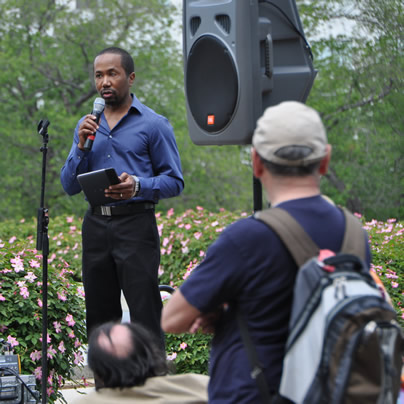
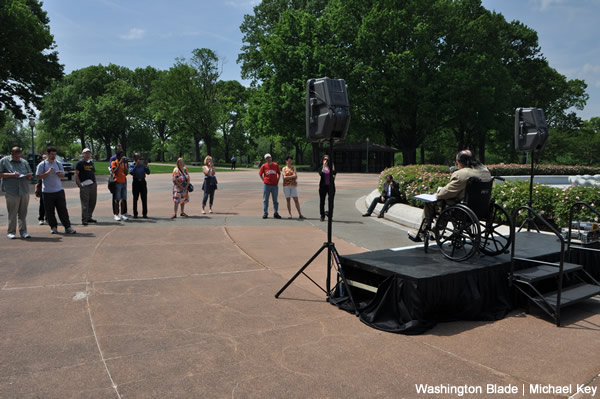
Lack of turnout for the local DC component of the 'worldwide' equality march led to the cancelation of the rally's march portion. (Washington Blade photo by Michael Key)
Saying they were unwavering in their commitment to LGBT equality, a contingent of 14 LGBT activists and their straight supporters held a rally across the street from the U.S. Capitol early Saturday afternoon as part of a series of Worldwide LGBT Civil Rights marches in the U.S. and abroad.
The event was promoted mostly on Facebook without the involvement of established local and national LGBT organizations. It was the brainchild of Oklahoma City gay activist Joe Knudson, who called for a series of simultaneous LGBT marches and rallies in cities throughout the world on April 21.
With less than 20 participants present at the conclusion of the rally, organizers chose to forego the march.
“These marches are occurring in over thirty cities around the globe,” said Curtis Sledge, a Richmond, Va., gay activist who organized the D.C. event and was among three speakers at the rally held at Upper Senate Park.
“Regardless of the size of the crowd…we’re here to say it’s our time right now,” Sledge said after the rally. “We are seeking equality not just for us but for everyone.”
The organization Let’s Reach One Million People Campaign, through which Knudson and others worked to organize the marches and rallies, listed 18 U.S. cities and 12 cities in countries in Europe, Asia and Africa where marches were scheduled to take place. It could not be determined at press time whether all of them took place, especially those in Africa.
According to reports in the gay and straight media, marches or rallies in most of the U.S. cities where they took place drew fewer than 100 people. The LGBT newspaper George Voice reported about 50 turned out for a rally and march on the state capital in Atlanta.
The Athens, Ga., Banner-Herald reported that about 75 people turned out for a march in that Georgia city, which was covered by the straight press. In Chicago, about 15 people participated in a March and rally and about 30 turned out for the march and rally in Portland, Ore., according to a report by the LGBT blog Bilerico Project.
In a statement released to organizers and supporters of the events, Knudson said between 6,000 and 8,000 people participated in the events in the U.S. and overseas. He said the enthusiasm and impact the events would have in the U.S. and abroad would be far more significant than the number of people attending them.
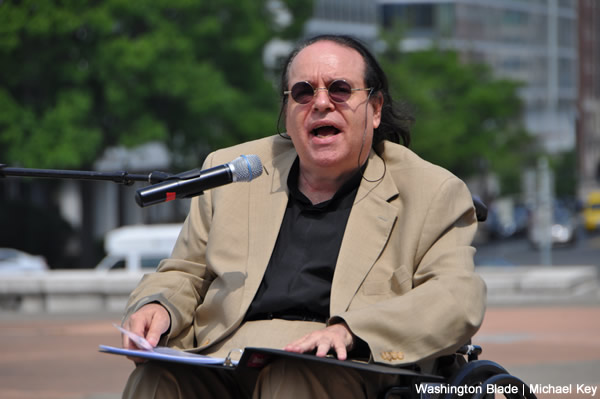
Jonathan Wolfman (Blade photo by Michael Key)
Jonathan Wolfman, a writer, former teacher and chief editor of an online travel site called CastleGayGuide.com, gave the keynote speech at the D.C. rally. Describing himself as a straight ally to the LGBT movement, Wolfman called LGBT rights “the essential civil rights mandate of our era.”
He noted that in addition to rallies and marches in the U.S., many of the LGBT events were scheduled to take place overseas, including such countries as Uganda, Nigeria, and Pakistan.
“That some are marching today in several of those nations takes guts and a belief in ultimate justice,” he said. “I salute all marchers today but especially those who risk arrest and beatings and worse for their commitment.”
Lamel Clark, 21, a Richmond resident, told the rally the 1960s era black civil rights movement was his inspiration for becoming involved in the LGBT movement as an African American gay man.
“Many years ago a great man stood on the steps of the Lincoln Memorial and spoke of a dream. He dreamed of a day when people could be treated equally and not judged by the color of their skin,” said Clark, speaking on a stage next to a fountain and facing the Capitol Building.
“I’m proud to stand not too far from where he was and know that his dream was a reality,” he said. “But today I stand before you with a dream of my own. I dream of a day when I can have the option to marry whoever I please and not have to worry about their sex but to be able to marry just on the basis of love.”
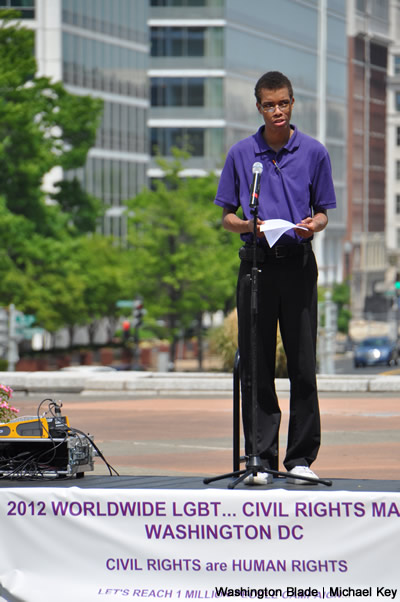
Lamel Clark (Blade photo by Michael Key)
Clark added, “I stand here because I have found the person who I want to spend the rest of my life with. So many people have told me, oh, it’s o.k. You don’t have to be married to spend the rest of your life with someone. My response is that’s not enough…I want to say loud and proud this is my husband.”
Among those standing nearby listening to Clark and the other two speakers were two U.S. Capitol police officers. The two likely were assigned to patrol a rally and parade that organizers stated in their application for a parade permit was expected to attract between 1,500 and 2,500 people.
Sledge said he was at a loss to say why so few people attended. He said he contacted a number of local organizations as well as several D.C. area universities about the planned march and rally. According Sledge, a Facebook page promoting all of the planned U.S. Worldwide March events had more than 20,000 members.
He said a number of people who told him they planned to attend D.C. rally didn’t show, including D.C. gay activist Brian Watson, who was listed as a scheduled speaker.
Watson did not return calls seeking to confirm whether he agreed to speak at the event.
When asked why he thought most of the established U.S. national and local LGBT organizations chose not to participate in the marches, Knudson said sources familiar with various groups told him the groups don’t like to get involved in events that they don’t control.
“I was point blank told by some that it is not proper for a new and young grassroots organization such as the Let’s Reach 1 Million People Campaign, to initiate such action as we did without first getting the approval of some of the older more established organizations,” Knudson told the Blade.
“[I]n doing so we stepped on a lot of egos and I was told egos of LGBT organizations do not heal very well or very fast,” he said.
Veteran D.C. gay activists Bob Summersgill, former president of the Gay and Lesbian Activists Alliance, and Rick Rosendall, the group’s current vice president, disagreed with Knudson’s assessment of the established LGBT groups.
“Speaking for myself and GLAA, if we were so egotistical and controlling as Mr. Knudson says in his laughable generalization, we wouldn’t have the record of accomplishment that we do,” Rosendall said. “LGBT advocates in D.C. have a long history of coalition work, which is not about getting permission but about consultation.”
Summersgill said organizers of the worldwide marches didn’t adequately communicate what they wanted people to do to advance their goals of equality “other than to walk around while members of Congress were out of town.”
In addition to granting permission to hold the rally on U.S. Capitol grounds, the permit called for a march from the Capitol along Constitution Avenue to 15th Street, N.W., where it was to travel north and turn right on Pennsylvania Avenue and head back towards the Capitol. The march was scheduled to end at 3rd Street and Pennsylvania Avenue, N.W.
Wolfman, a Maryland resident, gave a ringing defense of same-sex marriage and needled opponents who say same-sex nuptials are a threat to the institution of marriage.
“This may be the most ludicrous idea going,” he said. “Encouraging marriage simply encourages marriage. It is impossible to see how the gay marriage next door threatens my straight marriage. It is equally impossible to understand how the legalization of gay marriage could possibly convince straight people not to marry or encourage them to split up.”
Sledge said in his speech that the LGBT rights movement has picked up considerable momentum over the past few years. Among the work still to be done in the U.S., he said, was the eradication of bullying and other forms of discrimination against LGBT youth.
“Never for a moment those of you in the gay community – never for a moment look on yourself as being inferior or less than human but stand tall with your heads held high as a person with a heart, with talent and significance in this world,” he said.
“And for all this we should be accepted for being what God created. Equality is our birthright. We are equal.”
District of Columbia
Gay priest credited with boosting church support for LGBTQ Catholics
Fr. Tom Oddo’s biographer speaks at Dignity Washington event
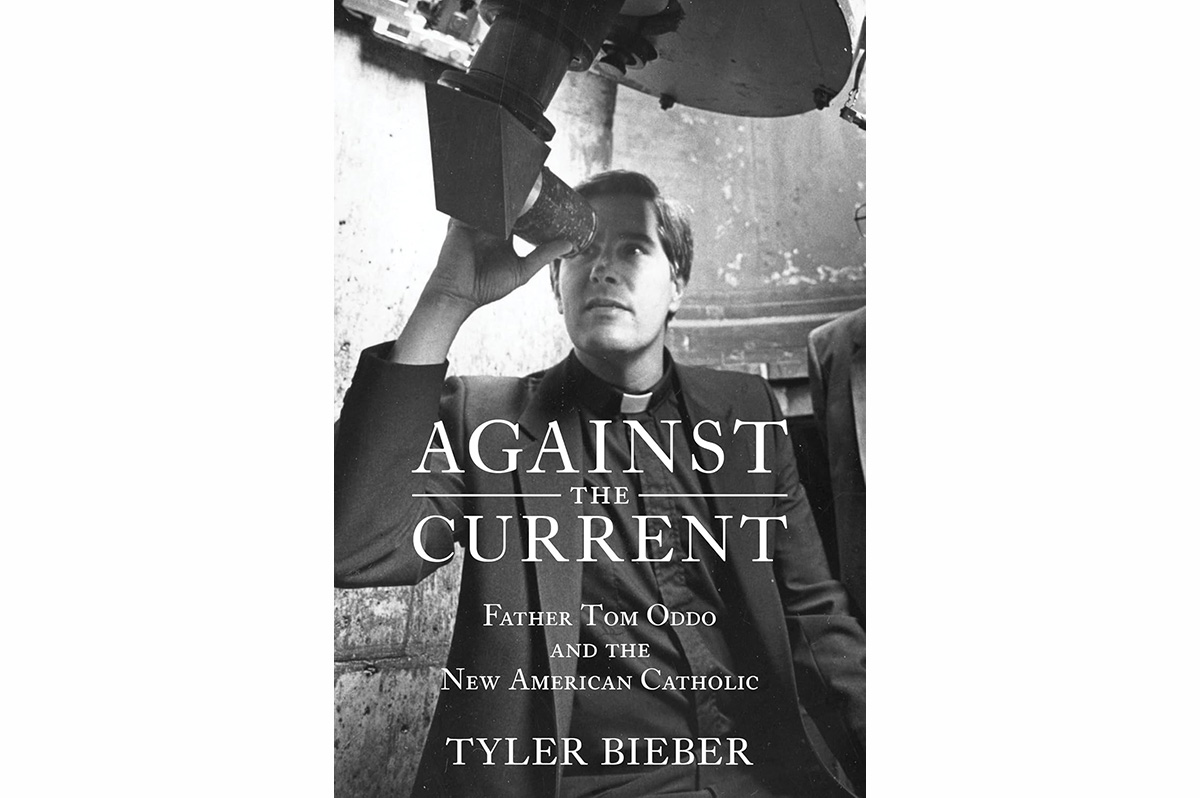
The author of a biography of a U.S. Catholic priest said to have advocated for support by the Catholic Church of gay Catholics in the early 1970s has called Father Thomas ‘Tom’ Oddo a little known but important figure in the LGBTQ rights movement.
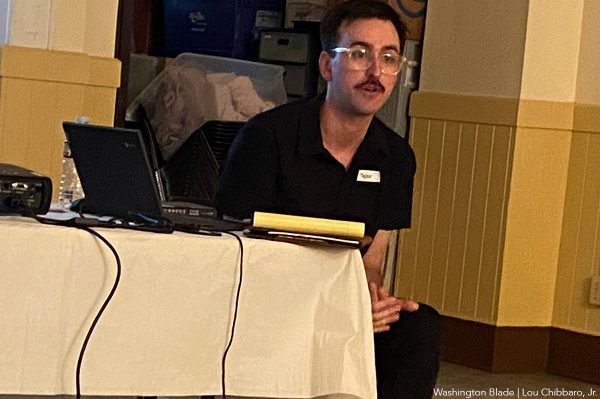
Tyler Bieber, author of the recently published book “Against The Current: Father Tom Oddo And the New American Catholic,” told of Oddo’s life and work on behalf of LGBTQ rights at a March 22 talk before the local LGBTQ Catholic group Dignity Washington.
Among Oddo’s important accomplishments, Bieber said, was his role as a co-founder of the national LGBTQ Catholic group Dignity U.S.A. in 1973 at the age of 29.
But as reported in the prologue of his book, Bieber presented details of the sad news that Oddo died in a fatal car crash in 1989 at the age of 45 in Portland, Ore., where he was serving as the highly acclaimed president of the University of Portland, a Catholic institution.
“He was a major figure in the gay rights movement in the 1970s, an unsung hero of that movement,” Bieber told Dignity Washington members, who assembled for his talk in a meeting room at St. Margaret Episcopal Church near Dupont Circle, where they attend their weekly Catholic mass on Sundays.
“And Dignity U.S.A. saw intense growth in membership and visibility” during its early years under Oddo’s leadership, Bieber said. “The story of Father Tom and his contemporaries is a story largely untold in the history of the gay rights movement, but one worth knowing and considering,” he said.
As stated in his book, Bieber told the Dignity Washington gathering Oddo was born and raised in a Catholic family on Long Island, N.Y., and attended a Catholic high school in Flushing Queens. It was at that time when he developed an interest in becoming a priest, according to Bieber.
After studying at the University of Notre Dame and completing his religious studies he was ordained as a priest in 1970 and began his work as a priest in the Boston area, Bieber said. It was around that time, Bieber told the Dignity Washington audience, that gay Catholics approached Oddo to seek advice on how they should interact with the Catholic Church. It was also around that time that Oddo became involved in a group supportive of then gay Catholics that later became a Dignity chapter in Boston.
In a development considered unusual for a Catholic priest, Bieber said Oddo in 1973 testified in support of gay rights bill before a committee of the Massachusetts Legislature and collaborated with then Massachusetts gay and lesbian rights advocate Elaine Noble.
In 1982, at the age of 39, Oddo was selected as president of the University of Portland following several years as a college teacher in the Boston area, Bieber’s book states. It says he was seen as a “vibrant and capable administrator who delivered real results to his campus,” adding, “His magnetism was obvious. One student described him as ‘John Kennedyesque’ to the university’s student newspaper.”
Bieber said that although Oddo was less active with Dignity U.S.A. during his tenure as UP president, he continued his support for gay Catholics and what is now referred to as LGBTQ rights.
“For those that knew him prior to his term at UP, though, he represented something greater than an accomplished university administrator and educator,” Bieber’s book states. “He was a new kind of priest, a gay man living and ministering in a world set loose from tradition by the Second Vatican Council,” the book says.
It was referring to the Vatican gathering of worldwide Catholic leaders from 1962 to 1965 concluding under Pope Paul VI that church observers say modernized church practices to allow far greater participation by the laity and opened the way for sympathetic consideration of gay Catholics.
District of Columbia
HRC to host National Rainbow Seder
Bet Mishpachah among annual event’s organizers

The 18th National Rainbow Seder will take place at the Human Rights Campaign on Sunday.
The sold out event is the country’s largest Passover Seder for the Jewish LGBTQ community.
Organizations behind the event include Bet Mishpachah, a local D.C. LGBTQ synagogue that Rabbi Jake Singer-Beilin leads, and GLOE, an Edlavitch DC Jewish Community Center program that sponsors events for the queer Jewish community. The theme for this year’s Seder is “Liberation For All Who Journey: Remembering, Resisting, Rebuilding.” Rabbis Atara Cohen, Koach Frazier, and Avigayil Halpern will lead it.
The Seder will honor the late GLOE co-chair Michael Singer. Singer also served on the Edlavitch DC Jewish Community Center’s board.
“This Seder is both a celebration of how far we have come and a call to continue building a more just and inclusive world.” Bet Mishpachah Executive Director Joshua Maxey told the Washington Blade.
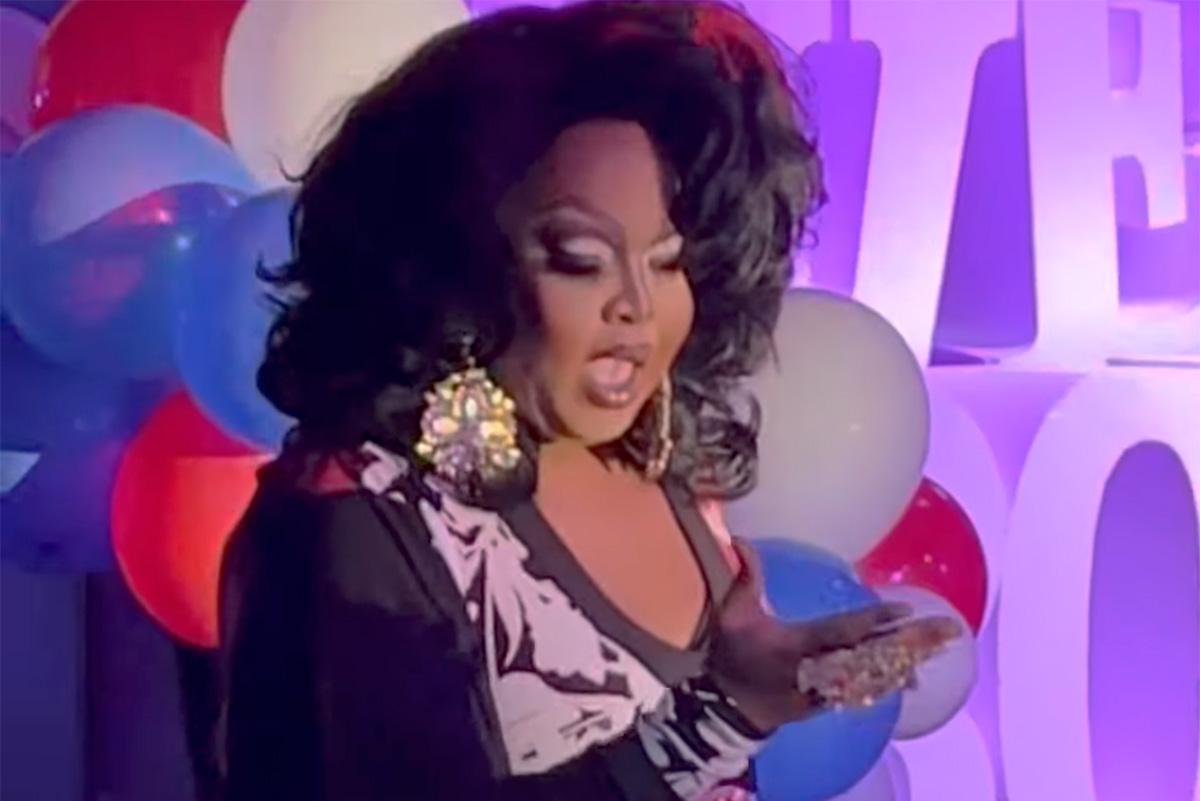
A gay man was murdered in Petersburg, Va., on March 13.
Shyyell Diamond Sanchez-McCray, who was also known as Saamel and Mable, was a drag queen who won the Miss Mayflower EOY pageant in 2015. Reports also indicate Sanchez-McCray, 42, was a well-known community activist in Virginia and in North Carolina.
Local media reports indicate police officers found Sanchez-McCray shot to death inside a home in Petersburg.
Sanchez-McCray’s brother, Jamal Mitchell Diamond, in a public statement the Washington Blade received from Equality Virginia and GLAAD, said Sanchez-McCray was not transgender as initial reports indicated.
“Our family has always embraced the fullness of who he was. He used the names Saamel, Shyyell, and Mable interchangeably, and we honor all of them. There is no division within our family regarding how he is being represented — only a shared commitment to preserving his truth with love and respect,” said Diamond.
“He was also deeply committed to community work through Nationz Foundation, where he worked and completed multiple state-certified programs to support marginalized communities,” added Diamond. “That work meant a great deal to him.”
Authorities have not made any arrests.
The Petersburg Bureau of Police has asked anyone with information about Sanchez-McCray’s murder to call Petersburg-Dinwiddie Crime Solvers at 804-861-1212.

Trans-led HIV clinic in Portsmouth struggles amid funding cuts

D.C. goes gaga for Gaga

Gay priest credited with boosting church support for LGBTQ Catholics

HRC to host National Rainbow Seder

Markwayne Mullin confirmed as next DHS secretary

‘How We Survived’ panel set for March 25

Calendar: March 21-26

Small is beautiful: subcompact SUVs

‘Inherit the Wind’ isn’t about science vs. religion, but the right to think