Opinions
Don’t look left during Pride, it’ll ruin the celebration
Anti-business radicals whine about corporate sponsors and participants
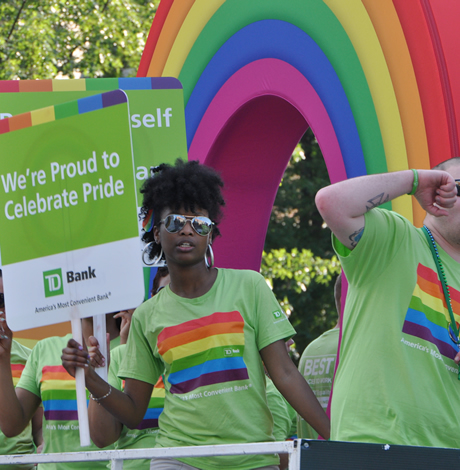
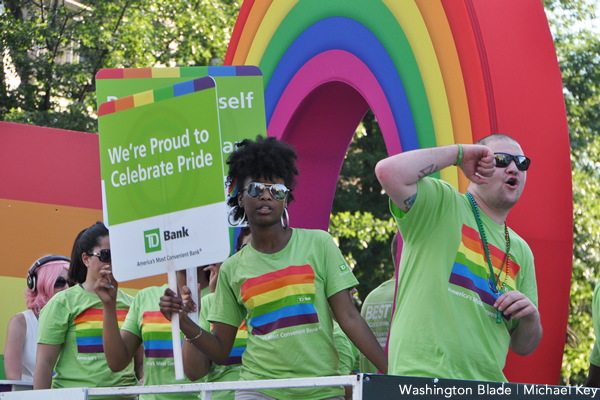
(Washington Blade file photo by Michael Key)
At least two things are almost certain to occur in the run-up to D.C.’s 40th annual LGBT Capital Pride celebration this weekend. You’re going to see one-too-many rainbow feather boas and the predictable dissident lament about how the whole gay rights thing has turned out will rear its head as if set on a timer.
The latter has already occurred.
Washington City Paper arts editor Christina Cauterucci last week penned a feature piece in the weekly publication’s annual Gay Issue harshly criticizing the “commercialization” of the local Pride celebration, titled “Swallow Your Pride.” If you can wade through the proffered “queer”-obsessed, lingo-laden and polemical condemnation of both the Saturday evening parade and Sunday daylong festival you will also find my voice offering more history and less histrionics. Be forewarned, however, that Cauterucci’s obsession with radical sloganeering and extremist terminology may require the assistance of an open browser to define trendy terms like “cismen” for the uninitiated.
On the any-moment verge of what is widely anticipated to be a Supreme Court ruling legalizing same-sex marriage nationwide, some still whine that the astonishingly accelerated advancement of civil equality for lesbians and gays hasn’t included our rejection of mainstream culture and the demise of capitalism.
This has been happening for the 20 years since the then-named “Lesbian and Gay Freedom Festival” first launched as a re-imagined high-profile downtown event on America’s Main Street in 1995.
I should know. I produced it.
I can attest to one simple reality as a result of that experience: change proves difficult, even for us. That’s something that continues to this day and is reflected in the anxiety-ridden adjustment for some to acceptance and assimilation. Despite these being achievements of local LGBT leadership and rank-and-file residents by both political and cultural measure.
D.C. is a poor choice of hometown to languish in disgruntlement about threading into the fabric of local life. The ethos of the city is accomplishment, not angst. As Gay and Lesbian Activists Alliance president Richard Rosendall is fond of remarking, gay people in the District “like to get things done.” The resulting advancements in equality are the envy of any locale nationwide.
The radical-left disaffected and disappointed might be happier living amongst the brutal, bruising and bitter battles notably associated with the infamous internecine strife of places like San Francisco. Perhaps better to find solace on a goat farm in New England – or even a planet like Pluto, given that the chronic complaining sounds so strange.
The central premise of Cauterucci’s essay is that the Capital Pride committee should reject support from the business sector as a poisoning influence, a feeding from the trough of racism, misogyny and all else evil. She prefers something “rooted in the reclamation of historical oppression.” She also fails to mention that her own employer, the City Paper, has been a prominent sponsor of Capital Pride as recently as last year.
Ironically, Cauterucci touts as idealized model the alternative “Dyke March” that “eventually sputtered out” sometime in the last decade. She fondly recalls a speaker at the event imploring attendees “to wage the broadest, most diverse struggle against capitalism.” Attempts to revive the event this year didn’t pan out, but it might be that the coordinator will again bring a sign to the parade reading, as Cauterucci reports, “Happy Pride, Fuck Corporate Sponsorship.”
I am quoted offering the observation that “the biggest ally to the LGBT community at this point in its history is the business community, and they’re driving our progress. They’ve demonstrated that they want to be part of our community and they want our business. We should happily be willing to share the cost of producing our events with them.”
Ignoring LGBT distinction as a disproportionate demographic of entrepreneurs and both business creators and leadership is also to deny part of our own heritage.
My advice this weekend: Don’t look left during Pride, it’ll ruin the celebration.
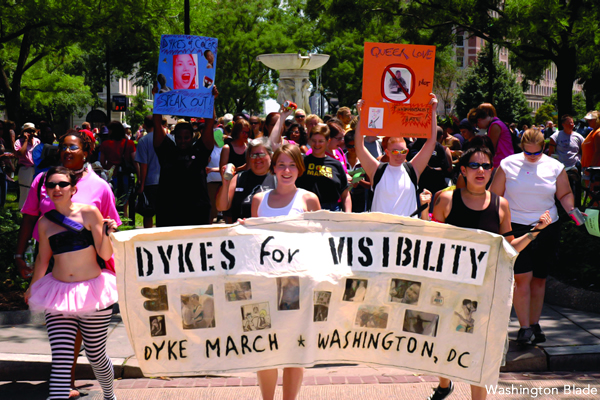
2004 Dyke March (Washington Blade file photo)
Mark Lee is a long-time entrepreneur and community business advocate. Follow on Twitter: @MarkLeeDC. Reach him at [email protected].



Opinions
Barney Frank’s powerful legacy for LGBTQ federal employees
The ‘Great Gay Communicator’ deserves respect
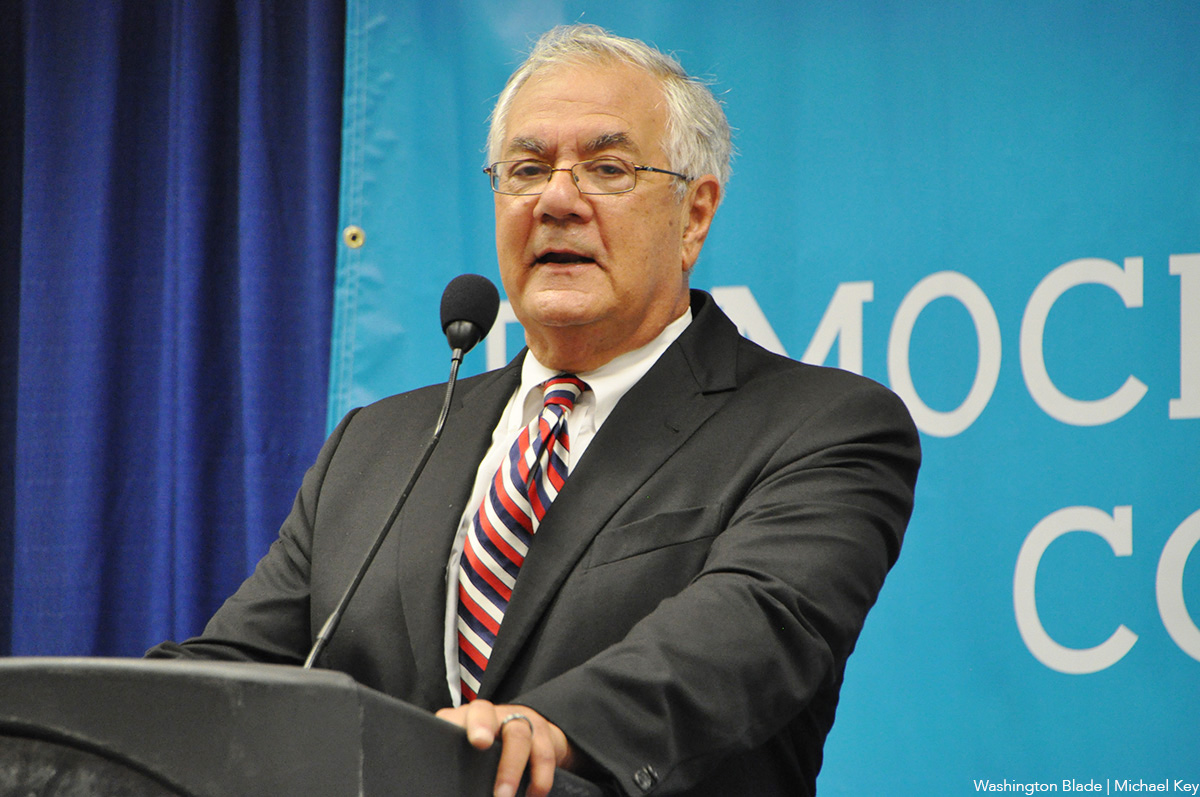
Former Congressman Barney Frank, who died last week, was dogged during his life over being gay. The self-proclaimed only “left-handed, gay, Jewish congressman,” in Congress deserved better.
Frank’s perseverance paved the way for others. With wit and intelligence, he helped educate Americans about sexuality. As a federal employee and a member of the Federal Gay, Lesbian or Bisexual Employees (GLOBE), a government-wide organization founded by Dr. Len Hirsch, I saw Frank’s unforgettable speaking style when he was a guest speaker at our monthly events.
Frank’s detailed presentations about federal employment policies were not recorded. The only record of them, edited by Dr. Hirsch and other members of the GLOBE board, is in the minutes of the GLOBE meetings. I held several positions in GLOBE, including secretary, assistant newsletter editor, and as an elected member of the board. I drafted the minutes of the meetings.
GLOBE’s minutes were edited to protect the identity of federal employees. This was important because then-U.S. Sen. Jesse Helms (R-N.C.) attempted to obtain the minutes. Helms felt LGBT advocacy in the federal workplace was an illegal form of political activity. GLOBE was also concerned that the minutes would be illegally accessed and forwarded to Helms or used to blackmail federal employees. GLOBE’s minutes are preserved at the National Archives.
When I was named Gay, Lesbian, Bisexual Program Manager at the Department of Agriculture in 1993, I immediately notified Frank’s office of my appointment. After a federal newsletter published an article about a speech I gave, Helms accused me of using government resources to support “a homosexual agenda.” During several hours on the evening of July 19, 1994, Helms told the Senate and C-SPAN’s television audience that LGBT federal employees had their minds in their crotches. He called LGBT federal employees “perverts.”
Helms had government documents that described the position of “Gay, Lesbian, Bisexual Program Manager.” It was a program that used the incendiary words “promote” and “recruit” homosexuals. It was a huge mistake for government bureaucrats to have written such a program. Helms published it in the Congressional Record. Frank helped us through this battle and others.
Aside from Frank, there were other LGBT members of Congress in the 1990s. Gerry Studds (D-Mass.), Steve Gunderson (R-Wisc.), and James Kolbe (R-Ariz.). Studds was censured for an affair with a 17-year-old male page in the House. Gunderson was publicly outed by a fellow House Republican. Kolbe was subject to sexual accusations.
Among these gay congressmen, Frank weathered a hostile media, personal scandal, and vicious attacks from his Republican colleagues. In 1995, former Texas GOP House Majority Leader Dick Armey was caught referring to Frank as “Barney Fag.” His apology was grudging.
“I rule out that it was an innocent mispronunciation,” responded Frank. “I turned to my own expert, my mother, who reports that in 59 years of marriage, no one ever introduced her as Elsie Fag.”
After celebrating his 72nd birthday, Frank married his longtime partner. He successfully worked to place marriage equality into the 2012 Democratic platform, which President Obama endorsed.
Still, Frank was dogged by homophobia. The Tea Party’s Doug Mainwaring called Frank’s wedding “a mockery, a parody, a staggering caricature of the most fundamental and towering of American institutions.”
In an interview with Washingtonian magazine, Frank said he “hates being classified as ‘the gay congressman,’” as his legislative accomplishments go beyond gay rights. He co-sponsored the 2010 Dodd-Frank Wall Street Reform and Consumer Protection Act.
Frank will especially be remembered in Washington for his sharp wit. He once referred to advocating for gay marriage legalization as “cruising for gay rights.” He wrote devastatingly funny op-ed pieces, notably for the Washington Post.
Though Frank may not have wanted to be known as a gay congressman, when he spoke, the LGBT community listened. He was the Great Gay Communicator. Barney Frank deserved respect. May his memory be a blessing.
James Patterson, a life member of the American Foreign Service Association, is a writer and communications consultant in the D.C. area.
If I admit I’m HIV positive, some men immediately reject me. If I lie and say I’m HIV negative, many of those same men will gladly have unprotected sex with me.
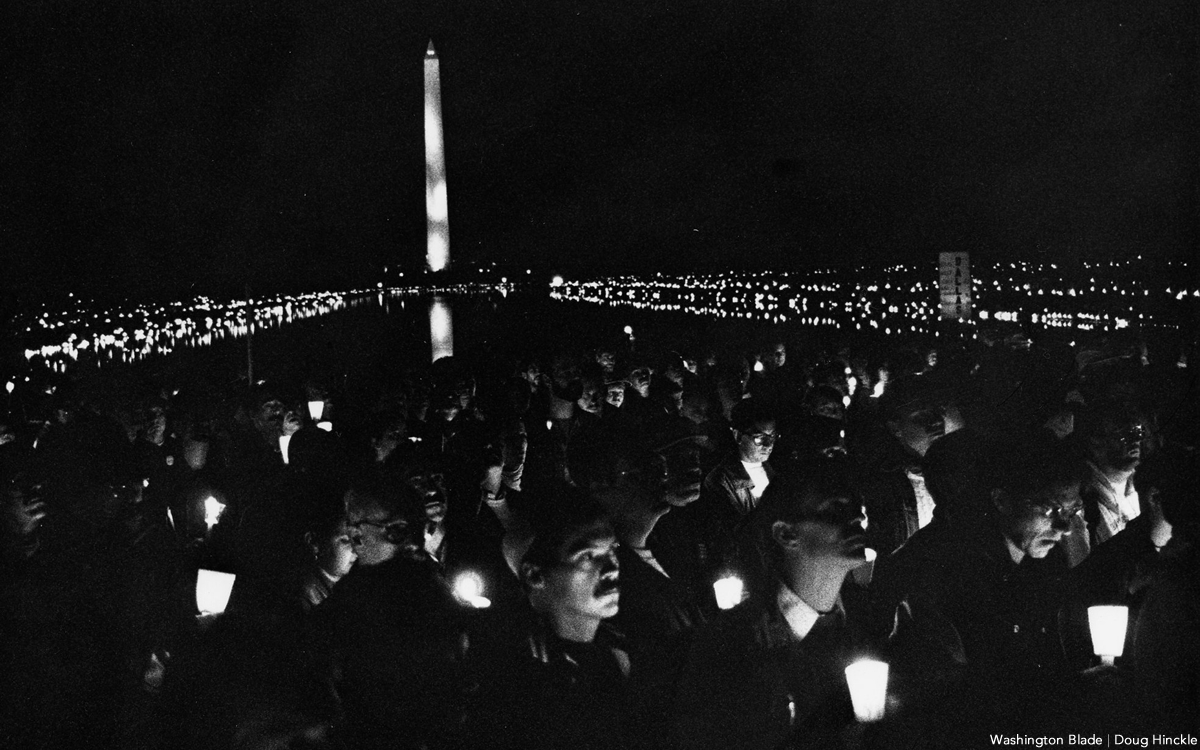
That contradiction has haunted me for years and made me wonder: What would the gay men who died of AIDS in the 1980s think if they could see us now?
The future would absolutely astonish them. Everybody carries around a handheld device that can instantly broadcast their thoughts, faces, bodies, and lives to the entire planet. We elected a Black president twice. Same-sex marriage is legal. Gay people can openly marry, raise children, grow old together, and even get divorced like everybody else. HIV itself is no longer “the deadly disease” it was when I learned I was infected in 1985 at age 23.
Back then, life expectancy was often measured in months. Surviving long enough to grow old felt like science fiction.
Now there are medications that can suppress the virus so effectively, a person living with HIV can become “undetectable,” meaning they cannot sexually transmit the virus. Countless people who once expected to die can now live long enough to worry about all the ordinary things people worry about as they age: heart disease, bad knees and what restaurant closes too early.
Back then, that wasn’t even a pipe dream. But the future also got weird.
What shocks me most is not the medical progress. It’s the emotional contradiction surrounding it. The general public no longer fears sharing space with people living with HIV. Most people understand you cannot get HIV from a hug, a handshake, sharing food, breathing the same air, or sitting next to someone on a plane.
But sex is different. Especially in the gay world, where stigma still lingers in strange and contradictory ways.
I’ve watched gay men reject HIV-positive men while simultaneously engaging in anonymous unprotected sex with people whose status they know only because somebody typed a word into an app. “Negative.” “Clean.” “DDF.”
As if viruses never lie.
At the same time, we now live in a sexual culture far more open and visible than anything most gay people from the 1980s could have imagined. The bathhouse has largely been replaced by hookup apps and social media. Sexual behavior is documented, broadcast and archived in real time.
But greater sexual freedom did not necessarily bring greater emotional clarity.
Some men still fear HIV intensely. Others eroticize it. Some even document their attempts to acquire it.
We solved the medical crisis of HIV far faster than we solved the psychological, emotional and sexual contradictions surrounding it.
As a long-term survivor, I sometimes feel like a time traveler trapped between two worlds: one that remembers the terror and one that barely remembers the war.
That feeling became the seed for my new novel,“The Unfrozen Few.” I imagined a group of AIDS patients from the late 1980s choosing cryogenic freezing rather than death, only to wake up in present-day America. They emerge into a world of smartphones, same-sex marriage, social media and medical breakthroughs, but also into a world that still doesn’t fully know what to do with people living with HIV.
In many ways, the frozen few are simply long-term survivors with the volume turned all the way up.
I think the dead would be amazed by how far we’ve come. And stunned by the ways we still haven’t.
Randy Boyd is a longtime HIV survivor, five-time Lambda Literary Award finalist and author of five novels, including ‘The Unfrozen Few,’ a speculative series about AIDS patients who were cryogenically frozen in the 1980s and awaken in present-day America. More information is available at randyboydauthor.com.
Opinions
Dual endorsement for Independent Council-at-large: Patterson or Crawford
Let’s move the District forward
(Editor’s note: This column reflects the writer’s opinion and does not constitute a Washington Blade endorsement of any candidate.)
The race for Independent Council-at-Large is interesting. There are three main candidates and I suggest making your choice easier by first eliminating Elissa Silverman from consideration. She is a retread, and it is time to move forward, not backward.
There are two candidates whom I have taken the time to talk with in some depth. They are both impressive, and either will make a great addition to the D.C. Council. I have some minor issues with both, but then have never found a candidate who I would agree with 100%, and never expect to.
Jacque Patterson has held public office, and served the community well, as president of the D.C. State Board of Education. Just recently a study was released, and while we know there are many outstanding issues in our schools, this new Education Scorecard report from Harvard, Stanford, and Dartmouth, ranks District of Columbia students first in the nation for academic growth in both math and reading between 2022 and 2025. While they are still not doing as well as we want all our students to do, progress is important, and this scorecard shows how the District is working to help its students. Take a look at Jacque’s website to see what he will focus on. You will find it impressive. He understands among other issues what small businesses mean to D.C., what we need to do for safer communities, and to provide more opportunities for all our youth.
Then take a look at Doni Crawford who has now been serving on the Council for about four months, having been chosen to replace Kenyan McDuffie until the election, when he resigned to run for mayor. She previously worked in his office as committee director for the Council’s Committee on Business and Economic Development. Prior to that she worked at the D.C. Fiscal Policy Institute. Her focus is also on safer communities, economic development, housing, and youth. You can look at Doni’s website to get a more detailed understanding of where she intends to focus her time.
Both candidates have talked about how they will work to fight for D.C. statehood, and to ensure the 700,000 residents of the District can set their own budget priorities, and make their own legislative decisions, without oversight from Congress.
When looking at who you choose to vote for as a Council member in D.C., it is important to understand the person you select will be working closely with 12 other members. They have to understand the art of compromise to get their initiatives passed. They must have the personality that will demand respect of the other members, and a style that will make them stand out on the Council. I think Jacque and Doni are the two choices in this Independent Council-at-large race who will be able to do that. Also, remember in an at-large seat on the Council the focus is a little different than when you are selecting a Council member for your own ward. These members need to have a little broader view, and be able to balance all constituents in every ward of the city. That is a little more difficult.
I know from talking with them that both Jacque and Doni are committed to equality, and just as important, economic equality. They understand for the District to do well; everyone needs a fair playing field. I have gotten the strong feeling they both understand what is happening around the nation is impacting the people of D.C. That includes the resurgence of antisemitism, as well as racism, Islamophobia, homophobia, and sexism. They understand we are faced with a White House, and Republican-controlled Congress, who instead of doing anything to combat these issues, are making them worse. And because home rule still gives Congress and the felon in the White House much-too-much control over D.C., this impacts us directly. I have confidence in both Patterson and Crawford, that they will fight this, and do it intelligently, and successfully, to the benefit of all the people they are looking to serve.
So, my recommendation is you look at both their websites and decide who your first choice will be. Then rank that person #1 on your ballot for Independent Council-at-large. Then because you can with ranked choice voting, rank the other one #2. Then stop! You don’t need to rank any more.
Again, I think either Jacque Patterson or Doni Crawford will serve us well on the Council. They are both smart, experienced, and both will bring something new to the Council. Elissa Silverman had her chance before, and there were reasons the voters turned her out. Let’s not go backwards, but rather let’s move the District forward, with either Jacque Patterson or Doni Crawford.
Peter Rosenstein is a longtime LGBTQ rights and Democratic Party activist.

10 HIV/AIDS activists arrested on Capitol Hill

JR.’s hosts meet & greet for mayoral candidate Janeese Lewis George

Campaign to support Va. marriage amendment repeal launched

Why Michelle Visage needs you to get ‘PrEP Wise’

White House Correspondents’ Dinner rescheduled after shooting

Nine Russian LGBTQ groups deemed ‘extremist’ banned

‘The Stranger’ queers an existentialist classic

Ghanaian lawmakers approve anti-LGBTQ bill

Time travelers from the AIDS era