Arts & Entertainment
‘Orange’ teaser
Alliances deepen on season three which debuts Monday


Taryn Manning and Lea DeLaria in season three of ‘Orange is the New Black.’ (Photo by JoJo Whilden, courtesy Netflix)
Jenji Kohan’s Netflix smash “Orange is the New Black” is back to doing what it does best: character exploration.
Season three opens with a new and (relatively) improved Pennsatucky doing her best to be more respectful of others and less uptight about vulgarity. She’s genuinely trying to better herself, and it’s incredibly satisfying to see her transformation from a villain to someone reformed and compassionate. The season builds from there and the first six episodes suggest this season will be the best, most emotionally complex, season to date.
Thankfully, the Piper/Alex drama resolves fairly quickly and focus pulls away from the two just enough to focus on other, more interesting characters while keeping Taylor Schilling as the top-billed actor. The show is able to remain fresh and captivating by not dwelling on this will they/won’t they pairing.
Litchfield has turned upside down as conditions improve for inmates. Little victories following a bed bug infestation change the attitudes of several inmates, like Red. Because only so much happiness can go around, the prison guards are getting the shaft as a change in ownership of the prison means fewer hours and slashed benefits. The question arises as to who the real prisoners are (hint: still the actual prisoners).
This shake-up is thanks in part to the addition of newcomer Mike Birbiglia’s character, who flawlessly brings a layered, subtle and mysterious performance with each line. The show also welcomes Mary Steenburgen. Like Birbiglia does to Joe Caputo, so does Steenburgen, playing former guard Mendez’s mother, complicate the pregnant Dayanara’s life. Daya, meanwhile, grows more and more isolated as she runs out of options for how to take care of her unborn baby.
Unlike season two, there is no clear primary antagonist. The “Clash of the Titans”-esque struggle between Red, Vee and Gloria has resolved, and each tribe is left to deal with the aftermath of Rosa’s escape and hit-and-run, immortalized with the mic-droppiest of lines: “Always so rude, that one.”
The show has shifted from the man vs. man-style of conflict to man vs. self. Nicky battles her addiction more than ever. Morello is depressed, having lost her job driving the van. Chang, in one of the best episodes so far, struggles with immense insecurities and loneliness. Crazy Eyes refuses to accept the loss of Vee, her mother figure. These and other internalized conflicts become more of a prison for the characters than Litchfield itself, as they fight to free themselves from their masochistic choices.
Tribe members intermix less than they have before, with the exception of Soso, who struggles to find her place in the prison. Even Chang, the other prominent Asian character, does not accept her, as Soso is part Scottish.
However, this racial isolation has given room for new bonds to form, like the budding friendship between Boo and Pennsatucky, which began at the end of season two. The unlikely pairing of the unapologetic lesbian and the religious zealot proves to be among the most delightful relationships of the new season. They help each other accept their past mistakes, learn from them and grow. They’ve each toned down their respective idiosyncrasies and welcome each other as friends and equals. Boo’s intellectualism and Pennsatucky’s emotional side complement each other well and they somehow find within the other a support system.
One of the more heartbreaking character explorations focuses on Marisol “Flaca” Gonzalez (Jackie Cruz). We learn the reason for her teardrop tattoo and the guilt she carries. In one episode, her story comes full circle. The promise of a new job assignment quickly changes from a symbol of hope to one of futility, as she ends up right back where she started before being sent to prison. While others thrive under the new administration, she’s lost her light. It’s a powerful moment for Cruz, who has shown she can dominate a scene just as well as Laverne Cox, who is tragically underused this season.
With each season, “Orange” explores themes surrounding motherhood, and season three is no exception. Can bad actions define a good mother? Can a mother’s best intentions still fail to help her daughter? How does motherhood transcend blood bonds? What happens when we have no parental figures to turn to and we’re left on our own? While conflicts in season three are much more internalized than in previous seasons, they are no less thrilling.
Some of the best bits are tips of icebergs that suggest a much more complex story waiting to be unraveled in a future episode. When the enigmatic Blanca Flores attends the “book funeral” (a necessary book burning following the bed bug infestation), she explains sadly that she prefers reading over living her own life. But as always, when things seem darkest in Litchfield, there’s always hope tomorrow will be taco night.



Theater
Minimal version of ‘Streetcar Named Desire’ heading to Dupont Underground
Director Nick Westrate on this traveling take on Williams’s masterwork
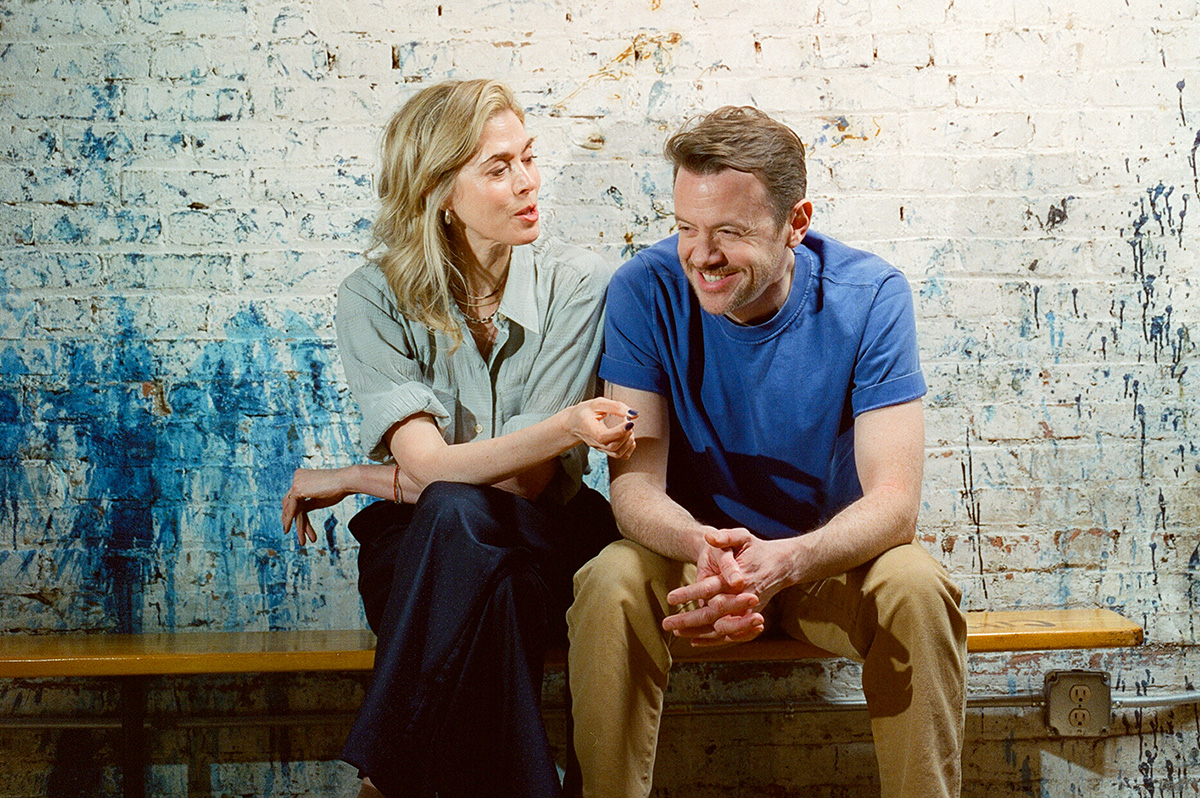
‘A Streetcar Named Desire’
Produced by The Streetcar Project
April 20-May 4
Dupont Underground
19 Dupont Circle, N.W.
Tickets start at $85.
Dupontunderground.org
An aggressively minimal version of Tennessee Williams’s “A Streetcar Named Desire” is poised to run at Dupont Underground (April 20-May 4), the nonprofit cultural space located in a repurposed, abandoned 1949 streetcar station beneath Dupont Circle.
The Streetcar Project’s production performs in site-specific spaces. It’s almost entirely without design elements. There is no steamy, cramped Vieux Carré apartment. You won’t see Blanche’s battered trunk exploding with cheap finery, faded love letters, and demands for back property taxes, or the familiar costumes.
Co-created by Lucy Owen (who stars as Blanche DuBois) and out director Nick Westrate in 2023, this traveling spare take on Williams’s masterwork about a fragile woman on the margins in conflict with her brutish brother-in-law seems a reaction to necessity. It’s also an exploration of whether, like Shakespeare’s “Henry V,” it can subsist on language alone.
With little distractions (even Blanche’s cultivated southern belle accent has been daringly stripped away), the spotlight shines almost solely on text. “This play holds that,” says Westrate, 42. “I remind the actors that the while there is plenty of movement, language is really the only game in town.”
New York-based Westrate, who’s best known as an esteemed actor with New York and regional credits including Prior Walter in János Szász’s production of “Angels in America” at Arena Stage, describes “Streetcar” as “the most perfect play on earth” but not one he thinks of acting in (“I’m not right for Stanley Kowalski or Mitch”) though he agreed to direct.
“These days if you’re not a not a movie star or an established director, you’re not likely to do “Streetcar.” So, for us, we have to be able to do it with almost nothing, on the New York subway if necessary. And that’s kind of how we built it.”
Westrate first experienced Dupont Underground while attending a staged reading. He was so obsessed with the space as a prospective place to take the production, he found it hard to concentrate. He says, “With its long, curved track and tunnel, Dupont Underground is a terrifying, beautiful room that carries so much metaphorical weight, so much possibility for our production.”
WASHINGTON BLADE: Is finding the right space for this “Streetcar” part of the thrill?
NICK WESTRATE: Whenever I enter a weird room or pass by an abandoned CVS, I try to figure out how we might do the show there, especially places that are dilapidated, architecturally odd, or possibly haunted. And each space we use, lends something to the production. The Rachel Comey store in Soho was a very Blanche coded space. And an artist’s workshop on Venice Beach in California with its huge saws and metal hooks lent raw imagery. The scenes between Blanche and Stanley near the end were absolutely terrifying.
BLADE: More recently that same bare bones production has played in more traditional spaces like the Wheeler Opera House in Aspen and San Francisco’s A.C.T. Is it hard to now go to Dupont Underground?
WESTRATE: Each time we do this we have to crack open the play again because the staging is entirely new, but we’re used to performing in unusual spaces and Dupont Underground rather takes us back to form. As a former streetcar station, it’s the most appropriate space we’ve had yet.
The cast will literally act on streetcar tracks and go without dressing rooms but they’re game, and because they have history and authorship over the work, the sacrifice is more meaningful than if they were just some hired guns.
BLADE: Audiences have an expectation, especially with a work they’re likely to know. How do they react seeing such an unadorned take on Williams’s American classic?
WESTRATE: For the first 10 or 15 minutes, they’re unsure. Then, you can pretty much see the audience members’ brains click in and their imaginations turn on. It’s like they’re scratching an itch that they didn’t even know they had.
BLADE: Did you and Lucy foresee gaining this kind of momentum behind your vision?
WESTRATE: Absolutely not. Lucy had a philosophy that we’ll just walk through open doors. Early on, we were given spaces and artists filled the seats, and increasingly we’ve begun to rent some spaces and attract more regular theatergoers.
We basically sell tickets in order to pay a living wage to artists involved. There isn’t some big institution or commercial producer who’s getting a lot of money from this. Audiences of all types seem to respond to this mode of making theater.
BLADE: In presenting “Streetcar” intermittently, usually with the same cast over three years in wildly varying venues, have you learned more about a piece that you already loved?
WESTRATE: Mostly I’ve come to realize that Blanche is the smartest character I’ve ever read in a play. She’s like Hamlet – tormented by dreams and terrified of death. She’s skilled at wordplay and always ahead of everyone else in the room. Also like Hamlet, people think she’s insane and she uses that to her advantage.
Blanche is certainly the Everest of roles for actresses and watching Lucy sort of break it apart in a different way than you’ve ever seen, and knowing that I’ve helped to facilitate this performance has been one of the great joys of my career.

Friday, April 10
Center Aging Monthly Luncheon With Yoga will be at 12 p.m. at the DC Center for the LGBT Community. Email Mac at [email protected] if you require ASL interpreter assistance, have any dietary restrictions, or questions about this event.
Women in their Twenties and Thirties will meet at 8 p.m. on Zoom. This is a social discussion group for queer women in the Washington, D.C. area. For more details, visit Facebook.
Saturday, April 11
Go Gay DC will host “LGBTQ+ Community Brunch” at 11 a.m. at Freddie’s Beach Bar & Restaurant. This fun weekly event brings the DMV area LGBTQ+ community, including allies, together for delicious food and conversation. Attendance is free and more details are available on Eventbrite.
The DC Center for the LGBT Community will host a screening of “Love Letters” at 1:30 p.m. This movie is a tender, intimate look at love, parenthood, and the quiet fight to claim your place in your own family. For more details, visit the DC Center’s website.
Sunday, April 12
Spark Social will host “Tea Time! A Local DC Drag Comedy Show” at 3 p.m. This event features the hilarious TreHER and Tiara Missou Sidora. This dynamic duo will have guests cackling as they discuss the “Latest Tea” in DC. Have drama in your own life? TrevHER and Tiara are ready to provide advice and rate how hot your tea is. Hottest tea wins a piece of Spark merch. Tickets cost $13.26 and can be purchased on Eventbrite.
Just Kidding Comedy Collective will host “Best of DC at the Woke Mob Comedy Festival” at 5 p.m. at Pikio Taco. The Woke Mob Comedy Festival celebrates everything that makes this region the best and showcases the DMV’s funniest comedians, especially highlighting BIPOC, women, LGBTQ+ and gender-queer performers, plus a few “prodigal” comics who got their start here before heading national. Tickets cost $15.18 and can be purchased on Eventbrite.
Monday, April 13
Center Aging: Monday Coffee Klatch” will be at 10 a.m. on Zoom. This is a social hour for older LGBTQ adults. Guests are encouraged to bring a beverage of choice. For more information, contact Adam ([email protected]).
Genderqueer DC will be at 7 p.m. on Zoom. This is a support group for people who identify outside of the gender binary, whether you’re bigender, agender, genderfluid, or just know that you’re not 100% cis. For more details, visit www.genderqueerdc.org or Facebook.
Tuesday, April 14
Trans Discussion Group will be at 7 p.m. on Zoom. This event is intended to provide an emotionally and physically safe space for trans people and those who may be questioning their gender identity/expression to join together in community and learn from one another. For more details, email [email protected].
Coming Out Discussion Group will be at 7 p.m. on Zoom. This is a safe space to share experiences about coming out and discuss topics as it relates to doing so — by sharing struggles and victories the group allows those newly coming out and who have been out for a while to learn from others. For more details, visit the group’s Facebook.
Wednesday, April 15
Job Club will be at 6 p.m. on Zoom upon request. This is a weekly job support program to help job entrants and seekers, including the long-term unemployed, improve self-confidence, motivation, resilience and productivity for effective job searches and networking — allowing participants to move away from being merely “applicants” toward being “candidates.” For more information, email [email protected] or visit thedccenter.org/careers.
The DC Center for the LGBT Community will host “Movement for Healing” at 3 p.m. This trauma- and yoga therapy–informed class is designed to help guests gently reconnect with their body and their breath. Through mindful movement, somatic awareness, and grounding practices, guests will explore how to release tension, increase mobility, and cultivate a deeper sense of safety and ease within. For more details, visit the DC Center’s website.
Thursday, April 16
The DC Center’s Fresh Produce Program will be held all day at the DC Center for the LGBT Community. People will be informed on Wednesday at 5:00 pm if they are picked to receive a produce box. No proof of residency or income is required. For more information, email [email protected] or call 202-682-2245.
Virtual Yoga Class will be at 7 p.m. on Zoom. This free weekly class is a combination of yoga, breathwork and meditation that allows LGBTQ+ community members to continue their healing journey with somatic and mindfulness practices. For more details, visit the DC Center’s website.
Movies
A Sondheim masterpiece ‘Merrily’ rolls onto Netflix
Embracing raw truth lurking just under the clever lyrics
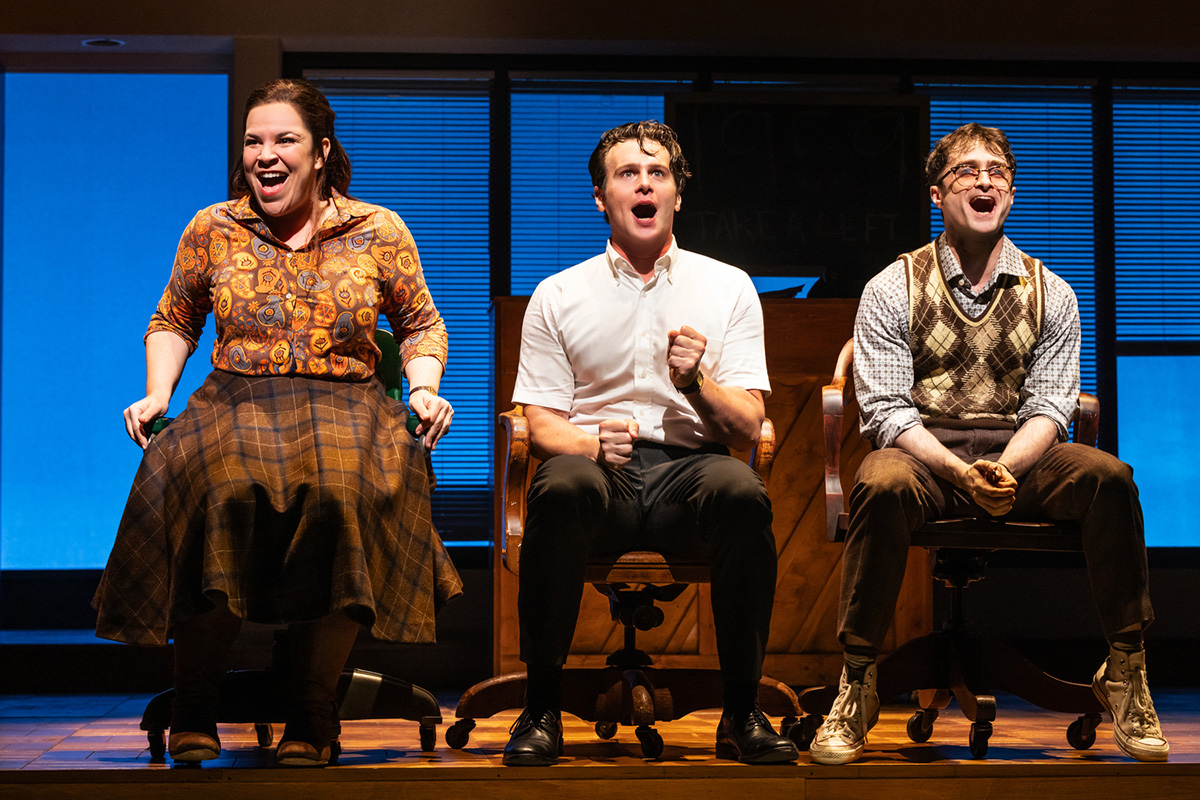
It’s been long lamented by fans of the late Stephen Sondheim – and they are legion – that Hollywood has hardly ever been successful in transposing his musicals onto the big screen.
Sure, his first Broadway show – “West Side Story,” on which he collaborated with the then-superstar composer Leonard Bernstein – was made into an Oscar-winning triumph in 1961, but after that, despite repeated attempts, even the most starry-eyed Sondheim aficionados would admit that the mainstream movie industry has mostly offered only watered-down versions of his works that were too popular to ignore: “A Little Night Music” was muddled into an ill-fitted star vehicle for Liz Taylor, “Sweeney Todd” became a middling entry in the Tim Burton/Johnny Depp canon, “Into the Woods” mutated into a too-literal all-star fantasy with most of its wolf-ish teeth removed, and we’re still waiting for a film version of “Company” – not that we would have high hopes for it anyway, given the track record.
Of course, most of those aficionados would also be able to tell you exactly why this has always been the case: erudite, sophisticated, and driven by an experimental boldness that would come to redefine American musical theater, Sondheim’s musicals were never about escapism; rather, they deconstructed the romanticized tropes and presentational glamour, turning them upside down to explore a more intellectual realm which favored psychological nuance and moral ambiguity over feel-good fantasy. Instead of pretty lovers and obvious villains, they showcased flawed, complicated, and uncomfortably relatable people who were just as messed-up as the people in the audience. Any attempt to bring them to the screen inevitably depended on changes to make them more appealing to the mainstream, because they were, at heart, the antithesis of what the Hollywood entertainment machine considers to be marketable.
To be fair, this often proved true on the stage as well as the screen. Few of Sondheim’s shows, even the most acclaimed ones, were bona fide “hits,” and at least half of them might be considered “failures” from a strictly commercial point of view – which makes it all the more ironic that perhaps the most purely “Sondheim” of the stage-to-screen Sondheim efforts stems from one of his most notorious “flops.”
“Merrily We Roll Along” was originally conceived and created more than 40 years ago, a reunion of Sondheim with “Company” book-writer George Furth and director Harold Prince, based on a 1934 play by George Kaufman and Moss Hart. Telling the 20-year story of three college friends who grow apart and become estranged as their lives and their goals diverge, it wasn’t ever going to be a feel-good musical; what made it even more of a “downer” was that it told that story in reverse, beginning with the unhappy ending and then going backward in time, step by step, to the youthful idealism and deep bonds of camaraderie that they shared in their first meeting. On one hand, getting the “bad news” first keeps the ending from becoming a crushing disappointment; but on the other hand, the irony that results from knowing how things play out becomes more and more painful with each and every scene.
The original production, mounted in 1981, compounded its challenging format with the additional conceit of casting mostly teen and young adult actors in roles that required them to age – backwards – across two decades; though the cast included future success stories (Jason Alexander and Giancarlo Esposito, among them), few young actors could be expected to convey the layered maturity required of such a task, and few audiences were capable of suspending their disbelief while watching a teenager play a disillusioned 40-year old. This, coupled with a minimalist presentation that left audiences feeling like they were watching their nephew’s high school play, turned “Merrily We Roll Along” into Sondheim’s most notorious Broadway flop – despite raves reviews for the show’s intricately woven score and the stinging candor of its lyrics.
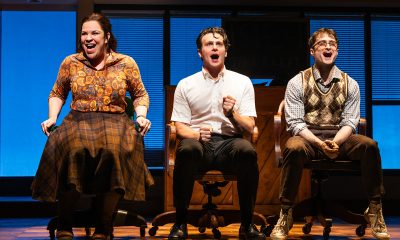
Fast forward to 2022, when renowned UK theater director Maria Friedman staged a new revival of the show in New York. In the interim, “Merrily” had undergone multiple rewrites and conceptual changes in an effort to “fix” its problems, abandoning the concept of using young performers and opting for a more “fleshed-out” approach to production design, and the show’s reputation, fueled by a love for its quintessentially “Sondheim-esque” score, had grown to the level of “underappreciated masterpiece.” Inspired by an earlier production she had helmed at home a decade earlier, Friedman mounted an Off-Broadway version of the show starring Jonathan Groff, Daniel Radcliffe, and Lindsay Mendez – and suddenly, as one critic observed, Sondheim’s biggest failure became “the flop that finally flew.” The production transferred to Broadway, winning Tony Awards for Groff and Radcliffe’s performances, as well as the prize for Best Revival of a Musical, in 2024.
Sondheim, who died at 91 in 2021, participated in the remount, though he did not live to see its premiere, nor the success that officially validated his most “problematic” work.
Fortunately, we DO get the chance to see it, thanks to a filmed record of the stage performance, directed by Friedman herself, which was released in limited theaters for a brief run last year, but which is now streaming on Netflix – allowing Sondheim fans to finally experience the show in the way it was designed to be seen: as a live performance.
Embracing the conventions of live theatre into its own cinematic ethos, this record of the show gives viewers the kind of up-close access to its performances that is impossible to experience even from the front-row of the theatre – and they are impeccable. Groff’s raw and deeply deluded Frank Shepard, the ambitious composer who sells out his values and alienates his friends on the road to success and wealth; Radcliffe’s mawkishly loyal Charlie Kringas, who remains committed to the dream he shared with his best friend until he just can’t anymore; and Mendez’ heartbreaking perfection as Mary Flynn, the wisecracking good-time girl who rounds out their trio while concealing a secret passion of her own – each of them bring the kind of raw and vulnerable honesty to their roles that can, at last, reveal both the deep insights of Sondheim’s intricate lyrics and the discomforting emotional conflicts of Furth’s mercilessly brutal script.
Yes, it’s true that any filmed record of a live performance loses something in the translation. There’s a visceral connection to the players and a feeling of real-time experience that doesn’t quite come through; but thanks to unified vision that Friedman shepherded and instilled into her cast – including each and every one of the brilliant ensemble, who undertake the show’s supporting characters and embody “the blob” of show-biz hangers-on who are central to its cynical theme – what does come through is more than enough.
Honestly, we can’t think of another Sondheim screen adaptation that comes close to this one for embracing the raw truth that was always lurking just under the clever lyrics and creative rhyme schemes. For that reason alone, it’s essential viewing for any Sondheim fan – because it’s probably the closest we’ll ever get to having a “real” Sondheim film that lives up to the genius behind it.

Minimal version of ‘Streetcar Named Desire’ heading to Dupont Underground

Comings & Goings

An effort to increase the number of psychiatrists of color

Calendar: April 10-16

BLUF leather social set for April 10 in Rehoboth

Man faces first S.C. ‘hate intimidation’ charge

Police mental health struggles gain growing attention

Trump budget would codify expanded global gag rule

Cuba under pressure and without answers