News
Trump blows off question on Roy Moore’s views against gays
President says he’ll meet with U.S. Senate candidate next week


President Donald Trump speaks at a press conference in the White House Rose Garden on Oct. 16. (Image public domain)
Trump refused to a say whether he’s comfortable with Moore serving in the U.S. Senate in response to a reporter who inquired about the candidate’s opposition to homosexuality and belief Muslims shouldn’t be allowed to serve in public office.
“I’m going to be meeting with Roy sometime next week and we’re going to talk to him about a lot of different things, but I’ll be meeting with him,” Trump said. “He ran a very strong race. The people of Alabama — who I like very much, and they like me very much — but they like Roy, but we’ll be talking to them, and I can report back to then, OK?”
The reporter also posed the question to Senate Majority Leader Mitch McConnell (R-Ky.), who was present at the news conference, but McConnell never responded to question and Trump proceeded to the next reporter.
Moore has built an virulently anti-LGBT reputation over his career as chief justice of the Alabama Supreme Court before he became a U.S. Senate candidate. In 2015, Moore urged his state to refuse to recognize the U.S. Supreme Court ruling in favor of marriage equality nationwide. A 2005 tape was unearthed over the course of his Senate run in which he said homosexuality should be illegal. (Such a law would be unconstitutional as a result of the Supreme Court’s 2003 decision in Lawrence v. Texas).
At the anti-LGBT Values Voter Summit last week, Moore expressed his view Christian theology should take precedence over all government laws and the country must “go back to the basis of our morality, which is in God, not man.”
In the Republican primary, Trump supported not Moore, who was a favorite of the far-right and Steve Bannon, and instead supported incumbent Sen. Luther Strange (R-Ala.). Moore ended up beating Strange in the primary by a several points after which Trump tweeted Moore “sounds like a really great guy.”
Trump’s refusal to repudiate Moore falls short of the response White House Press Secretary Sarah Huckabee Sanders delivered last month when she said the two “don’t agree” on LGBT issues.
Chad Griffin, president of the Human Rights Campaign, chided Trump for declining to condemn in a tweet containing a video of the exchange.
.@realDonaldTrump had an opportunity to condemn Roy Moore’s vile and extreme views. He refused. #NoMoore https://t.co/QzgG5Qs6Tn
— Chad Griffin (@ChadHGriffin) October 16, 2017
Moore is facing a run-off on Dec. 12 in Alabama to win the open U.S. Senate seat against Democratic nominee, Doug Jones, whom the Human Rights Campaign has endorsed. A Cygnal poll published on Thursday found Moore enjoys an eight-point lead in the race.


District of Columbia
D.C. Black Pride set for Memorial Day Weekend
Dozens of events to reflect theme of ‘New Black Renaissance’
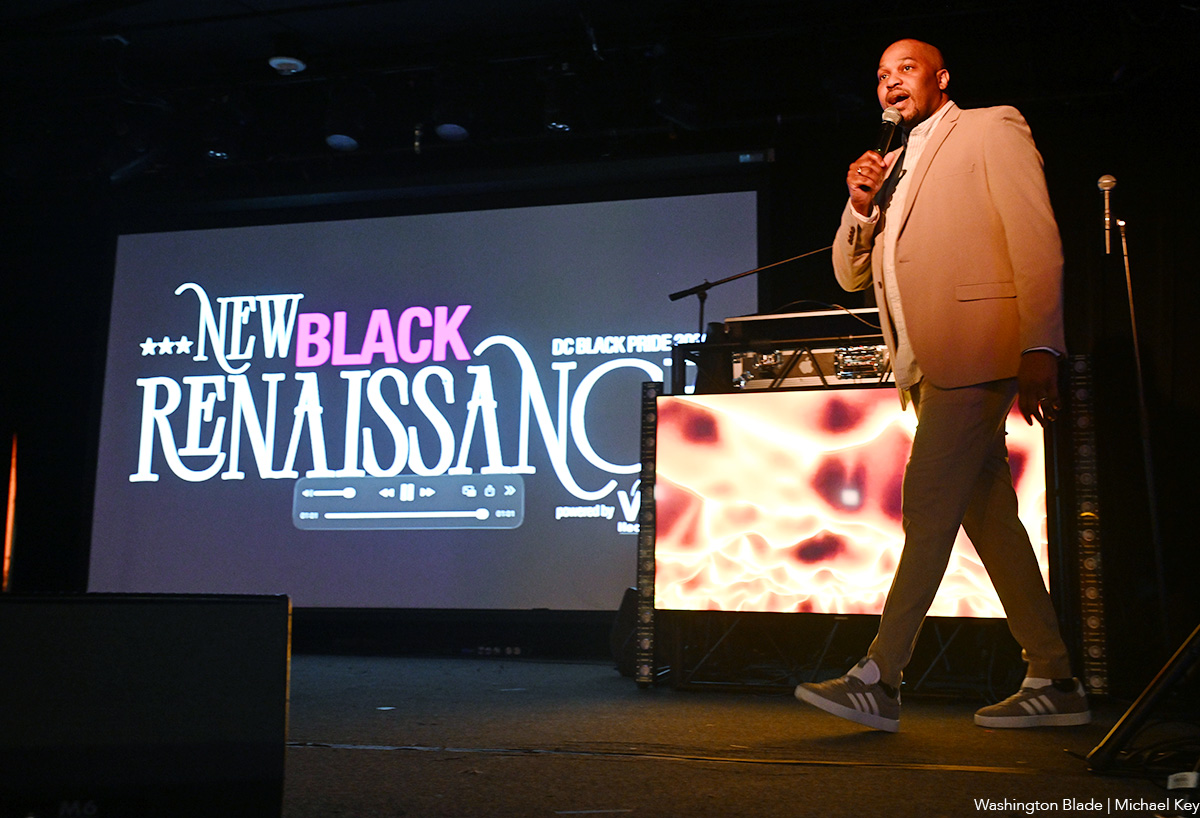
D.C.’s annual LGBTQ Black Pride celebration is scheduled to take place May 22-25 as it has since its founding 35 years ago on Memorial Day Weekend with several dozen events in locations across the city.
Like recent years, most of the official events are scheduled to take place at the Westin D.C. Downtown Hotel, including the Opening Reception on Friday, May 22, when Grammy Award-winning singer-songwriter Durand Bernarr was scheduled to be among the performers.
“This high-energy reception brings together community leaders, creatives, tastemakers, and visitors from across the globe for a night rooted in connection, joy, and celebration,” according to a statement on the Black Pride website.
Also, like past years, the second day of official Black Pride events set for Saturday, May 23, will include a dozen workshop sessions on a wide range of issues and topics. The workshop sessions will take place at the Westin Hotel.
On that same day, Black Trans Pride is scheduled to take place at the hotel from 1- 6 p.m., according to the official schedule of events.
“The goal is and always has been to make sure we have events for everybody, regardless of their financial situation, regardless of their agenda,” said Kenya Hutton, president and CEO of the Center For Black Equity, the D.C. LGBTQ group that organizes D.C. Black Pride.
Hutton said this year for the first time there will be a D.C. Black Pride Fun Run. The Black Pride website says the 5k run will take place Saturday, May 23, from 8 a.m.-12 p.m. starting at the Frederick Douglass Bride near the D.C. Navy Yard.
He said another first will be a film screening of the documentary film “Not Your Average Girl,” about the life of trans woman, author, and advocate Hope Giselle, scheduled for May 22 at the nearby Eaton Hotel.
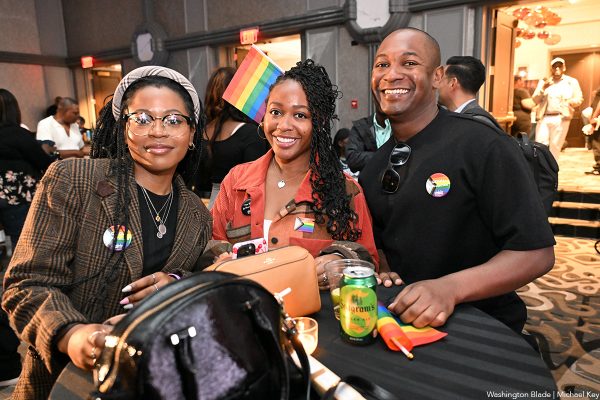
Also, like in past years, this year’s Black Pride will feature a Rainbow Row organization and vendor expo at the Westin from 5-9 p.m. Friday and 10 a.m. to 8 p.m. on Saturday that includes information tables set up by organizations and vendors.
The annual Pride In The Park event will take place Monday, May 25, from 12-7 p.m. at Fort Dupont Park located at 3600 F St., S.E. And the seventh annual “Brunch & Babes” drag event was scheduled for Sunday, May 24, at Hook Hall nightclub at 3400 Georgia Ave., N.W.

Among the other events taking place at other locations is a Sunday, May 24 “G-Spot Day Party” organized by local gay activist Geno Dunnington to be held at Bravo Bravo nightclub at 1001 Connecticut Ave., N.W. from 3-9 p.m. Dunnington told the Washington Blade the event will include the playing of house music, which he says played a role in local D.C. Black LGBTQ culture and in the first Black Pride celebration in 1991. The Black Pride website includes a write up of how that came about.
“From 1976 until1990, the ClubHouse in Washington, D.C. was a remarkable nightclub founded by Black members of D.C.’s LGBTQ community, widely known for its signature event – the Children’s Hour,” the write-up says. “This event was a true celebration and took place annually during Memorial Day weekend,” it says.
“When the ClubHouse closed in 1990, many feared the Memorial Day tradition would be lost,” the write-up continues. “However, three men – Welmore Cook, Theodore Kirkland, and Ernest Hopkins – envisioned creating an event that would continue the tradition of the Children’s Hour while also bringing awareness to the growing HIV/AIDS epidemic in their community.”

The write-up adds, “Their vision and hard work gave life to the first Black Gay and Lesbian Pride event on May 25, 1991, on the grounds of Banneker Field,” which is located near Howard University. “This first event drew 800 people, who were centered around the theme of ‘Let’s All Come Together.’”
It says organizers expanded the scope of the Black Pride events over the next several years as it evolved and prompted Black Pride events in other cities and the formation of the International Federation of Black Prides, which later became the Center for Black Equity.
“D.C. Black Pride was the catalyst for what is now regarded as the Black Pride Movement,” the writeup says. “Since its birth, more than 50 other Black Pride celebrations now take place throughout the world, many using D.C. Black Pride as its model.”
It adds, “Today, more than 500,000 members of the lesbian, gay, bisexual and transgender community of African descent and their allies come to Washington, D.C. on Memorial Day weekend to celebrate the beauty of a shared community and raise awareness and funding for HIV/AIDS in the name and spirit of Black Pride.”

Hutton said D.C. Black Pride has grown to a point where organizers cannot keep track of all the unofficial events taking place.
“There are a number of events that are not even on our website,” he said. “They’re parties. People are having cookouts. There are all kinds of things that are happening over the weekend, that are official listed events, partner events, and non-partner events.”
As she has in recent past years, D.C. Mayor Muriel Bowser this year issued an official mayoral proclamation declaring May 22-25, 2026 as “DC BLACK PRIDE WEEKEND.”
A list of the official 2026 D.C. Black Pride and partner events and their locations can be accessed at dcblackpride.org.

Federal Government
Texas Children’s Hospital reaches $10 million settlement with DOJ over gender-affirming care
Clinic specializing in detransition care will be established

The Justice Department announced May 15 that it has reached a settlement with Texas Children’s Hospital, one of the nation’s top pediatric hospitals.
Under the agreement, the hospital will pay more than $10 million in damages and civil penalties related to its provision of gender-affirming care and will establish a clinic specializing in detransition care.
The DOJ partnered with Texas Attorney General Ken Paxton’s office to resolve allegations that the hospital submitted false billings to public and private insurers to secure coverage for pediatric gender-affirming procedures. The department alleges the conduct violated the Federal Food, Drug, and Cosmetic Act, the False Claims Act, and federal fraud and conspiracy laws.
The settlement was reached out of court, meaning neither party formally admitted wrongdoing. Both the DOJ and Texas Children’s Hospital denied liability.
“The Justice Department will use every weapon at its disposal to end the destructive and discredited practice of so-called ‘gender-affirming care’ for children,” Acting Attorney General Todd Blanche said in a DOJ press release. “Today’s resolution protects vulnerable children, holds providers accountable, and ensures those harmed receive the care they need.”
The DOJ’s hardline stance on gender-affirming care sharply contrasts with the positions of major medical organizations, transgender healthcare advocates, and human rights groups, which broadly support gender-affirming care as an evidence-based treatment for gender dysphoria.
Adrian Shanker, former Deputy Assistant Secretary for Health Policy and Senior Advisor on LGBTQI+ Health Equity at the U.S. Department of Health and Human Services under during the Biden-Harris administration, told the Washington Blade the settlement could have sweeping consequences for trans youth and healthcare providers nationwide.
“The Trump administration’s framing of gender-affirming care is wildly inaccurate, scientifically implausible, and frankly, just mean-spirited,” Shanker told the Blade. “What’s really clear is that the science hasn’t changed, the evidence hasn’t changed — it’s only the politics that have changed. Unfortunately, the people that lose out the most with a settlement like this one are the patients that are denied access to care where they live.”
According to Shanker, the agreement also requires Texas Children’s Hospital to revoke privileges for physicians involved in providing gender-affirming care, potentially limiting their ability to practice elsewhere.
“This is a weaponized Department of Justice doing absurd investigations against providers that are providing care within the established standard of care,” he said. “They’ve come up with an absurd remedy in their settlement to require a so-called ‘detransition clinic’ to open at Texas Children’s. It’s harmful to science, it’s harmful to trans people, and it’s harmful to the medical profession.”
Shanker argued the case reflects a broader politicization of trans healthcare.
“Every American should be concerned about the weaponized Department of Justice and their obsession with trans people and their access to care,” he said. “These hospitals that provide gender-affirming care, the providers of gender-affirming care, have done nothing wrong. They followed the standards of care that are well established and followed the mountain of evidence.”
Karen Loewy, senior counsel and director of constitutional law practice at Lambda Legal, echoed those concerns.
“For Texas Children’s to capitulate to this pressure campaign of both Paxton and the Trump administration and end this care, and go after physicians who had been lawfully and faithfully taking care of their patients, it’s hard to see that as anything other than bending the knee in the face of political pressure,” Loewy told the Blade. “That’s not putting your mission above politics. Your mission is to provide health care for kids that need it.”
Loewy said the settlement reflects years of efforts by Paxton and the Trump-Vance administration to target gender-affirming care providers. Paxton has pursued investigations into providers across Texas since 2022 and supported a 2023 law banning gender-transition-related medical care for minors. Meanwhile, the Trump-Vance administration moved quickly in its second term to restrict trans healthcare access, including through Executive Order 14187, titled “Protecting Children from Chemical and Surgical Mutilation.”
“This is a perfect storm of Ken Paxton’s own mission to stigmatize and target trans young people and their healthcare in Texas with the Trump administration’s targeting of trans people and gender-affirming medical care,” Loewy said. “It is the two of them together. Without that, you wouldn’t have had this settlement.”
Loewy also emphasized that the settlement is part of a broader legal strategy targeting providers nationwide.
“You can’t view this one in isolation from all of the other administrative subpoenas that have been sent to hospitals or other kinds of medical providers that have provided gender-affirming medical care to trans adolescents,” she said. “It is all part and parcel of the same direct line from the executive orders that were issued in the first days of this Trump administration.”
“Every court that has considered those subpoenas has found them illegitimate and issued for an improper purpose, or at least narrowed them really dramatically,” she added. “Courts agree these hospitals didn’t do anything wrong. It’s the DOJ that has the problem here.”
Shanker also criticized the settlement’s requirement that the hospital establish a detransition clinic, arguing the move contradicts existing medical evidence.
“The irony shouldn’t be lost on anyone that the Trump administration is claiming that gender-affirming care lacks a scientific basis, and then is requiring the opening of a so-called detransition clinic, which certainly lacks a scientific basis,” Shanker said. “There’s less than a 1% regret rate when it comes to gender-affirming care. That’s lower than knee surgery, lower than bariatric surgery, lower than childbirth, lower than breast reconstruction, and lower than tattoos.”
Loewy was similarly blunt in her criticism.
“This is the most craven, political, ridiculous elevation of ideology over evidence,” she said. “They are creating a program built on an outcome that almost never happens. It is unprecedented and politically mandated rather than healthcare mandated.”
She said the settlement’s broader effect will be to intimidate providers and further marginalize trans people.
“The real effect here is to further stigmatize trans people and intimidate healthcare providers,” she said. “This is about sending a message nationwide that the DOJ is coming after the doctors. These are committed, faithful, law-abiding physicians and healthcare providers who just want to provide the healthcare their patients actually need.”
Both Loewy and Shanker warned that restricting access to gender-affirming care could deepen health disparities for trans people.
“We know that when transgender Americans lack the care that they need, we end up with higher rates of depression, higher rates of anxiety, higher rates of self-harm and suicidal ideation,” Shanker said. “We know that gender-affirming care is a medically appropriate, scientifically grounded form of care that resolves these challenges and leads us toward health equity. It’s unfortunate that the Trump administration has politicized not only transgender medicine, but the very basis of public health.”
Shanker said the restrictions are already prompting some trans people to relocate in search of care.
“We’re already seeing medical refugees leave states that have restricted access to care to move to states where it’s still available,” he said. “Frankly, we’ve already seen some trans people go to other countries to receive care or maintain access to care.”
Loewy said the DOJ’s recent subpoenas targeting hospitals, including those issued to NYU Langone Health in New York, suggest the administration is escalating its legal strategy.
“We’ve seen the DOJ escalate this by convening a grand jury and issuing grand jury subpoenas to hospitals,” she said. “That is going to be the next front in this fight.”
In addition to , there has been as large increase in anti-trans legislation in the past few years — with 126 federal pieces of legislation introduced this year and 26 state level policies passed across the country.
Still, Loewy pointed to recent court victories as evidence that challenges to these policies can succeed.
“Just yesterday, a state court in Kansas struck down that state’s ban on gender-affirming medical care in one of the most meticulous recognitions of the medical consensus and the harm of denying care to trans young people,” she said. “When courts actually look at the science and the impacts on trans people, they still can rule the right way.”
Asked whether there is any optimism to be found amid the ongoing legal battles, Loewy said she continues to draw hope from advocates, families, and community organizers fighting back.
“The solidarity of the community is really what brings hope,” she said. “There are incredible lawyers, advocates, families, and organizations fighting every day to protect these kids and their privacy and safety. It is that community strength and collaborative effort that continues to give me hope.”
Cuba
Cuba marks IDAHOBiT amid heightened tensions with U.S.
Energy crisis, fears of military intervention overshadow events

International Day Against Homophobia, Transphobia, and Biphobia commemorations took place in Cuba against the backdrop of increased tensions between the country and the U.S.
Mariela Castro, the daughter of former Cuban President Raúl Castro who is the director of the country’s National Center for Sexual Education, spoke at a Havana press conference on May 13. Mariela Castro, who is a member of Cuba’s National Assembly, also participated in an IDAHOBiT gala that took place in the Cuban capital on May 14.
CENESEX organized an IDAHOBiT event in Havana on Sunday. The group this month also put together panels and other gatherings.

‘Love is law’
IDAHOBiT commemorates the World Health Organization’s declassification of homosexuality as a mental disorder on May 17, 1990.
This year’s IDAHOBiT theme was “At the Heart of Democracy.” CENESEX-organized IDAHOBiT events took place under the “Love is Law” banner.
“On this day we remember diversity is wealth and equality is a right that does not allow exceptions,” said Cuba’s National Office of Statistics and Information on Sunday. “To say ‘no’ to homophobia, transphobia, and biphobia is to affirm Cuba is being built around the inclusion, the dignity, and the recognition of all people.”
Mariela Castro’s uncle, Fidel Castro, in the years after the 1959 Cuban revolution sent thousands of gay men and others deemed unfit for military service to labor camps known as Military Units to Aid Production.
His government forcibly quarantined people living with HIV/AIDS in state-run sanitaria until 1993. Fidel Castro in 2010 formally apologized for the labor camps, which are known by the Spanish acronym UMAP.
His brother, Raúl Castro, succeeded him as Cuba’s president in 2008. Fidel Castro died in 2016.
The Cuban constitution bans discrimination based on sexual orientation and gender identity, among other factors. Authorities, however, routinely harass and detain activists who publicly criticize the government. (The Cuban government in 2019 detained this reporter for several hours at Havana’s José Martí International Airport after he tried to enter the country to cover IDAHOBIT events. Officials then allowed him to board a flight back to the U.S.)
Same-sex couples have been able to marry on the island since 2022.
Cuba’s national health care system has offered free sex-reassignment surgeries since 2008. Activists who are critical of Mariela Castro and/or CENESEX have previously told the Washington Blade that access to these procedures is limited.
Lawmakers in 2025 amended Cuba’s Civil Registry Law to allow transgender people to legally change the gender marker on their ID documents without surgery.
Federal prosecutors to reportedly indict former Cuban president
American forces on Jan. 3 seized now former Venezuelan President Nicolás Maduro and his wife, Cilia Flores, at their home in Caracas, the Venezuelan capital, during an overnight operation.
Venezuela after Maduro’s ouster stopped oil shipments to Cuba. That, combined with a U.S. energy blockade, has caused widespread blackouts and a severe fuel shortage that has paralyzed the country.
Federal prosecutors are reportedly planning to indict Raúl Castro over his alleged role in the 1996 shooting down of four planes that Brothers to the Rescue, a Miami-based Cuban exile group, operated over the Florida Straits that separate Cuba and the Florida Keys. The Associated Press notes Raúl Castro, who is 94, was Cuba’s defense minister when the incident took place.
CIA Director John Ratcliffe on May 14 met with Raúl Castro’s grandson, Raúl Guillermo Rodríguez Castro, and other Cuban officials in Havana.
Axios on Sunday reported Cuba “has acquired” more than 300 drones and is preparing to use them to attack Guantánamo Bay, a U.S. naval base on the island’s southern coast, and other targets that include Key West, Fla., which is less than 100 miles north of the Communist country. Cuban President Miguel Díaz-Canel said Cuba is “not a threat, nor does it have aggressive plans or intentions against any country.”
“Cuba, which is already suffering from a multidimensional aggression by the U.S., does indeed have the absolute and legitimate right to defend itself against a military onslaught. This cannot, however, be logically or honestly be wielded as an excuse to wage war against the noble Cuban people.”
Las amenazas de agresión militar contra #Cuba de la mayor potencia del planeta son conocidas.
Ya la amenaza constituye un crimen internacional. De materializarse, provocará un baño de sangre de consecuencias incalculables, más el impacto destructivo para la paz y la estabilidad…
— Miguel Díaz-Canel Bermúdez (@DiazCanelB) May 18, 2026

A case of retaliation, not stalking

PHOTOS: Equality Prince William Pride

D.C. Black Pride set for Memorial Day Weekend

Anti-LGBTQ commentator Tyler O’Neil to testify in Southern Poverty Law Center probe

Texas Children’s Hospital reaches $10 million settlement with DOJ over gender-affirming care

This year’s IDAHOBiT to highlight democracy

‘The Inheritance’ is most-nominated at this year’s Helen Hayes Awards

HIV Vaccine Awareness Day set for May 18

Calendar: May 15-21