Connect with us

Arts & Entertainment

Taylor Swift helps superfan propose to his boyfriend

The singer gave a surprise performance at their engagement party
Published

on

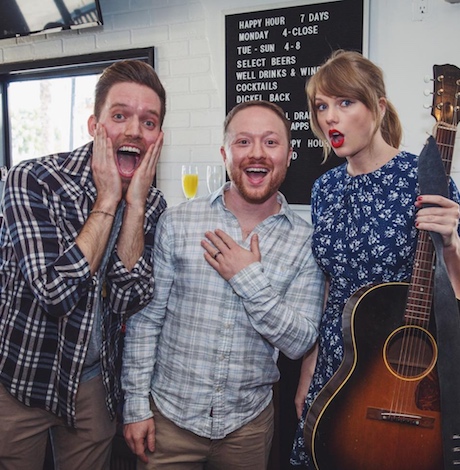
Taylor Swift helped one fan have a dream proposal of his “Wildest Dreams” when she unexpectedly dropped by an engagement party.

Alex Goldschmidt proposed to his boyfriend Ross Girard over the weekend and the couple celebrated with friends and family at the Sycamore Tavern in Los Angeles on Saturday.

However, that wasn’t the only surprise Goldschmidt had planned for Girard.

Goldschmidt surprised the group, and his fiancé, when he introduced Swift who walked into the room with a guitar.

“There was a song that was very special to you two called ‘King of My Heart.’ This is from Alex, but sung by me,” Swift says before performing the song for the party.

In an Instagram post, Goldschmidt explained why the song was so special to the couple.

“I decided to propose to Ross listening to this song in my car,” Goldschmidt writes.

Watch below.

Advertisement
FUND LGBTQ JOURNALISM
SIGN UP FOR E-BLAST

Movies

The 25 greatest queer movies of the 21st century so far

‘Moonlight,’ ‘Brokeback,’ ‘Carol,’ among highlights

Published

on

Mya Taylor and Katana Kiki Rodriguez in ‘Tangerine.’ (Image courtesy of Magnolia Pictures)

There’s something about a calendar milestone that seems to demand the making of lists.

Whether it’s a list of resolutions for the future or a list of high points for the past, we are happy to oblige – so as we move past the first quarter of our current century, here’s our list of the top 25 queer films since the end of the last one, listed in order of their release, and chosen through a blended consideration of overall critical consensus, cultural impact, and yes, individual tastes.

Our favorites might not be the same as yours, because taste is always subjective, so look at this as an inspiration to celebrate yours by making a list of your own.

Hedwig and the Angry Inch (2001)

John Cameron Mitchell’s screen adaptation of his own genderqueer musical about a third-rate rock singer with a botched sex-change made his jubilantly rebellious off-Broadway hit accessible to uncountable queer audiences for whom its comically-tortured pseudo-autobiographical tale of empowerment through rebellious self-expression felt like “being seen,” and the rest is history. 

Mulholland Drive (2021)

Late revered auteur David Lynch’s neo-noir Hollywood mystery – delivered in his famously incomprehensible style – is also a film that strongly centers a same-sex love affair between naive Hollywood-hopeful actress (Naomi Watts) and the darker, more worldly woman (Laura Herring) with whom she becomes entangled. While their relationship may transmute throughout Lynch’s hallucinatory narrative, it remains the unequivocal emotional core of the film.

Bad Education (2004)

Renowned queer Spanish filmmaker Pedro Almodóvar scored a career high point with this boldly imaginative cinematic melodrama in which a gay film director (Fele Martínez) is reunited with a friend and lover (Gael García Bernal) from boarding school, who has written a script based on the story of their youthful relationship. A breathtaking exploration of a story’s evolution through many retellings – and of cinema’s power to illuminate the human truth behind it.

Brokeback Mountain (2005)

What can we say that hasn’t already been said? Ang Lee’s exquisitely heart-rending adaptation of Anne Proulx’s tale of two cowboys in love smashed open doors for queer storytelling in “mainstream” cinema and perfectly captured the agony of impossible longing that so many people in the rainbow community know all too well. Heath Ledger and Jake Gyllenhaal will forever be the litmus test for true allyship, thanks to their fearless commitment to the validity of a love that simply can’t be “quit.”

Shortbus (2006)

John Cameron Mitchell makes a second appearance on our list for directing this controversial, groundbreaking dramedy featuring intertwined love stories – queer and otherwise – around an underground Manhattan “salon” hosted by Justin Vivian Bond. Featuring explicit scenes of un-simulated sex in a gently satirical commentary on the struggle to connect in a post-millennial world, it pushed boundaries while also validating an open view toward sexuality, relationships, and identity itself.

Pariah (2011)

Dee Rees’s drama about a Black lesbian teen (Adepero Oduye) coming to terms with her identity was a landmark of representation, amplifying both the struggle of queer people facing homophobia from within their own community and the self-empowerment that comes with embracing who you are.

Weekend (2011)

Gay British filmmaker Andrew Haigh made an impressive breakthrough with this romance about two gay Londoners (Tom Cullen and Chris New) who fall in love during a one-night stand, filmed with a mix of scripted structure and improvised performance to capture an eminently relatable queer portrait of the kind of fleeting connection that stays with us for a lifetime.

Stranger by the Lake (2013)

This erotic thriller from French filmmaker Alain Guiraudie channels Hitchcock at his most perverse for its story of a “cruiser” at a nude gay lakeside beach (Pierre Deladonchamps) who becomes infatuated with a man who may or may not be a serial murderer (Christophe Paou). Scary, sexy, and utterly hypnotic, there’s a reason it’s frequently named as one of the best queer horror films of all time.

Carol (2015)

Iconic queer filmmaker Todd Haynes has scored several hits this century, but most impactful of all is his adaptation of Patricia Highsmith’s midcentury lesbian romance between a married woman (Cate Blanchett) and a shopgirl (Rooney Mara), which breaks radical ground by imagining the possibility of a happy ending for queer love in an era that represses it.

Tangerine (2015)

Future “Anora” Oscar-winner Sean Baker made his breakthrough with this gritty, iPhone-filmed dramedy about two trans sex workers on an all-night quest in the streets of Hollywood. Shot on iconic location and boasting the raw authenticity of real-life trans performers Kitana Kiki Rodriguez and Mya Taylor, each of whom knew the “streetlife” of the movie firsthand, it represented a huge advancement in the way trans stories were depicted onscreen while revolutionizing the independent film scene with its DIY audacity.

Moonlight (2016)

Barry Jenkins’ adaptation of Tarell McCraney’s play about a closeted young Black man growing up in the crack-blighted projects of Miami became a landmark of queer cinema by winning the Best Picture Oscar, but its real accomplishment lies in its three-act depiction of coming to terms with queer sexuality in an environment of social disadvantage, entrenched homophobia, and limited opportunity for escape. An unequivocal masterpiece.

BPM (Beats per Minute) (2017)

French filmmaker Robin Campanello crafted this urgently contemporary historical drama about AIDS activism of the 1990s, based on his own real-life experiences as a member of the Parisian chapter of ACT UP, and the result is a thrilling portrait of shared community commitment – and heartbreak – that feels like the most powerful documentary you’ve ever seen.
 

Call Me by Your Name (2017)

Timothée Chalamet and Armie Hammer in ‘Call Me By Your Name.’ (Photo courtesy of Sony Pictures Classics)

Luca Guadagnino’s coming-of-age romance between a teen boy (an incandescent Timothée Chalamet)  and his father’s grad student assistant (Armie Hammer) in Tuscany of the early 1980s may have sparked some controversy over the supposed inappropriateness of the age gap between its onscreen lovers and later revelations about Hammer’s real-life inclinations, but this James Ivory-scripted distillation of the pangs of first queer love transcends all that to become an irresistibly potent masterwork – and touchstone – that gives eloquent voice to both a sense of queer longing and a spirit of pastoral bliss that we all know will always be too good to last.

God’s Own Country (2017)

Often (and perhaps unfairly) characterized as a sort of companion piece to “Brokeback Mountain,” this first directorial effort by UK filmmaker Francis Lee depicts a romance between a young sheep farmer (Josh O’Connor) and the Romanian immigrant worker (Alec Secăreanu) he hires to help him after his father is sidelined by a stroke. In this case, however, the obstacles to their union come from internalized homophobia, not from outside judgments, and the trope of an unhappy ending for queer lovers is – tentatively, at least – rejected for a palpable sense of hope. It’s a small shift, perhaps, but the impact is huge.

The Favourite (2018)

Greek absurdist filmmaker Yorgos Lanthomos won accolades for this historical drama about lesbian power struggles in the 18th-century court of Britain’s Queen Anne (Oscar-winner Olivia Colman), who plays two would-be mistresses (Emma Stone and Rachel Weisz) against each other in a Machiavellian competition for royal favor and the power that goes with it. Consistently appalling and frequently grotesque in its portrait of weaponized proximity to power, it’s as uncomfortably funny as it is radically feminist in its portrayal of forced female enmity in a society still governed by masculine standards, even when a woman holds the dominant position.

Portrait of a Lady on Fire (2018)

This French historical drama from Céline Sciamma might seem at first glance as if it were merely another iteration of the period lesbian romance that has become almost a cliche, but it transcends the tropes to assert a message of feminist rebellion against the male-dominated societal norms – magnified by its 18th century setting – which would dismiss and devalue the inner experience of women, and leaves us all wanting to see “The Patriarchy” burned to the ground.

Neptune Frost (2021)

In this singularly genre-defying musical romance from Saul Williams and Anisia Uzeyman, magical Afrofuturist realism collides with dystopian tech-driven sci-fi for a story of romance between an intersex refugee from Burundi (Cheryl Isheja/ Elvis Ngabo) and a rebellious coltan miner (Bertrand “Kaya Free” Ninteretse), blending elements of cosmic spirituality with brutally oppressive political reality to create a visually striking modern-day myth, rooted in African tradition, that incorporates the struggle for queer identity into a larger battle against suppression and domination by a shadowy over-class concerned only with power and profit. Palpably weird and unrepentantly radical, it speaks – and sings – truth to power in a way that most modern films could simply never imagine.

Everything Everywhere All at Once (2022)

This multi-Oscar-winning surprise hit from the filmmaking team known collectively as “The Daniels” (Kwan and Schwienert are their real-life surnames) might be a brilliantly absurdist action comedy about a war for the fate of the multiverse, but it’s built around the struggle of an Asian-American mother (Michelle Yeoh) to reconcile her strained relationship with her queer daughter (Stephanie Hsu) and come to terms with her disillusionment over her devoted but seemingly incompetent husband (Ke Huy Quan) – all while negotiating her tax returns with a no-nonsense IRS agent (Jamie Lee Curtis) who may have been her lesbian lover in another reality. It might take a collective effort from dozens of alternative timelines, but the fight is definitely worth it, in the end.

Fire Island (2022)

Director Andrew Ahn teamed with writer/star Joel Kim Booster for this modernized gay adaptation of “Pride and Prejudice” in which Jane Austen’s 19th-century social commentary is reframed in the world of queer culture, highlighting the class differences between economic and social status and amplifying the experience of queer Asian-American males in the predominantly white-centric queer heirarchy of the contemporary age. It sounds like a stretch, but it’s a more authentically heartfelt – and unapologetically intelligent – queer romcom than the much-touted “Bros,” which debuted the same year to a dishearteningly meager box office take.

Tar (2022)

Acclaimed Kubrick protege Mike Field’s third movie is this ethically challenging drama starring Cate Blanchett as a renowned lesbian conductor targeted by “cancel culture” over her history of predatory sexual misconduct. An alternately bemusing and horrifying portrait of toxic behavior and a world more interested in passing judgment than addressing inequities, it’s an uncompromisingly detached cautionary tale about female power in a world still governed by patriarchal standards, with Blanchett’s flawless performance as the glue that holds it all together.

All of Us Strangers (2023) Andrew Haigh makes a second appearance on our list as writer/director of this haunting adaptation of a novel by Japanese author Taichi Yamada, in which a lonely screenwriter (Andrew Scott) revisits his childhood home to commune with his long-dead parents (Jamie Bell, Claire Foy) while navigating a tentative new relationship with a melancholy neighbor (Paul Mescal) in his strangely deserted apartment building. Part ghost story, part melancholy romance, and all about the exploration of queer isolation and lingering childhood trauma, it’s an unexpectedly uplifting love story with supernatural overtones that render it into the stuff of mystical poetry. An essential queer classic, right out of the box.

I Saw the TV Glow (2024)

As queer cinema continues to struggle with the challenge of bringing trans stories to the big screen in the face of political pushback from transphobic culture warriors, filmmaker Jane Schoenbrun has bravely pushed forward, and this – her second feature – achieves full-on cinematic greatness, delivering a trans allegory in the shape of a disquieting horror movie about former teen schoolmates (Justice Smith and Jack Haven) haunted by phantom memories of a favorite TV show from their past. Capped with a final sequence that drives home the despair of living a life of pretense against your own inner truth, it’s a surreal and devastatingly immediate fantasia on themes of gender, sexuality, and conformity, but also an indictment against the outright erasure of trans identity in a world that would rather pretend it never existed in the first place.

Love Lies Bleeding (2024)

Rose Glass’s  lesbian neo-noir thriller teams queer icon Kristen Stewart with Katy O’Brien for a twisted love story between the daughter of a small-town crime boss and an aspiring steroid-addled bodybuilder which takes them both on a harrowing road of violence and terrible choices yet keeps us pulling for their union every step of the way. A slice of deliberate B-movie exploitation cinema at its most elevated, it embraces its generic camp to achieve a deeply satisfying spirit of rebellion that leaves us all calling for an end to the patriarchy, right now.

The Visitor (2024)

Underground filmmaker and “queercore” pioneer Bruce La Bruce has a long history of creating brilliant countercultural cinema underneath the mainstream radar, but he finds his way onto our list via his audacious remake of Pier Paolo Pasolini’s “Terorema,” in which a mysterious and sexually fluid stranger destroys a dissolute bourgeois household by seducing each of them – from father and mother to son, daughter, and maid – in turn. Reset into contemporary England and informed by a xenophobic fear of the “other,” it doubles down on Pasolini’s sociopolitical statement while upping the ante with transgressive scenes of un-simulated sex. The result is an unforgettable excursion into radical queer expression that fearlessly exposes the hypocrisies of so-called “straight” society while fostering an “eat the rich” attitude of sexual rebellion that has yet to be matched by any filmmaker working within “the system.”

The History of Sound (2025)

South African filmmaker Oliver Hermanus has made a number of passionate queer films during his career, but this WWI-era romantic drama about two music scholars (Paul Mescal and Josh O’Connor). who fall in love while gathering folk songs in rural New England, surpasses his earlier triumphs by offering up a bittersweet-but-transcendent meditation on the power of music to preserve and immortalize the struggles and hardships of each generation, as humans – queer or otherwise – strive to find happiness in the proscribed limitations of their lives. Yes, it’s tragic; but thanks to the exceptional tenderness between its two stars and the compassion with which Hermanus extends to them, it leaves us with the memory of the good things while offering hope for a future that gives us – at long last – the freedom to be who we are.

Continue Reading

Theater

Out actor talks lead role in ‘Fiddler on the Roof’

Signature Theatre production runs through Jan. 25

Published

on

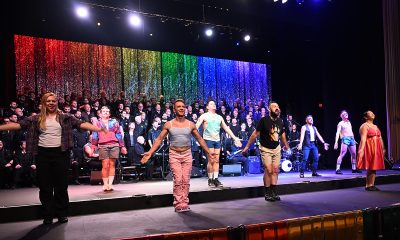
Ariel Neydavoud (Perchik), Lily Burka (Hodel) and the cast of ‘Fiddler on the Roof at Signature Theatre. (Photo by Christopher Mueller)

‘Fiddler on the Roof’
Through Jan. 25
Signature Theatre
4200 Campbell Ave.
Arlington, Va.
Tickets start at $47
Sigtheatre.org

Out actor Ariel Neydavoud is deep into a three-month run playing revolutionary student Perchick in the beloved 1964 musical “Fiddler on the Roof” at Signature Theatre in Arlington.  And like his previous gigs, it’s been a learning experience. 

This time, he’s gleaning knowledge from celebrated gay actor Douglas Sills who’s starring as the show’s central character Tevya, a poor Jewish milkman in the fictional village of Anatevka in tsarist Russia circa 1905. 

In addition to anti-Semitism and expulsion, Tevya is struggling with waning traditions in a changing world where his daughters dare suggest marrying for love. Daughter Hodel (Lily Burka) falls for Perchick, an outsider who comes to town brandishing new ideas. 

And along with its compelling and humor filled storyline, “Fiddler” boasts iconic numbers like “If I Were a Rich Man,” “Tradition,” “Matchmaker, Matchmaker,” and “Sunrise, Sunset.”

Neydavoud, born and raised as an only child in the West Los Angeles neighborhood lightheartedly referred to as Tehrangeles (due to the large Iranian-American population), has always been passionate about performing. “It’s like I came out of the womb tap dancing,” he says. Fortunately, his mother, an accomplished pianist and composer, served as built-in accompanist. 

He began acting and singing at kid camps and a private Jewish middle school alongside classmate Ben Platt. In his teens, Neydavoud spent three glorious weeks at Stagedoor Manor, a well-known theater camp in Upstate New York, where he solidified his desire to pursue theater as a profession, and started to feel comfortable with being queer.

Following high school, he studied at AMDA (American Musical and Dramatic Academy) and soon after morphed from theater student to professional actor. 

WASHINGTON BLADE: Your entry into showbiz seems to have been a smooth one.

ARIEL NEYDAVOUD: I’m happy to hear it seems that way. I’d rarely describe anything about this profession as smooth; nonetheless, what I love about this work is that it gives opportunities to have so many new experiences: new shows, new parts, and new communities who come together in a moment’s notice purely for the sake of creating art.  

BLADE: Tell us about Perchick. 

NEYDAVOUD: He comes to Anatevka and challenges their ideals and way of life. That’s something I can relate to. 

I’m Jewish on both sides, but I’m also queer, first generation American, [his mother and father are from Germany and Iran, respectively], and a person of color. I never feel like I belong to a single community. That’s what has emboldened my inner activist to speak up and challenge ideas that I don’t necessarily buy into. 

BLADE: You sing beautifully. Perchick’s song is “Now I have Everything,” an Act II melody about finding love. Was it an instant fit for you? 

NEYDAVOUD: Not instantly.I’m traditionally a first tenor. Perchick is baritone range, a little outside of my comfort zone. After being cast, I asked our director Joe Calarco if he would be comfortable raising the key, something they did with the recent Broadway revival. He was firm about not doing that. 

As an artist I see challenges as opportunities to grow, so it’s been really good exploring my lower register.  

BLADE: Audiences have commented on an intimacy surrounding this production. 

TK: It’s performed in the round with a dining table at its center. It could be a sabbath or seder table, however you interpret it, but I find it a brilliant way to illustrate community and tradition. 

It feels like the audience is invited to the table and join the residents of Anatevka. The show’s moments of joy like the betrothal song “To Life (L’Chaim)” are intensified, and conversely the pogrom scenes are made more difficult. It feels like we’re sharing space. 

BLADE: Do your encompassing identities broaden casting possibilities for you? 

NEYDAVOUD: Marketing yourself as ethnically ambiguous can be a helpful tool. After “Hamilton” and the pandemic there was more of a shift toward authenticity. I try to steer toward playing Middle Eastern, Southwest Asian, Jewish, and mixed-race characters without being too prescriptive. 

BLADE: Tell us your dream roles?

NEYDAVOUD: I’d love to play the Emcee in Cabaret [often portrayed as a gender-fluid, queer-coded, or non-binary figure]. And I’d like to direct a production of “Godspell” with a fully Middle Eastern cast. I think portraying Jesus and disciples in Middle Eastern bodies as Bohemian idealists living under an oppressive regime could be especially impactful. 

BLADE: Can today’s queer audiences relate to life on the shtetl? 

NEYDAVOUD: As a piece, “Fiddler” is timeless. Beyond the magical score, it hits home with just about anyone who’s ever felt othered. There are relevant themes of displacement and persecution, and maintaining cultural identity in the wake of turbulence, all ideas that tend to resonate with queer people.

Continue Reading

Books

This gay author sees dead people

Published

on

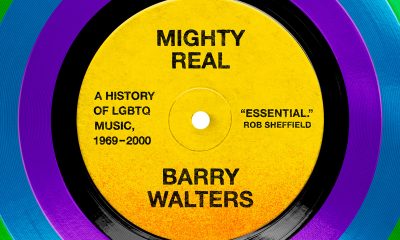
(Book cover image courtesy of Spiegel and Grau)

‘Are You There Spirit? It’s Me, Travis’
By Travis Holp
c.2025, Spiegel and Grau
$28/240 pages

Your dad sent you a penny the other day, minted in his birth year.

They say pennies from heaven are a sign of some sort, and that makes sense: You’ve been thinking about him a lot lately. Some might scoff, but the idea that a lost loved one is trying to tell you he’s OK is comforting. So read the new book, “Are You There, Spirit? It’s Me, Travis” by Travis Holp, and keep your eyes open.

Ever since he was a young boy growing up just outside Dayton, Ohio, Travis Holp wanted to be a writer. He also wanted to say that he was gay but his conservative parents believed his gayness was some sort of phase. That, and bullying made him hide who he was.

He also had to hide his nascent ability to communicate with people who had died, through an entity he calls “Spirit.” Eventually, though it left him with psychological scars and a drinking problem he’s since overcome, Holp was finally able to talk about his gayness and reveal his otherworldly ability.

Getting some people to believe that he speaks to the dead is still a tall order. Spirit helps naysayers, as well as Holp himself.

Spirit, he says, isn’t a person or an essence; Spirit is love. Spirit is a conduit of healing and energy, speaking through Holp in symbolic messages, feelings, and through synchronistic events. For example, Holp says coincidences are not coincidental; they’re ways for loved ones to convey messages of healing and energy.

To tap into your own healing Spirit, Holp says to trust yourself when you think you’ve received a healing message. Ignore your ego, but listen to your inner voice. Remember that Spirit won’t work on any fixed timeline, and its only purpose is to exist.

And keep in mind that “anything is possible because you are an unlimited being.”

You’re going to want very much to like “Are You There, Spirit? It’s Me, Travis.” The cover photo of author Travis Holp will make you smile. Alas, what you’ll find in here is hard to read, not due to content but for lack of focus.

What’s inside this book is scattered and repetitious. Love, energy, healing, faith, and fear are words that are used often – so often, in fact, that many pages feel like they’ve been recycled, or like you’ve entered a time warp that moves you backward, page-wise. Yes, there are uplifting accounts of readings that Holp has done with clients here, and they’re exciting but there are too few of them. When you find them, you’ll love them. They may make you cry. They’re exactly what you need, if you grieve. Just not enough.

This isn’t a terrible book, but its audience might be narrow. It absolutely needs more stories, less sentiment; more tales, less transcendence and if that’s your aim, go elsewhere. But if your soul cries for comfort after loss, “Are You There, Spirit? It’s Me, Travis” might still make sense.

The Blade may receive commissions from qualifying purchases made via this post.

Continue Reading

Popular