Virginia
Activists rally at Fairfax County School Board meeting
FCPS governing body unanimously passes LGBTQ History Month recognition
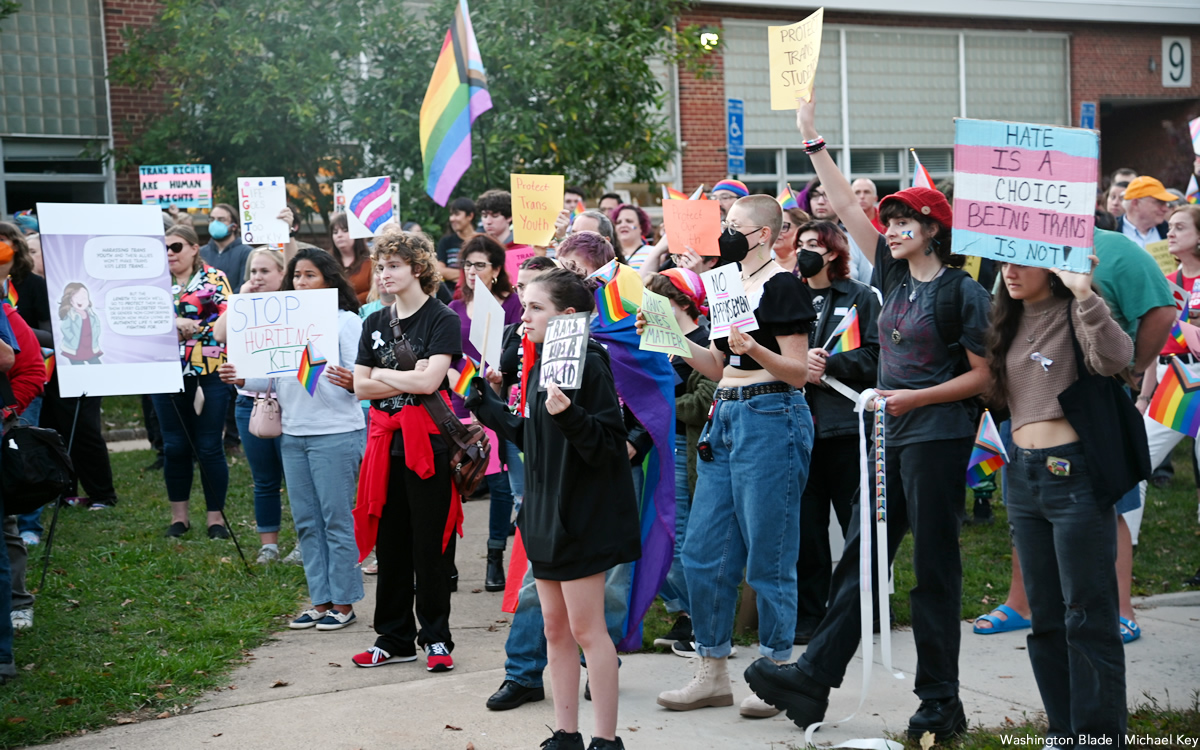
A group of more than 200 activists gathered outside of Luther Jackson Middle School in Vienna on Thursday to object to the new “model policies” for transgender students proposed by Republican Gov. Glenn Youngkin’s administration.
Many activists have voiced support for the policies enacted by the General Assembly and former Gov. Ralph Northam, which were intended to protect LGBTQ students in general, and trans and gender nonconforming students in particular. However, the Youngkin administration released revisions on Sept. 16 that differ substantially from the policies passed into law in 2020.
The activists oppose the revised “model policies” for including the mandate that students use school facilities for the sex they were assigned at birth and the restriction of students to be able to change their names and pronouns without parental permission. Further, the policies direct teachers and staff not to conceal a student’s gender identity from parents, even when a student asks to keep that information private.
Activists from the student-led Pride Liberation Project were joined by state Del. Marcus Simon (D-Falls Church), educators, students, concerned community members and activists from the Fairfax County Federation of Teachers, Pride in FCPS and the Democratic Socialists of America ahead of the Fairfax County School Board meeting before it took place inside the middle school.
McLean High School senior Casey Calabia, a Pride Liberation Project organizer, spoke to the crowd.
“When I came here this afternoon, I made the active choice to forget the probability and statistics test I have because how can these classes mean anything to me when my rights are at risk, when my safety in a classroom is at risk,” said Calabia. “Education is not for parents, education is not for teachers, it is not for your next political agenda, education is for students.”
“It is to bring up the next generation to be competent, to be kind, to be loving and to feel safe where they deserve to be safe,” added Calabia. “How can my county do anything but make the necessary move for our education to keep us better? To keep us safe?”
“When it’s hard, when we face resistance, there are tons of people and thousands more that come to places like this to stand up for trans kids, to stand up for queer kids,” Calabia said. “I am proud that I get to honor a long-standing tradition of queerness, of being nonbinary, of being transgender. It is something I’m privileged to do every single day of my life. So it is here at FCPS that I’m grateful to everyone continuing to help defend my right to thrive. Every single one of my fellow students, teachers, staff and community members equally deserves their right to thrive.”
Fairfax County students were joined at the rally by parents like Laura Stokes.
“I’m a very proud parent of a trans nonbinary fourth grader in FCPS,” Stokes told the assembled activists.
“Whenever Youngkin says he’s about ‘respecting parents’ choice,’ I don’t feel like I’m reflected in that statement. What about parents like me?” Stokes asked. “I don’t see myself in that proposal. I don’t see myself in that policy.”
David Walrod of the Fairfax County Federation of Teachers admonished the Youngkin administration.
“What we have seen from Glenn Youngkin and the Virginia Department of Education is unconscionable, reprehensible,” Walrod said.
“We’ve seen governors use students as political pawns before.” Walrod charged. “We’ve seen governors like Gregg Abbott of Texas and Ron DeSantis of Florida create the most dehumanizing laws against LGBTQ students that they could think of. The Virginia legislature saw past the political games and they saw human beings, they saw students, they saw children.”
“The Northam administration supported these efforts and created policies meant to protect students, promote inclusion and equity and give students a chance to thrive,” Walrod continued. “Gov. Youngkin and Supt. Ballow on the other hand have shown us they don’t believe members of the LGBTQ+ community are worthy of protection. They’ve shown us that they support demonizing students to score political points.”
“I ask the school board to say ‘no’ to Glenn Youngkin,” Walrod said. “I ask the school board to say ‘no’ to Jillian Ballow and I ask the Fairfax County School Board to say ‘yes’ to giving students the ability to be themselves.”
Following the rally, activists filed into the Luther Jackson Middle School auditorium for the Fairfax County School Board’s public meeting.
Board Chair Rachna Sizemore Heizer began the meeting with a statement prepared by the board and acknowledged the large crowd of LGBTQ student activists in attendance.
“The Fairfax County School Board understands that our LGBTQIA+ students, staff, and families are worried about the impact of Gov. Youngkin’s proposed model policies for transgender and gender-expansive students,” Heizer read into the public record. “Nearly one in five transgender and non-binary youth attempted suicide in the last year. LGBTQIA+ youth who found their school to be affirming reported lower rates of attempting suicide. It is necessary to ensure our school community is a place where all students can live without fear of prejudice, discrimination, harassment or violence.”
“Our policies and regulations will continue supporting our transgender and gender-expansive students, staff, and families. Fairfax County School Board Policy 1450 protects students, educators, and other staff from discrimination based on sexual orientation and gender identity,” Heizer continued.
Heizer then listed the protections outlined in FCPS Regulation 2603 and reiterated the board’s commitment to the Viriginia Human Rights Act, Title IX and the “settled law of Grimm v. Gloucester County School Board,” requiring respect for students’ gender identity.
“Protecting, supporting and affirming our transgender and gender-expansive students is critical to achieving a safe and respectful learning environment for all students, and providing them with equal access to educational programs, services, and activities. The work to do so in a holistically inclusive way continues, but we know that, from this commitment, we will not waiver,” concluded Heizer.
The board later unanimously passed a resolution introduced by member Karl Frisch (Providence District) recognizing October as LGBTQ History Month in Fairfax County Public Schools.




Virginia
Gay Va. couple hopeful voters will enshrine marriage equality in state constitution
Early voting has already begun in the state
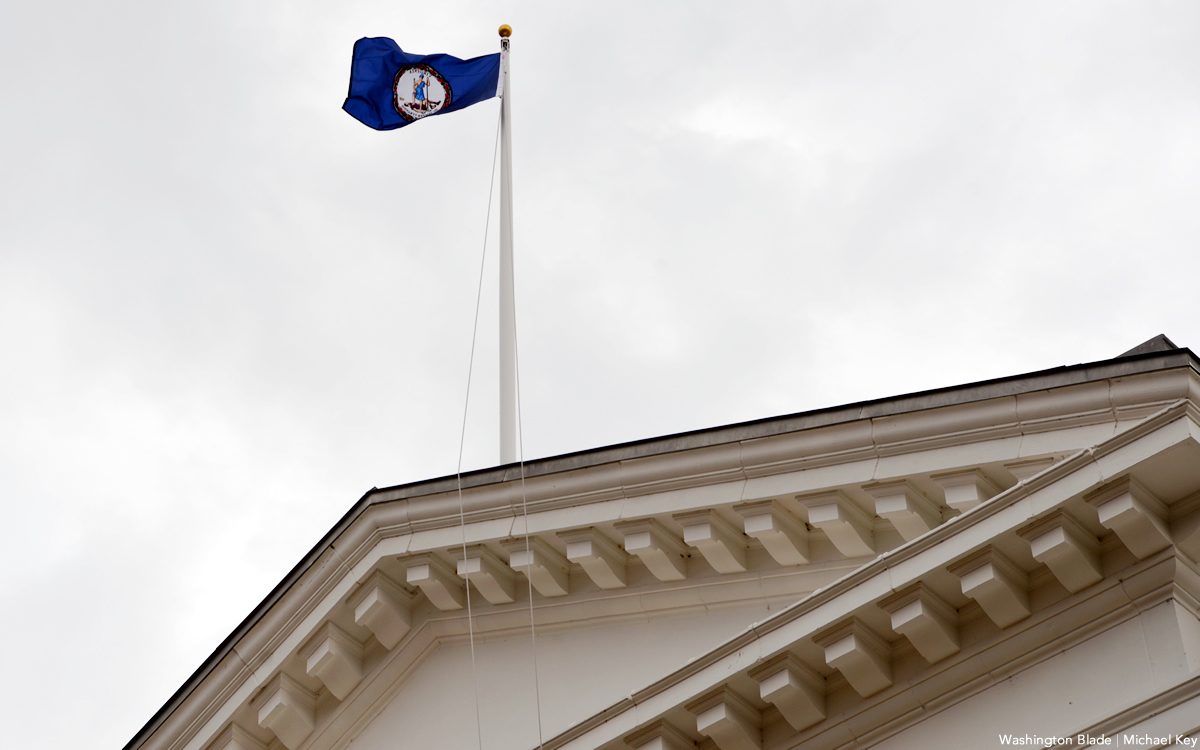
A referendum on whether to enshrine marriage equality in Virginia’s constitutional amendment is on the ballot this year.
If voters approve Question 2, it will codify the U.S. Supreme Court’s Obergefell ruling in 2015 that extended marriage rights to same-sex couples across the country — gays and lesbians have been able to legally marry in Virginia since Oct. 6, 2014.
Ron Bookbinder and James Fisher are a married couple who live in Arlington.
They have been together for 38 years — Bookbinder and Fisher married in 2014.
“We think this is a critical vote to remove this discriminatory language from the constitution and to ensure that going forward, no matter what happens, the state of Virginia will ensure marriage equality,” Fisher told the Washington Blade. “It is it is really difficult and upsetting to think that our current state constitution would prohibit same-sex marriage, even though the federal government overrides that now. There’s no saying what may happen in the future.”
Bookbinder said it was important for him and Fisher to get married “to gain social equality.”
“I was surprised how good it felt, how important it was to begin to say, ‘my husband rather than my partner,'” Bookbinder said.
Bookbinder then explained why it feels good to be married.
“Is it a legal partner, a business partner, a tennis partner, you know, or a romantic partner? But when you say my husband James, everyone knows exactly what you mean and confers an equal status with everyone else who’s married, and we were both surprised at how good it felt and how equal it felt to suddenly be married and be able to state that you were married and discuss your husband rather than your partner, and I would hate to lose that,” he said.
Bookbinder and Fisher said they are hopeful that voters will approve the amendment, noting Virginia has become more progressive over the years.
“I think people have, with the Supreme Court decision, people have seen that a same-sex marriage is just a marriage,” stated Fisher. “It’s just two people who love each other, and I think more and more people have attended a same-sex marriage, someone in their family or a friend, and the experience of what this is, firsthand experience, is so important in shaping people’s opinions, and I think the period of time that we’ve had since the Obergefell decision has given a lot of voters that experience, which I think is really important and powerful.”
The couple also said the push to enshrine marriage equality in Virginia’s constitution is in response to the Trump-Vance administration.
“And I think due to President Trump doing all the horrible things he’s done to so many groups, including LGBTQ, especially trans people, that Virginians are kind of pushed to be even more progressive to protect those who need protection, which would include the LGBTQ community in terms of marriage equality, so I’m confident it will pass,” said Bookbinder.
Narissa Rahaman, executive director of Equality Virginia, sent the Blade a statement about early voting on Question 2 that has already begun.
“With early voting now underway, our focus is making sure every Virginian knows Question 2 is on their ballot,” said Rahaman. “The outdated ban on same-sex marriage still in Virginia’s state constitution leaves a gap in protections for the thousands of same-sex couples that call this state home, but after 20 years we have the chance to fix it.”
Log onto www.mobilize.us/vaformarriage to find out more about the campaign in support of Question 2.
Virginia
Virginia Anti-Violence Project struggles to fill federal funding gaps
Group has lost 54 percent of funding since 2020
A loss of federal funding has threatened to adversely impact the Virginia Anti-Violence Project’s work in the state.
The group’s mission is to assist LGBTQ and BIPOC (Black, Indigenous and people of color) victims of domestic, sexual, interpersonal, and state violence with direct support, education, and advocacy. The VAVP seeks to build a future where LGBTQ and BIPOC individuals can live freely without a sense for worry about violence.
“Virginia Anti-Violence Project helps to close the distance between services existing and LGBTQIA+ survivors actually being able to reach safety, stable housing, and support that they can trust,” VAVP Executive Director Ebony Clark told the Washington Blade on Tuesday. “Our mission is to provide direct services and advocacy to LGBTQ+ survivors across Virginia.”
Clark said obtaining state and federal funds has become increasingly difficult.
“One of the reasons that we can talk about is politics and how you know queer diverse, queer communities are targets when it comes to politics, and so that may be a reason why the funding is decreasing in in very niche areas, but overall, state funding, federal funding has been lost or significantly reduced when it comes to culturally specific marginalized populations,” Clark said. “The bigger picture is that funding that was purposed for diversity, equity, inclusion, marginalized populations, or you know culturally competent programming, those funds have been strategically reduced or eliminated on state and federal levels overall.”
Even more so with the current Trump-Vance administration.
Data shows federal funding for one “major federal victim-services funding stream in” Virginia has dropped 54 percent over the last six years: from $25.1 million in fiscal year 2020 to $11.6 million in fiscal year 2026.
Clark noted some federal funding has been denied due to VAVP’s DEI policies — it has had to “water down” their language. These cuts have forced VAVP to limit housing and economic support, which has resulted in fewer resources for its clients.
The organization has set up a goal for receiving between $250,000-$300,000 a year that would allow it to operate — and focus on client housing.
“Housing is fundamental to safety,” Clark told the Blade. “If you know leaving violence puts someone on the street or forces them back to the person harming them, that means the crisis isn’t over. So there needs to be other prevention strategies and reactive strategies in place to be able to prevent further violence from folks.”
VAVP has set up a link for anyone who is interested in making a donation. It is here.
The VAVP website is also accepting donations.
Virginia
Winsome Earle-Sears ‘Life and Marriage Tour’ to include Northern Va. stops
Voters to consider marriage equality, reproductive rights referenda in November
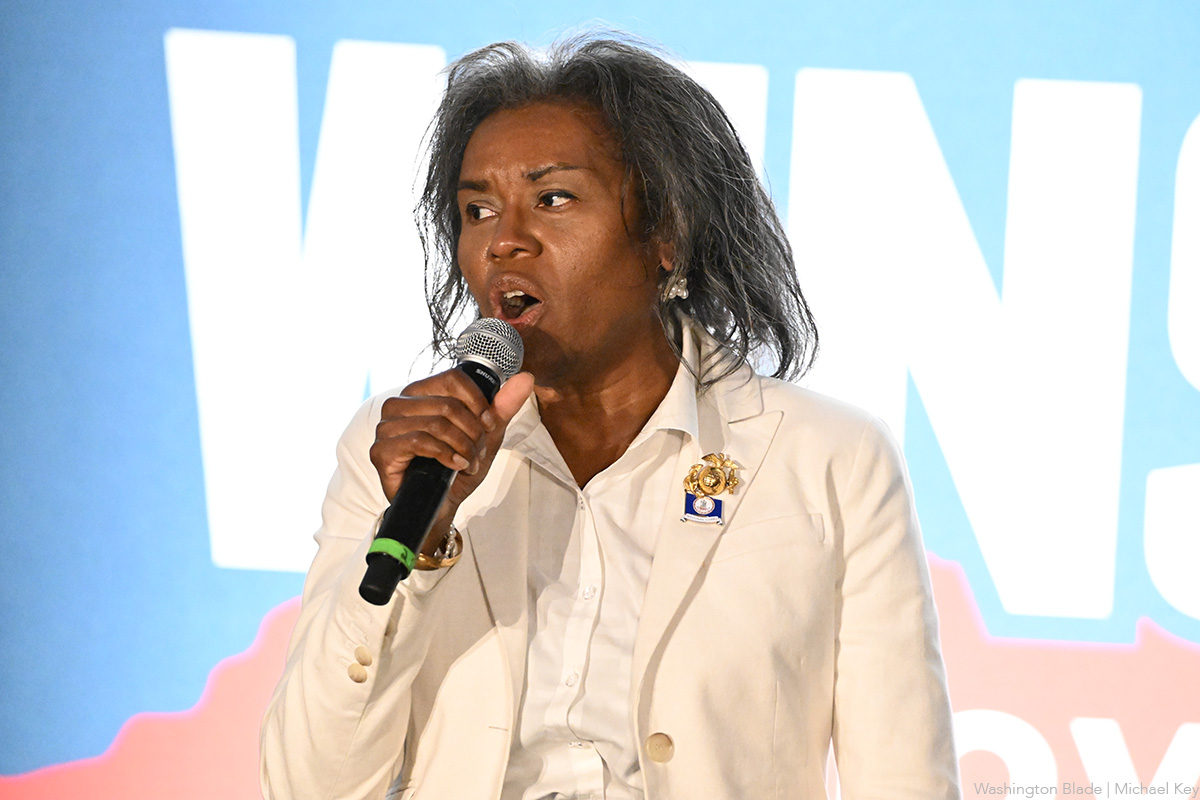
Former Virginia Lt. Gov. Winsome Earle-Sears has announced her campaign against efforts to enshrine marriage equality and reproductive rights in the state constitution will make several stops in Northern Virginia.
Her “Life and Marriage Tour” will include stops in Manassas, Winchester, and Harrisonburg. Earle-Sears said the “Life and Marriage Tour” will also travel to Virginia Beach, Lynchburg, Roanoke, Charlottesville, and other cities across Virginia “throughout September and October.”
The announcement did not include specific dates.
“Virginia, you’ve been asking where the Life and Marriage Tour is headed — here’s a look at our current tour locations,” she said on X on Tuesday. “We’ll be traveling across the commonwealth throughout September and October, and we’re still building the journey.”
Current Gov. Abigail Spanberger, a Democrat, last November defeated Earle-Sears, a Republican, in the race to succeed Republican Glenn Youngkin.
Voters in 2006 approved the Marshall-Newman Amendment, which defined marriage in Virginia as between a man and a woman.
Same-sex couples have been able to legally marry in Virginia since 2014. Youngkin a decade later signed a bill that codified marriage equality in state law.
Two successive legislatures must approve a proposed constitutional amendment before it can go to the ballot.
Spanberger signed bills that finalized the marriage equality and reproductive rights referenda’s language.
The referenda will take place on Nov. 3.

Equality Chamber hosts Pride in Business Expo and Profits & Pours

Learn more about Virginia’s queer history

Annapolis Pride arrives this weekend

Calendar: October 2-8

Renee Good’s family files two federal lawsuits

529 openly LGBTQ candidates running in Brazilian election

Meet the LGBTQ candidates running for U.S. House, Senate

Ana Brnabić becomes world’s first openly lesbian head of state

Vote now! Best Of LGBTQ DC readers’ choice awards

Gay Va. couple hopeful voters will enshrine marriage equality in state constitution
-

 Brazil5 days ago
529 openly LGBTQ candidates running in Brazilian election
-
2026 Midterm Elections4 days ago
Meet the LGBTQ candidates running for U.S. House, Senate
-
Serbia4 days ago
Ana Brnabić becomes world’s first openly lesbian head of state
-
Arts & Entertainment4 days ago
Vote now! Best Of LGBTQ DC readers’ choice awards