Arts & Entertainment
Life-long ‘Fan’
Gay writer explores, Aretha, gays in black gospel and more
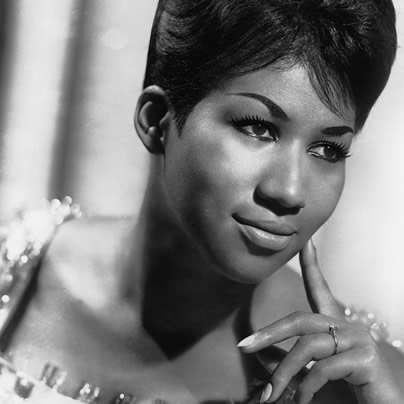
‘The Fan Who Knew Too Much’
By Anthony Heilbut
Knopf
$30
354 pages
anthonyheilbut.comAretha Franklin concert
Saturday, Nov. 17
7:30 p.m.
DAR Constitution Hall
1776 D Street, NW
$59.50-115.50
ticketmaster.com
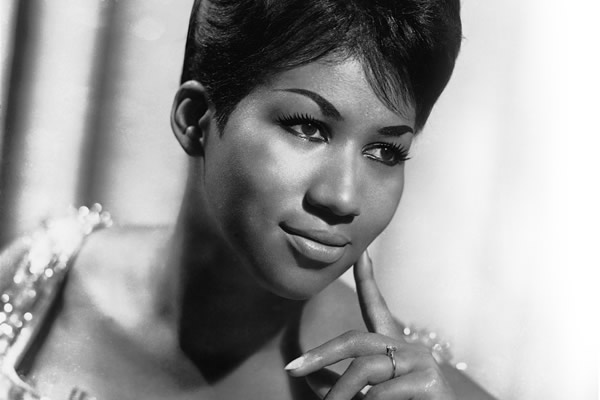
Vintage early ’60s promo still of Aretha Franklin during her Columbia Records years. (Photo courtesy of Sony Music Entertainment)
In a roundabout way, there’d be no rock music without gays and lesbians.
That’s the assertion of gay New York-based writer/historian Anthony Heilbut. In a sprawling, juicy tome that’s as gossipy and anecdotal as it is academic, he writes in “The Fan Who Knew Too Much” that there would have been no golden age of black gospel music (roughly1945-1960) without gays. He, and other rock historians also assert there’d be no mainstream rock and roll without classic black gospel influence.
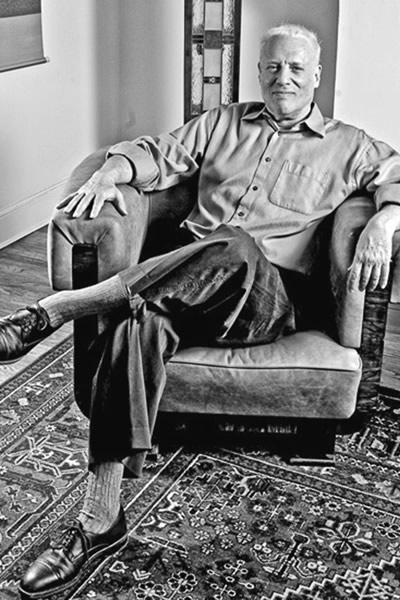
Gay author Anthony Heilbut says Franklin’s underrated work at Columbia Records is her best, contrary to popular opinion, which venerates her later Atlantic Records period. (Photo by Stephen Ladner)
“It means a lot to me that gay people know about this,” Heilbut says during a lengthy phone chat last week. “Gospel is really the most essential American music. Everyone sort of understands that black church singing, it’s really been the center of American singing since the 19th century. It follows through in jazz as well. It’s a great gay contribution.”
Though white and an atheist, as a teen, Heilbut went to hear the great R&B and soul acts of the day at the Apollo in New York. He was often the only white person in the room. He got a heads up from the ushers.
“I think they kind of took pity on this lone white boy,” he says. “They said, if you dig this, you ain’t heard nothin’ yet, the gospel shows are so much better. The showmanship, the vocalism. I came to know almost all the singers and became absolutely enthralled. They were so much more dynamic than their secular counterparts. You just cannot imagine rock and roll and R&B without the influence of these singers.”
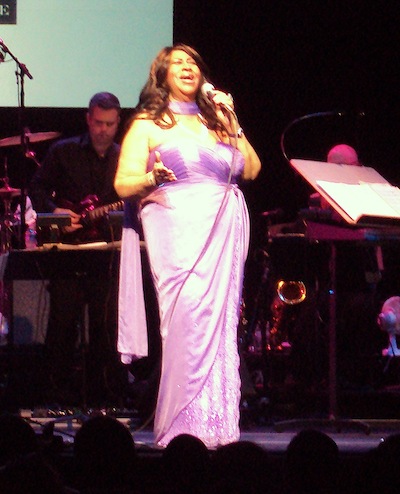
Aretha in concert at Wolf Trap, summer 2011, the last time she played the D.C. market. (Blade file photo by Joey DiGuglielmo)
Heilbut’s book, out earlier this year, is a collection of lengthy essays. Subtitled “Aretha Franklin, the Rise of the Soap Opera, Children of the Gospel Church and Other Meditations,” it includes a lengthy essay on how many black gospel legends — figures like James Cleveland, Clara Ward and others were either gay, lesbian or bi. In the essay “Aretha: How She Got Over” he explores how the soul legend — in town this weekend for a concert at DAR Constitution Hall — integrated the styles of the gospel legends she admired as a teen into the hit secular records she later recorded at Columbia and Atlantic. Though Franklin’s gospel roots are well known, Heilbut extrapolates the richness of those influences in unprecedented ways.
Other essays explore writer Thomas Mann (“The Magic Mountain”), the phenomenon of the male soprano and late soap opera maven Irna Phillips.
One senses, however, that despite Heilbut’s many interests and decades — he’s 71 — of following the careers of many, his heart is most deeply rooted in the gospel music of his youth. He eventually produced records for some of his favorites and writes and shares movingly of not only their great talent, but the hypocrisy with which the church has dealt with — often with scorn and outright condemnation — the contributions of its gay musicians.
Typical of many of the “old school” black gospel establishment, Heilbut quotes the legendary Shirley Caesar as “beseeching the ‘sissies and bull daggers’ to ‘come up and be saved,’ and warning that homosexuals were ‘stealing our children.’”
More analysis than biography, though, Heilbut illustrates how a lifetime of following a singer or musical phenomenon can result in an uncanny insight that the subjects themselves are often loathe to discuss — Franklin, as journalists and long-time fans know, is famously prickly and evasive on many topics.
For the record, Heilbut says Franklin and her legendary father, Rev. C.L. Franklin who became a mid-century legend as pastor of Detroit’s New Bethel Baptist Church — were way more accepting of gays than many others in the era.
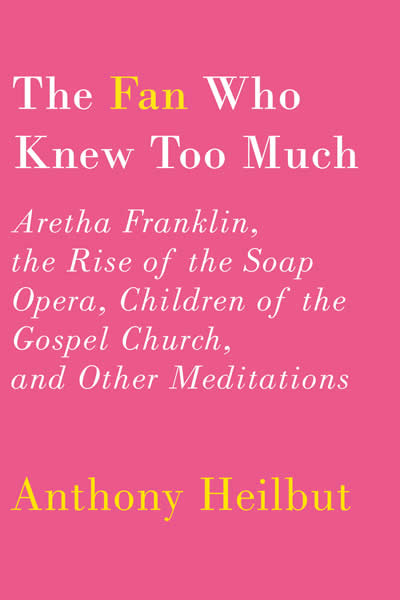
Cover art of Anthony Heilbut’s new book. (Cover image courtesy of Knopf)
Heilbut says Franklin, though not as vocal as some, has made her gay support known in several ways — from singing at a recent same-sex wedding to inviting gay-welcoming clergy (Bishop Carlton Pearson) to comment during a Whitney Houston tribute she hosted during a concert at Radio City Music Hall while Houston’s mother, Cissy, stuck with old school, anti-gay leaders (TD Jakes, Donnie McClurkin) at her daughter’s funeral.
“Aretha does these little things without really saying a word,” Heilbut says.


Out & About
Tyler Clementi Foundation to host fundraiser in Rehoboth
Special remarks to be given by Jane Clementi, Rep. McBride
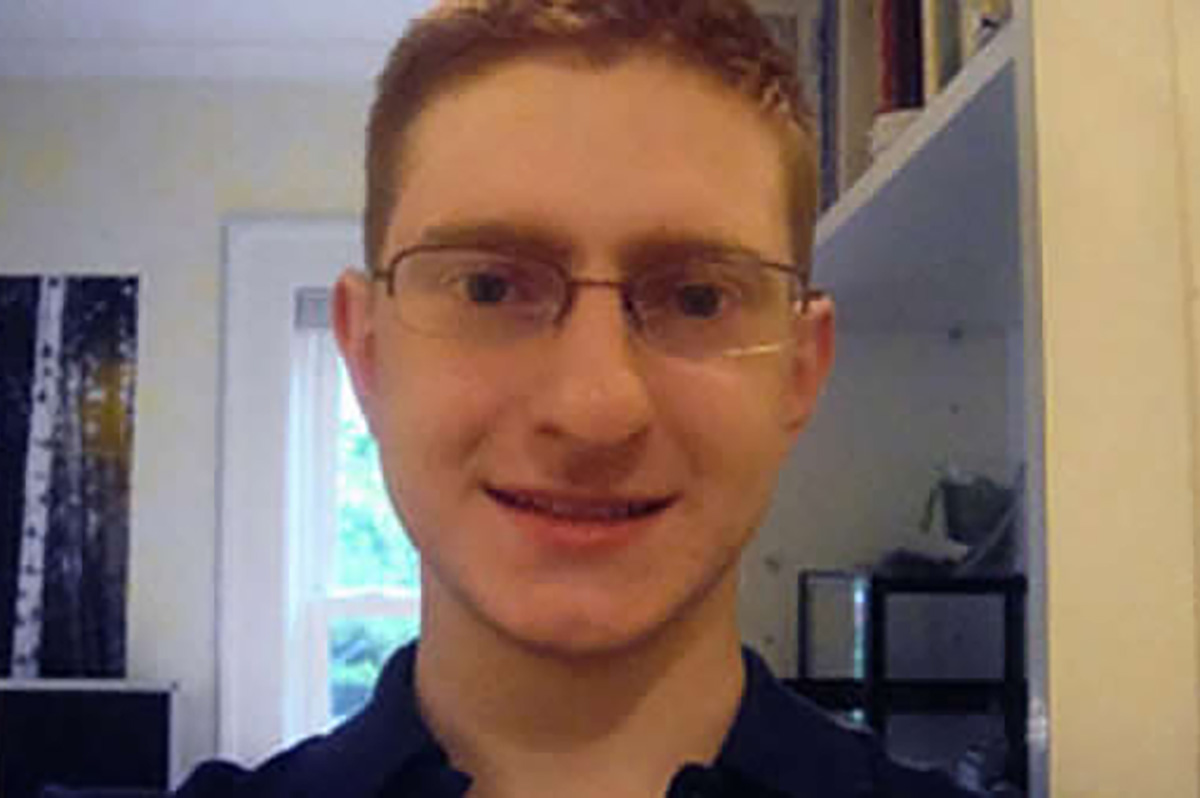
To kick off National Coming Out Month, the Tyler Clementi Foundation will host a fundraiser on Thursday, Oct. 1 at 6 p.m. at CAMP Rehoboth in Delaware.
The event will feature special remarks by Jane Clementi and Rep. Sarah McBride. If you are unable to attend, please consider making a donation to support the work of the Tyler Clementi Foundation to end online and offline bullying and harassment in schools, workplaces, and faith communities.
For more details, visit the Tyler Clementi Foundation’s Facebook page.
Friday, September 25
Go Gay DC will host “LGBTQ+ Community Happy Hour” at 7 p.m. at DIK Bar. This is a chance to relax, make new friends, and enjoy happy hour specials at this classic retro venue. Attendance is free and more details are available on Eventbrite.
Trans Discussion Group will be at 7 p.m. on Zoom. This event is intended to provide an emotionally and physically safe space for trans people and those who may be questioning their gender identity/expression to join together in community and learn from one another. For more details, email [email protected].
Saturday, September 26
Go Gay DC will host “LGBTQ+ Community Brunch” at 11 a.m. at Freddie’s Beach Bar & Restaurant. This fun weekly event brings the DMV area LGBTQ+ community, including allies, together for delicious food and conversation. Attendance is free and more details are available on Eventbrite.
Black Lesbian Support Group will be at 1 p.m. on Zoom. This is a peer-led support group devoted to the joys and challenges of being a Black Lesbian. For more details, email [email protected].
Sunday, September 27
“Nellie’s DC Drag Brunch” will be at 12 p.m. at Nellie’s Sports Bar. Come get served like a queen by a queen. Join Sapphire Blue, Deja Diamond and their team of amazing drag performers for the most fun you’ll have all weekend. Tickets cost $58.51 and are available on Eventbrite.
Monday, September 28
“Center Aging: Monday Coffee Klatch” will be at 10 a.m. on Zoom. This is a social hour for older LGBTQ+ adults. Guests are encouraged to bring a beverage of choice. For more information, contact Adam ([email protected]).
Queer Book Club will be at 7 p.m. on Zoom. The Queer Book Club meets on the fourth Monday of the month to discuss queer books by queer authors. This month’s reading is “Happy Iceland” by Anne Marie Wells. For more details, visit the DC Center for the LGBTQ+ Community’s website.
Tuesday, September 29
The DC Center for the LGBTQ+ Community will host “Center Aging: Painting Class” at 1 p.m. This is a free watercolor painting workshop that will be held in the community room and led by Laya Monarez. All supplies and light snacks will be provided. This workshop involves paint, so please dress accordingly. Email Mac at [email protected] for more details.
Wednesday, September 30
Job Club will be at 6 p.m. on Zoom upon request. This is a weekly job support program to help job entrants and seekers, including the long-term unemployed, improve self-confidence, motivation, resilience and productivity for effective job searches and networking — allowing participants to move away from being merely “applicants” toward being “candidates.” For more information, email [email protected] or visit www.thedccenter.org/careers.
Thursday, October 1
The DC Center for the LGBTQ+ Community’s Fresh Produce Program will be held all day at the Center. People will be informed on Wednesday at 5:00 pm if they are picked to receive a produce box. No proof of residency or income is required. For more information, email [email protected] or call 202-682-2245.
API Queer Support Group will be at 7 p.m. on Zoom. This is a support group for the Asian and Pacific Islander queer community. The support group is co-sponsored by APIQS (Asian Pacific Islander Queer Society DC) and AQUA (Asian Queers United for Action). For more details, email [email protected].
Television
‘Star Trek: Strange New Worlds’ star Celia Rose Gooding breaks down that finale time travel twist
Season 4 finale gives actress ultimate showcase as a performer
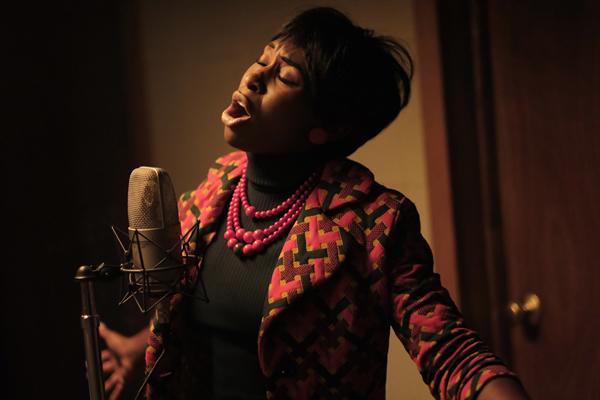
At long last, Celia Rose Gooding can talk about the “Star Trek: Strange New Worlds” Season 4 finale. And it’s a finale that belongs almost exclusively to her.
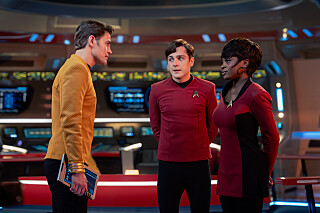
In the finale episode, now available to stream on Paramount+, communications officer Nyota Uhura (Gooding) comes face-to-face with an older version of herself.
In order to save Scotty (Martin Quinn), Uhura must uncover a mystery and confront the leader she was always destined to be.
It’s one step closer to “Strange New Worlds” closing the gap between “The Original Series,” where fans were first introduced to Uhura through Nichelle Nichols’s iconic performance back in 1966.
“We see them confront each other and love each other in a way that can only breed more self-acceptance, self-understanding and self-actualization, which is what fans have been hungry for this whole time,” Gooding says of Uhura’s interaction between past and future self.
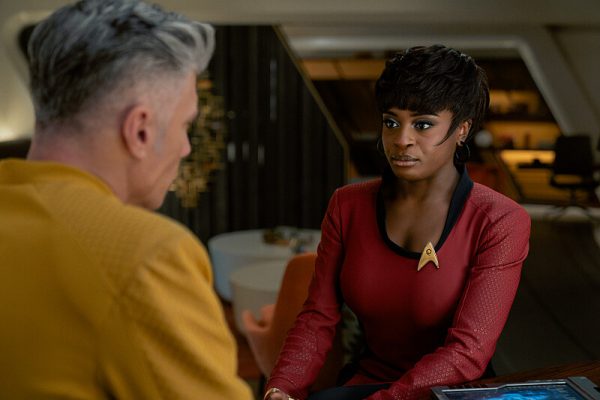
Gooding spoke with the Washington Blade to break down the emotional final episode, why she was hesitant to pay homage to Nichols’s beehive hairdo, and her hopes for the future of Black and queer representation on “Star Trek” amid the Paramount-Warner Bros. merger. This interview has been edited and condensed.
I know you’ve already finished filming the upcoming fifth and final season, so first of all, congratulations! This finale is such an exciting showcase for you. Can you break down this time travel twist and how you approached playing these two different versions of Uhura?
So much of what this episode meant to me was about honoring everything Uhura means — not just to me, but to Trekkies across the world, to people who’ve seen themselves in Uhura, and most importantly to Nichelle Nichols. I didn’t get the opportunity to meet her, although I’m desperate to have had that. But I think there’s something really special and unique about being able to have a conversation with a version of yourself that you no longer recognize in the past, and also a version of yourself that you do not recognize in the future. So much of the conversation between the two Uhuras in the beginning is filled with tension; they’re not super fond of each other just because they are so different. There’s so much growth and separation between their two mentalities. Given the stakes of the episode, “Strange New Worlds” is hearing things and is called on in a way that she does not understand. And so much of Uhura’s job, as a communications officer, is to understand — especially the things that she’s hearing, the conversations that are going on. When she is detached from that understanding, she’s left floating in this really uncomfortable space. The first thing that she can reach out and grab onto is something that should not be happening; she should not be able to speak to a version of herself that exists in the future. It breaks so many directives; she is breaking a lot of rules about time travel and temporal anomalies.
And then on the flip side, we have “TOS [The Original Series]” Uhura, who gets back on this mission, and something has gone terribly wrong. That tenacity, that perseverance, that reminiscent characteristic between both of these Uhuras is that they’re not going to give up. I love that in Uhura’s mind, if something doesn’t make sense to her, it’s because something is wrong. And not because she is incapable of understanding what’s happening; it’s that something has happened and it must be corrected. I love the confidence that we see in “TOS” Uhura of talking to her friends and crewmates and being like, “You aren’t listening to me. You need to listen to me!”
What was the most challenging part of playing these two parts?
The time jump between the two of them. Originally, it was three years, but now in the edit it’s just one. And playing “Strange New Worlds” Uhura, who knows all of this time has passed but doesn’t know what’s in it that makes her future self so unrecognizable — at first, I was trying really hard to make sense of that tension, trying to establish something. I kept coming up against the obstacle of, “How can I make this make sense?” Even when we only had 16 hours until shooting, I was down to the wire. I had conversations with director Chris Fisher, and he really implored me to not focus so hard on trying to make it make sense; the moment it makes sense is the moment we don’t have a story anymore. So much of the tension and conflict is that we don’t understand how this has happened; these two characters have to make it make sense together, and they do, because they always do! But it was a real challenge as an actor to live in that liminal, unknown, uncharted space and let that discomfort be the fuel for the engine that is the story. Even as I talk about it now, I fear that I’m not making any sense!
Finally, I think fans of Uhura have been so hungry for her to just inch closer and closer and close that gap, and I think while [the Season 4 finale] doesn’t completely close that gap all the way, we see them confront each other and love each other in a way that can only breed more self-acceptance, self-understanding, and self-actualization, which is what fans have been hungry for this whole time.
And you get to pay homage to Nichelle Nichols with that iconic beehive hairdo.
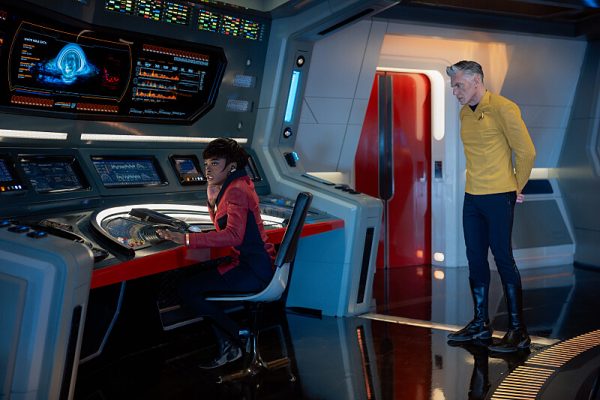
Story-wise, it was important for us to give the audience a way to immediately recognize who was talking because they’re both me, with my face. And it wasn’t just my hair that established the timeline change — it was the lighting, color grading, and everyone else’s different looks and costume changes. But the conversation around that iconic beehive- at first, I was a little resistant. I’m not gonna lie to you. I didn’t love the idea of recreating this iconic hairstyle because I have such admiration for Nichelle Nichols. God, I owe her so much for this era of my career. It is all thanks to her and what she has done, and so it felt like blasphemy, sacrilege. I was like, “I don’t know if this is right, guys; I think some things are just meant to be precious.” And then I saw it on camera, and I was like, “You know what? Maybe there’s a reason why they’re the showrunner, and maybe I should just do my part and let everybody else do their part.” It’s so recognizable, iconic, and immediately present.
I’m just filled with pride. I’ve been holding on to this episode for so long. I’ve been dying to talk about this episode because we shot it a year and four months ago, in June 2025. And I’m just really excited for fans to see it. It was a labor of love. It is an ode to Nichelle, but it’s also an ode to the version of Celia that said yes to playing Uhura because she had no idea what she was fucking in for. She had no idea, and just as Uhura held her hands and said, “You’re doing great,” I just want to hug that version of myself who was so hard on themselves, the same way the “Strange New Worlds” Uhura is, and just tell her to exhale and be like, “Baby, you got it. The hard part is behind you now. You get to just show up, do your job, and learn the lessons day-by-day.
As we’re celebrating “Star Trek”’s 60th anniversary this year, it’s been a moment to recognize the show’s diversity and inclusion. There are, naturally, some fears about what the future of the show will look like considering where the industry is going amid the Paramount merger. As a queer person, how do you feel about the potential for the show to continue embracing diversity and perspective?
I know my publicist is holding her breath right now! I am really excited to be surprised about the future of “Trek” because right now, realistically, there is no “Trek” in production. We have another season of “Starfleet Academy” to release, and another season of “Strange New Worlds” to release, and then it gets quiet for live-action “Star Trek.” I know there’s a Nickelodeon show coming; there’s a lot of animated “Trek” happening, but when it comes to Gene Roddenberry’s vision, I don’t know what the future holds. The unknown can mean so many different things, and I am really excited about what I’ve been able to donate to this franchise. I’m so excited about what it means as a dark-skinned, Black queer individual to exist in Trek, to have my vessel that Uhura lives on in, and what it means for me and my community.
I can’t imagine that “Strange New Worlds” is going to be the last of “Trek.” I hope that is not the case because “Trek” has done so much for how people think about the future and how people embrace the future. There is so much positivity and diversity embraced in “Trek,” and the world is only going to get more diverse, despite what the powers that be want you to believe. We’re not going back, and I am excited for “Star Trek” to continue to be at the forefront of the stories that are told about how we do not go back, about how we move forward and embrace each other and embrace the unknown, embrace the diversity of opinion and experience. I’m just really excited to be surprised. I want to wake up one day and be like, “I could never have imagined this for ‘Trek’!”

Tyler Clementi Foundation to host fundraiser in Rehoboth

Calendar: September 25-October 1

Former Capital Pride board member reiterates sexual harassment allegation

Grace Meng sharply criticizes DOJ over hospital settlements

‘Star Trek: Strange New Worlds’ star Celia Rose Gooding breaks down that finale time travel twist

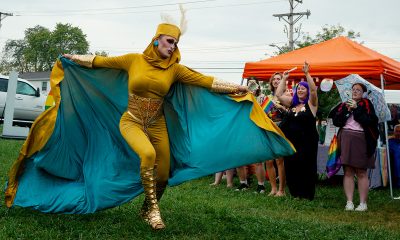
PHOTOS: Shenandoah Valley Pride

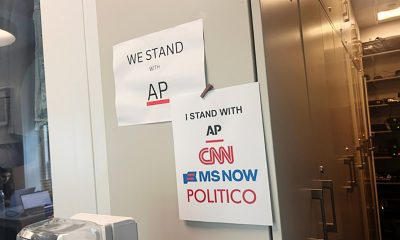
White House press pool pushes back after Trump bars three outlets

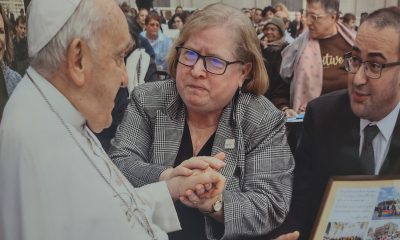
Long-time DignityUSA executive director announces retirement

For lesbian victims of domestic violence, competent care is scare

United States Conference on HIV/AIDS grapples with federal budget cuts
-

 Photos5 days ago
PHOTOS: Shenandoah Valley Pride
-
White House5 days ago
White House press pool pushes back after Trump bars three outlets
-
National5 days ago
Long-time DignityUSA executive director announces retirement
-
National4 days ago
For lesbian victims of domestic violence, competent care is scare