National
DENIED: White House says ‘no’ to ENDA exec order
Request for directive rebuffed at high-level meeting

The Obama administration has categorically denied requests from LGBT advocates to issue an executive order protecting LGBT people against workplace discrimination at this time, according to individuals who took part in a White House meeting on Wednesday. The denial was corroborated by a senior administration official.
In a statement to the Washington Blade, Joe Solmonese, president of the Human Rights Campaign and among the attendees, said advocates were told the administration won’t take action to bar federal contractors from discriminating against LGBT workers.
“Earlier today, we were told that the administration is not ready to move forward with a federal contractor nondiscrimination executive order at this time,” Solmonese said. “We are extremely disappointed with this decision and will continue to advocate for an executive order from the president. The unfortunate truth is that hard-working Americans can be fired simply for being gay or transgender. Given the number of employees that would be covered by this executive order, it represents a critical step forward.”
Solmonese continued that extensive research and polling has been done demonstrating that the executive order would be a useful tool and would enjoy broad support.
“Ten years of HRC’s Corporate Equality Index, as well as the research of our partner organizations to include the Center for American Progress and the Williams Institute, demonstrate that there is ample rationale for this kind of order,” Solmonese said. “No similar executive order has ever had this kind of extensive research or factual basis established. While we believe that further study is unnecessary, we will continue to engage with the Administration to ensure that the case is made even stronger for workplace protections.”
Shin Inouye, a White House spokesperson, said in a statement on the meeting that Obama remains committed to legislation that would bar workplace discrimination against LGBT people known as the Employment Non-Discrimination Act.
“The president is dedicated to securing equal rights for LGBT Americans and that is why he has long supported an inclusive Employment Non-Discrimination Act (ENDA), which would prohibit employers across the country from discriminating on the basis of sexual orientation and gender identity,” Inouye said. “The president is committed to lasting and comprehensive change and therefore our goal is passage of ENDA, which is a legislative solution to LGBT employment discrimination – just as the president pressed for legislative repeal of [‘Don’t Ask, Don’t Tell’].”
A senior administration official, speaking on condition of anonymity, also said the administration doesn’t expect to issue an executive order on LGBT non-discrimination for federal contractors at this time.
“We are deeply committed to working hand-in-hand with the LGBT community to enlist support from key stakeholders and other decision-makers, and to continue to engage with and educate the business community and the public more broadly about the importance of employment nondiscrimination and the importance of passing ENDA,” the official said.
Another attendee at the meeting, gay Democratic lobbyist Robert Raben, corroborated that advocates were told the executive order wouldn’t happen, but the goal of the meeting was more to explore ways that the administration could address workplace discrimination facing LGBT Americans — primarily through legislative means.
“For me, it was a conversation about very, very interested and committed people about what the administration could be doing to make the case for … protections of people in the employment context,” Raben said. “What could they be doing to get ENDA moving? What should they be studying and understanding and what data do they need? … So for me, it was less about the tactic of an executive order and more about can we figure out how to work together to get ENDA over the finish line?”
Raben continued he felt many advocates in attendance at the meeting “focused on an executive order,” but he doesn’t fall into that category.
“That’s not my position,” Raben said. “I don’t live and die on a particular tactic. I’ve been working on the Employment Non-Discrimination Act for 20 years in January. … I don’t get worried about a particular tactic, I’m worried about how we change people’s minds so the Chamber of Commerce isn’t ridiculous about it.”
Raben added he has no idea whether the Chamber of Commerce has weighed in on an executive order barring workplace discrimination against LGBT people.
Others in attendance at the meeting who issued statements saying the administration wouldn’t issue an executive order barring workplace discrimination against LGBT people were Carey and Stachelberg.
Since the executive order is similar in its goal to ENDA, the directive has sometimes been referred to as the “ENDA” executive order. However, the order would be more limited in scope because it only affects federal contractors. Multiple sources, speaking on condition of anonymity, have told the Blade the Labor and Justice Departments have cleared such a measure and it’s awaiting action at the White House.



New York
Judge blocks DOJ from obtaining transgender patients’ medical records
Advocacy groups sued White House
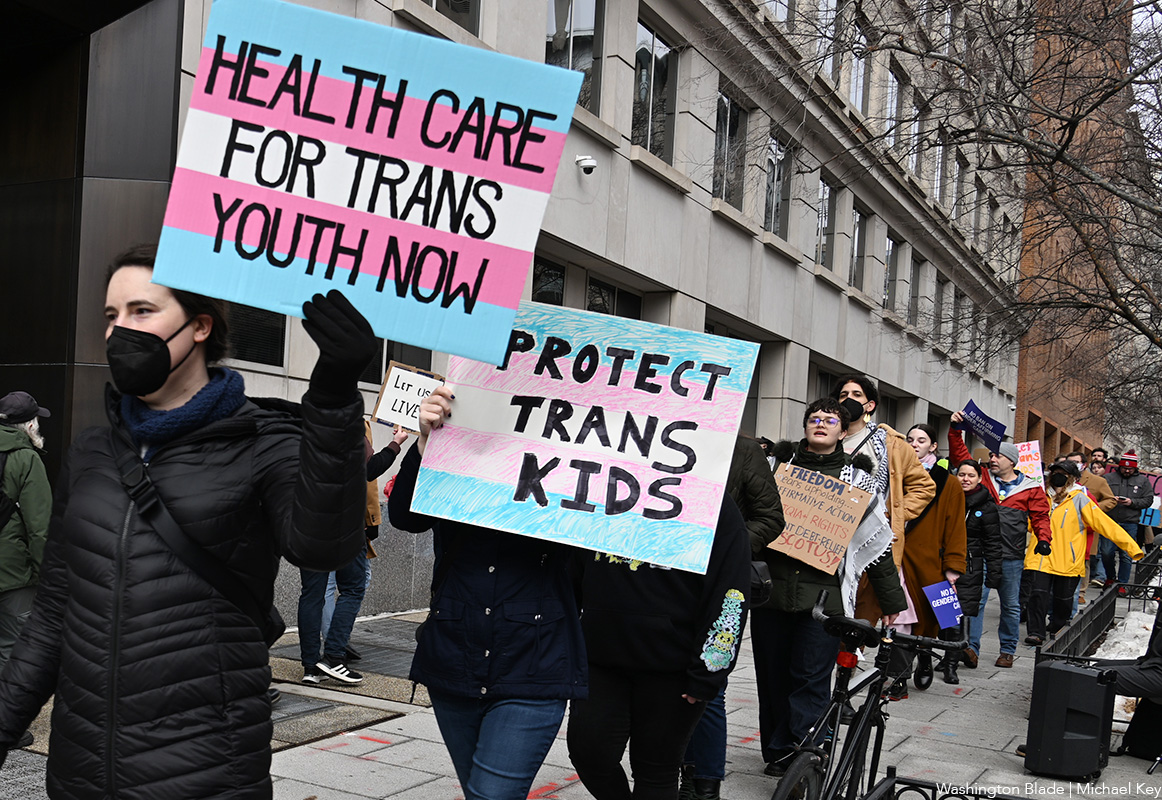
A judge for the U.S. District Court for the Southern District of New York has granted a request from multiple transgender people for a temporary restraining order, blocking the disclosure of plaintiffs’ and class members’ medical information to the Justice Department.
Judge Katherine Polk Failla approved the Temporary Restraining Order and Provisional Class Certification, preventing any further information from being provided to the Trump-led DOJ.
The medical data was requested through subpoenas issued by the Trump-Vance administration’s DOJ to multiple hospitals in New York City — most notably NYU Langone — which halted its Transgender Youth Health Program in May following a federal push to stop providing trans minors with gender-affirming care.
In May 2026, NYU Langone Hospitals received a subpoena from a federal grand jury in Fort Worth, Texas, demanding that the hospitals turn over the identities and sensitive health information of any patient who had received medical treatment for gender dysphoria while under the age of 18 at NYU Langone between January 2020 and May 2026.
Lambda Legal, the American Civil Liberties Union, and the New York Civil Liberties Union filed a lawsuit, “Coe, et al. v. Blanche, et al.,” against the Trump-Vance administration on behalf of three families with trans youth and two trans young adults who were minors when they began care, in June 2026.
The lawsuit requests a temporary restraining order blocking the DOJ from violating the patients’ constitutional privacy rights by obtaining identifying and sensitive health information as part of its investigation into unspecified health offenses. The DOJ issued subpoenas to NYU Langone and other similar healthcare institutions in New York City, including Mount Sinai, that provide or have provided gender-affirming medical care to trans minors. All plaintiffs have filed under pseudonyms to maintain their privacy and anonymity.
Multiple leaders of organizations that helped push for the restraining order provided quotes about the ongoing situation and what it means for the fight for trans children’s access to healthcare in the U.S.
“Today’s order from the court is a victory for the basic privacy of our clients and all families like theirs across New York City. It is no secret that this administration will use every lever in its power to attack transgender people and fulfill its misguided goal to ‘end’ gender-affirming medical care — care that is legal and protected in New York State. Using subpoenas to attain the identities and sensitive health information of transgender young people to effectuate such goals should send chills down the spine of every American. Our laws and our Constitution recognize that we all have a right to confidentiality about the most intimate and private information about ourselves,” said Omar Gonzalez-Pagan, senior counsel and health care strategist at Lambda Legal. “Whether a young person receives any type of medical care is a decision for that patient, their family, and their doctor, not for political appointees to decide, interfere with, or know. The government cannot abuse its powers to violate the constitutional rights of transgender young people and their families. It is an enormous relief for these families that the court has stopped them from doing so as this case proceeds.”
“We’re thankful the court has granted our emergency request to protect the privacy interests of transgender New Yorkers and their families,” said Chase Strangio, co-director of the ACLU’s LGBTQ & HIV Rights Project. “Patients and families trust their doctors with their most intimate, private information and should trust in turn that this information will be protected from impermissible and harassing demands for disclosure from the federal government or anyone else. For the past year, the Trump administration has not only decided that it knows better than these families and their doctors what their medical needs are, but has also sought to obtain troves of sensitive information about patients in New York. We will continue to fight on behalf of these families and the fundamental liberty of all transgender New Yorkers and those who come here to seek needed medical care.”
“New York’s laws recognize that transgender youth deserve fundamental privacy protections for their sensitive medical records and unobstructed access to the care they need,” said Bobby Hodgson, deputy legal director at the New York Civil Liberties Union. “As the Trump administration tries to bully transgender youth, scare families, and intimidate healthcare providers into dropping their patients, we’re thankful the court found these tactics are likely unconstitutional and put a stop to them here in New York.”
Federal Government
Trump holds housing bill hostage to anti-trans SAVE Act
President’s SAVE Act failed in the Senate
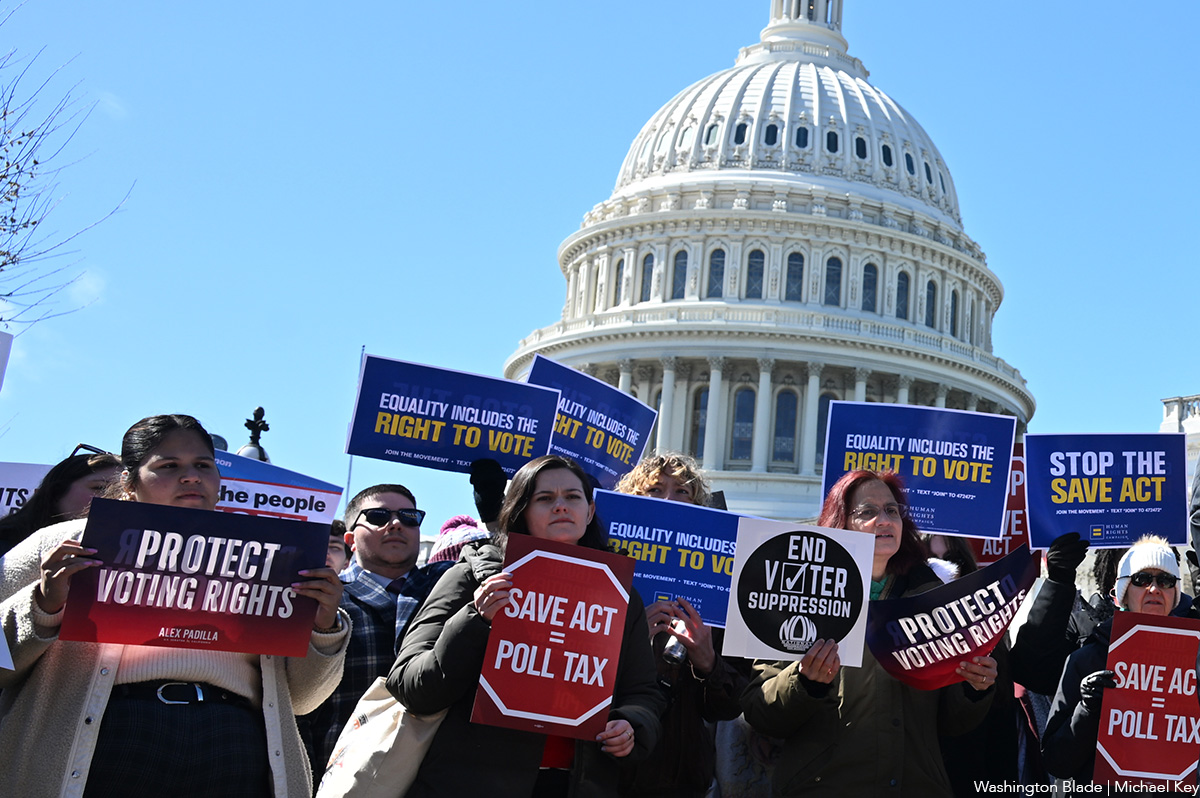
President Donald Trump is refusing to sign a new bipartisan housing bill unless his SAVE Act is approved by the legislative branch.
The bill being prevented from being enacted into law is the “21st Century ROAD to Housing Act.” The legislation is an attempt by Congress to make buying a home in the U.S. Senate more affordable in response to various factors — including housing shortages and regulatory constraints — that have made homeownership increasingly difficult. The total number of homeowners has nearly stopped growing, with high interest rates and surging home prices pushing more Americans toward renting.
The housing bill was considered highly bipartisan, something that is rare in this Congress. The House voted to pass the bill 358-32 on Tuesday after the Senate approved the measure 85-5 a day earlier. The legislation was led by U.S. Sens. Elizabeth Warren (D-Mass.) and Tim Scott (R-S.C.) in the Senate and U.S. Reps. Maxine Waters (D-Calif.) and French Hill (R-Ark.) in the U.S. House of Representatives.
Some of the highlights of the legislation are aimed at increasing the supply of affordable housing while making homeownership more accessible. The bill would streamline environmental reviews and direct the U.S. Department of Housing and Urban Development to provide guidance to communities on reforming zoning and land-use policies that can create barriers to housing development.
The legislation would also expand the definition of “manufactured housing,” making it cheaper and easier to mass-produce homes built in factories before being transported to their sites. To encourage additional development, the bill would provide grants and loans for the construction of new housing, the rehabilitation of aging properties, and the conversion of vacant buildings into residential units. It would also increase certain banks’ Public Welfare Investment cap, allowing them to direct more capital toward low-income and affordable housing projects.
In an effort to help more Americans purchase homes, the legislation would create a program to expand access to small-dollar mortgages, which are often used to finance lower-cost homes, while also seeking to improve housing opportunities for veterans. The bill would further promote homeownership by limiting the number of single-family homes that large institutional investors can own and requiring them to disclose how many such properties they control, a measure intended to prioritize American families over corporate buyers.
The bill the president wants enacted — the SAVE Act — is a restrictive and anti-transgender piece of proposed legislation.
The bill would impose a number of new limitations on voter registration across the country by amending the National Voter Registration Act of 1993 to require in-person proof of citizenship for anyone seeking to vote in U.S. elections. The bill would also limit acceptable forms of identification to documents such as a birth certificate or passport — records that the Brennan Center for Justice estimates more than 21 million Americans do not possess — effectively restricting access to the ballot. It would also ban online voter registration, DMV voter registration efforts, and mail-in voter registration.
Trump pushed for the SAVE Act to include a provision that would ban gender-affirming medical care for trans minors, even with parental consent, and prohibit trans people from participating in school or professional sports consistent with their gender identity rather than their sex assigned at birth.
Trump also pressed Senate Majority Leader John Thune (R-S.D.) to eliminate the filibuster so the Republican-controlled Congress could pass the SAVE Act, saying Republicans will never win another election without it.
It is expected that Congress will override the president’s veto and pass the 21st Century ROAD to Housing Act, as it requires a two-thirds supermajority vote in both the House of Representatives and the Senate — a threshold the legislation currently exceeds.
It is not expected that the SAVE Act will pass the Senate in its current form. It passed the House, but every Democrat and four Republicans voted against it in the Senate.
New York
N.Y. governor’s race presents stark contrast on LGBTQ rights
Democratic Gov. Kathy Hochul expected to face Republican Bruce Blakeman

As states across the country grapple with a rapidly changing federal landscape under President Donald Trump, governors have increasingly become the first line of defense — or enforcement — on issues ranging from healthcare and education to LGBTQ rights.
Nowhere is that more apparent than in New York, Trump’s home state, where the 2026 gubernatorial race is shaping up as a high-profile battle over the future of LGBTQ protections.
Incumbent Democratic Gov. Kathy Hochul is seeking a second full term as New York’s 57th governor and the state’s first female governor. She enters the race with strong support from LGBTQ advocates and organizations, including an endorsement from the Stonewall Democrats of New York City. Earlier this year, Hochul was also endorsed by progressive leaders like New York City Mayor Zohran Mamdani and U.S. Rep. Alexandria Ocasio-Cortez. She is running alongside New York City Council Speaker Adrienne Adams as her lieutenant governor candidate.
Throughout her tenure, Hochul has signed a series of measures aimed at strengthening protections for LGBTQ New Yorkers, particularly transgender residents.
Among the most notable is New York’s “Trans Safe Haven Act,” which protects out-of-state trans youth, their parents, and medical providers who travel to New York to access legally protected gender-affirming care. Hochul has also signed legislation requiring health insurance plans to cover HIV prevention medications, including PrEP and Post-Exposure Prophylaxis (PEP), without out-of-pocket costs.
Additionally, Hochul signed a Long-Term Care Bill of Rights that prohibits discrimination against LGBTQ seniors and people living with HIV in long-term care facilities.
“As the birthplace of the LGBTQ+ rights movement, New York has long been at the forefront of advancing equality,” Hochul said in a statement during Pride month. “During Pride month, we celebrate New York’s vibrant LGBTQ+ community and acknowledge the importance of protecting the rights and freedoms of LGBTQ+ New Yorkers. This month and every month, we proudly stand with the LGBTQ+ community and remain committed to building a more inclusive and equitable future for all where everyone can live freely with dignity, safety, and respect.”
On the Republican side, Nassau County Executive Bruce Blakeman has emerged as the party’s leading candidate. Blakeman is running with Madison County Sheriff Todd Hood as his lieutenant governor pick.
Blakeman, Nassau County’s 10th county executive, was first elected in 2021 after defeating Democratic incumbent Laura Curran. He previously served as a commissioner of the Port Authority of New York and New Jersey, a Nassau County legislator, and a Hempstead town councilman.
A longtime supporter of Trump, Blakeman appeared alongside the president during a 2024 event honoring slain NYPD Officer Jonathan Diller.
LGBTQ advocates have frequently criticized Blakeman for his positions on trans issues, particularly his opposition to trans women participating in women’s sports.
In February 2024, Blakeman signed an executive order barring women’s sports teams that include trans women from using Nassau County athletic facilities. The policy applies to youth, collegiate, and professional teams. Teams that include trans men were not affected. The order has since been halted by the New York State Appellate Division swiftly issued an injunction halting enforcement while the plaintiffs appeal the decision
Ahead of announcing the order, Blakeman repeatedly referred to trans women as “biological males” and argued they should compete on men’s or co-ed teams. LGBTQ rights groups condemned the policy, saying it discriminates against trans athletes and contributes to the marginalization of trans youth.
Trump endorsed Blakeman’s gubernatorial campaign in December 2025, shortly after U.S. Rep. Elise Stefanik (R-N.Y.) announced she would not seek the Republican nomination. The president made his endorsement via Truth Social that “Bruce is MAGA all the way, and has been with me from the very beginning.”
The Washington Blade contacted Blakeman’s campaign seeking comment on his LGBTQ policy priorities and views on issues including nondiscrimination protections, trans rights, and healthcare access. The campaign did not respond.
The race highlights two sharply different approaches to LGBTQ policy in a state widely regarded as the birthplace of the modern LGBTQ rights movement, home to the 1969 Stonewall uprising that helped launch the contemporary movement for LGBTQ equality.
Despite the ideological contrast, early polling suggests Hochul remains the clear favorite. Most public surveys show the incumbent holding a double-digit advantage over her potential Republican challengers, with some polls placing her lead at roughly 20 percentage points ahead of the November election.

Eswatini’s government ordered to allow LGBTQ group to legally register

Does Pride decor resemble Trump’s design aesthetic?

Nearly 6,000 turn out for Pride Night Out at the Nationals

White House to end PEPFAR funding for South Africa