Local
Mendelson elected interim Council Chair
Pro-gay Councilman will run in November special election

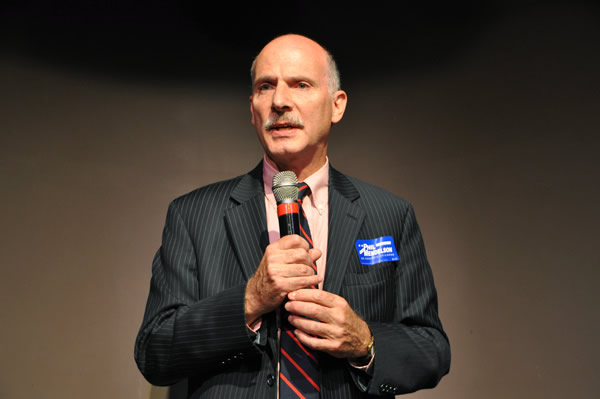
Phil Mendelson (Blade file photo by Michael Key)
Members of the D.C. City Council on Wednesday elected fellow Council member Phil Mendelson (D-At-Large) as interim chair of the Council until a special election to fill the chairperson’s seat on a permanent basis is held in November.
Mendelson, who played a lead role in the Council’s 2009 approval of the city’s same-sex marriage law, has said he will run in the special election to become the Council’s permanent chair.
The Council’s selection of Mendelson for the interim post came after Council member Kwame Brown (D-At-Large) resigned as the chairman last week, one day after pleading guilty to felony bank fraud.
At its special meeting Wednesday, the Council also voted to elect Council member Michael Brown (I-At-Large) as interim Council President Pro Tempore, a mostly ceremonial position that places Brown third in line to become mayor in the event that Mayor Vincent Gray should resign.
As interim Council Chair, Mendelson is second in line to become mayor.
Michael Brown, like Mendelson, has been a longtime strong supporter of LGBT rights.
The Council picked Michael Brown over Council member Vincent Orange (D-At-Large), who entered the race for the President Prop Tempore post, by a vote of 8 to 4. Orange initially said he would challenge Mendelson for the interim Council chair position, but on Wednesday he chose to compete for the President Prop Tempore position instead.
Mendelson, meanwhile, will remain as chair of the Council’s Judiciary Committee, which has jurisdiction over the D.C. Metropolitan Police Department and which has monitored the police response to anti-LGBT hate crimes. He will also assume the chairmanship of the Council’s Committee of the Whole, which traditionally is headed by the Council chair.
LGBT political activists have joined others in the community in watching with great interest whether an ongoing federal investigation into alleged illegal campaign practices in Gray’s 2010 mayor election campaign will implicate Gray, who has denied any wrong-doing. Two high-level officials in the Gray campaign have pleaded guilty in recent weeks to campaign related violations.
City Hall observers expect other Council member and non-Council members to run in the special election for the Council chair post, most of whom are likely to be supporters of the LGBT community.
Similar to past elections, LGBT advocates may be forced to choose among friends in determining who to endorse in the special election. The Gertrude Stein Democratic Club, the city’s largest LGBT political group, and Log Cabin Republicans of D.C., a gay GOP group, are expected to become engaged in the special election.



Delaware
Del. AG Jennings seeks third term touting LGBTQ support, decline in crime
‘To discriminate against trans children is child abuse’
(Editor’s note: This is the second of a two-part report on the race for Delaware attorney general. For last week’s interview with Democratic candidate Dwayne Bensing, visit washingtonblade.com.)
Delaware Attorney General Kathy Jennings spoke to the Washington Blade to discuss why she should be elected to a third term.
Born and raised in Wilmington, Del., Jennings’ career in criminal prosecution spans decades. Prior to being sworn in as Delaware’s attorney general in 2019, Jennings worked as a prosecutor under the Delaware Department of Justice for years before being named Delaware State Prosecutor.
As a prosecutor, Jennings worked to convict the serial killer responsible for the murders of five women in New Castle County. This case was the first that DNA analysis was used as evidence in a Delaware court.
“My focus for years has been reducing violent crime in our state, in particular gun violence. Over the course of my tenure, we have seen a dramatic drop in violent crime,” said Jennings.
According to the Criminal Justice Council, under Jennings’s leadership in 2024, Delaware saw its lowest violent crime rate on record.
“We are seeing violent crime going down to historic lows in the state of Delaware, and in particular in our largest city, the city of Wilmington,” said Jennings.
At the end of 2023, homicides had decreased in Wilmington by more than 50% and shootings in Dover had declined by 23%. Additionally, the state’s prison population fell by nearly 25% since 2019 and the recidivism rates declined by 60%.
Jennings explained “This job takes commitment, dedication, and lots of experience in the criminal justice system, because it’s our job to make sure that the criminal justice system is fair and equal to everyone.”
Within her efforts to reduce violent crime, Jennings said that she has especially focused on fighting gun violence.
“I have made a priority in my administration to go after the gun lobby and to make sure that the state of Delaware has gun safety laws that are effective in reducing violent crime and that also are effective in protecting people, most especially our children,” she said.
“The No. 1 cause of death for children in our country are guns, and as long as that’s the case, my work is not done,” she added.
Jennings said that she wants to protect children in particular from gun violence and that this fight remains a work in progress.
“We are beating the gun lobby in the legislature and in the courts, and we are seeing dramatic results in terms of reductions in gun violence that takes a lot of work that is ongoing,” said Jennings.
Fighting the Trump administration remains an integral part of Jennings’s work as attorney general, as she has sued the Trump administration more than 40 times.
“The Trump administration’s lawsuits could have cost Delaware almost a billion dollars in federal funds if we had succumbed to their extortionist threats, and we didn’t do that.” said Jennings.
“We sued opioid manufacturers and distributors, getting $250 million to this state to fight addiction as a result of that. We will continue to do all the work that Delawareans expect us to do,” said Jennings.
“We’re successful, and we’re going to continue to be successful,” Jennings said regarding her legal battles with the Trump administration.
In terms of support for the LGBTQ+ community, Jennings has previously sued HHS for discriminating against transgender Delawareans.
Last summer, Jennings sent a letter to Nemours Children’s Hospital imploring them to reconsider its decision to stop providing gender-affirming care services to new transgender youth patients. Her primary opponent, Dwayne Bensing, criticized this letter for not being strong enough in protecting the trans community.
The Blade asked Jennings about how she plans to continue to be an ally to the LGBTQ+ in a third term. She responded by saying: “We need to keep fighting to ensure that there are constitutional amendments that further protect children and protect marriage equality in our state, and we’re fighting to make sure those amendments are on the way.”
“To discriminate against trans children, in my mind, is child abuse. That’s what we’ve been fighting in the courts,” said Jennings.
Jennings emphasized the importance of protecting LGBTQ+ youth by noting, “Our children deserve an environment where they are treated with compassion and equality.”
“It’s going to take a very strong attorney general who knows what she is doing to continue this fight,” said Jennings.
The Blade also asked Jennings about her oversight of the restructuring of OpenAI. Originally founded as a nonprofit corporation in Delaware in 2015, OpenAI announced its goal to transition to a for profit corporation in May of 2025.
“It is the duty of the attorney general to ensure that a corporation is fulfilling its charitable purpose,” said Jennings. “OpenAI’s charitable purpose is to use it to benefit all of humanity. That’s a big mission.”
Jennings worked closely with California Attorney General Rob Bonta to oversee OpenAI’s transition from nonprofit to for profit.
“We got deeply involved in Open AI’s restructuring process to make sure the charitable corporation would be capitalized well to fulfill their mission of benefiting humanity and that they would prioritize safety. Those two goals were achieved.”
The restructuring process was approved by Jennings and Bonta in October of 2025. They appointed three independent directors to oversee OpenAI’s actions. “These three are independent directors who report to us several times a year,” said Jennings.
“We achieved a far superior result, because we are in the boardroom, we’re able to see what [OpenAI] is doing.”
“We have the full ability to go after OpenAI if they don’t fulfill our urges and we get the ability to oversee them on an ongoing regular basis,” said Jennings.
Jennings reiterated her desire to continue her work as attorney general: “These fights have to continue uninterrupted by people who know what they’re doing.”
“It is an honor and a privilege to have been voted in by Delawareans these last two terms, and I’m asking them to put me in again. I’m fighting hard,” said Jennings.
The primary election for Delaware attorney general is Sept. 15.
District of Columbia
New report says LGBTQ young adults in D.C. facing affordability crisis
79 percent of respondents reported difficulty paying rent or mortgage

A newly released report on the findings of a survey of 304 LGBTQ young people aged 18-30 who live in D.C. shows as many as 79 percent of those surveyed report they are struggling to pay rent or a mortgage.
The report, entitled Out and Counted: 2026 LGBTQ+ Young People Community Survey Findings, also shows at least 80 percent of those surveyed “feel isolated often or some of the time” and their reported use of tobacco-nicotine products, alcohol, and marijuana was “significantly higher” than that of the general adult population.
“Nearly one third of respondents have considered leaving the District, driven by housing insecurity,” the report says.
The survey and report were prepared jointly by the D.C.-based Wanda Alston Foundation, which provides housing and other support services for at-risk and homeless LGBTQ youth, and the Los Angeles-based Loyola Marymount University’s LGBTQ+ Politics Research Initiative.
The report says the LGBTQ young people completed the detailed survey in March and April of 2026 “thanks to multiple outreach strategies, including paid digital ads, in-person outreach, and other communication channels.”
Cesar Toledo, executive director of the Wanda Alston Foundation, said the survey included as many as 80 questions and a number of local LGBTQ organizations helped in arranging for the young people to take the survey.
“These findings suggest the District’s LGBTQ+ young people are being pushed to the brink,” Toledo said in a statement released by the Alston Foundation. “They are working hard, yet hitting an affordability cliff, deepened by a loneliness paradox and alarming health-risk behaviors,” he said.
He added, “To ignore these findings is to accept a ‘Queer Flight’ that will displace our LGBTQ+ community and drain the very lavender economic engine that Wells Fargo once famously noted as a secret sauce to economic growth.”
Gabriel Magni, associate professor of political science and Director of the LGBTQ+ Politics Research Initiative at Loyola Marymount University, said in the statement that the survey finding indicate that LGBTQ young people can be priced out “traditional LGBTQ+ hubs” that have historically been important in advancing LGBTQ equality.
“These findings raise serious concerns regarding affordability and the mental health of LGBTQ+ youth in a city that has long welcomed the LGBTQ+ community,” he said in the statement.
The report says about 41 percent of the survey respondents identified as gay, 17 percent as lesbian, 16 percent as bisexual, 14 percent as queer, 8 percent as pansexual, 1 percent as asexual, and 1 percent as demisexual.
The full report can be accessed here.
District of Columbia
Capital Pride draws tens of thousands to D.C.
Revelers lined 14th Street for parade, festival took place on Pennsylvania Avenue.

Tens of thousands of people gathered across D.C. over the weekend as Capital Pride celebrated its annual Pride festivities with a parade, festival, concerts, parties, and community events centered on the theme “EXIST. RESIST. Have the Audacity!”
Although the events took place a week later than usual due to America 250 celebrations the week prior, crowds turned out in force to celebrate Pride month and the LGBTQ community.
The weekend began with the Crack of Noon Parade Brunch, where awardees were recognized and parade grand marshals David Archuleta and Monroe Alise mingled with attendees. Honorees included D.C. Del. Eleanor Holmes Norton, D.C. Mayor Muriel Bowser, Benjamin Coy, Charity Blackwell, Darryl Hamilton, Thea Kano, Kendall Martinez-Wright, Lee Levingston Perine, Dylan Drobish, Tyler Hack, Patrick Magee, Judy Schloss, Darrell Wood, Tyler Cargill, and Dai Nguyen.
Saturday’s Pride parade kicked off at 3 p.m., drawing large crowds along 14th Street, N.W.
Floats, cheerleaders, marching bands, and performers entertained attendees as they made their way through the city. The Canadian Embassy’s float featured cardboard cutouts of characters from “Heated Rivalry,” while others sprayed water into the crowd to provide relief from the summer heat.
Attendees of all ages lined the streets, with children reaching for bracelets, candy, and bubble wands tossed from parade participants. Pride flags waved throughout the crowd, and businesses along the route decorated storefronts in celebration. Others watched from balconies and rooftops overlooking the parade.
The parade also remembered SaVanna Wanzer, a lifelong D.C. resident who passed from natural causes on April 24. Wanzer was a longtime advocate for LGBTQ rights, specifically transgender rights, in the community, creating her own celebrations and organizations over the years. Multiple floats featured framed photos and flowers in her honor.

Following the parade, thousands gathered at the 17th Street Block Party, presented by Absolut Vodka. The event featured performances by DJs Bruno and Lauren, and Citrine the Queen as attendees danced and celebrated into the evening.
Earlier in the day, younger attendees participated in family-friendly activities at Stead Park, including glitter tattoos, hair tinsel, crafts, and other activities before heading to the parade.
Celebrations continued throughout the night with events including RIOT! The Official Parade Opening Party, featuring headliner Myki Meeks, as well as ELIX-Her and KINETIC: Toyland. Across the city, LGBTQ community members and allies gathered for parties and nightlife events that extended well into the evening.
The festivities continued Sunday with the Capital Pride Festival and Concert.
Hundreds of vendors lined the festival along Pennsylvania Avenue, N.W., offering everything from handmade crafts and leather goods to nonprofit fundraising opportunities and political initiatives. Attendees browsed booths, enjoyed food and drinks, and spent the afternoon exploring the festival.
The main concert featured performances by Maren Morris, queer rapper Leikeli47, Lisa Lisa, “Heated Rivalry” DJ Harrison, Tracy Young, and Meeks. Additional performances took place at the Monument Stage and Dupont Dance Stage.
The Monument Stage featured DJ Jerry’s Dance Party, DC’s Different Drummers, and Vagenesis, while the Dupont Dance Stage hosted a variety of DJs and provided space for attendees to dance throughout the day.
While much of the weekend focused on celebration and joy, organizers said this year’s theme, “EXIST. RESIST. Have the Audacity!,” reflected both the resilience of LGBTQ people and the challenges the community faces, and speakers emphasized Pride’s roots in activism and community.
“Grounded in the undeniable truth that our existence is not up for debate, this year’s theme calls on the community to live loudly and proudly, stand firm against injustice and erasure, and embody the collective strength that has always defined the LGBTQ+ community,” said Capital Pride Alliance in a statement.
According to the American Civil Liberties Union, there are 530 anti-LGBTQ+ bills across the U.S. that have been introduced this year. While 333 have been defeated, 93 are advancing in their legislature, and 33 have been passed into law or will soon be.
The U.S. Supreme Court is currently in the process of deliberating on the topic of trans athletes in college-level sports, and recently supported a case allowing for what is considered so-called conversion therapy under Colorado law. At a time when support for the LGBTQ community seems to be fading, the message from the Capital Pride Alliance is a reminder that Pride began as a protest.
Earlier Sunday at the main concert stage, Rayceen Pendarvis addressed attendees, speaking about the ongoing work required to create change and the importance of perseverance.
“I leave you with the words of Angela Davis: ‘I am no longer accepting the things I cannot change, I am changing the things I cannot accept,’” Pendarvis said.
Pendarvis has a legacy in D.C. for fighting for change, emceeing LGBTQ events, and using her strengths, as she refers to herself as a “queer elder,” to be able to use her experience and wisdom to push her community in the direction she wishes to see it go.
“Love is also the greatest gift we have. You are the light that outweighs the darkness,” Pendarvis said.
She then asked attendees to turn to someone they did not know, hug them, and tell them they loved them. The crowd responded by embracing one another in a moment that reflected the sense of community that defined the weekend.
Dupont Circle once again fenced off during Pride
The celebrations unfolded amid renewed attention on Dupont Circle.
The National Park Service closed Dupont Circle Park from June 19 through June 22 at 6 p.m., citing public safety concerns. According to NPS, the closure was intended “to provide for public health and safety and protect natural and cultural resources in Dupont Circle Park.”
The weekend was largely free of major incidents.
However, a shooting occurred Saturday night near the 900 block of Florida Avenue, N.W., near the U Street Corridor shortly after 10 p.m. Two men sustained non-life-threatening injuries. Authorities have not indicated any connection between the shooting and Pride events.
The weekend concluded with the “Capitol” Sunset Party, providing a final celebration for attendees as another year of Capital Pride festivities came to a close.

African leaders once again trade African family values for American family values

Television loses a legend, longtime ‘Will & Grace’ director James Burrows

Del. AG Jennings seeks third term touting LGBTQ support, decline in crime

Nepalese Supreme Court issues landmark marriage equality ruling

New report says LGBTQ young adults in D.C. facing affordability crisis

Delaware guv signs bill to protect children born using assisted reproduction

Minor league team in York, Pa., forfeits Pride Night game after some players refuse to wear special jersey

My trans daughter thrived in Chicago public schools

‘Stop! That! Train!’ is made for fans, but fun for all

‘Mani Fiesta tu Orgullo’: memoria, resistencia y celebración marcan inicio del Mes del Orgullo en El Salvador
-

 Delaware5 days ago
Delaware guv signs bill to protect children born using assisted reproduction
-
Sports5 days ago
Minor league team in York, Pa., forfeits Pride Night game after some players refuse to wear special jersey
-
Opinions5 days ago
My trans daughter thrived in Chicago public schools
-
El Salvador5 days ago
‘Mani Fiesta tu Orgullo’: memoria, resistencia y celebración marcan inicio del Mes del Orgullo en El Salvador