Opinions
Time to fix D.C.’s liquor licensing mess
Hank’s Oyster Bar battle illustrates need for regulatory reform

It’s a pity that hearings conducted by the D.C. Alcoholic Beverage Control (ABC) Board are not videotaped.
If they were, every D.C. Council member and the mayor could be strapped in chairs and forced to view the entire mind-numbing 4-1/2 hour alcohol licensing protest hearing held last week that proved to be a stunning illustration of what is wrong with the city’s current regulatory process. District elected officials would eyeball firsthand the mess they have allowed to plague restaurant and bar alcohol licensing procedures for far too long.
The infamous seven-year battle waged by a group of only six Dupont Circle area objectors against respected and award-winning restaurant Hank’s Oyster Bar exemplifies problems inherent in the current licensing system. The popular neighborhood business operated by lesbian chef-owner Jamie Leeds, located adjacent to the corner of 17th and Q streets, was forced to close half of its outdoor patio beginning on the day the recent Capital Pride parade floated by due to the relentless efforts of the required “gang of five or more” license protesters.
At the hearing on June 13, the protagonists in this infuriating tale awkwardly hemmed and hawed on the witness stand as they were repeatedly unable to explain to the board why they had been unresponsive to multiple entreaties by Leeds to meet in early 2010 to discuss the restrictions of a so-called “Voluntary Agreement” they forced upon the business in 2005. Incredulously, they cited only a claim nowhere in evidence for a demanded “Powerpoint presentation” on all details prior to even agreeing to talk.
The original operating restrictions, including seating capacity limits, had allowed the highly anticipated restaurant to finally open but subsequently prevented the opportunity to expand into an adjacent vacant space unexpectedly made possible by modifications to an area licensing moratorium. Leeds had little choice but to seek relief through termination of the agreement, eventually granted later that year.
The latest hearing was required by a May 17 District Court of Appeals remand of the issue for additional ABC Board review resulting from a lawsuit initiated by the protesters. The appeals court ruled that the board had not considered all elements required for a “Voluntary Agreement” termination, acknowledging confusion originating with poorly constructed regulatory language.
Discerning the group’s motivation for intransigence is easy. Obstinacy had conveyed to them inordinate power in years past. If they simply refused to meet, what could the business do? The tiny group understood that, once again and as bestowed by city rules, they held all the high cards.
The questions are simple: How much longer will elected officials permit small and unrepresentative groups to unfairly derail the licensing process and abuse the system? When will city leaders reserve community input to the open and accessible public forum provided by the elected Advisory Neighborhood Commission (ANC) accountable to all residents? Does the District government possess the common sense to put a stop to out-of-balance procedures thwarting local amenities and community small businesses fueling the city’s signature hometown hospitality economy?
As it stands now, small ad hoc groups comprised of only five individuals and self-identified commonly unrepresentative citizens groups – some formed primarily to interject themselves into licensing matters – utilize outsized abilities to delay or deny alcohol licensing approvals or force licensees into signing restrictive “Voluntary Agreements” to survive.
Reforming this madness should be a top priority for Jim Graham, who chairs the Council committee with oversight of alcohol licensing, along with his colleagues and the mayor. Instead of kowtowing to the loud voices of the few, it’s time for Graham to step up and put an end to these ridiculous city rules.
Jack Evans, representing the midtown commercial district stretching from Georgetown to the U.S. Capitol with the largest number of alcohol-licensed businesses, also has a responsibility to initiate reform of current archaic procedures. As Committee on Finance and Revenue chair, he should understand the importance of common sense and fairness in managing local economic development and reaping the revenues generated by the city’s largest private sector business segment.
As both politicians know from the avalanche of correspondence they have received in recent days, concerned constituents are awaiting action.
Council members Graham and Evans, it’s time to fix this folly.
Mark Lee is a local small business manager and long-time community business advocate. Reach him at [email protected].




Opinions
My trans daughter thrived in Chicago public schools
Washington wants to make that impossible
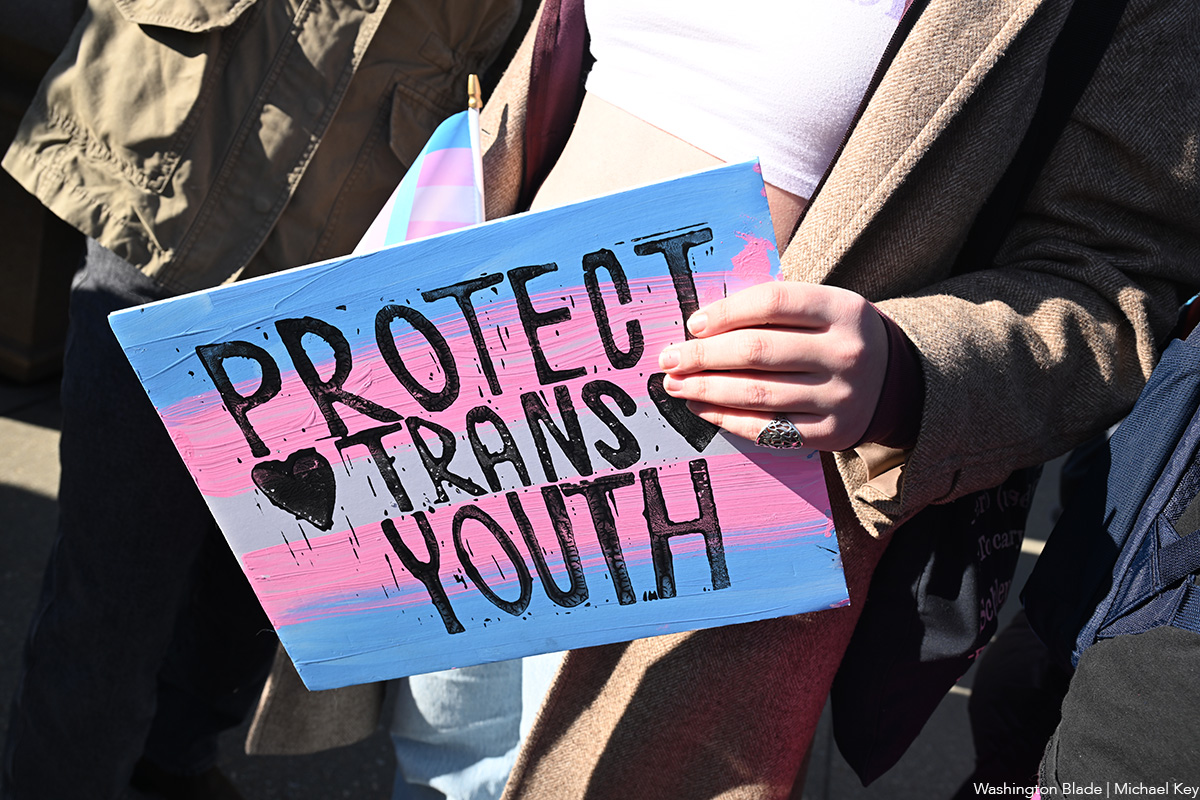
I am a Chicagoan whose daughter is transgender. But that is not the most important fact about her. My daughter loves fashion, sings in choir, is active at church, and is, by every measure, your classic American teenager.
Yet it is her gender identity that politicians in Washington have once again decided to make their business.
She’s had the benefit of attending school in a district that affirms her, with educators who have added protections for students like her to a contract, in a city that benefits from and believes in diversity.
If the Republican-led Congress that is subpoenaeing the CEO of Chicago Public Schools truly was interested in “inappropriate content” and its impact on students, they would start with the anti-trans state legislation that increases youth suicide attempts by 72%, not the school districts making them feel safe and welcomed. Protecting these kids in school is not a culture war talking point. It is suicide prevention.
But that is not what they are doing. Instead, they are calling to question the head of a school district where Chicago’s values have made our schools safer places for students of every gender, race, and nationality.
The same administration that has yet to investigate the Epstein files but is moving the FCC to put warning labels on television shows that portray inclusive families and characters of different sexualities, is telling on itself in what they think is permissible and what they think is harmful for school-age youth. They say this is about parental rights and children’s well-being, but the parental right I care most about is the right for my daughter and all children to walk into a school building and feel safe and affirmed instead of scared and threatened.
My daughter spent 13 years in Chicago public schools. Her teachers used her chosen name. Her classmates accepted her for who she is. She wore a formal dress at choir concerts, landed a female lead in the school musical, and used the women’s bathroom without anyone batting an eye. When she went to a school dance, her teachers celebrated her like any other student, gushing over her dress, cheering her on. Nobody treated her like a problem to be managed.
That is not luck. That is Chicago. It’s the result of educators who fought hard for these protections. While MAGA has moved other states to bar teachers from even acknowledging LGBTQ+ students, the Chicago Teachers Union ratified a contract that does the opposite. It puts gender support coordinators in every network, codifies protections for chosen names and pronouns, and incorporates CPS guidelines for transgender students into the collective bargaining agreement itself.
Those are not bureaucratic details. They are what stands between a child like mine and the bully who, without them, could decide she does not deserve dignity and hurt her without consequence.
Chicago believes every student, including LGBTQ+ children, belongs in school and deserves to feel safe there. Our city has grit and resolve and a deep sense of pride in the diversity that makes it what it is. I believe that is exactly why this administration has put us in its crosshairs. This is a city that shuts down its streets for the Pride parade, Puerto Rican Day Parade, St. Patrick’s Day, and the Bud Billiken Parade. This is the Chicago I am raising my daughter in. The Republicans in Congress have decided that belief is the problem.
They have already passed a bill to pull federal funding from any school that affirms a transgender student’s identity without first notifying parents. They’re attempting to withhold funds from Chicago and other districts for programs that reverse generations of discrimination and disinvestment. They want to dismantle the Department of Education and have already passed a law to fund private religious schools with public dollars. Putting our school district under the lights of their circus is just one tactic in their political agenda.
I wanted my daughter to read, to do math, to graduate ready for whatever comes next, and find her place in the world. Every parent I know wants that. My daughter recently graduated. She got there because she had good teachers, she applied herself, and she never had to walk into school ashamed of who she was or afraid of what might happen.
It matters to me that my daughter was in a district intentionally seeing to her safety, immigrant students’ sanctuary, and Black students’ success. What they see as a violation is really our city’s commitment to the dignity of all students
What they are running is not a parental rights agenda. It is a defunding agenda against parents, students, and educators who don’t subscribe to their beliefs, and Chicago is just the beginning.
Washington can hold all the hearings it wants, but they’ll never be able to erase children like my daughter. And I pray that our schools will never make children like her think twice before walking through those doors for the most formative years of their lives. Whether they attend a school district that supports them in holding their heads high or one that bends the knee to make them fearful instead is what this fight is actually all about.
Mary Kay Devine is a Chicago resident.
Opinions
Congratulations to Lewis George and all winners in D.C.’s primary
New mayor will have to navigate a hostile president
The primary is just about over and we are about to have a new mayor in D.C.
For the first time D.C. has ranked choice voting. Because of this, we don’t have a final winner for every race on election night. It will take a few days to declare some winners. I opposed ranked choice, and would rather see a run-off between the top two candidates, but the voters of D.C. spoke, so we have ranked choice.
Let me congratulate Janeese Lewis George, the apparent winner of the primary for mayor. Now it will be on to the general election where we can be close to 100% certain she will be the next mayor. I campaigned against her for a variety of reasons, and those reasons still hold. But she will have my support, and I congratulate her on her win. It is my hope she will become a good mayor for all the people of the District. That she will be a mayor we can all trust, and work with. That she will always speak up for the LGBTQ community, and speak out against anyone who wants to discriminate against us. Just as I hope she will actively fight antisemitism, Islamophobia, sexism, and racism. That she will fight for economic equality. So, again, I give her my full support at this time, trusting she will do all those things, because we all want only the best for all the people of the District. So, Janeese Lewis George, I salute you on your win, and wish you success.
In addition to a new mayor, we will have a new delegate to Congress, Robert White. I wish him well, and hope he will work to form the coalitions we will need if we are ever to get statehood. But also hope his first goal as we fight for that, will be to get us legislative and budget autonomy. Then we reelected Brian Schwalb as Attorney General, Phil Mendelson as Council Chair, and Zachary Parker as Council member for Ward 5. I hope they all continue the good work they have been doing. Then congratulations to Oye Owolewa for his win as Democratic Council member- at-Large. Then in the special election for Independent Council member-at-Large, Elissa Silverman reclaimed her seat. I hope those who endorsed her will fare better than I did when I previously endorsed her. I was nominated by the mayor for a seat on a board, and Ms. Silverman said she couldn’t participate in my committee review, or vote for me, as it would look bad for her as I had endorsed her. Figure that one out. Thankfully, the other 12 members of the Council had no problem confirming me.
I hope the people in Ward 1 will get fair and equal representation, from former Metro DC Democratic Socialists of America chair, Aparna Raj, who apparently won that election. Congratulations also to Matthew Frumin, reelected in Ward 3, and Charles Allen, reelected in Ward 6. Then congratulations to my friend Phil Pannell, and all the others elected to Democratic Party posts.
With the new members of the Council, and the new mayor, we can definitely anticipate some changes in how our government is run, and which issues will be a priority. I just hope considering the frustration we all feel with the felon in the White House, they will be able to hold in check some of their thoughts, understanding he can inflict pain, and has shown a willingness to do so, on the people of D.C., if he is challenged too fiercely, and too directly, especially true when the challenge comes from the mayor. He can, and will, react negatively, and we have seen that. The new mayor must know how to walk a tight rope, because it’s a skill she will need when dealing with the lying, racist, sexist, homophobic felon in the Oval Office. Disgusting or not, he will be around for the first two years of the new mayor’s term. I would rather see him in jail, but so be it.
The new mayor and the Council will be working on some of the same issues that have been around for a number of years, and some new ones. They will still be fighting the rat problem, and I mean the animals, and then we look forward to the new RFK stadium, and the Commanders return to D.C. The team made certain promises, and it is up to the government to hold them accountable, including working with the community, building affordable housing, a new supermarket, and a host of other commitments. They must monitor hiring to ensure residents of D.C. are given all the opportunities possible, for jobs at every level on the various projects.
Again, congratulations to all the winners.
Peter Rosenstein is a longtime LGBTQ rights and Democratic Party activist.
Letter-to-the-Editor
Primary Day is not the end of election season in D.C.
Ultra-local positions on November ballot; city’s future at stake

Fellow citizens and voters in the District of Columbia!
Primary Day has passed. By now there should be some idea whom our new Congressional representative, mayor and members of the City Council may be. Hopefully Mr. Trump’s chest beating threats to take over the District resulted in more voters than ever sending a crystal-clear message to the White House.
Election Day, Tuesday, Nov. 3, delivers the final decisions and requires every registered vote to cast final votes on the aforementioned positions. WAIT! There are other elected positions to fill.
The DC Board of Education will have candidates in Wards 1,3, 5, and 6. Finally, there are the ultra-local positions: all those running for the entire Advisory Neighbor Commissions in all eight wards. There are 345 Single Member Districts around the city representing around 2,000 neighbors.
Love your city and want to have a say in your area? Then consider running for the ANC. To learn more, check out www.oanc.dc.gov.
Of course, also check out the DC Board of Elections at www.dcboe.org.
There might also be some initiatives/referenda to be decided on the November ballots.
Do let the LGBTQ+ Victory Fund/Institute know if you are running either for the Board of Education or your local ANC at www.victoryfund.org.

‘Stop! That! Train!’ is made for fans, but fun for all

Delaware guv signs bill to protect children born using assisted reproduction

Calendar: June 19-25

My trans daughter thrived in Chicago public schools

Minor league team in York, Pa., forfeits Pride Night game after some players refuse to wear special jersey

Gay San Diego mayor elected US Conference of Mayors president

UFC fighter says ‘Michelle Obama is a man’ at White House event

There is no Pride in detention

This John Waters interview has been edited for readability — but perhaps not human decency

Calif. governor’s race spotlights Becerra’s LGBTQ advocacy
-

 California4 days ago
Gay San Diego mayor elected US Conference of Mayors president
-
National4 days ago
UFC fighter says ‘Michelle Obama is a man’ at White House event
-
Opinions5 days ago
There is no Pride in detention
-
Baltimore4 days ago
This John Waters interview has been edited for readability — but perhaps not human decency