News
‘Dangerous’ time in Russia
Violence, anti-gay legislation prompt calls for Sochi Olympics boycott
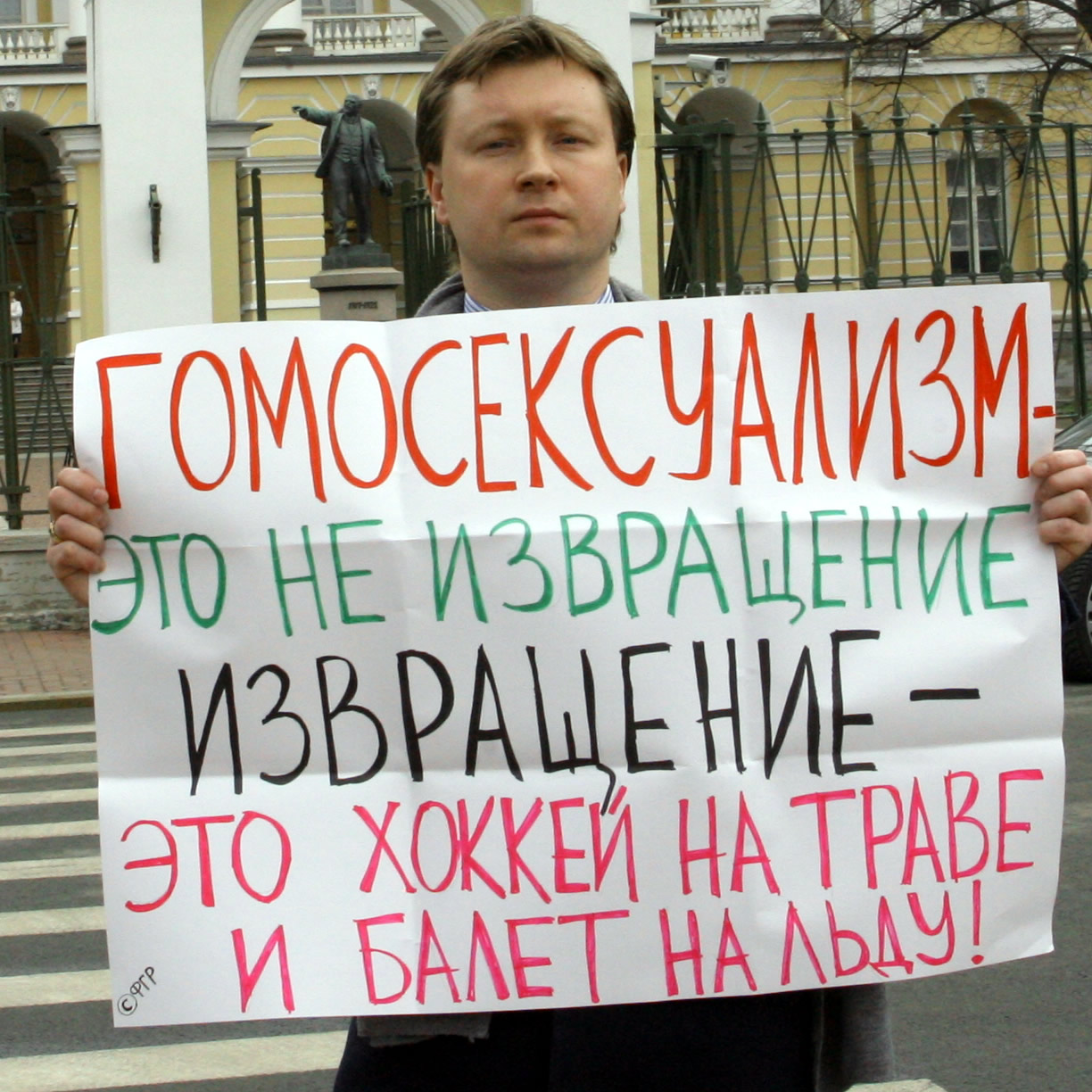
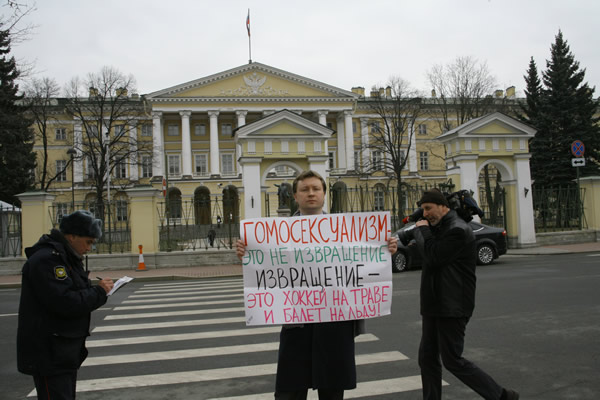
Nikolai Alekseev in 2012 holds a sign in St. Petersburg that reads “homosexuality is not a perversion. Perersion is grass hockey and ice ballet.” He was fined 5,000 rubles ($154) for violating the city’s ban on gay propaganda to minors. (Photo courtesy of GayRussia.ru)
As LGBT rights advance in the United States, gays in Russia are experiencing the opposite trend: an erosion of rights and a violent backlash against those fighting for equality there.
Russian lawmakers on Tuesday approved a bill that would ban the “promotion of homosexuality” to minors, leading some to urge a U.S. boycott of the 2014 Winter Olympics in Sochi.
The measure passed in the Duma by a 436-0 vote margin with one abstention. Individuals would face fines of between 4,000 and 5,000 rubles ($124-$155,) and government officials would face fines of between 40,000 and 50,000 rubles ($1,241-$1,551.)
Media organizations and other groups would face a fine of up to 1 million rubles ($31,000) or suspension of their activities for up to 90 days. Foreigners could also face up to 15 days in jail and deportation.
Nikolai Alekseev of Gay Russia, an LGBT advocacy group, told the Washington Blade from Moscow on Wednesday he “was expecting” lawmakers would support the measure. He noted programs on Russian television were largely supportive of the measure – and some of its supporters publicly compared homosexuality to pedophilia.
The Federation Council, Russia’s upper house of parliament, still needs to approve the bill, but observers expect it will easily pass.
President Vladimir Putin, who announced his divorce from his wife of 30 years last week, is expected to sign it into law.
“I was sure it would be passed,” Alekseev said. “It will now be signed by the president, who is very much using this fight against homosexuals in his campaign to attract voters.”
The State Department in January criticized the passage of the “promotion of homosexuality” bill on its first reading. The United Nations, Amnesty International and German Chancellor Angela Merkel are among those who have also spoken out against the measure.
“Russia is trying very hard to make discrimination look respectable by calling it ‘tradition,’ but whatever term is used in the bill, it remains discrimination and a violation of the basic human rights of LGBT people,” Graeme Reid, LGBT rights program director at Human Rights Watch, said. “To try to exclude LGBT people as ‘non-traditional’ is to try and make them less than human. It is cynical, and it is dangerous.”
“This is a very sad day for the Russian LGBTI community and for Russian democracy,” Martin K. I. Christensen, co-chair of ILGA-Europe’s Executive Board, added.
The measure passed amid growing concerns over anti-LGBT violence and discrimination in the country.
Two men allegedly sodomized Vladislav Tornovoi with empty beer bottles and set his body on fire near Volgograd on May 10 after he reportedly came out to them. Reuters on June 3 reported authorities on the Kamchatka Peninsula in Russia’s Far East said three men stabbed and trampled a gay man to death late last month before they set his car on fire with his body inside.
Russian lawmakers are also poised to ban foreign same-sex couples from adopting Russian children.
Alekseev said hundreds of skinheads and other anti-gay demonstrators confronted the few dozen LGBT protesters who kissed outside the Duma before Tuesday’s vote. He noted several of the advocates were attacked; and one of them remains in the hospital.
Alekseev said authorities arrested many of the LGBT activists and “didn’t touch any of the anti-gay protesters.”
“We’re quite used to such hostility and to such arrest,” he told the Blade.
Boycott Sochi Olympics?
HereTV.com host Jim Morrison posted a petition to the White House’s website after Tuesday’s vote that calls for a boycott of the 2014 Winter Olympics that will take place in the Russian city of Sochi in February.
“For my country to participate in this is outlandish,” he told the Blade.
A Russian appeals court in March 2012 upheld a lower court ruling that blocked a group that sought to disseminate information on the Russian LGBT rights movement during the Sochi games.
Alekseev, who has appealed the decision to the European Court of Human Rights, noted the country will also host the 2018 World Cup.
He said economic sanctions against Russia is one way to pressure the government to improve its record on LGBT rights and other human rights issues. Alekseev added, however, the international community “should think” before it decides to participate in the Sochi Olympics and the World Cup.
“[They are] a very good opportunity to raise particular concerns,” he said. “One of the ways for many countries would be to boycott these international sporting events because they take place in a country which doesn’t respect basic human rights.”
The United States and other countries boycotted the 1980 Summer Olympics in Moscow in response to the Soviet Union’s invasion of Afghanistan the year before.
Cyd Zeigler, Jr., co-founder of Outsports.com, described the boycott as “the biggest black eye this country has ever self-inflicted.”
“The Olympics are supposed to be apolitical,” he said, noting gay Olympic diver Greg Louganis was unable to compete because then-President Jimmy Carter decided to boycott the games. “To start playing politics by removing an opportunity for these athletes to participate — something they’ve been working for all their lives would be a disgrace.”
Blake Skjellerup, a gay short track speed skater from New Zealand who plans to compete in Sochi, said he would not support a boycott of the games.
“The Olympic games for athletes is something they dream of their whole life and spend their whole life working for,” he told the Blade during an interview on Tuesday night from Calgary where he continues to train. “To have that swept away from underneath you is pretty shocking.”
Gay gymnast Josh Dixon, who finished 13th at the Olympic trials ahead of last summer’s London games, said there would be “nothing more disheartening” than to “discredit the years of work put into accomplishing a goal taken away for political reasons.”
“To have that work taken away, let alone the time it took to reach such a level, would be gut-wrenching,” he told the Blade.
Zeigler and Skjellerup both said they support any athlete who decides to publicly speak out against LGBT rights abuses in Russia.
“I’ll be focusing 110 percent on my competing,” Skjellerup said. “I’m not going to tone down the sort of person that I am just because I’m in a country that has these barbaric laws that exist saying that who I am is wrong.”
The U.S. Olympic Committee did not respond to the Blade’s request for comment.




District of Columbia
Physician: addiction doesn’t always look the way you think it does
Yngvild Olsen headed HHS’s Center for Substance Abuse Treatment during Biden-Harris administration
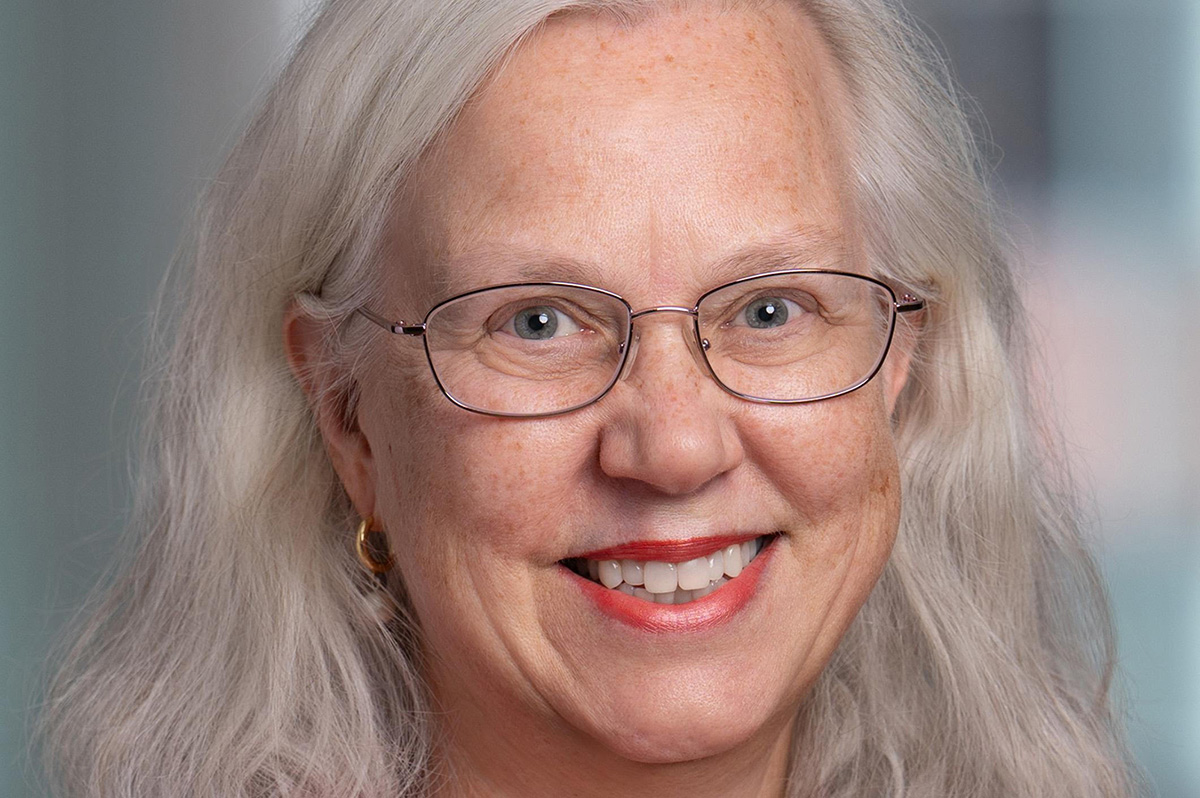
Many people think the telltale signs of drug addiction include sweating and vomiting. But a prominent addiction medicine physician says the best signals aren’t always so visible.
Dr. Yngvild Olsen says more accurate signs come from the brain, specifically the compulsion to keep using drugs, including opioids, despite damage to education, career and relationships.
While it may be harder to understand the true nature of drug addiction, it’s never been more important because of the increased fatality risk of even microscopic amounts of fentanyl, which can be found in many illegal drugs.
Olsen, who headed the Center for Substance Abuse Treatment at the Department of Health and Human Services in the Biden-Harris administration, has worked in addiction treatment for more than two decades. She is now a healthcare advisor with the law and professional consulting firm Manatt, Phelps & Phillips and a physician at the Institute for Behavior Resources/Reach Health Services in Baltimore.
Olsen met with Youthcast Media Group to discuss her career, the opioid epidemic and what to know about fentanyl. The physician, a graduate of Harvard Medical School and the John Hopkins Bloomberg School of Public Health, cited her field experiences as key in shaping her perspective on addiction treatment and recovery. This interview is edited for clarity and length.
What made you believe this work in addiction treatment is important?
I had a couple of experiences really early on in my career that very significantly shaped my interest in addiction and addiction medicine, and my belief that I had a role, and that I could really help people get better from that disease. So the first was during the summer between my first and second year in medical school. I spent the summer on the Eagle Butte and Pine Ridge reservations in South Dakota and really saw firsthand just the devastating impact that substance use — in that case, alcohol — had on not only individuals, but their families and whole communities, and just how profound that impact had been for people who had lost their lives, who had lost family members, who had physically, emotionally and spiritually negative impacts of just feeling very hopeless and and trying to find solace in their substance use, particularly their alcohol use, and doing that without really finding it. I think that was really the lesson that experience taught me.
What did you learn about treatment practices during your medical education? How was that helpful to your career?
When I was a resident in general primary care at Boston Medical Center, I was really fortunate to have a group of mentors who also were general internists, like I was training to be, who were very interested and focused on medical education and research in substance use. And so they modeled for me many of the interactions that we had with patients. I got to do a research study with one of them looking at smoking cessation among people with opiate use disorder, taking methadone. And really importantly, I got to spend a month with one of them at the Boston City Public Health Department’s Opioid Treatment Program, or what some people call a methadone clinic, because he was their medical director. I got to see people recover, and who had recovered, who had gotten their lives back together, gotten their families back together, had new families (or) businesses. It was unbelievably helpful to see that people could recover, that they did recover, and that I, as a physician, could be part of their treatment. I saw people get better, and recover, with medications like methadone and buprenorphine, and other services designed individually for them. That was really helpful and kind of a big eye-opening moment for me.
What factors contribute to addiction and why is it considered a complex disease?
People come into treatment for their addiction — or when they’re not in treatment, but are in an emergency department or on the street — with a lot of shame. They have a lot of shame about this disease that they have, that for so long, they were told, ‘Well, you know, you should just stop. Why can’t you just stop?’ Well, we know that addiction is a disease. It’s a complex disease that has lots of different factors related to it. So there’s a big genetic component that combines with environmental factors and other risk factors. For example, people have what’s called adverse childhood experiences. Some of these are if they grow up with lots of physical or sexual abuse or emotional abuse or have parents who are in jail. That’s really traumatic and so all those childhood experiences that increase stress are a big risk factor.
What is the easiest opioid to get addicted to?
It used to be heroin. That was a big problem, particularly in the Northeast and other parts of the country. That shifted to prescription opioids, beginning around the year 2000. So for about 10 years, it was really prescription opioids that were a big problem — people misusing them. And then it switched back to heroin. And then in about 2015, fentanyl came on the scene, and that really changed the game, given just how unbelievably potent fentanyl is, so it doesn’t take a lot to cause an overdose. Now there are all those other synthetic opioids, like the orphines and nitazenes and all those combinations of other substances, but fentanyl is really what’s still kind of driving a really big part of the overdose crisis.
Do LGBTQ individuals face heightened challenges when battling addictions? How do addiction specialists like you account for those challenges?
We certainly know that the prevalence of overdose and the challenges of substances is higher in the LGBTQ+ community. Where I see patients, we did a big LGBTQ+ training and had a grant to specifically provide services to that population. Where we were located, in Baltimore City, there is a big transgender community not that far from us. Particularly in the LGBTQ+ population, they have multiple stigmas. So it just compounds multiple stressors. And stress is a risk factor for substance use, and particularly a risk factor for recurrence of a substance use disorder. And so when you have all these negative factors building up in people, that can make it that much more challenging for people to find the services that they find meaningful and that are welcoming and supportive of them. So we tried very hard — and we still do — to make sure that we are a welcoming and safe space, because I think it is that safety that is really paramount.
What advice would you give someone worried about a friend or family member’s substance use?
There are two things. One is: I would talk to that person about your concerns and how that person’s personality changes or their behavior changes when they’re using or in withdrawal, and how that might be impacting their health and how they’re feeling. And then second: you can let them know that there are actual treatments that are really helpful, that can make them feel better and that can help them get back to who they were before they started using. It’s important not to be accusatory because … [people] have a lot of shame already, and so when somebody starts accusing them, that shame just gets worse. And a lot of times, people who have a substance use disorder or are using opioids won’t necessarily agree that they have a problem when you first start to talk to them. But talk to them again every time something happens and say, ‘I’m really worried about you because this now has happened and I see it as being tied to your substance use.’ And let them know that there are people who can help and that they could actually feel a lot better.
This work is part of a partnership between the Washington Blade Foundation and Youthcast Media Group, funded in part through a FY26 Community Development Grant from the Office of D.C. Mayor Muriel Bowser. Adrian Malone is a senior at Bard High School Early College DC, one of Youthcast Media Group’s journalism class partners. Shreya Jyotishi, YMG assistant manager of content and programming, is a former Washington Blade intern and 2026 graduate of American University.
Afghanistan
ICC unseals arrest warrants for Taliban officials accused of persecuting LGBTQ people, women
‘For LGBTIQ+ people, this matters enormously’
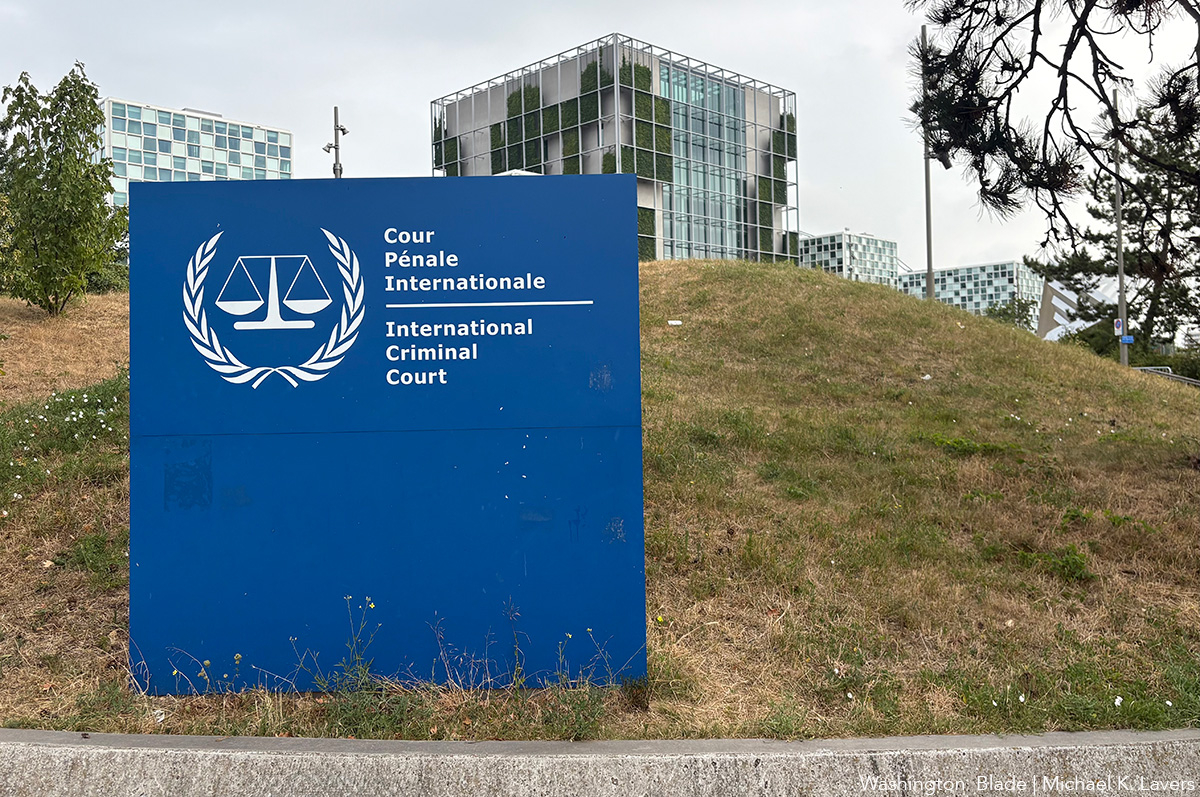
The International Criminal Court this week unsealed arrest warrants for four Taliban officials in Afghanistan accused of targeting LGBTQ people, women, and others who defy the group’s strict gender norms.
The warrants the ICC unsealed on Oct. 5 are for Hibatullah Akhundzada, the Taliban’s supreme leader, and Chief Justice Abdul Hakim Haqqani. The ICC also unsealed warrants for Education Minister Habibullah Agda and Higher Education Minister Neda Mohammad Nadim.
The ICC last year announced warrants for Akhundzada and Haqqani, as the Washington Blade previously reported.
“In the warrants of arrest, the (Pre-Trial) Chamber (II), in line with current developments in international law, found that the definition of ‘gender’ in the Rome Statute necessitates an interpretation that goes beyond a purely biological conception of sex,” reads the ICC’s Oct. 5 announcement. “It considered that it requires acknowledging the socially constructed roles, behaviors, expectations, and hierarchies traditionally associated with individuals on the basis of their sex. The Chamber considered that these societal constructs, commonly referred to as ‘gender norms,’ form part of the contextual lens through which acts amounting to gender-based persecution under article 7(1)(h) must be assessed.”
“It found that there are reasonable grounds to believe that the four suspects are criminally responsible for having ordered, induced or solicited the crime against humanity of persecution, under article 7(1)(h) of the Rome Statute, on gender grounds against girls, women, and other persons non-conforming with the Taliban’s policy on gender, gender identity or expression; and on political grounds against persons perceived as ‘allies of girls and women,’” it adds. “These crimes are believed to have been committed on the territory of Afghanistan since the Taliban seized power on Aug. 15, 2021, and have continued until at least Jan. 20, 2025.”
The Rome Statute established the ICC, which is in the Dutch city of The Hague, in 2002 after 60 countries ratified it.
The U.S. is among the countries that do not recognize the ICC. Secretary of State Marco Rubio on Friday announced U.S. sanctions against the ICC, which he described as a “rogue court.”
Then-ICC Chief Prosecutor Karim Khan in January 2025 announced a request for warrants against Taliban officials over their treatment of women and other groups since they regained control of Afghanistan in 2021. It marked the first time the ICC specifically named LGBTQ people as victims in a gender persecution case before it.
A report that Outright International released in 2023 notes Taliban officials have systematically targeted LGBTQ people — especially gay men and transgender women.
Taliban officials have subjected them to physical and sexual assault as well as arbitrary detention. The Outright International report also notes Taliban authorities have carried out public floggings for alleged same-sex sexual relations, and have collected intelligence on LGBTQ activists and community members.
Artemis Akbary, executive director of the Afghanistan LGBTIQ Organization, on Oct. 5 described the additional arrest warrants as “huge.”
“For LGBTIQ+ people, this matters enormously,” he said. “It strengthens the understanding that gender persecution can also capture persecution based on non-conformity with imposed gender roles, identities, and expressions.”
“This is an important development for accountability in Afghanistan, and potentially far beyond it,” added Akbary.
District of Columbia
Bet Mishpachah participates in D.C. Oct. 7 commemoration ceremony
Wednesday marked three years since Hamas attacked Israel
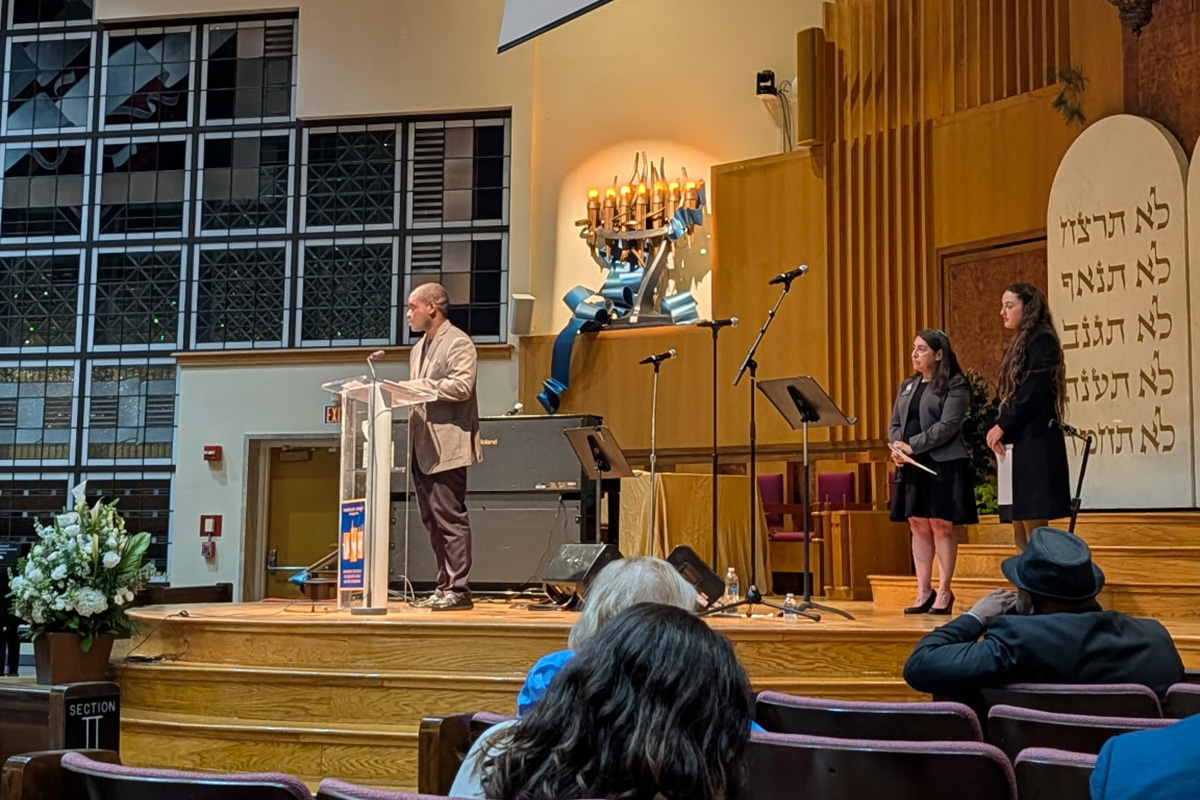
Bet Mishpachah Executive Director Joshua Maxey on Wednesday was among those who spoke at a ceremony in D.C. that marked the third anniversary of the Oct. 7 attack in Israel.
The Jewish Federation of Greater Washington hosted the ceremony that took place at the Washington Hebrew Congregation in Northwest D.C. Bet Mishpachah is the city’s LGBTQ synagogue.
“It was a deeply moving evening, especially hearing the stories of people who knew those who were murdered and those who survived and experiencing music that gave a voice to grief and hope,” Maxey told the Washington Blade.
Hamas militants on Oct. 7, 2023, killed roughly 1,200 people, including upwards of 360 partygoers at the Nova Music Festival near Re’im, a kibbutz that is a couple miles from the Gaza Strip, when it launched its surprise attack on Israel. The militants also kidnapped more than 200 people.
The Hamas-controlled Gaza Health Ministry says Israeli forces have killed more than 74,000 people in the enclave since Oct. 7.
The International Criminal Court in 2024 issued arrest warrants for Israeli Prime Minister Benjamin Netanyahu; former Israeli Defense Minister Yoav Gallant; former Hamas leader Yahya Sinwar; Mohamed Diab Ibrahim al-Masri, the head of Hamas’s military wing known as the Qassam Brigades; and Ismail Haniyeh, chair of the Hamas Political Bureau, after it accused them of committing war crimes and crimes against humanity in Gaza and Israel.
The Israeli government has strongly denied it has committed genocide in Gaza.
An Israeli airstrike on a compound in Khan Younis, a city in southern Gaza, on July 13, 2024, killed killed Deif, one of the alleged Oct. 7 masterminds. Israel less than three weeks later assassinated Haniyah in Tehran, the Iranian capital. Israel Defense Forces soldiers on Oct. 16, 2024, killed Sinwar in Rafah, a city in southern Gaza.
Hamas last October released the remaining hostages in Gaza as part of a ceasefire agreement that President Donald Trump helped broker. Israel has continued to conduct airstrikes and other military operations in Gaza since the official suspension of hostilities took effect.
“For Bet Mishpachah, it was especially meaningful to lift up the names of LGBTQ+ people, those whose identities we know and those whose stories may never be fully known, who were murdered, and to honor the LGBTQ+ survivors whose resilience continues to inspire us,” said Maxey, referring to his participation in Wednesday’s ceremony. “Emily Damari’s story is particularly poignant: while held hostage, she had to hide the fact that she was gay because she feared that revealing her identity to her captors could put her life at even more risk. Yet, she survived.”
“Her story, like so many others, reminds us of the extraordinary courage it takes simply to remain human in the face of hatred,” he added. “May we continue to remember and to mourn, to honor, and to work toward a future rooted in peace and hope.”

Center for Black Equity honors leaders, activists at BE. Gala

In ‘The Lost Brontë,’ a complicated lie can lead to danger

CAMP Rehoboth Block Party returns Oct. 18

Essential queer horror classics for Halloween

Solidarity beyond the parade: the actual cost of Pride

10 years later, we still can’t shake Barry Jenkins’s ‘Moonlight’

‘Some Like It Hot’ a wild ride at renovated Bernard Family Theatre

D.C.’s LGBTQ homeless facilities face possible hit from Trump funding cuts

Trump uses anti-trans slur against Democratic Senate candidate

U.S. int’l trade negotiator, consultant James Bedore dies at 82
-

 Movies5 days ago
10 years later, we still can’t shake Barry Jenkins’s ‘Moonlight’
-
Theater5 days ago
‘Some Like It Hot’ a wild ride at renovated Bernard Family Theatre
-
District of Columbia5 days ago
D.C.’s LGBTQ homeless facilities face possible hit from Trump funding cuts
-
2026 Midterm Elections5 days ago
Trump uses anti-trans slur against Democratic Senate candidate