News
Clay Aiken ‘actively considering’ run for Congress: sources
‘American Idol’ alum has reportedly talked to DCCC about a bid
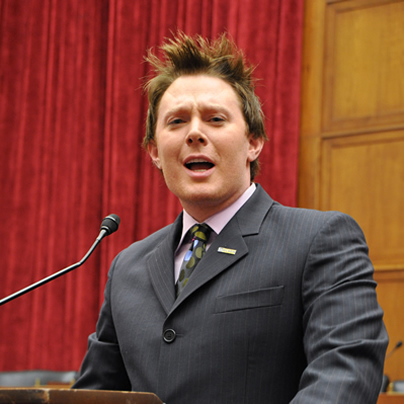
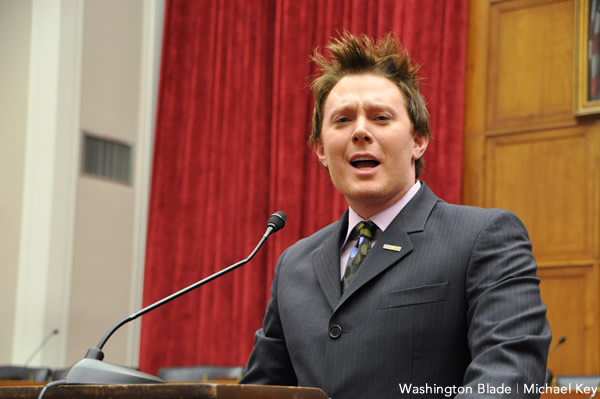
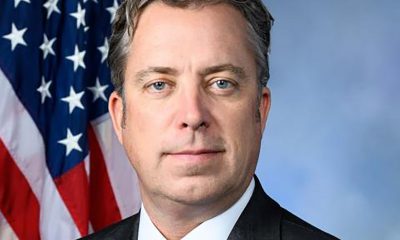
Clay Aiken is “actively considering” a run for Congress, sources say. (Washington Blade file photo by Michael Key)
Gay singer and “American Idol” runner-up Clay Aiken is actively considering a bid to represent North Carolina’s 2nd congressional district in the U.S. House, according to two Democratic sources familiar with his plans.
The sources, who spoke on condition of anonymity, said the 35-year-old Raleigh native has taken initial steps for a run, including consulting with political operatives in Washington, D.C., about a bid for the seat.
One Democratic source said Aiken made phone calls to gauge support, talked to the Democratic Congressional Campaign Committee and has met with figures in Raleigh, N.C., about a potential bid. Although it’s unclear when Aiken might formally announce a decision, the source said Aiken is “actively considering” it and “sounding and acting like a candidate.”
To help explore a run, the source said Aiken has been working with Betsy Conti, a Raleigh-based political strategist who’s worked for former North Carolina Gov. Bev Purdue and Democratic presidential nominee Al Gore in addition to serving as Maryland’s deputy labor secretary in the Glendening administration. It’s unclear whether Aiken has formally hired her or anyone else to help with his bid.
Another Democratic source said Aiken was in D.C. last month meeting with pollsters at Hart Research Associates to examine polling data with one of the partners at the firm.
The DCCC hasn’t responded to multiple requests to comment about a potential Aiken candidacy in the past few weeks. Neither Conti nor the Hart Research Associates responded to the Blade’s request for comment on Thursday.
Aiken himself was unable to be reached for comment. A Los Angeles-based management company known as the Firm, which reportedly represented Aiken for his music career in the last decade, didn’t respond to a request for comment.
Aiken wouldn’t be the only candidate on the Democratic side to pursue a run for the House seat, which is currently occupied by Rep. Renee Ellmers (R-N.C.). Former North Carolina Commerce Secretary Keith Crisco is expected to formally announce his candidacy on Monday. He formed a campaign committee to explore a run in December.
The filing deadline to participate in the primary is Feb. 28. The primary itself in North Carolina is set for May 6.
Although the polls indicate Republicans may be favored as the mid-term elections approach on a general ballot, the Democratic nominee — whether it’s Aiken, Crisco or someone else — may have a shot at the seat, which comprises Raleigh and was controlled by Democrats before the Republican surge in 2010. A House Democratic aide, who also spoke on condition of anonymity, described the second congressional district as a “winnable seat” for Democrats.
After finishing in second-place on Fox’s “American Idol” in 2003, Aiken used the prominence he gained from performing on the show to launch a successful music and Broadway career. He’s sold more than six millions copies of his albums, and, according to Forbes, made $1.5 million in 2010.
Aiken has also drawn on his fame to help promote causes as an activist. He co-founded the the National Inclusion Project, formerly the Bubel/Aiken Foundation, which seeks to help children with disabilities. Tapped as a national ambassador for the United States Fund for UNICEF in 2004, Aiken has travelled to Afghanistan, Indonesia, Uganda, Mexico, Kenya and Somalia as part of aid missions.
The singer has also taken part in LGBT activism. In 2010, the singer appeared at a briefing on Capitol Hill on behalf of the Gay, Lesbian & Straight Education Network, or GLSEN, to urge for passage of anti-bullying legislation with LGBT protections known as the Student Non-Discrimination Act and the Safe Schools Improvement Act.
“Like many kids now in middle schools and high schools, I was bullied,” Aiken said at the time. “I was picked on, I was called gay, I was called fag, I was called sissy, you name it. Fortunately, I was able to overcome it and live through it because of a number of friends who were supportive of me.”
Dogged by rumors about his sexual orientation during his appearance on “American Idol” and over the course of his musical career afterward, Aiken came out as a gay in 2008 by appearing on the cover of “People” magazine with his then-infant son Parker Foster Aiken.
“It was the first decision I made as a father,” Aiken told the magazine. “I cannot raise a child to lie or to hide things. I wasn’t raised that way, and I’m not going to raise a child to do that.”



News
Blade editor inducted into D.C. Society of Professional Journalists Hall of Fame
Joe Reberkenny, Michael Key won SPJ awards
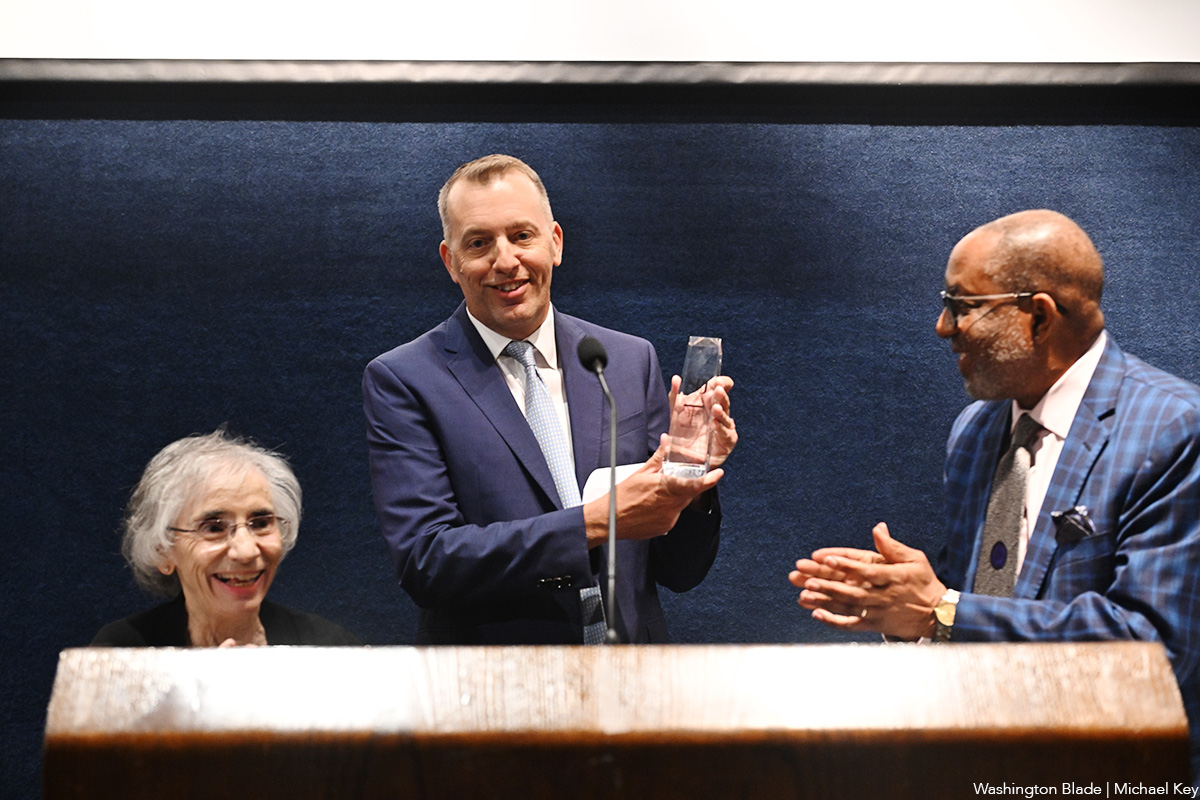
The Society of Professional Journalists’ Washington, D.C., Pro Chapter on Tuesday inducted Kevin Naff, the Washington Blade’s editor and co-owner, into its Hall of Fame.
The induction took place at the group’s annual dinner that took place at the National Press Club.
White House Correspondent Joe Reberkenny won an SPJ award in the weekly newspaper features category for his article “Queer defiance, footlong in hand: the rise of ‘Sandwich Guy.’” Photo Editor Michael Key won two SPJ awards: one in the weekly newspaper feature photography category for a photo of a protest that he took outside the D.C. Attorney General’s office, and another in the weekly newspaper photography story category for his article “‘Trump Must Go Now’ march to the White House.”
International News Editor Michael K. Lavers was a finalist for SPJ awards in the weekly editorial/opinion writing category, the weekly newspaper non-breaking news category. Senior Reporter Lou Chibbaro was also a finalist for an SPJ award in the weekly newspaper non-breaking news category.

District of Columbia
McDuffie on LGBTQ support and standing up to Trump
‘I’m committed to governing with the queer community at the table’
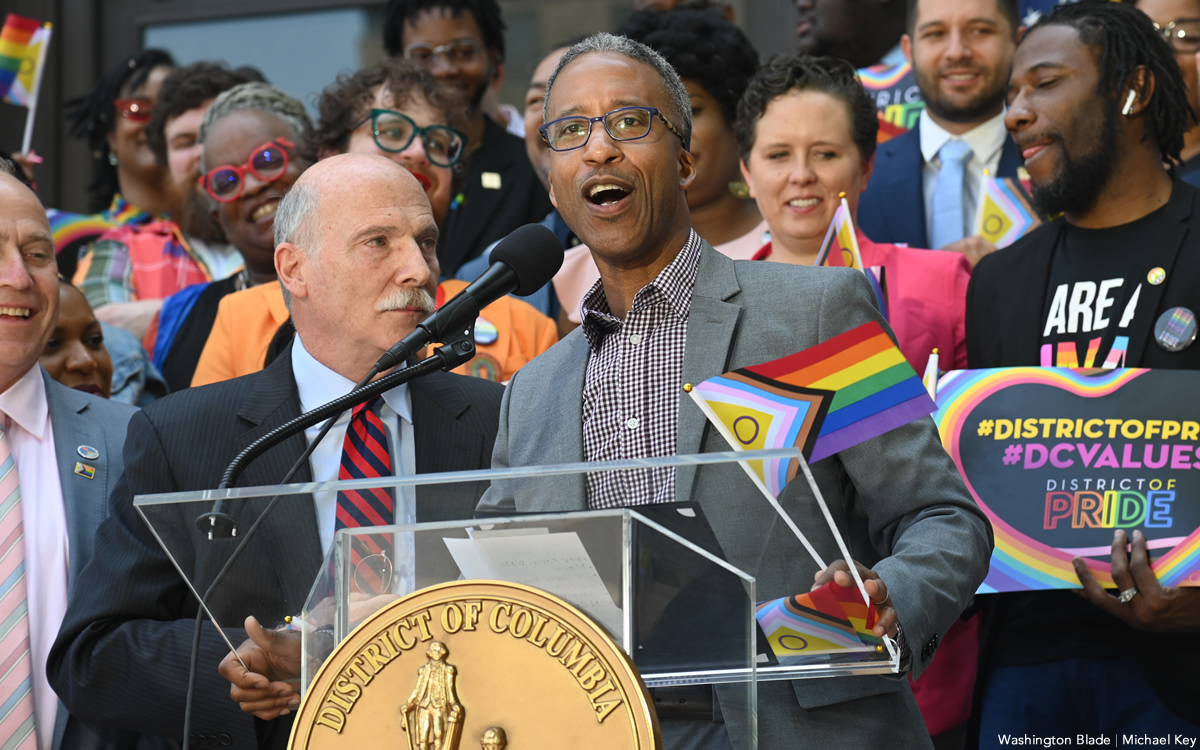
Former D.C. Council member Kenyan McDuffie is running for mayor as Muriel Bowser’s third term expires in January. He’s running in a crowded Democratic primary field; recent polls show him in second place behind Council member Janeese Lewis George. D.C.’s primary is Tuesday, June 16.
The Blade sat down with McDuffie on June 8 for a wide-ranging conversation about his pro-LGBTQ record and challenges now facing the community.
The Blade reached out to fellow mayoral candidates Lewis George and Rini Sampath, who identifies as queer, for interviews. Neither responded to repeated requests over several weeks.
Blade: Members of the D.C. LGBTQ community are receiving information that most if not all the seven Democratic candidates for mayor, including you and Council member Janeese Lewis George, are strong supporters of the LGBTQ community. What message would you have for LGBTQ voters on why they should support you rather than one of the other candidates?
McDuffie: Thank you for the question, Lou. And thank you for your work over the years with the Washington Blade. I’m really looking forward to having this conversation. You know, Washington, D.C. is the capital of the United States, and our city is one of the most beautifully diverse and inclusive cities in America because generations of LGBTQ+ residents, advocates, and organizations have fought to make it that way.
And throughout my time on the Council, I’ve been proud to support that work by advancing equity and opportunity and standing up for the rights and dignity of every resident across the District regardless of where they live, who they know, how much money they have. And as mayor, I’m going to build on that progress by ensuring D.C. remains a place where LGBTQ+ residents can live safely, where they can access quality healthcare and housing, they can build families and businesses and thrive in the neighborhoods of our city.
And now more than ever, making sure we protect residents from a hostile federal administration, including President Donald Trump, who seeks to roll back civil rights and civil liberties.
Blade: Some people, including members of the LGBTQ community, have criticized Mayor Bowser for what they say has been her position of not standing up forcefully enough against the Trump administration on various issues, including the deployment of National Guard soldiers in the city. What are your thoughts on that? How would you deal with the Trump administration if you were mayor?
McDuffie: Well, I’m going to deal with the Trump administration by prioritizing D.C. residents first. I’m going to stand up and fight back against federal infringement from Donald Trump and from Republicans in Congress or any other individual or organization that seeks to threaten Washington, D.C. residents.
And that means on day one rescind the executive order that permits cooperation between the Metropolitan Police Department and ICE and DHS [U.S. Department of Homeland Security]. And I know because of my work 13-and-a-half years on the Council doing research, authoring transformational legislation that protects people’s civil rights, that makes the Metropolitan Police Department more transparent, doing things like authoring the landmark NEAR Act [a 2016 D.C. law aimed at reducing violent crime].
I know from that work, and I know from my former work as a civil rights attorney in President Obama’s Department of Justice that you have to fight to ensure that we have a fair and more just society. I did that as a civil rights attorney traveling the country fighting to protect people’s civil rights. I did that as a prosecutor who fought crime and delivered justice for victims.
And I’m going to do that as mayor to ensure that we use every legal and political tool available as mayor to resist any federal effort to roll back LGBTQ+ protections in Washington, D.C. And I’m committed to governing with the queer community at the table and lifting up their contributions to this city at the center of every decision that I make as mayor. You know that I’ve been a champion making Washington, D.|C. more equitable, more just, and economically inclusive. And I plan to continue to build on that work that I have done and the work that so many important people have done in the LGBTQ+ community in Washington, D.C. to make sure that our residents can live safely and thrive in Washington, D.C.
And so, we’re going to fight back against Trump and any hostile federal administration to make sure we’re protecting the residents first. And we will work with the federal government where there is an opportunity to do transformational economic development projects like RFK, transformational infrastructure projects like expanding Union Station. Both of those will create thousands of jobs and thousands of opportunities for D.C.-based small businesses.
But I will draw a very bright line when it comes to protecting the civil rights of individuals across the District of Columbia, including the LGBTQ+ community and our vulnerable neighbors like our immigrant neighbors and families who in many cases today are living in the shadows, afraid to leave their homes, afraid to go to work, afraid to walk their kids to school because they’re being snatched off the streets in safe places around schools and places of worship. And it is utterly despicable what Donald Trump has done and how he’s weaponized our federal law enforcement.
Blade: As a follow-up to that, reports surfaced last year that the mayor had to cut the budget for the Office of LGBTQ Affairs for this year by $600,000 because of a large cut in the city’s budget by Republicans in the U.S. House of Representatives. Would you do something to try to restore the funds that were cut from that office?
McDuffie: Absolutely. I will as mayor fully fund the Mayor’s Office of LGBTQ+ Affairs and direct it to proactively identify gaps in city services while also ensuring that the Office of Human Rights has additional resources to vigorously enforce efforts against discrimination across government agencies and within the private sector where it arises. I am a civil rights attorney by training. And I will bring the full force of the District of Columbia government to bear when it comes to protecting the rights of our residents, including especially our vulnerable communities like LGBTQ+ community.
And we’re going to fully fund the Office of LGBTQ+ Affairs and make sure it is doing the work proactively to identify any gaps in services any gaps in resources that are needed to shore up the supports and services to the community. And that’s been my record on the Council, too. As you know, I’ve supported on the Council marriage equality. That I’ve supported helping to repeal D.C.’s anti-surrogacy laws, expanding opportunities for LGBTQ couples.
You know that I’ve supported polices that recognize diverse family structures and co-introduced and passed the birth certificate equality amendment act. I supported efforts to reduce bureaucratic barriers faced by transgender residents. So, that’s the kind of work that I’ve done as a Council member. And as mayor I’m going to really fight and deliver for our LGBTQ+ neighbors to ensure that they’re supported, seen, heard, continue to be woven into the fabric of our city.
Blade: Do you or your campaign have any plans for participating in any LGBTQ Pride events during Pride month?
McDuffie: Oh, we are going to be not only front and center in marching in the Pride parade but being there as a resources to work directly with the organizers to make sure that they have every single thing that they need to build on the strong legacy of Washington, D.C.’s Pride community and all the festivities that are associated with it. I was so proud to stand on the steps of the Wilson Building last year for WorldPride and announce what Washington, D.C. does and how we do it and why we’re so special as a city. And when it comes to supporting Pride this year, I’m going to be right there marching with everybody else and ensuring that the longstanding relationships with the LGBTQ community across the District of Columbia are shown and displayed as our nation’s capital sets the example of what it looks like to really protect the beautiful diversity that we have in our city.
Blade: People have been talking about the poll just released by the Washington Post showing you to be 11 points behind Janeese Lewis George in the race for mayor. Do you have any reaction to that?
McDuffie: Well, what the poll shows is that I have the broadest coalition of support across the District of Columbia. Because I continue to show up and meet residents where they are. That demonstrates whether you are a longtime resident or whether you are Black or white or a member of the LGBTQ+ community. My support in the District of Columbia is deep, and it is broad.
Because I will govern as mayor in the way I have led as a Council member, which is by building the broadest coalition possible, walking across differences and really coming out with solutions to address intractable issues. So, I know that Washington, D.C. has been a national leader when it comes to protecting civil rights and ensuring fairness and justice. And I’ve been one of the people who led on those issues, making our city more racially equitable, more socially just, and more economically inclusive.
Blade: As you know, some of your critics have been trying to link you to the Pepco electric rate increase and for being responsible for higher utility costs. Do you have a response to that?
McDuffie: They try to link me to a number of things that are a part of what is a widespread disinformation campaign much like what we’ve seen on a national level from Trump and other Republicans. I don’t accept it. I think the fact that I’ve been elected four times in the District of Columbia, I demonstrate my ability to work with residents across the District of Columbia to get things done.
When it comes to utilities, I’m going to fight to lower utilities costs for residents, ensuring that we expand renewables and alternative energy sources, recognizing that Janeese Lewis George was the only Council member who voted against expanding solar a couple of years ago. But I’m also going to make sure that we have automatic enrollment for individuals in the District of Columbia who are having trouble paying for the utilities. I will make sure we protect seniors who are feeling a squeeze when it comes to being able to pay for utilities …
And we’re going to make sure that everybody understands why their energy bill is going up and push back against disinformation, so that they understand that a lot of what we’re seeing in increased utility bills, which I also face with my wife, is driven by demand on the regional grid at PJM. It is the data centers that are driving up our costs and lowering supplies. I’m going to hold those data centers accountable to pay their fair share for how they are contributing to the increase in utility costs that residents across the District of Columbia and across the region are seeing on their Pepco bills.
Blade: Thank you for your time. Do you have anything else you may wish to say to conclude your remarks?
McDuffie: Just to be clear that the disinformation campaign that Janeese Lewis George and her supporters are waging is one of the lowest political tactics that we’ve seen in D.C. politics. But she is banking on voters who are not doing their research. And what I know is that D.C. voters are smart. They know me from my work on the Council. And they know I am better qualified on day one to stand up and fight back against Trump to protect home rule and to deliver a city that is safer, that is more affordable and deliver a government that is more accountable and works for residents across the District of Columbia.
Congress
EXCLUSIVE: Pelosi reflects on four decades of LGBTQ advocacy
Blade spoke with House speaker emerita before her 2027 retirement
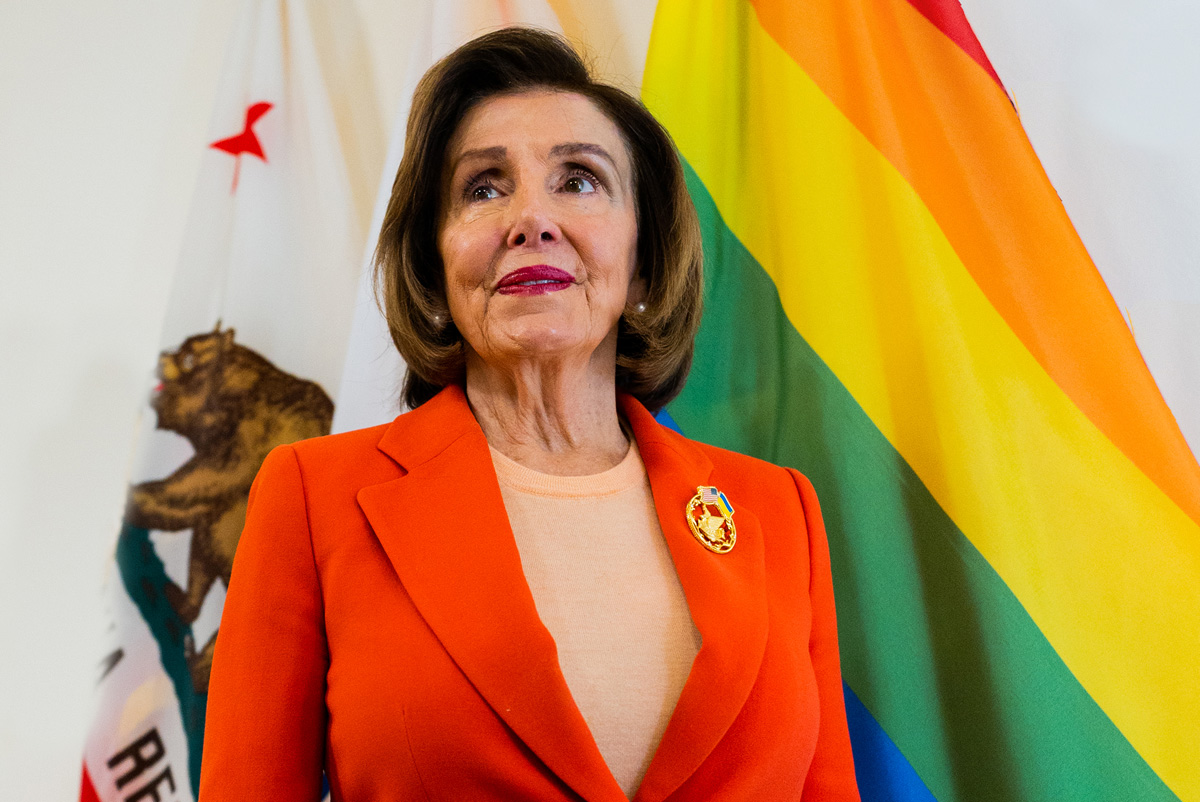
For nearly four decades, House Speaker Emerita Nancy Pelosi (D-Calif.) has been one of the most influential champions of LGBTQ rights in American politics.
The former U.S. House of Representatives speaker helped lead landmark LGBTQ legislation through Congress; including the repeal of “Don’t Ask, Don’t Tell,” passage of the Matthew Shepard and James Byrd Jr. Hate Crimes Prevention Act, and multiple House approvals of the Equality Act. She also played a central role in congressional efforts to combat HIV/AIDS and oppose restrictions targeting transgender Americans.
In an exclusive interview with the Washington Blade; Pelosi reflected on those accomplishments, the role grassroots activists played in achieving them, and the ongoing challenges facing the LGBTQ community during President Donald Trump’s second term.
When asked which LGBTQ-related achievement she is most proud of, Pelosi pointed not to a specific bill, but to the movement that made those victories possible — and the loud, strong-willed grassroots believers in a better America than the one they had found themselves in.
“Anything that we accomplished, whether it was fighting HIV and AIDS, ending discrimination, passing hate crimes legislation, or ending ‘Don’t Ask, Don’t Tell,’ would never have happened without outside mobilization,” Pelosi said, expressing gratitude for those who saw a problem and dared to speak its solution into existence. “Our inside maneuvering was important, but we couldn’t do our best job without the community. Every chance I get, I thank them for their patriotism because they make democracy function.”
Pelosi explained that her initial LGBTQ advocacy efforts were directly shaped by the LGBTQ community in the San Francisco area and by the HIV/AIDS epidemic that decimated the community during the 1980s.
The former speaker recalled arriving in Congress in 1987 and making HIV/AIDS a centerpiece of her agenda from the start.
“My first words on the House floor were that I had come here to fight HIV and AIDS,” Pelosi told the Blade. “People asked why I would make that my first statement. To me, that reaction showed just how much discrimination still existed and how much work remained to be done.”
She continued, explaining that advocating for San Francisco — with its once-vibrant LGBTQ community that was dying more with every passing day — became a joint effort between community-driven activists and government officials trying to manage and mitigate the crisis that claimed more American lives than the Vietnam War.
“When we were trying to bring the Democratic convention to San Francisco, people were saying they couldn’t come because of HIV/AIDS,” she said. “What emerged from that moment was community-based advocacy, community-based care, prevention, and research. Every success we had sprang from the community itself.”
Multiple times during the interview, Pelosi returned to those four pillars of the effort to combat HIV/AIDS: community-based advocacy, community-based care, prevention, and research.
She argued that the epidemic, despite its horrific toll, ultimately helped many Americans better understand and accept LGBTQ people in a society that had not been as tolerant.
“When families learned that a son or daughter was HIV-positive and gay, barriers started to break down,” Pelosi said. “Love prevailed in many cases. I actually give HIV/AIDS some credit for the acceptance of marriage equality because people began seeing these issues through the lens of family.”
Pelosi also highlighted the passage of federal hate crimes legislation as one of her — and the LGBTQ rights movement’s — most defining victories.
“Matthew Shepard’s mother came and spoke to members. (The late-former Massachusetts Congressman) Barney Frank told his story. We had to convince people that leadership means leading, not following,” Pelosi said. “That legislation was incredibly important because it forced people to confront the real consequences of hate.”
She said she refused pressure to remove transgender protections from the bill, despite promises from others that it would pass more easily if lawmakers only protected what they viewed as the least vulnerable groups.
“People told me, ‘You can pass this in a minute if you take out trans,'” Pelosi recalled. “I said, ‘I won’t pass it in 100 years because I’m not ever taking out trans.’ We passed it with trans protections included.”
The Blade also asked Pelosi about the stalled passage of the Equality Act — which would add federal protections for LGBTQ people through amendments to the Civil Rights Act of 1964 that would explicitly prohibit discrimination based on sex, sexual orientation, and gender identity. She expressed confidence that the Equality Act will eventually become law, though she acknowledged the political obstacles that have persisted since its creation in the 1970s.
In her office, among bowls of Ghirardelli chocolates and prints depicting national parks in her district, a large photo hangs on the wall showing Pelosi standing at the House rostrum with LGBTQ advocates beneath the words “#EQUALITY ACT” — photographic proof that she had already passed the landmark legislation in the House, if only the U.S. Senate had agreed.
“We passed it in the House again and again,” she said. “The Senate is more difficult because of the procedural hurdles, but we’re not stopping. We’ll stick with it until the job is done.”
The longtime Democratic leader also credited civil rights icon John Lewis with helping build support for the legislation when others argued the growing LGBTQ rights movement was, as one California Democratic legislator put it, “too fast, too much, too soon.”
“There were people who worried about opening up the Civil Rights Act to include LGBTQ protections,” Pelosi said. “John Lewis told us, ‘We can’t wait. We must do it now.’ He was instrumental in helping move that effort forward.”
Much of the conversation eventually turned to the Trump-Vance administration’s policies affecting trans Americans.
Pelosi argued that Executive Order 14183, “Prioritizing Military Excellence and Readiness,” which puts restrictions on trans military service weakens national security, and efforts to limit gender-affirming healthcare for trans children with the Executive Order “Protecting Children From Chemical and Surgical Mutilation” ignores the needs of families.
“When they diminish the ability of transgender people to serve in the military, they diminish our national security,” she said. “At the same time, families are being told they can’t get the care their children need. That is deeply troubling.”
She recounted hearing testimony from conservative parents whose views changed after their own children came out as trans — a transformation she said changed hearts and minds, even among people she had once seen wearing red MAGA hats.
“One mother told us she was a Trump supporter until her child needed medical care and her state wouldn’t allow it,” Pelosi said. “She said she had to leave Texas to care for her child. Hearing stories like that reminds people that these are families, not political talking points.”
Pelosi described efforts to restrict healthcare access for trans youth as both discriminatory and morally wrong.
“Some of the things they’re doing by refusing to support clinics that meet the needs of trans kids are sinful,” she said. “I’m a religious person, and I believe every child is God’s child. We have a responsibility to meet their needs.”
Asked what she would say to people who oppose LGBTQ equality, Pelosi returned to a theme that surfaced throughout the interview: love.
“I’ve seen families completely transform when these issues become personal,” she said. “People who once opposed HIV/AIDS funding became advocates when someone they loved was affected. Love has a way of changing hearts.”
As for how she hopes history remembers her role in the movement, Pelosi again shifted attention away from herself and toward activists.
“People were dying, and the community demanded action,” she said. “I hope people remember that the progress we made came from the very vocal participation of LGBTQ people and their allies. I was honored that they trusted me to carry that fight in Congress.”
Pelosi, who has announced she will not seek reelection and plans to retire from the House in 2027, said the struggle for equality is far from over.
“Every major expansion of rights in this country has been a long struggle,” she said. “We’ve laid a foundation, but there is still more work to do. We still have to pass the Equality Act.”
When asked what she credits for the change in public understanding and the growth of the LGBTQ movement, she said respect lies at its foundation.
“This month, Pride Month, people would say to me, ‘It’s easy for you because you’re from San Francisco, and San Francisco is so tolerant,'” Pelosi said. “And I would say to them, ‘Tolerant to me is a condescending word.’ Tolerance is a good word writ large, but in terms of the subject, it’s not about tolerance — it’s about respect. Respect is what made it almost inevitable that I would have nothing but enthusiasm for what I was doing. We don’t just respect — we take pride in our community. But that pride springs from respect that people have to have for everything, including the differences that they see.”

Blade editor inducted into D.C. Society of Professional Journalists Hall of Fame

Pride in a new world order

McDuffie on LGBTQ support and standing up to Trump

PHOTOS: Fairfax City Pride