Arts & Entertainment
Fran Drescher dishes that there could be a ‘The Nanny’ revival in the works
Co-creator Peter Marc Jacobson would be on board
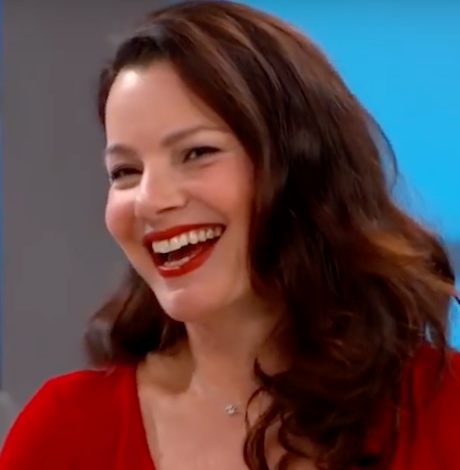
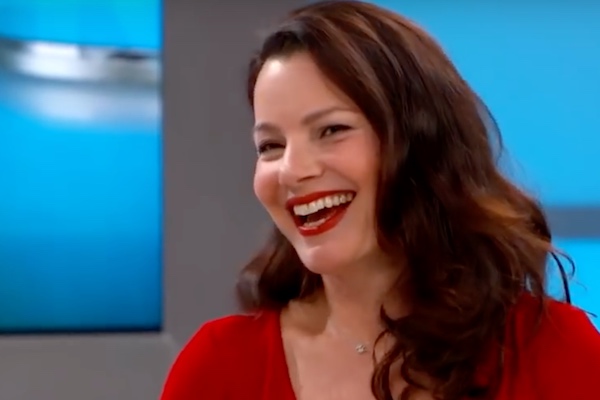
Fran Drescher (Screenshot via YouTube)
Fran Drescher spilled that there have been discussions for a possible “The Nanny” revival.
Drescher revealed to Entertainment Tonight that the sitcom, which celebrates its 25th anniversary this year, may be headed back to the small screen.
“We’re talking about it,” she says. “Peter [Marc Jacobson] and I are talking about it.”
Drescher and her ex-husband Marc Jacobson created the show, based loosely on her life growing up in Queens, New York, in 1993. It chronicled the adventures of Fran Fine as she became the nanny to British Broadway producer Maxwell Sheffield’s three children. The sitcom would go on for six seasons before ending in 1999.
“The thing is our show would be the same characters 20 years later. We can’t just pick up where we left off. But in a way, that could be really good because the show can have a whole fresh bend to it,” Drescher says.
As for what her sitcom counterpart would be up to these days, Drescher believes she would be politically outspoken.
“That’s what I think Fran would be doing now — opening her big Queens mouth for the greater good,” Drescher says.


Celebrity News
My evening with Madonna
Gay icon headlined the World Pride Music Festival in Amsterdam

Editor’s note: International News Editor Michael K. Lavers and Photo Editor Michael Key will be on assignment in the Netherlands through Aug. 10. They will be covering World Pride in Amsterdam.
AMSTERDAM — Madonna and 6,000 of her closest friends celebrated World Pride at Amsterdam’s AFAS Live concert hall early Sunday morning. I was fortunate enough to be one of them.
Madonna last Wednesday nearly broke the internet when she said on social media in Dutch that “I got somethin’ I wanna talk about,” referring to an opening line in “Danceteria,” one of the tracks on her “Confessions II” album that has received rave reviews since its July 2 release. The track has been on near constant replay on my playlist since I first heard it.
— Madonna (@Madonna) July 28, 2026
MISTR — a telehealth platform that offers free access to PrEP, Doxy PEP, STI testing, and long-term care that has organized Madonna’s Club Confessions shows in the U.S. and the U.K. — later confirmed the rampant speculation. I woke up on July 30 to an email in my inbox from MISTR and the World Pride Music Festival PR team that said I was on the press list.
Madonna was indeed going to headline the World Pride Music Festival that Jake Resnicow and Insomniac produced, and I was going to be there. OMFG!!!!
The gay icon had one more surprise in store.
The Dutch internet on Saturday once again broke over speculation that Kylie Minogue was going to appear alongside Madonna. I was getting ready to leave our hotel in Amsterdam on Saturday night when I saw a video of the two of them together.
“Madonna is now teasing Kylie Minogue on her social media … she may be one of her ‘special guests’ tonight,” I wrote in a text to Washington Blade Editor Kevin Naff at 8:46 p.m.
“Have fun! This is turning into the gayest concert ever,” he responded.
I arrived at AFAS Live shortly before 11 p.m. My press contact walked me and two other Dutch journalists into the venue’s cavernous main room known as the Black Box. We made small talk for a few minutes before I started to walk around and listen to Josh Harrison who was on the decks.
Madonna was scheduled to take the stage at 1:30 a.m., but she is known for being late — she is Madonna and she does what she wants. Hayla, a British singer, and Bebe Rexha are among those who performed ahead of Madonna. Thousands of sweaty men — including a group of Australians next to me who were eagerly awaiting Kylie’s anticipated appearance — packed the Black Box and were dancing, anticipating what was to come.

MISTR CEO Tristan Schukraft at one point came on stage and declared Madonna was indeed in the building. The moment for which we were all eagerly waiting finally came shortly before 2:30 a.m.
“Mother is here and this is gay heaven,” said Madonna when she took the stage.
Stuart Price, who produced her “Confessions on a Dance Floor” album in 2005, manned the decks during Madonna’s set.
She opened it with “I Feel So Free” from “Confessions II.” Madonna then sang “Bring Your Love” and “Danceteria” to which this reporter — and everyone else — sang along.
Madonna then teased a surprise before she began to perform “Love Sensation.” Kylie soon appeared on stage. It was nearly too much for my fellow partygoers from Australia. It was indeed the gayest concert ever!
Madonna and Kylie performed “Love Sensation” together. They then sang “Hung Up” and “Sorry” from “Confessions on a Dance Floor” to round out the set that ended shortly after 3 a.m.
Madonna and I share the same birthday — Aug. 16 — and I would like to think she and Kylie gave me an early birthday present. In all seriousness though, it was an amazing night for me and for everyone else who was fortunate enough to be there.
“On the dance floor I feel so free,” says Madonna in the opening of “I Feel So Free.”
For those few precious hours at AFAS Live I did not think about the Trump-Vance administration and the myriad ways it is destroying the U.S. I did not think about the National Guard troops deployed to D.C. I did not think about the pointless wars that continue to ravage Ukraine and other countries around the world. I simply lost myself on the dance floor and celebrated an icon who has always stood with my community.
Thank you, Madonna.

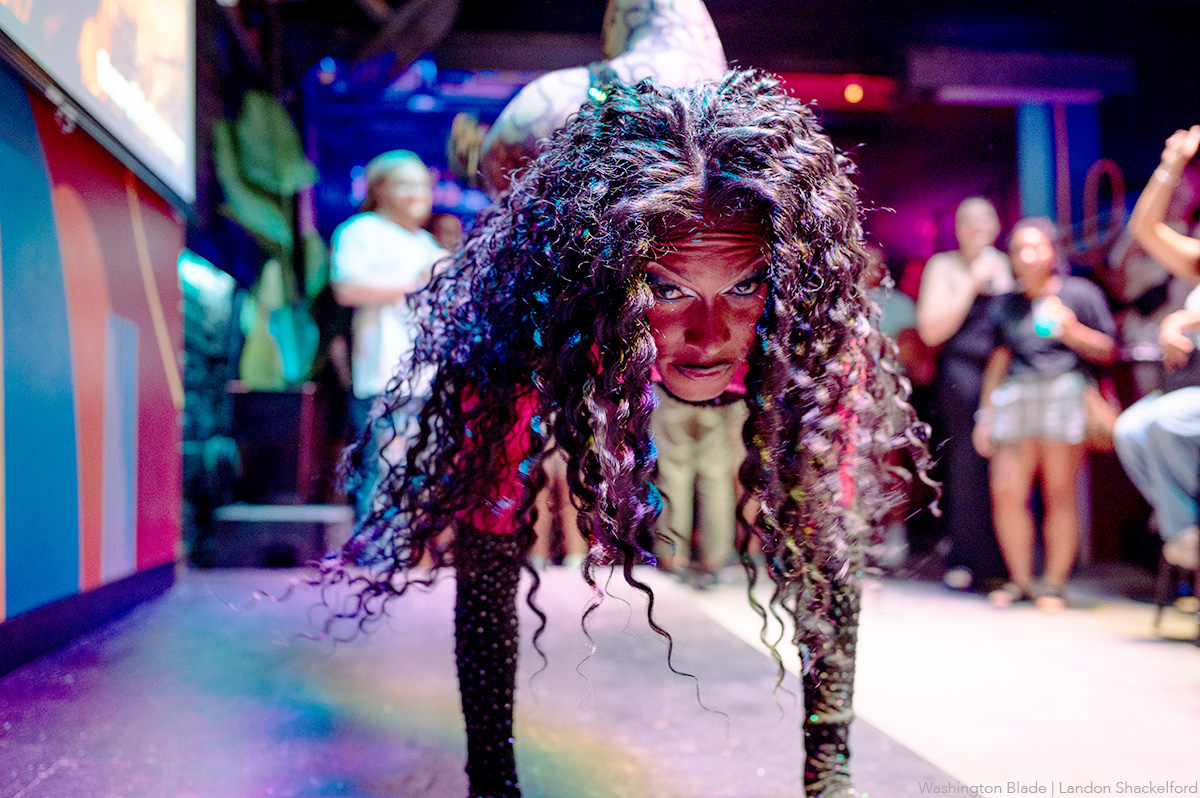
The Petal Release Party and Drag Show was held at Spark Social on Friday, July 31. Performers included Tiara-Missou, Labianna and Darcy de la Cuadra.
(Washington Blade photos by Landon Shackelford)




Celebrity News
Madonna headlines World Pride Music Festival in Amsterdam
Kylie Minogue made surprise appearance alongside gay icon

AMSTERDAM — Madonna on Sunday headlined the final night of the World Pride Music Festival in Amsterdam.
The gay icon took the stage shortly before 2:30 a.m. local time (8:30 p.m. ET on Saturday) during Club Confessions, a set that MISTR, a telehealth platform that offers free access to PrEP, Doxy PEP, STI testing, and long-term HIV care, organized.
“Mother is here and this is gay heaven,” said Madonna when she took the stage inside Amsterdam’s AFAS Live concert hall that can hold up to 6,000 people.
Stuart Price, who produced Madonna’s 2005 “Confessions on a Dance Floor” album and “Confessions II,” which debuted on July 2, DJed the set.
Kylie Minogue made a surprise appearance. She and Madonna performed a new remix of “Love Sensation” from “Confessions II.”
(Washington Blade video by Michael K. Lavers)
“Throughout my career, I’ve always supported efforts to fight HIV and AIDS, and that fight begins with education and access,” said Madonna in a MISTR press release. “With MISTR, (CEO) Tristan (Schukraft) is expanding access to HIV prevention and sexual healthcare for everyone. Through this work, he’s helping preserve and strengthen LGBTQ+ spaces while investing in the communities and culture that have long sustained us.”
Minogue in an Instagram post thanked Madonna, Price, Schukraft, and MISTR.
Madonna appeared at The Abbey in West Hollywood, Calif., in April. Madonna in June celebrated Pride month with a pop-up performance in New York’s Times Square.
Jake Resnicow and Insomniac produced the World Pride Music Festival that also featured Bebe Rexha and Paris Hilton, among others.
“Pride has always been about bringing our community together,” said Resnicow. “At a moment when too many people are being told to hide or make themselves smaller, gathering openly, joyfully, and without apology matters more than ever. I couldn’t be prouder of what this festival brought to life in Amsterdam — one dance floor, completely free.”

Buttigieg indicates he may run for president in 2028

Remembering Elliot Leonard, generous visionary who helped LGBTQ communities thrive

My evening with Madonna

PHOTOS: Petal Release Party

Madonna headlines World Pride Music Festival in Amsterdam

PHOTOS: Lambda Legal in the Pines

Calendar: July 31-August 6

Taiwan’s government has failed to update process to change gender markers on ID documents

Come showcase your singing, poetry talent