Arts & Entertainment
‘Flash’ actor Rick Cosnett comes out as gay
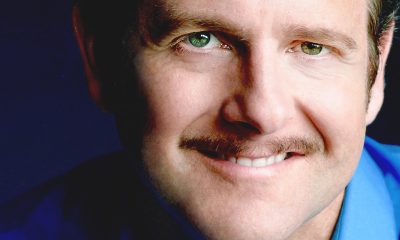
Another young actor has just joined the growing list of celebrities who have decided to go public about being gay.
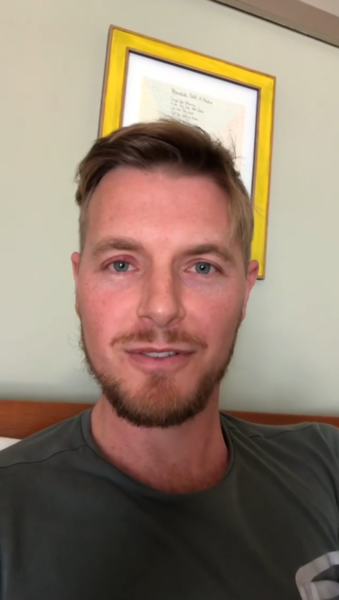
Rick Cosnett, known to fans as Eddie Thawne on “The Flash,” Wes Maxfield in “The Vampire Diaries, and Elias Harper in “Quantico,” came officially out of the closet on Thursday evening with a brief, no-nonsense announcement on his Instagram.
“Hi everyone,” says the 36-year-old Cosnestt in the clip. “Dramatic pause. Um, I’m gay and I just wanted everyone to know because I’ve made a promise to myself to live my truth every day and sometimes that is a really hard thing to do when you have all these subconscious things that you don’t even know about from childhood and society and from just life. There you go. I’m sure most of you probably knew anyway. And … um yeah. That’s actually all I wanted to say.”
He closed by quipping, “I also have a stye on my eye which really adds to the drama of the whole thing.”
Cosnett was born in Zimbabwe, where he was raised on a farm in Chegutu by theatre-loving parents who gave him the acting bug. At seventeen, the family moved to Australia, where he studied at Queensland University of Technology in Brisbane, eventually receiving a Bachelors of Fine Arts in Acting He launched his career with roles on Australian television before being cast on “Vampire Diaries” in 2013.
As an unexpected piece of trivia, his cousin is actor Hugh Grant.
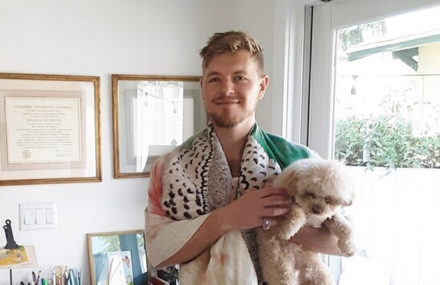
Cosnett teased his announcement with another Instagram post earlier in the week, posting a photo of himself in a white dress and multi-colored scarf with a caption thanking friends for “helping me find and experiment with my self expression.”
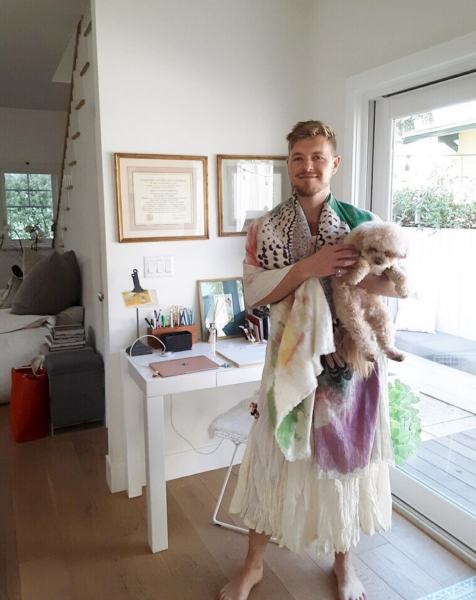
“Feels good, and terrifying,” he added, and finished with a quote:
“’So those bars I see that restrain your wings,
I guess you won’t mind
if I pry them open.’ ~ Rumi”
Judging from the comments on Cosnett’s announcement, his fans are overwhelmingly supportive.




Movies
‘Spaced out on sensation’: a 50-year journey through a queer cult classic
Excellence of ‘Rocky Horror’ reveals itself in new layers with each viewing

Last week’s grab of nine Tony nominations for the new Broadway revival of “The Rocky Horror Show” – coming in the midst of the ongoing 50th anniversary of the cult-classic movie version – seems like a great excuse to look back at a phenomenon that’s kept us “doing the Time Warp” for decades.
It’s a big history, so instead of attempting a definitive conclusion about why it matters, I’ll just offer my personal memories and thoughts; maybe you’ll be inspired to revisit your own.
First, the facts: Richard O’Brien’s campy glam-rock musical became a London stage hit in 1973; that success continued with a run at Los Angeles’s Roxy Theatre in 1974, and a Broadway opening was slated for early 1975. In the break between, the movie was filmed, timed to ride the presumed success of the New York premiere and become a mega-hit – but it didn’t happen that way. The Broadway show closed after a mere handful of performances, and the movie disappeared from theaters almost as soon as it was released.
This, however, was in the mid-1970s, when “cult movies” had become a whole countercultural “scene,” and the film’s distributor (20th Century Fox) found a way to give “The Rocky Horror Picture Show” another chance at life. It hit the midnight circuit in 1976, and everybody knows what happened after that.
When all of this was happening, I was still a pre-teen in Phoenix, and a sheltered one at that. It wasn’t until 1978 – the summer before I started high school – that it entered my world. Already a movie fanatic (yes, even then), I had discovered a local treasure called the Sombrero Playhouse, a former live theater converted into an “art house” cinema; my parents would take me there and drop me off alone (hey, it was 1978) for a double feature. I remember that place and time as pure heaven.
It was there that “Rocky Horror” found me. The Sombrero, like so many similar venues across the country, made most of its profits from the midnight shows, and “The Rocky Horror Picture Show” was the star attraction. I saw the posters, watched the previews, got my first peeks at Tim Curry’s Frank, Peter Hinton’s Rocky, and all the rest of the movie’s alluringly “freaky” cast; when I came out of the theater after whatever I had watched, I would see the fans lining up outside for the midnight show. I could see their weird costumes, and smell the aroma I already knew was weed, and I knew this was something I should not want to have any part of – and yet, I absolutely did.
After I started high school and found my “tribe” with the “theater kids,” I was invited by a group of them – all older teenagers – to go and see it. I had to ask my parents’ permission, which (amazingly) they granted; they even let me ride with the rest of the “gang” in our friend’s van – with carpeted interior, of course – despite what I could see were their obvious misgivings about the whole situation.
It would be over-dramatic to say that night changed my life, but it would not be wrong, either. I was amazed by the atmosphere: the pre-movie floor show, the freewheeling party vibe, the comments shouted at the screen on cue, the occasional clatter of empty liquor bottles falling under a seat somewhere, and that same familiar smell, which delivered what, in retrospect, I now know was a serious contact high.
As for the movie, I had already been exposed to enough “R” rated fare (the Sombrero never asked for ID) to keep me from being shocked, and the gender-bent aesthetic seemed merely a burlesque to me. I was savvy enough to see the spoof, to laugh at the lampooning of stodgy 1950s values under the guise of a retro-schlock parody of old-school movie tropes; I “got it” in that sense – but there was so much about it that I wasn’t ready to fully understand. Because of that, I enjoyed the experience more than I enjoyed the film itself.
I’m not sure how many times I saw “Rocky Horror” over the next few years, but my tally wasn’t high; I drifted to a different friend group, became more active in theater, and had little time for midnight movies in my busy life. I was never in a floor show and rarely yelled back at the screen (though I did throw a roll of toilet paper once), and I didn’t dress in costume. Even so, I went back to it periodically before the Sombrero closed permanently in 1982, and as I gradually learned to embrace my own “weirdness,” I came to connect with the weirdness that had always been calling me from within the movie. Each time I watched it, I did so through different eyes, and they saw things I had never seen before.
That process has continued throughout my life. I’ve frequently revisited “Rocky” via home media (in all its iterations) and special screenings over the years, and the revelations keep coming: the visual artistry of director Jim Sharman’s treatment; the dazzling production design incorporating nods to iconic art and fashion that I could only recognize as my own knowledge of queer culture expanded; the incomparable slyness of Tim Curry’s unsubtle yet joyously authentic performance; the fine-tuned perfection of Richard O’Brien’s ear-worm of a song score. The excellence of “The Rocky Horror Picture Show” revealed itself in new layers with every viewing.
There were also more intimate realizations: how Janet was always a slut and Brad was always closeted (I related to both), and how Frank’s seduction becomes the path to sexual liberation for them both; how Rocky was the “Über-Hustler,” following his uncontrolled libido into exploitation as a sex object while only desiring safety and comfort (I related to him, too), and how the “domestics” were driven to betray their master by his own diva complex (I could definitely relate to both sides of that equation). How Frank-N-Furter, like the tragic Greek heroes that still echo in the stories we tell about ourselves, is undone by hubris – and anybody who can’t relate to that has probably not lived long enough, yet.
The last time I watched (in preparation for writing this), I made another realization: like all great works of art, “The Rocky Horror Picture Show” is a mirror, and what we see there reflects who we are when we gaze into it. It’s a purely individual interaction, but when Frank finally delivers his ultimate message – “Don’t dream it, be it” – it becomes universal. Whoever you are, whoever you want to be, and whatever you must let go of to get there, you deserve to make it happen – no matter how hard the no-neck criminologists and Nazi-esque Dr. Scotts of the world try to discourage you.
It’s a simple message – obvious, even – but it’s one for which the timing is never wrong; and for the generations of queer fans that have been empowered by “The Rocky Horror Picture Show,” it probably feels more right than ever.
a&e features
Yes, chef!
From military service in Syria to cooking in coastal Delaware, Justin Fritz delivers comfort and connection
Driving down the long stretch of road that connects Rehoboth to Bethany Beach, I’m thinking about the morning ahead of me. I’ve done tough jobs before on subjects I knew nothing about. But when it comes to this assignment – profiling a local chef – I can’t help but worry that I’ve bitten off more than I can chew.
I eat food. I love food. Ironically, I can’t cook.
Sure, I can make a passable meal in a pinch, but when it comes to innate culinary skills, I don’t have the gene. That means I eat out often. Even when the food is good, the experience is rarely inspiring. I have no doubt that the guy I’m about to profile can cook, but for me, food is fuel, not fun. Writing about eating feels like reading about dancing. You can understand the mechanics, but the magic is harder to capture.
Sooner than I expected, I reach my destination. Rising quietly from the dunes, the weathered cedar shingles and wraparound porch of The Addy Sea Inn gives off the kind of understated confidence money can’t buy. Built in 1904, it doesn’t try to impress you. It just does. I pull into a gravel parking space, step out of the car, and take a breath. Already, I sense that I’ve misjudged what this morning will be.
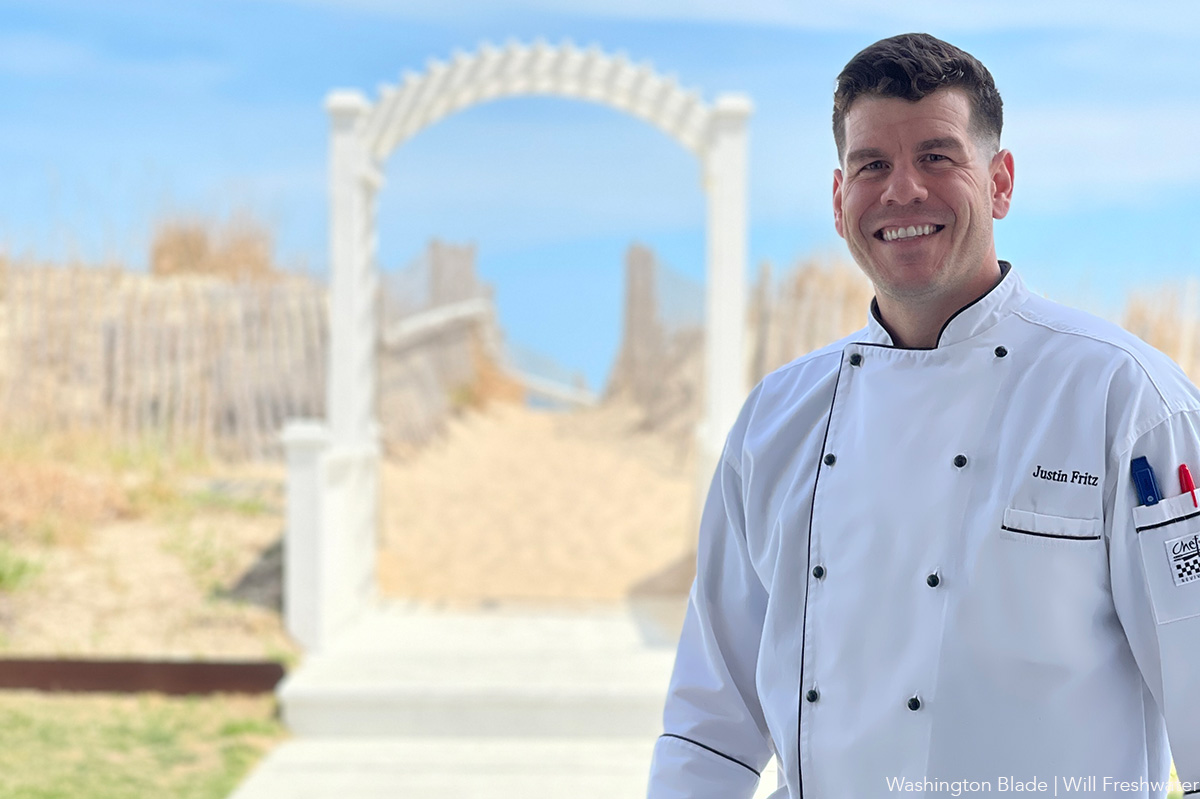
Inside, breakfast service has just wrapped, but the dining room is still humming with energy. Plates clink. Fresh coffee is brewing. After a quick round of introductions with the staff, I’m ushered back to the kitchen, where Executive Chef Justin Fritz is waiting.
The room is modest, only slightly larger than my kitchen at home, anchored by a narrow stainless-steel island that serves as the operational center. Whatever the kitchen lacks in space it makes up for in technology. The appliances are state-of-the-art and the multi-tiered glass oven on the wall looks smarter than I am.
There’s no brigade of line cooks. No shouted orders. No “Hands” or “Yes, chef!” echoing off the walls. There’s just me and him. It’s a one-man show.
His first wedding tasting is less than an hour away, but instead of rushing, Justin offers me the grand tour. Pride radiates from him — not ego, but something quieter. We move through the inn, past guests and staff he greets by name, out onto a porch overlooking the beach and Atlantic, where meticulously planned weddings unfold like carefully choreographed dreams.
“This whole place transforms,” he says, gesturing toward the lawn. “We pitch a 90-foot tent in a yard that can accommodate 150 guests. We set the DJ and the bar up in the back on a floating deck that becomes a dance floor.”
On our way back inside, we stop to see herbs growing in a double row of hanging planters — mint, basil, strawberries trailing down the wall like decorations you can eat. It’s not performative. It’s practical. Everything here has a purpose.
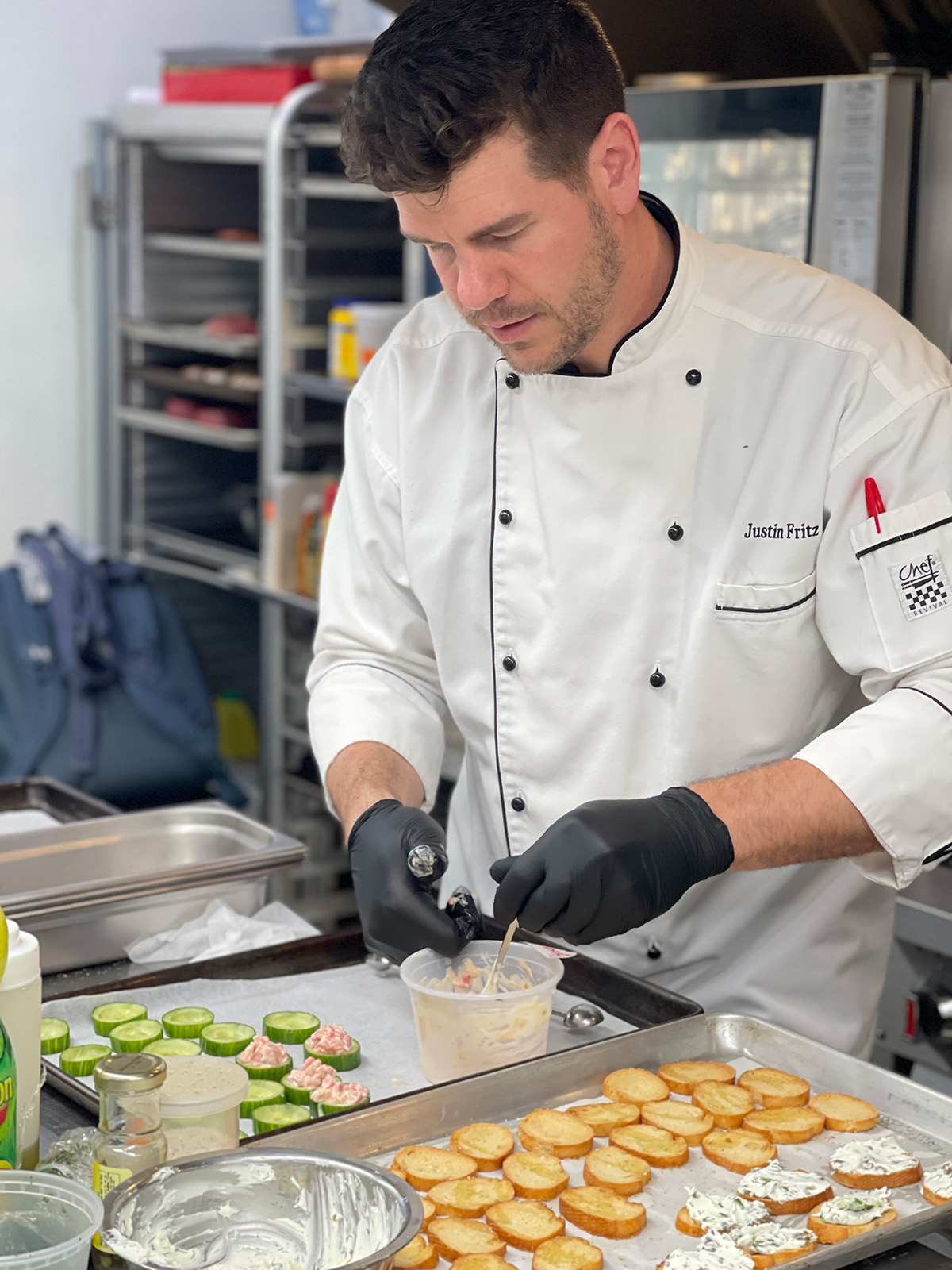
Back in the kitchen, the tempo shifts. There are no printed-out recipes or neatly arranged mise en place. Justin stops talking just long enough to consult the whiteboard hanging on his refrigerator. There are notes – words, not sentences – cueing him on all the things he needs to remember.
When he finally goes into action, it’s intense, but controlled. Justin knows every inch of his kitchen and moves efficiently to gather what he needs to get five different entrees into the oven. I try to be a fly on the wall, but I’m the elephant in the room. I try, and fail, to move out of his way.
After our fifth near-collision, he laughs. “You just stay there,” he says. “I’ll move around you.” And he does.
Justin’s path to The Addy Sea Inn wasn’t linear, and in many ways, that’s what defines him. After culinary school and early professional success, he made a decision that shifted everything: He enlisted in the Army Reserves alongside his younger brother. In an unexpected twist, Justin completed the enlistment process first, while his brother’s path was delayed pending a medical waiver.
Initially, Justin’s role had nothing to do with food. He worked as a computer technician, repairing advanced equipment — a technical, methodical position that stood in stark contrast to the creative environment of a kitchen. Then, as often happens in Justin’s stories, his circumstances changed. A casual conversation with a commanding officer one afternoon led to a sudden reassignment.
“He said, ‘You’re supposed to be at the range. Get in the car — I’ll explain on the way.’” Justin recalls. “Next thing I know, I’m deploying.”
The destination was Syria. And instead of working with electronics, he found himself back in a kitchen — only this time, under conditions that redefined what cooking meant.
“They didn’t want military cooking,” he says. “They wanted home cooking.”
That expectation, simple on the surface, became extraordinarily complex in practice. Ingredients had to be sourced from local markets where quality and safety were inconsistent. Refrigeration was limited. Water couldn’t be trusted. Meat arrived butchered in ways that required improvisation rather than precision.
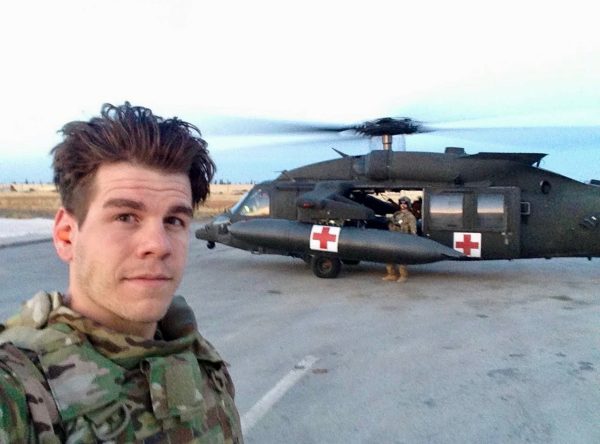
“One time I ordered lamb,” he says. “It came back as bones. Just bones. I scraped the meat off and turned it into sausage because I couldn’t waste it.”
So, Justin adapted. He baked bread from scratch, created meals that could be eaten days later, and found ways to bring a sense of normalcy into an environment defined by uncertainty. French toast, burritos, pretzels, tiramisu — dishes that, under different circumstances, might have felt routine became something else entirely.
“I think people underestimate what food means,” he says. “It’s not just eating. It’s memory. It’s comfort. It’s safety.”
That last word lingers.
By the time Justin arrived at The Addy Sea Inn, he carried more than just professional experience. He brought discipline, resilience, and a perspective shaped by environments far removed from coastal Delaware. But he also brought uncertainty.
The new role required something different from what he’d done before. Here, he wasn’t executing someone else’s vision — he was responsible for creating one.
“I realized I get to do this,” he says. “I get to build this.”
What he has built is both ambitious and carefully controlled. Under new ownership and with a growing team, The Addy Sea Inn has evolved into a sought-after destination for weddings and events. The scale has increased, but the operation remains intentionally lean, which puts more pressure on Justin to deliver.
A single day might include breakfast service, take-away lunch preparation, afternoon tea, wedding tastings, and a full-scale event execution. Layered on top of that are cooking classes, early-stage digital content, and a catering business Justin has deliberately paused so he can focus on something more cohesive.
“I want to grow the culinary side of this place,” he says. “Not just more events, but better experiences. Classes, tastings — things that bring people into it. I love teaching. I love sharing it.”
It’s a vision rooted less in expansion and more in depth. Not more for the sake of more, but more meaningfully.
When I return a few days later for breakfast service, the experience feels both familiar and entirely new.
The day begins with sunrise. Before anything else, Justin pauses and brings his team outside. It isn’t a long break, and it isn’t framed as anything formal. It’s simply a moment — watching the light shift over the water, occasionally catching sight of dolphins moving just beyond the shoreline.
Then, without ceremony, the work begins.
Eggs crack. Bacon sizzles, potato pancakes bake on the grill. Orders move in and out with steady consistency. There’s no frantic energy, no sense of scrambling to keep up. Instead, there’s a flow — continuous, measured, almost meditative.
“It doesn’t always feel like work,” he says.
Watching him move through the morning, it’s easy to understand why.
Hours later, after the hustle and bustle of the first meal has ended, Justin turns his attention to a larger, albeit more creative task — cupcakes for two themed parties. Already inspired, he lifts a heavy electric mixer onto the counter and pushes a flour-dusted binder in front of me.
“I’ll bake the cupcakes. You make the butter-cream frosting,” he says, flipping to the page with the recipe. “Double it.”
The request sends me into a mild panic, especially since it requires math. But Justin believes I can do it. To my surprise, so do I. The first batch of chocolate cupcakes are already out of the oven before I finish the first bowl of frosting. Since all I have to do is repeat the process, I’m starting to feel relieved and maybe even a little cocky. That’s when it hits me.
“Chef, I made a mistake…I forgot to double the amount of vanilla. I need to do it over.”
“It’s fine,” Justin says casually, swiping a small disposable plastic spoon across the silky surface. “It tastes great. Focus on the next batch.”
The result, two exquisitely decorated cupcakes, are almost too pretty to eat.
“These are yours to take home,” he says as he carefully packs them away in a to-go box.
I start to protest, to tell him he should save the best for himself or the other guests. But I stop myself and pause and savor the moment. This one, I keep.
Chef Justin Fritz resists easy categorization, and that may be part of what makes him so compelling. He is classically trained, but without pretense. His military background suggests rigidity, yet his approach is flexible and intuitive. He carries himself with a quiet confidence, never needing to announce it. Part Jason Bourne, part Willy Wonka. Justin isn’t just cooking food, he’s making magic.
By the time I leave, my understanding of the assignment has shifted. What I expected to be a story about food has become something broader, more nuanced. It’s about care. About connection.
That sense of purpose extends beyond the kitchen. When I ask Justin what’s next, he speaks not just about growth and ambition, but about balance — about building a life that allows space for both. There’s a quiet acknowledgment of Cheyenne, his partner of five years, woven into that answer. Not as a headline, but as something steady and grounding, part of how he measures what comes next.
I arrived thinking I would write about a chef. What I found instead was someone who uses food as a language — a way to communicate, to connect, and to create something that stays with you.
The only way to experience Chef Justin’s cooking is to step inside his world — by checking into The Addy Sea Inn (www.addysea.com) or securing a ticket to one of the inn’s limited public events, including the Spring Soirée and the Toys for Tots Holiday Fundraiser. There’s no standalone restaurant, no reservation to book online. His food exists within the rhythm of the inn itself.
In louder, larger kitchens, “Yes, chef!” is a command — sharp, immediate, unquestioned.
But here, at the edge of the ocean, it lands differently.
Not as an order.
As trust.
And maybe that’s the real story — not the food, not the title, but the quiet, deliberate way Chef Justin Fritz makes people feel something they don’t forget.
Sports
Jason Collins dies at 47
First openly gay man to actively play for major sports team battled brain cancer
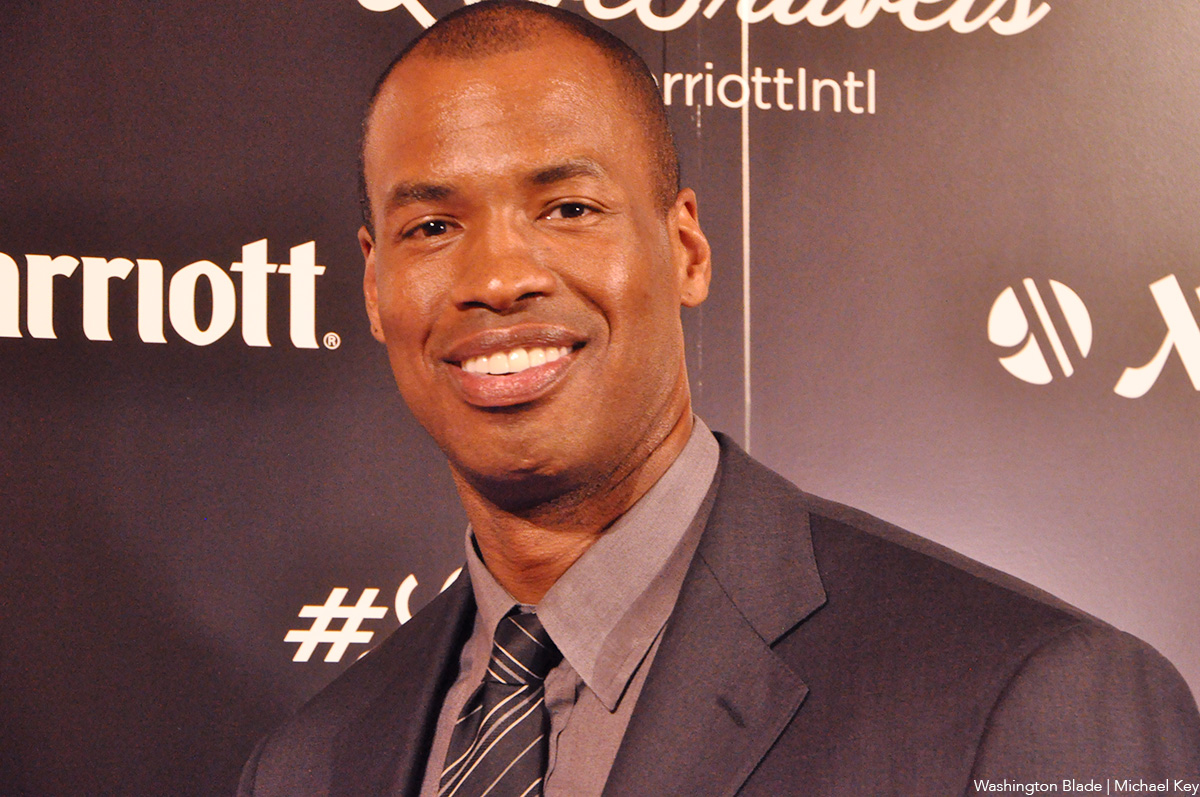
Jason Collins, the first openly gay man to actively play for a major professional sports team, died on Tuesday after a battle with brain cancer. He was 47.
The California native had briefly played for the Washington Wizards in 2013 before coming out in a Sports Illustrated op-ed.
Collins in 2014 became the first openly gay man to play in a game for a major American professional sports league when he played 11 minutes during a Brooklyn Nets game. He wore jersey number 98 in honor of Matthew Shepard, a gay college student murdered outside of Laramie, Wyo., in 1998.
Collins told the Washington Blade in 2014 that his life was “exponentially better” since he came out. Collins the same year retired from the National Basketball Association after 13 seasons.
Collins married his husband, Brunson Green, in May 2025.
The NBA last September announced Collins had begun treatment for a brain tumor. Collins on Dec. 11, 2025, announced he had Stage 4 glioblastoma.
“We are heartbroken to share that Jason Collins, our beloved husband, son, brother and uncle, has died after a valiant fight with glioblastoma,” said Collins’s family in a statement the NBA released. “Jason changed lives in unexpected ways and was an inspiration to all who knew him and to those who admired him from afar. We are grateful for the outpouring of love and prayers over the past eight months and for the exceptional medical care Jason received from his doctors and nurses. Our family will miss him dearly.”
NBA Commissioner Adam Silver said Collins’s “impact and influence extended far beyond basketball as he helped make the NBA, WNBA, and larger sports community more inclusive and welcoming for future generations.”
“He exemplified outstanding leadership and professionalism throughout his 13-year NBA career and in his dedicated work as an NBA Cares Ambassador,” said Silver. “Jason will be remembered not only for breaking barriers, but also for the kindness and humanity that defined his life and touched so many others.”
“To call Jason Collins a groundbreaking figure for our community is simply inadequate. We truly lost a giant today,” added Human Rights Campaign President Kelley Robinson in a statement. “He came out as gay — while still playing — at a time when men’s athletes simply did not do that. But as he powerfully demonstrated in his final years in the league and his post-NBA career, stepping forward as he did boldly changed the conversation.”
“He was and will always be a legend for the LGBTQ+ community, and we are heartbroken to hear of his passing at the young age of 47,” she said. “Our hearts go out to his family and loved ones. We will keep fighting on in his honor until the day everyone can be who they are on their terms.”

Capital Stonewall Democrats endorses Janeese Lewis George for D.C. mayor

UK government makes trans-inclusive conversion therapy ban a legislative priority

‘Live Your Pride’ is much more than a slogan

‘Spaced out on sensation’: a 50-year journey through a queer cult classic

Lambda Legal names new deputy policy director

America’s broken pipeline of mental healthcare for trans youth

Senate Democrats press DOJ over anti-trans prison directives

DJ Chanel Santini is bringing the heat and some gender-fluid diversity to XBIZ Miami

National tour of ‘Gatsby’ comes to National Theatre

Anti-LGBTQ violence prevention efforts highlighted at D.C. community fair
-

 National3 days ago
America’s broken pipeline of mental healthcare for trans youth
-
Federal Government4 days ago
Senate Democrats press DOJ over anti-trans prison directives
-
Music & Concerts5 days ago
DJ Chanel Santini is bringing the heat and some gender-fluid diversity to XBIZ Miami
-
Theater5 days ago
National tour of ‘Gatsby’ comes to National Theatre