Opinions
Opinion | U.S. senators: It’s time to act against anti-LGBTQ discrimination
Draw your inspiration from past bipartisan consensus
Georgia has had the eyes of the nation on it for some time now. It’s just over five years since people across Georgia braced themselves as lawmakers sent sweeping anti-LGBTQ legislation to the desk of then-Gov. Nathan Deal. The LGBTQ community feared for the potential harms that the broad “license to discriminate” bill could bring. Business leaders feared billions of dollars being drained from the state’s economy as major players from Hollywood, the business sector, and even the NFL threatened to pull investments.
But after thousands of calls, meetings, and letters, Gov. Deal, a Republican and devout Evangelical Christian, ultimately did the right thing. He vetoed the bill, saying, “We do not have a belief in my way of looking at religion that says we have to discriminate against anybody.”
At the time Gov. Deal’s veto was heralded as a radical move for a Republican leader. But the truth is that Republican lawmakers faced with bills targeting LGBTQ people frequently take action against these measures. We saw it earlier this year in Arkansas as Gov. Asa Hutchinson vetoed a draconian anti-transgender healthcare bill. Earlier this year, Utah Gov. Spencer Cox teared up while condemning an anti-trans bill, saying, “These kids are just trying to stay alive.” Prominent Republican leaders in South Dakota, Texas, South Carolina, and Arizona have vetoed or moved to block anti-LGBTQ bills. Stalwart Republican senators from Alabama and Iowa have passionately supported open military service for transgender people.
There are plenty of examples of Republicans supporting LGBTQ people, but they’ve often been lost in the headlines stoking the so-called left-versus-right “culture wars.”
In my home state of Georgia, Gov. Deal’s action inspired further evolution on LGBTQ issues. In the five legislative sessions since Gov. Deal’s veto, Georgia’s legislature has not passed a single anti-LGBTQ bill. Republicans and Democrats alike have defended LGBTQ Georgians from discriminatory measures. And so many Georgians across the political spectrum – within families, friend groups, and workforces – have had conversations about what dignity for LGBTQ people looks like.
Now it’s time for the members of the United States Senate to build on that consensus by taking the most important and critical step yet for LGBTQ Americans. It’s time for senators on both sides of the aisle to come together and enact equality legislation that would establish concrete, enduring nondiscrimination protections for all LGBTQ people in areas like housing and public spaces, including restaurants, stores, and hospitals. LGBTQ people in too many states – 29 nationwide – remain vulnerable because of a lack of explicit nondiscrimination laws at the state and federal levels.
Polling consistently shows that a wide majority of Americans of both political parties strongly supports protecting LGBTQ people from discrimination. More than eight in 10 Americans support LGBTQ-inclusive nondiscrimination laws, including 62% of Republicans. We cannot let the loudest voices of a fringe minority hold our country back from delivering the promise of liberty, security, and equality for all people, no matter where they live.
Because really, we are so close to passing federal LGBTQ protections – closer than ever before. Nearly 50 years after its first introduction in Congress, the Equality Act passed with bipartisan support in the House, and received its first-ever Senate hearing. Republican senators in the Senate Judiciary Committee voiced empathy for the harms that discrimination has caused LGBTQ people. They also expressed a willingness to finding a path to protect us. And there is more than one bill proposed to address the inequity that LGBTQ people are subjected to. The Senate judiciary committee opened a door to the long overdue conversation.
Now it’s on us to hold that door open and guide all of our senators through. Democratic senators must reach out to their Republican colleagues and address concerns. Republicans must draw on the many recent examples of conservative leaders working to protect LGBTQ people.
We can’t afford another 50 years of federal inaction on our protections. We can’t afford for the two parties to keep butting heads in a bitter stalemate. For the first time in history, we have a real opportunity to secure protections for LGBTQ Americans.
We must seize this opportunity, seek common ground and find a solution that works for everyone. It’s essential that right, left, and center come together, reach consensus, and do the right thing. At last.
Jeff Graham is executive director of Georgia Equality. Reach him at [email protected].





Opinions
BLADE ENDORSEMENT: Susan Stewart for mayor of Rehoboth Beach
Voters should reject Suzanne Goode’s crass bullying and elect city’s first out mayor
Voters in Rehoboth Beach head to the polls on Aug. 8 to elect a new mayor and the choice couldn’t be more obvious.
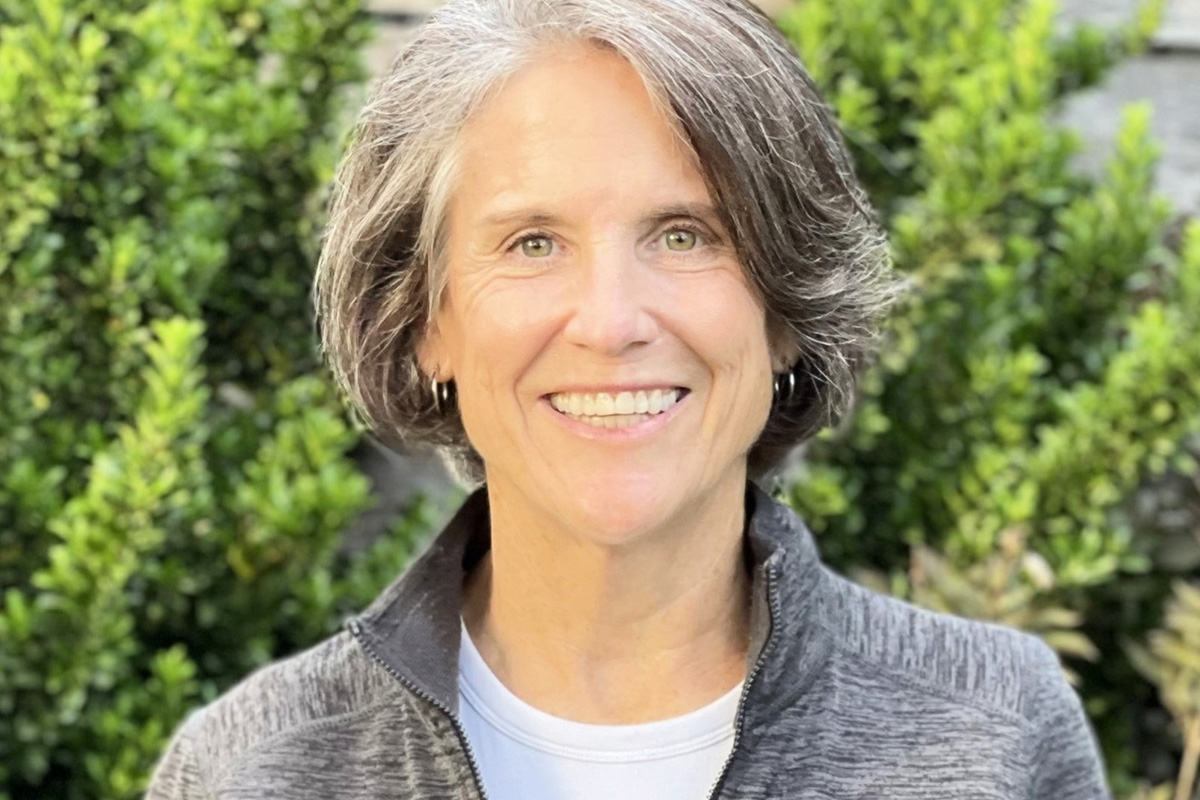
Susan Stewart is a smart, effective Commissioner with a background in finance who happens to identify as part of the LGBTQ community, which would make her the first openly gay Rehoboth mayor if elected. Stewart has worked as an attorney and later a financial services adviser at major banks and brokerage firms. In 1996, she founded her own financial advisory firm. She currently works as a financial adviser and senior vice president with The StewartGroup, RBC Wealth Management. She also serves on the Rehoboth Beach Commission and has served on the Planning Commission and the Mixed-Use and Stormwater Utility Task Forces. She has a deep knowledge of the inner workings of the city, including budgeting and development along with an appreciation for what makes Rehoboth special — its natural beauty, walkability, and charming character.
“Rehoboth Beach has important opportunities ahead,” Stewart says on her campaign website. “From infrastructure improvements and stormwater solutions to commercial revitalization and responsible growth, the decisions we make today will shape our city for decades. I am committed to helping Rehoboth Beach move forward.”
Stewart is our choice for mayor. She would represent the city well as it looks to the future with the retirement of Mayor Stan Mills, who has served for six years in that role after 12 years as a Commissioner.
There is a special urgency to the election this year with the mayoral candidacy of fellow Commissioner Suzanne Goode, a divisive figure whose emails have raised serious questions about her judgement and legitimate concerns about where she stands on LGBTQ issues.
Controversy erupted in March when Stewart outlined allegations that Goode used derogatory language in emails, particularly toward City Manager Taylour Tedder.
“All of our emails are public information under FOIA,” Stewart told the Blade in a recent interview. “I simply asked the city to link them on the website, and then the city published a transcript of [Goode’s emails].”
Stewart said that she did this on behalf of the city’s employees such as Tedder: “We have a moral and legal obligation to support our employees,” Stewart told the Blade. Goode denied all of the allegations and said that they were based on falsehoods.
Tedder has accused Goode of creating a “hostile work environment” for city employees and publicly rebuked Goode for insulting him in an email as “the mayor’s whore.”
“Calling me a derogatory term, the ‘mayor’s whore,’ which I don’t think is a professional way to put something, talking badly about an employee’s religion,” Tedder said.
Tedder was referring to an email in which Goode wrote to Rehoboth Beach City Solicitor Lisa Borin Ogden: “I am sorry that I learned from Google when you were first interviewed [in the] spring [of] 2025 that you are Jewish. My opinion of my fellow Jews declined significantly thanks to you since last summer. Actually would have thought you would have more compassion than the average person, based on your late brother. Except you don’t. I am sick of your haughty attitude toward me.”
Goode, who’s Jewish, denied the remark was racist.
“I don’t think a Jewish person can discriminate against another Jewish person,” Goode said, according to a March report by Coast TV News.
But Mayor Mills issued a statement calling the remarks “reprehensible and unbecoming of an elected official in our community.”
That’s putting it diplomatically. Referencing a city official’s religion and then invoking her dead brother should be disqualifying for a mayoral candidate. But it gets worse. The Blade reviewed Goode’s emails that were made public following local media FOIA requests. They are disturbing.
In a January email, Goode wrote to Mills demanding to know who encouraged CAMP Rehoboth and Clear Space Theatre to apply for city grant funds. She then unfairly disparages CAMP as a “questionable non-profit.” She wrote:
“Gays and theatre aficionados can donate as much as they like to these pet causes. Some taxpayers think the theatre is second-rate as community theatres go, and many dislike the RB emphasis on LGBTQ when heterosexuals don’t demand equivalent display of their sex lives in public view.”
I’ve been coming to Rehoboth since the ‘90s. We don’t “display our sex lives in public view.” But Rehoboth is that rare place in America where LGBTQ people can comfortably and safely come together in community. Where partners and same-sex spouses can hold hands in public. Where gender non-conforming visitors can express themselves. None of that has anything to do with our “sex lives” and Goode’s disgusting comment is a common slur used against our community. She should retract that statement and apologize for it. Rehoboth’s vibrancy is due in very large part to its LGBTQ residents, tourists, and business owners and we all deserve better than homophobic slurs from elected officials.
Additionally, CAMP and Clear Space are vital, affirming spaces as worthy of grant funds as any other organization. Her repeated attacks on those important Rehoboth institutions raise more concerns given they are both run by openly gay and lesbian officials.
In a November 2025 email passage about Clear Space Theatre, Goode wrote, “But there are some folks in town, who ironically have to remain in the closet (conservatives now have to do what gays had to do in the 20th century — ah, the irony) who object to the woke, drag queen bent of Clear Space at times. They have confided this in me, and thanked me for fighting for their tax dollars. Maybe I will regret speaking up, as some LGBTQ activist will attack me physically, even though I am a complete supporter of gay rights, and have as many gay male friends as female friends now that I live in RB with a large gay population.”
So Goode fears physical violence from the local LGBTQ community? I’ve been around a long time and cannot recall a Blade story about a gay person beating up a straight person in Rehoboth, though we have covered scores of gay bashings and other violent attacks targeting LGBTQ people and businesses over the decades. Equating the plight of modern conservatives to 20th century violence that killed countless LGBTQ people is the height of ignorance.
Further, her use of “woke” as a derogatory term raises alarms as it echoes President Trump’s racist and transphobic rhetoric.
In an email from just last month, Goode wrote, “Just because the LGBTQ community feels oppressed and discriminated against, that doesn’t mean that those who identify as LGBTQ are better able to recognize racial discrimination than someone like myself. It might surprise some of you to learn that I briefly dated an African American fellow college student.”
So we should trust Goode’s instincts on racial issues because she dated a Black guy in college? You can’t make this stuff up.
During a March Commissioners meeting, Goode criticized Rehoboth’s rainbow crosswalks as a “non-essential item” and questioned why they weren’t painted yellow and white, which she said would be more “effectual” for safety purposes than rainbow colors. This attack on rainbow crosswalks represents another MAGA/Trump nod. Transportation Secretary Sean Duffy last year launched a nationwide campaign to remove rainbow crosswalks. Florida Gov. Ron DeSantis, a Trump ally, ordered the removal of rainbow crosswalks, even targeting the crosswalk at the Pulse nightclub.
For these and many other reasons, Goode is unfit to serve as mayor (or Commissioner) and voters must reject her toxic brand of bullying and ignorance.
Susan Stewart, meanwhile, represents the opposite of Goode’s crass foolishness. Stewart is a competent, calm presence on the board. She works collaboratively and respectfully. Her deep knowledge of the city and its processes will serve her well as mayor. And her commitment to maintaining Rehoboth as one of the country’s most visible, supportive, LGBTQ-affirming cities in the country make her an obvious choice for mayor.
The election takes place on Aug. 8, from 10 a.m.-6 p.m. at the Rehoboth Beach Convention Center.
Kevin Naff is editor of the Washington Blade. Reach him at [email protected].
Opinions
Matthew Rosenstein in ‘Make Me French’ a hit at Clear Space Theatre
‘A bagel who dreamed of being a croissant’
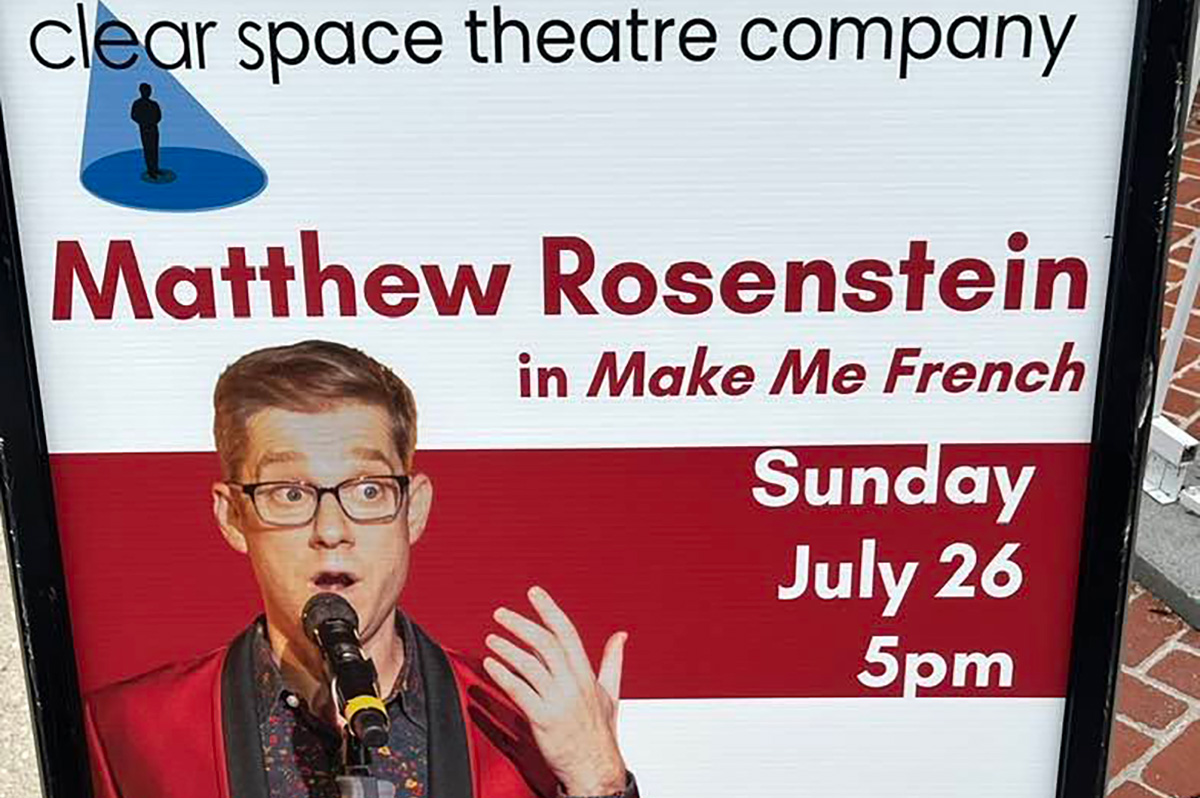
Clear Space Theatre Company was founded in 2004 and has become a huge success in Rehoboth Beach, Del. They present performances all year long, and always have a great summer season when the town grows by the thousands. Not only do they have some great main productions this year, “The Cher Show,” “Pretty Woman,” and “Mean Girls,” but they also have a strong series of cabaret performances.
Matthew Rosenstein’s show, “Make Me French!” was part of that series. While I haven’t seen them all, it will be hard to beat his show. He is a superb storyteller and singer. He blends his real-life experiences, with music from different genres, including showtunes and French disco. Some of the songs he uses to tell his story include: “Belle / Go the Distance” (Menken/Ashman; Menken/Zippel), “Ahh, Paree/Les prénoms de Paris” (Sondheim; Brel); and “Hymne à L’Amour” (Marguerite Monnot/Edith Piaf/Hiroyuki Takei/Fumiaki Uemura).
He has a way of making you feel part of his life story. The show is directed and co-authored by cabaret icon Robbie Rozelle, and it features music direction and arrangements by the incredibly talented Michael Cuschieri, who also plays the piano. The backup band included, Jim McGiffin on bass; Joshua Getka on drums; and Jessica Brams-Miller who sings backup and banters with Matthew, in a wonderful French accent. They are all immensely talented.
The blurb I received from Clear Space said about the show: “A bagel who dreamed of being a croissant, young Matt Rosenstein longed for a life that was far more sophisticated, and interesting, than his own as a suburban New Jersey teenager in the 1990s. His one prayer? “Make Me French!” Matt was determined to not just learn French but to be as French as possible.” Matt went so far as to call Air France from pay phones as a youngster, just to practice speaking with a real French person.
He eventually got the chance to move to Paris to fulfill his dream, and learned some hilarious lessons along the way. Matt shares what he’s learned about what he calls our most ‘misunderstood’ ally. The stories and songs are about: Why do French people not get fat? Are they rude? And do they hate Americans? He talks, and sings about these things in a wonderfully humorous way. You get caught up in the stories and then realize not only is Matt a great story teller, but he has a really strong voice. He generally stays away from politics in the show but does suggest he left the United States when George W. Bush became president, and returned when Obama was elected. He didn’t actually say what he wants to do today, but the audience did get the idea.
After living in Paris, he came back to the U.S. and had what he calls, ‘a second awakening.’ He worked with a vocal coach, met and became friends with many in the theater world and did his first show, “A Pleasure to Have in Class,” which is stories and songs about his life as a people-pleaser, from childhood to his gay divorce. This second show he shared with the public for the first time in 2023 at The Green Room 42.
Matt told Broadway World, “to do a one-man show, you first have to have the confidence you have a story to tell, that you have something to share with people. Not just something that you want to say, but something relatable that will connect with the audience. And then you have to work with a good team. You need a director that can help you shape an arc out of the story and make sure that it’s not just therapy on stage. So having a good team, making the right musical choices, making sure that you’re not coming from too self-centered of a place, has been key for me.” Matt followed all that advice well, and the result is the wonderful “Make Me French.”
This is the first show Matt has done outside of New York. I hope for audiences it won’t be the last. The world awaits this talented performer. You can follow Matt on Instagram and on his website, showtunesmatt.com. The Clear Space cabaret series continues all summer; visit clearspacetheatre.org for tickets.
Now the disclaimer: I am not related to Matthew Rosenstein, and this is an unbiased review. It would be nice to be related to such a talented guy, but we have found no indication we share any relatives at all. I first met Matthew after his show at Clear Space Theatre in Rehoboth Beach.
Peter Rosenstein is a longtime LGBTQ rights and Democratic Party activist.
Germany
We must not scapegoat refugees after Berlin Pride terrorist attack
‘LGBTI people must not be instrumentalized to spread hatred against others.’
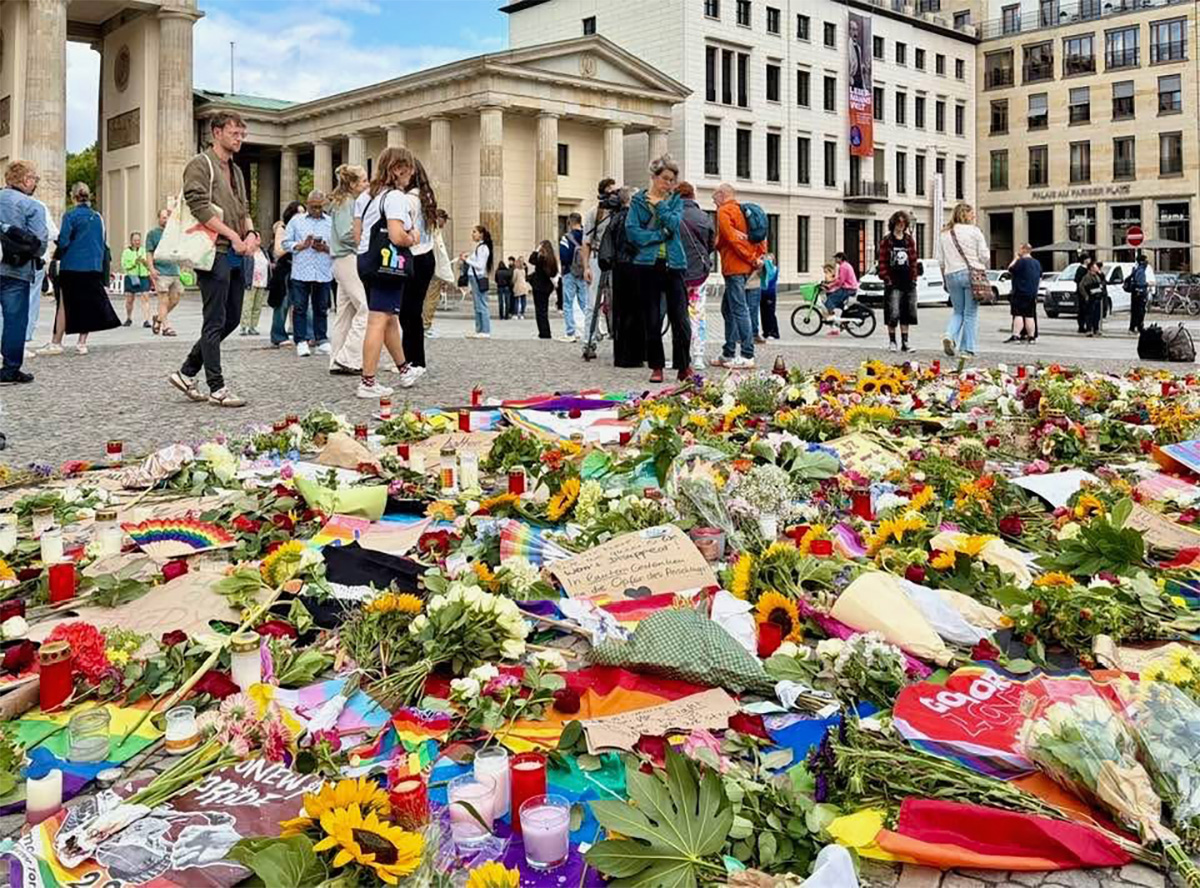
On Saturday, during Berlin’s Christopher Street Day, one of Europe’s biggest LGBTQ Pride events, a 21-year-old religious extremist drove a van into the crowd and then used a knife to stab multiple people. One person died and 29 others were injured.
When I saw this news on social media, I sincerely felt scared, and not because one more bigot used his religion to justify violence against people like me. It has, unfortunately, happened too often. Despite being happy to see the overwhelming support for the queer community and the condemnation of terrorism, I was terrified by the wave of Islamophobic and anti-immigrant statements that came even from “left” and “progressive” people who should know better, who generally support refugees, who know that all people are equal, and that you shouldn’t treat others as less human because of their religion.
In 2020, a Russian MP threatened to start a criminal case against me after I interviewed Muslim women about why they called themselves feminists and wrote about my own relationship with feminism and Islam, mentioning that I was following events in Syria and had read some academic books on the Islamic State. Surprisingly, the MP claimed that I was recruiting women to ISIS by using feminist ideas, which, of course, was absolutely ridiculous for many reasons, including the fact that I was an openly nonbinary transgender person. But some media outlets and queer people online, including those who called themselves progressive, refused to support me or believed the lie. This is what an anti-extremist witchhunt looks like. If I had been in Russia, and not in the UK, I probably would have been in prison.
It is extremely important to oppose extremism by knowing the actual facts about terrorist groups and not starting a moral panic.
Here are four examples of what media coverage and queer people online often misunderstand about the events in Berlin, and why it’s important.
1. Islam is not the problem
Despite a common misunderstanding, this terrorist act wasn’t even about Islam.
Islam, just like Christianity and Judaism, has a variety of views on LGBTQ rights, from affirmative to condemning. I think everyone in the American Bible Belt has met Christian fundamentalists who praised violence against LGBTQ people or used violence against their own queer children, so it is a universal problem. But the thing is Abdul Ballout was not an ordinary conservative Muslim. He was known for wanting to join ISIS. It is an apocalyptic cult that teaches that we are living in the last era, so they are trying to re-create the caliphate that they believe should be restored before Doomsday.
Most of the Muslim people I know, including conservative Salafi Muslims, see the group as dangerous criminals, or don’t see the group as a Muslim group at all. The vast majority of ISIS victims are not Western people or queer people, but cisgender heterosexual Muslims in the Middle East and Africa who the group considers to be infidels. ISIS is widely condemned by Muslim communities and scholars, and blaming Islam for the actions of cult members is like blaming Christianity and all Christians — or even all Christian fundamentalists — for the actions of Branch Davidians members or for the mass murder-suicide committed by members of the People’s Temple.
2. Refugees are not the problem — and Germany is not a safe haven for refugees
First, the attacker was a German citizen. But the media continue to blame migration. Germany is seen as a safe haven for refugees and asylum seekers in the U.S., the UK and beyond. But the time when Germany was safe is long gone. For refugees from Russia between 2022 and 2025 alone, around 90 percent of refugee claims have been refused by Germany, including the claims of political prisoners. The situation for non-White Muslim refugees is even worse, especially in regions such as Bavaria.
I have personal experience working with some refugees in Germany who are also Muslim. The way the migration service mistreated them is beyond anything I saw while working with refugees and being a refugee in the UK. I saw cases in Germany where an asylum seeker’s family was threatened back home because of social media posts the asylum seeker had made, or where a person was detained and sent back to their homeland despite having a history of persecution and torture by the government. Very often, when a person is taken by the immigration service, their loved ones don’t know where they are. Queer refugees also report homophobic and transphobic attitudes in the system.
The narrative that Germany is too generous to refugees was created by the far right and has little to do with reality, and it harms actual refugees, including queer refugees, by silencing their voices.
3. There is no collective responsibility
It is an extremely old and dangerous idea.
Just as all gay men shouldn’t be blamed for what the American serial killer Jeffrey Dahmer did just because he was gay; we shouldn’t blame all Muslims, all people of Middle Eastern origin, or any other large demographic group for the crime of one terrorist. Even if the terrorist had been a refugee and a Muslim, it shouldn’t actually matter, because under the law in any modern non-authoritarian country, an individual shouldn’t be held responsible for the actions of their social group.
After all, when a white, Christian, cisgender, heterosexual, neurotypical person commits a crime, it is almost always seen as an individual’s fault. Why is it different for marginalized groups? The idea of collective responsibility harmed the gay community for decades and is harming the trans community right now, for example after Charlie Kirk’s murder. The best thing we can do is stop this narrative, because it will be used against us.
The only reason I explained about ISIS and the refugee experience in Germany is to show how far from reality the popular accusations are.
4. Witch-hunts and scapegoating serve the far-right agenda and are extremely anti-queer
From my own experience, as an openly trans person speaking against Islamophobia, sexism and queerphobia who was accused of supporting the cult that kills queer people, promotes the sexual exploitation of women and sees the majority of Muslims as legitimate targets, I can say for sure that moral panic can go wild.
People who remember the Satanic Panic of the 1980s, or even the attacks on Muslim communities after Sept. 11, should know this.
Now even queer people are attacking refugees and Muslim communities online while the German government is introducing more draconian measures against those groups.
ILGA-Europe, the biggest LGBTQ organization in Europe, made a statement warning against any attempt to weaponize the attack.
“This tragedy must not be used to fuel hatred against migrants, foreigners or Muslim communities. We reject any attempt by anti-democratic actors to exploit what happened to divide communities, scapegoat minorities or turn one group against another,” Chaber, the group’s executive director, said. “LGBTI people must not be instrumentalized to spread hatred against others, nor should the existence of racism, Islamophobia or anti-migrant hatred be used to minimize the threats faced by LGBTI people. The rights, safety, and dignity of all people must be defended.”
People who live at the intersection of multiple marginalized identities — LGBTQ Muslims, LGBTQ people of color and LGBTQ refugees — will probably suffer the most from this moral panic. Moreover, these are the same political groups that target refugees, Muslim communities and queer people. If this hatred isn’t stopped now, everyone is potentially at risk.
Condemning terrorism is important, but it is no less important to stop creating more victims.

PHOTOS: Petal Release Party

Madonna headlines World Pride Music Festival in Amsterdam

Reggie White relishing first season as artistic director of Woolly Mammoth

PHOTOS: Amsterdam Pride Canal Parade

Amsterdam Pride Canal Parade draws hundreds of thousands

Madonna to perform at World Pride in Amsterdam

BLADE ENDORSEMENT: Susan Stewart for mayor of Rehoboth Beach

PHOTOS: Lambda Legal in the Pines

Calendar: July 31-August 6