Theater
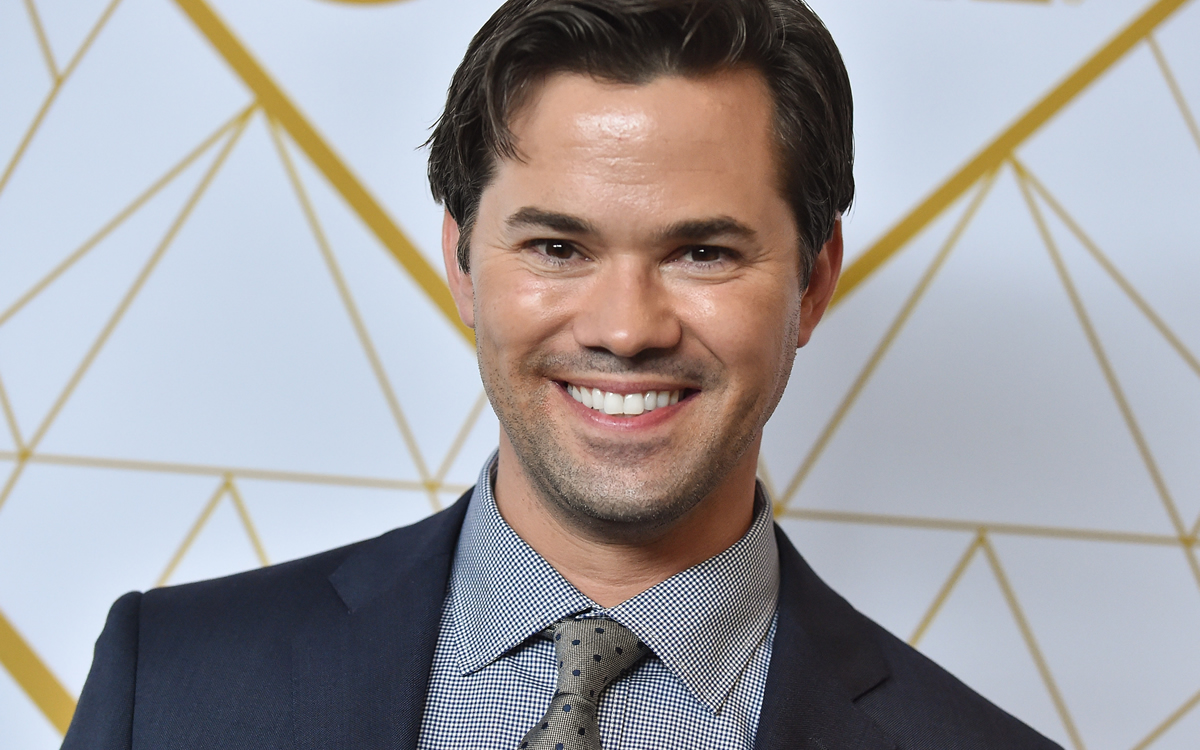
Andrew Rannells making D.C. debut at Kennedy Center
Celebrating 50 years of Broadway shows in Washington
‘50 Years of Broadway at the Kennedy Center’
Feb. 11 and 12
Kennedy Center Opera House
$59-$249
Kennedy-center.org
For two nights only, a host of big-name talent is converging on the Potomac to celebrate great musicals with “50 Years of Broadway at the Kennedy Center.”
A standout in the concert’s exciting lineup (which includes Tony Award-winner James Monroe Iglehart, Norm Lewis, La Chanze, Vanessa Williams, etc.) is out musical theater star Andrew Rannells. Best known for his memorable Tony Award-nominated turn as goody-two-shoes Elder Price in “The Book of Mormon” and as gay best friend Elijah on HBO’s “Girls,” Rannells also played in Broadway productions of “Hairspray,” “Jersey Boys,” “Falsettos,” “Boys in the Band,” and “Hamilton” (as a temporary replacement).
Despite a busy career that’s taken him all over, this weekend’s gig marks Rannells’ first time singing on a Washington stage. He has, however, been to town to hawk his book “Too Much Is Not Enough,” a terrific memoir featuring stories about growing up in Omaha, Neb., his move to Manhattan in 1997, really bad highlights, and sometimes humiliating work experiences.
Via phone from New York, Rannells, 43, recently took time from re-learning lyrics to talk about Broadway and other stuff.
WASHINGTON BLADE: For many Washingtonians, their introduction to Broadway is a national tour of a hit show at the Kennedy Center.
ANDREW RANNELLS: For me, besides watching the Tonys on TV, it was the Orpheum in Omaha — mostly the second national tour of a show, but always very exciting.
When I was last home in Omaha for Christmas, I was going through old Playbills that I’d collected, as every good gay boy does, and names popped up – Patrick Wilson in “Carousel,” Sutton Foster who passed through town with a production of “Grease.”
BLADE: Was Broadway always the focus?
RANNELLS: I thought my career would start when I was on Broadway. When in fact, there have been lot of jobs before and in between, and each took me closer to where I wanted to be. I don’t think I would have gotten “Hairspray” or “Mormon” if I hadn’t done all that work and met all those people.
When doing “Falsettos,” we had a dedicated group of younger fans who’d come to the stage door and they’d ask if there was a short cut to big success. There isn’t. I worked 12 years before starring in “Mormon.” As an older person looking back five years is no big deal but to people starting out it seems like forever. And then add seven years before that and it’s unimaginable.
BLADE: Playing Elder Price in “Book of Mormon” must have been an especially heady time for you.
RANNELLS: Oh, it was. And a busy two years too. We went from workshopping to Broadway to the Tony Awards in a short time. And I was also doing TV: Lena Dunham saw the show opening night and the following week she asked me to do “Girls.” A few weeks later I was on set doing the scene where I tell Lena’s character that her father is gay. I’d never spoken lines on camera before.
BLADE: Amazing. Any truth to the reboot rumors?
RANNELLS: Actually, Lena was misquoted on that. She said there won’t be a reboot until the characters had something new to say. To me, I think the show hasn’t been off the air long enough to go back.
BLADE: What will we see you doing at the Kennedy Center?
RANNELLS: Some really fun stuff with talented friends: Stephanie Block and I will be singing “Move On” from “Sunday in the Park with George.” Christopher Jackson, who I briefly did “Hamilton” with on Broadway, and I are doing “You’re Nothing Without Me” from “City of Angels.” And Betsy Wolfe and I are singing “Suddenly Seymour” from “Little Shop of Horrors.”
It’s been a minute since I’ve performed in a theater this size, so I’m a little nervous. I’ll probably be clutching Stephanie and make Chris Jackson hold me back stage until we’re done.
BLADE: And what’s up next for Andrew Rannells?
RANNELLS: A Hulu limited series about the Chippendales murders, a crazy and sad story based on the podcast “Welcome to Your Fantasy.” Murray Bartlett from “White Lotus” is playing Nick DeNoya the producer/choreographer who was murdered. I play his lovah.
And I’m writing a second book that leads from 2005 to the present. It includes “The Book of Mormon,” “Girls,” and working with [out producer/director/writer] Ryan Murphy. I cover all of the opportunities that shifted things for me.
BLADE: Enjoy your time in D.C.
RANNELLS: I will. Just wish I could hang out longer.




Theater
Reggie White relishing first season as artistic director of Woolly Mammoth
First five shows a reminder that ‘pressure is a privilege’
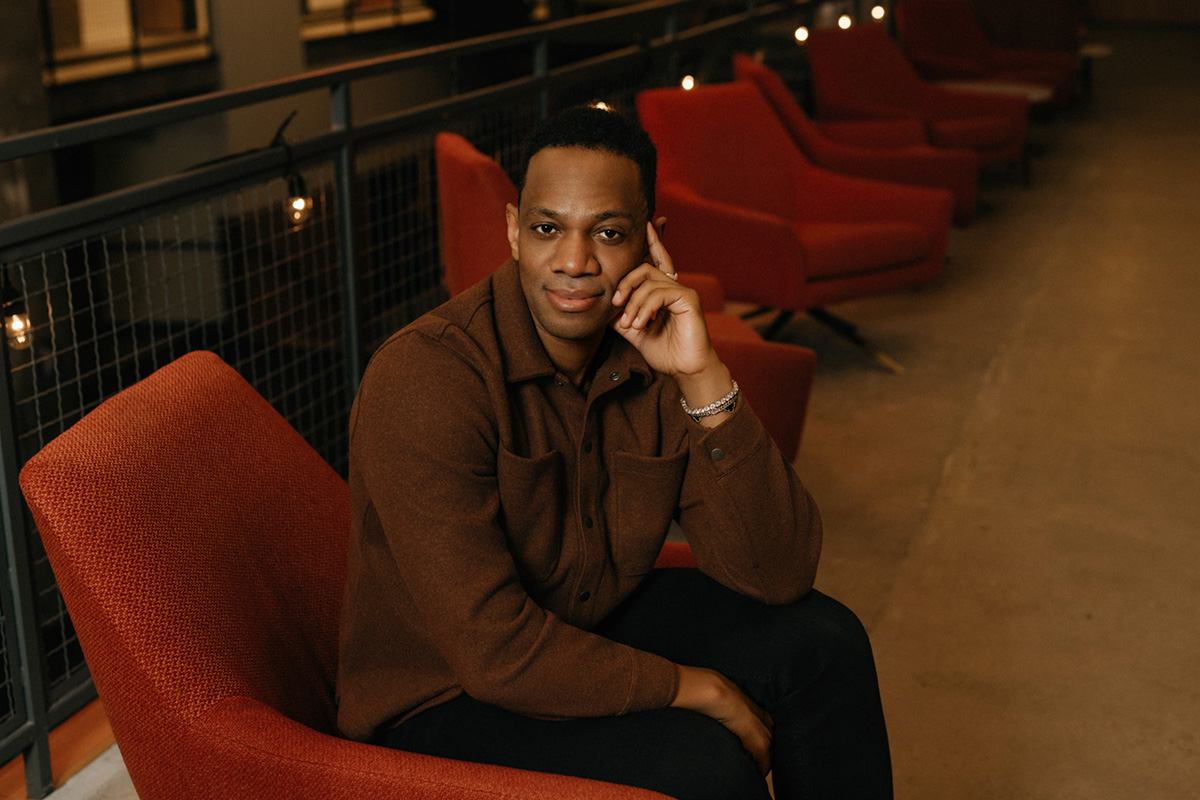
Madly talented and preternaturally energetic, Reggie D. White, 38, is about to launch his first season as artistic director of D.C.’s boundary-pushing Woolly Mammoth Theatre Company.
White brings a lot to the job. As actor, playwright, and director, his varied resume includes a 2019 Broadway acting debut in Matthew López’s Tony Award–winning play “The Inheritance,” his semi-autobiographic play “Fremont Ave.” that opened to acclaim last season at Arena Stage, and a number of exciting regional directing credits.
A longtime admirer of Woolly, the out theater-maker was selected from a pool of candidates before receiving the offer last November and starting work in January. His season of five world premieres kicks off with gay playwright Steve Yockey’s “Venus” (Sept. 9-Oct. 4), a darkly funny study of modern relationships told through two lesbians looking back on their first encounter.
White was introduced to Woolly Mammoth as a pre-law student at Cal State Hayward in the San Francisco Bay Area, long before he foresaw a life in the arts. “As part of a random theater history course, I was assigned to write a paper on a counterculture company called Woolly Mammoth,” he recalls “Strange name. I was like what the hell is that?”
Nineteen-year-old White was intrigued. Research acquainted him with Howard Shalwitz who co-founded Woolly in 1980, and the company’s commitment to living playwrights and new work. He also learned how theater could be used as a tool for difficult conversations and shape the way people thought about social issues by employing imagination and rigor.
“Never in a million years did young me envision that one day I’d be Woolly’s third artistic director in its 46-year history,” says White. “It’s kind of serendipitously insane.”
WASHINGTON BLADE: Was there a moment when the enormity of the job hit you?
REGGIE D. WHITE: After I’d signed my contract and finished all the paperwork, I got my keys and sat in the theater by myself in the dark and thought about what an incredible honor it is to be trusted with what happens in this beautiful space [in D.C.’s Penn Quarter]. I might have cried. Sometimes I have to pinch myself to remember it’s real.
BLADE: Are you curating the upcoming 2026–2027 season?
WHITE: Yes, I am. It’s very rare that an incoming artistic director gets to program their first season, but I was lucky in terms of time. After being hired late last year, I asked Woolly’s managing director Kimberly E. Douglas, if she thought it would be crazy if I programmed the season. She warned me it would be hard.
I invoked tennis legend Billie Jean King’s maxim “pressure is a privilege” and got to work.
These plays [dubbed White’s “first five”] represent both the kind of theater that Woolly can do really well and speak directly to my voice as curator and how I want to contribute to the larger theatrical conversation in the DMV.
Getting here has meant a lot of late nights. But I knew the juice would be worth the squeeze.
BLADE: As a queer artistic director, what makes you unique?
WHITE: When I was playing in “Inheritance” on Broadway, after a performance, U.S. Supreme Court Justice Sotomayer came backstage to meet the cast. She spoke about how her lens on the world as a Puerto Rican woman shapes her decisions. Similarly, because I’m a queer Black man I see through a lens that shapes my work.
I know I’m not the only queer artistic director in town. For me, it influences how I make editorial decisions. Out of this season’s five plays there are explicitly queer characters in four [“Venus,” “Chanukkah Spectacular,” “Ten Grand,” and “Love I Awethu Further”] and I’m directing two [“Venus,” “Ten Grand”].
BLADE: Will we see familiar faces?
WHITE: Every show this season will feature a Woolly Mammoth company member in its cast. Our company also includes designers and directors who we’ll include. I’m invested in continuing to provide a showcase for their work.
BLADE: How do you think queer audiences will receive the season?
WHITE: Very well, I think. For queer people who’ve had to navigate the world subversively and solve problems in unique ways, I think it will be especially interesting. I find theater a potent place for questions.
Like all artistic directors. I’ll show up for the job in my own way. I’m just excited that I’ve been invited to bring the fullness of myself to the role.
Theater
D.C. summer theater offers something for every taste
From family fare to ‘Brontë Sister House Party’

Staycation doesn’t preclude time travel.
For instance, Happenstance Theater’s production of “Adrift: A Medieval Wayward Folly” now playing at Round House Theatre in Bethesda invites audiences to go somewhere familiar but far from home.
A timely piece of theater, “Adrift” takes place shortly after an apocalypse, prompting a group of seafaring fools to ask “What do we do now?”
What ensues is a gorgeously lit glimpse into the dark ages bursting with slapstick comedy and high art. Characters and mise-en-scène are inspired by the late Middle Ages/early Renaissance paintings of Hieronymus Bosch, and archetypes from the Tarot. Bosch’s surreal heaven and hellscapes are brought to life with music, devised and existing text, puppetry, and movement.
Sabrina Mandell, Happenstance’s charming co-artistic director and bona fide “visionary tornado” describes Happenstance, now marking its twentieth anniversary season, as small and agile, more interested in sustainability than growth. “It’s served us well. Our goal has never been to own a building,” she adds.
Over the years, the company has fostered an ensemble (Mandell, co-artistic director Mark Jaster, Gwen Grastorf, Sarah Olmsted Thomas, and Alex Vernon), an immensely creative team. In addition to performing, each member contributes in various ways: puppet making, social media, props, etc.
They play off each other endlessly. (“Sort of like the Carol Burnett Show only different?” I ask. “Exactly.” she agrees. They’ve been through a lot and have formed common vocabulary. Nostalgia buffs, they enjoy old films, art movements, and historical eras. The vibe is eccentric and there’s a bit of queer sensibility.
The two-time Helen Hayes Award winner for costume design, does it all — props and costumes and marketing. In “Adrift,” she plays both the oracle and a crone.
Mandell was born on the coast of Nova Scotia, Canada, the daughter of artists, and later lived in Montreal. As a young woman, she worked on schooners. For Mandell, it’s been a magical life filled with visuals marvels, she says.
When Happenstance begins rehearsal, there’s no fixed script: “We choose a territory and everyone does a deep dive. I’m interested in alchemy, the Tarot, mortality, and the Shaministic roots of theater. All of which are well represented in this production.”
The experience is also immersive. Audiences are encouraged to pose questions to the oracle. Much is whimsical, and in true Medieval fashion the 85-minute show is not without a hellmouth (the jaws of hell) and plenty of demons. Happenstancetheater.org
For staycationing kids, there’s “Pete the Cat: A Live Rock Musical” (through Aug. 2) at Imagination Stage in Bethesda. Follow Pete (played by Michael Perrie Jr.) and the Biddle family as they rock out in a fast-paced, globe-trotting musical based on the massively popular children’s book series. Imaginationstage.org.
There’s more family theater at Glen Echo Park in Maryland. Adventure Theatre MTC puts a spin on beloved fairytale with “Sleeping Beauty: The Time Traveler” (through Aug. 9). A humdrum summer changes when a young Rolly (Carl L. Williams) is whisked back in time to the Age of Charlemagne where he meets Aurora (Chelsea Majors), a bold 12-year-old princess with dreams of knighthood and adventure beyond her castle walls. (Chelsea Majors). Adventuretheatre-mtc.org.
Also at Glen Echo Park, The Puppet Co. presents “The Three Billy Goats Gruff” (through Aug. 23), ideal for kids 4+ and puppet aficionados of all ages. Thepuppetco.org
Broadway at the National on Pennsylvania Avenue presents “The Notebook” (through Aug. 30). Based on Nicholas Sparks’s best-selling novel that inspired the successful film, this romantic musical tells the story of unlikely couple Allie and Noah, who against all odds (hardship, separation, and Alzheimer’s disease) share a lifetime of love. Broadwayatthenational.com
In Vienna, Va., Wolf Trap takes you to Rome circa 1800 with Puccini’s “Tosca” (Aug. 4) presented by Wolf Trap Opera, in collaboration with the Washington National Opera Orchestra.
Following Puccini it’s a magical summer night with Diana Ross (Aug. 19). Expect to hear the superstar and two-time Grammy Lifetime Achievement Award winner perform many of her iconic hits including “I’m Coming Out,” “Ain’t No Mountain High Enough,” “Stop in the Name of Love” and more. Wolftrap.org
Nu Sass, a company that promotes marginalized genders in all aspects of theater, presents Courtney Bailey’s “Brontë Sister House Party” (Aug. 14-Sept. 12) at Van Ness on Main Street (4340 Connecticut Ave., NW). In life, the Brontë Sisters, Emily, Charlotte, and Anne, wrote their 19th century English lit classics in the virtual isolation of their father’s remote York parsonage. Now, stuck in purgatory, they’re suffering through party after party in an endless time loop. For them, hosting is truly hell, until they finally find a way to make it tolerable. Nusass.com
At Olney Theatre Center it’s “A Gentleman’s Guide to Love and Murder” (through Aug. 23), a Tony Award–winning musical farce about murder, manners, and money starring out actor Tom Story as all seven members of the rich, ill-fated D’Ysquith family. This fast-paced comedy promises to be a good time.
The Olney Outdoors summer series (Aug. 9-Sept. 12) also at the Olney Theatre Center features tribute bands, cabaret-style performances, comedy, drag, and family sing-alongs on the open-air Root Family Stage. Among the transportive tribute bands are “Space Oddity – The Ultimate David Brighton Bowie Experience” (Aug. 28) and for Labor Day weekend, it’s “Almost Queen” (Sept. 5) with Joseph Russo playing the band’s front man and queer icon Freddie Mercury. Olneytheatre.org
Signature Theatre in Arlington presents “Respect: Aretha Franklin” (Aug. 11-30), a musical tribute celebrating the Queen of Soul starring powerhouse performer Nova Y. Payton. Not to be missed. Sigtheatre.org
Theater
‘My Favorite Sociopath’ debuts at Shepherdstown’s CATF
Gay playwright Aurin Squire’s take on D.C. journalism in the ‘90s
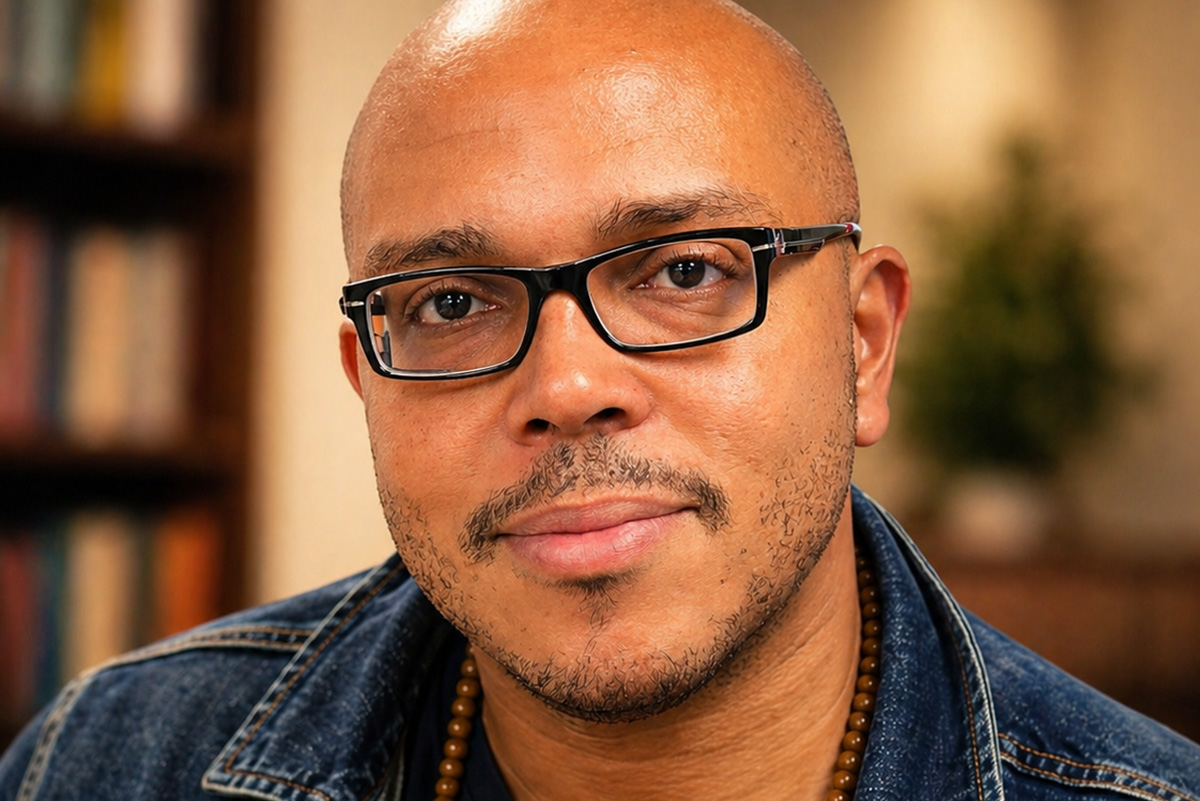
‘My Favorite Sociopath’
Contemporary American Theater Festival
July 10-Aug. 2
Shepherdstown, W.Va.
Catf.org
Discernment. It’s a thing some people have, explains playwright Aurin Squire, especially when you’re gay or Black in America (Squire is both).
“You instinctively know when the mob is teaming up for the best interests of the powers that be. You can feel it in the air.”
In his sharp new satire “My Favorite Sociopath,” Squire writes about life experiences but set in a different time and place: It’s the 1990s, early days of the 24-hour news cycle, and three ambitious journalism students are pursuing success in D.C.
And now, Squire’s play, along with other new works, are making their world premieres at the annual Contemporary American Theater Festival (CATF) at Shepherd University in historic, queer-friendly Shepherdstown, W.Va. (just a 90-minute drive from D.C.).
“All of my plays are queer in some way,” says Squire, 46. “This one touches on harmless and dangerous lies. The characters are on the spectrum sexually, and it’s interesting how all that falls out.”
And he’s given it a lot of thought.
“Already as a kid, it seemed to me that the rage against rap music and sex was coming from closeted people resisting their own urges and temptations. For me, it was interesting to see a witch hunt led by witches. Queer people can always call out a lie.”
Since September, Squire has also been working with a TV show about the tech industry set in Silicon Valley. He says, “It seems the general flow of the tech industry is that humanity and civilization is finished and it’s just about accumulating as many goods as possible before everything collapses. In fact, those who are profiting actually agree. But for those who disagree, they believe the solution is to build bigger gates, but activists believe we can stop this”
Yet, he’s learned from folks associated with the show. “Many say the quickest way to divorce yourself from any responsibility or regulations — smash and grab. Otherwise, you have to stop and think and regulate your desires for greed and power”
Squire possesses a penchant for pithy titles. He laughs, explaining the first thing he wrote as a student at Juilliard was “Obama-ology,” the comedy with contemporary message. While a lot of people liked the name, it didn’t necessarily vibe with the author. He concedes that he chooses names based on “easy to remember” and titles that won’t be easy to lose as a file.
Another is “Defacing Michael Jackson,” a coming-of-age dramedy set in rural Florida in 1984, specifically Squire’s native town Opa-locka, Miami, a fantastical place famed for its fanciful Moorish revival architecture.
Living in the shadow of exotic structures, he wasn’t particularly fazed. Squire says “It wasn’t until returning to visit after my freshman year at Northwestern University in Chicago that I realized how weird it was: When you grow up in a place, you take surroundings for granted no matter how over the top.”
Now based in New York (where for two happy years, 2017-2019, he shared digs with drag king Murry Hill), Squire returns frequently to Miami to be with family, but this summer has been filled with both work and travel.
Currently, he’s in Shepherdstown with CATF shaping up “My Favorite Sociopath.” Later this summer he will travel to South Africa for research, followed by a silent writing retreat in Santa Fe, N.M.
Much of Squire’s work reflects the Latino, African, Caribbean, African-American, and Jewish cultures he grew up around in South Florida.
When asked if today’s winds of anti-multiculturalism worry him, he replies, “No, because that’s going to pass. Most people don’t like, people are seeing the negative results of it, and the young people coming up despise it. White male gamers were tricked momentarily through the algorithms into voting against their own interests and they’re now seeing how it’s not working out for them.
“Conservatives always try to stop progress and eventually they always lose. It’s just a question of where we’ll be in the middle of the end of civilization before that happens. I’d like to hope we can turn the ship around before then.”
In addition to “My Favorite Sociopath,” CATF summer season features three other world premieres (Lisa D’Amour’s comedy “The Smoker,” “Refugee Rhapsody” by Yussef El Guindi, “Best Line Wins: A Play Inspired by the Improvised Lives of Elaine May & Mike Nichols” by Beth Kander) and “¡VOS!” by Christina Pumariega.
CATF runs from July 10-Aug. 2 in three venues on the Shepherd University campus: Frank Center, Marinoff Theater, and Studio 112.

PHOTOS: Petal Release Party

Madonna headlines World Pride Music Festival in Amsterdam

Reggie White relishing first season as artistic director of Woolly Mammoth

PHOTOS: Amsterdam Pride Canal Parade

Amsterdam Pride Canal Parade draws hundreds of thousands

‘Heartstopper Forever’ delivers satisfying conclusion

Madonna to perform at World Pride in Amsterdam

BLADE ENDORSEMENT: Susan Stewart for mayor of Rehoboth Beach

PHOTOS: Lambda Legal in the Pines