Theater
Out actor embraces role in audacious, healing production
‘There’s Always the Hudson’ confronts painful wounds head on
‘There’s Always the Hudson’
May 9-June 5
641 D St., N.W.
$29-$64
Woollymammoth.net
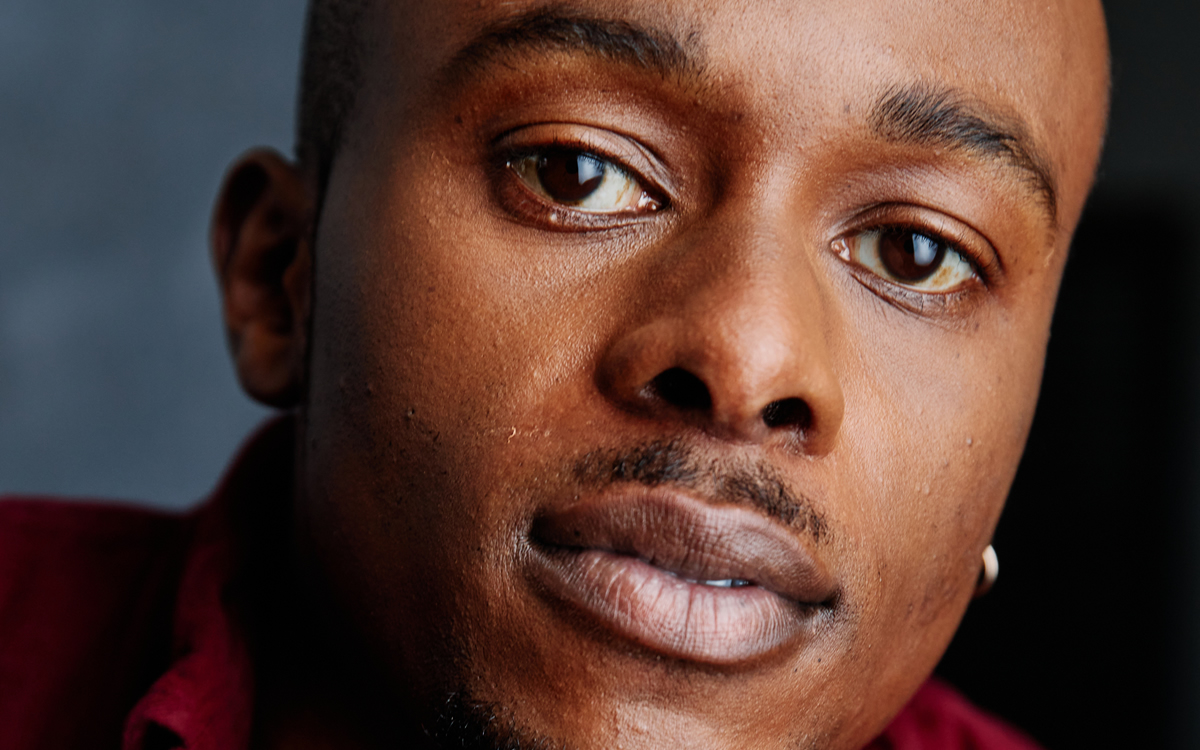
Healing can be messy, says out actor Justin Weaks. And in “There’s Always the Hudson,” playwright/actor Paola Lázaro’s audacious and unapologetically healing new work, actors can’t cower and audiences are compelled to experience a little discomfort along with the entertainment.
Lázaro and Weaks play best friends Lola and T (short for Toussaint) who met in a sexual abuse survivors support group three years previously. At some point, the pair made a pact that if things failed to improve, they’d kill themselves. When Lola says today’s the day to die, they agree to first settle scores with some of those who’ve hurt them. The night is about them taking New York City by storm and confronting their wounds head-on.
T is Black, gay, a Haitian immigrant, and a survivor of sexual abuse and trauma – identities that can heavily stigmatize in our culture. Throughout the course of the play, the audience watches as T increasingly find his voice.
Weaks, 31, says, “Lola and T have a lot to say and world has told them they’re not interested in hearing from people like them. But this is the night they say the shit that needs to be said.”
And without hesitation, he adds, “Playing T is one of greatest honors of my career, a dream come true.”
The piece is different from anything else he’s done, and for the playwright and star to agree to take this ride with him, he feels, is extraordinary: “You’ve never seen people talk like this on stage, I promise. It’s radical.”
A lean and mean intermission-less 80 minutes, the play covers some heavy terrain but it’s also “funny as hell – and might leave you with a little bit of whiplash,” he says. Its director, Jess McLeod, whom Weaks charmingly describes as “a fiery general with an enormous heart, the perfect person for the job,” keeps the five-person cast on task.
While Weaks has been a part of new works in the past, this time feels unique. It wasn’t until a little over a month ago that T, a character conceived by the playwright four years ago, was rewritten as gay.
“The play worked with T straight, but now that he’s gay it’s hitting on so many cylinders,” he says. “I’m not sure that change could have happened if someone else was in the role. I like to think my presence in the process maybe informed that in some way and deepened the work.”
In November 2021, Weaks left D.C. for New York. “It was time, and ‘There’s Always the Hudson’ is the perfect punctuation mark for the end of my time in Washington.”
Just three weeks after coming to D.C. from North Carolina in 2016, the gifted actor was diagnosed with HIV: “I didn’t know anybody yet. Didn’t have community yet. I had come to work, for a year, maybe two. Never foresaw being embraced by the community in the way that I’ve been.
“I understand what it feels like to have an identity that is stigmatized. Part of why I feel connected to T., through playing him, I get to feel. By stepping into his journey, I get to heal a lot of stuff.”
During Weaks’ time in the DMV, he earned multiple Helen Hayes Award nods winning in 2017 for his supporting turn in Theater Alliance’s “Word Becomes Flesh.” Other performances of note, among many, include “BLKS” and “Gloria” (Woolly Mammoth) “G of the Ocean” (Round House) “Dontrell, Who Kissed the Sea” (Theater Alliance) and “Curve of Departure” and “Pipeline.” (Studio).
“There’s Always the Hudson” was two weeks into rehearsal in March 2020 when production was shut down due to COVID. Everyone involved felt then it was an important and affecting work, and they still feel that way, he says. Now the original cast and creative team have reconvened to deliver on the play’s promise.
“It’s a thrill to create a role that will forever be a part of the American theater canon. When I graduated from college 10 years ago there were no parts like T. I’m excited that he’ll be inhabited by many actors after me, but I’ll always feel protective of Toussaint.”





Theater
‘Feeling Afraid’ explores life of a neurotic stand-up comic
Navigating sex, work, and possibly love in London
‘Feeling Afraid As If Something Terrible Is Going to Happen’
Through July 12
Studio Theatre
1501 14th St., N.W.
$55-$102
Studiotheatre.org
Wordily yet rightly titled, solo show “Feeling Afraid As If Something Terrible Is Going To Happen” dives deeply into the world of a neurotic stand-up comic as he navigates sex, work, and possibly love in London.
Busy arranging hookups and dates on “The App,” the 36-year-old gay funnyman juggles a full dance card; still he’s never been in a romantic relationship. While he’s willing to give love a shot, he’s not pressed about it. As he says, he harbors no fear of dying alone.
Currently making its American premiere at Studio Theatre, this darkly humorous Edinburgh Fringe import features terrific out English actor Steven Webb as The Comedian who’s about to explore what it means to spend all his time with one man.
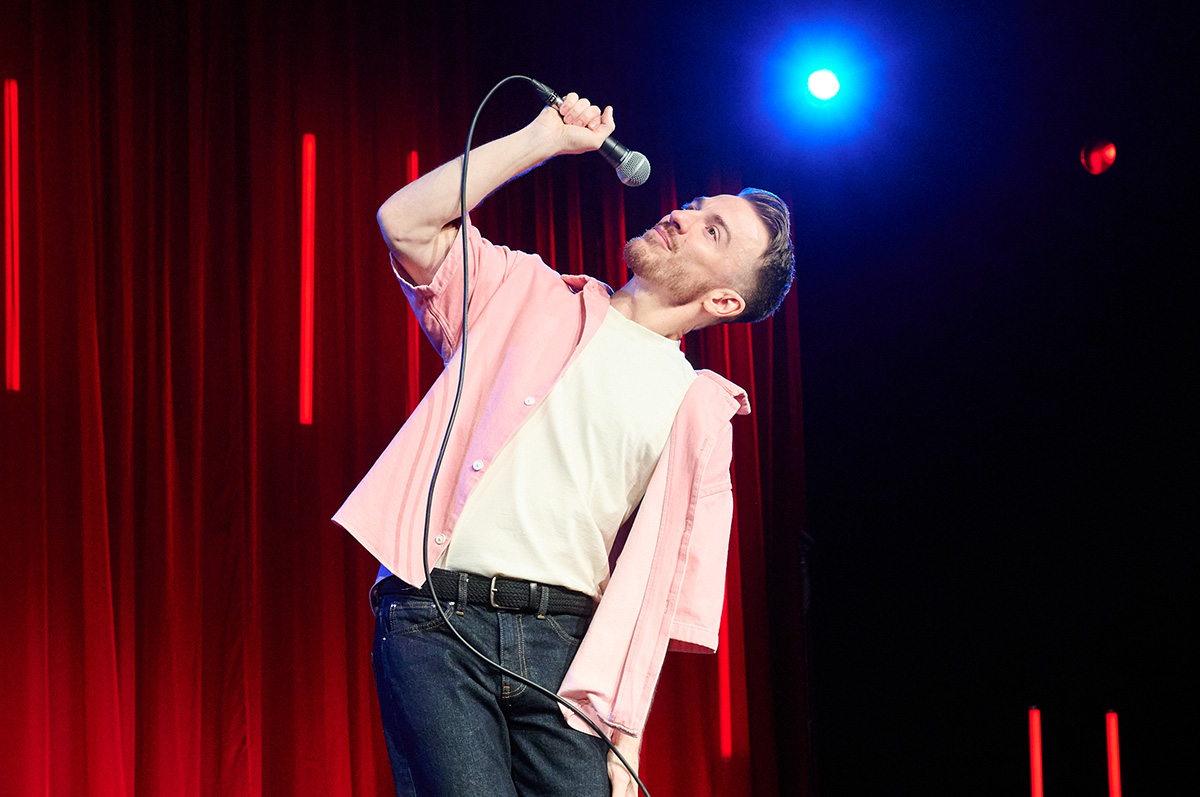
At Studio’s intimate Mead Theatre, Kat Heath’s minimal set says standard comedy club (fluorescent tube lighting, the mic with a long cord, a single stool backed by a rose-colored curtain), but gay playwright Marcelo Dos Santos has conjured something much more than a live comedy set.
Yes, The Comedian bounces onstage in his red Converse high tops, jeans, and pink shirt with a huge mouth emblazoned on the back, but he delivers more than jokes. At times hilariously self-deprecating, then dark, and occasionally a lesson on what makes standup work, this is a layered, well-acted piece.
With Webb (a keen caricaturist of types and voices) playing all the parts while conducting The Comedian’s hilariously frenetic interior monologue, “Feeling Afraid” takes us through a summer of love. It seems after six chaste dates with The American, our nervous hero has found Mr. Right. The American is earnest, smart, hesitant to initiate sex. He’s also well built with a beautiful smile. And strangely, he’s been medically advised not to laugh aloud.
The Comedian delights in the joys of new love: dates, first kisses, sex, and then suddenly spending all of his time with the adored. Visits to art galleries become fun. Eating home cooked meals followed by grim documentaries is a thing. The Comedian is beguiled as his own boyish figure fills out, but something isn’t right. He can’t entirely relax.
Along the way we meet the Aussie doctor, our protagonist’s longtime hookup; a young runner with some exceptional body parts; the random third in a failed threesome; grumpy working comics, male and female; and an ineffectual counselor.
Webb gives a lightning-fast performance that boggles the mind (in terms velocity and virtuosity). He can be impish, very impish. He’s nervous energy incarnate, flashing jazz hands, grimacing but handsome when still. He’s likeable, a necessity when delivering a hilariously rude joke just feet away from two stone-faced audience members. (Perhaps they were laughing on the inside? At any rate, they stayed through the end the show.)
Produced by the team behind Fringe hits “Fleabag” and “Baby Reindeer,” small stage works that were developed into major TV screen successes, “Feeling Afraid” is funny for sure, and it’s also highly confessional, sexually explicit, and raw.
Written by Dos Santos during COVID lockdown, the piece was a smash hit in the 2022 Edinburgh Fringe before finding further success in London. Its depiction of a youngish queer guy navigating the big city rings entirely true. Like so much Fringe stuff, the one-man show is delightfully lewd and standup inspired.
One little moan: the show closes cleverly but too abruptly with its star dashing offstage without sufficiently basking in the admiration and applause of his thoroughly chuffed audience.
They say third time’s a charm, and regarding “Feeling Afraid,” I’d agree. After two performance cancellations (first for laryngitis and the second involving faulty air conditioning on an especially muggy June evening), I made my third trek to Studio where I found both the actor and AC in very fine fettle. And truly, Webb’s work was more than worth the wait.
Theater
‘Suffs’ an entertaining chronicle of battle to pass 19th Amendment
Tony-winning musical highlights trailblazing women’s rights activists
‘Suffs’
June 16 – 28
National Theatre
1321 Pennsylvania Ave., N.W.
$115 and up
Broadwayatthenational.com
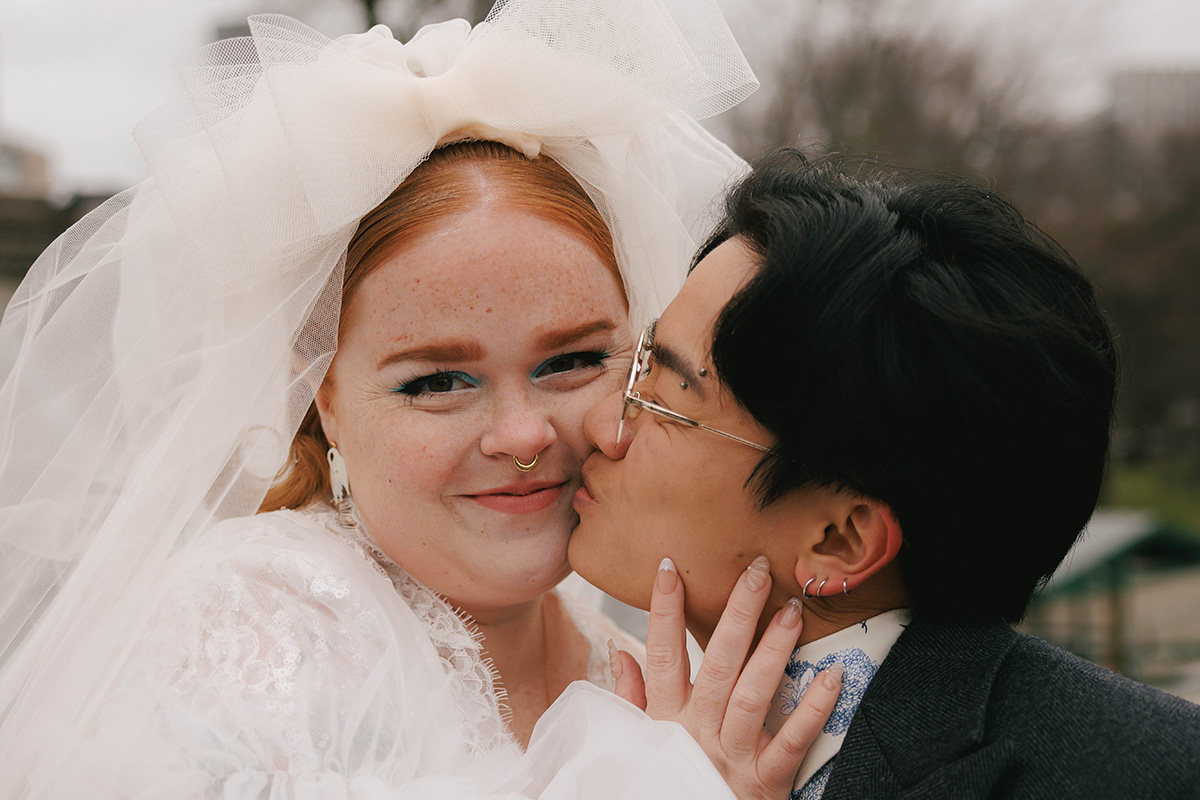
Poised to kick off a two-week run at D.C.’s National Theatre (June 16-28), “Suffs,” the Tony Award-winning musical written by Shaina Taub, promises an entertaining chronicle of what was the arduous political battle to pass the 19th Amendment.
Far from a dry look backward, Taub’s dramedy brings to life a high stakes world inhabited by historical trailblazing women’s rights activists like Alice Paul, Carrie Chapman Catt and Catt’s lifetime partner, Mollie Garrett. It manages to be upbeat without neglecting the grim bits including incarcerations and forced feedings.
Out actor Gwynne Wood plays suffragist Lucy Burns. As Alica Paul’s old college friend and fellow organizer of the 1913 march on Washington, Wood’s Lucy brings comforting humor and razor wit.
In real life, Wood, a Boston Conservatory grad, is married to lighting designer Anna Brevetti. They met in 2023 while working on the tour of “1776” (Wood played Founding Father George Read) and were instantly smitten.
In true theater fashion, they became engaged while on tour in San Francisco and tied the knot this past March in Boston on a day off from “Suffs.” The entire cast was invited to the wedding.
“The craziest thing about touring and being newly married is that you’re away from the person you most want to be with. But I do love touring (with long-haired chihuahua Gemma for company), and I love doing this show.
“During my long-distance courtship with Anna, we felt so good, seen and appreciated; we didn’t want to let that go just because I’m on the road.”
As of now, Wood is booked with “Suffs” through Aug. 9, and then it’s home to Bushwick, Brooklyn to enjoy married life.
BLADE: You’ve expressed a close connection to your character Lucy Burns.
WOOD: I was an ensemble member of the “Suffs” pre-Broadway workshop, and even then, the role of Lucy (played on Broadway by Ally Bonino) resonated.
Lucy is that friend who we all want to be and have. She’s very funny. She’ll hold you accountable but will still give support. She’s the one who brings cupcakes to the sleepover.
She also has a poignant second act ballad aptly titled, “Lucy’s Song. In it, Lucy talks about the importance of her long friendship with Alice Paul, while also officially retiring from activism. Basically, she’s saying “girl, I’m tired.”
BLADE: What about “Suffs” is especially meaningful for a queer actor?
WOOD: There’s so much about it that’s GREAT for a queer actor. I love learning about queer suffragists who were at the front of societal change. They were fighting this fight while having to deal with internal stuff like feeling marginalized, some were experiencing gender fluidity and transness. There’s documented evidence of all these things.
For a lot of lesbians in particular who felt out of place in heteronormative society, the suffragist movement was a place where they felt comfortable, a place where they were not told what to do by men.
BLADE: What was your introduction to musical theater?
WOOD: Growing up in Waynesboro, Va., Mom put me in community theater at ShenenArts in nearby Staunton. My first part was a salt shaker in “Beauty in the Beast.” My sister was the pepper shaker. We were two little tiny redheads waddling out like penguins. I was obsessed.
BLADE: Was Lucy Burns queer?
WOOD: There’s no evidence that Lucy was queer. Unlike fellow prominent suffragists [Carrie Chapman and Mollie Garrett] who were buried side by side, Lucy isn’t known for being in a romantic relationship.
I don’t know if Lucy and Alice were a couple, and I don’t want to rewrite a story that I don’t know. But I can say there is a lot of love from Lucy to Alice. That said, “Suffs” is undeniably intertwined with queerness.
BLADE: Can you see yourself as having been a suffragist?
WOOD: I’d love to say yes. It takes a lot, but I hope that I could have done it. People before us have done it, and people after will probably have to do it too.”
Theater
Timothy Nelson on the premiere of his opera ‘Song of Sakuntala’
Story of love, loss, redemption unfolds amid Indian classical music
‘The Song of Sakuntala’
IN Series
In Washington and Baltimore
Atlas Performing Arts Center, 1333 H St., N.E.
(Selected dates June 6-14)
Baltimore Theatre Project, 45 W. Preston St., Baltimore
(June 19-21)
$25-35
Inseries.org
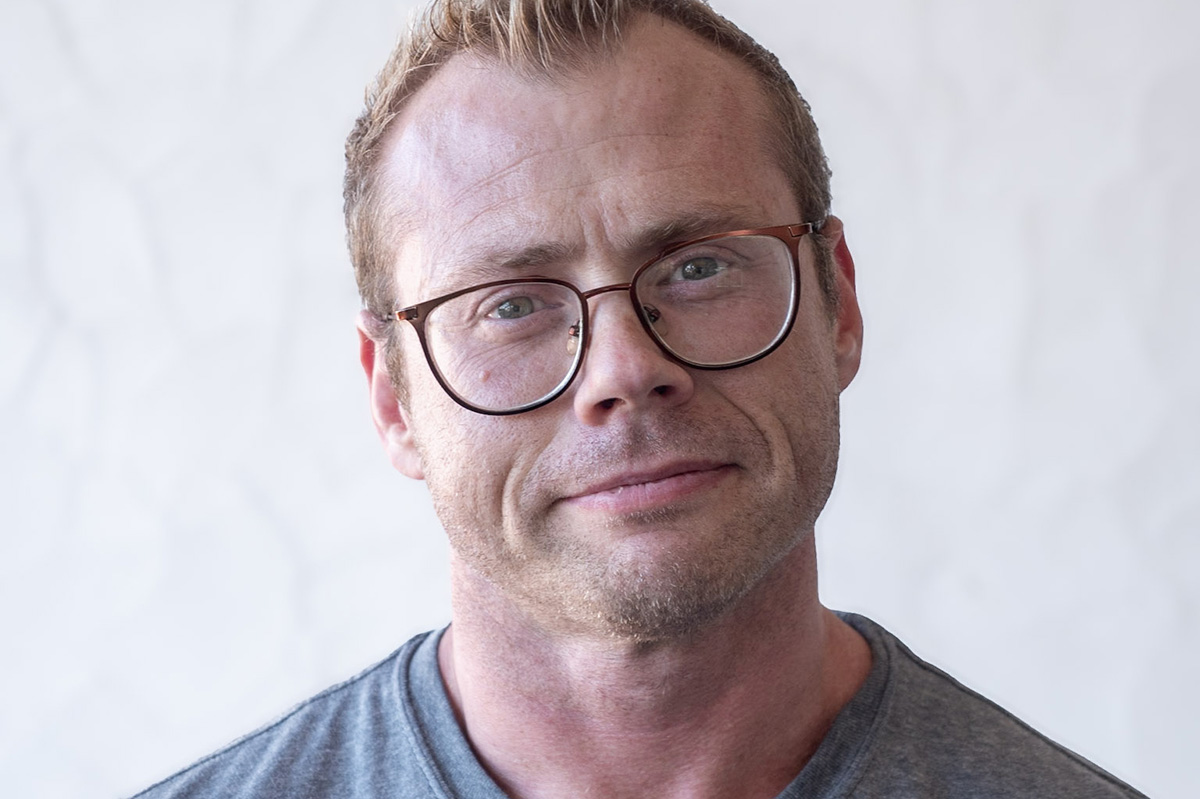
As the artistic director of IN Series, Timothy Nelson rarely blows his own horn, but for the world premiere of his own opera “The Song of Sakuntala,” he’ll make an exception.
During a recent interview squeezed in between afternoon and evenings rehearsals, Nelson took time to talk about his opera (while nearby his “blessing of a husband” prepared a giant dinner for the entire cast and crew).
As smart and gracious as ever, Nelson explains that he wrote the opera a decade ago at a low point in his life: He was divorcing and wanted to immerse himself into something musical, all-consuming, a project tantamount to writing a thick novel.
At the time, Nelson’s mentor, the influential American stage and opera director Peter Sellers, pushed him to write again. Nelson recalls, “I hadn’t composed for some time. I wanted to see if I could do it, and I wanted to revisit Indian classical music.”
He adds, “There was never any anticipation of it being produced. It was a way of processing and dealing with life in a healthy way.”
Adapted from Kālidāsa’s 5th-century dramatic masterpiece, “The Song of Sakuntala” brings together Western baroque and Indian classical musical traditions into a story of “love, loss, memory, and redemption.” His libretto, a reflection of South Asian storytelling, includes the words of the great Indian poets Tagore, Naidu, and Vidyapati.
The story follows “a prince and a woman of the forest who fall in love and wed in secret. He departs, and she later seeks him out, only to have him deny all recognition of her. She disappears in sorrow; he spends the rest of his life searching. At the end, in the same forest where they first met, they find each other again and are transfigured.”
At 90 minutes, the uninterrupted piece features three singers (Aryssa Leigh Burrs, Teresa Ferrara, Marvin Wayne Allen) accompanied by an instrumental ensemble led by acclaimed sitarist Rajib Karmakar, who specializes in bridging Indian and Western classical traditions, and conducted by Nelson who also joins the music making on drone and harmonium.
Burrs plays the prince. Originally written for a countertenor, Nelson imagined a man singing the role but ultimately cast a woman to play the part.
Because the piece is “fiendishly difficult in almost unnecessary ways,” Nelson explains with a wicked chuckle, he knew that Burrs had the talent and sharp brain required for the role.
The prince is cruel without explanation. Despite that, 40-something Nelson admits to relating to the opera’s prince: “In midlife, you reflect on your mistakes. At least for now that’s how I feel. I might have felt different earlier and it could change later on.”
Nelson lived in India for nine months, backpacking and studying in different places, absorbing different musical styles and playing pieces as varied and complex as any Western music.
And while based in D.C., IN Series performs in both Washington and Baltimore using various borrowed venues. “The Song of Sakuntala” is playing at both the Atlas Performing Center in D.C. (6/6-6/14) and Baltimore’s beloved Baltimore Theatre Project (6/19-6/21) with its terrific acoustics.
In a past conversation, Nelson who lives in Adams Morgan, shared that all audiences bring something specific to the table. Baltimore tends to attract more risk taking while D.C. audiences often lean into the intellectual side of what the company does.
At the helm of IN Series for eight years, Nelson has relished reimagining opera and musical theater, but only recently did he decide to program his latest work. The way in which “The Song of Sakuntala” blends Western and non-Western music is very much a part of the IN Series music brand, so it seemed the perfect selection to close the season.
“I do this humbly with great hesitancy. And I know it feels a little unseemly to cheer on your own work, but I will say, it’s a piece that is successful in sitting in both places (Western and South Asia) and the Indian musicians on board are responding to it.”

Eswatini’s government ordered to allow LGBTQ group to legally register

Does Pride decor resemble Trump’s design aesthetic?

Nearly 6,000 turn out for Pride Night Out at the Nationals

White House to end PEPFAR funding for South Africa

Washington Blade names new publisher

Union leader files assault complaint against gay Md. delegate after fight at early-voting site

PHOTOS: 2026 Capital Pride Parade

US no longer refuge for LGBTQ refugees

Cool convertibles