Politics
Harris becomes the de facto 2024 Democratic Party nominee for president
Advocacy groups praise vice president, President Biden
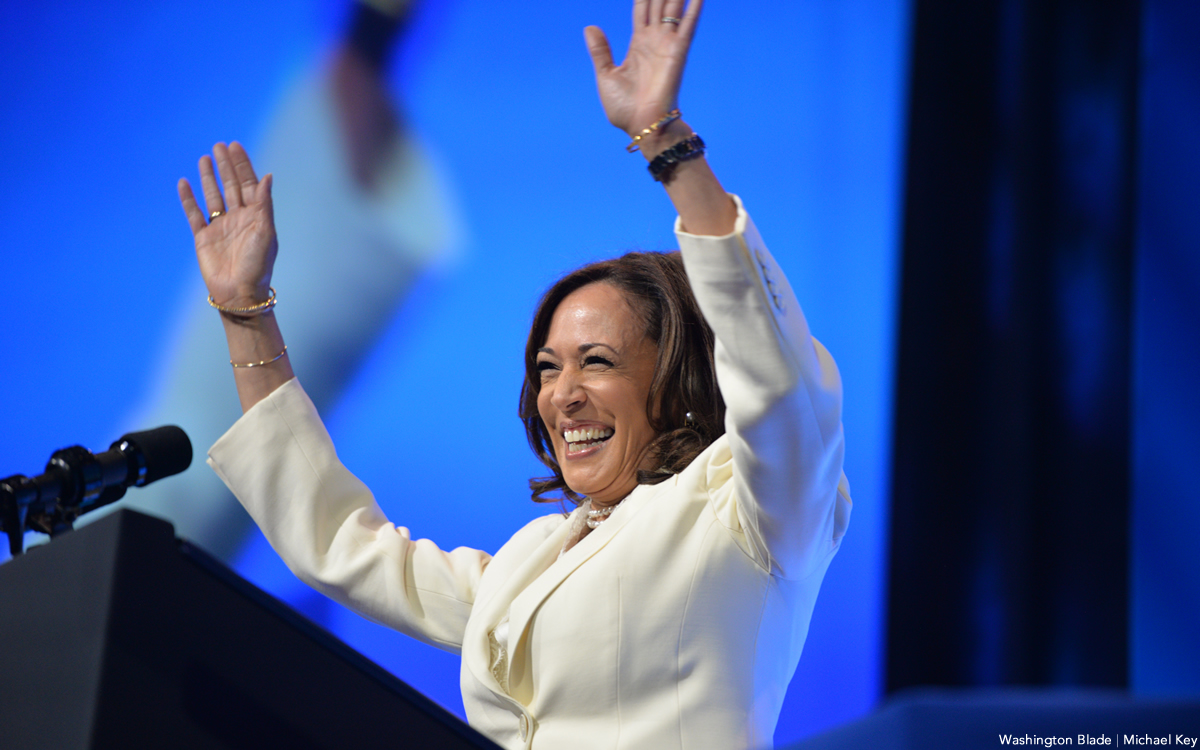
Less than three days after President Joe Biden announced his decision to step off the ticket and endorsed Kamala Harris to run in his stead, the vice president had emerged as her party’s de facto pick to take on the Republican nominee Donald Trump in November.
According to data from the Associated Press, by Monday 2,868 of the nearly 4,000 delegates who represent Democratic voters had endorsed Harris, well exceeding the 50 percent threshold necessary for her to lock up the nomination, which will be made official during the Democratic National Convention next month. The first ballots will be cast between Aug. 1 and Aug. 7.
“When I announced my campaign for president, I said I intended to go out and earn this nomination,” the vice president said in a statement Monday. “Tonight, I am proud to have secured the broad support needed to become our party’s nominee,” she said, adding, “I look forward to formally accepting the nomination soon.”
Virtually all prominent Democrats whose names were floated as potential rivals quickly lined up behind Harris, including Michigan Gov. Gretchen Whitmer, who was tapped to co-chair the campaign, and Transportation Secretary Pete Buttigieg, the first openly gay Cabinet member, who is considered a top contender to be her running-mate for vice president.
As of midday Wednesday, endorsements had come from over 90 percent of House Democrats, including Speaker Emerita Nancy Pelosi (D-Calif.) and Minority Leader Hakeem Jeffries (D-N.Y.) as well as from every Democratic governor and every Democratic U.S. senator except for Jon Tester (D-Mont.) and Bob Menendez (D-N.J.) (who was just convicted on charges related to an international bribery scheme and announced plans to resign from Congress.)
Also supporting Harris are major organizations that are allied with the party (limited, of course, to those permitted under FEC rules to endorse political candidates). Among them are major labor unions like SEIU and IBEW, advocacy shops like Emily’s List and Gen Z for Change, and civil rights groups like UnidosUS and the Human Rights Campaign.
And in a signal of the popularity of a reconfigured Democratic ticket led by the vice president, her campaign announced that a record breaking sum in excess of $100 million was raised between Saturday afternoon and Tuesday morning with mostly small-dollar contributions from 1.1 million supporters, 60 percent of whom were first-time donors.
The journey toward Harris’s nomination began with the president’s shaky performance against Trump during the televised CNN debate on June 27, which led to a chorus of calls for the 81-year-old to step aside as polls showed he had no clear path to winning the race.
By and large, the Democratic donors, celebrities, and elected officials who pushed for a new ticket did so despite their admiration and affinity for Biden and respect for his record as president. Within the party and beyond, his decision to walk away was celebrated as a patriotic sacrifice of personal ambition for the good of the country.
After Biden backed Harris, she visited campaign headquarters in Wilmington, Del., on Monday, where she delivered remarks about how she will parlay her experience as a prosecutor who went after “predators” and “fraudsters” into her work arguing the case against Trump and ultimately defeating him in November.
Harris also reaffirmed her loyalty to and kinship with Biden while reassuring campaign staff, who had just weathered — by far (at least, so far) — the rockiest period of the 2024 cycle.
“I know it’s been a rollercoaster, and we’re all filled with so many mixed emotions about this,” she said, adding, “I just have to say: I love Joe Biden.”
The president, who was isolating and recovering from COVID-19 at his home in Rehoboth Beach, Del., called in to the event with words of support and encouragement for the team and for Harris, to whom he said, “I’m watching you, kid,” and “I love ya.”
The next day, Harris headlined a rally in the key battleground state of Wisconsin, where the reception she received was widely described as palpably energetic and enthusiastic, especially when compared to similar campaign affairs prior to the vice president’s emergence this week as the presumptive Democratic nominee.
Putting aside voters’ apparent enthusiasm for her candidacy, the massive uptick in fundraising dollars, the rapid coalescence of support for her nomination from virtually the entire Democratic Party along with the various affiliated interests and entities, and the deftness with which she navigated an especially fraught conflict of which she was in the very center both personally and politically, any lingering questions about whether Harris has the full suite of skills and attributes of a top-tier candidate for national political office may have dissipated with her performances in these and other recent public appearances.
If, in fact, they persist, concerns about Harris’s ability to rise to the occasion largely stem from her 2020 Democratic presidential primary campaign, which folded ahead of the Iowa caucuses amid criticism that the California Democrat failed to articulate a cohesive and authentic message about her reasons for running and her vision for America.
As San Francisco Chronicle Washington Correspondent Shira Stein said during Jake Tapper’s CNN program on Tuesday, Harris has sharpened her skills as a politician over the past four years as she has served as vice president.
The political landscape has also shifted in ways that seem more broadly favorable to her candidacy in 2024. For example, voters might be more receptive to a nominee who built her career as a smart-on-crime prosecutor now that conversations about justice in policing are less salient than they were in the aftermath of George Floyd’s murder while concerns about public safety are now more ascendant.
The 2020 campaign aside, to the extent that Harris may have other handicaps — missteps while in office, controversial elements of her prosecutorial record, her perceived shortcomings as a candidate — they are, largely, already known, Stein said. “She’s been in political life for quite a long time.”
Far less clear is what the polls will look like over the months ahead as Harris reintroduces herself to voters and the dust settles from recent events that have caused tremendous upheaval in the 2024 race, including Biden’s departure from the ticket.

LGBTQ groups and leaders back Harris while thanking Biden
In written statements and public remarks over the past few days, LGBTQ leaders and organizations highlighted Biden and Harris’s records advancing rights and protections for the community, touted their administration’s legacy as the most pro-LGBTQ in history. (Washington Blade editor and co-owner Kevin Naff published an op-ed Wednesday titled, “Joe Biden, our fiercest ally“.)
They voiced confidence in Harris’s vision for building on that progress over the next four years and chronicled the ways in which she — in her roles as San Francisco district attorney, California attorney general, U.S. senator, and vice president — had a hand in many of the major milestones in the fight for LGBTQ civil rights that were won over the past few decades, from the legalization of same-sex marriage to ending the so-called “gay and trans panic defense.”
Several who spoke out to support Harris noted that she would be the first Black woman and the first South Asian presidential nominee to lead a major party ticket, having previously broken barriers throughout her career in elected office.
“We are deeply grateful to President Biden for his more than 50 years of public service and his longtime support for the LGBTQ+ community,” HRC President Kelley Robinson said. “Today’s announcement reflects what President Biden has done his entire career and will be core to his legacy: Putting the needs of Americans and his country above his own.”
“We owe the Biden-Harris team a debt of gratitude for leading the country out of a state of chaos and constant crisis under former President Trump,” she said. “And the Human Rights Campaign endorses the tough, formidable, and experienced Vice President Kamala Harris for president. Vice President Harris has the support of millions of Americans, as primary voters have already made the decision to put her on the ticket.”
Robinson said, “Vice President Kamala Harris is a trailblazer and has been a champion for LGBTQ+ equality for decades: from leading the fight in San Francisco against hate crimes and her work in California to end the so-called gay and transgender ‘panic defense’ to her early support for marriage equality and her leadership serving as our vice president.”
“Convicted felon Donald Trump has already shown that he aims to destroy democracy and divide the country in his quest for power,” she said. “Vice President Kamala Harris is a true champion of unity and accountability – and will fight for a country where no one is above the law and ‘justice for all’ means something.”
HRC, Robinson wrote, “could not be prouder to endorse Vice President Kamala Harris and commit to channeling our resources and supporters to work to elect the first Black and South Asian woman president of the United States.”
LGBTQ+ Victory Institute President Annise Parker said her organization “commends President Joe Biden on leading the most progressive and inclusive presidential term in American history” under which “LGBTQ+ people have received a record number of federal appointments, including cabinet members, judges and around 14 percent of political appointments.”
“His dedication to supporting LGBTQ+ communities and championing pro-equality legislation and executive action has created the most inclusive and affirming administration our country has ever seen,” Parker said. “And, despite attacks on LGBTQ+ liberties in state governments nationwide, the Biden administration has reinforced its dedication to LGBTQ+ equality through action.”
“We are sincerely grateful for President Biden’s leadership, partnership and service to our nation,” she said. “We know we have a trusted ally in Vice President Kamala Harris who works tirelessly toward full LGBTQ+ equality.”
Noting how Harris’s identity would make her nomination historic for the party and the country, Parker said she “is an enthusiastic supporter of pro-equality policies and LGBTQ+ communities” and added that “the record-breaking LGBTQ+ inclusivity of the Biden/Harris administration will continue under Harris’ leadership” while “the possibility that someone like Secretary of Transportation Pete Buttigieg could be her running mate is monumental.”
“The prospect of a Harris/Buttigieg ticket would be a watershed moment in our decades-long efforts to make all levels of government more inclusive and could be the most historic Presidential ticket ever in our nation,” she said.
National LGBTQ+ Task Force Action Fund Executive Director Kierra Johnson said: “We are grateful for President Biden’s decades of service and allyship to LGBTQ communities — and for everything his administration has done to move our community forward.
“At this critical moment for our democracy and our freedoms, we have both hope and excitement for Vice President Kamala Harris and what she can do for our country. We fully expect a continued commitment to always putting our communities first.
We now recommit to moving forward in the democratic process, the upcoming convention and the November elections.
The Task Force action fund calls on LGBTQ+ people and our allies to take action and engage in the political process. Only through a show of voting power in the Nov. 5 election will we begin building the democracy we deserve.”
Gay U.S. Rep. Mark Takano (D-Calif.), who on Saturday became the 36th Democrat on Capitol Hill to call for Biden to exit the race, urged the president to hand “the torch to Vice President Harris as the Democratic Party presidential nominee.”
“It has become clear to me that the demands of a modern campaign are now best met by the Vice President, who can seamlessly transition into the role of our party’s standard bearer,” he wrote.
Another gay Democrat in the California delegation, U.S. Rep. Robert Garcia, told Lesley Marin of CBS News on Monday that “we’re going to unite behind Vice President Harris,” noting “the incredible record that she’s been a partner of,” which has included “lowering the price of insulin, infrastructure, investments in climate change, [and] her incredible work in protecting women’s right to choose.”
“At the same time, she’s a prosecutor,” Garcia said. “Look at her work as attorney general. She’s going to prosecute the case against Donald Trump.”
U.S. Rep. Mark Pocan (D-Wis.), the openly gay chair of the Congressional Equality Caucus, also spoke in support of Harris during an interview with CBS News Sunday, arguing that “She’s ready to win Wisconsin,” which is “one of those pivotal states” along with Michigan and Pennsylvania that “are on the top of the list” for Democrats to win in November.
Harris has “the energy to run around the state and do all the campaigning and show that contrast with” the Republican nominee who is “old” and “tired,” the congressman said, using an argument against Trump that has been rolled out by a number of Democrats following Biden’s withdrawal from the race on Sunday.
The vice president will be especially effective in relaying to voters how Trump’s appointment of three conservative justices to the U.S. Supreme Court during his first term led to a decision revoking constitutional protections for abortion that were in place since Roe v. Wade was decided in 1973, Pocan said. As a result, he added, “now we are in 1849 law in Wisconsin” with respect to reproductive rights.
An ally both politically and personally
In a written statement to the Blade, Harris for President Senior Spokesperson Kevin Munoz said, “Vice President Harris has been a steadfast ally and fighter for LGBTQ+ Americans since her early days in office.”
He added, “Like President Biden, she’s never shied away from fighting for us, as demonstrated by her record throughout her time in public service, as well as being a part of the most pro-LGBTQ+ administration in history. Vice President Harris has had the LBGTQ+ community’s back, and this November, we’ll have hers.”
High-profile LGBTQ officials serving in the Biden-Harris government include Buttigieg, U.S. Department of Health and Human Services Assistant Secretary for Health Rachel Levine, and Ben LaBolt and Karine Jean-Pierre, who respectively serve as communications director and press secretary for the White House.
Two gay men who were on her staff prior to her election as vice president spoke with the Blade for a story in June that accompanied the newspaper’s exclusive interview with Harris. Munoz and Sergio Gonzales, senior advisor to Harris and the campaign, were among the six LGBTQ aides and officials who participated in a three-part profile series last year (during which time the operation in Wilmington was far leaner than it is now.)
Those who are close with the vice president (or those who follow her speeches closely) understand she has deep ties to the community and treasured relationships with LGBTQ friends and colleagues like Jim Rivaldo, a political consultant who helped elect gay rights pioneer Harvey Milk before leading Harris to victory in her first district attorney’s race in 2003.
As vice president, Harris not only shared in the credit for her administration’s pro-LGBTQ wins while maximizing representation from the community in positions of power and influence in American government, but she also found ways to signal her support through other personal, individual means.
For example, Harris in 2022 became the first sitting VP to host a Pride month celebration at the vice presidential residence at the Naval Observatory, which became an annual tradition under her tenure.
Rosenberg Foundation President Tim Silard, who worked under Harris when she was San Francisco district attorney, shared a statement with the Blade by text voicing his support for her candidacy.
“Vice President Harris will be the most outstanding President in my lifetime,” he said. “She has been an unwavering champion of the LGBTQ community, fighting to make all of our families safer and expanding civil rights and our opportunities to thrive.”
Silard added, “I know she will take on bullies at home and abroad and bring our nation together in new and exciting ways. I could not be prouder to support her and will do anything I can to help elect her.”






2026 Midterm Elections
Meet the LGBTQ candidates running for U.S. House, Senate
Pappas would become first out gay man elected to upper chamber

The midterm elections are often seen as a report card for the party in power, giving voters an opportunity to weigh in on the direction of the country after two years of unified control of the federal government. With Republicans controlling the White House, Congress and the Supreme Court, the 2026 elections could reshape the balance of power in Washington and determine what the next two years of federal policy will look like.
Among the candidates looking to shape that future are a large number of openly LGBTQ politicians running for federal office. All of the candidates listed below openly identify as members of the LGBTQ community and are running as Democrats, seeking seats in both the U.S. House of Representatives and the U.S. Senate. (See below for a list of LGBTQ incumbents.)
The New Candidates
U.S. Senate:
Chris Pappas — NH
The United States House of Representatives:
Cait Conley — NY-17
Jeremy Moss — MI-11
JoAnna Mendoza — AZ-06
Marni von Wilpert — CA-48
Scott Wiener — CA-11
Chris Gallant — NY-1
JD Ford — IN-5
Janelle Sarauw — U.S. Virgin Islands
If all of these candidates running for federal office win their seats, this would make the federal government the queerest legislative term for Congress ever.
Chris Pappas would become the first openly gay male senator if he wins the race against Republican John E. Sununu. Pappas is currently leading early polls 50% to Sununu’s 42%, and is seen as a fairly centrist Democrat with a slew of accomplishments passed through the House since his election in 2018 that make him a desired candidate for the purple “Granite State.”
Cait Conley is fighting to take two-term incumbent Republican Mike Lawler’s seat for New York’s 17th district, covering parts of Westchester, Rockland, Putnam and Dutchess counties. Conley has a long history of working as a public servant through her extensive military service, which includes six overseas deployments with the Army and work with the National Security Council. Current polling shows she has an advantage over her opponent, 64% to his 36%, making this one a race to watch.
Jeremy Moss is running for election in Michigan, after quickly rising in the ranks within the Great Lake state. Moss, who was elected to his city’s city council, then to the state House, then to state Senate has had a lengthy connection with state politics for someone so young. He also served as the state’s first gay president pro tempore. He is running in the Detroit suburbs, including Oakland County. Nearly all polling puts Moss in the lead with some already giving him 99%.
JoAnna Mendoza is a veteran of the U.S. Navy and U.S. Marine Corps running for a House seat for the Tucson and southeastern Arizona area. She has been outspoken about how the cost of everyday necessities under the current leadership of President Trump and Republicans in Congress has made people in her state less safe. She is currently locked in a tight race with her Republican counterpart, leading Juan Ciscomani 47% to 45%.
Marni von Wilpert is running to represent northern San Diego County. She has experience representing the area as a San Diego City Council member, former prosecutor, and Obama workers’ rights attorney. Von Wilpert holds a narrow lead over Republican Jim Desmond, 45% to 42%.
Scott Wiener is looking for a chance to take former House Speaker Nancy Pelosi’s seat in the San Francisco area. Weiner holds a narrow lead over the Pelosi-endorsed San Francisco supervisor Connie Chan. A New York Times poll has him leading 45% to Chang’s 40%.
Chris Gallant has a slew of federal accomplishments under his belt, from working as an FAA air traffic controller to serving in the U.S. Army and New York Army National Guard, including as a Black Hawk helicopter pilot, and is a volunteer firefighter on Long Island. Despite all of this dedication to public service, he’s running in a solidly red district with recent predictions favor LaLota 81 to 26.
JD Ford is fighting to represent the northern Indianapolis suburbs and north-central Indiana against Republican incumbent Victoria Spartz. He was the first and only openly LGBTQ person elected to the Indiana Legislature, running his campaign on making living more affordable. Polling puts him slightly behind Spartz 48% to 46%.
Janelle Sarauw is trying to win the U.S. Virgin Island’s seat in the U.S. Congress. While there is no voting power, the seat can participate in debates. Sarauw is likely to win the seat after sweeping the primary earlier this year, and will face off against Shelley Moorhead, an independent, in November.
The Incumbents
Becca Balint — VT-At Large
Emily Randall — WA-06
Eric Sorensen — IL-17
Mark Pocan — WI-02
Mark Takano — CA-39
Ritchie Torres — NY-15
Robert Garcia — CA-42
Sarah McBride — DE
Sharice Davids — KS-03
Becca Balint is running for reelection to represent all of Vermont, making her one of the few candidates on this list who represents an entire state rather than a congressional district. Balint, a former teacher and Vermont state senator, has made housing affordability, mental health, and protecting democracy central parts of her platform. Recent polling gives Balint a substantial lead over Republican challenger Gerald Malloy, 60% to Gerald’s 30%.
Emily Randall is running for reelection in Washington’s 6th Congressional District, which includes the Olympic Peninsula and parts of the Kitsap Peninsula across Puget Sound from Seattle. Randall, who previously served in the Washington state Senate, has made expanding access to affordable health care a major part of her platform. She appears to be in a relatively strong position for reelection where she won 60% of the vote in Washington’s August top-two primary, while her Republican opponent Teresa Fox received about 25%.
Eric Sorensen is running for another term representing western Illinois. The former television meteorologist has centered his congressional work on lowering costs for working families. There is no public polling in the race, but a current nonpartisan forecast gives Sorensen 59% of the vote compared to Republican Dillan Vancil, with 40%.
Mark Pocan is seeking to continue representing Madison and south-central Wisconsin. Pocan, who has served in Congress since 2013, has focused on issues including health care affordability, workers’ rights and LGBTQ+ equality. There is no public polling of the race, but the current field has no Republican candidate, and a nonpartisan forecast gives Pocan more than a 99% modeled chance of winning.
Mark Takano is running for reelection in California’s 39th congressional district, which includes Riverside and portions of the Inland Empire east of Los Angeles. Takano has made health care and veterans’ issues major parts of his congressional work. There is no public polling of the race, but in his primary he came in first with 61% of the vote compared to Republican Steve Manos’s 39%.
Ritchie Torres is running for another term representing New York’s 15th congressional district in the Bronx. Torres, who previously served on the New York City Council, has made housing, economic development, education, and public safety major parts of his platform. There is no current public polling of the race, but multiple prediction sites have it squarely his to win.
Robert Garcia is seeking another term representing California’s 42nd congressional district, which includes Long Beach and southeastern Los Angeles County. Garcia, the former mayor of Long Beach, has focused on issues including infrastructure, transportation, education, and LGBTQ+ rights while in Congress. There is no public polling of the race, but forecasting has Garcia winning the seat over Republican Brian Burley 99% to 1%.
Sarah McBride, is running for reelection to represent Delaware’s sole congressional district, meaning she represents the entire state. McBride, who made history as the first openly transgender member of Congress, has centered her campaign on lowering health care costs, protecting reproductive health care, and strengthening workers’ rights. There is no public polling of the general election, but a current nonpartisan forecast gives McBride a 99.1% modeled chance of winning against Republican Joseph Arminio.
Sharice Davids is seeking another term representing Kansas’ 3rd Congressional District, which covers the Kansas side of the Kansas City metropolitan area. Davids, a former White House fellow and attorney, has made agriculture, lowering costs, and health care central parts of her platform. There is no current public polling of the race, but prediction polling shows she has a 94% chance of winning her race.
White House
Trump-appointed judge restores White House TV pool access
Judge called in to question president’s justification of the ban

A federal judge ordered the White House to restore West Wing press credentials to three news organizations after President Donald Trump attempted to bar their access for unfavorable reporting.
Early Thursday morning, Trump-appointed U.S. District Judge Timothy Kelly granted a temporary restraining order brought by POLITICO, CNN, and MS NOW as part of a joint lawsuit. The lawsuit cites the imperative role of a “free press” and ordered the 78 journalists’ credentials returned to the three outlets for at least the next two weeks as litigation plays out.
In the eight-page ruling, the judge goes over a slew of laws that Trump may have violated in banning the three media groups — from stepping on their First Amendment rights to a free press to the Fifth Amendment right to due process.
The judge also questioned Trump’s justification for removing the outlets, originally saying it was a matter of national security.
“The court is skeptical — at least on this record — that defendants’ interest in safeguarding national security is the actual motivation for, or is even advanced by, the revocation of plaintiffs’ hard passes,” Kelly wrote in an 8-page ruling issued just before 1 a.m. ET.
“Nothing in the record that predates this suit suggests that the revocation of plaintiffs’ hard passes was motivated by national security concerns. Certainly, that is not what President Trump said when he announced that he was ‘banning’ plaintiffs from the White House — instead, he focused on the alleged lack of truthfulness and negativity of plaintiffs’ reporting,” the judge added.
The Washington Blade reached out to the White House press office asking if the administration would file an appeal to keep the journalists out of the West Wing but did not hear back before publication time.
White House
White House press pool pushes back after Trump bars three outlets
As President Trump refuses entry to outlets he deems unreasonable, lawsuits have been filed to regain access to the West Wing
Past the first checkpoint to get into the White House, multiple carts filled with camera equipment sat along a fence. Wagons loaded with tripods, cables, mics, and cameras sat just past where they normally would be working at full power. Today, they were turned off and packed away.
Last week, President Donald Trump decided to bar CNN, MS NOW and POLITICO from the White House following reporting he considers “FAKE NEWS.”
Trump, in a post on Truth Social on Monday morning, described his move as “instituting an assault on the FAKE NEWS,” which he said has “grown like Cancer in our beloved United States of America.”
“It is corrupt, purposeful, pervasive, fully coordinated, and totally out of control,” he wrote on the social media site he owns. “It is a threat to our National Security, and must be stopped, NOW!”
As a result, all of the major television networks that comprise the television press pool — ABC, CBS, NBC, CNN, and Fox News — suspended their White House TV pool coverage. They decided to no longer send camera crews to cover President Donald Trump’s events.
“The public has a vital interest in receiving accurate, independent information about its government,” the five White House TV pool networks said in a joint statement Monday. “No administration should restrict a news organization because it objects to its reporting.”
POLITICO, CNN and MS NOW filed a lawsuit Monday to immediately restore access for their reporters, who had their credentials confiscated by the Secret Service.
In the White House, there was a noticeable shift in the atmosphere. The Washington Blade is the only LGBTQ news outlet that is part of the White House Press Pool, and was acting as the primary print pooler as the situation unfolded on Monday.
Whispers about who might be kicked from the press pool next could be heard both in the press area of the West Wing, as well as outside the part of the White House dedicated to filming the president’s office. The area where TV stations normally film their live shots of the White House while reporting looked less busy than a normal Monday — especially as the president made his way to New York City ahead of the UN General Assembly meeting this week.

CNN’s outdoor filming area, which is staffed nearly at all times, sat dark with a green cover over the space that normally houses its cameras and political reporters like Kaitlan Collins.
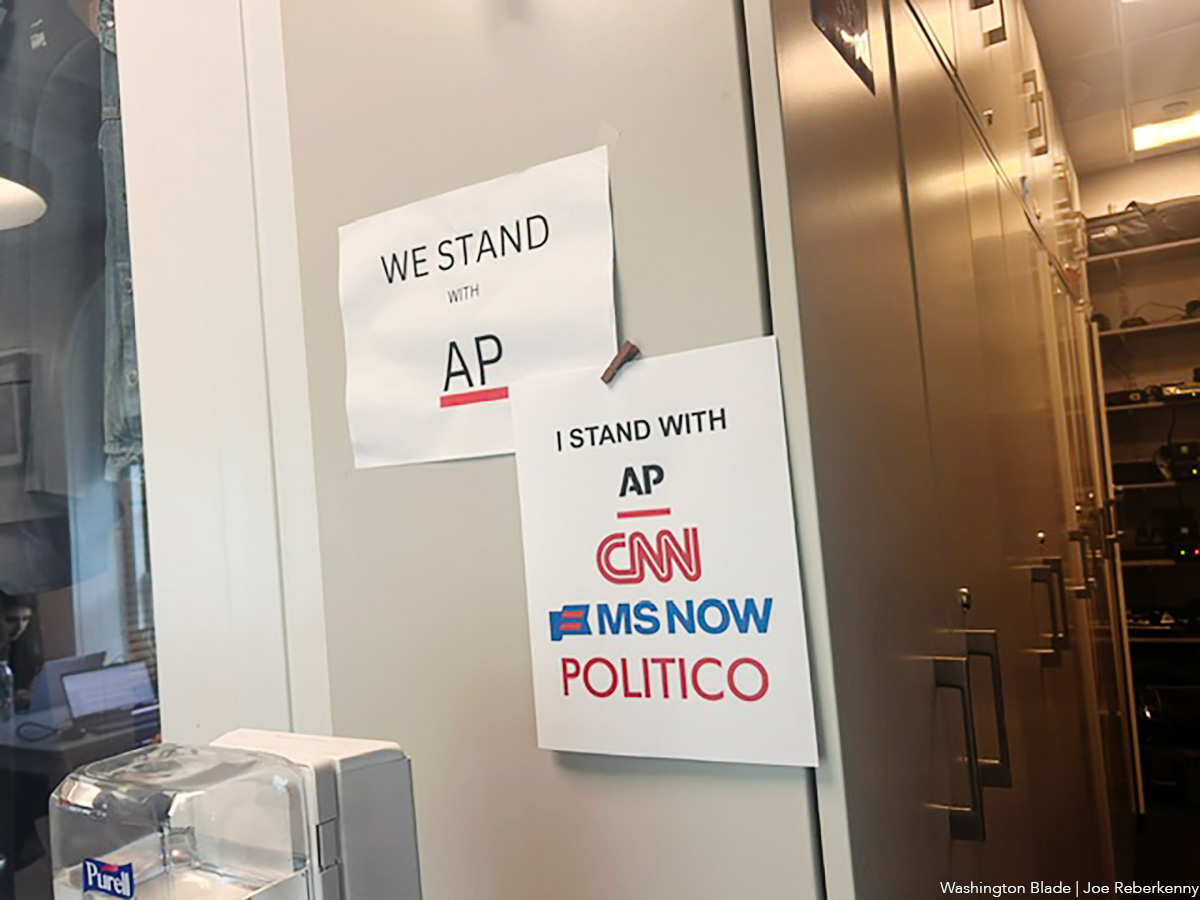
There were small signs of solidarity from other outlets in the press office. A sign that has hung outside one of the news offices in the West Wing was updated. It originally read, “WE STAND WITH AP” following President Trump’s first attempt at removing a news outlet he deemed unfavorable. It now includes “I STAND WITH AP CNN MSNOW POLITICO.”
The change could also be felt as the press pool attempted to cover the president.
There was a ribbon cutting in honor of the $6 million helipad installed at Trump’s behest — which had nearly no audio as a result of fewer microphones in the space following the outlets’ removal on Monday afternoon, and partly because of the loud sound of Marine One.
Vice President JD Vance defended Trump when asked about the changes to TV access at the White House, standing with the president despite this likely being a violation of the First Amendment’s guarantee of a free and fair press.
“He’s not banning media outlets. What he’s doing is saying we’re not going to give you special access to the White House if you engage in what is effectively propaganda,” Vance said, alleging that 92% of the stories from CNN, MS NOW and Politico about Trump are “negative.”
“That’s not representative of the American people. It’s not representative of public opinion,” Vance said.
He pushed back on the notion that this is a hindrance on free speech — claiming access to the president through White House visitation is a privilege — a privilege that in this administration, at least until courts weigh in, could change the landscape of the American media system.
“It’s about basic fairness. They can still report. They still have the access to free speech. They’re just not going to get an office in the White House anymore,” Vance said.
Jacqui Heinrich, the White House Correspondents Association President condemned the president’s actions in restricting media access in a statement sent to WHCA members on Saturday.
“Today’s action revoking access for journalists from CNN, POLITICO, and MSNOW violates the First Amendment. The implications extend beyond these organizations: a standard used to exclude one news outlet because of its coverage could be applied to any outlet in the future.
“The American people, through a free and independent press, must be able to scrutinize those elected to power, regardless of whether government officials view it favorably. That’s why courts have repeatedly held that once the White House provides access to journalists, it cannot deny that access arbitrarily or based on the content of their reporting. The WHCA calls on the administration to immediately restore our colleagues’ access.”

Lula, Flávio Bolsonaro to face off in second round of Brazilian presidential election

The financial realities facing LGBTQ+ first-time buyers

‘Merrily’ is for Sondheim super fans, the uninitiated, and anyone in between

Engrossing ‘Tip Toe’ delivers tension and an ominous warning

Eliot Glazer’s new book an engaging collection of essays

Meet the LGBTQ candidates running for U.S. House, Senate

Ana Brnabić becomes world’s first openly lesbian head of state

Vote now! Best Of LGBTQ DC readers’ choice awards

Gay Va. couple hopeful voters will enshrine marriage equality in state constitution

Victory Fund board investigates former staffers’ allegations against CEO Evan Low
-

 2026 Midterm Elections4 days ago
Meet the LGBTQ candidates running for U.S. House, Senate
-
Serbia4 days ago
Ana Brnabić becomes world’s first openly lesbian head of state
-
Arts & Entertainment4 days ago
Vote now! Best Of LGBTQ DC readers’ choice awards
-
Virginia4 days ago
Gay Va. couple hopeful voters will enshrine marriage equality in state constitution