National
Board members for LGBTQ foreign affairs group resign amid Trump attacks
GLIFAA vows to keep fighting outside the government
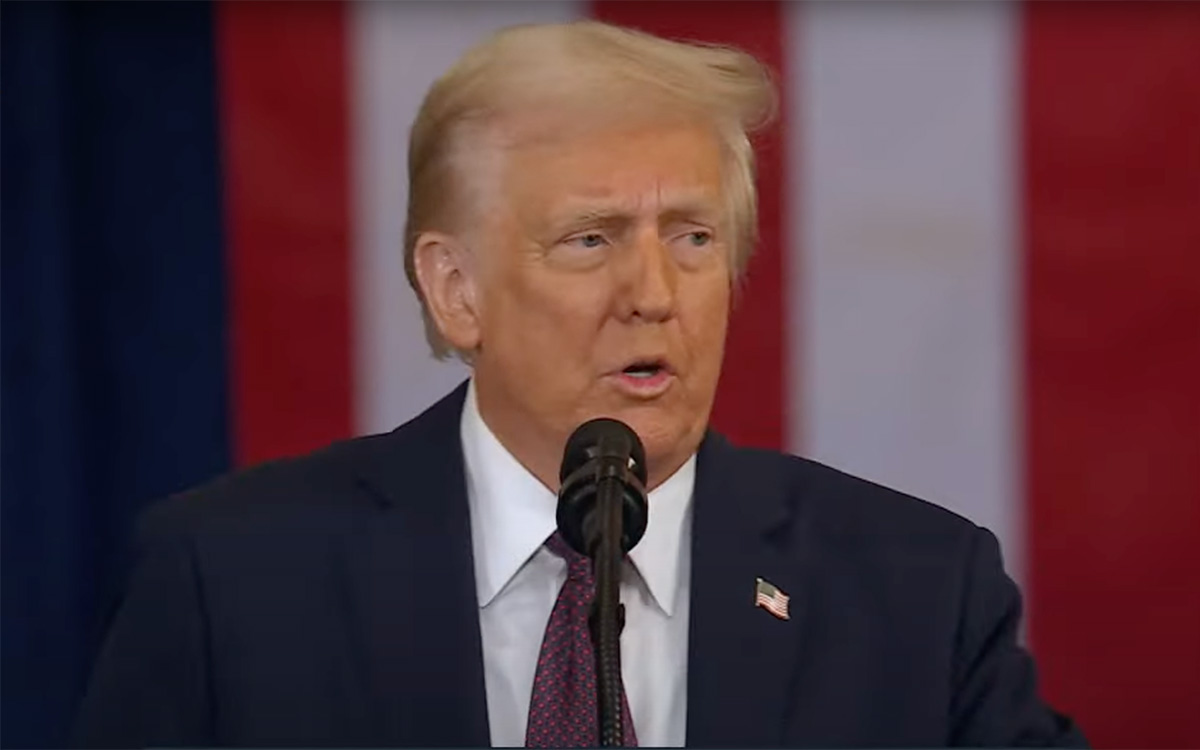
The board of the affinity group Gays and Lesbians in Foreign Affairs Agencies (GLIFAA) announced “extraordinary measures,” including a spate of resignations, on Friday to keep in compliance with President Trump’s “Defending Women” executive order.
GLIFAA, an employee resource group that advocates for LGBTQ inclusion, equality, and workplace protections within U.S. foreign affairs agencies, announced that elected board members who were active U.S. government employees stepped down. The group was forced to take the drastic step amid Trump’s attacks on federal workers and efforts to slash spending. In a letter obtained by the Washington Blade, GLIFAA says that its work within the Executive Office will end because of Trump’s “Defending Women from Gender Ideology Extremism and Restoring Biological Truth to the Federal Government” order, but will continue advocating for LGBTQ federal workers through its independent 501(c)(3) nonprofit organization status outside of its former official government capacity.
Executive Order 14168, also known as the “Defending Women” order, prompted this change within GLIFAA. It mandates that federal agencies recognize only two sexes, prohibits the use of gender identity in federal documents, and stops funding for gender-affirming care and any programs promoting “gender ideology.”
In the letter sent on Friday, the organization explained its board members resigned to comply with the recent executive order on LGBTQ rights, but not before appointing an interim board to help make the shift out of the federal government. It also urged all members of GLIFAA to remove any work email accounts connected with the organization and switch them to personal email addresses to avoid any potential retaliation, as well as to pay membership dues to allow the organization to continue protecting LGBTQ federal workers.
Despite these changes to the organization’s structure and ability to work in an official capacity within the government, the message was clear that GLIFAA will adapt to these changes to continue supporting LGBTQ federal workers, as well as other LGBTQ people facing oppression.
“We recognize the deep challenges this moment poses to both our membership and our mission to advocate for human rights, dignity, and equal access to opportunities for all members of our Community,” the letter reads. “Since 1992, GLIFAA has successfully advocated for policies that reversed discriminatory security clearance denials, secured benefits and accreditation for our spouses and family members, expanded healthcare and insurance coverage to meet the needs of our community, and promoted the advancement of human rights globally. We began this work in 1992 without official Department recognition, and while our activities as an employee organization have ceased for now, our mission to advocate for full legal and social equality for our members and their family members in the U.S. foreign affairs community will continue, albeit under different terms.”
The letter continued, advocating for perseverance amid an administration that has been hostile to the LGBTQ community, especially the trans community.
“In challenging times, the strength and resilience of our community matters more than ever. GLIFAA always has and always will represent all letters of the LGBTQIA rainbow. We are strongest when we stand together. So, we urge you to reach out to other members, uplift your colleagues and friends, and carry forward GLIFAA’s unwavering spirit of resilience, determination, and support for equality — wherever you are.”
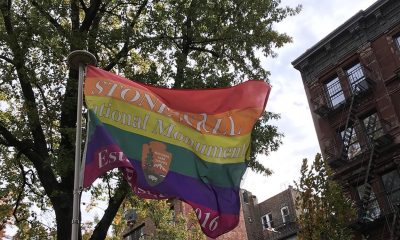
This comes days after multiple federal government websites wiped any mention of transgender people, removed mentions of how HIV and other health problems disproportionately impact the LGBTQ community, and information on Civil Rights protections to comply with Trump’s executive order. Some websites affected by this order include formerly non-partisan organizations like the Centers for Disease Control and Prevention, Census Bureau, and National Park Service.

National
Queen Jean is Tony’s first transgender winner
Designer/activist wins for work on ‘Cats: The Jellicle Ball’
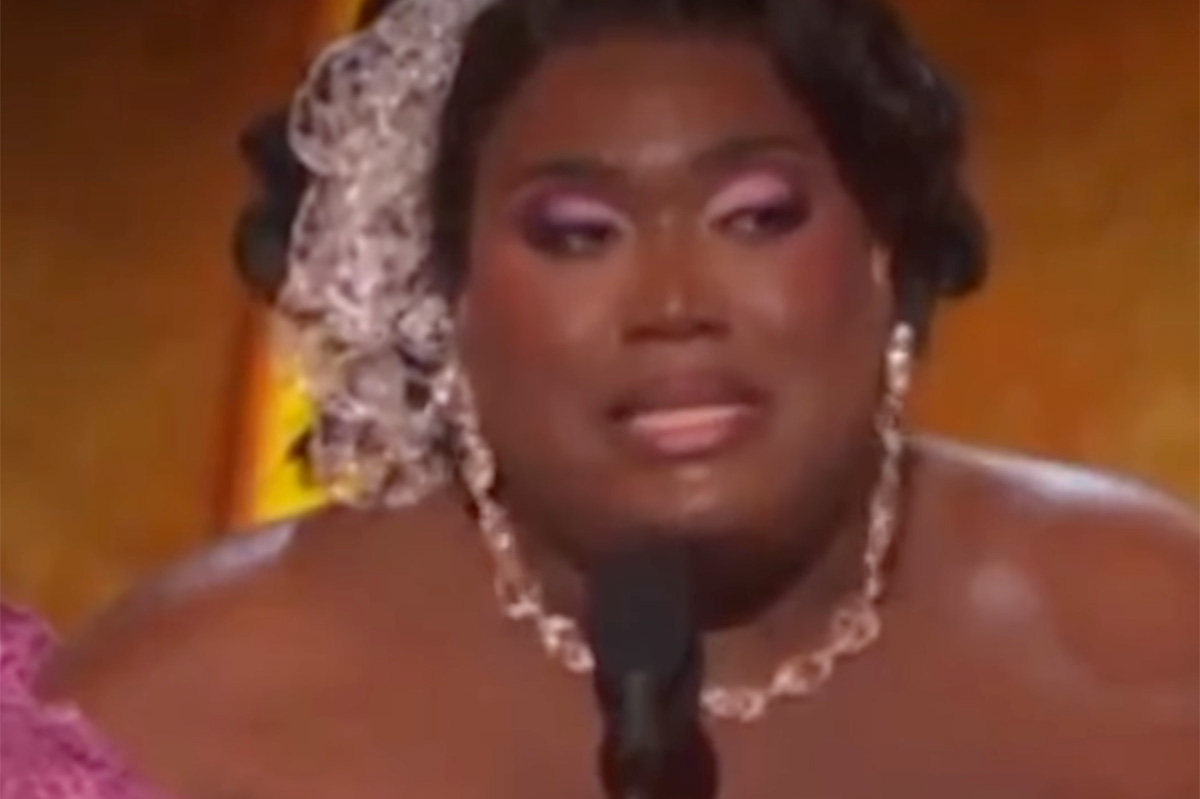
It was a historic night at the 79th annual Tony Awards on Sunday as Queen Jean won the award for Best Costume Design of a Musical, making her the first out transgender person to win a Tony.
“This experience has been monumental. We are here for the legacy of queer people, trans people,” she said. “We are taking up space in ways we have to take up space. We have to shift the paradigm. So I just want to say, thank you all so much for this incredible honor. The world right now is deeply, deeply combating so many ailments, and we know as a society that when we come together, we can make real, permanent change.”
She won the award for her work on “Cats: The Jellicle Ball” and was also nominated for best costume design of a play for “Liberation.”
In addition to her stage work, Queen Jean is the founder of Black Trans Liberation, an organization that supports trans and gender-nonconforming people in New York City.
National
Madonna turns Times Square into massive dance floor
Pop icon celebrates Pride month with surprise performance

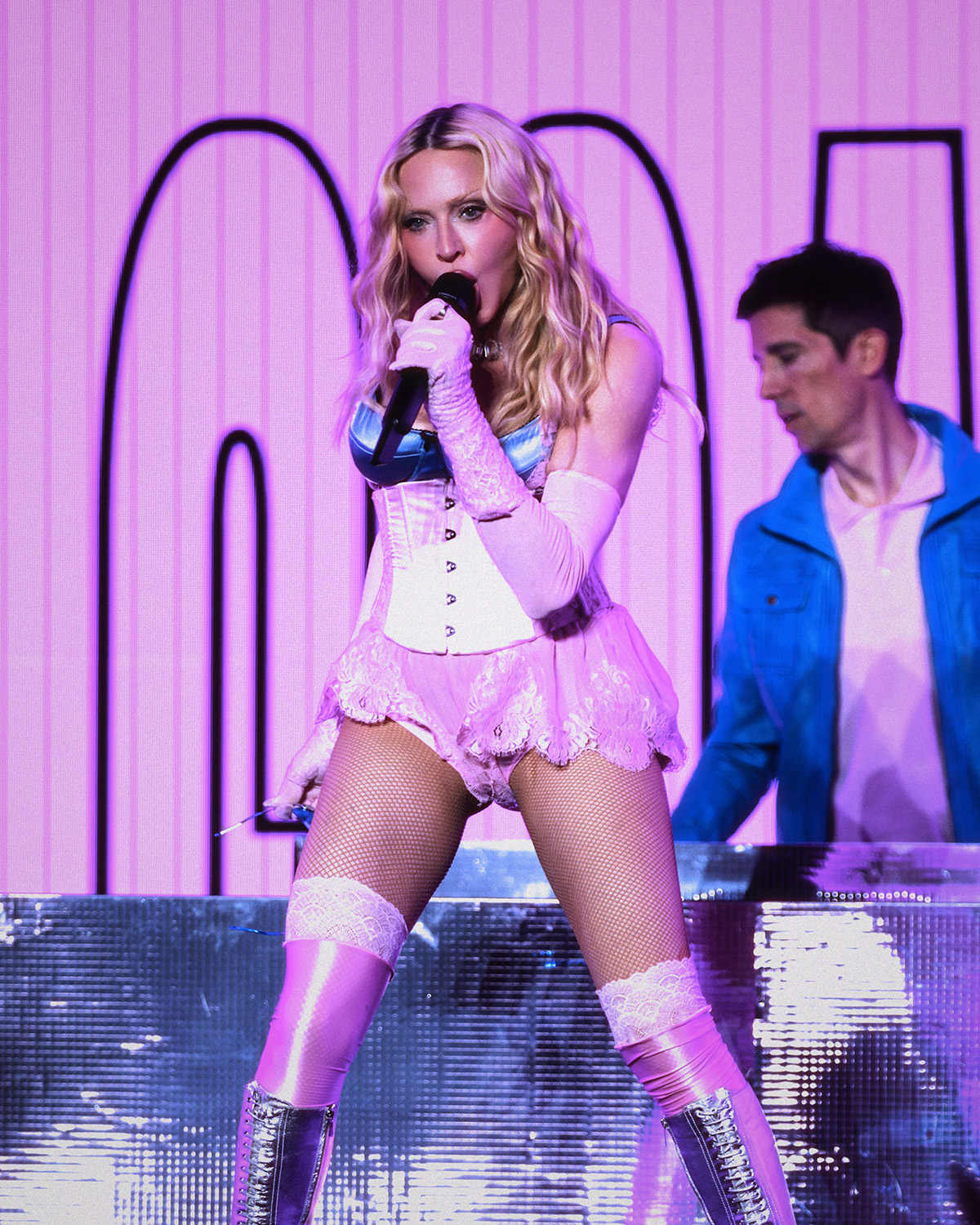
Pop icon Madonna celebrated Pride month with a pop-up performance in New York City’s Times Square on Thursday to the delight of 50,000 fans.
She performed for about 15 minutes high above street level, including several songs from her new album “Confessions II” due on July 3, along with a trio of songs from the first “Confessions on a Dance Floor.”
In addition to the brand new “Love Sensation,” she performed “I Feel So Free” and “Bring Your Love,” plus “Hung Up,” “Get Together” and “I Love New York.” She wished the crowd a happy Pride season; the event was shared with audiences through Grindr’s first-ever livestream.

National
Gallup finds LGBTQ support among Americans is dropping
Marriage equality support lowest since 2016
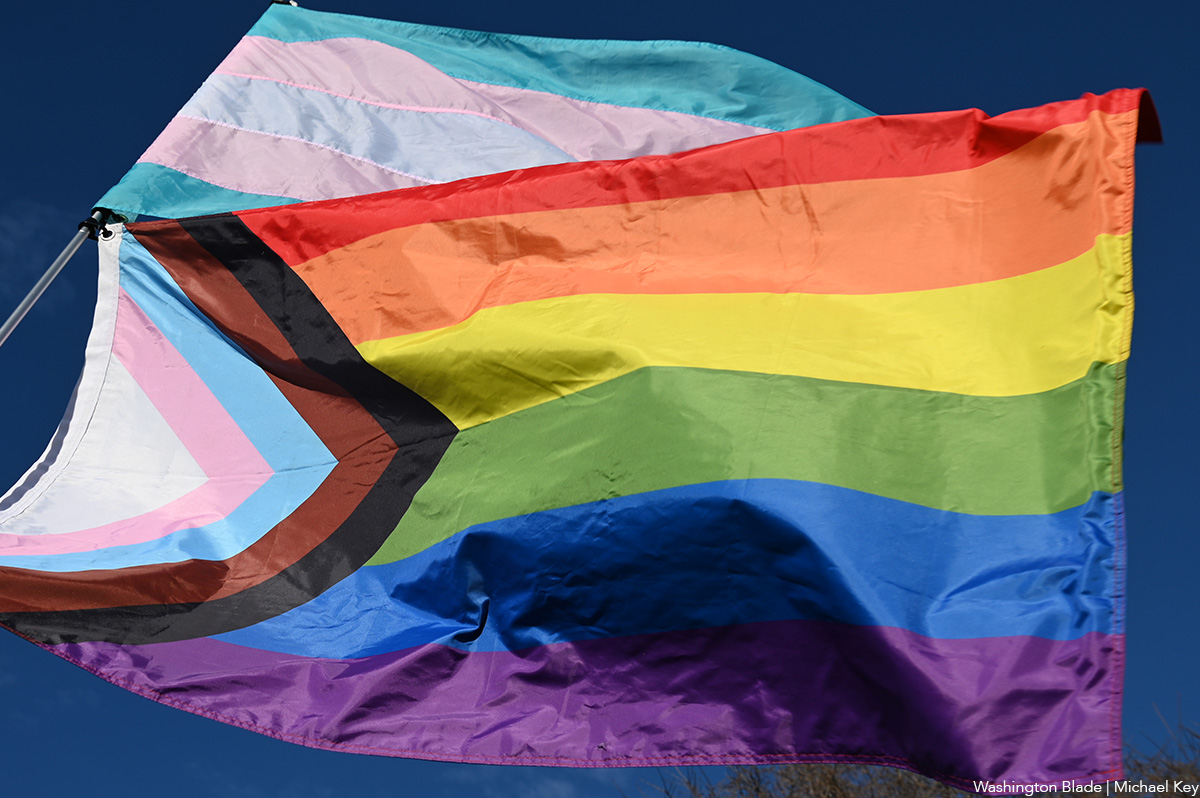
Gallup, one of the leading organizations in public opinion polling, has found that LGBTQ support among Americans is dropping.
The poll, whose data was collected using Gallup’s annual Values and Beliefs survey, was conducted in May and was published on Wednesday. The data was collected through telephone interviews from a sample of more than 1,000 adults living in all 50 states and D.C. using random digit dialing.
It highlights declining attitudes surrounding LGBTQ issues in multiple areas — from support for same-sex marriage to views on gender identity and the morality of one’s sexuality.
One of the most striking findings was that support for marriage equality fell six points from its 2022-2023 high.
The survey also found that 62 percent of Americans view gay and lesbian relations as morally acceptable, the lowest level since 2016 just after same-sex marriage was legalized nationwide by the U.S. Supreme Court.
One newer question on the poll found that the perceived morality of changing one’s gender has dropped eight points since 2021, indicating the American public is less supportive of transgender people.
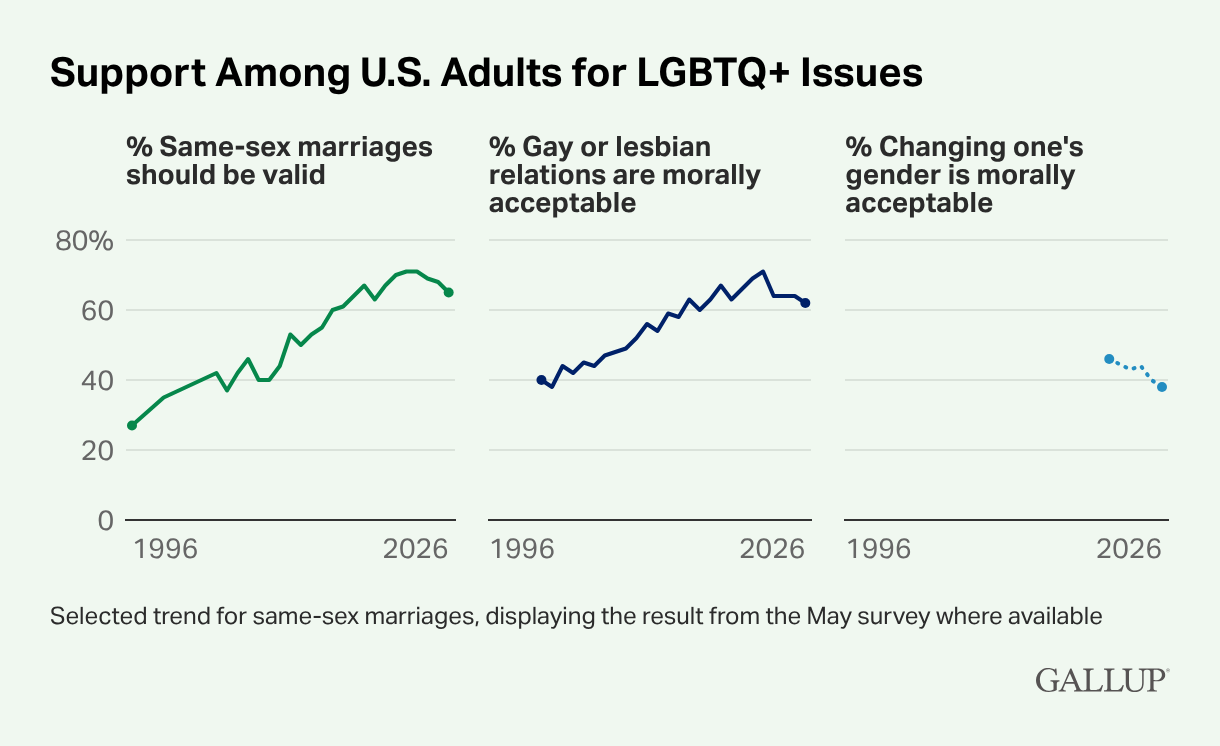
The data attributes much of the decline to shifting Republican views alongside the party itself. Conservative leaders have pushed back against diversity, equity, and inclusion programs that were intended to foster greater acceptance of LGBTQ people and other historically disadvantaged groups.
President Donald Trump has been a guiding force behind waves of anti-LGBTQ sentiment, particularly when it comes to trans rights. The president has enacted multiple executive orders, including Executive Order 14168, “Defending Women from Gender Ideology Extremism and Restoring Biological Truth to the Federal Government,” which mandates that gender be defined by one’s sex assigned at birth. He also signed Executive Order 14183, “Prioritizing Military Excellence and Readiness,” which barred qualified trans applicants from joining the military and led to the removal of trans service members already serving in the armed forces.
Additionally, he signed Executive Order 14201, “Keeping Men Out of Women’s Sports,” which prohibits trans female athletes from participating on women’s and girls’ sports teams.
In February, Gallup found that an estimated 9 percent of Americans identified as part of the LGBTQ community in some form.
The organization also found that 23 percent of adults under age 30 identify as LGBTQ, compared with 10 percent of those ages 30 to 49 and 3 percent or less among those ages 50 and older.

Blade editor inducted into D.C. Society of Professional Journalists Hall of Fame

Pride in a new world order

McDuffie on LGBTQ support and standing up to Trump

PHOTOS: Fairfax City Pride