News
Miss Universe Organization criticizes Russia LGBT rights record
Statement comes after Andy Cohen said he will not co-host pageant in Moscow
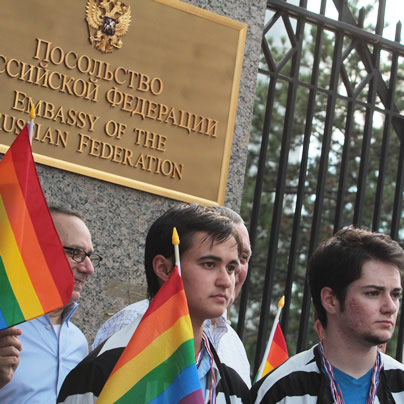
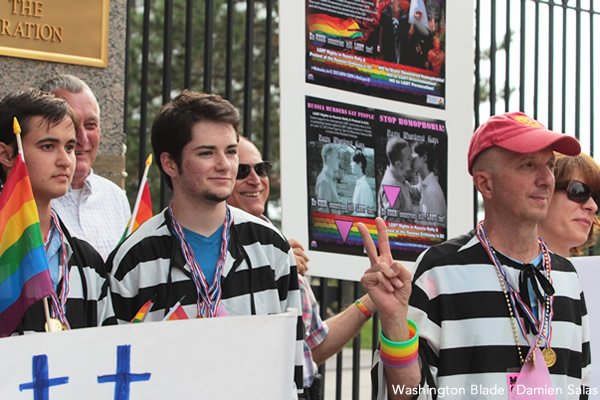
Protesters gathered outside of the Russian Embassy on Wednesday, July 31, 2013. (Washington Blade photo by Damien Salas)
The Miss Universe Organization on Tuesday expressed concern over a law that bans gay propaganda to minors in Russia and the ongoing anti-LGBT crackdown in the country.
“The Miss Universe Organization believes in equality for all individuals and is deeply concerned by the laws recently enacted in Russia and currently in place in several other countries,” it said in a statement GLAAD released. “Both the law, as well as the violence experienced by the LGBT community in Russia, are diametrically opposed to the core values of our company. Our organization has always embodied a spirit of inclusion and is a celebration of people from all countries and walks of life.”
The statement comes less than a week after Andy Cohen told E! News he turned down a request to co-host the 2013 Miss Universe pageant that will take place in Moscow in November, in part, because “he didn’t feel right as a gay man stepping foot into Russia.”
Francesco Pascuzzi, a gay man from Somerville, N.J., urged the Miss Universe Organization that Donald Trump co-owns with NBC Universal, in a Change.org petition to relocate this year’s pageant from the Russian capital over the country’s LGBT rights record.
“It is our hope this year’s Miss Universe contest in Moscow will help foster a common understanding and appreciation of the rights of all individuals, regardless of their nationality, race, religion or sexual orientation,” the Miss Universe Organization statement said.
Cohen could not be reached for comment.
Trump’s representatives last week did not return the Blade’s request for an interview.
“While I appreciate the Miss Universe Organization’s concern over Russia’s anti-gay policy, statements alone won’t protect gay staff and fans traveling to the pageant,” Pascuzzi said in a statement.
Growing outrage over the country’s gay rights record threatens to overshadow the 2014 Winter Olympics that will take place in Sochi, Russia, in February.
Russian chess champion Gary Kasparov and playwright Harvey Fierstein are among those who have called for a boycott of the Sochi games. Author Dan Savage, LGBT rights advocate Cleve Jones and others have called for a boycott of Russian vodka.
Gay Olympic diver Greg Louganis, who was unable to compete in the 1980 Summer Olympics in Moscow because then-President Jimmy Carter boycotted them over the Soviet Union’s invasion of Afghanistan the year before, is among those who feel the U.S. should compete in the Sochi games. President Obama, retired tennis champion Martina Navratilova and a coalition of LGBT advocacy groups that include Outsports.com and Athlete Ally also oppose an Olympic boycott.
Figure skater Johnny Weir, whose husband is of Russian descent, told CBS News earlier this month he is “not afraid of being arrested” while at the Sochi games.
American runner Nick Symmonds criticized the gay propaganda ban after he competed at the World Athletic Championships in Moscow last week. High jumper Emma Green Tregaro and sprinter Mao Hjelmer, who are from Sweden, painted their fingernails in rainbow colors as they competed in the same event.
The Miss Universe Organization said in its statement the “safety of our contestants, staff and crew is of the utmost importance.” It added it continues to work with “our Russian hosts to ensure the security and well-being of those traveling to Russia for the pageant.”
GLAAD said it plans to urge the Miss Universe Organization to continue speaking out against the gay propaganda law and anti-LGBT violence in Russia.
“Miss Universe is an organization with incredible impact all around the globe,” GLAAD spokesperson Omar Sharif, Jr., said. “Following this important first statement, Miss Universe has a unique opportunity to continue to speak out against the anti-LGBT violence and laws in Russia and demonstrate that the international community does not support Russia’s anti-LGBT brutality.”




Netherlands
Dutch prime minister visits Stonewall Inn
Rob Jetten is the Netherlands’ first openly gay prime minister
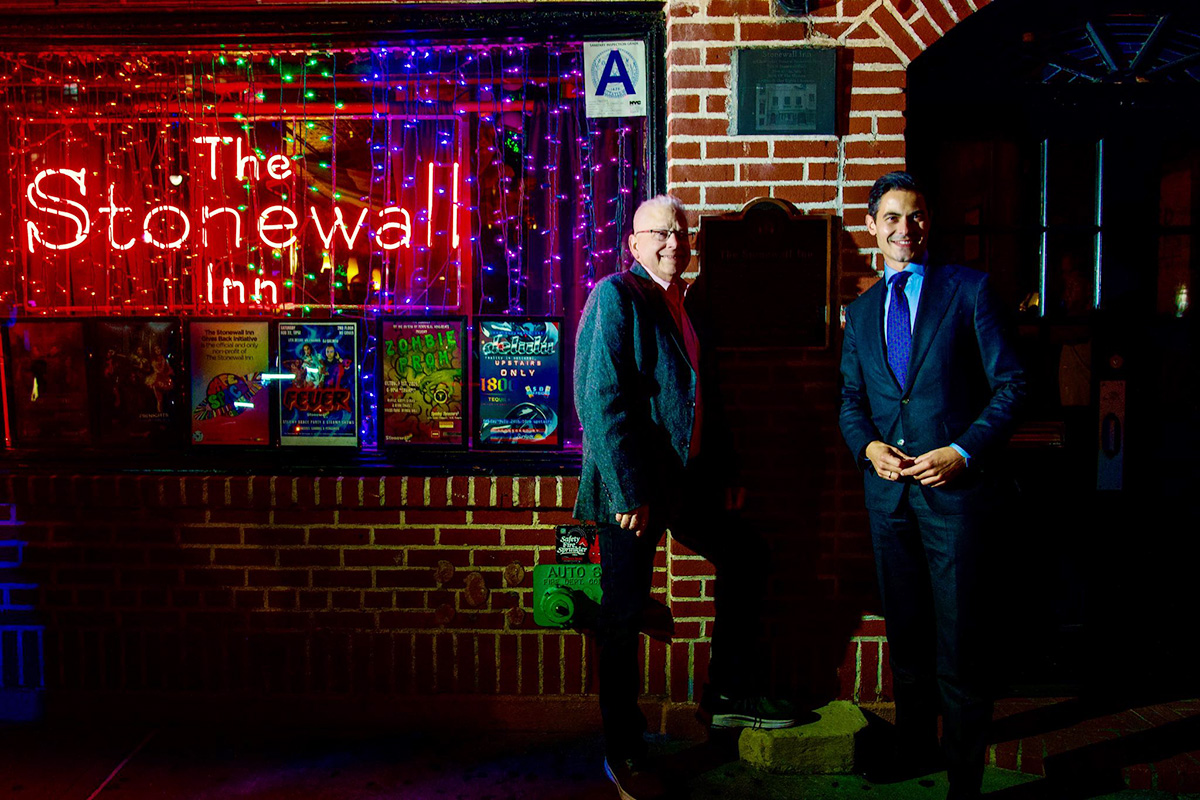
Dutch Prime Minister Rob Jetten on Monday visited the Stonewall Inn in New York.
“The Stonewall Inn is not just a gay bar in New York, but the place where in 1969 riots took place as a reaction to years of discrimination and police violence,” wrote Jetten on X. “This is seen as the starting point of the global LGBTIQ+ emancipation and activism. Nowadays, the bar is a national monument, dedicated to the LGBTIQ+ rights movement.”
“For me, it is impressive and moving to be here tonight. And also fitting, because the defense of human rights is an important part of our foreign policy,” he added. “The Netherlands stands alongside the Stonewall Inn community when it comes to everyone’s right to live openly, safely, and with pride, no matter who you are or who you love.”
De Stonewall Inn is niet zomaar een gay bar in New York, maar de plaats waar in 1969 rellen plaatsvonden als reactie op jarenlange discriminatie en geweld van de politie. Dit wordt gezien als startpunt van de wereldwijde lhbtiq+-emancipatie en activisme. Tegenwoordig is de bar… pic.twitter.com/hJmFYjF91Z
— Rob Jetten (@MinPres) September 23, 2026
Jetten in February became the Netherlands’s first openly gay prime minister.
He opened last month’s World Pride Human Rights Conference in Amsterdam. Jetten also participated in a panel with former Irish Prime Minister Leo Varadkar, former San Marino Captain Regent Paolo Rondelli, and other current and former heads of government who are gay or lesbian.
Jetten is scheduled to speak to the U.N. General Assembly on Thursday.
District of Columbia
Capital Pride chair resigns from board after just 10 months
Anna Jinkerson ‘taking step back to move forward’

Anna Jinkerson, who has served as chair of D.C.’s Capital Pride Alliance Board of Directors for the past 10 months and has served on the board for the past four years, confirmed she is resigning from the board effective Sept. 30.
Capital Pride Alliance serves as the lead organizer of D.C.’s annual LGBTQ Pride events.
“I am taking a step back to move forward and plan to stay engaged in the community,” Jinkerson told the Washington Blade in a statement. “Serving as a volunteer leader during a period of transition following World Pride was both an honor and a challenge,” she said.
“Throughout my tenure, I focused on strengthening accountability, improving communications, supporting staff and volunteers, and helping position the organization for long-term success,” she told the Blade in her statement. “Meaningful organizational progress requires collaboration, dedication, and a shared commitment to serving the community, and I am proud of the work accomplished during this period.”
In February of this year, during Jinkerson’s tenure on the board, Capital Pride announced it had expanded the size of its board from 12 to 25 members.
Around that same time one of the existing board members, transgender activist Taylor Lianne Chandler, announced in a letter to fellow board members that the Blade obtained from an anonymous sender that she was resigning from the board. Among her reasons for resigning, she said in the letter, was the board’s failure to address “sexual misconduct” within the Capital Pride organization.
In the letter, which she confirmed for the Blade was authentic, Chandler said she and other board members raised “credible concerns” of alleged sexual misconduct within the Capital Pride organization and the board chose not to adequately respond to those concerns.
Chandler told the Blade a Capital Pride investigation identified an individual implicated in a “pattern” of sexual harassment related behavior, but said she was bound by a Non-Disclosure Agreement that applied to all board members and she could not provide further details.
When the Blade contacted Capital Pride for comment on Chandler’s allegations, Jinkerson responded with a statement saying Capital Pride was addressing her concerns.
“When concerns are brought to CPA, we act quickly and appropriately to address them,” Jinkerson said. “As we continue to grow our organization, we’re proactively strengthening the policies and procedures that shape our systems, our infrastructure, and the support we provide to our team and partners,” she said.
In her statement to the Blade this week commenting on her planned resignation from the Capital Pride board, Jinkerson appeared to refer to the concern raised by Chandler.
“I am proud to have advocated for sexual harassment training, supported staff and volunteers when concerns were raised, engaged community leaders in important conversations, and helped advance practices that strengthen safety, transparency, and accountability,” she said.
“As I step away from board service, I do so with gratitude for the opportunity to serve and with confidence in the organization’s future,” she added. “I am taking a step back to move forward, and I look forward to remaining actively engaged in our community and continuing to support efforts that advance equality, belonging, and pride for all.”
Fiji
Spike in HIV cases prompts Fiji to declare national emergency
Country recorded 2,016 new diagnoses in 2025
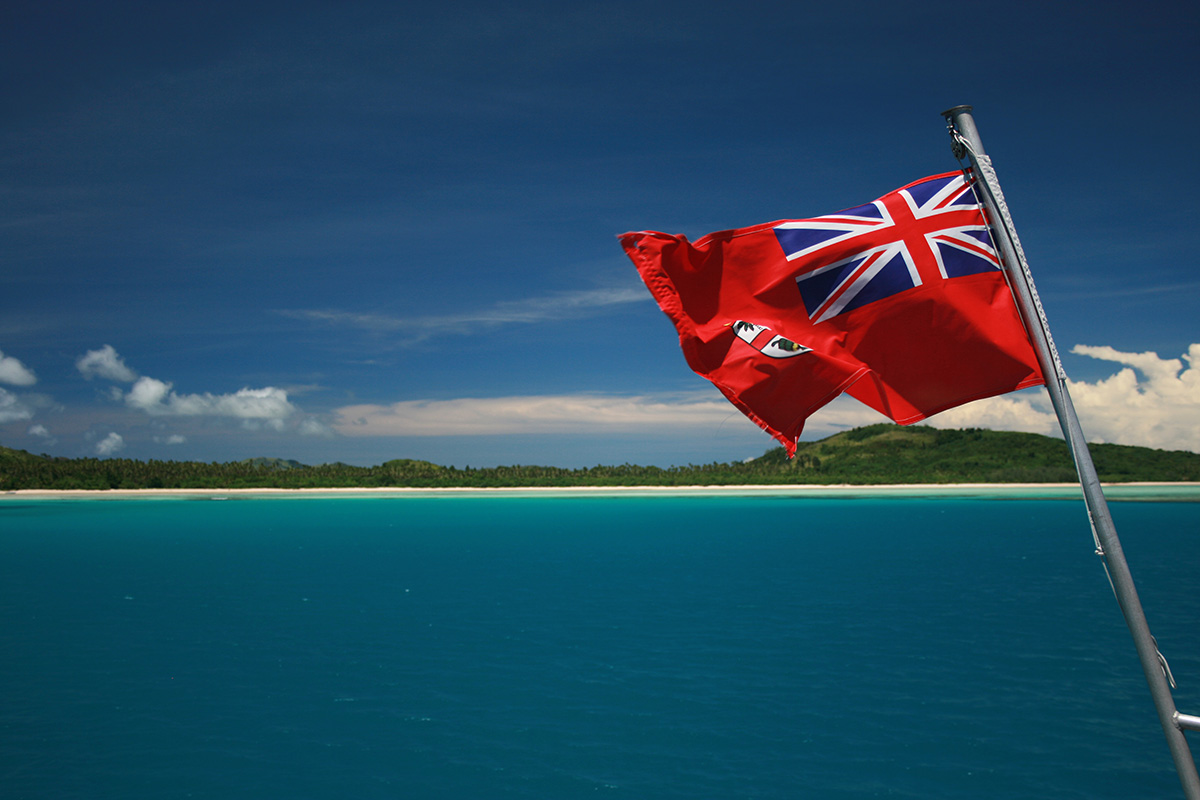
Fiji, a small Pacific island nation, on Sept. 15 declared a national emergency as it confronted one of the sharpest increases in new HIV infections globally.
The surge had been building for years, prompting the government to begin intensifying its response two years before the emergency declaration.
In 2024, the government adopted a four-year HIV Surge Strategy, covering 2024 through 2027, and later put in place a national plan to respond to the outbreak. UNAIDS and the World Health Organization have supported that effort.
The scale of the crisis is stark.
An estimated 9,100 people were living with HIV in Fiji in 2025, according to UNAIDS — a 12-fold increase from 2010. HIV has no cure, but effective treatment can suppress the virus, allowing people living with HIV to live long, healthy lives, and preventing sexual transmission when the virus remains undetectable.
In announcing the emergency, Health and Medical Services Minister Ratu Atonio Lalabalavu said the country recorded 2,016 new HIV diagnoses in 2025, the highest annual total on record. He called the figures a sign of the “seriousness of the epidemic and the urgent, coordinated response our country now needs.”
The crisis is also affecting children.
Save the Children Fiji said this week that a two-month-old baby is currently the youngest patient in the country living with both HIV and tuberculosis. The organization said 59 babies acquired HIV through mother-to-child transmission in 2025, while 67 new HIV cases were recorded among children under 15.
Five years ago, about one in every 167 people in Fiji was estimated to be living with HIV, according to government figures cited by the Associated Press. Since then, Fiji has also emerged as an important transit point in the regional drug trade, with international criminal networks moving narcotics from Latin America and Asia toward markets including Australia and New Zealand. Some of those drugs are also reaching Fiji’s domestic market, where injecting drug use has become an increasingly important route of HIV transmission.
Sexual transmission has continued to fuel the outbreak, with health officials pointing to inconsistent condom use and gaps in HIV testing. Stigma and misinformation have made the problem harder to confront, according to UNAIDS Pacific adviser Renata Ram, who has warned that limited knowledge about HIV can discourage people from seeking testing and care.
In a statement to the Washington Blade, Eamonn Murphy, UNAIDS’ regional director for Asia and the Pacific and Eastern Europe and Central Asia, cautioned against viewing Fiji’s epidemic through the lens of a single behavior or community. Among cases where the mode of transmission is known, he said, more than half are linked to sexual transmission and more than 42 percent to injecting drug use.
“The rise in infections among women and infants also shows that HIV has reached more widely across society,” Murphy said. “What stands out is how quickly the epidemic changed compared with the pace of the response. Access to PrEP and harm reduction remained limited, Fiji did not yet have a needle and syringe programme, and stigma and policy barriers continued to keep some people away from services.”
Murphy noted only 39 percent of people with HIV in Fiji knew their status in 2025, and only 22 percent of them were receiving treatment. He also pointed out a wider system-level problem.
“COVID-19 and the years that followed disrupted services, shifted attention and resources, and left community-led outreach operating below the scale that was increasingly needed,” said Murphy. “The epidemic moved faster than the response.”
Murphy said the immediate challenge is to bring HIV prevention and treatment closer together and make both easier to access at scale. He said PrEP, condoms, testing and harm reduction — including Fiji’s planned needle and syringe program — need to reach people earlier. At the same time, people diagnosed with HIV need a clear path into same-day treatment, care and support that helps them remain in treatment.
The tool at the center of the harm-reduction debate is hardly new.
Needle and syringe programs provide people who inject drugs with sterile equipment, helping them avoid sharing needles and reducing the risk of HIV and other blood-borne infections. Decades of evidence have found that NSPs reduce HIV transmission without increasing drug use, and WHO describes them as a proven and cost-effective public health intervention. Such programs operate in more than 90 countries worldwide. Yet Fiji, even as injecting drug use has become an increasingly important route of HIV transmission, is only now moving toward introducing one.
“Trust is just as important as access,” Murphy told the Blade. “People most affected by HIV are more likely to use services when they are confidential, respectful and connected to organisations they already know. Community groups and peer workers are increasingly part of Fiji’s response, including the rollout of free PrEP, and that closer link with the health system can make a real difference.”
“As UNAIDS has stated, the national crisis declaration is ‘a call for action, not fear,’” he added. “Fiji has the tools to change the trajectory; the priority now is to turn political commitment into rapid, coordinated action that reaches people at scale. The UN Joint Team is working to support the national response.”
Joeli Colati, executive director of Fiji Network Plus, a nongovernmental support and advocacy network established by and for people living with HIV, told the Blade that HIV affects people in ways that extend far beyond their health. Some people are afraid to get tested because they fear being judged or worry that others will discover their HIV status. Others fear the consequences for their families, jobs and relationships, as well as stigma and gossip. For LGBTQ people and other vulnerable populations, Colati said, those fears can be even harder to navigate because some already face discrimination. When people do not feel safe, he said, they may avoid testing, treatment and other HIV services.
Fiji does not have a reliable national count of its broader LGBTQ population.
UNAIDS estimates that about 16,000 men who have sex with men and transgender people live in the country, though that figure should not be treated as an estimate of the entire LGBTQ community.
“We are also seeing a lot of HIV misinformation, especially on social media. This includes people sharing wrong information about how HIV is spread, how it is treated, and what it means to live with HIV,” said Colati. “Another serious concern is the increase in herbal healers claiming they can cure HIV. There is currently no cure for HIV. These claims can be dangerous if they make people stop or delay their HIV treatment. Herbal medicine should never be promoted as a replacement for antiretroviral therapy (ART).”
Colati said HIV peer counselors and NGO outreach workers are helping people at the community level, from supporting those newly diagnosed and helping them stay in care to reaching people who may not visit clinics, providing accurate information and connecting them with testing and treatment. He said people are often more comfortable seeking help from someone who understands what they are going through.
“As someone living with HIV myself for 19 years, I know that a person who is newly diagnosed needs more than medicine. They also need support, correct information and hope. With treatment, people living with HIV can live long and healthy lives,” Colati said. “We also need people to understand undetectable equals untransmittable, or U=U: when a person living with HIV takes treatment and maintains an undetectable viral load, they do not sexually transmit HIV. That is both a prevention message and a powerful message against stigma. Fiji Network Plus, the national network for people living with HIV, reinforced this message in our response to Fiji’s national HIV crisis.”
Asaeli Sinusetaki, acting chief executive of Rainbow Pride Foundation, an LGBTQ advocacy group based in Suva, the Fijian capital, in a statement to the Blade said the organization welcomed the government’s declaration because it showed officials now recognized the seriousness of the situation.
“It is unfortunate that it took this long to respond, because the warning signs were always there,” Sinusetaki added.
“For LGBTQ+ people, experiences can differ depending on how comfortable they are accessing services,” Sinusetaki said. “At the same time, LGBTQ+ communities in Fiji have been one of the driving forces behind prevention efforts. Yes, accessing services independently can be a challenge because of fear, particularly stigma and discrimination. But because many LGBTQ people are also part of the Peer Outreach Worker network, they have established trust within their communities and networks to help people access information and services.”
Sinusetaki said access to HIV testing remains a major challenge, with testing unavailable at many local health centers, forcing some people to travel to sexual and reproductive health clinics or hospitals. He said that can be a significant barrier in a country where people often do not seek medical care unless they are already sick, making it unlikely that someone would make a separate trip simply to get an HIV test.
“The emergency has also highlighted that HIV cannot be treated as a stand-alone issue,” said Sinusetaki. “LGBTQ people need access to a broader package of sexual and reproductive health services, STI screening and treatment, mental health and psychosocial support, prevention information, condoms and lubricants, PrEP and PEP and, where relevant, harm-reduction services.”
“For people who receive a positive diagnosis, the challenge does not end with testing,” Sinusetaki added. “We need to ensure that they are linked rapidly to treatment, supported to remain in care and treated with dignity throughout that journey.
The Blade reached out to Lalabalavu multiple times for comment, but did not receive a response.

Dutch prime minister visits Stonewall Inn

Clavicular charged in alleged rape of teenage influencer

Gov. Whitmer to serve as keynote speaker for Saturday’s HRC National Dinner

Capital Pride chair resigns from board after just 10 months

Spike in HIV cases prompts Fiji to declare national emergency

Activists protest outside Turkish Embassy in D.C.

A roundup of fall events not to be missed

Over 2,000 turn out for Hands Around the Kennedy Center protest

Furries take over the Metro