U.S. Supreme Court
LGBTQ rights on the line: What to watch as Supreme Court’s new term begins
The Supreme Court will hear cases shaping transgender sports participation and conversion therapy, with major LGBTQ rights implications.
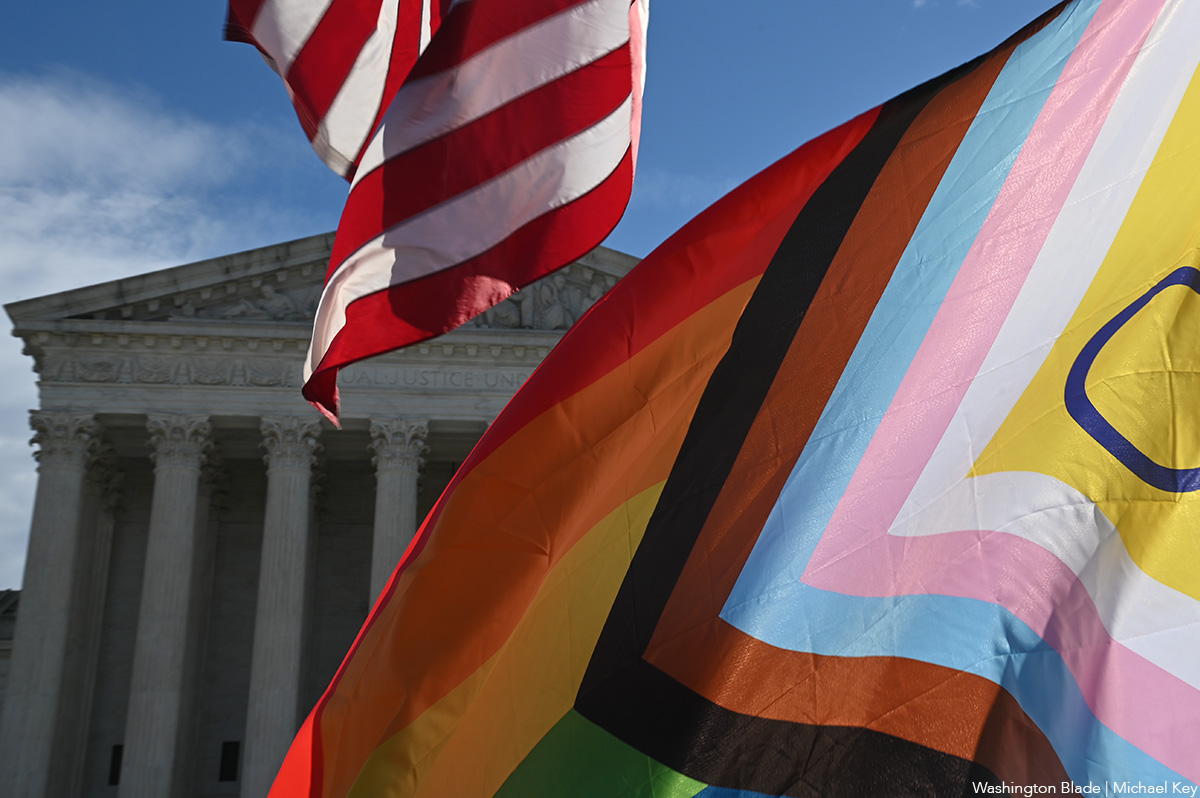
The Supreme Court’s new term begins this week, with multiple cases on the docket that could have serious consequences for the civil rights of the LGBTQ community.
Many issues are being debated this term, including the scope of civil rights protections under the Equal Protection Clause, Title IX, and the Voting Rights Act—all of which could leave LGBTQ Americans less protected.
This Supreme Court is different from years past. Its right-wing supermajority is utilizing a more activist approach to legal interpretation—siding more often with President Trump’s preferred interpretation of laws rather than a more constitutional evaluation. One Supreme Court Justice, Clarence Thomas, even went so far as to publicly state he has a problem with the way judges are restricted by past decisions, saying he is against the concept of stare decisis (or sticking to prior judges’ decisions) and that they are “not the gospel.”
There are three major cases that in some way impact—or have the possibility of impacting—the rights of LGBTQ Americans: West Virginia v. B.P.J., Little v. Hecox, and Chiles v. Salazar. The first two deal with the rights of transgender girls participating in sports. The last one, Chiles v. Salazar, centers around the legality of banning conversion therapy.
West Virginia v. B.P.J.
In West Virginia v. B.P.J., a transgender girl, known as B.P.J., takes gender-affirming medication and has since the onset of puberty. She wants to compete on her school’s cross-country and track teams. In 2021, West Virginia passed the “Save Women’s Sports Act,” which requires public school and collegiate sports teams to designate their players’ genders by “biological sex” rather than gender identity.
In this case, the Court will determine whether this act violates Title IX—a federal law prohibiting discrimination based on sex in education or any institution that receives federal funding—or the Equal Protection Clause, which prohibits unfair and unequal discrimination, by requiring B.P.J. to be on a team based on her biological sex.
As Joshua Block, senior counsel with the American Civil Liberties Union’s (ACLU) LGBT & HIV Project, explained, “In terms of the legal issues before the court, the West Virginia case presents both the Title IX issue and the equal protection issue.” He also highlighted the broader impact: “Some of the lower courts are actually holding their cases pending BPJ, the Seventh Circuit recently did that in one of their restroom cases.”
Little v. Hecox
In Little v. Hecox, the Court will similarly evaluate the legality of Idaho’s transgender sports law—the “Fairness in Women’s Sports Act,” which, since its passage in 2020, has barred any transgender girls from participating on public school-affiliated sports teams. There is specific wording in the law that says the hormones present in transgender women, regardless of their stage of transition, make them predisposed to winning and create an unfair playing field—even if transgender people take Gender-Affirming Hormone Therapy (GAHT).
Lindsay Hecox, a transgender woman and student at Boise State University, attempted to join the school’s cross-country team but was denied, with the school citing that her participation violates the law. Hecox, along with a cisgender high school athlete identified in court documents as Jane Doe, filed a suit arguing that the “Fairness in Women’s Sports Act” violated both of their constitutional rights under the Equal Protection Clause of the 14th Amendment.
Block noted during the briefing, “Lindsay, unlike BPJ, is a young woman in college, and she has not had blockers. She suppressed testosterone after puberty at the same time, as I mentioned, she was not, frankly, good enough to make the team, and has just been playing club sports.” Regarding procedural concerns, he added, “Unlike other cases where a party has sought to insulate a favorable judgment from review, we obviously think the decision below needs to be vacated because it’s moot.”
Block went on to spotlight that both West Virginia v. B.P.J. and Little v. Hecox are clearly supported by Title IX, using the Court’s decision in 2020 in Bostock v. Clayton County as the basis. In that case, the Court found that the Civil Rights Act of 1964 protects not only on the basis of sex and race, but also on sexual orientation and gender identity.
“There’s obviously an overlap on the question of whether, as a general matter, the Supreme Court’s reasoning in Bostock applies to Title IX,” Block said. “Bostock says you can’t fire someone for being transgender. I think it should go without saying that a school principal can’t expel someone for being transgender either. Despite that, the states are trying to argue that Bostock doesn’t apply to Title IX at all.”
Chiles v. Salazar
While West Virginia v. B.P.J. and Little v. Hecox examine Title IX and the Equal Protection Clause, Chiles v. Salazar evaluates the legality of a Colorado House Act banning conversion therapy under the Free Speech Clause of the First Amendment. The Free Speech Clause has five parts, but this case focuses on the right to practice the religion of one’s choosing and the provision that the state may not establish a religion. Conversion therapy is defined in this case as any practice that “changes behaviors or gender expressions or seeks to eliminate or reduce sexual or romantic attraction or feelings toward individuals of the same sex.”
In Chiles v. Salazar, Kaley Chiles, a licensed counselor who identifies as a Christian, has argued that HB19-1129, also known as the “Prohibit Conversion Therapy for a Minor Act,” violates her First Amendment rights. Chiles practices “faith-informed” counseling that seeks to “reduce or eliminate unwanted sexual attractions, change sexual behaviors, or grow in the experience of harmony with [their] physical body.” She brought forward a pre-enforcement lawsuit against the state, arguing that the law has made her refrain from discussing possible gender- and sexuality-related topics with her clients and has dampened her ability to provide counseling services in line with her and her clients’ religious preferences.
Josh Rovenger, the legal director at GLAD Law, an LGBTQ+ legal services and civil rights organization, explained what Chiles v. Salazar could mean for the future of LGBTQ rights in America.
“Fundamentally, what’s at stake… is whether a state like Colorado and the 23 other states, plus the District of Columbia that have similar laws have the ability to protect LGBTQ plus youth from disproven conversion therapy practices that cause lasting trauma to the individuals, their families, and entire communities.”
He went on, explaining that the scope of the law is so specific that the plaintiff’s concerns may not apply.
“The law here is really quite narrow, aimed at a very specific, specific prohibition, and a lot of the activities that the plaintiff says that she wants to engage in, as Colorado points out in its brief, just aren’t covered by the law,” Rovenger said. In addition, he added there are multiple states that have banned the practice of conversion therapy with little issue. “Multiple states which have bipartisan laws that were passed with widespread support, including support from religious communities, would potentially be invalidated as a result of that type of decision, and that would be overruling an overwhelming medical consensus about the evidence of conversion therapy practice harms.”
As GLAAD noted in a press release, “Every major medical and mental health association in the country condemns the practice and supports efforts to prevent practitioners from violating their oath to do no harm.”
The Bigger Picture
These cases, Rovenger explained, don’t collectively signal that the Supreme Court will side in one particular way, but rather that some of the justices are interested in the cases.
“The first is the fact that they took these cases only means that four justices were interested in hearing them,” Rovenger said. “It does not tell us anything about where they’re going to come out on the cases ultimately. And there was no reason for the court to take either of or any of these cases.”
Rovenger, who served as Associate Counsel to President Biden in the White House for Racial Justice & Equity, went on, emphasizing the importance of the broader political context in this legal targeting of trans kids.
“Before 2020, decisions about sports were being left to school districts and sports organizations, the people who know these issues best… And then in 2020 we saw trans issues more generally, but sports in particular, being used as a wedge issue and a weapon to further a political agenda,” he said. “Since the beginning of 2025 that has been on steroids from the federal administration, which has really targeted transgender individuals, generally, and transgender kids who just want the opportunity to play school sports for the same reason other kids do — to be part of a team where they feel like they belong.”
He continued, saying that these cases would mostly impact some of the most vulnerable LGBTQ population—LGBTQ youth.
“These cases are going to have significant implications for LGBTQ youth, for LGBTQ individuals more generally, for school environments, for the ability of states to protect LGBTQ youth from discredited medical practices. And so when we think about the day-to-day experience of LGBTQ folks in this country, particularly youth, these cases will have a direct impact on those lived experiences.”
A fourth case concerns marriage equality and a decade-old effort by former Kentucky county clerk Kim Davis to overturn the Obergefell ruling. Legal experts have called the effort a long shot. Justices will likely decide whether to hear the case later this fall.



U.S. Supreme Court
Supreme Court upholds state laws banning trans athletes from sports teams
Justices heard oral arguments in two cases in January
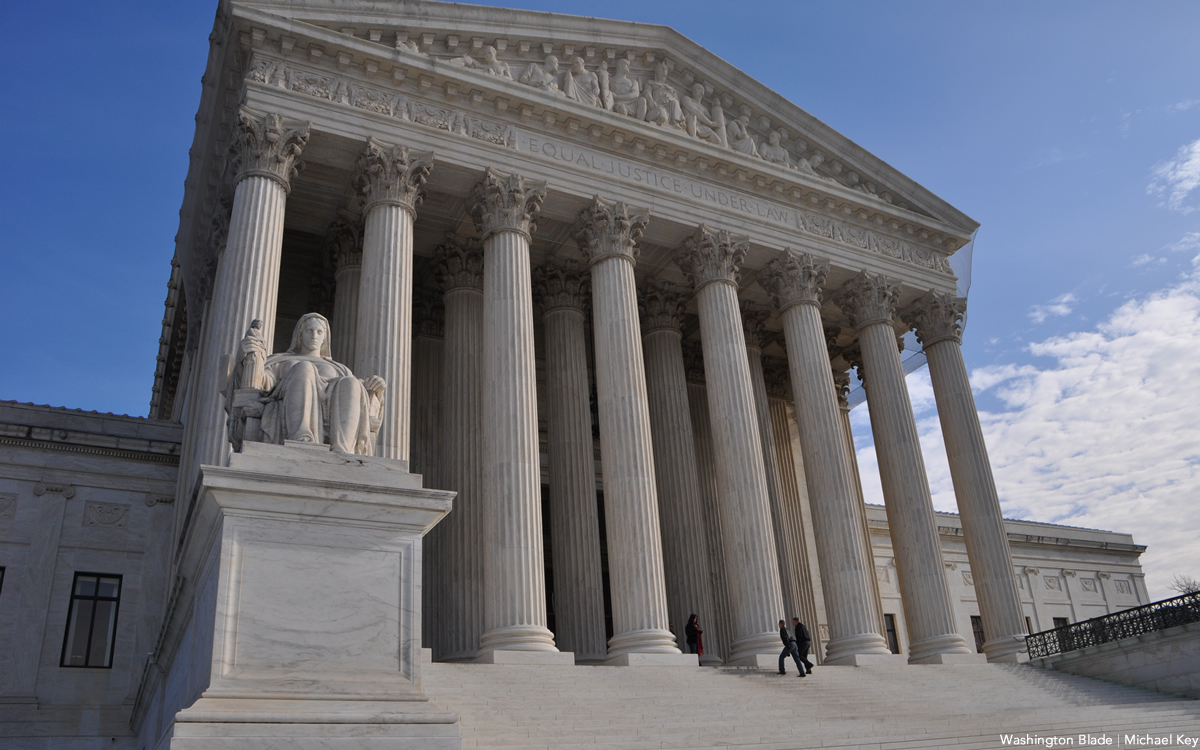
The U.S. Supreme Court on Tuesday upheld state laws that ban transgender athletes from school sports teams that correspond with their gender identity.
The justices in January heard oral arguments in two cases — Little v. Hecox and West Virginia v. B.P.J. — that challenged laws in Idaho and West Virginia respectively.
Both cases question the constitutionality of laws from both states that block trans girls from participating on girls’ teams at publicly funded schools — specifically if these bans violate the 14th Amendment’s Equal Protection Clause and Title IX. Since 2020, 27 states have banned transgender youth from playing school sports.
In a 6-3 decision made on party lines, the conservative justices asserted that laws prohibiting trans women and girls from participating in sports programs at publicly funded schools does not violate either constitutionally protected right. Notably the ruling does not require any state to categorically bar transgender girls from participating on girls’ sports teams, or transgender boys from participating on boys’ sports teams.
In the majority for the case, Justice Brett Kavanaugh delivered the opinion. It holds that schools can determine eligibility for women’s and girls’ sports teams based on biological sex. It also holds that West Virginia did not violate Title IX, which bars educational programs that receive federal funding from discriminating based on sex.
“Consistent with Title IX and the Equal Protection Clause, we hold that the States may maintain women’s and girls’ sports for biological females. They may determine eligibility for women’s and girls’ sports based on biological sex,” Kavanaugh wrote. “The Constitution and Title IX do not require an overhaul of women’s and girls’ sports throughout America.”
The Chief Justice John Roberts, along with Justices Clarence Thomas, Samuel Alito, Neil Gorsuch, and Amy Coney Barrett joined Kavanaugh’s majority opinion. It permissibly maintains female sports for biological females.
In his conclusion, Kavanaugh shares his belief of the importance of sports to women and girls but also a caution that “[n]o student-athlete on either side of the issue … deserves to be ostracized or vilified.”
Justice Sonia Sotomayor opinion was concurring in the judgment in part and dissenting in part. Justices Elena Kagan, and Ketanji Brown Jackson joined Sotomayor’s opinion.
In her dissent, Sotomayor explains that the majority opinion, while attempting to protect one groups Constitutional rights (those assigned women at birth), it puts another group’s constitutional rights (trans women) at its expense and in principle violates the Equal Protection Clause of the 14th Amendment.
“Because the majority, however, inflicts a hardship on those it disfavors without giving them the fair and full opportunity the Constitution requires to litigate their contentions, I respectfully dissent,” Sotomayor wrote, eventually pointing to how the states had evaluated issues of trans sports participants prior to these bans as evidence of general omission. “The ban eliminated this individualized approach in favor of categorical exclusion.”
She also pointed out that these rules to not equally exclude, further bolstering her argument that the majority opinion was not created with the truest sense of the Equal Protection Clause at its center.
“Teams “designated” for “females” “shall not be open to students of the male sex where selection for such teams is based upon competitive skill or the activity involved is a contact sport.” Teams “designated” for “males” do not have the same restriction.”
Jackson wrote in her dissent that this ban does explicitly allow for sex discrimination in any school or education program that receives federal funding.
“A transgender woman penalized for being perceived as aggressive has experienced discrimination ‘on the basis of sex’ just as much as a cisgender woman has, no matter that the transgender woman’s behavior matches expectations of her sex assigned at birth,” Jackson said. “Either way, the institution has imposed its gender-based expectations upon her. And either way, the institution may have violated Title IX.”
In West Virginia v. B.P.J., the case centers on B.P.J., a trans girl who was barred from competing on her school’s girls’ cross-country and track teams under West Virginia’s Save Women’s Sports Act, enacted in 2021. Under the law, it requires participation to be based on the athlete’s biological sex as indicated on their original birth certificate issued at the time of birth.
In Little v. Hecox, the details are slightly different, but ask the same 14th Amendment and Title IX questions but against Idaho’s Fairness in Women’s Sports Act. In this case Hecox, a trans woman and student at Boise State University wished to join the women’s cross-country team, but couldn’t under the law. She, with a cisgender athlete filed a suit against the governor, arguing the Equal Protection Clause of the 14th Amendment explicitly protects their rights to participate on the woman’s team.
Trans rights activists have criticized the highest court in the land’s decision, highlighting it legally allows for discrimination based on gender identity — something they argue is a foundational element of the spirit of the Equal Protection Clause.
Jennifer Levi, senior director of Transgender and Queer Rights at GLAD Law outright called the six conservative justices view of Equal Protection and Title IX as “wrong.”
“Today’s ruling gets it wrong. And it’s kids who will suffer for it. By upholding these blanket bans, the Supreme Court has allowed states to deny students even the chance to try out for a school team, simply because they are transgender,” Levi told the Washington Blade in a statement. “Policies that categorically bar students don’t advance fairness; they mandate exclusion.”
She continued, pointing out excluding some for the protection of others does not ensure fairness as the justices are arguing in their opinion.
“When a law bars every transgender girl regardless of age, hormones, or physiology, it isn’t about competitive fairness. It’s about keeping transgender kids out. We can protect women’s sports without doing that. Most of the country already does.”
Chris Erchull, senior staff attorney at GLAD Law, pointed out that while disappointing, the court does not mandate discrimination as the policy.
“This ruling does not require any state to follow West Virginia’s or Idaho’s cruel, overly-broad approach, and it does not mandate categorical bans on transgender students participating in school sports,” Erchull said. “It also leaves intact broader nondiscrimination protections for transgender students in education, including Title IX’s protections against sex discrimination for LGBTQ+ students. Discrimination has no place in our schools, and we can and should ensure that every student has the opportunity to learn, to thrive, and to know that they belong.”
Sasha Buchert, senior attorney and director of the Nonbinary and Transgender Rights Project at Lambda Legal, also emphasized the bad faith argument the majority opinion pushes for the sake of one exclusionary view of the Equal Protection Clause and Title IX.
“This ruling is deeply harmful for transgender women and girls who only asked for the ability to participate in sports with their peers,” Buchert said. “Countless studies have demonstrated the myriad benefits that come with participation in team sports. Now, one population, transgender youth and collegians, are targeted for specific and baseless discrimination. We will not be deterred and will continue to fight back to secure the equal participation that all youth, including transgender youth, deserve.”
Joshua Block, senior counsel for the American Civil Liberties Union’s LGBTQ & HIV Rights Project also echoed the lasting negative impact this ruling will have for trans Americans.
“This is a heartbreaking ruling for our clients and transgender girls like them who’ve asked for nothing more than the same opportunities afforded to their peers.” Block said. “The reality is that the equality of transgender women and girls takes nothing away from, and in fact promotes, the equality of all women and girls. We will continue to advance the fundamental principle that all young people deserve equal opportunity to thrive and succeed.”
Shannon Minter, legal director for the National Center for LGBTQ Rights, who himself is trans, issued a statement, reassuring that while upon face value the decision seems to undermine the rights of trans sports participants, it does not make that the rule.
“Today’s limited decision means that states and schools across the country still have the power to make reasonable rules to ensure fairness without banning all transgender girls,” said Minter. “Like other health or medical considerations in sports, reasonable policies for transgender student athletes rely on individual assessments rather than blanket bans. Every child deserves the chance to play sports with their friends and learn the lessons sports teach, including determination, resilience, and teamwork.”
Kelly O’Neill, an attorney for Legal Voice’s from Idaho also provided a statement to the Blade.
“It is profoundly unfair to deny a young person the benefits of teamwork and dedication because of who they are,” O’Neill said. “We should be removing barriers for girls and women in sports, not creating new ones.”
Human Rights Campaign President Kelley Robinson came to a similar conclusion.
“No kid — not my kid, not your kid, not any kid — deserves to be discriminated against. Yet this ruling is heartbreaking for transgender student athletes who are being forced to sit on the sidelines simply for who they are. When politicians convince the public that any girl could be ‘the wrong kind of girl,’ they invite harassment, intimidation, invasive questioning, or even an inspection of their body by a total stranger,” Robinson wrote in a statement shared with the Blade. “It’s sadly just the latest decision by the conservative justices on the Supreme Court to roll back protections for marginalized communities and create a second class citizenship for millions of people. We are sacrificing the dignity, privacy, and safety of America’s young people to solve a problem that was manufactured and exploited for political gain … We must continue this fight with full force until freedom, justice and equal opportunity are not flimsy promises, but nationwide guarantees.”
GLAAD President Sarah Kate Ellis, who presides over the world’s largest LGBTQ media advocacy organization, issued a statement on the ruling.
“This decision is at odds with the fundamental principles of fairness, freedom, and family that define our country and our communities. By allowing sweeping restrictions on a very small number of transgender students who simply wanted to participate in sports alongside their peers, the ruling creates an unnecessarily unfair playing field,” Ellis said. “Personal freedom and opportunity are best served when our legal protections expand access and guarantee safety for everyone. Today’s decision unfairly strips the rights of a few and threatens the ability of every girl and woman to play the sports they love.”
On the other side of the ideological isle, U.S. Sen. Jim Risch (R-Idaho) applauded the Supreme Court’s decision to uphold the state’s women and girl trans sport ban. In a statement the Republican called the court’s conservative view of as a win for “women, fairness, and the Gem State.”
“Idaho was the first state in the nation to ban biological men from competing in women’s sports and uphold the opportunities Title IX promised more than 50 years ago,” Risch said in a statement. “The Supreme Court’s decision affirms those protections and the generations of women who fought for fair, equal athletics.”
U.S. Supreme Court
11 years after Obergefell, marriage equality remains under scrutiny
Landmark ruling issued on June 26, 2015
Friday marks 11 years since the U.S. Supreme Court ruled the Constitution protects same-sex marriage in Obergefell v. Hodges. Despite that major win for LGBTQ people nationwide, the case may be on shakier ground than originally thought.
Obergefell v. Hodges, the case that determined the Constitution extends its protection of rights to same-sex couples and that states must recognize marriage licenses for same-sex couples from other states, was decided using a combination of cases from several states.
The central arguments in the case rested on the 14th Amendment’s Equal Protection Clause, Due Process Clause, as well as collateral spousal and parental rights.
Cases in play
The first case came from Michigan with DeBoer v. Snyder, where a lesbian couple, who were not legally allowed to marry in the Mitten State, attempted to adopt their third child but could not both obtain legal parental rights. April DeBoer and Jayne Rowse initially received a favorable ruling in district court, with the judge finding that the Michigan Marriage Amendment — which barred same-sex marriage in the Midwestern state — violated the Equal Protection Clause. The same day, the case was appealed to the 6th U.S. Circuit Court of Appeals, eventually making its way, along with the other five cases, to the highest court in the land.
Ohio had multiple cases that ultimately contributed to the judicial acknowledgment of same-sex marriage rights in the U.S.
The Supreme Court case most commonly associated with the fight for same-sex marriage — Obergefell — originated in Ohio. Beginning as Obergefell v. Kasich in the state, James Obergefell knew his longtime boyfriend, John Arthur, was suffering from ALS. Knowing Arthur’s life would end shortly — and understanding the couple could not legally marry in Ohio — they boarded a medically equipped plane, accompanied by a nurse and Arthur’s aunt, Paulette, and flew to BWI Airport in Maryland. There, they were legally married. Over the next several months, Arthur’s health continued to decline until he eventually passed away in October.
The legal battle began after Arthur died, as Ohio law refused to acknowledge that Obergefell was his husband and would not list him as Arthur’s surviving spouse on his death certificate. Obergefell challenged the decision, arguing it was unconstitutional and pursuing legal action. The local Ohio registrar agreed that refusing to recognize their out-of-state marriage license — which Ohio had recognized for different-sex couples in the past — discriminated against the couple. Despite that, the state attorney general continued to defend Ohio’s same-sex marriage ban.
The judge ultimately ruled that “a marriage solemnized outside of Ohio is valid in Ohio if it is valid where solemnized,” marking another step toward marriage equality. Ohio appealed the ruling, and the case ultimately contributed to the establishment of same-sex marriage protections under the federal Constitution.
The second Ohio case, Henry v. Wymyslo, much like DeBoer v. Snyder, involved parental rights for adopted children. The case included four couples — three lesbian couples who lived in Ohio and adopted children while residing there, and one gay couple from New York with an adopted son born in Ohio. The four couples filed a lawsuit against Ohio, seeking to require the state to list both parents on their children’s birth certificates.
Eventually, the judge — the same one who presided over Obergefell v. Kasich — ruled that the state must list both parents on their children’s birth certificates. Like many cases that make their way to the Supreme Court, it went through multiple appeals before ultimately reaching the nation’s highest court.
Kentucky also had two cases that contributed to the legal battle for same-sex marriage.
The first, Bourke v. Beshear, revolved around Gregory Bourke and Michael DeLeon, a same-sex couple married in Canada in 2004, and Randell Johnson and Paul Campion, who were married in California in 2008. Like DeBoer v. Snyder and Henry v. Wymyslo in their respective states, the plaintiffs challenged Kentucky’s ban on same-sex marriage and its refusal to recognize same-sex marriages performed in other jurisdictions so that both parents could be acknowledged on their children’s birth certificates.
The judge ultimately ruled, much like in Obergefell v. Kasich, that states constitutionally must recognize legally performed out-of-state marriages.
Love v. Beshear is the second case from the Bluegrass State.
Maurice Blanchard and Dominique James were denied a marriage license by Kentucky county clerks. The couple’s legal team filed to join Bourke v. Beshear, another case actively challenging the state’s ban on same-sex marriage, and the motion was approved, with the case restyled as Love v. Beshear. The judge ultimately ruled that Kentucky’s bans on same-sex marriage explicitly “violate the Equal Protection Clause of the Fourteenth Amendment to the United States Constitution, and they are void and unenforceable.”
The final case, Tanco v. Haslam, involved four same-sex couples who filed suit in Tennessee. Each couple had married outside Tennessee before moving to the state, with nearly all relocating for employment. One worked for the military, whose marriage was already recognized by the Department of Defense; one worked for the state; and two were professors. Seeking to have their out-of-state marriages recognized in Tennessee, the four couples filed Tanco v. Haslam in U.S. District Court for the Middle District of Tennessee. The court eventually granted a preliminary injunction requiring the state to recognize the marriages of the three plaintiff couples but denied the request to overturn Tennessee’s same-sex marriage ban.
To SCOTUS
All of these cases contributed to the legal challenge against same-sex marriage bans across the country and ultimately led to a 5-4 ruling that allowed same-sex couples to have their marriages recognized in all 50 states, Guam, Puerto Rico, and D.C.
The justices voted as follows: Anthony Kennedy, who authored the majority opinion, Ruth Bader Ginsburg, Stephen Breyer, Sonia Sotomayor, and Elena Kagan supported Obergefell while Chief Justice John Roberts, Antonin Scalia, Clarence Thomas, and Samuel Alito all dissented.
The court held that the 14th Amendment — specifically its Due Process Clause — guarantees the right to marry as one of the fundamental liberties it protects, regardless of the gender of those getting married.
The court also ruled that another provision of the 14th Amendment — the Equal Protection Clause — extends the right to marry enjoyed by different-sex couples to same-sex couples, finding that denying same-sex couples that right violates their right to equal protection under the law.
Some of the Supreme Court justices who dissented argued that this was a state issue, not a federal one, because the Constitution makes no mention of same-sex couples. They said it was beyond the purview of the court to decide whether states must recognize or license such unions. The dissenters argued that the majority was engaging in judicial policymaking, which they contended is not permitted under U.S. law.
Another argument made by the dissenting conservative justices was that the majority opinion infringed on religious freedom by engaging in this “judicial policymaking” rather than allowing state legislatures to determine the laws governing marriage.
Since the ruling
According to data from the Williams Institute, 823,000 same-sex couples are now legally married — more than twice the number in 2015 — as a result of the Supreme Court’s decision.
The ruling also increased the number of same-sex families raising children, largely because it removed legal barriers and paperwork restrictions that had prevented same-sex couples from being listed as parents. The data shows there are nearly 299,000 children under the age of 18 being raised by married same-sex couples as a result of Obergefell.
The states that saw the largest increases — and the most favorable changes to marriage rates — were in the South. The percentage of cohabiting same-sex couples who were married between 2014 and 2023 increased from 38 percent to 59 percent.
Many of the married same-sex couples surveyed said marriage improved their sense of safety and security (83 percent), life satisfaction (75 percent), and relationship stability (67 percent).
“Marriage equality has significantly benefited the lives and well-being of same-sex couples, their families, and the communities where they live,” said Christy Mallory, interim executive director and legal director at the Williams Institute.
Future of Obergefell
While same-sex marriage remains the law of the land, there have been multiple attempts by conservative and religious figures in America to reverse it.
In 2025, Kim Davis, the clerk of Rowan County, Ky., who made headlines 10 years earlier after refusing to issue marriage licenses following the striking down of same-sex marriage bans, approached the Supreme Court with the goal of getting Obergefell overturned.
She argued that the ruling put her religious beliefs at odds with her job and asked the court to strike it down. The consensus was nearly unanimous, holding that when a person serves as an agent of the state, they cannot place their personal religious beliefs above state policy because they are acting on behalf of the government.
Thomas, one of the Supreme Court’s most conservative justices, has also attempted to plant the seeds for overturning Obergefell.
In Dobbs v. Jackson Women’s Health Organization, which ultimately restricted abortion access in the country, he wrote a concurring opinion suggesting that Obergefell, along with several other precedents, should be “reconsider[ed].”
Later, without directly addressing Obergefell, Thomas told an audience at Catholic University’s Columbus School of Law that he didn’t “think that … any of these cases that have been decided are the gospel.”
While President Donald Trump has not implemented any executive restrictions on same-sex marriage during his presidency, his administration has made it clear that it opposes continued efforts to expand protections for same-sex couples, particularly when doing so conflicts with claims of “religious freedom.” The administration has attempted to remove sexual orientation and gender identity from federal health care and housing nondiscrimination protections and has significantly restricted the rights of transgender Americans.
Currently, same-sex marriage remains federally protected by the Respect for Marriage Act, and the Supreme Court has thus far declined to overturn Obergefell.
U.S. Supreme Court
Colo. activists condemn SCOTUS conversion therapy ruling
8-1 decision could have sweeping implications
The Supreme Court ruled in Chiles v. Salazar that a Colorado law banning conversion therapy is unconstitutional, striking down the state’s 2019 statute and potentially impacting similar laws across the country. Religious advocates have hailed Tuesday’s decision as a victory for the First Amendment and evangelical Christians, while LGBTQ activists warn it could lead to increased harm for LGBTQ youth.
The conservative majority, joined by two progressive members of the court, sided 8–1 with Kaley Chiles on March 31 in what some critics are calling a landmark ruling for religious zealots, placing the teachings of the Bible above established medical consensus. Chiles, a Christian therapist who practices what she describes as “faith-based talk therapy for children,” challenged Colorado’s House Bill 19-1129, a law prohibiting licensed professionals from engaging minors in efforts to change their sexual orientation or gender identity through conversion therapy. She successfully argued that she and her clients have a constitutional religious right to choose the type of therapy they seek, effectively nullifying the Colorado law banning conversion therapy.
When the court heard oral arguments in October 2025, early questions indicated that the justices were likely to rule against the state in a matter involving LGBTQ rights, making this the fourth major LGBTQ rights case to come from Colorado since 1996.
In 1996, the Supreme Court overruled state initiative Amendment 2 in Romer v. Evans, which tried, but ultimately failed to restrict rules on gay people’s protected status in Colorado. Then in 2018, SCOTUS presided over Masterpiece Cakeshop v. Colorado Civil Rights Commission, when a Lakewood baker refused to make a cake for a gay client, which the state argued violated it’s civil rights commission order, but the court sided with the baker, ruling the commission had violated his Christian beliefs. In 2023 the court ruled in 303 Creative LLC v. Elenis that a Denver-based web designer is legally allowed to refuse to make wedding websites for same-sex couples, and successfully arguing she was constitutionally protected under the First Amendment.
Chiles, who practices in Colorado Springs, combines traditional psychological approaches — including cognitive, behavioral, psychodynamic, and humanistic therapies — with Christian beliefs. She argued that the law violated her First Amendment rights by restricting her ability to practice therapy aligned with her religious values, as well as limiting the rights of clients seeking that form of care.
Conversion therapy, widely discredited by major medical and psychological associations, is defined as practices that attempt to change a person’s sexual orientation or gender identity. Under Colorado law, providers found in violation could face fines up to $5,000, suspension, or loss of licensure.
Lower courts — including a district court and the 10th Circuit — previously upheld the law, finding it regulated professional conduct rather than speech and therefore required only minimal constitutional scrutiny. However, the Supreme Court, with three Trump-appointed justices, determined that the lower courts failed to apply “sufficiently rigorous First Amendment scrutiny,” raising concerns about violations of both the Establishment Clause and the Free Exercise Clause. The ruling sends the case back to a lower court for further review.
The decision reflects a broader trend in recent years, with the current court — often referred to as the Roberts Court — more frequently siding with religious liberty claims, particularly those involving Christian plaintiffs.
To better understand the implications of the ruling, the Washington Blade spoke with Colorado-based LGBTQ advocacy organization Rocky Mountain Equality, which has spent decades organizing, educating, and providing services across the state.
Founded in 1994 as Boulder Pride, the organization has since expanded into a statewide force addressing LGBTQ issues, including healthcare, housing, and youth services. Now operating as Rocky Mountain Equality, the group saw a 62 percent increase in 2024 operating revenue, growing to more than $3.765 million while running the Equality Center of the Rocky Mountains in Boulder.
Mardi Moore, the chief executive officer of Rocky Mountain Equality, sat down with the Blade to discuss the ruling and its impact on the broader LGBTQ community, calling it both expected and deeply concerning.
“When the ruling came out today, I think we all knew it wasn’t going to be a winning battle after hearing arguments, but the 8-1 decision made me sad, and honestly, it’s turning into anger,” Moore told the Blade on Tuesday morning. “This is a really sad day — not just for LGBTQ kids, but for all kids in Colorado.”
Moore explained that the law passed with support from Colorado lawmakers and felt like progress toward making the state safer for LGBTQ residents.
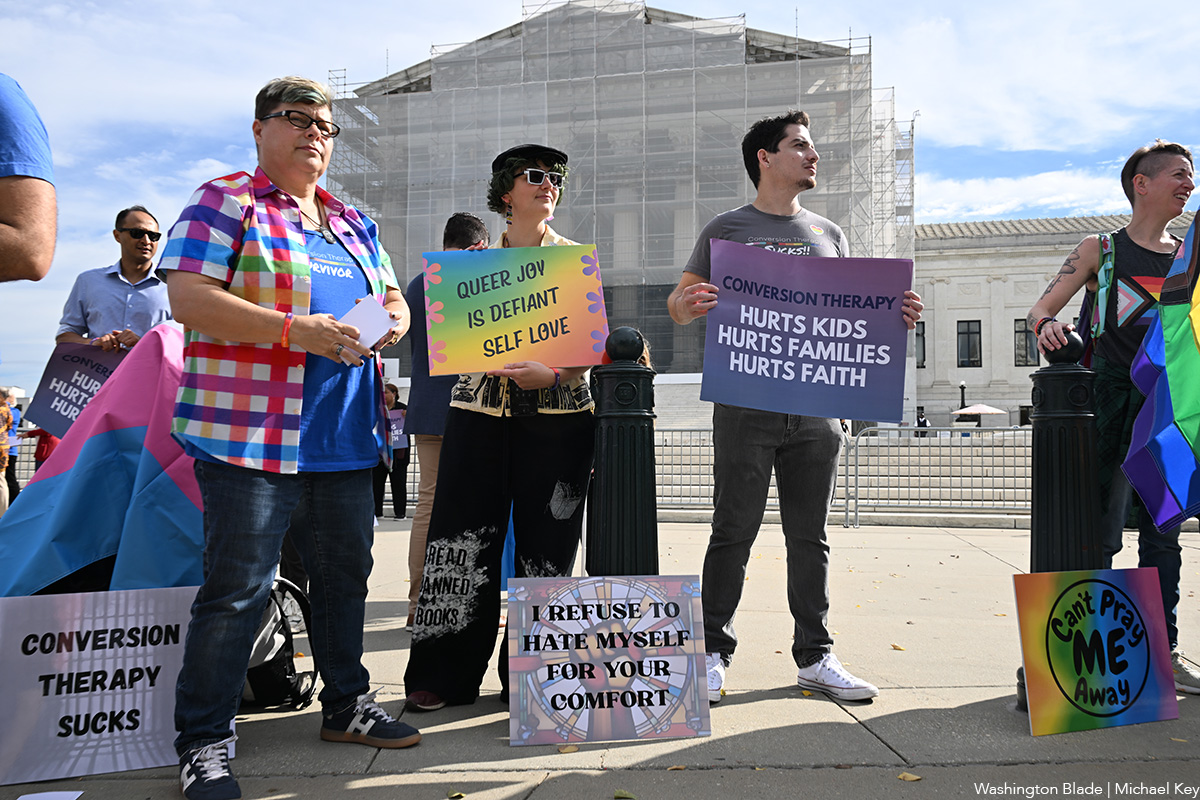
While oral arguments were being heard in October, the Blade spoke to a group of conversion therapy survivors who came to the nation’s capital to protest the ban’s removal and support one another. Their stories detailed the emotional and physical toll of conversion therapy.
“We all know the horror stories, and we know conversion therapy is pseudoscience,” she continued. “About a decade ago, Colorado passed a bill — under the leadership of then-Rep. Daniel Ramos — that banned conversion therapy with religious exceptions, which was a huge step forward.”
That step forward now feels like a step back, Moore suggested. While the ruling currently applies to Colorado, she warned it could embolden similar legal challenges nationwide.
“In our initial reading, this ruling only impacts Colorado and isn’t a broader issue for other states. But that doesn’t mean people who oppose LGBTQ rights won’t start fighting state by state,” Moore said. She pointed to the state’s history, including the fight against Amendment 2. “Here in Colorado, we’re used to these battles — we fought Amendment 2, and we’re still fighting now. There are two ballot measures this November: one targeting gender-affirming care for minors, and another banning trans youth from sports at all levels.”
These ballot measures, Moore explained, represent another attempt to restrict trans youth. One would limit gender-affirming surgeries for minors — procedures that research shows are extremely rare — while another would restrict sports participation based on sex assigned at birth.
“These efforts are trying to wipe trans kids off the map. This ruling is sickening — the religious right is still very active, and people who think voting doesn’t matter need to understand that presidents shape Supreme Courts.”
Moore emphasized that while national advocacy is critical, the fight increasingly comes down to local organizing and direct support.
“Here at Rocky Mountain Equality, we advocate for the community, train providers, and support people who have gone through conversion therapy. We have a strong youth program and will continue supporting young people in every way we can.”
“Colorado may seem progressive, but it’s still a purple state,” she added. “Messaging that works in Denver doesn’t always reach families who might send their kids to conversion therapy.”
The timing of the ruling — released on Trans Day of Visibility — also drew criticism.
“Releasing this decision on Trans Day of Visibility feels calculated. It takes a day meant for joy and turns it into another setback,” Moore said.
When asked about next steps, Moore pointed to state-apponited officials who support LGBTQ rights are likely reviewing options.
“I don’t have specifics yet on organized legal responses, but our attorney general, Phil Weiser, argued this case,” she said. “I imagine his office is reviewing every possible option right now.”
Despite the opinion dropping so recently, the emotional toll is already being felt.
“I texted a colleague this morning who went through conversion therapy — it was a sad emoji kind of day,” she said, also referencing a similiar feeling to the one she has now the case of Alana Chen, a University of Colorado Boulder student who died by suicide after experiencing conversion therapy.
“Her story devastated so many, including her mother,” she shared, adding that despite her death “is still advocating for young people” in the battle over conversion therapy — one that feels like it is getting worse with each ruling, with no end in sight.
“I think the real battle started this morning at kitchen tables. There are parents telling their kids, ‘I told you being queer was wrong — the Supreme Court says so,’” Moore said. “Those are the conversations we don’t hear, but they’re happening.”
Rocky Mountain Equality says it will continue focusing on direct support, specifically in rural communities which will face a particularly difficult time as LGBTQ rights become restricted.
“When people reach out to us from rural communities, we help connect them with affirming providers — locally if possible, or in places like Boulder County. We also help with financial support so they can access care. This work is about meeting people where they are,” she explained. “We’re working with organizations across the state, including in more conservative areas like Mesa County. The environments are very different, but we collaborate to share resources and support each other. Leading an organization right now is incredibly tough work.”
The organization is also mobilizing politically ahead of the ballot measures, using the anger from this case as fuel for the long hual to getting LGBTQ rights protected.
“Just last night, we had over 100 people at a kickoff event in Boulder for our campaign to defeat these ballot measures. People signed up to volunteer, donate, and write letters. We’re going to fight to make sure Colorado doesn’t become a ‘hate state’ again,” she said.
Moore also explained that as Colorado has become a leading destination for affirming healthcare and LGBTQ rights, people from more conservative neighboring states are seeking care there. She added that if the Centennial State can provide access to specialized care that has been politicized elsewhere, it should work to protect those services.
“People are coming to Colorado from surrounding states for gender-affirming care, abortion access, and support. We’re not going to let a small group of hateful voices take that away.”
She called on allies to take action, regardless of how small or meaningless it might seem at first.
“People can help by having conversations in their own communities about the value of every person. They can connect others with resources and support systems,” she said. “And for Colorado specifically, they can donate, share our work, and stand in solidarity.”
Moore drew parallels from past crises the LGBTQ community has had faced, yet many of the LGBTQ people she faught with in the seemingly impossible times of the past are still here and still fighting, emphasizing the community’s resilience..
“I was telling my staff — I’m an old dyke, and I remember the fight during the AIDS crisis. We were trying to make sure people were fed, cared for, and treated, all while our rights were under attack. We lost many lives, but we made it through — and we will again,” she recalled.
“They think if they attack us from every direction, they can erase us, but they’ve only made us stronger. We will continue supporting LGBTQ youth and all children who deserve protection from unregulated, harmful practices like conversion therapy.”
Other LGBTQ advocates also spoke out about the ruling’s impact.
Carl Charles, a member of the Elayne Cassidy Nicholas Memorial Counsel for Trans and Nonbinary Rights at Lambda Legal, issued a statement following the court’s ruling, while touching on and his personal experience with conversion therapy.
“I know firsthand the long-lasting harms of conversion therapy, having been subjected to it when I was 15 years old. This practice did not change my sexual orientation or gender identity. Instead, it destroyed important relationships and created shame and fear that took time and effort to undo. For many survivors, it is a reverberating life-long harm,” he said as he shared his story to the world via a friend-of-the-court brief with the Conversion Therapy Survivor Network, detailing the harms of conversion therapy they experienced.
“I am fortunate to have been able to transcend the trauma of that experience, to celebrate my identity as a transgender man, and to nurture a loving relationship with my husband. But so many young people do not have the familial or community support to withstand the impact of this unethical practice. LGBTQ+ youth do not need to be changed. Rather, like all youth, they need to be supported and celebrated for the unique and important people they are becoming.”
Human Rights Campaign President Kelley Robinson issued a statement following announcement of the court’s verdict, condemning the homophobic ruling as thinly veiled intolerance as masquerading a religious right fight. Before the case was heard, the HRC submitted amicus brief detailing how the legislation in question was not religous in nature, but is regulatory speech restriction that helping LGBTQ Americans.
“The court has weaponized free-speech in order to prioritize anti-LGBTQ+ bias over the safety, health and wellbeing of children,” her statement reads. “So-called ‘conversion therapy’ is pseudoscience, not real therapy. It has been condemned by every mainstream medical and mental health association and harms families, traumatizes children, and robs people of their faith communities. It is cruel and should never be offered under the guise of legitimate mental healthcare. To undermine protections that keep kids and families safe from these abusive practices is shocking — and our children deserve better.”

For lesbian victims of domestic violence, competent care is scare

UN human rights chief sounds alarm over ‘comprehensive onslaught’ against LGBTQ rights

White House press pool pushes back after Trump bars three outlets

PHOTOS: Shenandoah Valley Pride

Long-time DignityUSA executive director announces retirement

Jeremy Moss looks to bring LGBTQ advocacy from Lansing to Capitol Hill

Republican challenger misgenders McBride during forum, forced to leave

Queer mega stars coming to D.C. this fall

Activists protest outside Turkish Embassy in D.C.

A roundup of fall events not to be missed
-

 Congress5 days ago
Jeremy Moss looks to bring LGBTQ advocacy from Lansing to Capitol Hill
-
Delaware4 days ago
Republican challenger misgenders McBride during forum, forced to leave
-
Music & Concerts4 days ago
Queer mega stars coming to D.C. this fall
-
Turkey4 days ago
Activists protest outside Turkish Embassy in D.C.