National
Nearly 300 mayors join same-sex marriage campaign
Mayors for the Freedom to Marry launched last year.
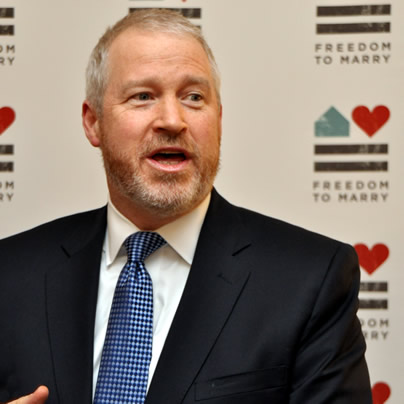
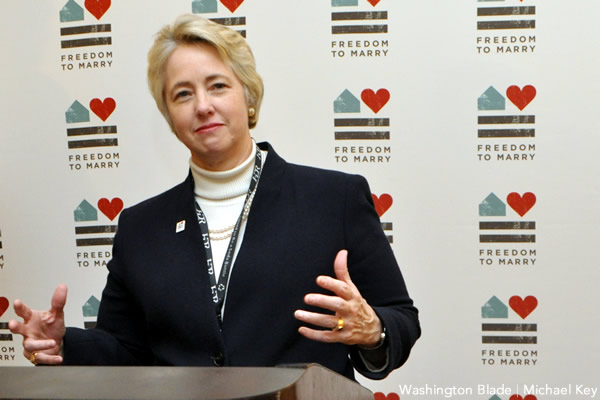
Houston Mayor Annise Parker (Washington Blade photo by Michael Key)
Mayors from across the country on Friday attended a reception during the U.S. Conference of Mayors’ annual D.C. meeting to commemorate the first anniversary of a campaign that features city executives who support marriage rights for same-sex couples.
Los Angeles Mayor Antonio Villaraigosa, Philadelphia Mayor Michael Nutter, lesbian Houston Mayor Annise Parker, gay Gainesville (Fla.) Mayor Craig Lowe and Seattle Mayor Mike McGinn are among those who attended the reception at the Capital Hilton in downtown Washington. Connecticut Gov. Dan Malloy, who is the former mayor of Stamford in his state’s Fairfield County, and Dallas Mayor Mike Rawlings, who sparked controversy last year when he refused to join the campaign, also made brief appearances.
“This has been an exceptionally monumental year for this cause — the cause of the freedom to marry,” Marc Solomon, national campaign director for Freedom to Marry, said. He noted 294 mayors from 42 states have joined the campaign since his organization formally launched it last January. “One thing I’ve learned that instead of going to Capitol Hill, if you really want to get something done you go to a mayor. You all were a crucial part of the historic wins this year.”
Solomon specifically thanked Villaraigosa, who chaired the 2012 Democratic National Convention, and Nutter for their efforts in support of the addition of a same-sex marriage plank to the party’s platform. He also praised Parker’s decision to join the campaign in spite of backlash she received from socially conservative pastors and others in her city who sharply criticized her public support for marriage rights for same-sex couples.
“If you’re out from L.A. and represent Hollywood and you have to come with the experiences that I come with, it’s a lot different than when you live somewhere where maybe not everybody is quite on board,” Villaraigosa said. “She [Parker] was steadfast in her commitment to this issue.”
Parker further discussed the controversy.
“Talking about marriage strikes a visceral cord in people and it changes the entire debate,” she said. “That is precisely why we have to have that conversation. Domestic partner benefits and the ability to recognize the relationship through complicated legal processes is not the same thing as marriage, which is an institution that we all recognize, that we understand in our hearts and in our minds that speaks across generations… we deserve full equality.”
The reception took place less than three months after voters in Maine, Maryland and Washington approved same-sex marriage referenda and Minnesotans rejected a proposed state constitutional amendment that would have banned nuptials for gays and lesbians.
The Rhode Island House Judiciary Committee on Tuesday is scheduled to vote on a same-sex marriage bill. Lawmakers in Delaware, Illinois, Minnesota, New Jersey and Hawaii are expected to consider the issue in the coming weeks and months.
The U.S. Supreme Court in March will hear oral arguments in cases challenging the constitutionality of the Defense of Marriage Act and California’s Proposition 8 that banned same-sex marriage in the Golden State in 2008. The justices are expected to issue their rulings in June.
“America would be a stronger place if folks were able to love who they want to love, be who they want to be with, ” Nutter said.
Des Moines (Iowa) Mayor Frank Cownie recalled the 2009 court ruling that struck down his state’s ban on nuptials for gays and lesbians. He described the recall of three Iowa Supreme Court justices who issued the decision as “shameful,” but stressed the fight for marriage rights for same-sex couples continues.
“It’s about equal rights,” Cownie said, noting gays and lesbians flocked to Iowa to tie the knot after the ruling took effect. “Here we are in the Heartland; conservative, really white Iowa and we had some judges that had the guts to stand up in front of everybody and say this ain’t right. Everybody has equal rights and you can’t separate those rights based on anybody’s decision on who they love and who they want to marry. So let’s keep up the right. We’ll keep it going in Iowa.”
St. Paul (Minn.) Mayor Chris Coleman noted to the Washington Blade during the reception that Richard Carlbom, campaign manager for Minnesotans United for All Families, which led the effort against his state’s proposed constitutional amendment, is a former staffer. He said he remains proud that Minnesota is the first state to reject a proposal that “would discriminate against way too many of our citizens.”
“No mayor in this country should allow their residents — their constituents — to be discriminated against,” Coleman said. “This is a seminal moment in this country where the tide has turned and I don’t think there’s any turning back on this one.”
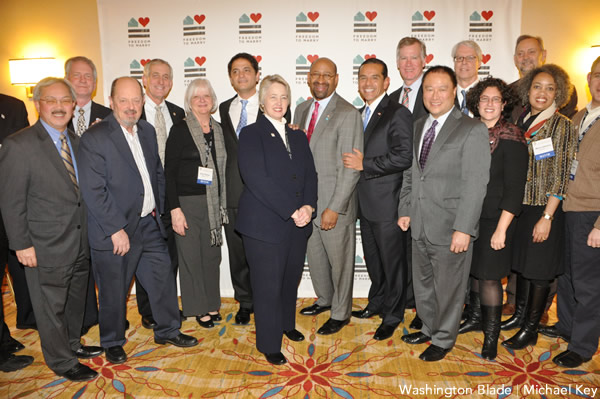
Mayors for the Freedom to Marry (Washington Blade photo by Michael Key)



National
Gallup finds LGBTQ support among Americans is dropping
Marriage equality support lowest since 2016
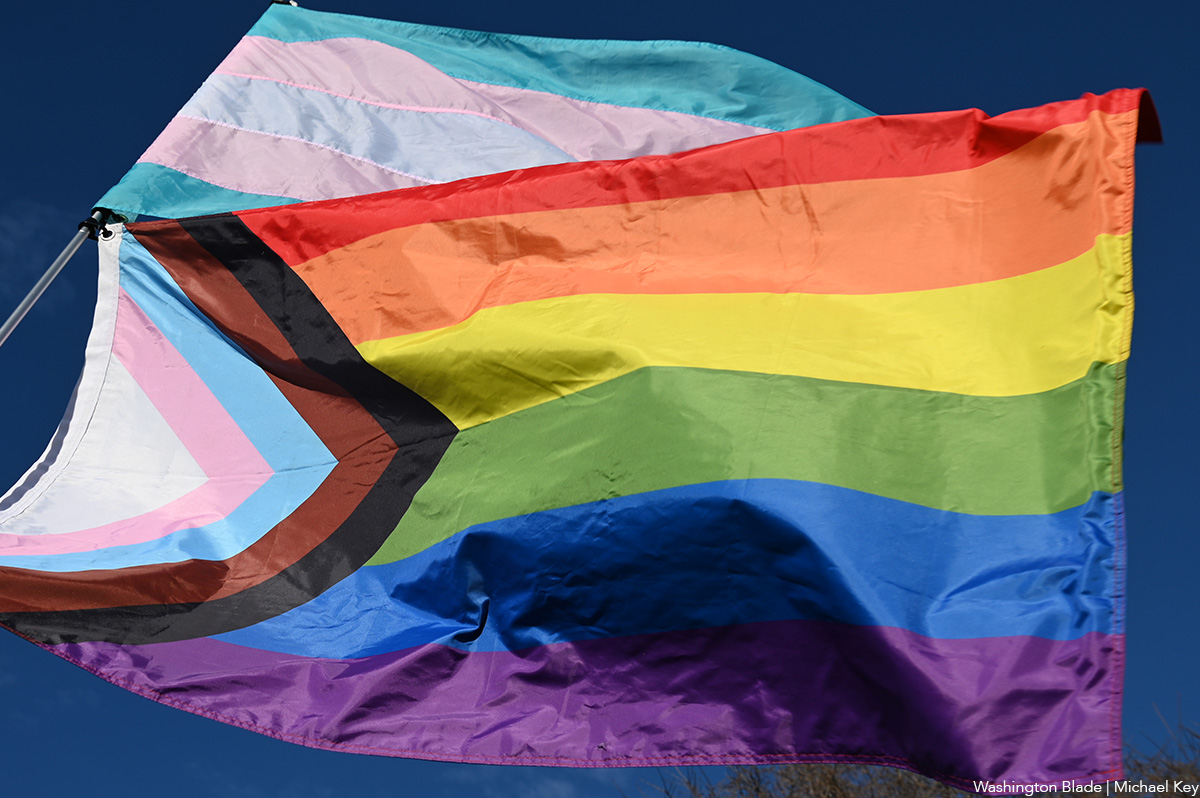
Gallup, one of the leading organizations in public opinion polling, has found that LGBTQ support among Americans is dropping.
The poll, whose data was collected using Gallup’s annual Values and Beliefs survey, was conducted in May and was published on Wednesday. The data was collected through telephone interviews from a sample of more than 1,000 adults living in all 50 states and D.C. using random digit dialing.
It highlights declining attitudes surrounding LGBTQ issues in multiple areas — from support for same-sex marriage to views on gender identity and the morality of one’s sexuality.
One of the most striking findings was that support for marriage equality fell six points from its 2022-2023 high.
The survey also found that 62 percent of Americans view gay and lesbian relations as morally acceptable, the lowest level since 2016 just after same-sex marriage was legalized nationwide by the U.S. Supreme Court.
One newer question on the poll found that the perceived morality of changing one’s gender has dropped eight points since 2021, indicating the American public is less supportive of transgender people.
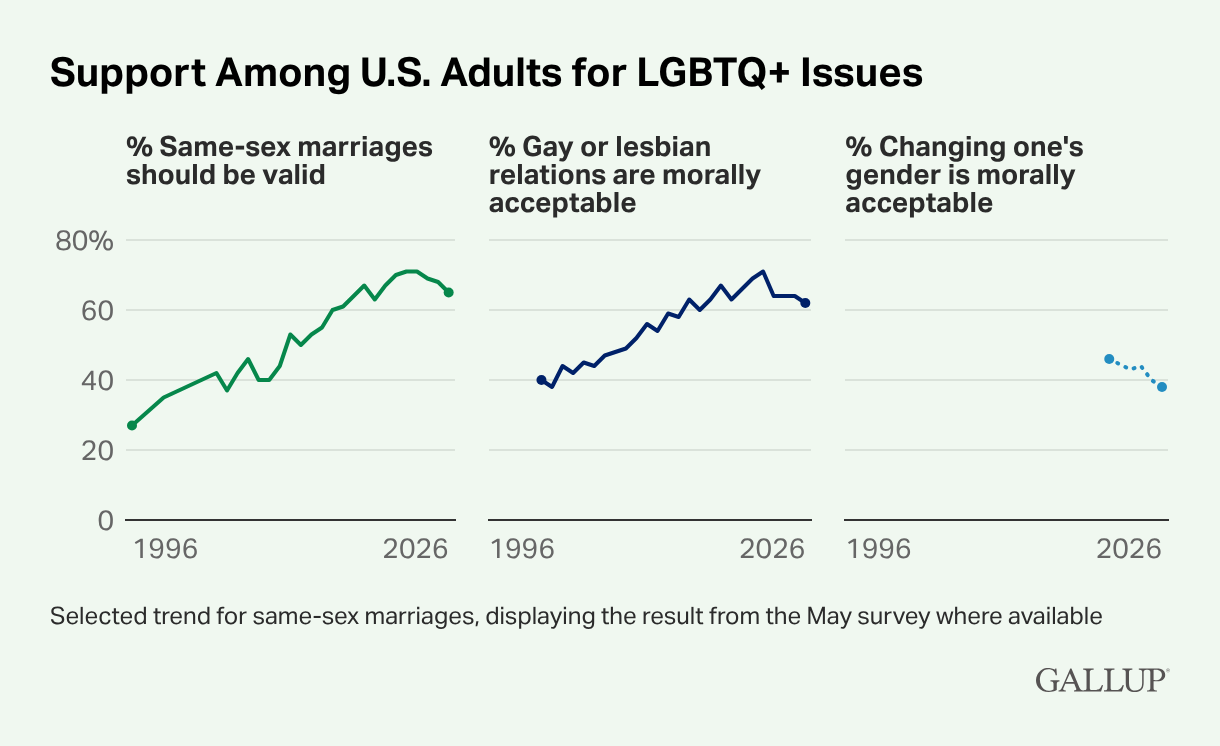
The data attributes much of the decline to shifting Republican views alongside the party itself. Conservative leaders have pushed back against diversity, equity, and inclusion programs that were intended to foster greater acceptance of LGBTQ people and other historically disadvantaged groups.
President Donald Trump has been a guiding force behind waves of anti-LGBTQ sentiment, particularly when it comes to trans rights. The president has enacted multiple executive orders, including Executive Order 14168, “Defending Women from Gender Ideology Extremism and Restoring Biological Truth to the Federal Government,” which mandates that gender be defined by one’s sex assigned at birth. He also signed Executive Order 14183, “Prioritizing Military Excellence and Readiness,” which barred qualified trans applicants from joining the military and led to the removal of trans service members already serving in the armed forces.
Additionally, he signed Executive Order 14201, “Keeping Men Out of Women’s Sports,” which prohibits trans female athletes from participating on women’s and girls’ sports teams.
In February, Gallup found that an estimated 9 percent of Americans identified as part of the LGBTQ community in some form.
The organization also found that 23 percent of adults under age 30 identify as LGBTQ, compared with 10 percent of those ages 30 to 49 and 3 percent or less among those ages 50 and older.
Congress
Ogles faces bipartisan backlash over anti-gay social media post
Tenn. congressman blamed the comment on staffer
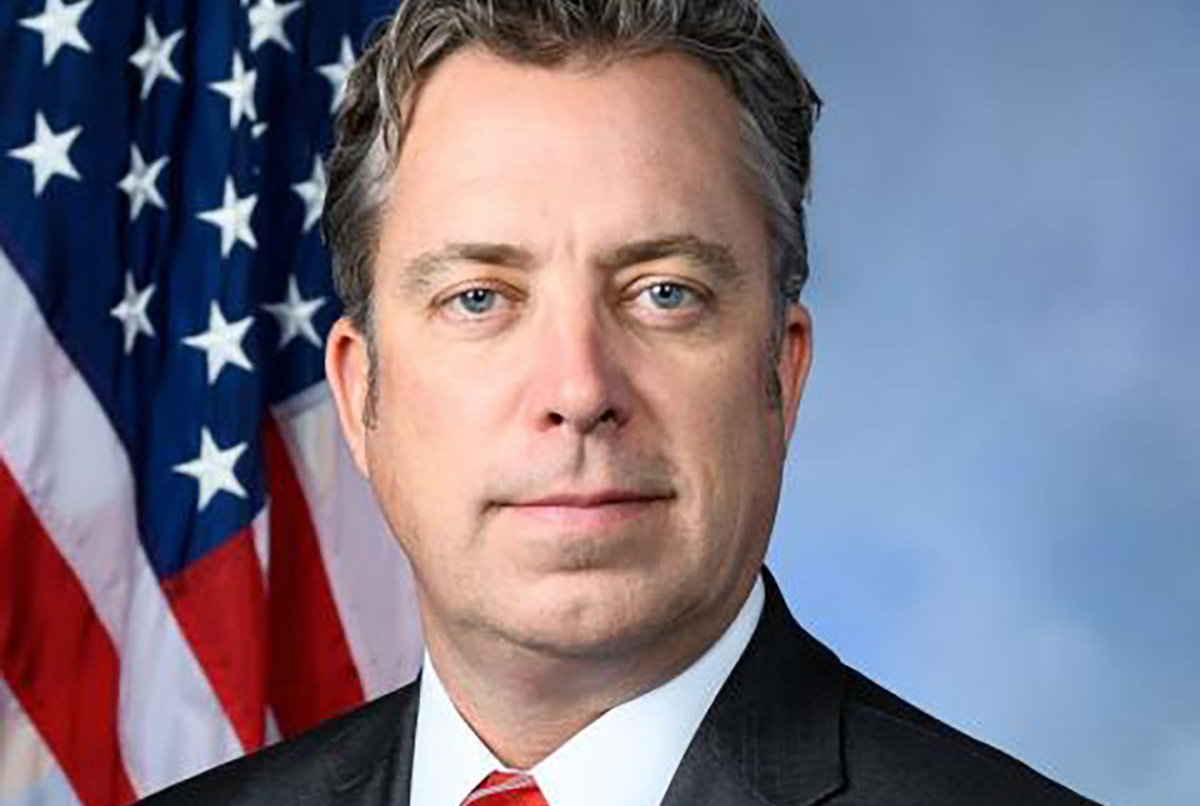
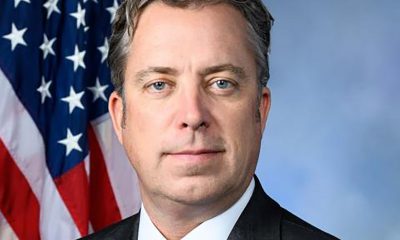
U.S. Rep. Andy Ogles (R-Tenn.), who represents Tennessee’s 5th Congressional District, is facing backlash from LGBTQ advocates and fellow Republicans after a social media post declared that “homosexuality has no place in America.”
“Homosexuality has no place in America. Happy Nuclear Family Month,” the congressman wrote in a post on X that was later deleted.
According to the Williams Institute at UCLA School of Law, an estimated 6.3 percent of U.S. adults identify as LGBTQ.
Following widespread criticism, Ogles removed the post and blamed it on a staff member.
“The post was stupid, hurtful and a complete distraction from my America First focus. The employee has been reprimanded,” Ogles said in a statement.
The Washington Blade reached out to Ogles’s office for comment but did not receive a response by press time.
Among those condemning the message was U.S. Rep. Mike Lawler (R-N.Y.), who called it “absolutely idiotic” in a social media post.
“Homosexuality exists. In America,” Lawler wrote on X. “In fact, Andy, you have family, friends, neighbors, colleagues, and constituents who are gay and lesbian. It doesn’t make them less than or somehow unworthy of being an American.”
U.S. Sen. Ted Cruz (R-Texas) also criticized Ogles’s remarks.
“For all of recorded history, homosexuals have been a part of humanity,” Cruz told TMZ DC. “I think the behavior of consenting adults is their business.”
Chris Sanders, the executive director for the Tennessee Equality Project and Tennessee Equality Project Foundation provided a statement to the Blade about Ogles’s comment.
“The Tennessee Nuclear Family Month resolution has really backfired on conservatives by ensnaring Congressman Ogles in scandal. He used the resolution as a pretext to say that our community doesn’t belong in America, resulting in incredible backlash from across the partisan divide,” Sanders said. “It is a good opportunity for him to pause and reflect on whether it’s time for him to resign. Fighting one’s own constituents is not the purpose of serving in Congress.”
Human Rights Campaign Senior Press Secretary Jarred Keller provided a statement to the Blade regarding Ogles’s comments.
“LGBTQ+ people are woven into the fabric of America, and any politician who questions that is severely out of touch with reality. When so many people are worried about whether they can afford gas to get to work or groceries for their families, the last thing we need is right-wing Republicans targeting marginalized communities with hateful attacks,” Keller said. “Representative Ogles should spend less time attacking LGBTQ+ people and start addressing the issues that actually matter, because last I checked, our community isn’t the reason families are struggling to make ends meet.”
The controversy comes as Tennessee continues to advance legislation affecting LGBTQ residents. The state already has several laws on the books that LGBTQ advocates have criticized, including the Adult Entertainment Act, enacted in 2023, which restricts certain “adult cabaret performances.”
Lawmakers have also introduced additional measures this legislative session, including the “No Pride Flag or Month Act,” which would prohibit state employees, volunteers, and agents from displaying Pride flags or participating in Pride observances while acting in an official capacity.
Another proposal, the “Banning Bostock Act” would seek to limit the application of state anti-discrimination protections based on the U.S. Supreme Court’s decision in Bostock v. Clayton County. Tennessee lawmakers have also passed other measures restricting LGBTQ rights and access to gender-affirming health care.
U.S. Military/Pentagon
Federal appeals court rules White House illegally banned trans troops
Defense Secretary Pete Hegseth says Pentagon will appeal to SCOTUS

A panel of federal appeals court judges ruled that President Donald Trump’s policy banning transgender troops likely violates their constitutional rights.
The three-judge panel from the U.S. Court of Appeals for the District of Columbia Circuit ruled 2-1 that Trump’s Executive Order 14183, also known as “Prioritizing Military Excellence and Readiness,” was created with the intent to exclude people from the military based on their gender identity.
The policy argues that trans people are inherently incapable of meeting the military’s “high standards of readiness, lethality, cohesion, honesty, humility, uniformity, and integrity,” citing a history of or signs of gender dysphoria as the cause. According to the Defense Department, this creates “medical, surgical, and mental health constraints on [an] individual.”
The policy states that, regardless of the physical or intellectual capabilities of each applicant, it views trans military applicants as a monolith, considering them less qualified than their cisgender peers.
Despite the panel’s majority opinion issued on Monday, the first day of Pride Month, the ban remains in effect. The U.S. Supreme Court allowed the Pentagon to enforce the policy last year and will continue to allow it to remain in place as litigation proceeds.
The panel’s new ruling will prevent the military from discharging current service members named in the lawsuit, but it does not allow new transrecruits to join.
The policy “appears to be driven by the bare desire to harm a politically unpopular group: persons who identify as transgender,” Judge Robert Wilkins, a Democratic appointee of President Barack Obama wrote for the majority.
Judge Justin Walker, the author of the dissenting opinion and a Republican Trump appointee, argued that the authority to determine military policy does not rest with the courts. Instead, he wrote, the Constitution grants that power to Congress through legislation and to the president as commander in chief of the armed forces.
“We have neither the expertise nor the authority to decide whether the military can exclude the plaintiffs from its ranks. The Constitution assigns that authority to Congress and the commander-in-chief,” Walker wrote.
Defense Secretary Pete Hegseth indicated that an appeal is in the works, posting, “See you at SCOTUS” on X on Monday in response to the ruling.
Jennifer Levi, senior director of transgender and queer rights at GLAD Law, which has led the litigation since last November, applauded the decision.
“Today’s decision is a powerful vindication of the plaintiffs’ extraordinary courage and unwavering commitment to their country,” Levi said.
The Washington Blade spoke with Second Lt. Nicolas (Nic) Talbott of the U.S. Army, the lead plaintiff in the case, and Levi from GLAD Law back in November.
While discussing the case and his experiences as a trans service member, Talbott said his identity is an asset rather than a hindrance, particularly when it comes to identifying problems and finding solutions, regardless of what others may think or say.
“Being transgender is not some sad thing that people go through,” Talbott told the Blade. “This is something that has taken years and years and years of dedication and discipline and research and ups and downs to get to the point where I am today … my ability to transition was essential to getting me to that point where I am today.”
He also discussed the impact of removing qualified and dedicated service members from the military, arguing that the consequences will be felt long after Trump leaves office.
“When we’re losing thousands of those qualified, experienced individuals … those are seats that are not just going to be able to be filled by anybody,” he said. “[That’s] military training that’s not going to be able to be replaced for years and years to come.”
“Every person who puts on the uniform is expected to make a tremendous amount of sacrifice,” Talbott said. “Who I am under this uniform should have no bearing on that … We shouldn’t be picking and choosing which veterans are worthy of our thanks on that day.”
Levi characterized the policy as overtly cruel and legally indefensible to the Blade.
“This policy and its rollout is even more cruel than the first in a number of ways,” Levi explained. “For one, the policy itself says that transgender people are dishonest, untrustworthy and undisciplined, which is deeply offensive and degrading and demeaning.”
She also argued that the administration’s cost justification is flawed, saying that removing and replacing trans service members is more expensive than retaining them.
“There’s no legitimate justification relating to cost … it is far more expensive to both purge the military of people who are serving and also to replace people … than to provide the minuscule amount of costs for medications other service members routinely get.”

PHOTOS: Shepherdstown Pride Parade

Charges against Budapest mayor for organizing Pride march dropped

Gallup finds LGBTQ support among Americans is dropping

Ogles faces bipartisan backlash over anti-gay social media post

First gay underwear party? How to have fun nearly naked

Books for a pre-Pride celebration

Barney Frank’s powerful legacy for LGBTQ federal employees

Claudia López comes up short in Colombian presidential election

PHOTOS: Hagerstown Pride