Local
Terry McAuliffe sworn in as Virginia governor
New Virginia governor pledged to fight anti-LGBT discrimination
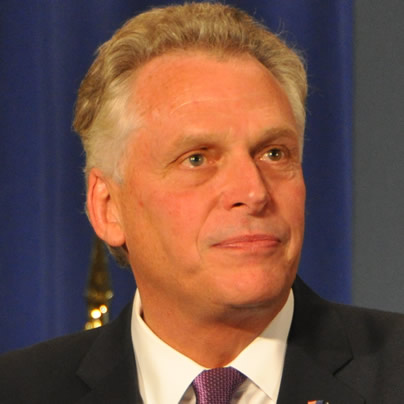
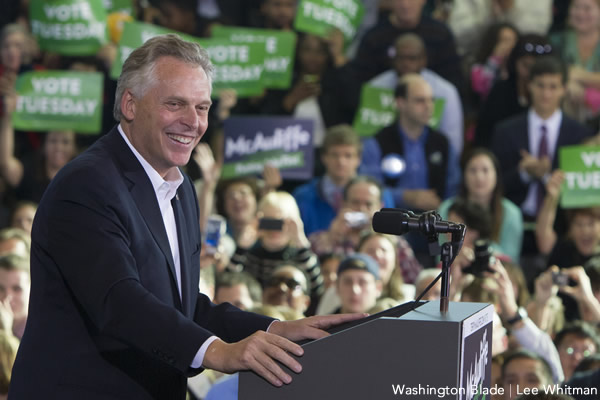
Terry McAuliffe was sworn in on Saturday as Virginia’s 72nd governor. (Washington Blade photo by Lee Whitman)
“An open and welcoming state is critical to the 21st century economy, but it’s also imperative for justice and fairness,” said McAuliffe.
The former DNC chair stressed throughout his inaugural address the economy remains among his administration’s top priorities. McAuliffe also said the commonwealth needs to “ensure that someone can’t lose their job simply because they are gay.”
“As the legislature and my administration work to diversity our economy, we need to remember that our sense of urgency is driven by those Virginians who struggle each and every day just to get buy and whose dream is simply to give their children the opportunities that may never have had,” said McAuliffe. “My administration will work tirelessly to ensure opportunities are equal for all Virginia’s children no matter if you are a girl or a boy, no matter what part of the commonwealth you live in, no matter your race or your religion and no matter who you love.”
Lieutenant Gov. Ralph Northam and Attorney General Mark Herring were also sworn in.
Gay state Sen. Adam Ebbin (D-Alexandria) told the Washington Blade in November after McAuliffe defeated then-Attorney General Ken Cuccinelli in the hotly contested gubernatorial race and Northam beat Chesapeake minister E.W. Jackson that the election results were a “clear victory for equality” that brings “the promise of a new day for Virginia.”
McAuliffe, Northam and Herring support marriage rights for same-sex couples. The former Democratic National Committee chair later on Saturday is expected to issue an executive order that would ban discrimination against LGBT state employees.
“We couldn’t be more ecstatic,” Maggie Sacra, chair of the LGBT Democrats of Virginia, told the Washington Blade earlier on Saturday during a brunch her group hosted at a downtown Richmond hotel.
Kathy Green of Henrico County said during the same event she feels former Gov. Bob McDonnell and Cuccinelli’s policies towards women’s reproductive health rights were “frightening.”
“Having Democrats in the statewide offices will really help to advance equal rights for our friends and co-workers and neighbors,” added Green.
Members of Public Advocate, an anti-LGBT group founded by Loudoun County Supervisor Eugene Delguadio, placed posters around the State House against the expected directive. They also handed out stickers that read “preserve traditional marriage” to passersby outside security checkpoints.
Lawmakers are expected to consider a number of LGBT-specific bills during the 2014 legislative session that began on Wednesday. These include measures that would ban anti-LGBT employment discrimination in Virginia, extend second-parent adoption rights to gays and lesbians and prohibit “ex-gay” conversion therapy to minors in the commonwealth.
Eight lawmakers have also introduced proposed resolutions that would seek a repeal of Virginia’s same-sex marriage ban that voters in 2006 approved by a 57-43 percent margin.
A federal judge in Norfolk on Jan. 30 is scheduled to hold the first hearing in a case challenging the commonwealth’s gay marriage ban that Ted Olson and David Boies, who argued against California’s Proposition 8 before the U.S. Supreme Court, joined last September. The American Civil Liberties Union, Lambda Legal and the ACLU of Virginia in August filed a separate class action federal lawsuit against the state’s ban on nuptials for same-sex couples on behalf of two lesbian couples from the Shenandoah Valley who were denied marriage licenses.
It remains unclear whether McAuliffe and Herring will defend Virginia’s same-sex marriage ban.
Equality Virginia Executive Director James Parrish told the Blade during a Jan. 8 interview the tone from the governor and the attorney general’s offices will be “a 180” compared to former Gov. Bob McDonnell and Cuccinelli. He said the state House of Delegates will remain a barrier to advancing pro-LGBT measures even with McAuliffe, Northam and Herring in office.
“Now that we have a friendly administration in the governor and the attorney general’s office, it will allow us to better make the narrative that the Senate and the governor and the attorney general and the Virginia public are all on the same page,” said Parrish.
Equality Virginia is among the groups that marched in the inaugural parade after McAuliffe, Northam and Herring took office. It is the first time an LGBT organization had been invited to take part in the quadrennial event.
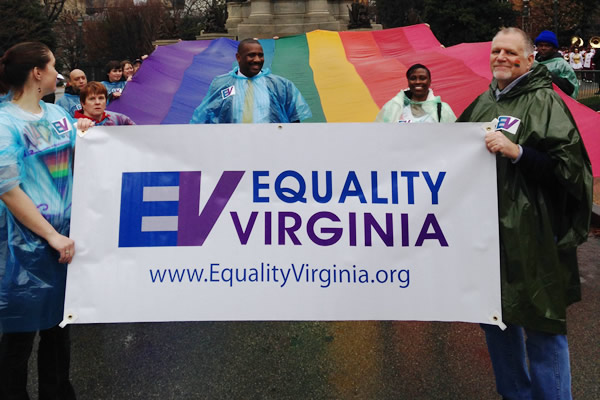
Equality Virginia was among the groups that marched in the Inauguration parade in Richmond, Va., on Saturday. It was the first time an LGBT group took part in the quadrennial event. (Photo courtesy of Kirsten Bokenkamp/Equality Virginia)


District of Columbia
Push to elect more LGBTQ ANC members yields results
31 of 43 known LGBTQ ANC members elected in 2024 seeking re-election
A 2026 list of candidates released by the D.C. Board of Elections shows that 31 of the 43 known LGBTQ candidates who won election in 2024 as Advisory Neighborhood Commissioners have filed the required petition signatures to be placed on the ballot this year to run for re-election.
The Washington Blade reported in 2024 that 43 known LGBTQ candidates won election to ANC seats that year in the November election
In a related development, the president of Capital Stonewall Democrats, D.C.’s largest local LGBTQ political group, said the group this year has recruited at least 39 LGBTQ candidates to run for Advisory Neighborhood Commission seats in the city’s Nov. 3 general election.
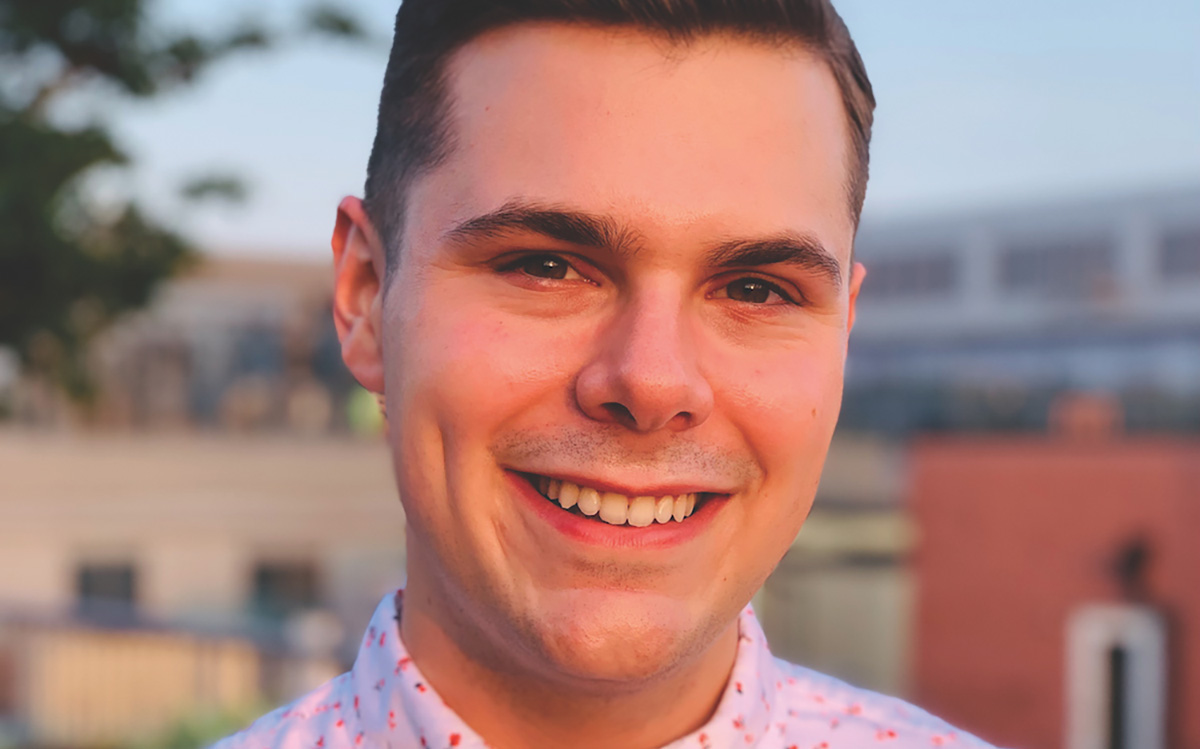
The group’s president, Stevie McCarty, an incumbent ANC member in the city’s Shaw neighborhood who is running for re-election, said the 39 candidates and possibly more responded to the group’s Queering ANCs campaign launched on July 7 that includes a website with detailed instructions for how best to run for an ANC seat.
“Since launching in early July, the site has drawn more than 20,000 views, and 39 candidates have used it to actually run,” McCarty said in a statement. He said he wasn’t sure if all the 39 candidates wanted to be identified as LGBTQ, and he was reviewing the list of incumbent LGBTQ ANC members who won election in 2024 to determine if any of the 39 candidates recruited were among those incumbents. He said he was not ready to release the names of the 39 candidates he said his group recruited to run for an ANC seat.
If none of the 39 candidates recruited by Capital Stonewall Democrats are among the 31 known LGBTQ ANC incumbents running for re-election, it would mean at least 70 LGBTQ ANC candidates will be on the city’s November election ballot.
McCarty said Capital Stonewall Democrats will send candidate questionnaires to the known LGBTQ ANC candidates as part of its process for endorsing candidates in the November election. He said he expects the group to help campaign for and provide financial support for the ANC candidates it endorses.
The D.C. local government is believed to be unique among U.S. cities in currently having 46 Advisory Neighborhood Commissions consisting of 345 single member districts in neighborhoods throughout the city in which unpaid Advisory Neighborhood Commissioners are elected for two-year terms.
The commissions are charged with considering a wide range of policies and programs impacting their neighborhoods, including traffic, parking, recreation, street improvements, zoning, liquor licenses, and economic development. Although ANCs do not have authority to set or reject policies or actions by city agencies, the agencies are required to give “great weight” to ANC recommendations, according to the law creating the ANCs.
“As an ANC member, I know firsthand how these seats shape our neighborhoods, from housing and public safety to sanitation,” McCarty said in the Capital Stonewall Democrats statement announcing the launch of the Queering ANCs campaign in July. “I’m proud to lead this effort to ensure more LGBTQ+ Washingtonians see themselves as leaders in their communities,” he said.
Some local LGBTQ activists, who asked not to be identified, said they were not aware of a significant boost in new LGBTQ ANC candidates from the Queering ANCs campaign. However, they praised the effort to recruit more LGBTQ ANC candidates and said the campaign could have yielded more candidates if it had started sooner than less than a month before the deadline for becoming a candidate.
McCarty said Capital Stonewall Democrats will continue to recruit LGBTQ D.C. residents to run as write-in candidates for ANC seats, especially in the 45 single member districts in which no candidate will be on the ballot. The Board of Elections candidate list shows many ANC single member districts that have just one candidate running without an opponent.
Following is a list of 33 known LGBTQ ANC candidates running in D.C.’s November 2026 election and the single member districts and neighborhoods in which they are running. All but two – Vita Rangel and J. Swiderski – are incumbents running for re-election. The Washington Blade will update this list if and when more LGBTQ ANC candidates become known.
1A04 – (Columbia Heights) Jeremy Sherman, he/him
1A10 – (Columbia Heights) Vita Rangel, she/ her [non-incumbent candidate]
1B03 – (Columbia Heights/U Street) J. Swiderski, they/he [non-incumbent candidate]
Jamie S. Sycamore, he/him
1B06 – (Columbia Heights/Meridian Hill) Miguel Trindade Deramo, he/him
1B07 – (U Street) Matthew Holden, he/him
1E01 – (Park View) Brad Howard, he/him
2B02 – (Dupont Circle) Jeffrey Rueckgauer, he/him
2B03 – (Dupont Circle) Vincent Slatt, he/him
2C01 – (Penn Quarter) Michael D. Shankle, he/him
2F05 – (Logan Circle) Christopher Dyer, he/him
2F07 – (Logan Circle) Kevin Cataldo, he/him
2G01 – (Shaw)Parker Griffin, he/him Howard Garrett, he/him
2G02 – (Shaw) Alexander ‘Alex’ Padro, he/him
2G04 – (Shaw) Steven McCarty, he/him
3B06 – (Wesley Heights) S. Robert Rodriquez, he/him
3F05 – (Van Ness/Cleveland Park) Adrian Jesus Iglesias, he/him
4B01 – (Takoma) Doug Payton, he/him
4B10 – (Lamond Riggs) Jinin Berry, she/her
4C06 – (Petworth) Christen Boss Hayes, they/them
4E02 – (16th Street Heights) Vince Micone, he/him
5B04 – (Brookland) Ra Amin, he/him
5B05 – (Brookland) Mónica Martínez López, she/her
5D05 – (Trinidad) Salvador Sauceda-Guzman, he/him
5F06 – (Eckington) Joe Bishop-Henchman, he/him
6B03 – (Capitol Hill) David Sobelsohn, he/him
6B09 – (Capitol Hill/Barney Circle) Karen Hughes, she/her
7C01 – (Deanwood) Brian Glover, he/him
7C03 – (Lincoln Heights) Carlos Richardson, he/him
7C04 (Deanwood) Anthony Lorenzo Green
7C08 – (Capitol View) Brandon M. Scott, he/him
8A01 – (Fairlawn) Tom Donohue, he, him
8B06 – (Garfield Heights) Marcus Thomas Hickman, he/him
Congress
Chris Van Hollen says the Democratic Party needs change. Is he the one to lead it?
Senator is backing anti-establishment Democrats across the country
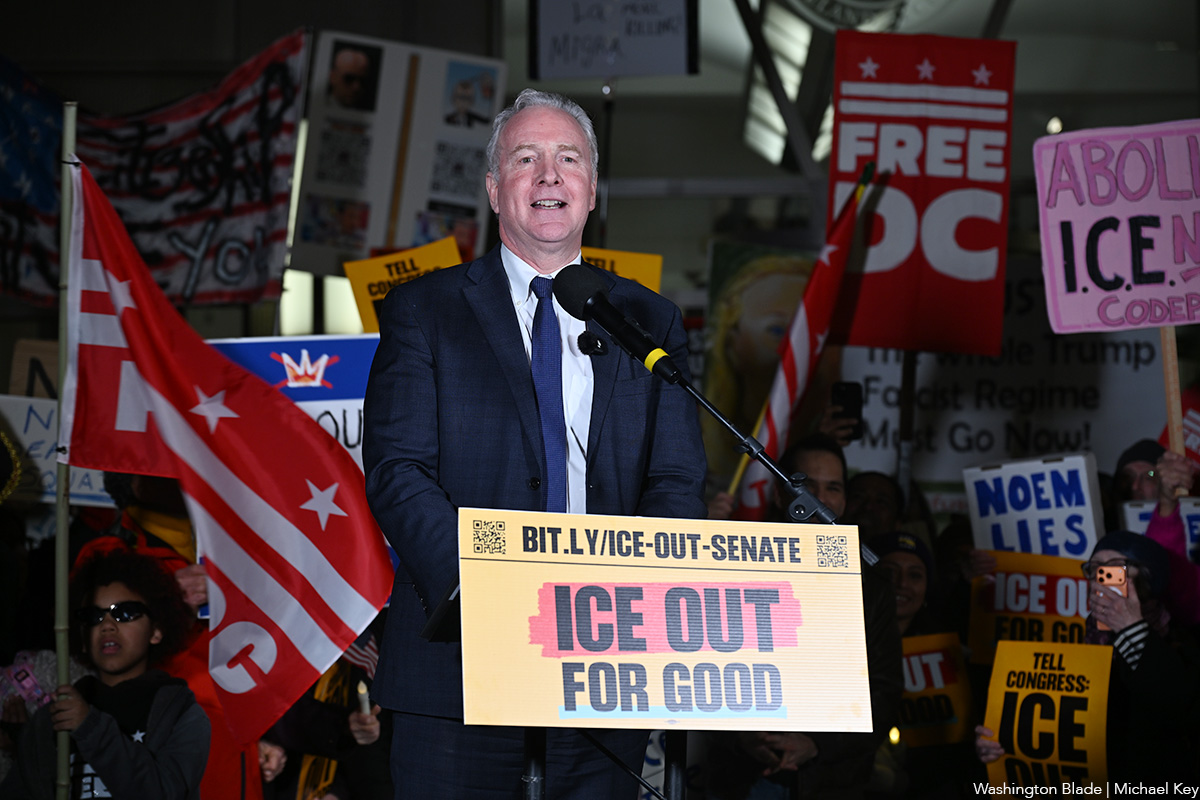
By LEE O. SANDERLIN | The Democratic Party is having something of an identity crisis — losing to President Donald Trump twice in three elections will do that.
Should the party embrace anti-establishment figures who espouse progressive policy ideas like Medicare for all and rhetoric about unrigging the economy for the 1 percent? Or should Democrats try to appeal to moderates who want to return to semi-normalcy in a time of political upheaval?
Although he’s been in Congress since 2002, with key leadership roles throughout his tenure, Maryland Sen. Chris Van Hollen, 67, counts himself firmly in the anti-establishment camp.
The rest of this article can be found on the Baltimore Banner’s website.
Baltimore
The fight to save one of Baltimore’s last gay bars
Leon’s closed in July after its owner’s death
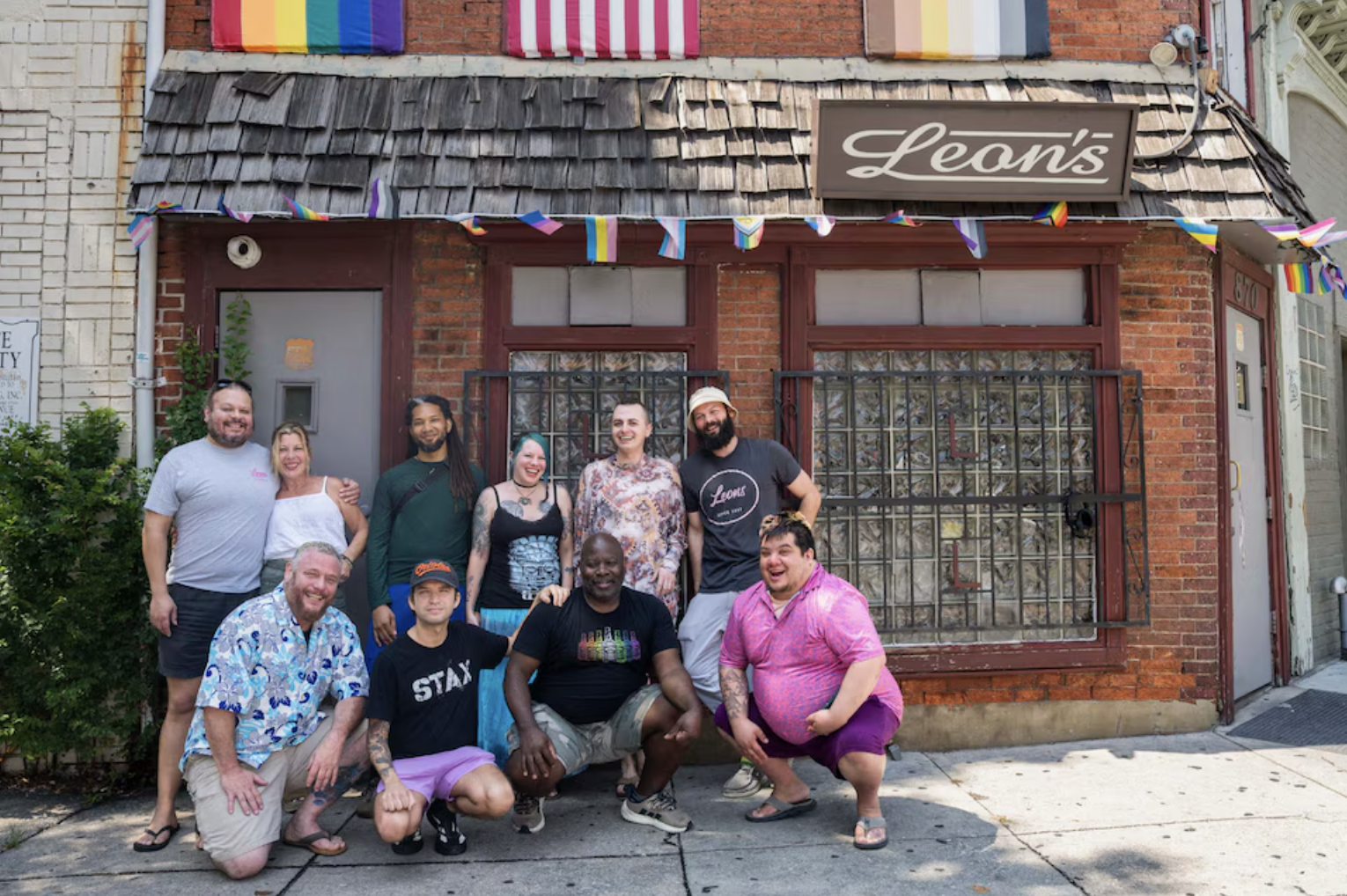
By JULIE SCHARPER and WESLEY CASE | Soon after Jim Becker came out as gay in 1967, he ducked into a Mount Vernon bar called Leon’s.
In the dark, smoky bar, men used pseudonyms for fear of being outed, as homosexual acts were illegal in Maryland. Bartenders, wary of vice squad raids, would blow a whistle if couples leaned in for a kiss.
But to Becker, arriving at Leon’s was a kind of homecoming. He could explore his identity, connect with other gay men and build community in the anxious years before the 1969 Stonewall uprising, a pivotal moment in the LGBTQ rights movement.
The rest of this article can be read on the Baltimore Banner’s website.

Push to elect more LGBTQ ANC members yields results

Chris Van Hollen says the Democratic Party needs change. Is he the one to lead it?

New data shows record-high LGBTQ population amid Trump attacks

Dolly Parton dies at 80

Monument to LGBTQ Canadians officially unveiled

Not all trans people are the same

Log Cabin Republicans remove transgender rights from mission

Exploring Renée Richards’s life through lens of a trans author

Why we need to protect ‘sacrilegious’ art