Local
Judge rules against Choi in ‘vindictive’ prosecution claim
Gay activist on trial for arrest over White House protest
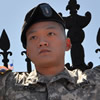
A federal judge ruled on Oct. 11 that gay former Army Lt. Dan Choi cannot argue in his ongoing trial that he was targeted for “selective” or “vindictive” prosecution following his arrest last year for chaining himself to the White House fence in a protest against “Don’t Ask, Don’t Tell.”
In a 17-page decision, Chief Judge Royce Lamberth of the U.S. District Court for the District of Columbia overturned an earlier ruling by Magistrate Judge John Facciola that allowed Choi’s lawyers to pursue allegations of selective or vindictive prosecution in the trial, which began Aug. 29.
Lamberth’s decision, among other things, granted a petition by prosecutors for a Writ of Mandamus, a formal and unusual request challenging a ruling of a trial judge by appealing to a higher court or to another judge with greater authority.
Under Lamberth’s decision, Facciola is prohibited from “considering selective or vindictive prosecution as a defense to the merits of the prosecution,” prohibited from “allowing evidence as to either claim” and barred from entertaining any motion filed by Choi to dismiss the case based on selective or vindictive prosecution.
Facciola is presiding over a non-jury trial in which Choi is being prosecuted for a misdemeanor charge of disobeying a lawful police order to disperse from the White House fence. Although the prohibition against Choi’s use of a defense based on selective or vindictive prosecution is a blow to the defense, one of his attorneys, Norman Kent, said Sunday that the defense will move forward on other grounds and that Choi’s defense team remains confident that Choi will be found not guilty.
Choi was the only one of a group of protesters arrested during the November 2010 protest that did not agree to plead guilty to the charge in exchange for having the case dismissed if they weren’t arrested again at the White House within a four-month period.
Through his attorneys, Choi has argued that he had a constitutional right to handcuff himself to the White House fence. The attorneys also have contested the government’s case on a technicality, saying police ordered Choi to disperse from the sidewalk. They note that Choi was standing on an elevated ledge on which the White House fence is attached, not the sidewalk itself and thus Choi was not legally bound to obey the police order.
Lamberth said in his decision that prosecutors were correct in arguing that under longstanding court rules of evidence, a case alleging selective or vindictive prosecution must be initiated in a pre-trial motion, not during the trial itself.
Choi’s attorneys — Kent of Fort Lauderdale, Fla., and Robert Feldman of New York — have argued that they lacked sufficient evidence of selective or vindictive prosecution prior to the start of the trial. The two said persuasive evidence of a selective-vindictive prosecution only emerged during their cross-examination of government witnesses during the trial itself.
Following strong opposition by the prosecutor in the case, Facciola ruled on Aug. 31 that preliminary evidence existed to show a selective or vindictive prosecution could have occurred against Choi. Facciola ruled that Choi’s lawyers could go forward with using selective-vindictive enforcement as a defense.
Feldman and Kent argued that Choi’s decision to handcuff himself to the White House fence in November 2010 was identical to two prior White House protests in which he and others handcuffed themselves to the fence. They noted that while prosecutors charged Choi in the earlier protests under a local municipal statute that carried no jail time, in the November 2010 protests, they charged Choi under a more stringent federal statute that includes a possible sentence of six months in jail.
Feldman and Kent alleged that prosecutors chose the more stringent statute in the November case because Choi’s protests were embarrassing the Obama administration over the gays in the military issue. They said the harsher prosecution was in retaliation for Choi’s political message that the White House wasn’t moving fast enough to repeal “Don’t Ask, Don’t Tell.”
Assistant U.S. Attorney Angela George, the lead prosecutor in the case, disputed that assertion, saying the government prosecuted Choi for refusing to obey a lawful order by police to move away from the White House fence. She said Choi’s political message was irrelevant to the government’s case and had no role in the decision to prosecute him.
In court briefs, George said prosecutors charged Choi under a more stringent law in the November case because it was the third time in less than a year that he had been arrested for the same illegal conduct and the government has legal discretion to select different statutes or regulations under which to make an arrest in such a case.
Facciola put the trial on hold on Aug. 31 after George said the government would take the unusual step of challenging his ruling through a Petition for a Writ of Mandamus. Under U.S. District Court rules, the court’s chief judge rules on such a petition.
Kent told the Blade on Oct. 16 that following consultation with Choi he and Feldman are strongly considering appealing Lamberth’s decision to the U.S. Court of Appeals for D.C. He said Choi’s legal team would make a final decision on whether to file an appeal by Oct. 20, a deadline set by Judge Facciola for the two sides to inform the court whether an appeal will be made or whether the trial will resume.
Choi enjoyed widespread support from LGBT activists when he worked with the LGBT direct action group GetEqual last year in a series of non-violent civil disobedience protests at the White House and other locations to pressure Congress and the Obama administration to push harder for repeal of “Don’t Ask, Don’t Tell.”
But since Obama signed legislation approved by Congress repealing “Don’t Ask, Don’t Tell” and since the repeal took effect on Sept. 20, some activists have questioned the rationale for Choi’s decision to demand a trial in the current case. Some have asked why Choi is contesting the type of civil disobedience arrest that most other protesters acknowledge involves breaking a law and choose to resolve by paying a small fine or agreeing to a plea offer like the one prosecutors made to Choi.
Gay rights attorney and television commentator Mark Levine called non-violent civil disobedience arrests an important and historic tradition in the U.S. civil rights movement made famous by Martin Luther King Jr. in his efforts to end racial discrimination. Levine said the benefit of drawing public attention to an injustice comes from the arrest itself, “not a long drawn out trial that has the potential for wasting court resources that would be better used for something else.”
Choi has said he chose to take his case to trial because he believes his action handcuffing himself to the White House fence is protected by his First Amendment right to free speech and should not be considered an illegal act.

District of Columbia
Capital Pride chair resigns from board after just 10 months
Anna Jinkerson ‘taking step back to move forward’

Anna Jinkerson, who has served as chair of D.C.’s Capital Pride Alliance Board of Directors for the past 10 months and has served on the board for the past four years, confirmed she is resigning from the board effective Sept. 30.
Capital Pride Alliance serves as the lead organizer of D.C.’s annual LGBTQ Pride events.
“I am taking a step back to move forward and plan to stay engaged in the community,” Jinkerson told the Washington Blade in a statement. “Serving as a volunteer leader during a period of transition following World Pride was both an honor and a challenge,” she said.
“Throughout my tenure, I focused on strengthening accountability, improving communications, supporting staff and volunteers, and helping position the organization for long-term success,” she told the Blade in her statement. “Meaningful organizational progress requires collaboration, dedication, and a shared commitment to serving the community, and I am proud of the work accomplished during this period.”
In February of this year, during Jinkerson’s tenure on the board, Capital Pride announced it had expanded the size of its board from 12 to 25 members.
Around that same time one of the existing board members, transgender activist Taylor Lianne Chandler, announced in a letter to fellow board members that the Blade obtained from an anonymous sender that she was resigning from the board. Among her reasons for resigning, she said in the letter, was the board’s failure to address “sexual misconduct” within the Capital Pride organization.
In the letter, which she confirmed for the Blade was authentic, Chandler said she and other board members raised “credible concerns” of alleged sexual misconduct within the Capital Pride organization and the board chose not to adequately respond to those concerns.
Chandler told the Blade a Capital Pride investigation identified an individual implicated in a “pattern” of sexual harassment related behavior, but said she was bound by a Non-Disclosure Agreement that applied to all board members and she could not provide further details.
When the Blade contacted Capital Pride for comment on Chandler’s allegations, Jinkerson responded with a statement saying Capital Pride was addressing her concerns.
“When concerns are brought to CPA, we act quickly and appropriately to address them,” Jinkerson said. “As we continue to grow our organization, we’re proactively strengthening the policies and procedures that shape our systems, our infrastructure, and the support we provide to our team and partners,” she said.
In her statement to the Blade this week commenting on her planned resignation from the Capital Pride board, Jinkerson appeared to refer to the concern raised by Chandler.
“I am proud to have advocated for sexual harassment training, supported staff and volunteers when concerns were raised, engaged community leaders in important conversations, and helped advance practices that strengthen safety, transparency, and accountability,” she said.
“As I step away from board service, I do so with gratitude for the opportunity to serve and with confidence in the organization’s future,” she added. “I am taking a step back to move forward, and I look forward to remaining actively engaged in our community and continuing to support efforts that advance equality, belonging, and pride for all.”
District of Columbia
Over 2,000 turn out for Hands Around the Kennedy Center protest
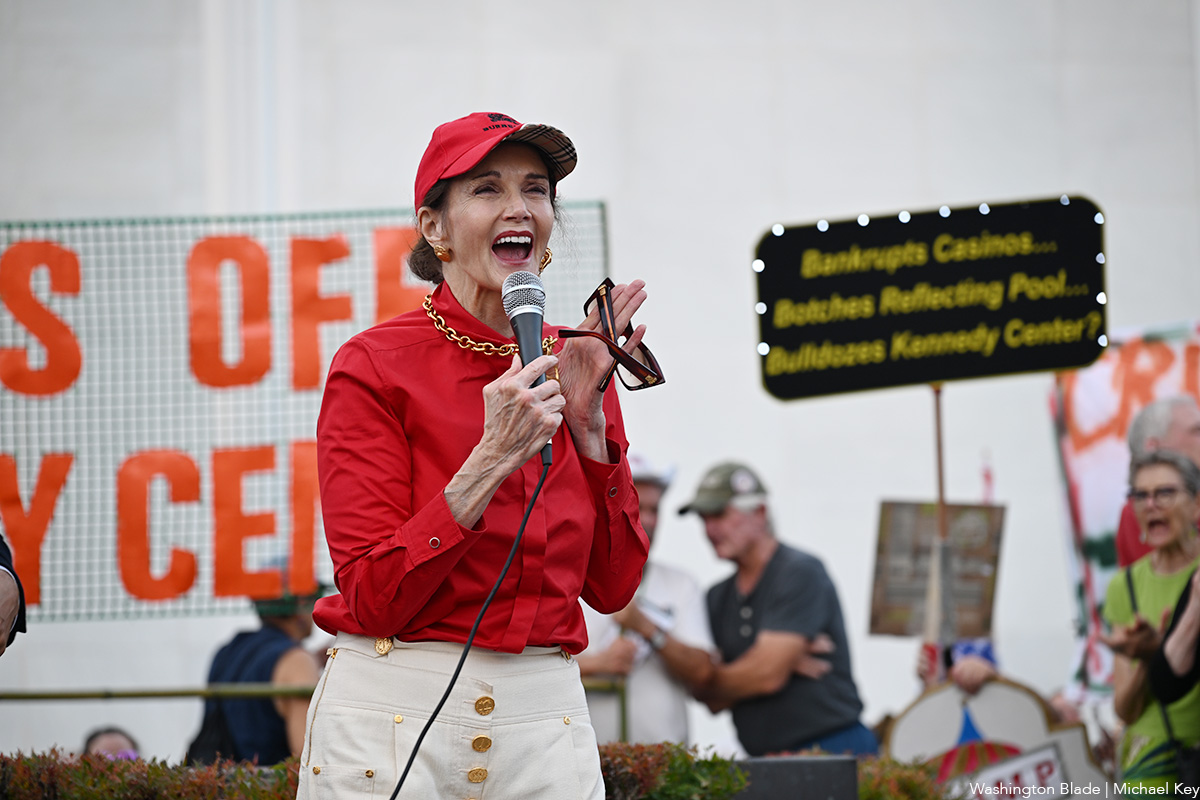
Drag performer Tara Hoot serves as MC, Gay Men’s Chorus of DC performs, attendees shout for Trump to keep ‘hands off’ Kennedy Center
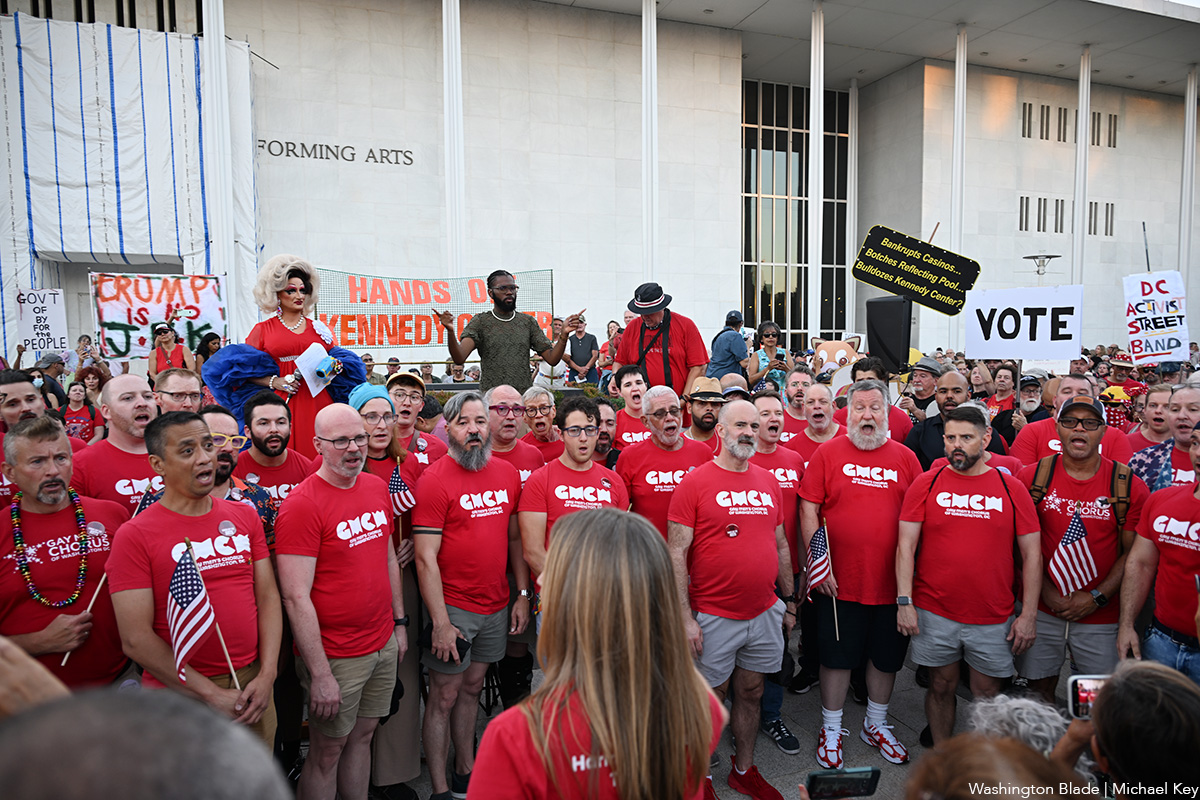
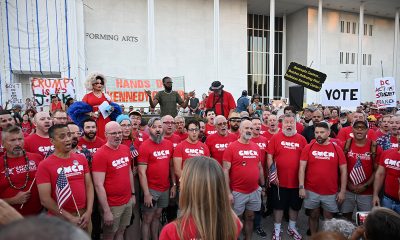
More than 2,000 supporters of the John F. Kennedy Center for the Performing Arts turned out on Sept. 18, for a rally in support of the performing arts center and a vocal protest against President Donald Trump’s threats to permanently close the center and possibly demolish it.
The event was organized by a group called Hands Off the Arts, which initially called for participants to form a “human chain” around the Kennedy Center’s main building following a rally on the plaza in front of the building.
However, due to a decision by the Trump-controlled Kennedy Center’s board of trustees to close the center earlier in the week and install fencing around part of the building, participants could only form the chain around part of the building, according to organizers.
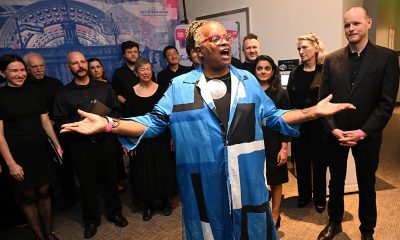
Drag performer Tara Hoot, who co-organized the event and served as master of ceremonies for the rally preceding the “human chain,” said the large turnout could have fully surrounded the building at least twice had the fencing not prevented a full encirclement.
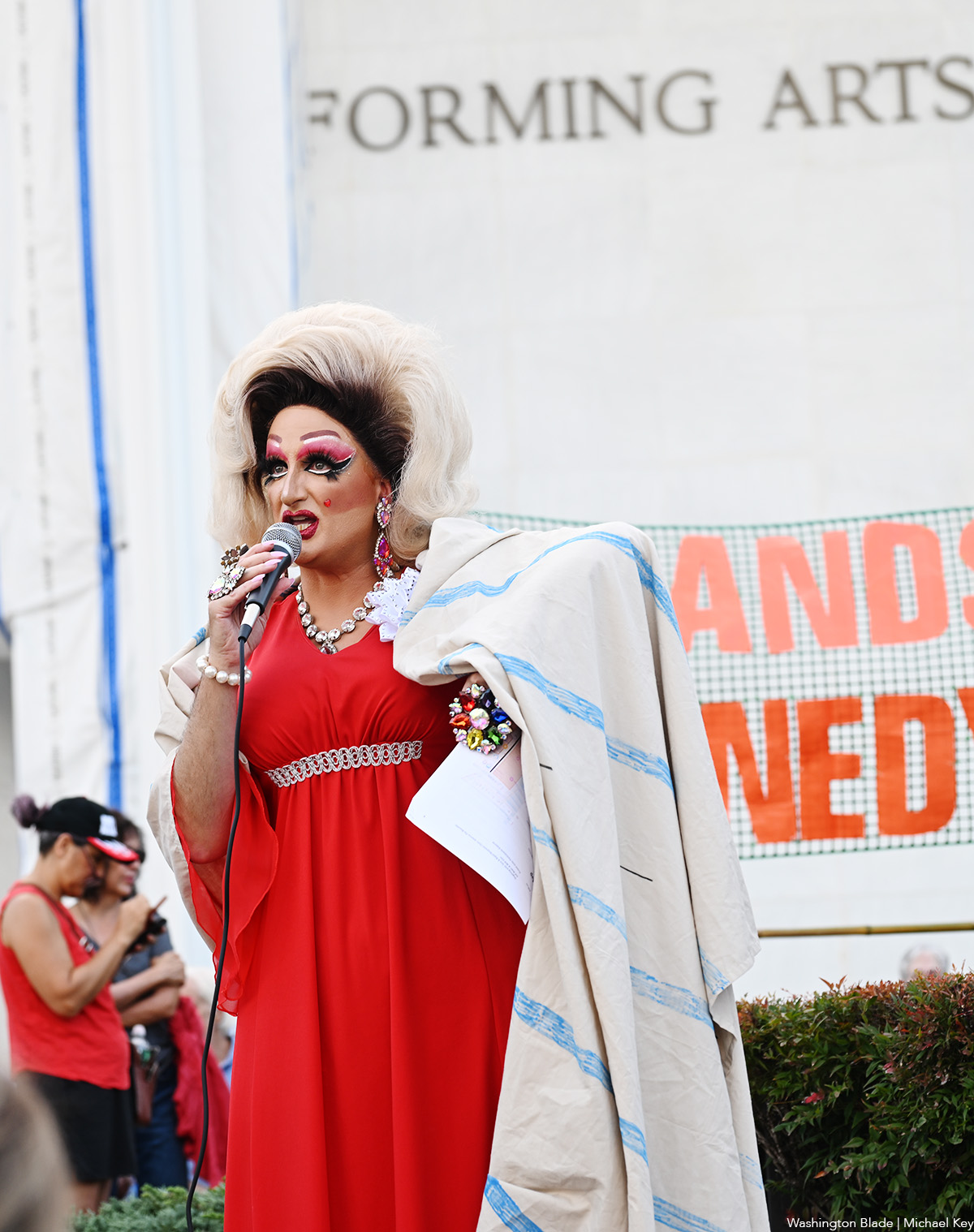
Among the musicians and singing groups that performed at the rally was the Gay Men’s Chorus of Washington, which, like other rally performers, had performed at the Kennedy Center in past years. They drew loud applause after singing one of their favorite songs from the Broadway musical show Ragtime, which includes the lyrics, “Will justice be demanded by 10 million men? Make them hear you. When they hear you, I’ll be near you again.”
View on Threads
Prior to their performance, Gay Men’s Chorus of Washington’s artistic director, Thea Kano, spoke at the rally, reminding participants that shortly after the Trump takeover of the center last year, Kennedy Center officials cancelled a concert the chorus was scheduled to perform there for World Pride 2025.
A Kennedy Center spokesperson said the cancellation was due to a scheduling conflict, but chorus members and LGBTQ activists believe it resulted from policies put in place by Trump and his leadership team at the Kennedy Center following Trump’s statements that he would end controversial “woke” performances that he claimed the majority of Americans disapprove of.
“Now this building sits empty in silence,” Kano told the crowd at the rally. “Let us raise our voices together and bring back the Kennedy Center as it was intended, a place where American culture could be celebrated and elevated, embracing the vibrancy with the spectrum of identify without censure and without politics,” she said.
Among the others who spoke at the rally were U.S. Rep. Don Beyer (D-Va.), U.S. Rep. Jonathan Jackson (D-Ill.), and D.C. Councilmember Robert White (D-At-Large).
Most speakers, along with LGBTQ participants in the hands-around-the-building event expressed strong opposition to Trump’s demand that the Kennedy Center name be changed from the John F. Kennedy Center for the Performing Arts to the Donald J. Trump and the John F. Kennedy Center for the Performing Arts.
At Trump’s request, his appointed board initially made that name change and placed Trump’s name on the front wall of the building along with the Kennedy name. But following legal action taken by opponents who pointed out that Congress must approve such a name change, a judge ordered the removal of Trump’s name from the building. Trump has said he will take steps to reverse that order and has said he will stop plans to renovate the Kennedy Center building and possibly demolish it if his name is not restored in the Kennedy’s Center’s official name.
Throughout the Sept. 18 rally, LGBTQ participants repeatedly responded to the Trump threats by shouting, “Hands Off!”
Chris Raleigh, one of the founders of Hands Off the Arts and a lead organizer of the Sept. 18 event at the Kennedy Center who spoke at the event told the Washington Blade that more similar events are being planned and he welcomes the support the event has received from the LGBTQ community.
“The LGBTQ community was here first, and we’re following them,” he said. “They’ve been the spearhead; they’ve been the vanguard. And I’m so thankful for heroes like Tara Hoot,” he said, adding, “It’s because they know what it means and how this is a safe place – the theater – for many LGBTQ people.”
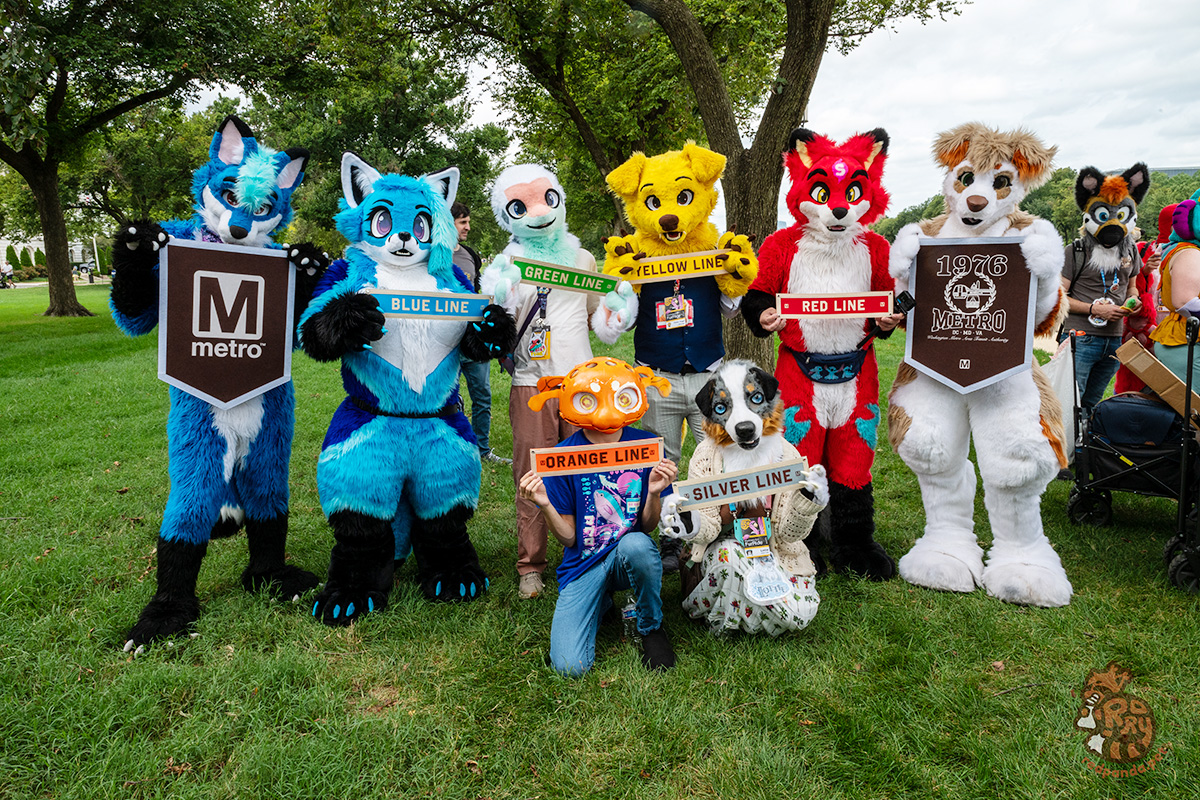
The DMV’s own furry group was on full display on the Metro on Sept. 12.
Shutterpaws is a volunteer-led 501(c)(3) non-profit organization located in Maryland.
The furry group has been doing the FurRide event since 2024 and has blown up in popularity for furries around DMV. They showcased themselves on the Silver and Blue Lines near the Smithsonian on Sept. 12.
“A lot of careful planning goes into running these events, with the goal being a seamless and enjoyable experience for everyone who attends,” says Zayre, a Shutterpaws staff member. “There’s a lot that you learn just by trial and error, and as Shutterpaws hosts more and more events, our team of event organizers continues to learn and refine our approach to keep things running smoothly and finding new ways to engage with our community.”
With a larger growth of participation in the community comes many challenges with the group, especially when it comes to the Metro rides and organizing.
“The biggest challenge that we face as organizers is keeping things fresh and finding new and engaging venues to host events,” says Zayre. “Recently we saw a lot of success hosting a meet at On Target Battlezone, an indoor NERF gun battle arena where our crew was welcome to show up and play both with and without a fur suit.”
Nevertheless, Shutterpaws receive overwhelming support from the community and partners.
“Across the DMV there are so many amazing places to host a Shutterpaws event so we can pursue our mission of helping connect fur suiters and photographers, and we’re blown away with the amount of support we’ve received from our community partners,” says Zayre.
Shutterpaws plans to do more events for anyone in the DMV who is interested.
Their next event in collaboration with DC Fur Meet will take place at Pitchers (2317 18th St., N.W.) on Saturday. Visit Shutterpaws’ website for more information.

Washington Blade responds to concerns over White House pool duties

Young people should know history of the fight for human rights

Dutch prime minister visits Stonewall Inn

Clavicular charged in alleged rape of teenage influencer

Gov. Whitmer to serve as keynote speaker for Saturday’s HRC National Dinner

Over 2,000 turn out for Hands Around the Kennedy Center protest

PHOTOS: Wanda Alston Foundation Fall Reception

PHOTOS: Walk and 5K to End HIV

What LGBTQ veterans are building after ‘Don’t Ask, Don’t Tell’