News
Russian athletes appear to challenge anti-gay law
Kiss comes as country’s sports minister again defends statute
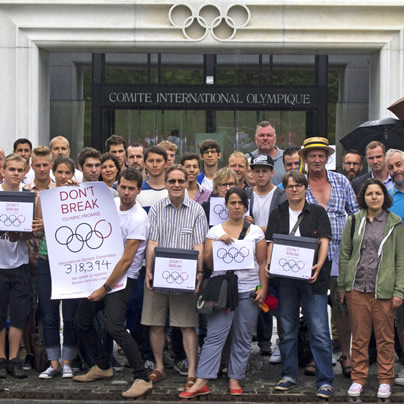
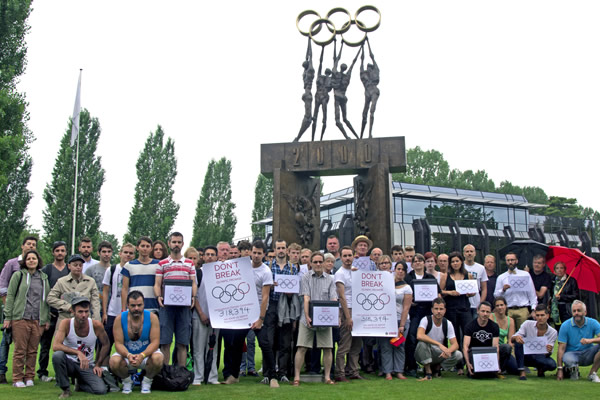
Members of All Out and Athlete Ally on August 7 presented a petition with more than 300,000 signatures to the International Olympic Committee that urges it to pressure Russia to end its gay crackdown. (Photo courtesy of All Out)
The Canadian Broadcasting Corporation reported Kseniya Ryzhova and Tatyana Firova kissed as they stood on the medal podium in Luzhniki Stadium in the Russian capital after they won the women’s 4 x 400 meter relay. The two women have yet to publicly say why they decided to kiss each other, but one of their teammates who was standing next to them on the podium appeared surprised by their public display.
The kiss comes against the backdrop of growing outrage over the gay propaganda ban that Russian President Vladimir Putin signed into law in June.
American runner Nick Symmonds criticized the statute during an interview with the Russian news agency RIA Novosti last week after he competed in the men’s 800 meter final at the World Athletic Championships. High jumper Emma Green Tregaro and sprinter Mao Hjelmer, who are from Sweden, painted their fingernails in rainbow colors as they competed in the same event.
“I had a suggestion from a friend on Instagram that maybe I could paint my nails in the colors of the rainbow,” Green Tregaro said in a video a Swedish newspaper posted onto its website as the Associated Press reported. “That felt like a simple, small thing that maybe could trigger some thoughts.”
Russia’s gay rights record sparks calls to boycott Olympics
Playwright Harvey Fierstein and other advocates continue to call for a boycott of the 2014 Winter Olympics that will take place in Sochi, Russia, in February over the country’s gay propaganda ban and ongoing LGBT rights crackdown.
Andy Cohen last week told E! News he turned down a request to co-host the 2013 Miss Universe pageant that will take place in Moscow in November, in part, because “he didn’t feel right as a gay man stepping foot into Russia.” Donald Trump, who co-owns the pageant along with NBC Universal, did not respond to the Washington Blade’s request for comment on Cohen’s decision or Russia’s gay rights record.
Gay Olympic diver Greg Louganis, who was unable to compete in the 1980 Summer Olympics in Moscow because then-President Jimmy Carter boycotted them over the Soviet Union’s invasion of Afghanistan the year before, is among those who feel the U.S. should compete in the Sochi games. President Obama, retired tennis champion Martina Navratilova and a coalition of LGBT advocacy groups that include Outsports.com and Athlete Ally also oppose an Olympic boycott.
Gay New Zealand speed skater Blake Skjellerup last month announced he will wear a Pride pin while in Sochi.
Figure skater Johnny Weir, whose husband is of Russian descent, told CBS News earlier this month he is “not afraid of being arrested” while at the Sochi games.
“If it takes me getting arrested for people to pay attention and for people to lobby against this law, then I’m willing to take it,” Weir told the network.
The Russian Interior Ministry last week said authorities will enforce the country’s gay propaganda ban during the Sochi games in spite of the “assurances” the International Olympic Committee said it has received from the Kremlin that the law would not impact athletes who plan to compete in the Olympics. Russian Sports Minister Vitaly Mutko defended the statute during a Moscow press conference on Sunday, while asserting the “freedoms of Russian and foreign athletes and guests who come to Sochi will be absolutely protected” as the AP reported.
“We want to protect our children whose psyches have not formed from the propaganda of drug use, drunkenness and non-traditional sexual relations,” he said.
Yelena Isinbayeva, a Russian Olympic pole vault champion, criticized Green Tregaro and Hjelmer during an August 15 press conference after she won her third world title at the IAAF world championships. The AP reported Green Tregaro wore red fingernail polish while she competed in Moscow on Saturday after Swedish athletic officials reportedly asked her to change their color.
“It’s unrespectful to our country; it’s unrespectful to our citizens,” Isinbayeva said as she defended the gay propaganda ban. “We are Russians. Maybe we are different than European people, than other people from different lands. We have our law that everyone has to respect.”



District of Columbia
‘Queer Love’ campaign launched to address domestic violence
D.C. event set for LGBTQ+ Domestic Violence Awareness Day on May 28
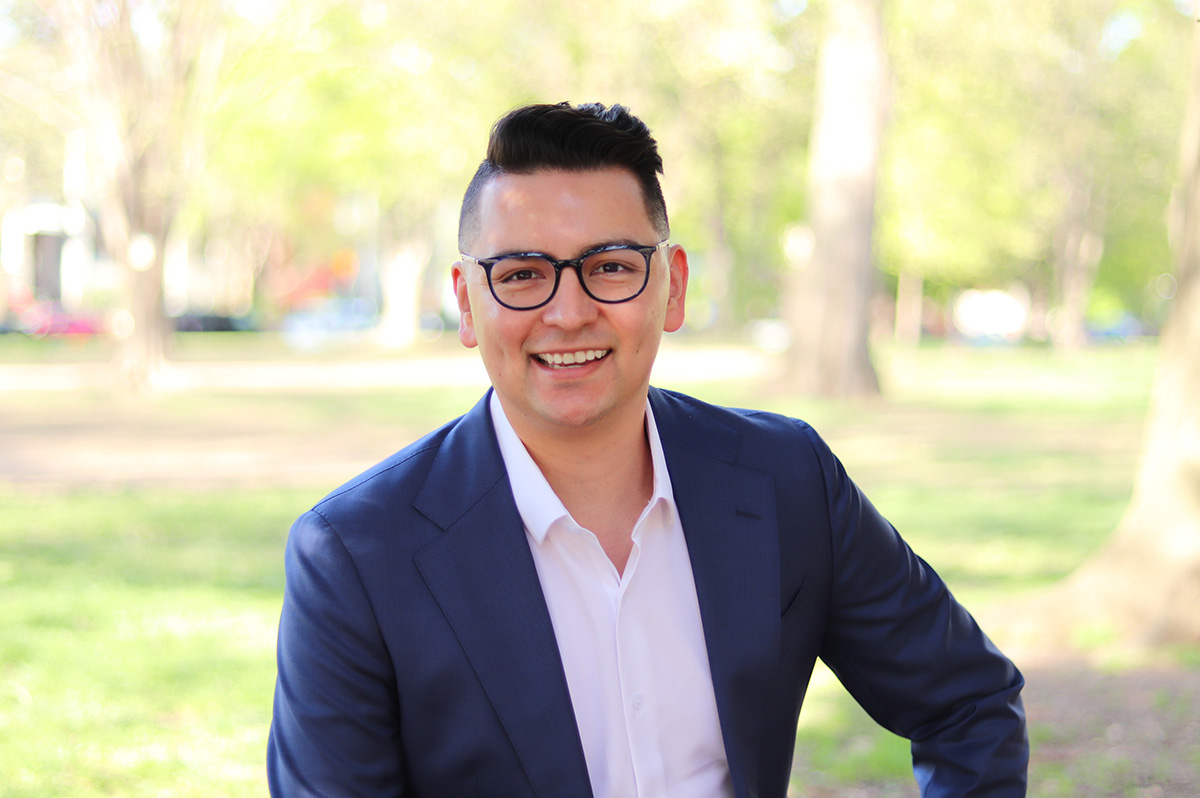
The D.C.-based Wanda Alston Foundation, which provides housing and support services for homeless LGBTQ youth, announced earlier this month that it has joined partner organizations to launch a Queer Love Shouldn’t Hurt campaign aimed at addressing domestic violence within the LGBTQ community.
In a May 18 statement, the Alston Foundation said the campaign involves a public awareness initiative leading up to LGBTQ+ Domestic Violence Awareness Day scheduled for May 28.
“Domestic and family violence in LGBTQ+ communities is real and too often invisible,” Cesar Toledo, the Alston Foundation’s executive director, said in the statement. “As a community, we do not talk about it enough, and that silence can leave survivors feeling isolated and alone,” he said. “We must break that silence.”
He added that culturally competent care for those impacted by domestic violence is available through a newly launched website, queerlove.org, “where people can safely access vital resources, educational toolkits, and support networks they need on their healing journey.”
The website announces one of the project’s first events, a Queer Love Community Social, was scheduled for Thursday, May 28, from 6-8 p.m. at the D.C. LGBTQ+ Community Center at 1827 Wiltberger St., N.W.
“Join us this LGBT+ Domestic Violence Awareness Day for a community social dedicated to visibility and survivor resilience,” the website statement says. “Let’s gather to strengthen our bonds, honor the path to healing, and share free resources,” it says of the May 28 event.
The website also announces a June 1 workshop called Empowering Survivors of LGBTQ+ Intimate Partner Violence, which it says will be presented by Jesse Wedell, an official with the D.C. LGBT+ Counseling Collaborative. The website provides an online form to register for the workshop upon which its location would be disclosed.
It identifies the partner organizations working with the Alston Foundation on the Queer Love Public Awareness Campaign as the LGBT+ Counseling Collaborative, Whitman-Walker Health, the D.C. LGBTQ+ Community Center, and Equality Chamber.
The resources and information provided by the project can be accessed at www.queerlove.org.
2026 Midterm Elections
Ken Paxton wins Texas Republican primary runoff
LGBTQ rights opponent will face Democrat James Talarico in November

Attorney General Ken Paxton won the Republican Senate primary in Texas on Tuesday, ousting incumbent U.S. Sen. John Cornyn.
Paxton won the primary against the four-term incumbent in large part due to President Donald Trump’s endorsement. Despite Cornyn voting with Trump more than 90 percent of the time, political insiders say being supportive isn’t enough to win Trump’s endorsement anymore — Republican candidates need to embrace the full MAGA image, something Paxton has done.
Paxton has served as Texas attorney general since 2015 and, before that, worked as a Texas state representative. He has approached both roles with what LGBTQ activists call a “consistently Anti-LGBTQ+ Record.” Following the landmark U.S. Supreme Court decision in Obergefell v. Hodges — the case that made same-sex marriage the law of the land — Paxton advised Texas county clerks they could refuse marriage licenses to same-sex couples on religious grounds.
His anti-LGBTQ crusade doesn’t stop at fighting against marriage equality.
Paxton has repeatedly demanded medical records for transgender youth in multiple states — including Texas, Georgia, and Washington — in hopes of making the practice illegal. His anti-trans actions go far past medical records. Paxton issued an opinion barring trans Texans from changing the sex on their driver’s licenses and birth certificates, claiming any changes made were “unlawfully altered,” and helped the DOJ reach an agreement with a Texas’s children’s hospital for providing minors gender-affirming care, eventually leading to a 10 million dollar settlement. He also authored a non-legally binding opinion equating gender-affirming healthcare for youth to child abuse.
In addition to his long history of anti-LGBTQ policy in the Lone Star State, Paxton is no stranger to controversy.
Multiple impeachment efforts brought against him in the state House of Representatives for “abuse of office” — with the state Senate later acquitting him — allegations that he used his office to assist large campaign donors, namely Nate Paul, and a widely publicized separation from his wife, state Sen. Angela Paxton, all impacted his run for the U.S. Senate seat — but not enough to keep him from the office.
Lynne Bowman, vice president of campaigns at the Human Rights Campaign, issued a statement following the announcement of Paxton’s primary win.
“Texans have a clear choice this fall, and an opportunity to reject failed policies that hurt all families,” Bowman sent to the Blade via email. “Ken Paxton is so out of step that he has fought to undercut marriage equality and spent time demanding personal medical records for young people who do not even live in Texas, all while becoming the most corrupt politician in America. The more than 2 million Equality Voters in Texas will send him packing.”
Paxton will face off against Democratic hopeful and vocal Trump critic James Talarico in the fall.
Talarico, who won the Democratic primary in April against Congresswoman Jasmine Crockett, has been a vocal supporter of LGBTQ rights, citing his ministry work as the source of his support for the community.
The race for Texas’s Senate seat will be decided on Nov. 3.
China
China’s top court acknowledges anti-LGBTQ discrimination
Postgraduate student petitioned for legal clarification

China’s Supreme People’s Court on May 8 issued a rare response to a petition involving LGBTQ discrimination.
In a surprising response; it discussed sexual orientation, gender identity, and gender expression. The response also mentioned workplace discrimination, public humiliation, and school bullying, language considered uncommon from China’s legal system.
The response stemmed from a proposal submitted by a postgraduate student in Qingdao through China’s xinfang petition system on March 25, urging the court to establish clearer judicial standards against discrimination based on sexual orientation and gender identity. Six weeks later, the Supreme People’s Court Research Office issued a written reply.
The Research Office is an internal legal and policy body within the Supreme People’s Court. It studies legal issues, drafts judicial guidance, and responds to legal inquiries submitted through official channels. Its responses do not carry the same legal weight as a judicial interpretation or court ruling.
“The opinions and suggestions you raised are of great value,” reads a translated version of the Supreme People’s Court Research Office response. “In order to thoroughly implement the Constitution, Civil Code, Employment Promotion Law and other legal provisions, and effectively protect citizens’ personality rights from infringement, the Supreme People’s Court has guided local courts at all levels to handle a number of related cases, and through typical cases and other forms has clarified adjudication rules.”
The response stated that courts may determine public insults, defamation and, discriminatory conduct targeting sexual orientation, gender identity and gender expression as infringement of personality rights. It also said employers treating individuals differently in hiring, employment, transfer or dismissal based on those characteristics could face employment discrimination claims. Schools could also bear legal responsibility for improper discipline or bullying involving students based on sexual orientation, gender identity and gender expression, according to the response.
“It’s not a systematic change from the authorities recognizing LGBTQ rights,” said Renn Hao, an LGBTQ activist in China. “However, it’s an informal statement from the Supreme Court. According to a scholar researching LGBTQ legal cases in China, courts are recognizing more cases involving LGBTQ discrimination and same-sex partners through their verdicts.”
China decriminalized consensual same-sex sexual relations in 1997 and removed homosexuality from the country’s list of mental disorders four years later. Chinese law, however, does not recognize same-sex relationships.
Public advocacy involving LGBTQ issues also remains tightly controlled. Authorities in recent years have continued restricting community organizing, public events, and online expression involving sexual minorities.
Discussions involving LGBTQ issues are also frequently censored on Chinese social media platforms.
Activists and advocacy groups say Chinese authorities in recent years have removed online content, shut down LGBTQ student group accounts and restricted public discussion involving sexual minority issues. After the Supreme People’s Court response began circulating online, related posts and articles were also removed from some Chinese platforms.
“It may still be too early to fully assess the long-term impact, as this development has only just happened and the situation is still unfolding,” said Xiaogang Wei, a Beijing-based LGBTQ rights activist, filmmaker, and founder of the China Rainbow Collective Foundation. “Although the reply is not legally binding, it represents a rare form of institutional acknowledgment of SOGIE-related discrimination in China. For Chinese LGBTQ people and advocates, this could become a meaningful reference point for future legal advocacy, public communication, and community awareness.”
Wei said the rapid removal of related posts and articles limited the development’s broader public impact and underscored how fragile LGBTQ visibility remains in China.
“This is why we believe it is important to continue sharing verified information and ensuring that this development is not erased from public understanding,” Wei said.
Chinese courts in recent years have also heard a number of LGBTQ-related employment discrimination cases, despite the absence of explicit nationwide protections based on sexual orientation or gender identity. In one notable case, the Supreme People’s Court in 2018 formally recognized “equal employment rights disputes” as a legal cause of action, allowing some discrimination-related cases to proceed through the courts.
Chinese courts have previously handled several LGBTQ-related disputes involving employment discrimination, custody, and so-called conversion therapy. In 2024, a Beijing court drew attention after recognizing visitation rights for a child involving a same sex couple, a decision activists described as a milestone for LGBTQ families in China.

‘How to Survive a Plague’ screens June 5

‘Queer Love’ campaign launched to address domestic violence
Ken Paxton wins Texas Republican primary runoff

China’s top court acknowledges anti-LGBTQ discrimination