Opinions
Dupont Circle’s silly ‘Safeway siege’ stupefies a city
It’s time to tell business and booze objectors they’ve caused enough harm
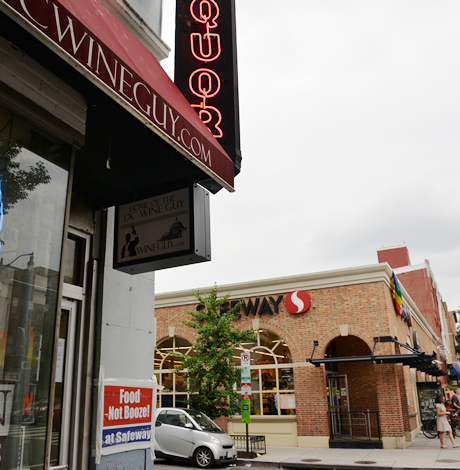
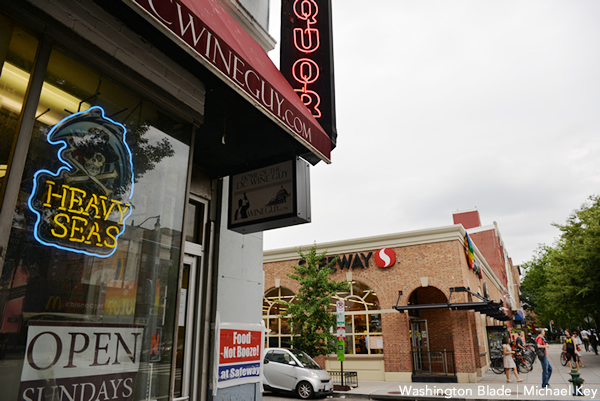
(Washington Blade photo by Michael Key)
They keep doing it to themselves in D.C.’s Dupont Circle neighborhood. It’s difficult to decide whether to laugh out loud or ply a pitying frown.
In recent weeks there’s been quite a bit of eye-rolling and head-shaking by residents in the adjacent Logan Circle area, and across the entire city, in response to the latest crazy crusade launched by Dupont denizens.
Coordinated by a long-unpopular and notorious band of usual suspects with a business-and-booze-battling legacy, a small group has busied themselves with organizing an effort to oppose approval of a beer and wine sales license for the Safeway on the 17th Street commercial strip. They’ve even got T-shirts and campaign signs emblazoned with their slogan, “Food Not Booze! at Safeway.”
Accustomed to robust offerings of both products at the nearby Whole Foods and Trader Joe’s outlets in Logan Circle and at groceries citywide, the vast majority of residents in the neighborhood and nearby are scratching their heads in stupefied reaction to the fuss.
The objectors raise all manner of unrelated complaints. They fret about the Safeway seafood selection, the freshness of produce, the variety of products, and the always dreary and detached service complacency proffered patrons – by labor union members comprising the “closed-shop” workforce. The latter applicable philosophical lesson and parallel political irony eludes them.
They claim to be combating “corporate greed” – so much so that Washington City Paper reporter Andrew Giambrone last week dubbed them “a cohort of anti-capitalist objectors.”
What’s worse, though, is that the owners of the next-door Cairo Liquors are helping spearhead the campaign by almost single-handedly collecting signatures on petitions in opposition to Safeway’s beer and wine sales licensing application. It’s an astonishingly transparent attempt at preferential “rent-seeking” through imposition of a nakedly self-serving regulatory prohibition to preclude market competition.
The licensing opponents brazenly call for protectionist marketplace manipulation to advantage retail liquor-selling businesses fearful of consumer choice and convenience or customer-benefiting price and product competition. Those are, in fact, what the majority of local residents value and prefer and which has not harmed standalone liquor stores that are standout retail trademarks of other neighborhoods.
All of these objector arguments are, in reality, irrelevant to the pending review of Safeway’s application by the city’s alcohol licensing board. They are completely meaningless in determining whether Safeway can be denied a beer and wine sales license as a qualifying full-service grocery store. The imbroglio only serves to brand Dupont as again combating commerce.
Once the iconic center of Washington’s gay community and a then-bustling destination neighborhood, the area earned a reputation as unfriendly to business and uninterested in development. Nearly 30 years ago the same agitators successfully sought not one, but two, of the city’s handful of liquor license moratoriums. The area suffered under that crude intervention, despite recent modifications to lessen the harm, as businesses shifted to other areas.
On Monday the Dupont Circle advisory neighborhood commission held a “town hall” on Safeway’s application. About 40 people showed up, almost exclusively the familiar faces that have long fought alcohol licensing and business development – and who generally comprise those attending the commission’s regular meetings.
The participant demographic at the forum skewed decidedly older. Dupont ANC vice-chair Daniel Warwick took to Twitter during the meeting to note that the median age of Dupont Circle residents is 34, while the age of those attending the commission’s meetings – including the special session that evening – is much older.
Warwick publicly pondered how to broaden interest in commission meetings. One suggestion would be to stop coddling the small gaggle of serial objectors. Not every ridiculous restriction or proposed prohibition warrants an ANC-hosted whine-fest. Aligning with them, and allowing them to dictate community discussions, harms the commission’s public perception.
After all, Safeway could choose to close eventually and leave Dupont residents sourcing victuals where beer and wine is sold alongside groceries.
The rest of the city wouldn’t be surprised.
Mark Lee is a long-time entrepreneur and community business advocate. Follow on Twitter: @MarkLeeDC. Reach him at [email protected].





Commentary
IDAHOBiT a reminder we all must stand up against transphobia
Trans rights remain under attack in U.S., around the world

May 17 is the International Day Against Homophobia, Transphobia, and Biphobia.
In 2026, transphobia is the biggest issue out there: all the stereotypes that were used against the LGBTQ community in general in the past are now used to attack the rights of transgender people and to create a moral panic against them. As a person who understood that they were not a girl — despite being assigned female at birth — since they were four, and who in their 30s had to wait in line for a gender clinic, I am obviously worried about this situation. Trans people continue to be seen less as people and more as part of an “agenda,” and there is a greater risk that the international trend of attacks on trans rights is just a first step in a broader attack on the LGBTQ community, and that soon bi, gay, and lesbian people will lose part of their hard-won rights to have the same protections and opportunities as heterosexual people.
When, in U.S. states such as Kansas, trans people face escalating legal and political restrictions on recognition that affect their everyday lives — for example, requiring their driving licenses to match the gender assigned at birth even after transition — while trans people in the U.S. are banned from military service and federal funding is stopped for gender-affirming care for trans youth, it is obvious to everyone that the problem is real. It is also global.
For example, there have been significant attacks on trans rights in the UK in recent years, especially against trans youth, many of whom have been denied gender-affirming care. The day when I finally found the energy to write this story was the day of the local British elections, when surprisingly many seats in city and town councils were won by the queerphobic populist Reform Party, creating some new Reform-dominated councils. Reform Party leader Nigel Farage has praised U.S. President Donald Trump and expressed admiration for Russian dictator Vladimir Putin — both of whom are known for endangering the lives of their trans citizens and rejecting trans identity as something that should be accepted.
So, who can challenge it? The general public often takes cues from public figures. Celebrities play a significant role in shaping public opinion and framing how different social issues are understood.
We need trans celebrities to speak up against transphobia when “anti-trans” celebrities like JK Rowling oppose our rights. It seemed that when conservatives around the globe stood up together to support each other, the trans community should unite, and trans celebrities should protect their trans siblings, while the broader LGB community should recognize the threat and unite around trans rights.
But not everything is so simple. Surprisingly, at a time of the greatest attack on trans rights in this century, many lesbian, gay, bi and even trans celebrities and influencers openly support transphobic policies and ideologies.
One of the clearest examples is Caitlyn Marie Jenner, a retired Olympic gold medal–winning decathlete and public figure known for her participation in the reality show “Keeping Up with the Kardashians.” She is one of the most famous trans people in the world.
From 2015 to 2016, she starred in the reality television series “I Am Cait”on E!, which focused on her gender transition and on telling a story to inspire the younger generation of trans people. In the first episode, Jenner also visited the mother of Kyler Prescott, a 14-year-old trans child who died by suicide earlier that year, and spoke openly about using her privilege to fight for awareness, equality, and dignity for trans people. The idea of supporting trans youth was one of the core themes of her TV series.
That was then.
Jenner’s perspective on trans rights became more and more transphobic. For example, in 2021 she opposed trans girls participating in girls’ school sports. In 2023, she launched a PAC campaign attacking trans youth rights. She also expressed support for Donald Trump and said about herself that she would never be a “real woman.”
Another famous example is transmasculine sex educator and activist Buck Angel, a former adult film actor. He was seen as a modern and progressive person in the 2000s and early 2010s, praised for increasing visibility for trans men through sex education, documentaries, public speaking, and media work. But later he started calling himself “transsexual” rather than “transgender,” following a more transphobic and rigid view of trans identity, and openly showed support for Trump and MAGA.
Of course, there are plenty of trans celebrities who continue to fight for trans rights — the most obvious example is Lana and Lilly Wachowski, notable film directors who gave us “The Matrix” films and the “Sense8” TV series. But the Wachowski sisters were known for being politically left-wing and progressive even before their transition. They are part of a progressive movement, not just a “famous trans person” like Jenner was.
So, why is this happening? Why have more mainstream and conservative trans celebrities, as well as some LGBTQ groups, turned away from trans rights? And what do we need to do?
One of the reasons is fear.
Popular and privileged people — whether they are socialites, actors or leaders of big organizations — are not used to being outcasts, and so they follow dominant trends. For them, the fear of not fitting in, being rejected by the audience and losing their position in society became bigger than their sense of justice. This is probably one of the reasons why some LGBTQ groups, such as the Log Cabin Republicans in the U.S., became more transphobic, or why the LGB Alliance in the UK became more popular.
Another reason is the polarization of society.
Some LGBTQ activists may hate me for saying this, but it is partly our fault. Mainstream trans communities sometimes make trans identity look like a “trend” or part of an ideology. The media — especially tabloids — are even more to blame for this stereotype than the trans community itself. When uninformed people hear about trans people today, many of them imagine left-wing, maybe even socialist, non-religious young supporters of Palestine who are good at understanding ecological issues and worried about global warming. Of course, many trans people are like that. But many are not. And those who are not often feel excluded and become more prone to public self-hatred.
It created a cycle in which people who did not feel part of the community started searching for an alternative that rejected them for being trans and encouraged them to accept transphobic rhetoric, betraying themselves and their trans siblings. This led to greater polarization and hatred against conservative trans people, pushing them even further away.
The International Day Against Homophobia, Transphobia, and Biphobia needs to be a day when we stand up against all transphobia, including the kind expressed by trans people, while at the same time supporting all trans people, no matter how uncomfortable their views may be for us.
Commentary
Disillusioned about democracy? Think of it as a community garden
May 17 is the International Day Against Homophobia, Transphobia, and Biphobia

A short walk from where I live, there is a community garden. People of all ages can participate in designing its areas and learn how to cultivate plants. Together, they build and maintain the space for the benefit of the entire community.
Democracy works the same way. It flourishes when people can bring their energy, knowledge, and presence to the common ground. It works precisely because most of us want to nurture neighborhoods where every life can flourish — no matter where we live, the color of our skin, or the food we enjoy on our tables.
But today, reactionary political movements and governments worldwide are poisoning our gardens with the invasive weeds of their authoritarian policies and exclusionary legislation. According to the CIVICUS Monitor, 73 percent of the world’s population lives in countries where governments repress fundamental civil society freedoms.
By now, we know the playbook. Whenever authoritarians seize our common garden, they drive out those they deem dispensable first. Very often, LGBTI people, racialized persons, and migrants are at the forefront of weathering the storm.
Only half a century ago, the wins that our movement has obtained seemed unthinkable. But those advances are always on the line, always one election away from the strongman of the hour deciding to unravel them.
On May 17, 1990, the World Health Organization removed homosexuality from the International Classification of Diseases (almost 30 years later, also in May, the removal of “gender identity disorder” followed.) The world celebrates this anniversary every year as the International Day against Homophobia, Transphobia, and Biphobia. This was a milestone in the global struggle for the rights of LGBTI people. Back then, 114 countries and territories worldwide still criminalized consensual same-sex sexual acts. Today, still 65 of them maintain those laws.
Progress has been steady. But in 2025, for the first time in years, that number started to grow again. Burkina Faso introduced a criminalizing law for the first time in its history. Trinidad and Tobago reversed recent gains. Senegal further tightened the threat after years of intensifying violence.
The obsession of legislators and policymakers with people’s bodies has translated into paroxysmal attacks against trans and intersex folks — from the 771 bills currently under consideration in the United States, to the disgraceful and misguided policy of the International Olympic Committee reintroducing sex testing and banning trans and intersex women athletes from competing in the female category.
And isn’t it ironic, really, that legislators worldwide put so much effort into driving LGBTI people out of public spaces, when at least 61 UN member states still have legal barriers that prevent civil society organizations working on sexual, gender and bodily diversity issues from formally registering and operating?
Political scientists Phillip Ayoub and Kristina Stoeckl, writing in the “Journal of Democracy”, show that illiberal governments deliberately deploy state-sponsored LGBTI-phobia to mobilize constituencies and frame liberal democracy as a cultural threat. These governments weaponise democratic pluralism for endless culture wars.
The playbook passes from one authoritarian to the next, activist Rémy Bonny showed. What started in Russia in 2013, with a law against the “promotion of non-traditional sexual relationships,” has grown into a pattern that illiberal leaders worldwide use to silence opposition and gain international influence amongst conservatives.
What makes this strategy particularly vicious is how it pits discriminated groups against one another. Time and again, reactionary people in power speak of “protecting women” just to attack trans and intersex people — manufacturing conflict among communities that, in fact, share a common struggle to protect the freedom to decide over their own bodies.
Whenever governments need to distract the public from their failures to create a better garden for everyone, they need a scapegoat. More often than not, it is LGBTI folks. Often, it is those fighting for safe abortions or against racism. Some other times, it is those advocating respectful relations with our land and natural resources. But the attacks never stop at a single movement. Case in point? Only 10 days ago, a government caved in to foreign influence and cancelled the largest global gathering on human rights in the digital age.
At ILGA World, we serve and work with LGBTI communities globally. We know that time and again, LGBTI people have resisted these pests, rolled up their sleeves alongside all the good people caring about their communities, and sown the seeds of change.
This year, the world will join to celebrate May 17 under the theme “At the heart of democracy.” Because, as disillusioned with the concept as people may be, deep down most of us believe that we all deserve a space where we can feel safe and thrive. And together, we can contribute to the beautiful, shared community garden that we deserve.
Julia Ehrt (she/her) is the Executive Director at ILGA World and a widely respected LGBTI activist and community leader.
Before joining ILGA World, she was the Executive Director of Transgender Europe, where she contributed significantly to how trans issues are perceived and debated today in Europe and beyond. She served as a founding Steering Committee member of the International Trans Fund (ITF) until 2019 and as a board member of the Association for Women’s Rights in Development (AWID) for six years. She is a member of the board of directors of the Astraea Lesbian Foundation for Justice, and a signatory to the Yogyakarta Principles plus 10.
Julia holds a PhD in mathematics and lives with her partner and child in Berlin and Geneva.
Commentary
‘Live Your Pride’ is much more than a slogan
Waves Ahead forced to cancel May 17 event in Puerto Rico
On May 5, I spoke by phone with Wilfred Labiosa, executive director of Waves Ahead, a Puerto Rico-based LGBTQ community organization that for years has provided mental health services, support programs, and safe spaces for vulnerable communities across the island. During our conversation, Labiosa confirmed every concern described in the organization’s public statement announcing the cancellation of “Live Your Pride,” an event scheduled for Sunday in the northwestern municipality of Isabela. But beyond the financial struggles and organizational challenges, what stayed with me most was the emotional weight behind his words. There was pain in his voice while describing what it means to watch spaces like these slowly disappear.
This was not simply the cancellation of a community event.
“Live Your Pride” had been envisioned as a celebration and affirming gathering for LGBTQ older adults and their allies in Puerto Rico. In a society where many LGBTQ elders spent decades hiding parts of themselves in order to survive, spaces like this carry enormous emotional and social significance. They become places where people can finally exist openly, without fear, apology, or shame.
That is why this cancellation matters far beyond Isabela.
What is happening in Puerto Rico cannot be separated from the broader political climate unfolding across the U.S. and its territories, where programs connected to diversity, inclusion, education, mental health, and LGBTQ visibility increasingly find themselves under political attack. These changes do not always arrive through dramatic announcements. More often, they happen quietly. Funding disappears. Community organizations weaken. Safe spaces become harder to sustain. Eventually, the absence itself begins to feel normal.
That normalization is dangerous.
For years, organizations like Waves Ahead have stepped into gaps left behind by institutions and governments, particularly in communities where LGBTQ people continue facing discrimination, social isolation, economic instability, and mental health struggles. Their work has never been limited to organizing events. It has involved accompanying people through loneliness, trauma, rejection, depression, aging, and survival itself.
“Live Your Pride” represented much more than entertainment. It represented visibility for LGBTQ older adults, many of whom survived decades of family rejection, religious exclusion, workplace discrimination, violence, and silence. These are individuals who came of age during years when living openly could cost someone employment, housing, relationships, or personal safety. Many learned to survive by making themselves invisible.
When spaces like this disappear, something deeply human is lost.
A gathering is canceled, yes, but so is an opportunity for healing, connection, recognition, and dignity. For many LGBTQ older adults, especially in smaller municipalities across Puerto Rico, these events are not secondary luxuries. They are reminders that their lives still matter in a society that too often treats aging and queer existence as disposable.
There are still political and religious sectors that portray the rainbow as some kind of ideological threat. But the rainbow does not erase anyone. It illuminates people and stories that society has often tried to ignore. It reflects the lives of young people forced out of their homes, transgender individuals targeted by violence, older adults aging in silence, and families that spent years defending their right to exist openly.
Perhaps that is precisely why the rainbow unsettles some people so deeply.
Its colors expose abandonment, hypocrisy, inequality, and fear. They force societies to confront realities that are easier to ignore than to address honestly. They reveal how fragile human dignity becomes when political agendas decide that certain communities are no longer worthy of protection, funding, or visibility.
The greatest concern here is not solely the cancellation of one event in one Puerto Rican town. The deeper concern is the message quietly taking shape behind decisions like these — the idea that some communities can wait, that some lives deserve fewer resources, and that safe spaces for vulnerable people are expendable during moments of political tension.
History has shown repeatedly how social regression begins. Rarely with one dramatic act. More often through exhaustion, silence, budget cuts, and the slow dismantling of organizations doing essential community work.
Even so, Waves Ahead made one thing clear in its statement. Although “Live Your Pride” has been canceled, the organization will continue providing mental health and community support services through its centers across Puerto Rico. That commitment matters because people do not survive on slogans alone. They survive because somewhere there are still open doors, trained professionals, supportive communities, and people willing to remain present when the world becomes colder and more hostile.
Puerto Rico should pay close attention to what this moment represents. No healthy society is built by weakening the organizations that care for vulnerable people. No government should feel comfortable watching community groups struggle to survive while attempting to provide services and compassion that public institutions themselves often fail to offer.
The rainbow has never been the problem.
The real problem is the discomfort created when its colors force society to confront the wounds, inequalities, and human realities that too many people would rather keep hidden.

Cuba marks IDAHOBiT amid heightened tensions with U.S.

PHOTOS: Blade Summer Kickoff Party

PHOTOS: Taste of Point

Honey, have we been priced out of gay paradise?

Comings & Goings

UK government makes trans-inclusive conversion therapy ban a legislative priority

Bureau of Prisons declines to reconsider transgender inmate policy

Yes, chef!

What’s new in Rehoboth Beach for summer 2026

LGBTQ community must say NO to Janeese Lewis George
-

 United Kingdom5 days ago
UK government makes trans-inclusive conversion therapy ban a legislative priority
-
Federal Government5 days ago
Bureau of Prisons declines to reconsider transgender inmate policy
-
a&e features5 days ago
Yes, chef!
-
Rehoboth Beach5 days ago
What’s new in Rehoboth Beach for summer 2026