Connect with us

News

Booker pledges to reverse trans military ban ‘right away’ if elected president

Trump administration has April 12 target date to start new policy
Published

on

Equality Act, gay news, Washington Blade
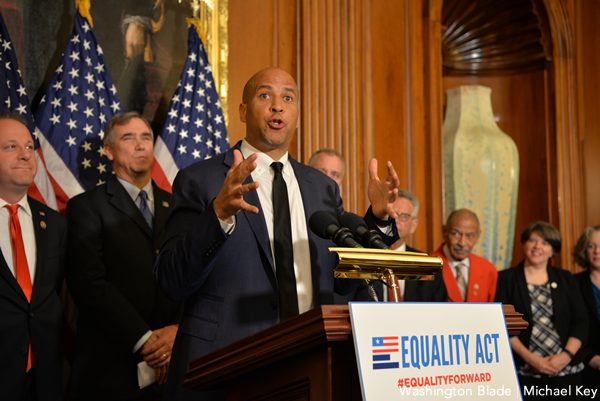
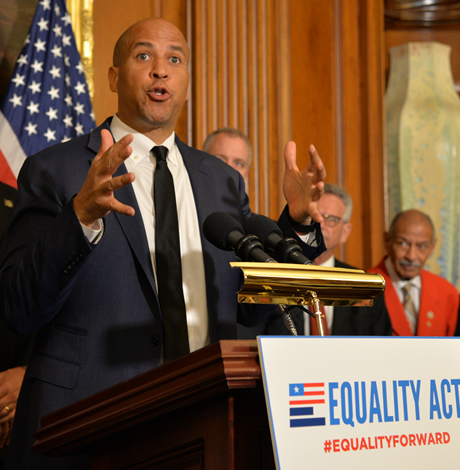
Cory Booker said he’d reverse the transgender military ban “right away.” (Washington Blade file photo by Michael Key)

Democratic presidential candidate Cory Booker said Sunday evening he’d reverse President Trump’s transgender military ban “right away” if elected to the White House in 2020.

Speaking to a crowd of more than 300 voters, Booker made the remarks in response to a question from transgender woman who asked him what he’d do to protect LGBT rights as president, according to the Associated Press.

“When I am president of the United States, right away I will end this ridiculous, insulting, un-American ban on transgender Americans serving in the military,” Booker is quoted as saying, reportedly to cheers from the crowd.

The Trump administration last week unveiled its plan to initiate its transgender ban on April 12 in the aftermath of courts lifting four orders that previously barred the U.S. military from enforcing the policy.

Other Democratic contenders, including Booker himself, have condemned Trump’s ban on transgender service, but the New Jersey Democrat now stands out for pledging to reverse the policy “right away” upon election to the White House.

Aaron Belkin, director of the San Francisco-based Palm Center, commended Booker in a statement called on other presidential candidates to make similar commitments.

“Sen. Cory Booker has listened to the considered judgment of all five military service chiefs and has taken a strong stand on the need to rid our military of discrimination on day one of his tenure if elected,” Belkin said. “This is the kind of leadership needed to ensure that politics doesn’t stand in the way of military readiness. We look forward to hearing where other candidates stand on this key issue of immediate reversal.”

Advertisement
FUND LGBTQ JOURNALISM
SIGN UP FOR E-BLAST

Senegal

Senegalese lawmakers approve bill to further criminalize homosexuality

A dozen men arrested in February for ‘unnatural acts’

Published

on

(Image by xileodesigns/Bigstock)

Senegalese lawmakers on Wednesday approved a bill that would further criminalize consensual same-sex sexual relations in the country.

The Associated Press notes the measure that Prime Minister Ousmane Sonko introduced in February would increase the penalty for anyone convicted of engaging in consensual same-sex sexual relations from one to five years in prison to five to 10 years. The AP further indicates the bill would prohibit the “promotion” or “financing” of homosexuality in the country.

The bill passed with near unanimous support. Only three of 135 MPs abstained.

President Bassirou Diomaye Faye is expected to sign the measure.

The National Assembly in 2021 rejected a bill that would have further criminalized homosexuality in Senegal.

Senegalese police last month arrested a dozen men and charged them with committing “unnatural acts.”

Continue Reading

Malaysia

Malaysia blocks access to Grindr, other gay dating websites

Restrictions part of continued anti-LGBTQ crackdown

Published

on

(Image by Flogel/Bigstock)

Malaysia has blocked access to Grindr, Blued, and other gay dating websites, and is now considering further steps to restrict their mobile application. 

Communications Minister Fahmi Fadzil on Feb. 25 said the government is pursuing legal measures to curb the availability of LGBTQ dating apps on Google’s Play Store and Apple’s App Store.

Fadzil, in a written parliamentary reply, said the Malaysian Communications and Multimedia Commission has not received any requests to remove the mobile versions of Grindr and Blued from app stores, noting the challenges of regulating platforms owned by foreign companies.

“Control over applications on platforms such as Google Play and Apple Store is subject to regulations and policies set by the said platform providers, since both applications are owned by foreign companies operating outside of Malaysia,” Fadzil said. “This includes those that spread lewd or immoral content, exploitation, abuse, scams, exploiting children or threats towards public safety.”

Fadzil was responding to a question about whether the Malaysian Communications and Multimedia Commission had worked with app store providers to block downloads of such apps.

The Washington Blade reached out to Google and Apple multiple times for comment but did not receive a response.

Malaysia has stepped up digital restrictions targeting the LGBTQ community as part of a broader crackdown on what authorities describe as “deviant” or immoral content. Consensual same-sex sexual relations remain criminalized in the country under both civil and Sharia law.

Malaysia has proposed a Cyber Crime Bill that would expand the government’s legal powers to address the misuse of digital platforms, including the promotion of same-sex dating applications, Deputy Prime Minister Ahmad Zahid Hamidi said. The bill would replace the Computer Crimes Act of 1997.

“We are disappointed in the decision to block access to Grindr in Malaysia and believe that online platform regulation should be proportionate and consistent with international human rights law,” a Grindr spokesperson told the Blade in an email. 

“At Grindr, our mission is to help make a world where the lives of our global community are free, equal, and just,” added the spokesperson. “For many of our users, Grindr is often the primary way for them to connect, express themselves, and discover the world around them. In addition to serving as an important source of information, Grindr is committed to advancing the health and well-being of the community around the world and through our social impact initiative, Grindr for Equality, we partner with hundreds of advocates, community-based organizations, and public health agencies to support the global LGBTQ+ community.”

Grindr, based in California, is popular around the world. Blued, a China-based app that BlueCity operates, is one of the world’s largest social networking and dating platforms for gay men.

Blued did not respond to the Blade’s request for comment.

Online platforms ‘critical for LGBTQ people’

Malaysian authorities in May 2023 raided Swatch stores at shopping malls across the country and confiscated more than 160 rainbow-colored watches from the company’s Pride collection, saying the designs carried “LGBT connotations.” The raids, which the Home Affairs Ministry carried out, were widely criticized by advocacy groups.

Police last June opened an investigation into a closed-door LGBTQ sexual health workshop. 

Selangor police chief Hussein Omar Khan said authorities were examining the event under the Penal Code for allegedly causing “disharmony or ill will” on religious grounds, as well as under the Communications and Multimedia Act, a law frequently used to police online speech. Critics said the investigation reflected growing government overreach and warned against the criminalization of public health initiatives aimed at marginalized communities. Activists cited this case as another example of Prime Minister Anwar Ibrahim’s crackdown on LGBTQ rights.

The Home Affairs Ministry in November 2020 banned the book “Gay Is OK! A Christian Perspective,” written by Pastor Oyoung and published by Gerakbudaya in 2013, saying it was likely to be “prejudicial to public order, morality and the public interest.” The Kuala Lumpur High Court later overturned the ban and ordered the respondents — then-Home Affairs Minister Hamzah Zainudin and the Malaysian government — to pay costs of 5,000 Malaysian ringgit ($1,276.81.)

A 2014 Human Rights Watch report documented widespread discrimination and abuse against transgender women in the country. 

The report found that trans people face arrests under laws that effectively criminalize “cross-dressing,” along with harassment and abuse by police and religious authorities. It also described systemic discrimination in employment, health care, and education, leaving many trans women marginalized and vulnerable to violence and exploitation.

Thilaga Sulathireh, a founding member of Justice for Sisters, a Malaysian trans rights group, said restrictions on LGBTQ people’s freedom of expression through censorship have been an ongoing trend in Malaysia over the past decade. 

Sulathireh said there have been increasing calls to curb what critics describe as “LGBT normalization” in films, books, and social media, which activists link to what they say is a harmful and inaccurate perception that LGBTQ people are immoral. Sulathireh added Grindr had been blocked in Malaysia for several years and that, as of last weekend, the app was no longer available on Google Play and the Apple App Store. Sulathireh said Justice for Sisters views the move as a serious violation of LGBTQ people’s rights to nondiscrimination, dignity, privacy, and freedom of expression.

“The blocking of LGBTQ related apps is part of the on-going and increasing trend of state sponsored discrimination against LGBTQ people in Malaysia,” Sulathireh told the Blade in an email. “In late February, the deputy minister in the prime minister’s (Religious Affairs) Department announced that the government is opting to replace references to LGBT persons with the term “budaya songsang” (deviant culture) and encouraged others to do the same to avoid LGBT normalization in all spaces, including social media. At the same time, called on members of the public to immediately report ‘suspicious activities, events or content.’”

Sulathireh told the Blade a deputy minister recently outlined a range of government-led initiatives targeting LGBTQ people in Malaysia. 

According to Sulathireh, these include so-called “spiritual guidance camps.” Sulathireh said some participants, including those who identify as “ex-LGBT” or part of the “hijrah” community, have been encouraged to act as peer educators to reach other LGBTQ people. 

Additional initiatives the deputy minister listed include academic Islamic conferences, state-level sermons coordinated by the state Islamic councils, and mosque-level programs. Sulathireh told the Blade the government presented a paper to the Council of Rulers outlining what officials described as the negative implications of legal gender recognition. Sulathireh said authorities have also established a multiagency committee to address issues involving Muslim LGBTQ people, promoted what they call “psychospiritual therapy,” and worked with police and the Communications and Multimedia Commission to monitor the promotion of LGBTQ-related activities online.

“The blocking of these apps and websites severely impacts all areas of LGBTQ people’s lives,” said Sulathireh. “These platforms have proven critical for LGBTQ people to find support, communities, access life-saving resources, information and services, love and intimacy. I think being able to find love, intimacy and connections is critical for LGBTQ’s self-acceptance, self-worth, health, and well-being.” 

“The blocking makes it even more challenging for people to connect safely online and offline,” added Sulathireh. “People will become more isolated and all of these have a severe impact on LGBTQ’s mental health and well-being, which is already poor.”

Sulathireh said Justice for Sisters research and observations indicate many LGBTQ people in Malaysia already experience social media and digital spaces as hostile environments. As a result, many limit their use of these platforms and adopt higher levels of self-censorship. Sulathireh added the recent bans targeting LGBTQ visibility on digital platforms are also unfolding alongside a broader policy push to restrict social media access for children under 16.

“The state sponsored LGBTQ discrimination over the years has resulted in increasing discrimination by non-state actors and anti-rights groups with impunity,” Sulathireh said. “This ban will further entrench the culture of impunity against LGBTQ people.”

Nalini Elumalai, senior Malaysia program officer at ARTICLE 19, an international freedom of expression organization, said the blocking of dating apps is not occurring in isolation but is happening under the guise of public morality, digital censorship, and the enforcement of laws that undermine the rights of LGBTQ individuals in Malaysia. 

Elumalai noted that Deputy Religious Affairs Minister Marhamah Rosli recently urged the public to refrain from using the term “LGBT” and instead describe it as “deviant culture” in an effort to combat normalization and reduce LGBTQ-related content on social media. Elumalai said blocking Grindr and Blued represents an ongoing attack on the LGBTQ community, particularly their rights to freedom of expression, access to information, and to be treated equally before the law without discrimination — protections guaranteed under Articles 8 and 10 of Malaysia’s Federal Constitution. 

“The blocking of LGBTQI+ dating platforms appears to reflect a broader pattern in Malaysia where LGBTQI+-related expression and activities face heightened scrutiny and repression, particularly when they become visible online,” said Elumalai in a statement to the Blade.

Elumalai noted JEJAKA, a community-based organization had to cancel their “Glamping with Pride” event that was to have taken place on Jan. 17-18 because of safety concerns after it received death threats on social media.

“Ongoing repression of LGBTQI+ expression will further entrench systemic discrimination against marginalized groups, normalise inequality, and perpetuate division and hostility among the people in Malaysia,” said Elumalai. “Further, when one group is punished or prevented from expressing themselves freely online, others, including various online platforms, may also self-censor out of fear that they too could face scrutiny or penalties, even for legitimate expressions.”

The Malaysian Communications and Multimedia Commission has not responded to the Blade’s request for comment.

Continue Reading

Chile

Far-right Chilean President José Antonio Kast takes office

Former congressman opposes LGBTQ rights

Published

on

Chilean President José Antonio Kast moments after his inauguration in Valparaíso, Chile, on March 11, 2026. (CNN Chile screenshot)

Chilean President José Antonio Kast took office on Wednesday.

Kast — the far-right leader of the Republican Party who was a member of the country’s House of Deputies from 2002-2018 — defeated Jeannette Jara — a member of the Communist Party of Chile who was the former labor and social welfare minister in former President Gabriel Boric’s government — in last year’s presidential election.

The Chilean constitution prevented Boric from running for a second consecutive term.

The Washington Blade has previously reported Kast has expressed his opposition to gender-specific policies, comprehensive sex education, and reforms to Chile’s anti-discrimination laws. Kast has also publicly opposed the country’s marriage equality law that took effect on March 10, 2022, the day before Boric took office.

The Movement for Homosexual Integration and Liberation, a Chilean LGBTQ and intersex rights group known by the acronym Movilh, declared a “state of alert” after Kast’s election, “given this leader’s (Kast’s) public and political trajectory, characterized for decades by systematic opposition to laws and policies aimed at equality and nondiscrimination of LGBTIQ+ individuals.”

Argentine President Javier Milei, Deputy U.S. Secretary of State Christopher Landau, and Venezuelan opposition leader María Corina Machado are among those who attended Kast’s inauguration that took place in the Chilean Congress in Valparaíso.

Continue Reading

Popular