Opinions
Trump, Republicans model the Third Reich
If their behavior doesn’t change the GOP deserves to die

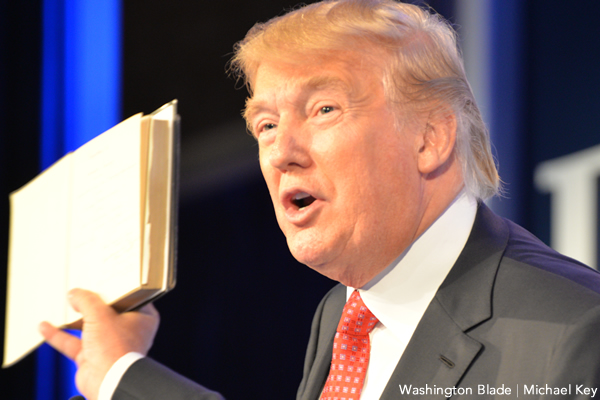
Donald Trump and the Republican Party are clearly using Hitler and the Third Reich as their model for how to destroy democracy in the United States. We are lucky we are strong enough they won’t succeed in the long run.
It has been reported: “According to a 1990 Vanity Fair interview, Ivana Trump once told her lawyer Michael Kennedy that her husband, real-estate mogul Donald Trump, now a leading Republican presidential candidate, kept a book of Hitler’s speeches near his bed.” While it is clear Trump doesn’t read much, recent events make this a believable story.
In judging the impact Trump’s speeches and lies have had one must only look at the recent actions of the Republican Party in Texas, led by their attorney general Ken Paxton who himself is reported to be under FBI investigation, to invalidate the vote in four other states. This spurious action was supported by 17 other state attorneys general and 126 Republican members of Congress. One can look at this in two ways. The first is all are so dumb they don’t know the United States is a federation. Under our system of federalism we don’t have one national election but rather each state holds an election. The total vote is counted and reported but each state’s election determines which candidate’s electors will participate in the Electoral College vote, which decides who will be the president and vice president. My take is these Republicans do understand that which makes their actions seditious (inciting or causing people to rebel against the authority of a state or monarch).
The 126 members of Congress who supported this lawsuit not only know about our democracy and our Constitution, they each took an oath that says: “I do solemnly swear (or affirm) that I will support and defend the Constitution of the United States against all enemies, foreign and domestic; that I will bear true faith and allegiance to the same; that I take this obligation freely, without any mental reservation or purpose of evasion.”
So will those 126 members suffer any consequences for their actions? While some suggest they not be seated in the next Congress, my view is they should all be censured. At a minimum they should have such a mark next to their names in our history books. While the Justices of the Supreme Court did the right thing by not taking the case, and we should thank them, those filing and lending their names to it should not escape without any repercussions.
Trump has now attacked the Supreme Court suggesting because they didn’t side with him the justices lack courage; I think it showed they had some. He has attacked individual judges around the country for throwing out all the specious cases his team is filing; he has attacked members of his own party like Georgia Gov. Brian Kemp for being unwilling to overturn the will of the voters. He has supported white nationalists and Neo Nazis. He refuses to concede the election and incited his supporters like the ‘Proud Boys’ to protest in the streets. He is using his bully pulpit to subvert our democracy just like Hitler did in Germany.
Will people stand up to him and his supporters in ways that will be remembered? That has yet to be seen and we may not know until the next general election or we could see it in the Georgia Senate run-off races. I am not for using violence to respond but there can be actions such as the one reported taken by the Orlando Sentinel’s editorial board which wrote, “The newspaper apologizes for endorsing GOP Rep. Michael Waltz who backed election reversal.” Newspapers around the nation that endorsed one of the other 125 members of Congress who joined Waltz should be doing the same. The fact we haven’t seen them do it yet is an indication of how strong the ‘cult’ of Trump is. He has a Hitler-like hold on the minds of people who in other ways we would consider normal.
The willingness of other elected Republicans to follow Trump’s lead for fear of losing their next election if they don’t is mindboggling. It might signal the final death knell of the Republican Party as we once knew it. If their behavior doesn’t change the party deserves to die.
Peter Rosenstein is a longtime LGBTQ rights and Democratic Party activist. He writes regularly for the Blade.




Opinions
Trump, Netanyahu, and Putin are all war criminals
We are living in a world of chaos as a result

Today there are war criminals leading three major governments. President Trump here in the United States, Benjamin Netanyahu in Israel, and Vladimir Putin in Russia. The world would be a better place if they were thrown into a jail cell together, and the key tossed away.
We are living in a world of chaos. Although these three are not responsible for all of it, they have a major role. All three are carrying out wars that they can’t win. Wars that should have never been started. In the process they are not only killing their stated enemies, but they’re also causing the deaths of their own people.
Here in the United States, we have a felon in the White House, who has done nothing but create chaos in the world since he took office. He has broken every promise he made to get elected, and while many of us knew they were all lies, he won anyway. He promised lower rents, lower mortgage rates, lower inflation, lower gas prices, lower grocery prices, and importantly, no new wars. He has accomplished the exact opposite in each of those areas. He began a war with Iran and started by bombing a school, mistake or not, killing innocent children. This after declaring war on immigrants here at home using his ICE Gestapo. He apparently thinks if he creates chaos, and then gets things back to close to where they were before he acted, he can claim victory. But even that seems out of his reach.
Then there is Prime Minister Netanyahu in Israel. His actions have made things worse not only for his enemies, but for Israelis at home, and Jews around the world. He began a war against Iran that he can’t win. He has committed war crimes against the Palestinian people in Gaza, and the West Bank, and by his actions brought out more anti-Semitism around the world. For me personally, he has made it more difficult to explain to people when I say I am a Zionist, it means I support the existence of the State of Israel, not its war criminal leader, and his government. He should have heeded what President Biden said to him after the Oct. 7 attack on Israel by Hamas. While retribution and getting back the hostages Hamas took was crucial, Biden counseled not to go overboard in response, like the United States did after 9/11. Instead, Netanyahu has killed thousands of Palestinian women and children, and has not made Israel much safer. He then began the war with Iran, and sent troops to fight in Lebanon. Yes, the Iranian government funds Hezbollah and Hamas, but one must ask if anything is better after Netanyahu’s actions. Israelis continue living in a state of active war.
Then there is Putin in Russia. He believed he could attack Ukraine and walk away with pieces of their country, maybe even all of it. Instead, he has Russia embroiled in a four-year war, killing thousands of Ukrainians, including many women and children, destroying parts of their country, and losing thousands of his own troops in a war he can’t win. His own people are suffering, and now, four years later, Ukraine has shown it still has the ability to attack Moscow. All three of these men have managed to show the weaknesses of their own countries.
In his effort to bluster through his many failures, Trump has destroyed relationships with our allies. It will take years, if ever, for them to trust the United States again. He invaded Venezuela and stole their oil, is starving Cuba, and created unease with Canada and Mexico on our own borders. He thinks this makes him look like a strongman, when it really shows all of his weaknesses. People should remember the treaty he abrogated with Canada and Mexico, was one he negotiated in his first term. Now he invites Chinese President, Xi, to the United States, and gives him the same red-carpet welcome he previously gave to Putin in Alaska, and in both cases, received nothing in return. He tries to keep the press he doesn’t like from having access to him.
All three are facing crucial elections that could severely impact their futures. Only Putin, a true dictator, is assured of winning because he controls the process. Trump is trying to emulate him, to keep from losing the Nov. 3, mid-term elections. Thankfully the courts are trying to stop him. Netanyahu could face being thrown out on Oct. 27, if Israelis do the right thing.
Again, I truly believe putting the three of them in a jail cell together would make our troubled world a little safer, and a much better place.
Peter Rosenstein is a longtime LGBTQ rights and Democratic Party activist.
Commentary
Center Arts Gallery celebrates 10 years with reception, auction
Oct. 17 fundraiser to feature jazz combo, artwork created on site

Ten years ago, I had a vision: to create a dedicated space within The DC LGBTQ+ Community Center for local LGBTQ+ artists to share their creativity in a community space conceived specifically for them. That vision became the Center Arts Gallery. Over the past decade, the Center Arts Gallery has grown into a true home for our LGBTQ+ siblings, a place illuminating our joy, resistance, and resilience through the power of art.
Art is so much more than decoration. It can be a powerful protest, a keeper of memories, a testament to survival, and a vivid reminder that our lived experiences deserve to be seen, heard, and deeply valued. When we created the Center Arts Gallery, our goal was to remove barriers so that queer artists could feel welcomed, supported, and completely free to express themselves. Now, as we mark the incredible 10th anniversary of Center Arts, love truly comes full circle as many of those same amazing artists and creatives are giving back by donating their artwork for a special benefit auction.
On Saturday, Oct. 17, 2026, The DC LGBTQ+ Community Center will host our annual Fall Reception and Art Auction, celebrating 10 years of Center Arts Gallery at 1827 Wiltberger St., N.W., with an ambitious fundraising target of $25,000.
Appropriately themed “The Art of Belonging,” this milestone celebration will bring our community together with intention, uniting multiple forms of local queer creativity under one roof. The evening promises to be an unforgettable experience.
We are thrilled to have the celebration hosted by award-winning spoken word artist, poet, and educator Charity Blackwell. Attendees will enjoy smooth jazz selections performed by 2nd Independence — a jazz combo from the DC Different Drummers — alongside delicious heavy hors d’oeuvres provided by Shaw Tavern and exquisite dessert offerings by celebrity chef Patrick Vanas.
Throughout the night artwork will be created live on site, joining the online pieces generously donated by local artists.
Most importantly, every dollar raised during the reception and auction goes directly toward sustaining The DC Center’s life-affirming programs and supportive services. From food assistance providing nourishing meals, the free food pantry, and behavioral health counseling, to trauma-informed case management, resource navigation, HIV/STI testing, and essential hygiene services like showers, laundry, and a clothing boutique, our doors remain open because
of community support. These funds also support our cyber lounge, mail and locker services, harm reduction supplies, and critical wellness programs.
To ensure that everyone in our community can fully participate, ASL interpretation will be provided during the event program. We offer flexible ways to join us: General Admission is free (currently at capacity), with custom signature cocktails, wine, and beer available for purchase.
For those looking for an elevated evening, our $75 VIP Experience includes early admission at 6 p.m., early online auction access, complimentary Champagne (6-7 p.m.), an intimate opportunity to mingle with participating artists, a special swag bag, plus an open beer and wine bar throughout the entire evening.
For 10 years, Center Arts Gallery has shown us that belonging is an art form we create together. As we look back on a decade of community and look forward to the future, I invite you to join us, support local queer artists, and invest in the essential programs that keep our community thriving. Let’s come together to ensure that The DC Center can continue to educate, empower, uplift, and connect us all for generations to come.
Kimberley Bush is executive director of The DC LGBTQ+ Community Center.
Opinions
The facts about Victory Fund’s investigation and the path forward
Probe did not find legal or policy violations by Evan Low
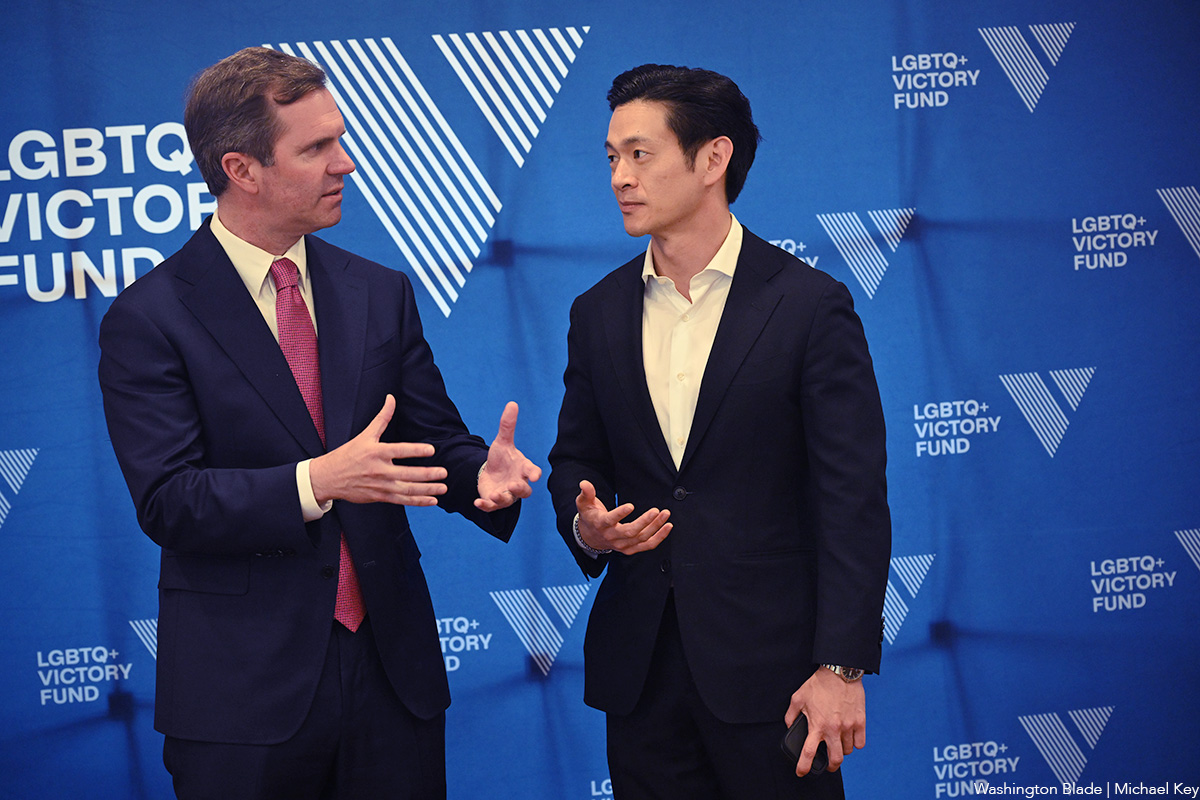
William Waybourn helped found an organization whose mission has never been more important, but his recent op-ed in the Washington Blade leaves readers with a fundamentally inaccurate impression about how the LGBTQ+ Victory Fund and Institute Boards responded to concerns raised about our organizations, their leadership, and our governance responsibilities.
The boards did not dismiss or minimize concerns. We did what responsible governing bodies should do: We took them seriously, retained experienced independent legal counsel, and authorized a thorough investigation to establish the facts.
The investigation proceeded without interference from the boards or organizational leadership, and the full boards were briefed on its eventual finding.
The conclusion matters: The investigation did not substantiate any legal or policy violations. After the briefing, the boards voted unanimously to accept the findings and close the investigation.
An independent investigation is meaningful only if we are prepared to respect its conclusions — whatever they may be. In this case, after reviewing the investigation and its findings, the boards continue to have confidence in President and CEO Evan Low.
That does not mean our work as governing bodies is finished or that any organization is beyond improvement. The boards will continue to work with staff strengthening Victory, including reviewing and updating policies to ensure they reflect best practices and support a strong working environment.
We can take matters raised seriously while also being clear about what an independent investigation did and did not find. Those are not contradictory positions. In fact, maintaining both is essential to treating everyone involved fairly.
Victory has endured for more than three decades because its mission is bigger than any one individual — a founder, board member, CEO, staff member, candidate, elected official, or donor. Generations of people have built Victory into an indispensable force for LGBTQ+ political representation, and those entrusted with governing it today take seriously our responsibility to protect that legacy and strengthen Victory for what comes next.
And what comes next could not be more consequential. Election Day is weeks away, LGBTQ+ candidates across the country are facing enormously important races, and our community continues to confront attacks on our rights and representation.
We will continue exercising the oversight expected of us, strengthening the Victory organizations, and focusing on the urgent work Victory was created to do: training and helping elect LGBTQ+ leaders, and ensuring our community has a voice wherever decisions about our lives are made.

Physician: addiction doesn’t always look the way you think it does

Calendar: October 9-15

ICC unseals arrest warrants for Taliban officials accused of persecuting LGBTQ people, women

Bet Mishpachah participates in D.C. Oct. 7 commemoration ceremony

Man charged in Mall of America shooting plot inspired by Pulse massacre: report

PHOTOS: Winchester Pride

Evan Low is not the leader the Victory Fund needs at this moment

Transgender woman elected to Brazilian Chamber of Deputies

Bowser, Office of LGBTQ Affairs announce LGBTQ+ History Month events

Alianza para la Inclusión fortalece la defensa de derechos LGBTQ en Centroamérica
-

 Photos5 days ago
PHOTOS: Winchester Pride
-
Opinions5 days ago
Evan Low is not the leader the Victory Fund needs at this moment
-
Brazil5 days ago
Transgender woman elected to Brazilian Chamber of Deputies
-
District of Columbia5 days ago
Bowser, Office of LGBTQ Affairs announce LGBTQ+ History Month events