News
FDA to loosen restrictions on blood donations by gay, bi men
“While today’s reports of an overdue move from the FDA is an important step, our community and leading medical experts will not stop advocating for the FDA to lift all restrictions against qualified LGBTQ blood donor candidates, said GLAAD President Sarah Kate Ellis

The Food and Drug Administration is reportedly drafting guidelines to ease restrictions on blood donations by gay and bisexual men by removing the required one-year period of sexual abstinence for those in exclusively monogamous relationships.
New rules can be expected in coming months as the agency is now finalizing an individualized risk assessment questionnaire to determine eligibility, sources briefed on the matter told The Wall Street Journal.
According to an FDA spokesperson, potential donors who have had anal intercourse with a new sexual partner within the past three months would likely be asked to wait an additional three months before donating.
The FDA issued a blanket ban on blood donation from all men who have sex with men amid the AIDS epidemic of the 1980s. Since then, the agency has narrowed those restrictions only twice.
Gay and bisexual men who abstained from sex for a year or longer were permitted to donate blood with a 2015 policy change. Then, faced with severe blood shortages during the COVID-19 pandemic, the FDA shortened the required abstinence period to three months.
GLAAD responded to Wednesday’s news of the FDA’s planned issuance of new guidelines with a statement that praised the move – while stressing that any restriction on blood and plasma donation by gay and bisexual men “is rooted in stigma, not science.”
“While today’s reports of an overdue move from the FDA is an important step, our community and leading medical experts will not stop advocating for the FDA to lift all restrictions against qualified LGBTQ blood donor candidates,” said GLAAD President Sarah Kate Ellis.







India’s Income Tax Department has opposed a same-sex couple’s petition that challenges Section 56(2)(x) of the Income Tax Act.
The provision exempts gifts between spouses from tax. The couple seeks the same benefit for their relationship.
At the center of the challenge is the explanation to the fifth provision of Section 56(2)(x). According to the petition, the provision excludes same-sex partners from the definition of “spouse.” The petition describes that exclusion as unconstitutional.
The provision defines “relative” to include an individual’s spouse, siblings, the spouse’s siblings, parents’ siblings, and other blood relatives.
Paiyo Ashiho and another petitioner, Vivek Divan, asked the Bombay High Court to recognize same-sex couples presumed to be in a marriage as “spouses” under the fifth provision to Section 56(2)(x).
A similar challenge is pending before the Karnataka High Court.
Bengaluru-based engineers Anurag Kalia and Akhilesh Godi have sought similar relief. Kalia said he wanted to give Godi a gold bracelet worth more than ₹115,500 ($1213.44.). The case remains pending.
The Prime Minister Narendra Modi-led government rejected the petition in an affidavit filed last year. It argued the plea was not legally tenable because it challenged no action or order of the Income Tax Department. Calling the petition an “abuse of process of law,” the government said the relief sought fell outside the scope of the Income Tax Act, 1961.
The government also argued the petitioners sought the benefits available to a “spouse” without legal recognition of their relationship. According to the affidavit, they had not placed on record any law recognizing their relationship as a marriage. It urged the court to dismiss the petition with costs.
The case returned to the spotlight on July 6, when the Bombay High Court heard the petition.
Justices B.P. Colabawalla and Firdosh P. Pooniwalla adjourned the matter after Solicitor General Tushar Mehta said he would appear on behalf of Modi’s government.
The petition comes nearly two years after the Indian Supreme Court’s marriage equality ruling.
In 2023, a five-judge Constitution Bench, in a 3-2 verdict, declined to recognize the constitutional validity of same-sex marriage in India. The country’s top court said MPs must decide whether to extend marriage rights to same-sex couples.
During the 2023 marriage equality hearings, lawyer Abhishek Manu Singhvi told the Supreme Court that marriage is a source of social validation, dignity, self-respect, fulfillment, and security. He argued that it also carries legal and civil benefits, including those related to taxation, inheritance, and adoption. Lawyer Anand Grover, who also appeared for the petitioners, told the court that marriage remains fundamental to the functioning of society and is necessary to access several state benefits, including joint tax benefits and surrogacy rights.
Chief Justice Dhananjaya Y. Chandrachud, in his minority opinion, said the Income Tax Act provides numerous tax benefits for payments made on behalf of a spouse, including deductions for life and health insurance premiums. He also noted that marriage confers several financial benefits on a spouse, including eligibility for gratuity, funeral expenses, medical benefits, and provident fund claims as the dependent of a deceased spouse.
In the marriage equality ruling, the Supreme Court recognized queer people cannot be discriminated against. The court said denying queer couples the material benefits and services available to heterosexual couples violates their fundamental rights.
While issuing directions to the federal, state, and territory governments; Chandrachud said the government should ensure there was no discrimination in access to goods and services. He also directed governments to sensitize the public about queer rights, establish a hotline for the queer community, create safe houses for queer couples, and ensure intersex children were not forced to undergo medical operations.
The petition is awaiting its next hearing before the Bombay High Court.
India’s tax system relies on both direct and indirect taxes, although its direct tax base remains relatively narrow. Individuals pay income tax at progressive rates of up to 30 percent, while consumers pay taxes on most goods and services through the Goods and Services Tax. The Income Tax Act also provides exemptions, deductions, and other tax benefits for eligible taxpayers, including those linked to family relationships and legal marital status.
India’s LGBTQ community is estimated to comprise between 135 million and 140 million people, or nearly 10 percent of the country’s population. Collectively, it is estimated to have a purchasing power exceeding $168 billion. The World Bank estimated that exclusion based on sexual orientation and gender identity cost India between $1.9 billion and $30.8 billion in lost economic output annually, or up to 1.7 percent of its gross domestic product.
India imposed a separate Gift Tax Act in 1958 to tax certain transfers of property made without consideration. Parliament repealed the law in 1998 to simplify the tax system and encourage genuine gifting. However, concerns over tax avoidance later prompted the government to bring gifts back within the Income Tax Act. Today, specified gifts exceeding prescribed limits may be taxed under Section 56(2)(x), subject to exemptions that include gifts received from relatives.
Under the Income Tax Act, gifts received from non-relatives exceeding ₹50,000 ($525.30) in a financial year are generally treated as taxable income, unless they qualify for a statutory exemption. Gifts received from specified relatives, including a spouse, are exempt from tax regardless of their value.
Tarun Khaitan — a research director and professor of public law at the London School of Economics Law School, honorary professorial fellow at Melbourne Law School, and associate fellow of the Bonavero Institute of Human Rights at the University of Oxford — told the Washington Blade the guarantee of equality and non-discrimination under India’s constitution was deliberately framed in broad terms because its framers envisaged that the understanding of those principles would evolve over time. They did not intend to freeze their meaning in 1950, he said. Instead, older and newer statutes alike must be interpreted in light of the constitution’s contemporary understanding.
“Constitutional values must inform the interpretation of all laws in India. It is well established in Indian jurisprudence that if a term can carry two meanings, the court will give it the meaning that complies with constitutional demands,” Khaitan said. “The term ‘spouse’ is not defined in the Income Tax Act, and unlike ‘husband’ or ‘wife’ is not a legal term of art in Indian family law. Its use by the Income Tax Act therefore is apt for judicial interpretation, which must be guided by the constitutional guarantees of equality and liberty.”
Asked how courts should balance respect for legislative choices with their constitutional responsibility to safeguard equality and dignity, Khaitan said he was not convinced that the legislature had made a clear choice in this case. He noted that the Income Tax Act uses the term “spouse” without defining it, adding that no other Indian law, to his knowledge, defines the term either. Its meaning has evolved over time, he said, pointing to the Oxford English Dictionary, which now defines a spouse as “a husband or wife, or a person joined to another in a comparable legally recognized union.”
Khaitan said the decision to restrict the meaning of “spouse” to different-sex married couples appeared to be the government’s interpretation rather than one expressly adopted by MPs. Even so, he said, courts have a duty to safeguard constitutional rights, although those rights are not absolute. The state, he said, must justify any restriction by demonstrating that it serves a sufficiently important public interest and that the limitation is proportionate to that objective.
“The extension of marriage would be a symbolic expression of equal acceptance of same-sex relations by law as well as a the extension of the bundle of material incidents that typically attach to it. Whether or not such extension happens, concerns such as inheritance, hospital visitation rights, decisions regarding end of life care, pensions etc affect the lives of same-sex couples as well as unmarried different-sex couples in a real, material sense,” Khaitan said. “There is no conceptual reason why the expressive salience of ‘marriage’ and the material incidents of a domestic partnership cannot be unbundled.”
Khaitan has had his scholarship cited by the Supreme Court in several constitutional cases, including Navtej Singh Johar v. Union of India, which decriminalized consensual same-sex relations, and Lt. Col. Nitisha v. Union of India, a landmark judgment on indirect discrimination.
Rehoboth Beach
HISTORIC: Susan Stewart elected Rehoboth’s first out mayor
Thanks LGBTQ supporters and vows to protect city’s small town charm

Residents of Rehoboth Beach elected City Commissioner Susan Stewart with 61% of the vote on Aug. 8, making her the city’s first openly gay mayor.
Stewart beat fellow commissioners Craig Their and Suzanne Goode in the race, as well as newcomer Jake Raak.
The final mayoral vote results were:
- Susan Stewart: 632
- Craig Their: 203
- Suzanne Goode: 177
- William “Jake” Raak: 23
“I’m very grateful because the LGBTQ+ community not only voted for me, but also supported me,” said Stewart.
Stewart said that she is particularly grateful for the support she received on social media from members of the LGBTQ+ community.
“I’ve had incredible support,” said Stewart.
Stewart said that her campaign showed her just how much residents of Rehoboth are engaged and care about the city.
“They really want to see what’s best for the community,” said Stewart.
Stewart spoke about the master planning initiative she has been working on as a commissioner, which she plans to continue as mayor.
“We’ve undertaken rewriting the commercial zoning code, and that’s foundational to the next step of the initiative,” said Stewart.
She said that she was proud of the results of charette week that was held last month where residents and business owners had the opportunity to speak with hired urban planners to give feedback for a zoning code update.
Stewart said that Rehoboth is at a tipping point as the city must find a way to balance the growth of the commercial district while improving the quality of life for residents.
“I don’t believe there needs to be tension between the business community and the residential experience,” said Stewart.
“I’m excited about a new master plan because we have a couple hotels coming, and we also have Clear Space Theatre looking for a new home, and we’re working with them,” said Stewart. “We want businesses to stay here.”
Stewart also said that she aims to embrace the concept of a ‘15-minute city,’ making the city much more accessible in terms of transportation in the downtown area for residents.
“The goal is to protect the small town charm and natural beauty of Rehoboth,” said Stewart. “I want to keep the momentum going.”
The Blade asked Stewart about any concerns she might have working with Commissioner Goode, whom she has criticized for sending inappropriate and offensive emails to city staff. Goode finished a distant third in the mayoral race and her husband fell short in his bid for a Commissioner’s seat. In that race, Jeffrey Goode received 239 votes; Patrick Gossett, who’s gay, received 813 votes and Mark Saunders 852. Saunders and Gossett will be sworn in next month.
“I’m really eager to move past this issue with Commissioner Goode,” said Stewart.
She said that she’s heard ‘loud and clear’ from the city that they want to move past this situation as best as they can while Goode remains in her seat as commissioner.
“There are no mechanisms for us to remove a sitting commissioner. Our laws don’t allow it,” said Stewart.
Stewart clarified that she has always focused on Goode’s behavior toward city staff.
“One thing I feel really passionate about is that the city employees have to know that they are heard. They are real people with real jobs, real professional reputations, and they’ve been harmed,” said Stewart.
The Blade also asked if Stewart had made a final decision on whom she plans to nominate to fill her Commissioner seat.
“I’m considering who to appoint and I have not made any final decisions,” said Stewart.
She noted that, as mayor, she only has the power to nominate a candidate and that the board of commissioners will have the final vote on whom to appoint to the board.
Stewart shared that she has received interest from a number of people and finds that to be a good sign.
“I think that’s a great sign because people want to serve. I’m eager to have someone in that seat who’s smart and has the best interests of the city,” said Stewart.
Stewart will be sworn in during the Board of Commissioners meeting on Sept. 18.
Federal Government
Todd Blanche’s record on LGBTQ issues comes under scrutiny as he takes over DOJ
Blanche was confirmed by the Republican controlled Senate 50-49.
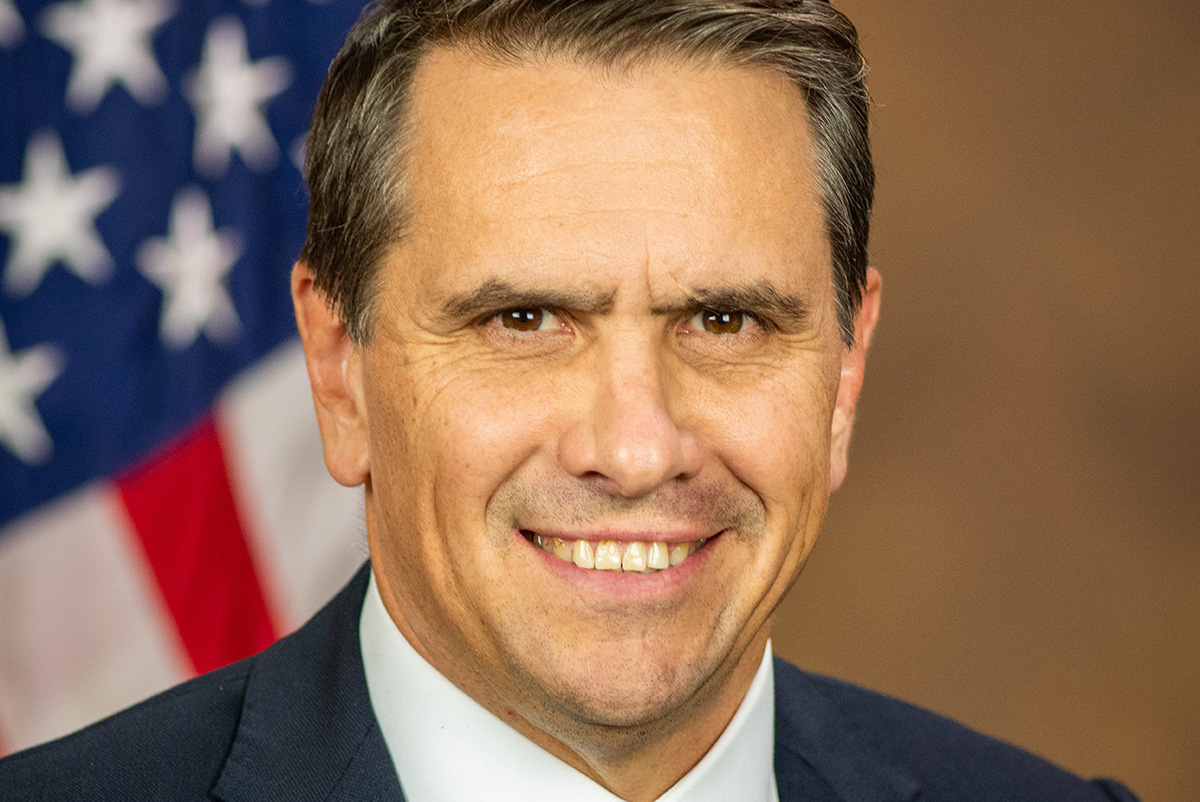
Todd Blanche, President Trump’s former personal lawyer, was sworn in as attorney general of the United States on Monday.
Blanche secured the position as the country’s 88th chief law enforcement officer on Sunday night after a contentious Senate confirmation process, ultimately ending with a 50-49 vote in his favor. All Democrats, as well as Republican Sens. Susan Collins and Lisa Murkowski, voted against him.
The confirmation hearing — and subsequent vote — brought questions surrounding Blanche’s credibility and integrity, as well as concerns about Trump’s ethical dilemmas surrounding cronyism, to the forefront.
The attorney general acts as the head of the Department of Justice, responsible for enforcing federal laws, representing the U.S. in court, and advising the president.
Blanche has a long history in Washington, beginning when he attended American University for his undergraduate education, like fellow former Trump attorney Michael Cohen. He began his legal career as an intern in the U.S. Attorney’s Office in Washington, which eventually became a full-time position.
That job eventually led him to work as a paralegal in the U.S. Attorney’s Office for the Southern District of New York while attending Brooklyn Law School at night. Blanche graduated cum laude in 2003.
Blanche left the public sector in 2014, taking a job in the Manhattan office of the law firm WilmerHale. In September 2017, he moved to Cadwalader, Wickersham & Taft LLP, where he was a partner in the White Collar Defense and Investigations practice.
There, Blanche represented several figures associated with President Donald Trump, including former New York City Mayor Rudy Giuliani and Trump’s former campaign manager Paul Manafort.
In 2024, Blanche switched from Democrat to Republican and moved from New York City to Palm Beach, Fla., where he would be closer to Trump’s primary legal residence at Mar-a-Lago.
He then served as Trump’s personal defense attorney in the New York state case that led to Trump’s 2024 conviction on 34 felony counts of falsifying business records to cover up hush-money payments to adult film star Stormy Daniels.
While serving as acting head of the Department of Justice before his official confirmation, Blanche played a central role in overseeing the department and was involved in leadership decisions tied to several controversial actions affecting LGBTQ people.
One of the first issues was transgender rights and gender-affirming care, particularly for minors — an issue the White House and Republican Party have made a key part of their broader cultural agenda and federal policy efforts.
In a letter to New York Attorney General Letitia James, Blanche declared that the Justice Department “will not sit idly by while you attempt to use your office to force harmful procedures on our most vulnerable population.”
The letter came before NYU Langone ended its gender-affirming care at the behest of the president, forcing the hospital system to stop prescribing puberty blockers and hormones to minors.
The hospital’s change in policy came after the Trump-Vance administration threatened to pull all federal funding if it continued providing the care.
Blanche wrote that “the Justice Department believes the law is clear, and anti-discrimination laws cannot be used to force NYU Langone to perform sex-rejecting procedures on children.”
“As just one example, your office’s position would require a hospital to prescribe certain medications for certain diagnoses, regardless of the hospital’s or its doctors’ independent medical determination about the propriety of such treatment,” he continued in the letter.
In addition to his anti-transgender positions, Blanche also echoed his predecessor, Pam Bondi, in taking a public stance on limiting LGBTQ-related protections at the federal level.
He aligned with Bondi’s sentiments in June 2025 regarding the U.S. Supreme Court’s 6–3 decision that restricted LGBTQ history lessons in schools and limited lower federal courts from issuing nationwide injunctions — rulings that have often blocked Trump administration policies.
Blanche called it “another great decision that came down today,” arguing the ruling “restores parents’ rights to decide their child’s education.”
“It took the Supreme Court to set the record straight, and we thank them for that,” he said. “Now that ruling allows parents to opt out of dangerous trans ideology and make the decisions for their children that they believe is correct.”
In December 2025, a Justice Department memo stated that, “effective immediately,” prisons and jails would no longer be held responsible for violations of standards meant to protect LGBTQ people from harassment, abuse and rape under the Prison Rape Elimination Act.
The law, passed unanimously by Congress in 2003, requires that incarcerated people be screened for their risk of sexual assault, including consideration of LGBTQ status, and applies to all correctional facilities.
Additionally, when the Justice Department, under Blanche’s deputy leadership and at Trump’s behest, attempted to force Children’s National Hospital in D.C. to turn over medical records related to gender-affirming care, U.S. District Judge Julie R. Rubin ruled that the effort “appears to have no purpose other than to intimidate and harass.”
Blanche also faced scrutiny over a slew of other issues surrounding his leadership during his tenure as acting AG.
The Justice Connection, a watchdog organization that works to protect current and former civil servants working in the U.S. Department of Justice, called his work so far “devastating.”
The organization said Blanche “harmed the department’s workforce, advanced the politicization of the department, undermined the rule of law, and threatened public safety.”
The group cited several issues, including what it described as Blanche minimizing the violent reality of the January 6 insurrection led by Trump supporters; investigating and attempting to prosecute President Trump’s perceived political enemies; the botched release of the Epstein Files to Congress and the public, including the release of victim and witness details and censorship surrounding the scope of Trump’s relationship with the convicted sex trafficker and pedophile; and the expansion of federal immigration enforcement in Minnesota which lead to the death of two U.S. citizens by federal officials.
Sharon McGowan, senior vice president of Policy & Litigation at the Human Rights Campaign, the largest LGBTQ advocacy group in the country, provided a statement to the Blade about Blanche’s confirmation calling it “chilling.”
“The last thing Todd Blanche deserves is a promotion,” McGowan said via email. “For months, Blanche has used his position as Acting Attorney General to advance President Trump’s personal and financial interests and to weaponize the Justice Department against the President’s enemies, whether they be transgender kids or civil rights organizations trying to help people vote. His notion of justice is warped and dangerous, and LGBTQ+ Americans deserve better.”

Same-sex couples challenges India income tax law

HISTORIC: Susan Stewart elected Rehoboth’s first out mayor

Todd Blanche’s record on LGBTQ issues comes under scrutiny as he takes over DOJ

Don’t miss summer productions at Clear Space in Rehoboth Beach

PHOTOS: World Pride March

Calendar: August 7-13

Insured on paper, excluded in practice

Greg Araki still wants your sex

Mr. Henry’s to host 60th anniversary party