Local
D.C. jury finds AARP Services illegally fired gay man
Former employee awarded $2.1 million in damages
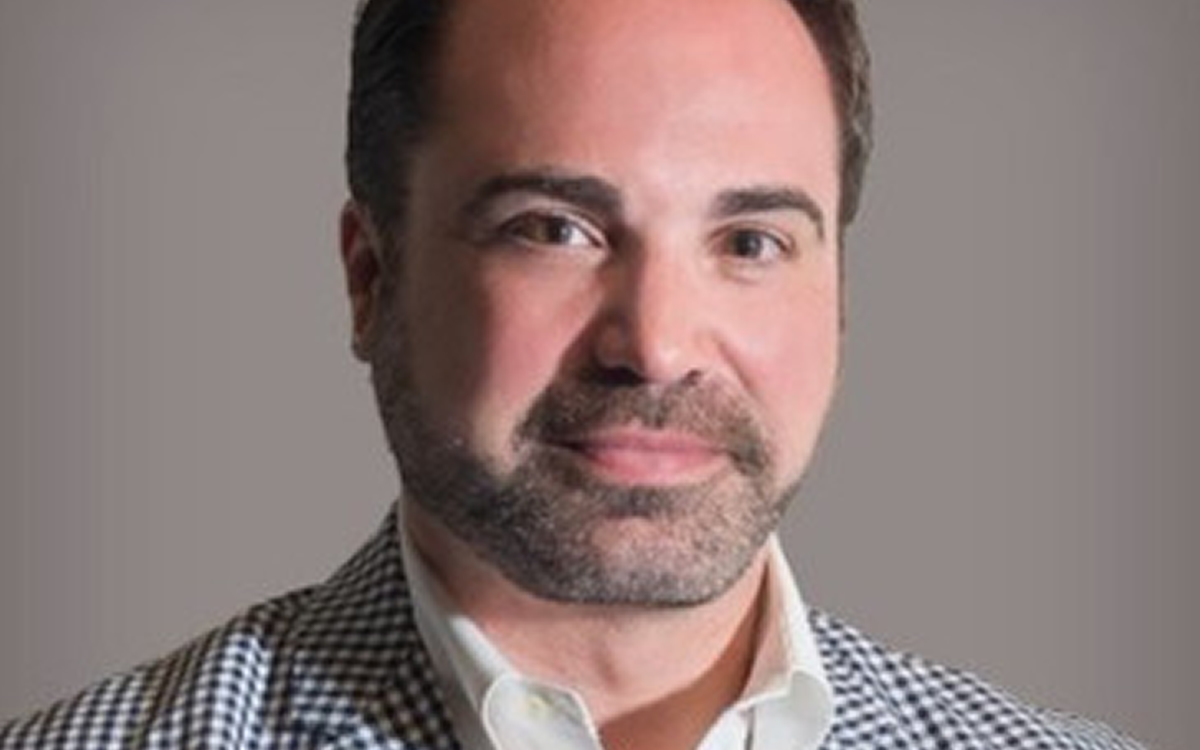
A D.C. Superior Court jury on March 15 handed down a verdict finding that the D.C.-based AARP Services, Inc., an arm of the AARP that interacts with businesses supportive of the nation’s seniors, illegally fired a gay manager because of his sexual orientation.
The jury’s verdict, which it said was based on a “preponderance of evidence,” came six years after Richard A. ‘Rick’ Deus Jr., who worked for AARP and AARP Services for 11 years, filed a lawsuit against his former employer in May 2018. The lawsuit charges that AARP Services violated the D.C. Human Rights Act by firing him after falsely accusing him of accepting gifts for travel from businesses affiliated with AARP that violated AARP employee ethics policies.
His lawsuit says he was fired in February 2018. At that time, he held the title of director of program management at AARP Services.
The lawsuit says AARP Services cited the alleged travel violations as the reason for its decision to fire him. The lawsuit named AARP Services and its then chief executive officer, Lawrence Flanagan, as the two defendants responsible for Deus’s firing.
But the jury’s verdict only named AARP Services as being at fault in the firing. It did not find Flanagan at fault and did not hold him responsible for damages, even though Flanagan testified at the trial that he made the final decision to terminate Deus on grounds that Deus violated the travel policy.
The jury also chose not to hold AARP Services responsible for paying punitive damages to Deus, whose lawsuit called for $5 million in compensatory damages and an additional $5 million in punitive damages.
In its verdict, according to online court records, the jury awarded Deus $1,612,916.18 in compensatory damages and $578,351 in damages for emotional distress that AARP Services is required to pay Deus. The court records show the jury awarded Deus another $1,118.89 to be paid by AARP Services for its alleged breach of contract with him in its decision to fire him.
An attorney representing AARP Services immediately following the verdict filed a motion requesting that Superior Court Judge Shana Frost Matini, who presided over the trial, issue a “directed verdict” overturning the jury’s verdict.
Such a motion is often filed by individuals or organizations on the losing side of a lawsuit, but such requests are rarely approved. Matini said she would schedule a hearing to consider the motion in May.
“I’m thrilled that the jury found that I was treated differently from my co-workers and discriminatorily fired,” Deus told the Washington Blade after the jury handed down its verdict. “That’s clearly what they found, and they awarded emotional pain and suffering,” he said. “But overall, I’m elated. It’s been six years of my life that I’ve been fighting and telling people that I was treated differently than anybody else and today I got my vindication.”
Laura Segal, AARP’s Senior Vice President for External Affairs, told the Blade in a statement, “AARP is pleased with the jury’s verdict that Lawrence Flanagan lawfully terminated Richard Deus’s employment.” She added, “AARP Services, Inc. (ASI) disagrees with the remainder of the verdict and is exploring all options for further legal review. We remain committed to an inclusive culture and warmth and belonging, where everyone is welcome.”
Attorneys representing AARP Services argued at the trial and presented witnesses denying Dues was fired because of his sexual orientation. They asserted that AARP Services had and still has gay and lesbian employees and managers and that the company has a longstanding policy of prohibiting discrimination on grounds of sexual orientation or marital status.
Deus’s lawsuit accused AARP Services of targeting Deus for discrimination based on his marriage to another man as well as for his sexual orientation. The jury did not find that AARP Services engaged in discrimination against Deus based on his marital status.
Flanagan was among the lead defense witnesses who testified at the nine-day-long trial. He testified that he has worked for many years with gay colleagues, has a gay relative who he admires, and would never have allowed his staff to engage in discrimination while he served as AARP Services CEO.
He noted in his testimony that his decision to fire Deus was based, in part, on the recommendation of AARP Services’ human resources or personnel director, Michael Loizzi, who is an openly gay man. Loizzi, who also testified at the trial, said that as a gay man he would never have called for Deus or anyone else to be fired because of their sexual orientation. He stated in his testimony that he recommended to Flanagan that Deus be fired because Deus violated AARP Services travel policy and lied to his supervisor about the details of the travel to get his supervisor’s approval under false pretenses.
Deus, during his own testimony, strongly disputed claims that he obtained permission for his travel by providing false information to his supervisor. His lawsuit states that both his supervisor and AARP Services’ legal counsel cleared him for the two trips that he has been accused of taking in violation of policy.
His lawsuit identifies heterosexual AARP and AARP Services employees who have taken business trips like the two taken by Deus that allegedly violated travel policy who were not fired or disciplined. A few faced disciplinary actions but were allowed to retain their jobs, the lawsuit says.
“This case is about the unequal treatment of a gay man when juxtaposed to the treatment of our heterosexual comparators,” Darrell Chambers, Deus’s lead attorney, told the Washington Blade after the verdict. “This is not a case about an organization or a group of people who hate gay people and decided that they were going to fire this man because they hate him,” Chambers said.
“Instead, it’s a case where the punishment that they consistently applied to gay employees, re Mr. Deus and Mr. Sanders, was harsher, far harsher than the punishment they applied to heterosexual employees who committed the same or similar acts.”
Chambers was referring to former AARP Services employee Jack Sanders, who is gay and who testified on video played at the trial that he was summarily fired on grounds that he allegedly sent pornographic photos or video images to another AARP Services employee, who complained about receiving the pornographic images.
Sanders has said the pornographic images in question were sent to the employee by his ex-boyfriend who wanted to portray Sanders in a negative light. Through telephone and wire transmission records Sanders was able to show that the images in question were sent from a device in Washington, D.C. at a time that Sanders was in Chicago, proving that Sanders could not have been the person who sent the images.
Deus’s attorneys brought out at the trial that AARP Services failed to give Sanders a chance to defend himself, prompting him to file his own lawsuit against AARP Services for which a settlement was reached. The terms of the settlement have not been publicly disclosed. But Deus’s attorneys cited Sanders’s case as yet another example of how AARP Services has treated gay employees differently from heterosexual employees.
AARP Services attorney Alison Davis argued during the trial that discrimination based on Deus’s sexual orientation had nothing at all to do with the decision to fire him. Davis told the jury that the two trips that Deus took that led to his firing, one to New York City and the other to New Orleans to attend the Sugar Bowl football game, were financed in part by companies that do business with AARP in violation of AARP and AARP Services policies for travel. Among other things, she said the Sugar Bowl is considered a championship game that has a value higher than smaller gifts that AARP employees are allowed to accept.
Deus testified that his reason for accepting an invitation to the Sugar Bowl game was to spend time with the new account director at the Allstate insurance company, which paid for the Sugar Bowl game ticket. “In 2019, we were going to be negotiating a new contract with Allstate and we wanted to establish a good relationship with her before the contract negotiations began,” he told the Blade. “That’s how you do business.”
Deus said he was referring to Allstate’s business relationship with AARP Services, which he said, similar to its interaction with other businesses, helps AARP provide support and services to the nation’s senior citizens.
In her cross examination of Deus on the witness stand, Davis also raised AARP Services’ claim in contesting the lawsuit that the emotional distress and depression that Deus says he suffered because of his firing could have been caused by issues unrelated to the firing. Davis asked Deus if his emotional distress was caused by stress that Deus has said he experienced years earlier when he came out as gay to his parents, who are ordained ministers, and in his interaction with his sister, who had been diagnosed as being bipolar.
Deus said that while his coming out to his conservative parents nearly 30 years ago and his sister’s mental health issues were a concern years earlier, he and his parents had long since reconciled over his sexual orientation and his sister’s mental health issues played no role whatsoever in the emotional distress he experienced after being fired by AARP Services.
In her cross examination of Deus on the witness stand, Davis also asked him if his decision to be interviewed by the Washington Blade last year for a Blade story about his lawsuit could have contributed to the difficulty, he said he encountered in finding employment after he was fired by AARP Services. Deus, who testified that he was hired by at least one other company that later laid him off, said he did not believe a Blade story about his lawsuit would have an adverse impact on him.




District of Columbia
D.C. Latinx Pride celebrates culture and heritage
Your guide to events throughout June
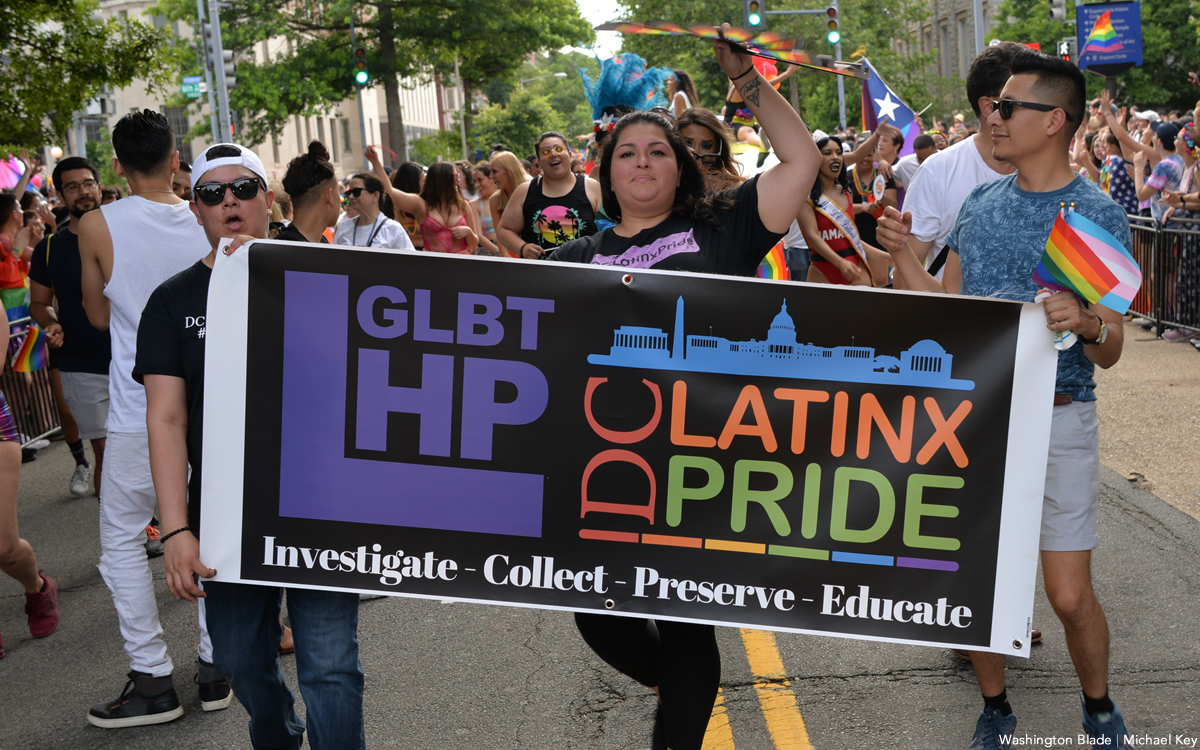
Organizers with the Latinx History Project have planned a host of events this Pride season with parties, poetry, drag and more.
The festivities begin with the DC Latinx Pride 2026 Kickoff at Crush Dance Bar (2007 14th Street, N.W.) on Friday, June 12 from 6-10 p.m. The party will include a coronation ceremony for the 2026 Royal Court: Ms. DC Latinx Pride Vida Rangel and Mx. DC Latinx Pride Steph Niaupari. RSVP at latinxhistoryproject.org. The event is free, though donations are accepted.
An outdoor event is planned for Sunday, June 14 from 11 a.m.-1 p.m. at Anacostia River Park (1500 Anacostia Dr., S.E.). Cultivating Queer Outdoor Joy is a “peaceful outdoor community event focused on grounding, connection, and queer joy in nature.” The event is free.
A panel discussion is planned for The Festival Center (1640 Columbia Rd., N.W., 2nd floor) on Monday, June 15 from 6-8 p.m. La Plática: The Future of 2 Spirits and Trans Natives will focus upon the “stories, leadership and vision of Two-Spirit, Indigiqueer and Trans Native people.” RSVP to the free event at latinxhistoryproject.org.
A sex-positive poetry workshop, “Hoetry: Writing Erotic Poetry,” is planned for Wednesday, June 17 from 6-8 p.m. at The Festival Center (1640 Columbia Road, N.W.). The event is free.
The workshop So You Wanna Do Drag? is planned for Thursday, June 18 from 5:30-8 p.m. at The Festival Center (1640 Columbia Road, N.W.). Featured guests Ricky Rose and Mari Con Carne will hold a style showcase to discuss the basics of developing a drag persona. RSVP to the free event at latinxhistoryproject.org.
The Latinx History Project is collaborating with Rumba Queer DC to produce an official Latinx Pride Party: Sin Vergüenza. The event is at the multi-level venue, Transmission (1353 H Street, N.E.) on Thursday, June 18 from 7 p.m.-1 a.m. There are dance lessons, vendors and three different music experiences in the sprawling venue. There will also be a drag showcase from 10-11 p.m. The event is 21+ and tickets are available at shotgun.live/en/events/sin-verguenza. Tickets are $15 for entry into the party. Tickets to participate in the dance lesson are $29.98. Participants may choose between a bachata lesson or a salsa lesson from 7-8 p.m.
La Fiesta: Official DC Latinx Pride Party is planned for Friday, June 19 from 10 p.m. – 2 a.m. at Bunker (2001 14th Street, N.W.). Serena Morena from “Drag Race México” and “Drag Race UK vs The World” is slated to headline the 21+ event. Early tickets are available for $15 (plus $0.38 service fee) until June 16. The door cover charge without early tickets is $20. Attendees can also purchase a meet and greet experience with Serena Morena for $30. Tickets are available at latinxhistoryproject.org.
The Latinx History Project plans to march in the Capital Pride Parade on Saturday, June 20 and to have a table at the Capital Pride Festival on Sunday, June 21. Visit latinxhistoryproject.org to register to march alongside LGP in the parade or to staff the table at the festival.
The DC Latinx Pride 2026 Closing Event is scheduled for Friday, June 26 from 6:30-8:30 p.m. at the Mexican Cultural Institute (2829 16th Street, N.W.). The free event is a panel discussion “centering the experiences of immigrants who have lived in Latin America and now call the United States home.”
Visit latinxhistoryproject.org for more information.
District of Columbia
JR.’s hosts meet & greet for mayoral candidate Janeese Lewis George
Event organized by Capital Stonewall Democrats, Queers for Janeese
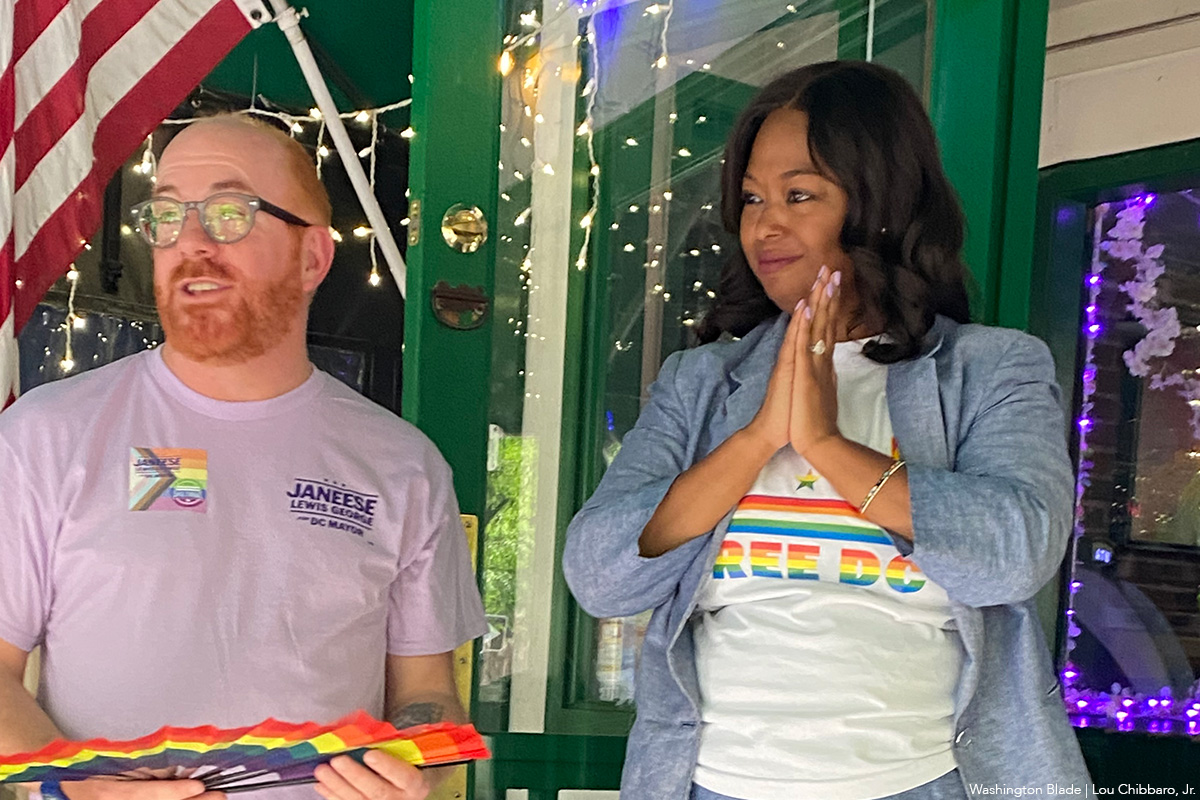
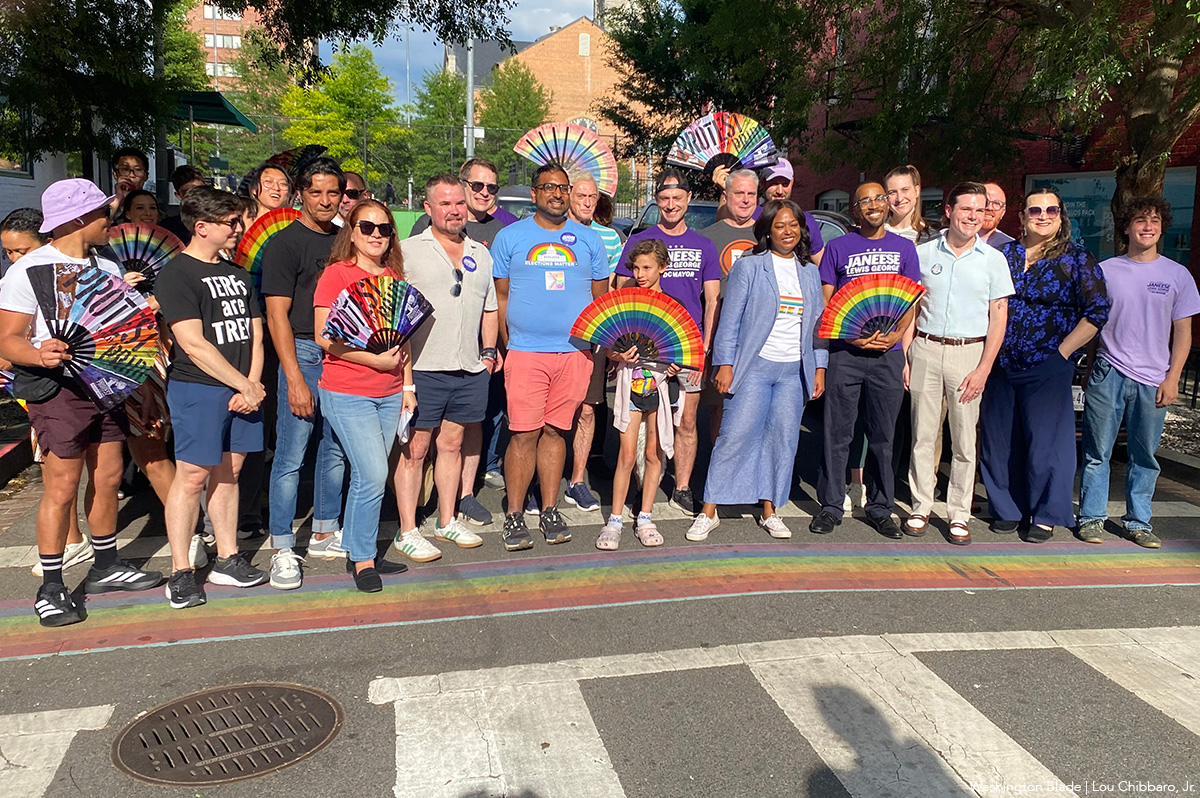
D.C. mayoral candidate Janeese Lewis George spoke to a crowd of LGBTQ supporters on June 1 at a meet & greet event held at JR.’s on 17th Street in the Dupont Circle neighborhood.
The event, organized by Capital Stonewall Democrats, which has endorsed Lewis George for mayor, with support from a group called Queers for Janeese, was followed by a “get out the vote” canvassing endeavor in which several of those attending the meet & greet visited the homes of nearby residents known to be Lewis George supporters.
The purpose of the canvassing was to remind Lewis George supporters to return their mail-in ballots or go to the polls on June 16 to elect Lewis George as the city’s next mayor, according to Matthew Kavanagh, one of the leaders of Queers for Janeese who attended the meet & greet event at JR.’s.
Local political observers consider Lewis George, a Ward 4 D.C. Council member, and former At-Large D.C. Council member Kenyan McDuffie, to be the two leading candidates in this year’s race for mayor. The two are among seven mayoral candidates competing in the city’s June 16 Democratic primary.
Lewis George told those attending the meet & greet, which was held on the JR.’s outdoor patio, that she has a long record of advocating for and initiating city polices and laws in support of the LGBTQ community. She said large corporate donors were backing her opponents and urged her LGBTQ supporters to help raise funds for her in the remaining days of the campaign.
Among those attending the meet & greet was gay longtime Dupont Circle civic activist Randy Downs who last November opened a nearby eatery called Protest Pizza. “I am queer and I am a Janeese supporter,” Downs told the Blade.
Stevie McCarty, president of Capital Stonewall Democrats, who also spoke at the meet & greet event, said his group would organize events in support of Lewis George in the remaining days of the campaign. Among them, he said, was an LGBTQ bar crawl in which supporters of Lewis George, including the candidate herself, would visit LGBTQ bars to promote her candidacy.
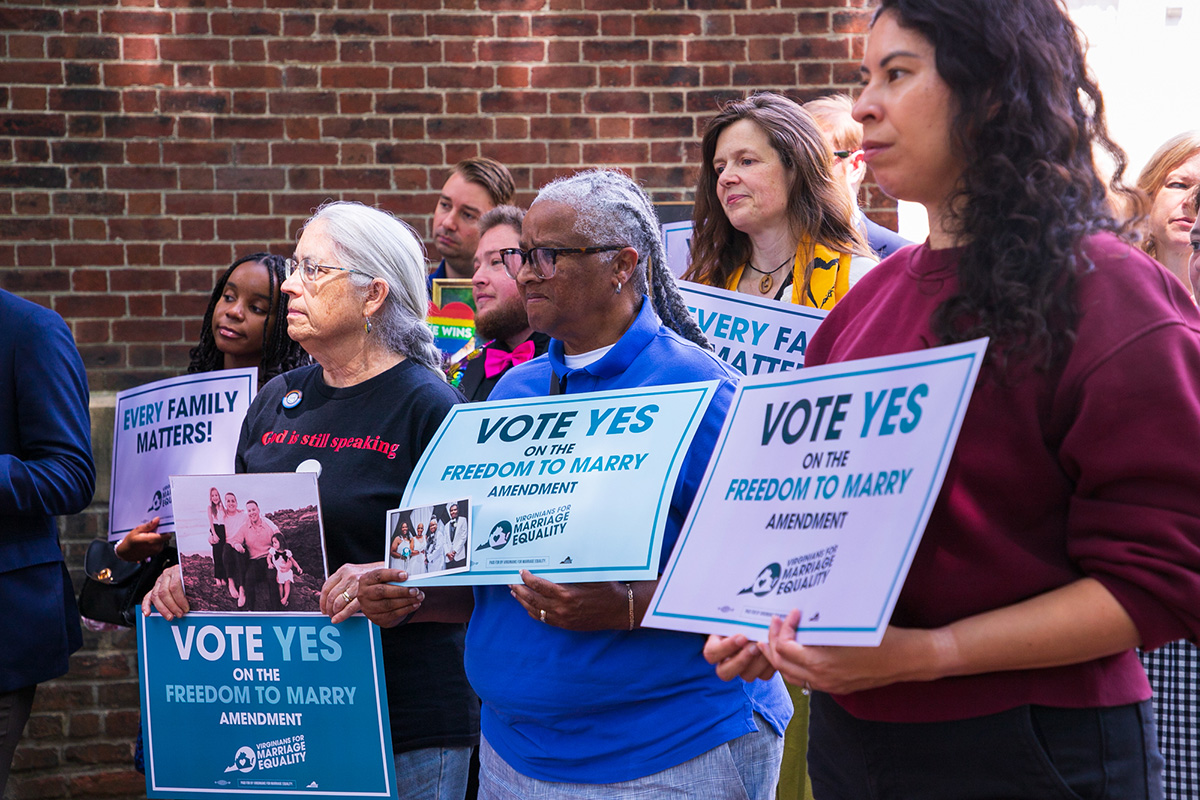
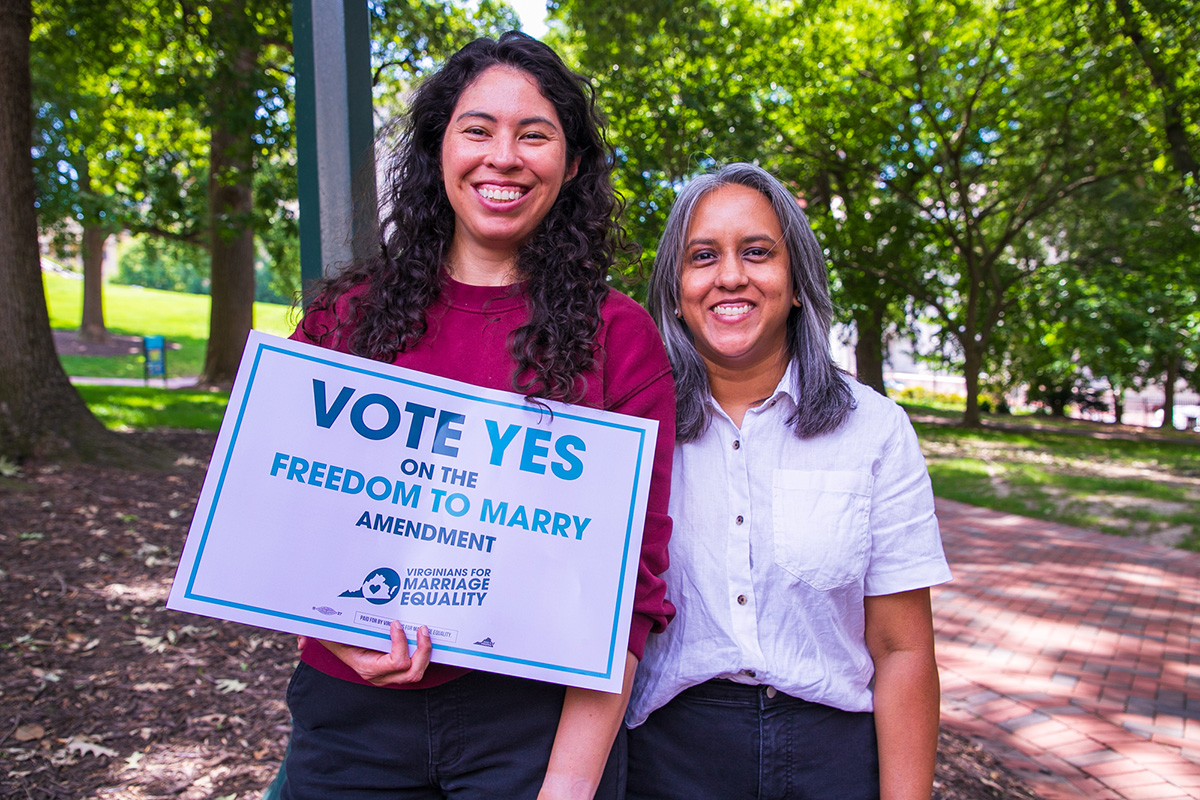
Virginians for Marriage Equality on Monday launched a campaign in support of repealing Virginia’s constitutional amendment that defines marriage as between a man and a woman.
Equality Virginia Executive Director Narissa Rahaman, former state Sen. Adam Ebbin, former state Del. Mark Sickles, and American Civil Liberties Union of Virginia Executive Director Mary Bauer are among those who spoke at the launch that took place in Richmond. State Del. Kirk McPike (D-Alexandria), who co-chairs the campaign, also participated.
“This amendment is about making clear that the government has no business deciding which marriages or which families are worthy of recognition,” said Bauer. “The ACLU of Virginia has been fighting for Virginians’ right to marry who they love since the landmark case, Loving v. Virginia, which struck down the ban on interracial marriage. Now we are proud to carry that legacy forward by standing with our coalition partners in the fight to pass this amendment and finally enshrine the right to marriage equality in the commonwealth’s constitution.”
Voters in 2006 approved the Marshall-Newman Amendment.
Same-sex couples have been able to legally marry in Virginia since 2014. Former Gov. Glenn Youngkin, who is a Republican, in 2024 signed a bill that codified marriage equality in state law.
Two successive legislatures must approve a proposed constitutional amendment before it can go to the ballot.
Democratic Gov. Abigail Spanberger in February signed a bill that finalized the referendum’s language.
The referendum will take place on Nov. 3.

Ogles faces bipartisan backlash over anti-gay social media post

First gay underwear party? How to have fun nearly naked

D.C. Latinx Pride celebrates culture and heritage

Fighting ‘Rainbow Panic’ in museums

A vice president marches by our side

Books for a pre-Pride celebration

Barney Frank’s powerful legacy for LGBTQ federal employees

Claudia López comes up short in Colombian presidential election

PHOTOS: Hagerstown Pride